Call Us
+86 136 6007 9809
Call Us
+86 136 6007 9809

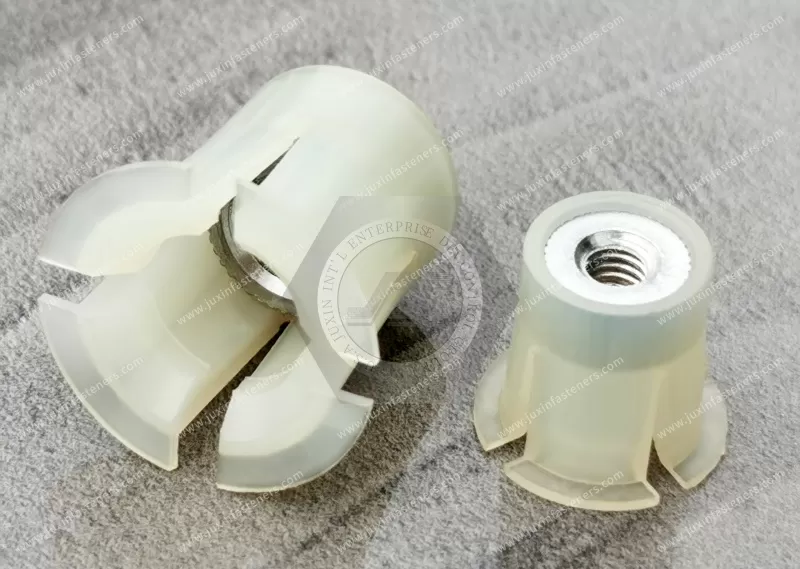
JUXIN FASTENERS supplies blind captive nuts with nylon cages and metal threaded inserts for sheet-metal and panel assemblies requiring accessible-side installation and serviceable threaded connections. The nylon cage retains the nut before final screw assembly and can help reduce direct metal contact with painted or delicate panel surfaces. Brass and stainless steel insert options, together with white or black nylon cages, support different OEM design requirements. Typical applications include electrical cabinets, telecommunications enclosures, equipment covers and industrial housings.
Product Type: Blind Captive Nut / Nylon Cage Nut
Thread Sizes: M3, M4, M5, M6, M8, M10, M12; #4-40, #6-32, #8-32, #10-24, #10-32, 1/4-20
Threaded Insert Materials: Brass or Stainless Steel
Cage Material: Nylon (grade to be confirmed)
Cage Colors: White or Black
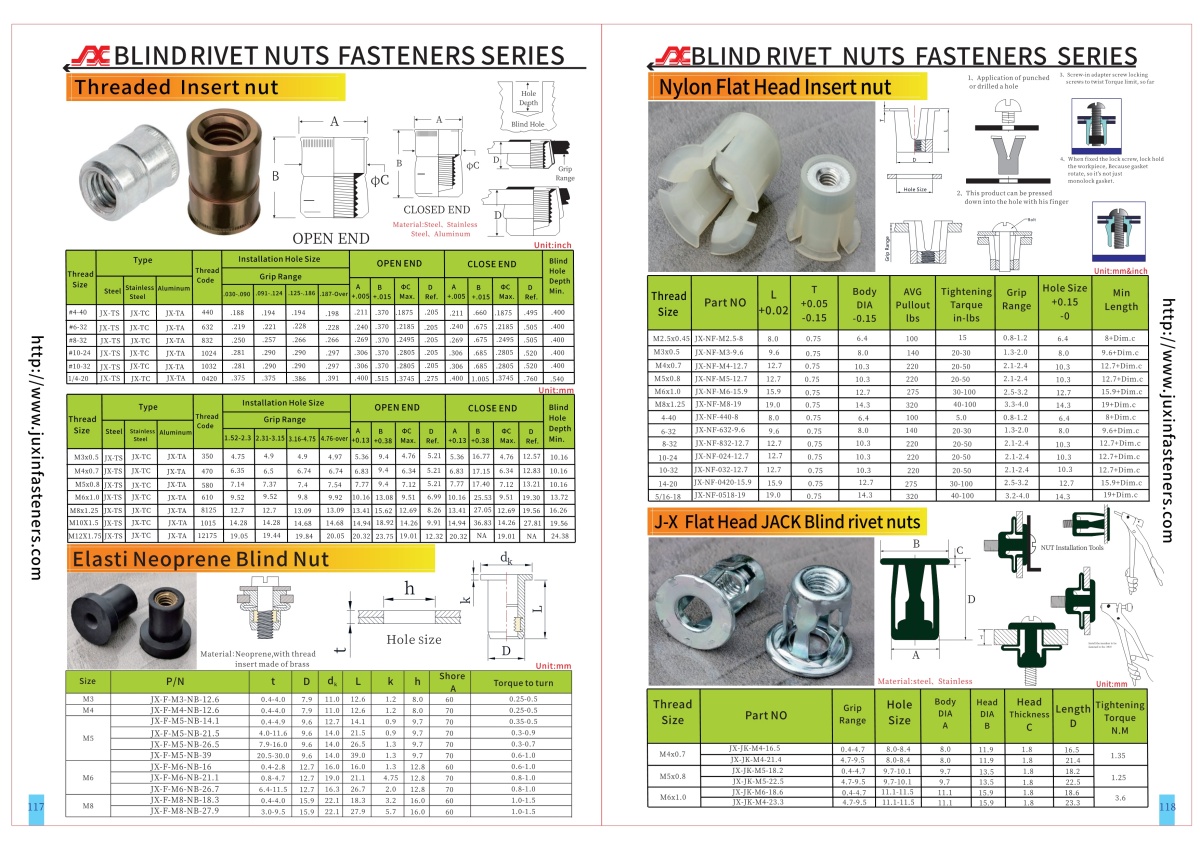
Supplied Grip/Panel Thickness Reference: 0.75 mm; verify by part number
Installation: Blind-Side Access Not Required for Compatible Designs
Special Riveting Tool: Not required for the described cage-retention design
Product Specification
Product Specifications — Blind Captive Nuts with Nylon Cages
JUXIN FASTENERS supplies blind captive nuts with nylon retaining cages and metal threaded inserts for OEM applications requiring removable threaded connections in sheet-metal panels, equipment housings and fabricated assemblies.
These products are also searched for as nylon cage nuts, blind-installation captive nuts, plastic cage nuts and removable captive threaded fasteners.
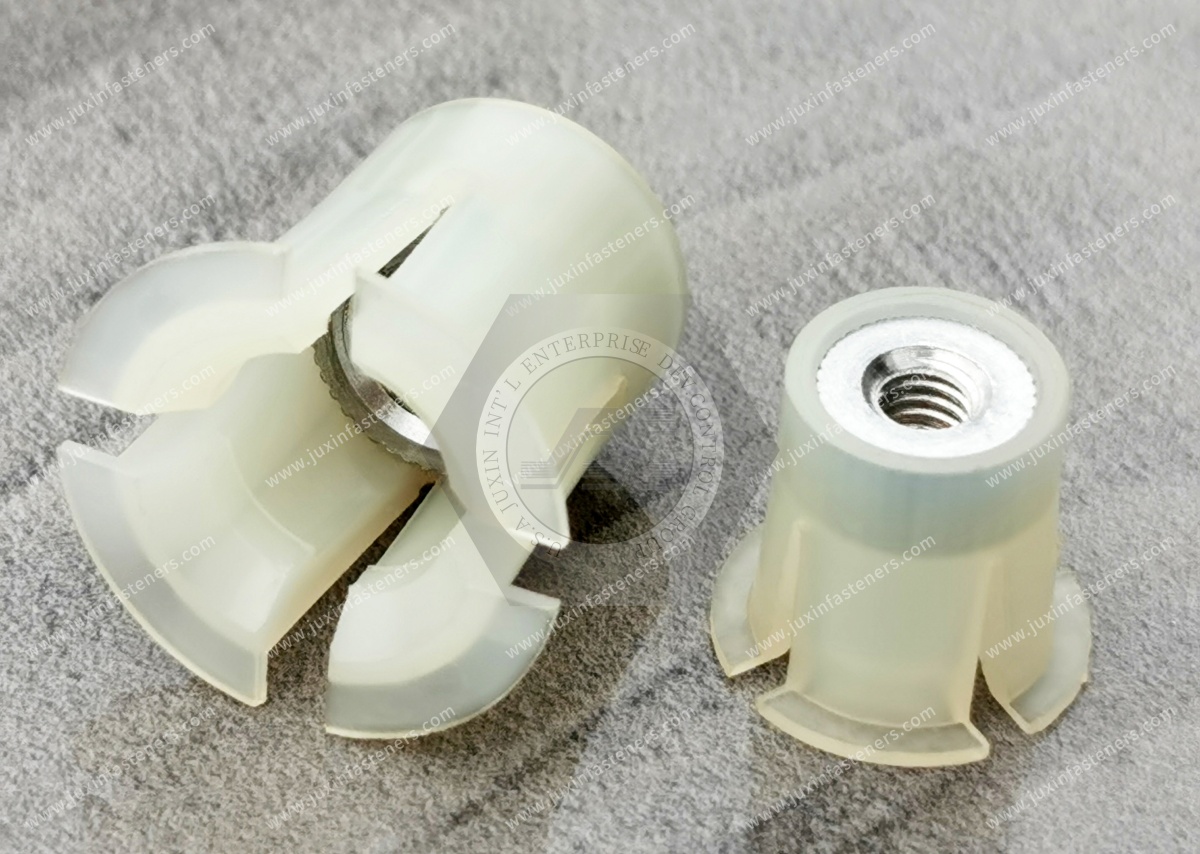
The fastening system combines a female-threaded metal insert with a nylon cage that retains the nut in a compatible mounting opening before the mating screw is installed.
This arrangement can simplify assembly where access to the rear of the panel is restricted.
Unlike conventional blind rivet nuts, which normally require mechanical deformation of a metal body during installation, this captive nut design relies on its retaining cage and mounting-hole engagement.
The actual cage geometry, mounting-hole configuration and installation procedure must be confirmed from the approved drawing.
Technical Product Specifications
Product Name: Blind Captive Nut
Alternative Names: Nylon Cage Nut, Blind-Installation Captive Nut, Plastic Cage Threaded Nut
Thread Configuration: Internal Female Thread
Metric Sizes: M3, M4, M5, M6, M8, M10, M12
Unified Inch Sizes: #4-40, #6-32, #8-32, #10-24, #10-32, 1/4-20
Threaded Insert Material Options: Brass, Stainless Steel
Nylon Cage Colors: White, Black
Nylon Grade: Subject to approved specification
Metal Insert Grade: Subject to approved specification
Supplied Panel Thickness Reference: 0.75 mm
Full Panel Thickness Compatibility: Subject to part-specific verification
Cage Dimensions: According to approved drawing
Mounting-Hole Dimensions: According to approved drawing
Installation Method: Mechanical Cage Retention in a Compatible Panel Opening
Special Riveting Equipment: Not required for the described design
Installed Mechanical Performance: Subject to application-specific validation
Packaging: According to confirmed purchasing requirements
Individual sizes, material combinations, cage configurations and mounting-hole dimensions must be verified before order confirmation.
What Are Blind Captive Nuts?
Blind captive nuts are female-threaded fastening components retained in a mounting panel by a separate cage or retaining structure.
In the nylon cage design, a metal threaded insert is enclosed or supported by a polymer cage.
The cage holds the threaded insert in position before the mating screw is installed.
The fastener can therefore provide a threaded attachment point without requiring a separate loose nut to be held behind the panel during final assembly.
Depending on the actual design, installation may be possible from one accessible side.
This can be particularly useful for equipment covers, service panels and enclosed sheet-metal structures.
Blind Captive Nuts vs. Blind Rivet Nuts
Blind Captive Nuts
Use a retaining cage to hold a metal threaded insert in a compatible panel opening.
The described design does not require a conventional rivet nut setting operation.
The connection can be designed for removal or replacement, subject to the actual cage geometry.
Blind Rivet Nuts
Use a deformable metal body that is mechanically set behind the panel.
Installation normally requires a compatible rivet nut setting tool.
The installed rivet nut generally remains mechanically retained after setting.
The two products should not be treated as direct substitutes without reviewing mounting-hole geometry, retention requirements and assembly conditions.
Blind Captive Nuts vs. Conventional Cage Nuts
Conventional cage nuts commonly use a metal spring cage to retain a threaded nut in a compatible opening.
Blind captive nuts with nylon cages use a polymer retaining structure.
Differences may include:
Cage material
Mounting-hole requirements
Installation direction
Retention mechanism
Surface contact
Available movement
Removal procedure
Load capacity
A nylon cage captive nut should not automatically be considered compatible with a standard rack square hole.
The actual hole geometry must be verified.
Nylon Cage Retention Principle
The nylon cage retains the metal insert in a compatible panel opening.
Depending on the design, elastic deformation or spring tension within the cage may help hold the assembly in place before final screw installation.
Important design characteristics include:
Cage exterior dimensions
Retaining features
Cage flexibility
Panel thickness
Mounting-hole dimensions
Insert position
Flange or shoulder geometry
Mating screw alignment
The retaining mechanism must be evaluated using the actual part drawing.
No universal installation force or retention rating is claimed.
Engineering Information Gain — Retention Before Assembly vs. Strength After Assembly
A captive nut performs two different mechanical functions.
Temporary Retention
The cage must hold the threaded insert in position during handling, transportation or assembly before the mating screw is installed.
Final Joint Performance
After assembly, the threaded connection must support the required service loads.
These functions should not be confused.
A cage may provide adequate preassembly retention without being designed to carry the entire service load independently.
The completed joint may transfer load through the screw, metal insert, panel and mating component.
OEM qualification should therefore distinguish cage retention from final joint strength.
Tool-Free Installation and Assembly Efficiency
The described blind captive nut design does not require a conventional blind rivet nut setting tool.
This can be useful for:
Low-volume equipment assembly
Field maintenance
Prototype development
Service-panel replacement
Equipment retrofits
Assembly stations with restricted access
However, tool-free installation does not mean that no tools are required for the completed screw joint.
The mating screw still requires an appropriate installation method.
Actual installation procedures should follow the approved fastener drawing and equipment instructions.
Removable and Serviceable Fastening
Blind captive nuts can be useful where equipment panels must be removed for inspection or maintenance.
The retained threaded insert helps reduce the need to handle a loose nut behind the panel.
Depending on the cage design, the captive nut itself may also be removable or replaceable.
Important service considerations include:
Cage wear
Repeated removal
Panel-hole damage
Thread condition
Cage deformation
Screw alignment
Replacement accessibility
Repeated reuse must be evaluated for the selected design.
Nylon Cage Protection for Painted and Delicate Surfaces
A nylon cage can reduce direct metal-to-panel contact in areas where the cage separates the metal insert from the mounting surface.
This may be useful for painted sheet metal, coated panels and selected delicate substrates.
However, the complete assembly may still include direct metal contact through the mating screw, washer or attached component.
The fastener should not automatically be described as scratch-proof or electrically insulating.
Actual surface protection depends on installation conditions and joint geometry.
Engineering Information Gain — Paint Protection Is Not Electrical Isolation
Nylon is commonly used as an electrically insulating engineering polymer.
However, the presence of a nylon cage does not guarantee electrical isolation across the completed joint.
Possible conductive paths include:
Metal screw
Metal threaded insert
Metal washer
Attached metal bracket
Exposed mounting hardware
For electrical equipment, surface protection and electrical isolation should be specified as separate requirements.
The complete assembly must be evaluated where insulation or grounding is important.
Brass Threaded Insert Options
Brass threaded inserts may be selected for applications where their material properties suit the required fastening conditions.
Potential considerations include:
Corrosion environment
Thread wear
Mating screw material
Required assembly torque
Mechanical loading
Electrical characteristics
Material compatibility
The actual brass alloy must be confirmed from the approved specification.
No specific brass grade or mechanical strength rating is claimed.
Stainless Steel Threaded Insert Options
Stainless steel inserts may be evaluated where the selected grade offers suitable corrosion and mechanical characteristics.
Important considerations include:
Stainless steel grade
Mating screw material
Thread engagement
Galling risk
Service environment
Required mechanical performance
The exact stainless steel grade has not been supplied.
Stainless steel should not automatically be described as corrosion-proof.
Material selection must reflect the intended environment.
White and Black Nylon Cage Options
The confirmed cage colors are white and black.
Color is not equivalent to a material grade or performance specification.
Two nylon cages of different colors may have different additive systems or material formulations.
For OEM qualification, the required characteristics may include:
Nylon grade
Color specification
Dimensional stability
Mechanical strength
Temperature suitability
Chemical compatibility
Aging behavior
Flame performance where required
No particular flame rating, UV rating or operating temperature is claimed.
Nylon Material and Environmental Selection
Nylon properties depend on the specific polymer grade, conditioning and environmental exposure.
Relevant factors include:
Moisture absorption
Dimensional changes
Temperature
Creep
Chemical exposure
Aging
Repeated installation
Local stress
The cage must retain its intended geometry and function under the specified service conditions.
The exact nylon grade and qualification requirements should be established before production approval.
Panel Thickness — 0.75 mm Reference
The supplied product information includes a 0.75 mm panel thickness reference.
Approximate inch conversion:
0.75 mm = 0.0295 in
This value should not be treated as a universal grip range covering every available thread size.
The actual compatible panel thickness depends on the cage geometry and selected part number.
An incorrect panel thickness may prevent proper retention or cause damage during installation.
Mounting-Hole Geometry
The mounting hole is critical to the function of a captive nut.
Relevant dimensions may include:
Hole shape
Hole width
Hole length
Hole tolerance
Corner geometry
Panel thickness
Edge distance
Burr condition
Surface coating
Panel flatness
The correct hole profile must be obtained from the approved drawing.
A generic round hole or square hole should not be assumed.
Engineering Information Gain — Why Hole Compatibility Matters More Than Thread Size
Two captive nuts may both have M6 internal threads.
However, they may have different cage dimensions and mounting-hole requirements.
A purchasing team may identify a lower-cost M6 alternative that appears similar.
If the replacement requires a different mounting opening, the substitution may create additional manufacturing costs.
Potential consequences include:
New punching tooling
Panel redesign
Assembly interference
Reduced retention
Increased installation time
Additional qualification testing
Supplier comparisons should therefore include the complete mounting geometry, not just thread size and unit price.
Metric Thread Sizes
The confirmed metric thread sizes are:
M3
M4
M5
M6
M8
M10
M12
ISO 261 and ISO 965 provide relevant references for ISO metric thread combinations and tolerances.
The actual thread pitch and tolerance must be confirmed from the approved specification.
Approximate nominal diameter references:
M3 = 0.118 in
M4 = 0.157 in
M5 = 0.197 in
M6 = 0.236 in
M8 = 0.315 in
M10 = 0.394 in
M12 = 0.472 in
These are dimensional references only.
They do not establish interchangeability with Unified inch threads.
Unified Inch Thread Sizes
The confirmed Unified inch sizes are:
#4-40 UNC
#6-32 UNC
#8-32 UNC
#10-24 UNC
#10-32 UNF
1/4-20 UNC
ASME B1.1 provides a relevant framework for Unified inch screw threads.
The thread designation must be maintained accurately in engineering drawings, purchasing records and inspection documents.
#10-24 and #10-32 are not interchangeable.
Metric and Unified inch thread systems are also not directly interchangeable.
Thread Engagement and Mating Screw Selection
The mating screw must be compatible with the captive nut's internal thread.
Selection should consider:
Thread size
Thread pitch
Thread tolerance
Screw length
Engagement depth
Mating component thickness
Washer thickness
Required tightening torque
Available clearance
An excessively long screw may interfere with internal components or the captive nut geometry.
An insufficiently engaged screw may not provide the required joint strength.
The correct screw length should be determined from the assembly drawing.
Axial Retention and Push-Out Performance
Installed retention depends on the cage geometry and its engagement with the panel.
Potential failure mechanisms include:
Cage disengagement
Cage deformation
Panel-hole deformation
Insert movement
Thread damage
Excessive local loading
No universal push-out or pull-out rating is claimed.
The installed fastener should be qualified under the intended load conditions.
Rotational Resistance
The captive nut must remain appropriately positioned while the mating screw is installed.
Rotational resistance may depend on:
Cage geometry
Mounting-hole engagement
Panel thickness
Material stiffness
Screw alignment
Applied assembly torque
The nylon cage should not automatically be assumed to provide the same spin-out performance as a mechanically set metal blind rivet nut.
Actual performance must be verified.
Installation Procedure
A typical installation process for a compatible nylon cage captive nut may include:
Confirm the correct part number and thread size.
Inspect the mounting hole.
Verify the panel thickness.
Check the cage and metal insert for damage.
Align the cage with the prepared opening.
Insert or engage the cage according to the approved design.
Confirm that the captive nut is retained.
Position the mating component.
Engage the correct screw.
Tighten according to the approved assembly procedure.
Inspect the completed joint.
The actual insertion direction and retaining action must be confirmed from the selected product drawing.
Electrical Cabinet Applications
Potential applications include:
Control cabinet panels
Electrical enclosure covers
Internal mounting brackets
Service access panels
Equipment housings
Engineering considerations include:
Panel thickness
Mounting-hole geometry
Screw access
Grounding requirements
Mechanical retention
Serviceability
Environmental conditions
No electrical safety certification is implied.
Telecommunications and Network Equipment
Blind captive nuts may be evaluated for:
Communications cabinets
Network equipment enclosures
Equipment access covers
Internal accessory brackets
Serviceable housing components
Their potential assembly advantages include retained threaded inserts and reduced need for rear-side access.
However, compatibility with standard telecommunications rack openings must be confirmed.
Commercial Foodservice Equipment
Potential applications include selected:
Equipment covers
Control housings
Internal brackets
Service panels
Fabricated metal enclosures
For foodservice equipment, engineers should consider cleaning conditions, moisture exposure, corrosion requirements and the suitability of the nylon cage and metal insert materials.
No direct food-contact approval is claimed.
Industrial Machinery and Equipment Housings
Potential uses include:
Machine guards
Access panels
Instrument housings
Light mounting brackets
Equipment covers
Serviceable sheet-metal assemblies
For vibrating equipment, the complete screw joint must be evaluated for loosening resistance and fatigue requirements.
A captive nylon cage does not automatically provide vibration locking.
Automotive Equipment
Blind captive nuts may be considered for selected non-safety-critical automotive components such as:
Equipment covers
Interior brackets
Access panels
Fabricated housings
Serviceable accessory components
Automotive applications may require customer-specific qualification, traceability and change control.
No automotive OEM approval is claimed.
Railway Equipment
Potential applications include selected:
Electrical equipment cabinets
Communications housings
Interior access panels
Maintenance covers
Non-structural equipment brackets
Railway applications may require additional evaluation of vibration, temperature, fire performance, corrosion and customer-specific requirements.
No railway certification or safety-critical approval is implied.
Engineering Example — Electrical Enclosure Access Panel
Consider an electrical enclosure requiring an M5 retained threaded nut in a painted sheet-metal panel.
The enclosure is assembled in a location where rear-side access is limited.
A nylon cage captive nut may be evaluated.
The engineering team should confirm:
Panel material
Panel thickness
Mounting-hole geometry
Nylon cage dimensions
M5 thread specification
Metal insert material
Screw length
Assembly torque
Required retention
Surface protection
Electrical grounding requirements
Service access
Environmental exposure
The nylon cage may reduce direct contact between the metal insert and painted panel surfaces.
However, complete surface protection and electrical behavior depend on the entire joint.
Engineering Example — Serviceable Telecommunications Cover
Consider a telecommunications enclosure requiring a removable cover with multiple captive threaded attachment points.
A blind captive nut may help retain the threaded inserts before the cover is assembled.
The design should evaluate:
Cage retention before assembly
Screw alignment
Mounting-hole tolerances
Panel thickness
Installation direction
Maintenance access
Repeated screw installation
Required mechanical retention
Material aging
Replacement procedure
For production use, the OEM should verify that the selected cage remains securely retained throughout handling and service.
OEM Procurement and Supplier Qualification
Purchasing and supplier development teams should review:
Product Identity
Confirm blind captive nut design and nylon cage configuration.
Thread Specification
Verify metric or Unified inch thread designation.
Insert Material
Confirm brass or stainless steel grade.
Cage Material
Define nylon grade and color.
Panel Compatibility
Verify mounting-hole geometry and thickness.
Installed Performance
Define cage retention and final joint requirements.
Documentation
Specify drawing revision, inspection and traceability requirements.
Commercial Requirements
Confirm order quantity, annual forecast, packaging and delivery expectations.
Supplier substitution should be based on dimensional and functional equivalence rather than product name alone.
Engineering Change Control
For established OEM programs, changes to the following characteristics may require customer review:
Nylon grade
Cage color formulation
Cage dimensions
Retaining features
Insert material
Thread dimensions
Mounting-hole compatibility
Manufacturing process
Inspection requirements
A material change may affect retention or environmental behavior even if the part appears dimensionally identical.
Relevant Engineering Standards
ISO 261 — ISO metric screw thread combinations.
ISO 965 — ISO metric screw thread tolerances.
ASME B1.1 — Unified inch screw threads.
ISO 273 — Clearance holes for bolts and screws, where relevant to the mating assembly.
ASTM D638 — Tensile properties of plastics.
ASTM D790 — Flexural properties of plastics.
ASTM D570 — Water absorption of plastics.
These are relevant engineering references for selecting and evaluating the fastening system.
They do not establish that every product has been tested or certified to the listed standards.
Actual acceptance criteria must be defined by the approved customer specification.
Frequently Asked Questions
What is a blind captive nut?
It is a retained female-threaded fastening component designed to provide a threaded attachment point in a compatible panel opening.
What is a nylon cage nut?
It is a captive nut using a nylon retaining cage to support or retain a metal threaded insert.
Do blind captive nuts require special tools?
The described nylon cage design does not require conventional rivet nut setting equipment. Actual installation requirements depend on the part geometry.
Are blind captive nuts removable?
Certain designs can be removed or replaced, subject to cage geometry and condition. The approved installation procedure should be followed.
Can they be installed from one side?
The described blind captive nut design is intended for applications where rear-side access is restricted. Installation compatibility must be confirmed for the selected part.
Do nylon cages protect painted panels?
They may reduce direct metal contact where the cage separates the insert from the panel. Complete scratch protection is not guaranteed.
Are blind captive nuts the same as rivet nuts?
No. Captive cage nuts and mechanically set blind rivet nuts use different retention methods.
What materials are available?
The confirmed threaded insert options are brass and stainless steel, with white or black nylon cages.
What thread sizes are available?
The supplied family includes M3 through M12 in the listed metric sizes and selected Unified inch sizes.
What panel thickness is supported?
A 0.75 mm reference has been supplied. The full compatible thickness range must be verified by part number.
Can these nuts be used in electrical cabinets?
They may be evaluated for suitable cabinet assemblies, subject to mechanical and electrical design requirements.
Are they suitable for railway equipment?
Potential applications require project-specific engineering and qualification review.
Related Industrial Fastening Solutions
Engineers and procurement teams may also consider the following fastening categories.
Thin Head Blind Rivet Nuts — for reduced-profile, mechanically installed threaded inserts.
Flat Head Blind Rivet Nuts — for conventional blind threaded fastening applications.
Knurled Body Blind Rivet Nuts — for alternative rotational resistance characteristics.
Hexagonal Body Blind Rivet Nuts — for compatible polygonal mounting-hole engagement.
Rubber-Coated Rivet Nuts / Well Nuts — for selected compliant mounting and vibration-damping applications.
Self-Clinching Nuts — for suitable press-installed sheet-metal applications.
Weld Nuts — for assemblies designed around an approved welding process.
Blind Rivet Studs — for one-sided mounting points requiring external male threads.
These are contextual internal-link anchor texts. Add hyperlinks only to verified live product pages.
OEM RFQ Checklist
For accurate quotation and technical review, please provide:
Required thread size
Metric or Unified inch thread designation
Engineering drawing or CAD file
Threaded insert material
Nylon cage color
Nylon grade requirements
Panel material
Panel thickness
Mounting-hole dimensions
Installation direction
Required cage retention
Mating screw specification
Assembly torque
Environmental requirements
Repeated service requirements
Inspection requirements
Initial order quantity
Estimated annual demand
Packaging and labeling requirements
Required delivery schedule
Providing the existing fastener drawing and mounting-hole details helps determine technical compatibility and accurate quotation requirements.
JUXIN FASTENERS — OEM Blind Captive Nut Supply
JUXIN FASTENERS supplies industrial fastening products for international OEM engineers, procurement teams, supplier development managers and equipment manufacturers.
Our blind captive nuts combine nylon retaining cages with brass or stainless steel female-threaded inserts.
The product family includes metric and Unified inch thread sizes for evaluation in electrical cabinets, telecommunications enclosures, commercial foodservice equipment, industrial machinery and other serviceable panel assemblies.
For technical review and OEM quotation, please provide your engineering drawing, thread requirements, panel thickness, mounting-hole dimensions, material preferences and purchasing quantity.
Request an OEM Technical Quotation
Email: info@juxinfasteners.com
Website: www.juxinfasteners.com
JUXIN FASTENERS — Industrial Fastening Solutions for OEM Engineering and Global Procurement.
Product Packaging
Product Packaging — Blind Captive Nuts with Nylon Cages
Packaging for blind captive nuts with brass or stainless steel threaded inserts and white or black nylon cages is subject to confirmed order and OEM requirements.
Protective Packaging: Suitable arrangements may be specified to protect nylon retaining features and internal metal threads during handling and transportation.
Cage Protection: Packaging should consider the risk of cage deformation, contamination and damage to retaining features.
Material Segregation: Different insert materials, cage colors, thread sizes and drawing revisions should be identified and segregated according to the approved order requirements.
Outer Cartons: Carton quantities and arrangements may be reviewed according to shipment weight, product dimensions and handling requirements.
Pallet Packaging: Palletized shipments may be considered for bulk OEM orders, subject to confirmation.
Product Identification: Customer-specified labels may identify part number, thread size, insert material, cage color, quantity, lot number and drawing revision.
Lot Traceability: Material and production traceability requirements should be defined in the approved purchasing and quality documentation.
OEM Packaging: Customer-specific packing quantities, labeling, component segregation and logistics instructions are subject to review.
Final packaging quantities and shipping details will be confirmed against the approved purchase order.
For OEM quotations and packaging requirements:
Email: info@juxinfasteners.com
Website: www.juxinfasteners.com
Product Pictures
Tags
Contact Us
Tel.:
+86 020 8621 0320
+86 020 3121 6067
E-mail:
Technical Support:
Navigation
SEND INQUIREY