Call Us
+86 136 6007 9809
Call Us
+86 136 6007 9809

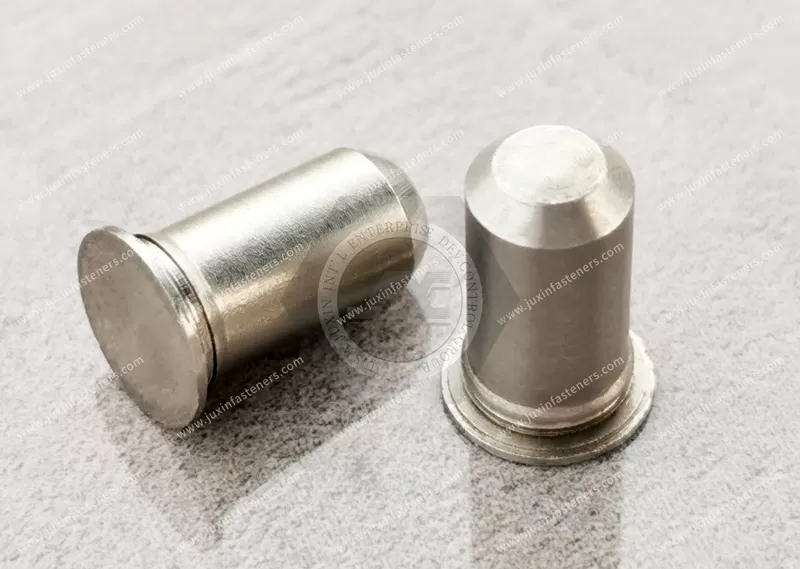
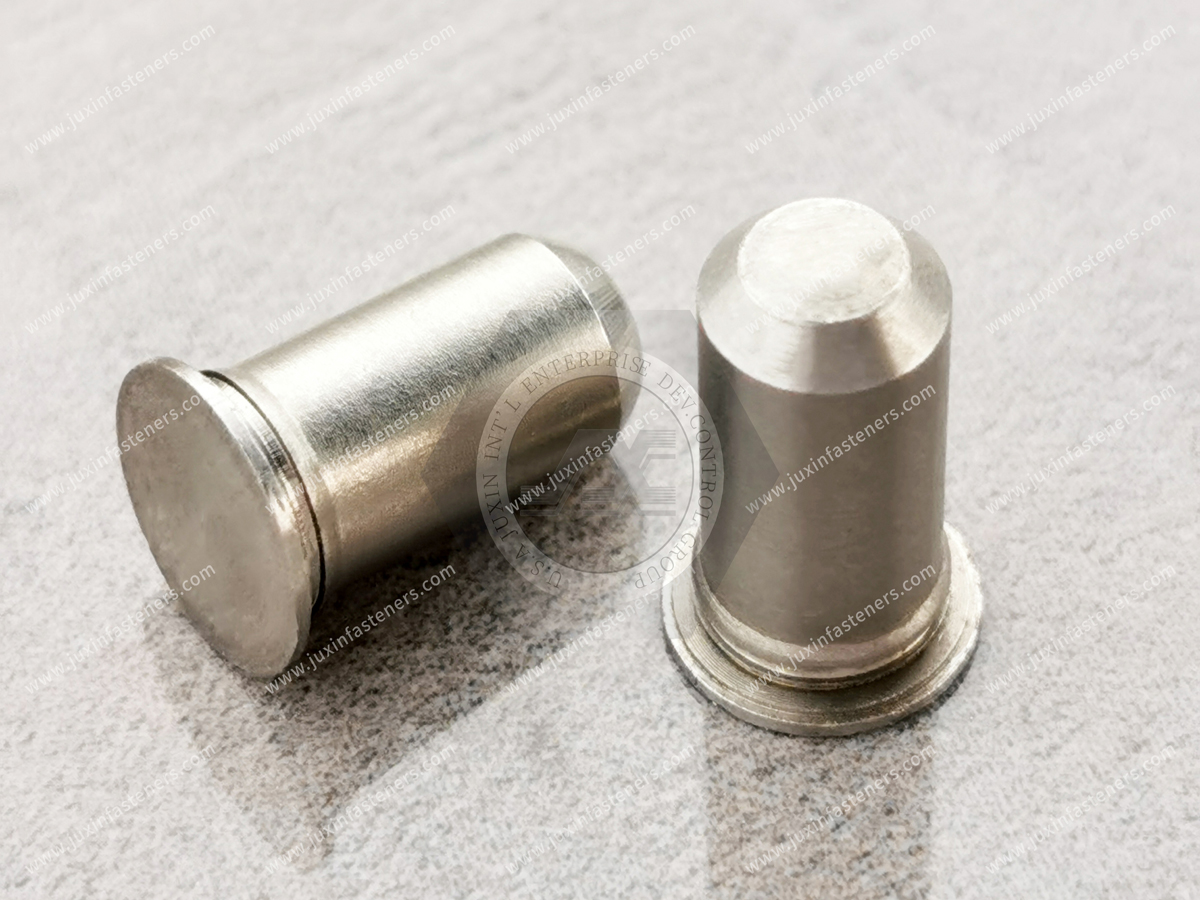
JX-TPS Flush-Head Self-Clinching Pilot Pins
JX-TPS self-clinching pilot pins provide permanent locating, positioning, and alignment features in thin sheet-metal assemblies.
Their chamfered ends help guide mating components into position, while the self-clinching mounting design creates a secure attachment without welding or separate mounting hardware.
The pins are installed into properly sized holes using controlled pressing force.
During installation, displaced sheet material flows into the fastener's retaining features, producing a flush-head installation on the mounting side.
JX-TPS pilot pins are intended for compatible steel and aluminum sheets. The related JX-TP4 series is designed for suitable stainless steel sheet applications.
Material: Carbon steel and stainless steel, depending on product series and approved specifications.
Typical applications include electronic enclosures, industrial control cabinets, equipment chassis, removable panels, precision sheet-metal assemblies, and OEM positioning systems.
Custom dimensions and application-specific configurations can be reviewed against customer drawings and assembly requirements.
Product Specification
Flush-Head Self-Clinching Pilot Pins – JX-TPS Engineering and OEM Supply Solutions
Juxin Fasteners supplies JX-TPS self-clinching pilot pins for manufacturers requiring repeatable component positioning, accurate panel alignment, and permanent locating features in sheet-metal assemblies.
Unlike conventional threaded studs, pilot pins are primarily intended to establish location, guide mating parts, or provide a defined positioning feature.
Their suitability for supporting external loads, pivoting components, or repeated engagement depends on the pin geometry, mating-part design, and verified operating conditions.
The JX-TPS series is intended for compatible steel and aluminum sheet applications. For stainless steel sheet assemblies, the related JX-TP4 series should be evaluated separately.
Product Design and Functional Characteristics
JX-TPS pilot pins combine a projecting locating shaft with a self-clinching retention feature. The projecting end is chamfered to assist alignment when a mating hole or component is brought into position.
The self-clinching head is designed to become flush with the mounting surface when installed in a correctly prepared sheet of sufficient thickness.
This construction helps designers create repeatable locating points without adding a separate nut, washer, or threaded fastener at each positioning location.
The pilot pin itself is not a substitute for a positive locking device where the assembly must resist separation, significant vibration, or externally applied service loads.
Materials and Sheet Compatibility
JX-TPS: Carbon steel pilot pins intended for suitable steel or aluminum sheets.
JX-TP4: Related pilot pin series intended for suitable stainless steel sheets.
For the JX-TPS series, the supplied application guidance identifies a maximum sheet hardness of HRB 70 or HB 125.
For the JX-TP4 series, the supplied application guidance identifies a maximum sheet hardness of HRB 92 or HB 195.
These hardness values are application selection limits from the supplied product information, not universal installation guarantees.
Sheet hardness, fastener hardness, material condition, hole dimensions, and actual installation performance must all be considered.
Carbon steel and stainless steel grades should be confirmed through the approved product drawing and purchase specification.
Where applicable, material requirements may reference relevant ASTM, SAE, EN, or ISO material specifications.
Flush-Head Installation and Minimum Sheet Thickness
The supplied technical information identifies flush-head installation for sheet thicknesses of 0.040 in. and greater, approximately 1.016 mm.
This is a general series guideline. The actual minimum sheet thickness must be confirmed for the selected pin size and material combination using the corresponding dimensional table and installation requirements.
The fastener is inserted into a properly sized mounting hole and installed using a suitable press with controlled axial force.
As the head is pressed into the sheet, the surrounding material flows into the fastener's retaining features. This produces mechanical retention and allows the head to sit flush with the mounting side.
Installation should be performed with appropriate support tooling to prevent panel distortion and maintain pin perpendicularity.
Hole Preparation and Installation Control
Correct hole preparation is essential to reliable self-clinching performance.
The mounting hole should be produced to the diameter and tolerance specified for the selected fastener. Hole roundness, burr condition, edge distance, and sheet flatness can influence installation quality.
Excessive burrs, oversized holes, insufficient sheet thickness, or inappropriate material hardness may reduce mechanical retention or prevent the head from seating correctly.
The installer should verify that the pin remains perpendicular to the panel and that the mounting surface is acceptably flush after pressing.
Installation force should be established from the approved product data and verified through production trials rather than assumed from a general press-capacity rating.
Positioning and Alignment Applications
Self-clinching pilot pins are particularly useful where two fabricated components must repeatedly meet in a controlled position.
In electronic equipment, the pins can help locate enclosure covers, chassis subassemblies, brackets, and internal mounting plates before final fastening.
In industrial automation equipment, pilot pins can support repeatable placement of removable guards, inspection covers, instrument brackets, and serviceable modules.
In electrical cabinets and power distribution equipment, locating pins can help guide mating panels into position and reduce assembly handling time.
For automotive electronics and transportation equipment,
suitable pilot pins may assist with locating sheet-metal brackets and electronic module housings where the assembly design has been validated for vibration and service conditions.
In precision machinery, pilot pins can provide repeatable location for covers, fixtures, and alignment features, subject to the required positional accuracy and load conditions.
Pilot Pin Diameter, Mating Hole Clearance, and Tolerance Stack-Up
Selecting a pilot pin requires more than matching the nominal pin diameter to the mating hole.
Design engineers should evaluate the pilot diameter, mating-hole diameter, positional tolerances of both components, panel thickness, and the expected direction of assembly.
A mating hole that is too small may prevent assembly or cause binding. Excessive clearance may reduce positioning accuracy and permit unwanted movement.
Where multiple pilot pins are used in one assembly, a fully constrained hole pattern may become difficult to assemble because of accumulated manufacturing tolerances.
A practical solution is to use one primary locating position and provide controlled clearance or a slotted mating feature at another location, where the functional requirements permit it.
This approach can reduce assembly interference without unnecessarily sacrificing positioning control.
Pin Length and Engagement Depth
The projecting pin length should be selected to provide adequate engagement with the mating component while avoiding interference with nearby hardware.
A longer pin may improve initial guidance, but it can also increase exposure to bending loads or complicate assembly where lateral clearance is limited.
A shorter pin may be preferable for compact enclosures, provided sufficient engagement remains after accounting for panel thickness, coatings, and dimensional tolerances.
For assemblies with repeated removal, engineers should consider insertion angle, wear at the mating hole, and the accessibility required for maintenance.
Positioning Versus Load-Bearing Functions
A locating pin and a structural fastening element perform different functions.
A pilot pin establishes a geometric reference or guides component engagement. A screw, captive panel fastener, threaded standoff, or another retaining device may still be required to hold the assembly securely in service.
Where a pin is expected to resist lateral loads, support a pivoting part, or operate under cyclic loading, the complete assembly should be evaluated for bending, bearing stress, sheet deformation, and retention performance.
Push-out resistance and torque-out resistance should not be treated as interchangeable performance measures.
For a non-threaded pilot pin, push-out resistance, lateral stability, and dimensional accuracy may be more directly relevant to the application.
Engineering Selection: JX-TPS Versus JX-TP4
JX-TPS is the appropriate starting point for steel or aluminum sheet assemblies within the specified hardness and thickness limits.
JX-TP4 should be considered when the mounting sheet is stainless steel and the corresponding installation conditions are satisfied.
The two series should not be substituted solely because their external shapes appear similar.
Differences in fastener material, hardness, sheet compatibility, and installation requirements can affect clinching performance.
Engineering teams should confirm the exact series designation, dimensions, material requirements, and approved installation conditions before changing an existing production specification.
Self-Clinching Pins Compared with Alternative Locating Methods
Compared with welded locating pins, self-clinching pilot pins can avoid a welding operation and the associated thermal effects on the mounting sheet.
Compared with loose dowel pins, they provide a permanently retained locating feature in the sheet-metal component.
Compared with threaded studs, they can offer a simpler locating geometry where threaded attachment is unnecessary.
Compared with conventional press-fit dowels in thick machined parts, self-clinching pilot pins are specifically intended for suitable sheet-metal mounting conditions.
The preferred solution depends on sheet thickness, material hardness, dimensional requirements, assembly volume, and service loads.
Dimensions, Drawings, and Custom Requirements
Series: JX-TPS.
Related stainless sheet application series: JX-TP4.
Fastener type: Flush-head self-clinching pilot pin.
Primary functions: Positioning, locating, guiding, and alignment.
Mounting method: Controlled press installation into a prepared sheet-metal hole.
Mounting sheet materials: Suitable steel or aluminum for JX-TPS; suitable stainless steel for JX-TP4.
General minimum sheet thickness guideline: 0.040 in. (approximately 1.016 mm), subject to the selected fastener's dimensional requirements.
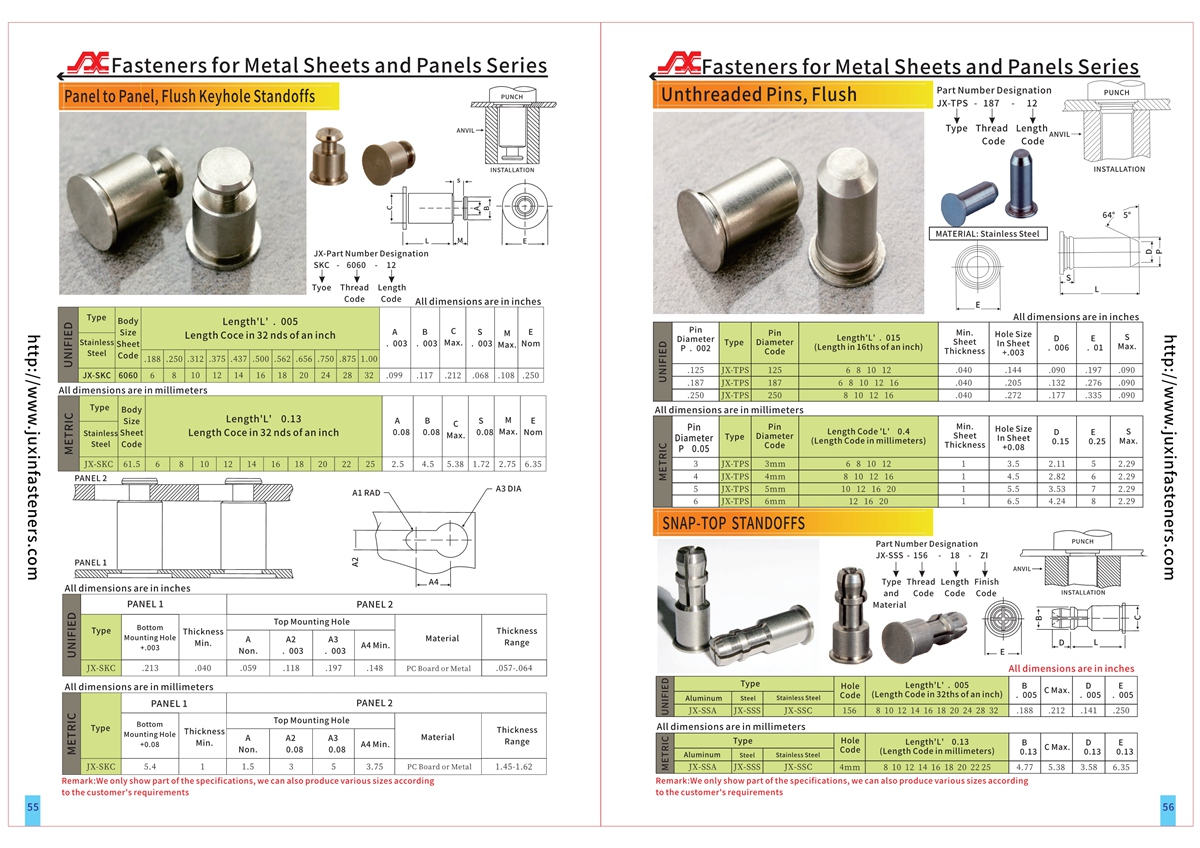
Available pin diameters, lengths, head dimensions, mounting-hole specifications, and installation tolerances should be taken from the applicable product drawing.
Refer to the supplied product specification PDF and CAD information, pages 55–56, for the relevant dimensional details.
Customer-specific pin lengths, dimensions, and configurations can be reviewed for OEM projects. Custom availability is subject to engineering evaluation and production confirmation.
Quality and Engineering Verification
For production applications, engineering and procurement teams should establish clear acceptance criteria before releasing a part for volume purchasing.
Important inspection characteristics include pilot diameter, projecting length, head dimensions, material specification, surface condition, and dimensional consistency.
After installation, relevant assembly checks may include head flushness, pin perpendicularity, push-out resistance, sheet distortion, and mating-component fit.
Where required by the application, testing can be defined using approved customer procedures and relevant international test methods.
Dimensional tolerances may be specified using applicable ISO GPS or ASME Y14.5 drawing practices, while material and hardness verification should reference the appropriate ASTM, ISO, or EN methods.
No particular international standard should be interpreted as certifying this product without supporting documentation and verification.
OEM Procurement and Supply Chain Considerations
For OEM procurement teams, pilot pins should be sourced against a controlled part specification rather than a generic product description.
The purchase specification should identify the required series, pin diameter, length, material, mounting sheet type, surface finish if applicable, and any critical dimensional or functional characteristics.
For ongoing production, buyers should also define packaging quantities, lot identification, inspection documentation, forecast volumes, and change-control expectations.
When qualifying a new supplier, production samples should be installed into representative sheet material and checked against the actual mating assembly.
This qualification process helps reduce the risk of assembly interference, inconsistent clinching retention, or unapproved dimensional substitutions.
Frequently Asked Engineering Questions
What is a self-clinching pilot pin used for?
It is used to create a permanently mounted locating or alignment feature in a compatible sheet-metal component.
Typical functions include guiding mating parts, establishing repeatable positioning, and assisting assembly.
Can JX-TPS pilot pins be installed in stainless steel sheets?
JX-TPS is specified for suitable steel or aluminum sheets. The related JX-TP4 series is intended for compatible stainless steel sheet applications.
The correct series should be selected according to sheet hardness and approved installation data.
Do self-clinching pilot pins require welding?
No. They are installed by pressing the fastener into a correctly prepared hole so that sheet material mechanically retains the fastener.
Can pilot pins replace screws?
They may eliminate separate hardware used only for locating a component.
However, they do not automatically replace screws or other fasteners required to retain an assembly under operating loads.
How should engineers select the mating hole?
The mating hole should be designed around the actual pilot diameter, positional tolerances, insertion clearance, and functional alignment requirements.
Multiple locating points require particular attention to tolerance stack-up.
Are custom pilot pin lengths available?
Application-specific dimensions can be evaluated against customer drawings, required quantities, and manufacturing feasibility.
Related Fastening Solutions and Internal Linking
For applications requiring permanent locating features in sheet metal, explore the Self-Clinching Pins and Studs product category.
For removable components requiring spacing and guided attachment, see Self-Clinching Standoffs – Type JX-SKC.
For applications requiring threaded attachment rather than positioning alone, review Self-Clinching Studs and Self-Clinching Nuts.
For removable covers and service-access panels, explore Captive Panel Screws and Spring-Loaded Panel Fasteners.
These related product pages should be linked using their verified internal URLs on www.juxinfasteners.com.
Request an OEM Quotation
Juxin Fasteners supports OEM and industrial procurement inquiries for JX-TPS self-clinching pilot pins and related sheet-metal fastening components.
To obtain a technical review or quotation, provide your 2D or 3D drawing, required pin diameter and length, mounting sheet material and thickness,
estimated order quantity, annual demand, and any inspection or packaging requirements.
Email: info@juxinfasteners.com
Website: www.juxinfasteners.com
Juxin Fasteners – Industrial Fastening Solutions for OEM Engineering, Manufacturing, and Global Supply Chains.
Product Packaging
Product Packaging and Export Protection
Juxin Fasteners provides protective packaging for JX-TPS self-clinching pilot pins to help prevent surface damage, deformation, and mixing of different part specifications during transportation and storage.
Standard packaging may include protective inner foam, suitable bags or inner boxes, reinforced export cartons, and palletized shipment according to order requirements.
Available carton dimensions include 29 × 19 × 19.5 cm and 23.5 × 17.5 × 8 cm. A referenced pallet configuration is 215 × 100 × 90 cm.
Actual packing arrangements depend on product dimensions, quantity, shipment weight, and customer requirements.
OEM packaging options can include customer-specific quantities per pack, part-number labels, lot identification, barcode labeling, and customized carton or pallet configurations.
Final packaging specifications, carton quantities, and logistics requirements are confirmed before order fulfillment.
Product Pictures
Hot Products
Contact Us
Tel.:
+86 020 8621 0320
+86 020 3121 6067
E-mail:
Technical Support:
Navigation
SEND INQUIREY