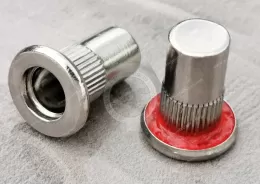
Call Us
+86 136 6007 9809
Call Us
+86 136 6007 9809

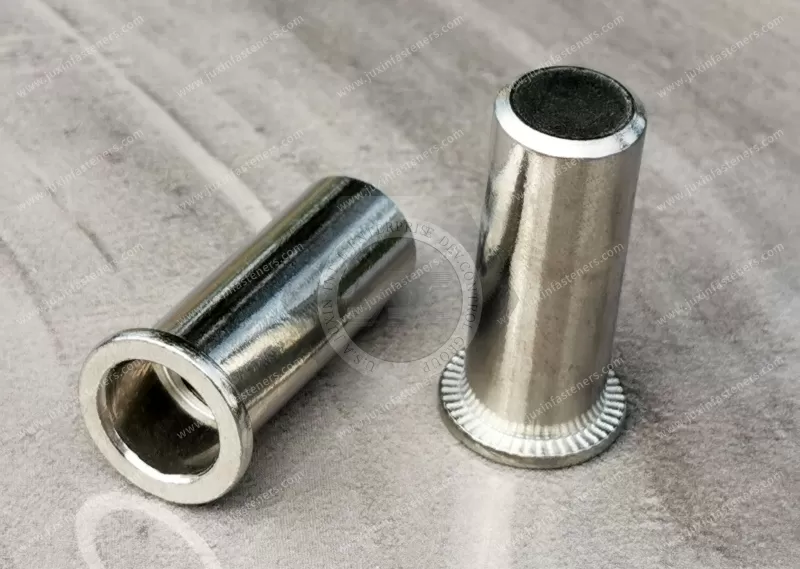
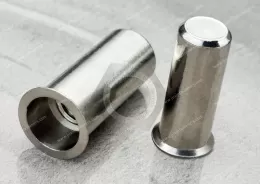
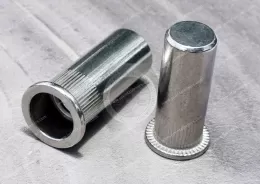
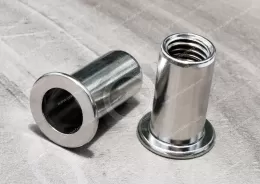
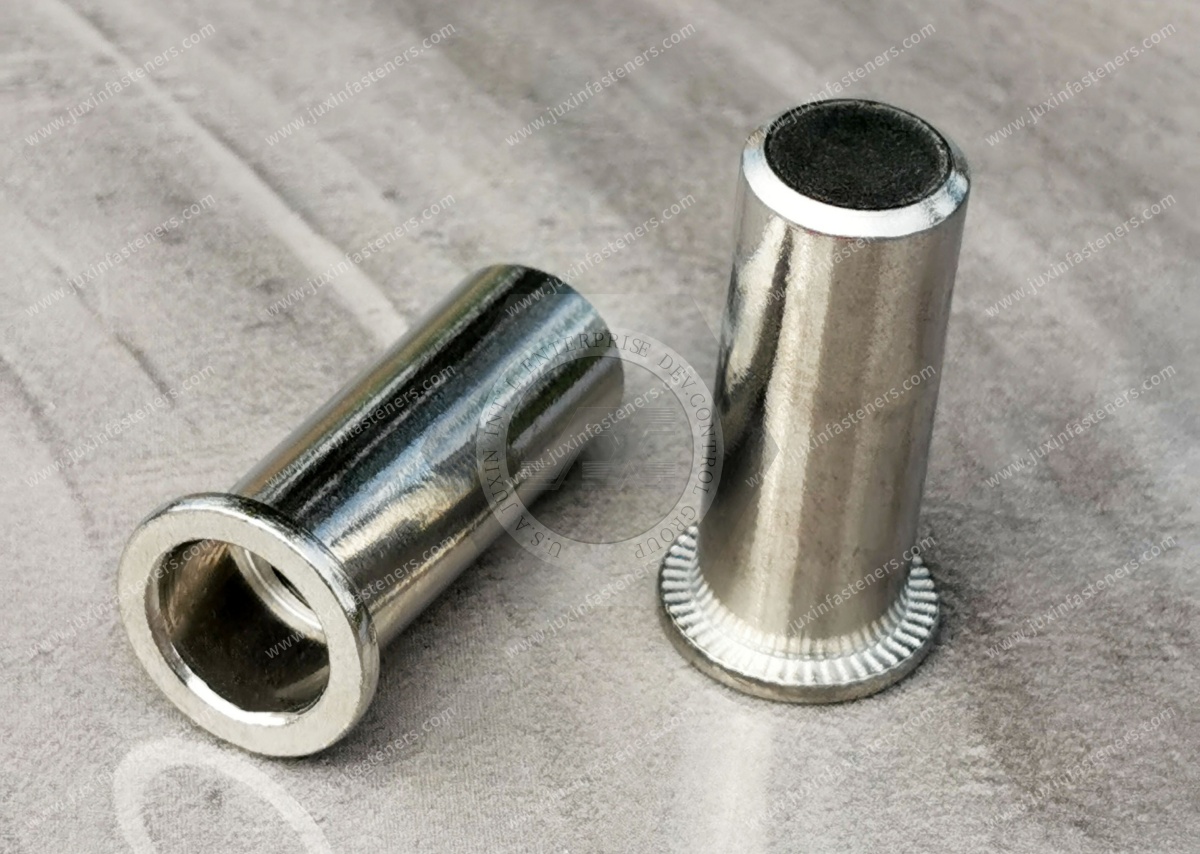
JUXIN FASTENERS manufactures stainless steel flat head, closed-end plain body blind rivet nuts for creating reusable internal threads in thin sheet metal, hollow sections, and OEM assemblies requiring one-sided installation.
The smooth cylindrical body fits a compatible round mounting hole, while the flat flange provides a bearing surface. The closed-end barrel encloses the threaded cavity and prevents screws from passing through the insert end.
Product Features
Metric threads: M3, M4, M5, M6, M8, M10
Inch-series threads: Subject to size and drawing confirmation
Material: Stainless steel (grade subject to confirmation)
Grip range: 0.5–4.0 mm (approx. 0.020–0.157 in), depending on size
Head: Flat head / Flanged head
Body: Plain / Smooth round body
End: Closed end
Installation: One-sided blind installation into compatible round holes
Applications include electrical enclosures, control cabinets, machinery housings, fabricated sheet-metal components, and OEM equipment requiring enclosed threaded inserts.
Product Specification
Technical Specifications — Stainless Steel Flat Head Closed-End Plain Body Blind Rivet Nuts
Product Specifications and Dimensional Overview
JUXIN FASTENERS stainless steel flat head closed-end plain body blind rivet nuts are internally threaded fastening components designed for one-sided installation in thin sheet metal,
hollow profiles and other compatible fabricated assemblies.
The product combines a flat flanged head, smooth cylindrical body and closed threaded cavity.
After installation, the rivet nut forms a mechanically retained female thread for a mating screw or bolt while preventing the bolt from passing completely through the insert.
This design is particularly relevant where rear-side installation access is restricted and where a closed threaded cavity provides an advantage over an open-ended insert.
| Technical Parameter | Product Specification |
|---|---|
| Product Type | Stainless Steel Blind Rivet Nut |
| Head Configuration | Flat Head / Flanged Head |
| Body Configuration | Plain / Smooth Round Body |
| End Configuration | Closed End |
| Material | Stainless Steel |
| Metric Thread Sizes | M3, M4, M5, M6, M8, M10 |
| Additional Threads | Inch Sizes Subject to Confirmation |
| Stated Product-Family Grip Range | 0.5–4.0 mm |
| Installation Hole | Round Hole, According to Product Drawing |
| Installation Method | One-Sided Blind Installation |
| Stainless Steel Grade | Confirm by Product Drawing or Order Specification |
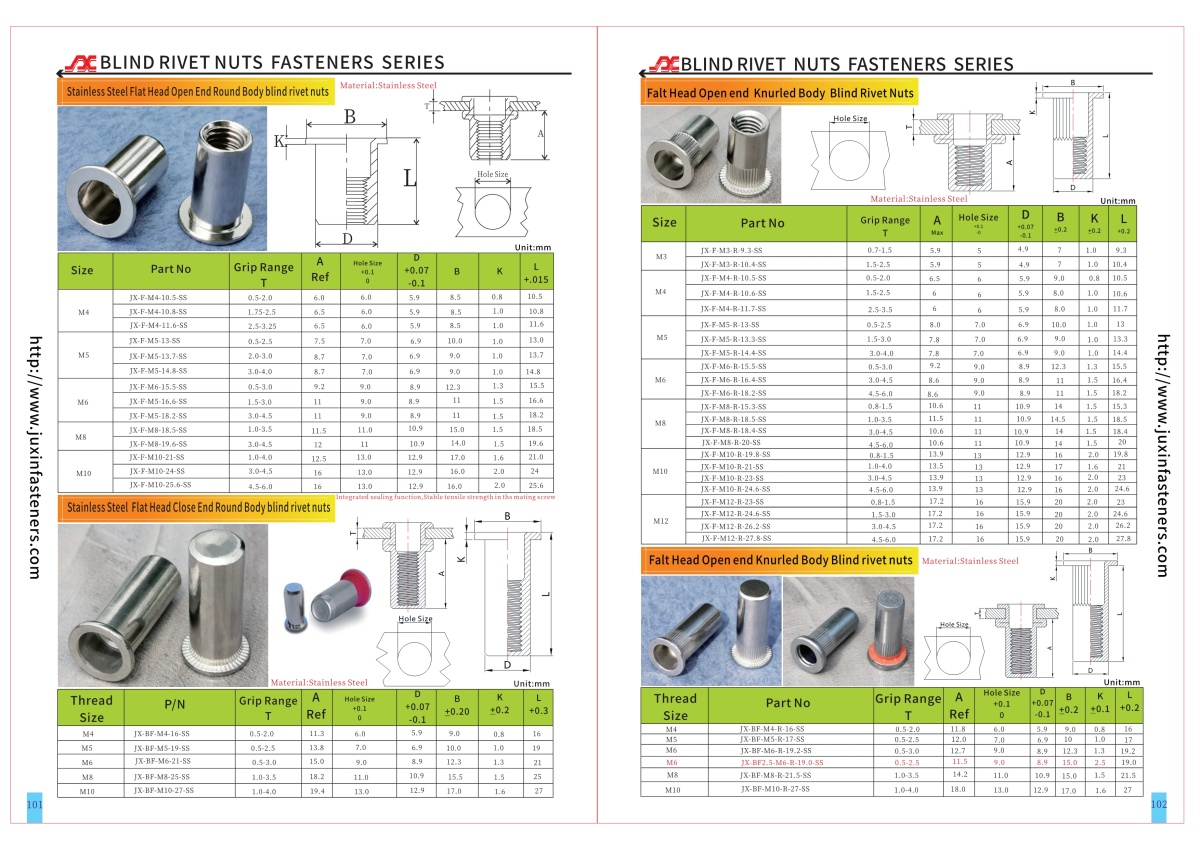
| Dimensional Reference | Product Specification PDF, Pages 101–102 |
| Custom Manufacturing | Drawing-Specific Requirements Subject to Review |
The listed grip range describes the supplied product family rather than the permissible thickness range of every individual size.
Actual installation dimensions and grip selections must be established from the corresponding technical drawing.
Closed-End Thread Geometry and Internal Cavity Design
The most important engineering characteristic of this rivet nut is its closed threaded cavity.
Unlike an open-end insert, the closed-end configuration limits the depth to which a mating bolt can enter the fastener.
This provides a physical end to the threaded passage and prevents the bolt from protruding through the insert.
The closed cavity also removes the direct through-bore opening found in open-end rivet nuts.
This can be useful where the assembly design seeks to reduce a potential route for contamination through the fastener body.
However, the internal cavity introduces an additional dimensional requirement: the designer must account for usable thread depth and the clearance between the bolt tip and the closed end.
A bolt that reaches the bottom of the cavity before the joint is fully clamped can create a false impression of proper tightening.
The applied torque may increase even though the intended clamping force between the assembled components has not developed.
For this reason, mating bolt length must be selected together with the panel thickness, attached component stack, required thread engagement and the actual internal cavity dimensions.
The usable threaded depth should be confirmed from the relevant drawing or through appropriate dimensional verification. It should not be inferred solely from the external body length.
Grip Range and Panel Thickness Selection
The stated product-family grip range is 0.5–4.0 mm.
Grip range refers to the thickness of the parent material or combined material stack that a particular rivet nut can mechanically retain after correct installation.
During setting, the designated deformable section of the rivet nut collapses behind the workpiece. The resulting retaining bulge works with the accessible-side flange to hold the insert in place.
The amount and geometry of deformation depend on the selected rivet nut body length, panel thickness and installation settings.
If the material thickness falls outside the permitted grip range, the insert may not form the intended blind-side retaining geometry.
This can affect axial retention, resistance to rotation and consistency of installation.
For assemblies involving multiple sheet-metal layers, the relevant thickness should be evaluated according to the actual material stack captured by the insert.
The correct size and grip configuration should always be selected from the product-specific dimensional information rather than assuming that every M3–M10 variant covers the complete family range.
Flat Flange Head and Panel Bearing Performance
The flat flange head provides a bearing surface against the accessible side of the panel.
Its function is to support the insert during installation and contribute to the distribution of contact pressure around the mounting hole.
The flange and blind-side retaining bulge form the mechanical retention system after setting.
For relatively thin or soft parent materials, flange diameter and local panel strength can have a significant influence on the connection's resistance to deformation or pull-through.
A larger bearing surface may be beneficial in some applications, but the flange dimensions must also be compatible with the surrounding component geometry and available head clearance.
The actual load-bearing capacity depends on the installed rivet nut, mounting-hole condition, panel material, grip thickness and loading direction.
The flat-head design should not be confused with low-profile or countersunk head configurations. Where the assembly requires reduced head projection, a different head geometry may be needed.
Smooth Round Body and Rotational Retention
The plain cylindrical body is intended for installation in a correctly dimensioned round mounting hole.
This geometry can be suitable for fabricated components where round holes are produced by punching, drilling or other controlled hole-forming processes.
The smooth body does not incorporate the pronounced external ribs associated with knurled or splined rivet nuts.
It also does not provide the geometric engagement of a full-hex body installed in a matching hexagonal hole.
Consequently, its resistance to rotation depends on the installed deformation, contact conditions, mounting-hole dimensions and parent-material properties.
For assemblies involving substantial bolt tightening torque, repeated removal of mating screws or demanding vibration conditions,
the engineer should verify that the selected plain-body insert provides adequate torque-to-turn resistance.
Where the application requires additional anti-rotation engagement, a knurled round body or full-hex configuration may be a more appropriate design alternative.
Rotational retention should be evaluated separately from axial pull-out resistance because an insert may perform differently under these two loading conditions.
Installation Hole Geometry and Sheet Metal Preparation
Reliable installation begins with correct hole preparation.
The mounting-hole diameter must allow the insert to enter without excessive interference while maintaining the intended fit for mechanical retention after setting.
An oversized hole may reduce rotational resistance or allow unwanted movement. An undersized hole may damage the insert, prevent proper seating or deform the parent material.
Hole roundness, burr condition, panel flatness and surface coatings may also influence installation results.
For punched holes, the manufacturer should consider edge quality and burr formation. For drilled holes, dimensional accuracy and appropriate deburring remain important.
Where the parent panel is coated or painted, the installation process should be assessed for potential coating damage and changes to hole dimensions.
The actual installation-hole diameter and tolerance must be taken from the approved dimensional drawing for the selected rivet nut.
Installation Method and Setting Equipment
Stainless steel closed-end rivet nuts are installed using compatible equipment that engages the internal thread and applies a controlled axial setting action.
The setting tool supports the flange while pulling on the threaded portion of the insert. This compresses the deformable body section and creates a retaining bulge behind the panel.
After setting, the tool is released and the insert remains mechanically retained within the workpiece.
Depending on thread size, insert geometry and production requirements, installation may be performed using suitable manual, pneumatic, hydro-pneumatic or automated equipment.
Stainless steel inserts may require different setting forces and tooling parameters from comparable aluminum or carbon steel rivet nuts.
The setting mandrel, nosepiece and installation stroke or force should be compatible with the selected part.
Insufficient setting may produce inadequate retention, while excessive setting can damage the thread, distort the flange or deform the panel.
For repeatable OEM production, installation settings should be established and validated using representative components.
Blind-Side Clearance and Closed-End Body Length
Although blind rivet nuts are installed from one accessible side, adequate space is still required behind the workpiece.
The closed-end body occupies space beyond the mounting panel, and additional clearance may be needed during the deformation process.
In compact enclosures, hollow metal sections and equipment housings, the designer should verify the relationship between the uninstalled body length, final retaining geometry and surrounding internal components.
A closed-end rivet nut may prevent the mating bolt from protruding through the insert, but it does not eliminate the external space occupied by the closed body itself.
For applications with limited blind-side clearance, the complete installed geometry should be reviewed before production approval.
Environmental Protection and Sealing Design
A closed-end rivet nut blocks direct passage through its threaded cavity, which distinguishes it from an open-end insert.
This can support equipment designs intended to limit contamination pathways through fastening points.
However, the interface between the flange and the mounting panel remains a separate potential path for moisture, dust or other contaminants.
The closed-end configuration alone does not establish a watertight or dust-tight joint.
Where environmental sealing is required, engineers should evaluate flange seating, mounting-hole quality, panel surface condition and the need for a compatible gasket, sealing washer or sealant.
Any additional sealing material must also be compatible with the stainless steel insert, parent material, installation process and intended service environment.
If the completed assembly must meet an ingress protection requirement, testing should be performed on the relevant enclosure or joint configuration using an appropriate method, such as IEC 60529 where applicable.
The sealing performance of the complete assembly should not be inferred solely from the use of a closed-end rivet nut.
Stainless Steel Grades and Corrosion Performance
The supplied product information identifies stainless steel as the material and references A2 stainless steel in the general product description.
A2 stainless steel is commonly associated with 304-type austenitic stainless steel.
A4 stainless steel, commonly associated with 316-type compositions, may be evaluated where increased resistance to certain chloride-containing environments is required.
The exact material grade must be confirmed for the selected product rather than assumed from the general family description.
Stainless steel corrosion resistance depends on alloy composition, surface condition, temperature, moisture, chemical exposure and joint geometry.
Crevice conditions beneath the flange or around the mounting hole can influence corrosion behavior in aggressive environments.
When stainless steel rivet nuts are installed in aluminum or coated carbon steel panels, galvanic corrosion should also be considered if an electrolyte is present.
The final material choice should reflect the complete assembly and the intended environmental conditions.
For projects requiring material documentation, the applicable ASTM or EN specification should be selected according to the actual material grade and stock form.
Mechanical Retention and Joint Failure Considerations
The installed performance of a blind rivet nut depends on more than its nominal thread size.
Axial loading may cause the insert to pull out of the panel or the parent material to deform around the mounting hole.
Excessive tightening torque may cause the insert to rotate or damage the internal thread.
A mating bolt may also fail if the applied load exceeds its mechanical capacity.
For closed-end rivet nuts, bolt bottoming introduces an additional assembly concern.
If the bolt reaches the closed cavity end before the joint is properly clamped, the connection may not achieve its intended preload.
For applications involving vibration, repeated maintenance or cyclic loading, the designer should evaluate the relevant service conditions and failure mechanisms.
Mechanical acceptance criteria should be established using the actual panel material, grip thickness, mounting-hole geometry and installation process.
No universal pull-out, torque-to-turn or fatigue performance value should be assigned without product-specific test data.
International Engineering References
Metric thread dimensions may be defined using ISO 261, with applicable tolerances established under ISO 965.
Where stainless steel material properties are specified, appropriate ASTM or EN material standards should be selected according to the actual material grade and manufacturing requirements.
ISO 3506 may provide relevant information for certain corrosion-resistant stainless steel fasteners where applicable, but compliance should not be assumed for every blind rivet nut configuration.
Where an environmental ingress protection rating is required, IEC 60529 may be relevant to testing the completed enclosure or assembly.
These standards provide engineering references and do not independently establish certification or conformity for a particular JUXIN product.
Product dimensions, material requirements and acceptance criteria should ultimately be controlled by the approved drawing and agreed technical specification.
Industrial Application Engineering
Electrical Cabinets and Control Enclosures
Closed-end stainless steel rivet nuts may be evaluated for control cabinets, mounting plates and removable access panels where one-sided installation is required.
The closed threaded cavity can reduce a direct through-bore contamination pathway, but enclosure sealing must still be assessed at the flange-to-panel interface.
Automotive and Transportation Assemblies
For selected transportation equipment housings and fabricated brackets, engineers should consider vibration, corrosion exposure, bolt engagement and rotational retention.
Closed-end geometry requires careful control of bolt length to prevent bottoming during assembly.
Industrial Machinery and Equipment Housings
Closed-end threaded inserts may be used in compatible machinery covers, guards and equipment housings requiring serviceable fastening points.
The designer should consider repeated maintenance, required clamp load, panel strength and available blind-side clearance.
HVAC and Outdoor Equipment
Stainless steel closed-end rivet nuts may be suitable for selected sheet-metal housings and service panels exposed to moisture or changing environmental conditions.
Material grade, galvanic compatibility and any required environmental sealing should be evaluated as part of the complete joint design.
Food-Processing and Washdown Equipment
The closed cavity may be useful where restricting a through-bore pathway is desirable.
However, suitability for cleaning environments, hygienic design or washdown service depends on the material grade, installation geometry, surface condition and complete sealing arrangement.
Electronics and Industrial Instrumentation
For compact equipment, the closed-end cavity can prevent the mating bolt from projecting through the insert.
Engineers should verify usable thread depth, bolt length, setting clearance and the position of adjacent internal components.
OEM Manufacturing and Custom Engineering Support
JUXIN FASTENERS manufactures industrial fasteners and drawing-specific components for OEM customers.
Our broader manufacturing capabilities include cold heading, cold forming, secondary CNC machining and turning, metal stamping,
plastic injection molding and combined manufacturing processes where suitable.
For certain custom metal components, cold forming may be followed by secondary machining to achieve specific dimensions or geometric features.
The production process for a particular rivet nut or custom part is selected according to material, geometry, tolerance requirements, tooling and order volume.
For closed-end stainless steel rivet nuts, custom engineering review may include special thread sizes, flange dimensions, body lengths, grip configurations,
internal cavity depth, material grades and customer-defined acceptance criteria.
Where the customer requires a specific bolt engagement length or installation clearance, these requirements should be incorporated into the technical drawing before production.
OEM RFQ and Technical Documentation
For an accurate quotation, please provide the required thread size, stainless steel grade, panel material, grip thickness, mounting-hole dimensions and product drawing.
Because this is a closed-end design, the mating bolt length, required thread engagement and usable internal cavity depth are particularly important.
If the application requires environmental protection, the inquiry should also define the intended exposure conditions and any sealing or ingress protection requirements.
Where mechanical performance is critical, the required torque-to-turn resistance, pull-out capacity or other acceptance criteria should be identified.
JUXIN can review sample quantities, production volumes, drawing-specific requirements, inspection documentation and packaging instructions as part of the OEM sourcing process.
The existing JUXIN specification PDF identifies pages 101–102 as a dimensional reference.
The applicable drawing should be checked to confirm that it corresponds to this closed-end plain round body configuration.
Closed-End Design for Threaded Cavity Protection
The defining feature of this product is its closed threaded end.
In an open-end rivet nut, the threaded bore provides a continuous passage through the insert. A closed-end rivet nut incorporates a closed cavity that restricts direct passage through the fastener body.
This distinction can be valuable in equipment where the designer wants to limit the entry of loose particles, moisture or other contaminants through the threaded insert itself.
However, the closed-end configuration does not automatically seal the interface between the flange and the mounting panel.
Where an enclosure must satisfy a defined ingress protection requirement, engineers should consider the complete assembly,
including the installation hole, flange seating, surface finish, sealant or gasket requirements and any applicable validation testing.
Closed-end rivet nuts should therefore be understood as a component of an environmental protection strategy rather than a universal waterproof fastening solution.
Flat Flange Head for Panel Support
The flat flange head provides a bearing surface on the accessible side of the panel and helps position the insert during installation.
As the rivet nut is set, the deformable section of its body forms a retaining bulge behind the parent material. The flange and blind-side deformation work together to mechanically retain the insert.
For suitable panel designs, the flange helps distribute contact pressure around the installation hole.
The actual resistance to pull-out, pull-through and local panel deformation depends on flange geometry, panel thickness, parent-material strength, hole dimensions and installation quality.
This configuration is useful where a conventional flanged head is acceptable and sufficient clearance is available above the panel.
Applications requiring reduced head projection should be evaluated using an appropriate low-profile or countersunk alternative.
Smooth Round Body for Conventional Round-Hole Installation
The smooth cylindrical body is designed for installation in a correctly dimensioned round hole.
This geometry can be convenient for sheet-metal parts manufactured through drilling, punching or other suitable hole-forming processes.
Unlike knurled or splined rivet nuts, the plain body does not feature pronounced external anti-rotation ribs.
Unlike full-hex rivet nuts, it does not require a matching hexagonal mounting hole.
For applications involving higher bolt tightening torque or frequent removal of mating fasteners,
engineers should verify that the smooth-body configuration provides sufficient resistance to rotation in the specified panel material.
A knurled or hexagonal rivet nut may be preferable where additional anti-rotation engagement is required.
Stainless Steel for Industrial Material Compatibility
Stainless steel is commonly selected for applications where corrosion resistance, durability, appearance or compatibility with the surrounding assembly is important.
A2 stainless steel is frequently associated with 304-type austenitic stainless steel, while A4 is commonly associated with 316-type molybdenum-bearing stainless steel.
A4 may offer improved resistance to certain chloride-containing environments compared with A2.
However, actual corrosion performance depends on the material grade, surface condition, environmental exposure and joint design.
The specific grade supplied for this product should be established through the approved part number or customer material specification.
For outdoor, coastal, washdown or chemically exposed assemblies, engineers should evaluate the complete fastening system rather than assuming that all stainless steel grades provide identical performance.
One-Sided Installation in Thin and Enclosed Structures
Closed-end blind rivet nuts are installed using a compatible setting tool that engages the internal thread and compresses the deformable body section.
This creates a mechanically retained female thread without requiring access to the rear of the workpiece.
The design is particularly useful for hollow profiles, tubular structures, equipment cabinets, sheet-metal housings and other assemblies with restricted rear access.
Installation reliability depends on the selected grip range, mounting-hole dimensions, parent-material properties and setting parameters.
The blind side must also provide adequate clearance for the rivet nut body and the deformation that occurs during installation.
Engineering Difference: Closed-End vs. Open-End Rivet Nuts
Closed-end and open-end rivet nuts may have similar external head and body geometries, but their threaded cavity designs create important differences.
An open-end rivet nut allows the mating bolt to extend through the insert when sufficient blind-side clearance is available.
A closed-end rivet nut limits bolt penetration to the available internal cavity depth.
This makes bolt-length selection particularly important.
A bolt that bottoms out inside the closed cavity before the joint is properly clamped can produce misleading tightening behavior and prevent the intended clamp load from developing.
Engineers should therefore verify usable internal thread depth, required thread engagement, bolt length and component stack thickness.
The closed-end design also blocks direct passage through the threaded bore, while the open-end configuration does not.
Neither design should be assumed to provide a particular environmental sealing performance without evaluation of the complete assembly.
Industrial Applications and Engineering Solutions
Electrical Enclosures and Control Cabinets
Stainless steel closed-end rivet nuts can be evaluated for electrical cabinets, control panels, equipment housings and removable mounting brackets.
Their one-sided installation capability is useful where rear access is restricted.
The closed threaded cavity may support enclosure designs intended to limit contamination pathways through fastening points.
Where an ingress protection rating is required, the complete installed joint must be evaluated with the enclosure design.
Automotive and Transportation Equipment
Closed-end stainless steel rivet nuts may be considered for selected equipment housings, fabricated brackets, service panels and other compatible transportation assemblies.
Design engineers should consider vibration, bolt tightening torque, repeated servicing and corrosion exposure.
For production applications, the installed insert should be evaluated using representative panel materials and specified setting conditions.
Industrial Machinery and Equipment Housings
Machinery covers, access panels and equipment enclosures often require retained threaded connections that remain attached when mating bolts are removed.
A closed-end rivet nut provides a reusable female thread while restricting direct passage through the insert body.
Engineers should verify the required thread engagement and ensure that the mating bolt does not bottom out in the closed cavity.
HVAC and Outdoor Equipment
Stainless steel closed-end rivet nuts may be suitable for selected equipment housings, service panels and mounting assemblies where corrosion resistance and one-sided installation are important.
For outdoor applications, material grade, moisture exposure, dissimilar-metal contact and flange sealing requirements should be reviewed.
Food-Processing and Washdown Equipment
Closed-end stainless steel rivet nuts may be considered for suitable equipment housings and non-product-contact fastening locations where limiting through-bore contamination pathways is beneficial.
However, the closed end does not independently establish hygienic design, food-contact approval or washdown performance.
The material grade, joint geometry, cleaning environment and complete sealing arrangement must meet the application's actual requirements.
Electronics and Industrial Instrumentation
Compact enclosures and instrument housings may benefit from a closed threaded cavity where unrestricted bolt penetration would interfere with internal components.
The designer should verify the usable thread depth, bolt length and installation clearance before finalizing the fastening arrangement.
General Sheet Metal Fabrication
Closed-end flanged plain body rivet nuts can be used in compatible cabinets, brackets, hollow metal structures and fabricated assemblies requiring one-sided threaded fastening.
Correct hole preparation and installation settings are essential to consistent production results.
OEM Manufacturing and Custom Engineering
JUXIN FASTENERS is an industrial fastener and custom component manufacturer with production workshops and more than 20 years of industry experience.
Our manufacturing capabilities include cold heading, cold forming, secondary CNC machining and turning, metal stamping,
plastic injection molding and combined manufacturing processes where appropriate to the component design.
For suitable custom metal parts, cold forming may be followed by secondary machining to achieve particular geometries, dimensions or tolerances.
For stainless steel closed-end rivet nut projects, JUXIN can review requirements involving thread sizes, flange dimensions,
body lengths, grip ranges, material grades, internal thread depth and drawing-specific manufacturing details.
Special attention should be given to the closed-end cavity dimensions because they affect usable bolt engagement and the available clearance inside the insert.
Custom production requirements are evaluated according to drawing complexity, material selection, tooling, tolerances and production quantity.
Our flexible manufacturing approach supports OEM engineers, sourcing managers, purchasing departments and supplier development teams seeking practical solutions for specific assembly requirements.
OEM Procurement and RFQ Requirements
For an accurate technical review and quotation, customers should provide the required thread size, stainless steel grade, panel material, grip thickness,
installation-hole dimensions and approved drawing or reference sample.
For closed-end designs, it is especially important to specify the mating bolt length, required thread engagement and any internal cavity restrictions.
Where environmental protection is part of the application, customers should also identify the required sealing conditions, exposure environment and relevant acceptance criteria.
Mechanical requirements such as torque-to-turn resistance, pull-out performance and installation validation should be defined where they are critical to the assembly.
Sample quantity, production volume, inspection requirements and packaging instructions can be reviewed as part of the OEM sourcing process.
Request a Technical Review or OEM Quotation
JUXIN FASTENERS
Email: info@juxinfasteners.com
Website: www.juxinfasteners.com
Stainless Steel Closed-End Rivet Nuts | OEM Threaded Inserts | Custom Industrial Fastener Manufacturing
Product Packaging
Product Packaging — Stainless Steel Flat Head Closed-End Plain Body Blind Rivet Nuts
Industrial Packaging for Stainless Steel Closed-End Rivet Nuts
JUXIN FASTENERS provides industrial packaging solutions for stainless steel flat head closed-end plain body blind rivet nuts supplied to OEM manufacturers,
equipment assembly operations, industrial distributors and international customers.
Packaging arrangements are selected according to the product dimensions, thread size, material requirements, order quantity and customer-specific handling instructions.
The objective is to protect the fasteners during storage and transportation while supporting efficient receiving, identification and inventory management.
Product Protection and Handling
Stainless steel blind rivet nuts should be handled and packaged to reduce unnecessary surface damage, contamination and moisture exposure.
For closed-end rivet nuts, protection of the threaded cavity and body geometry is particularly important because damage to the internal thread or closed-end section may affect installation and mating bolt engagement.
Where surface cleanliness or corrosion performance is important, packaging and handling procedures should also consider possible contamination from carbon steel particles or unsuitable storage conditions.
Any special protective packaging requirements should be established according to the customer's application and agreed purchase specifications.
Packaging Configuration
JUXIN FASTENERS can review suitable inner protection, carton packaging and palletized shipment arrangements according to the selected product and confirmed order.
The specific inner packaging material, carton dimensions, quantity per package, quantity per carton and pallet loading configuration should be confirmed before shipment.
Packaging requirements may vary between thread sizes and custom product configurations.
OEM and Customer-Specific Packaging
For OEM purchasing and supply-chain programs, packaging can be coordinated with customer requirements for part identification,
material grade labeling, batch or lot identification, carton markings and shipment instructions.
Customers may specify preferred packing quantities and packaging arrangements to support warehouse operations, production-line replenishment or industrial distribution.
Where traceability is required, the relevant identification and documentation requirements should be agreed during order confirmation.
International Shipment and Logistics
For international orders, the final packaging arrangement should reflect product quantity, shipment method, handling conditions and customer requirements.
Carton dimensions, gross weights, pallet quantities and shipping marks are confirmed according to the actual order.
Special packaging or handling instructions can be reviewed during quotation and production planning.
Request Packaging Information or an OEM Quotation
For accurate packaging coordination, please provide the required thread size, product drawing or part number, stainless steel grade,
order quantity, preferred packaging arrangement and shipping destination.
JUXIN FASTENERS
Email: info@juxinfasteners.com
Website: www.juxinfasteners.com
Stainless Steel Closed-End Rivet Nuts | OEM Manufacturing | Customer-Specific Packaging Solutions
Product Pictures
Contact Us
Tel.:
+86 020 8621 0320
+86 020 3121 6067
E-mail:
Technical Support:
Navigation
SEND INQUIREY