Call Us
+86 136 6007 9809
Call Us
+86 136 6007 9809

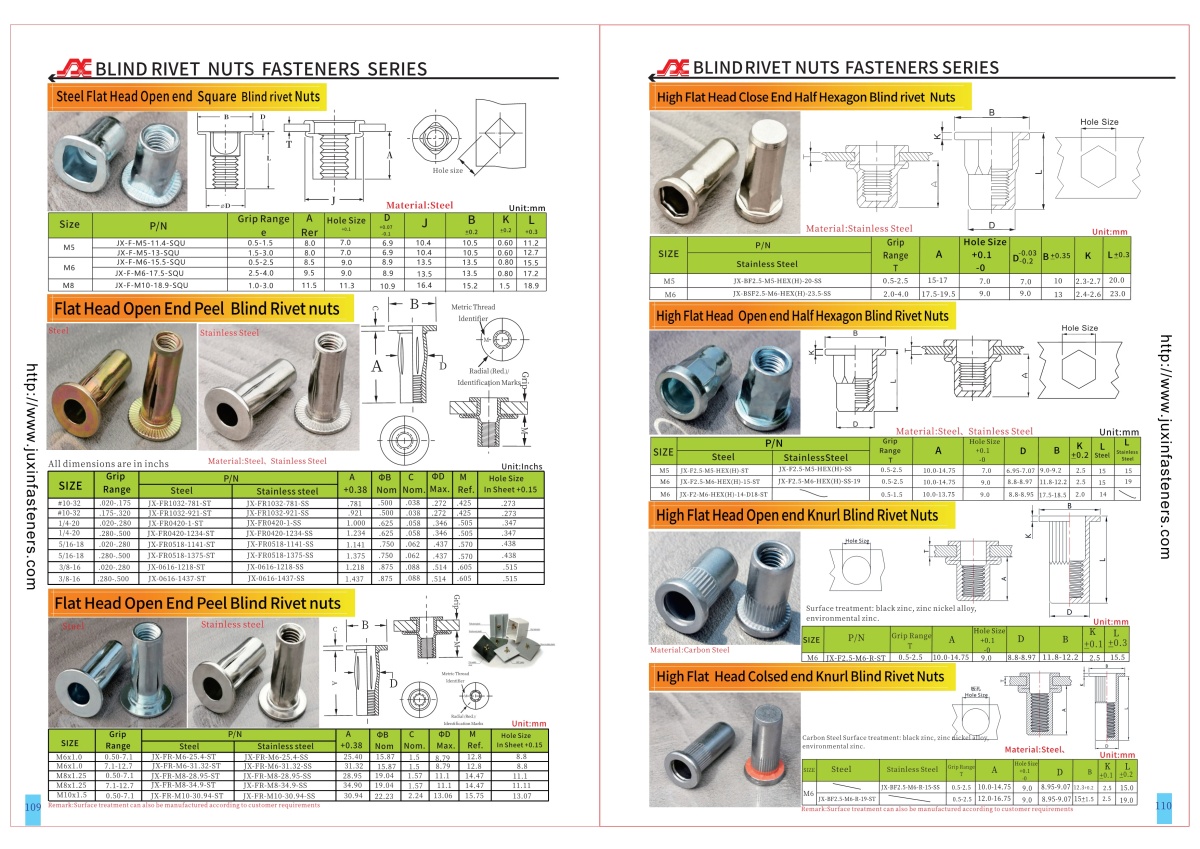
JUXIN FASTENERS manufactures steel flat head, closed-end knurled blind rivet nuts with underhead seals for reusable threaded connections in sheet metal, automotive components, EV battery enclosures, and OEM equipment requiring one-sided installation.
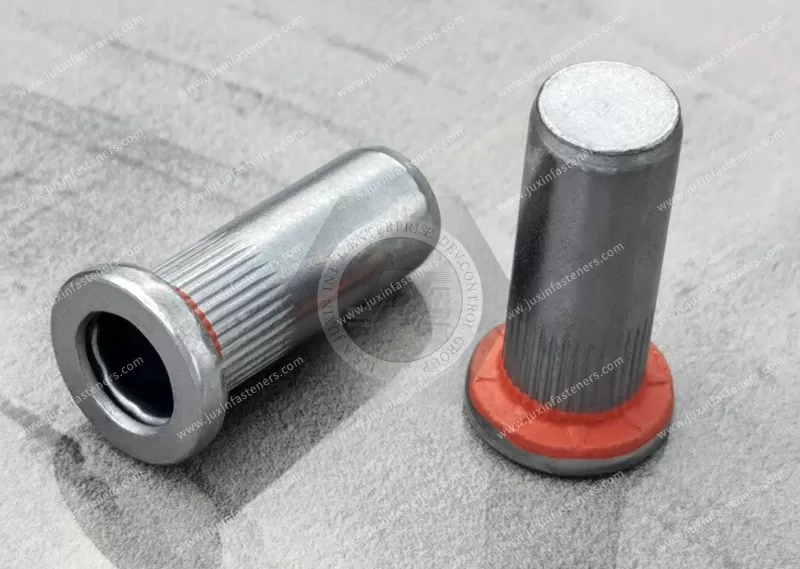
The knurled round body helps resist insert rotation, while the closed-end barrel blocks direct passage through the threaded cavity. Pre-applied sealing material beneath the flange helps reduce potential moisture ingress at the panel interface when properly installed.
Product Features
Metric threads: M3, M4, M5, M6, M8, M10, M12
Inch-series threads: Custom OEM requirements subject to drawing review
Material: Steel (grade subject to confirmation)
Finish: As supplied (surface treatment subject to confirmation)
Grip range: 0.5–4.0 mm (approx. 0.020–0.157 in), depending on size
Head: Flat head / Flanged head
Body: Knurled / Ribbed round body
End: Closed end
Sealing: Pre-applied underhead sealing material
Installation: One-sided blind installation
Applications include automotive assemblies, EV battery enclosure components, electrical cabinets, industrial machinery housings, and OEM sheet-metal equipment requiring additional sealing provisions.
Product Specification
Technical Specifications — Steel Closed-End Knurled Blind Rivet Nuts with Underhead Seal
Technical Construction and Product Specifications
JUXIN FASTENERS steel closed-end knurled blind rivet nuts with an underhead sealing feature are designed to provide mechanically retained internal threads in sheet-metal panels,
hollow sections and fabricated enclosures.
The product combines a flanged head, an externally knurled cylindrical body, a closed-end threaded cavity and a pre-applied sealing material at the flange interface.
Each feature contributes to a different aspect of the installed joint. The flange provides a bearing surface, the knurled body supports rotational engagement,
the closed end restricts direct passage through the threaded insert, and the underhead material is intended to provide sealing contact against the panel.
The product is intended for one-sided installation using compatible rivet nut setting equipment.
Product Technical Data
| Parameter | Specification |
|---|---|
| Product | Steel Closed-End Sealed Blind Rivet Nut |
| Head | Flat Head / Flanged Head |
| Body | Knurled Round Body |
| End | Closed End |
| Material | Steel |
| Finish | Natural Color, Subject to Approved Specification |
| Underhead Feature | Pre-Applied Sealing Material |
| Thread Sizes | M3, M4, M5, M6, M8, M10, M12 |
| Product-Family Grip Range | 0.5–4.0 mm |
| Installation | Blind, One-Sided |
| Mounting Hole | Round Hole per Approved Drawing |
| Customization | OEM Drawing-Based Requirements |
| Technical Reference | Product Drawing and Applicable Dimensional PDF |
The stated product-family grip range should not be applied indiscriminately to every thread size. Actual grip ranges, hole diameters,
body lengths and cavity dimensions must be confirmed from the selected product drawing.
How the Closed-End Sealing Rivet Nut Works
A blind rivet nut creates an internally threaded connection by mechanically deforming a portion of its body behind the parent material.
During installation, a compatible setting tool engages the internal thread and applies axial force. The deformable section collapses behind the panel, creating a retaining bulge.
The flange remains against the accessible side of the workpiece, and the retaining bulge forms on the blind side.
In this sealed configuration, the material beneath the flange is compressed against the panel during the setting process.
The result is a fastening point that combines mechanical retention with an underhead sealing interface.
Successful installation depends on the relationship between the rivet nut geometry, parent-material thickness, mounting-hole dimensions and setting parameters.
The seal also requires suitable compression and compatible contact surfaces.
Closed-End Design and Controlled Bolt Penetration
The closed-end body prevents the mating bolt from passing completely through the threaded insert.
This distinguishes it from an open-end rivet nut, which permits the bolt to extend through the body when rear-side clearance is available.
The closed cavity can be advantageous in equipment housings where internal components are located close to the fastening point.
It also blocks a direct passage through the threaded bore.
However, the usable internal thread depth must be considered when selecting the mating bolt.
An excessively long bolt can bottom out inside the closed cavity before the joint reaches the intended clamping condition.
For engineering approval, the usable thread depth, mating bolt length, attached component thickness and required thread engagement should be reviewed together.
Underhead Sealing and the Fastener-to-Panel Interface
One of the most important engineering distinctions between a standard closed-end rivet nut and a sealed closed-end rivet nut is the interface beneath the flange.
A closed-end body prevents direct passage through the internal threaded cavity, but it does not necessarily seal the gap between the fastener and the mounting panel.
The underhead sealing feature is intended to address this second potential leakage path.
During correct installation, the sealing material is compressed between the flange and the parent surface.
Depending on its material properties and the joint geometry, the compressed material may conform to small surface variations and help reduce the passage of moisture or contaminants.
The actual sealing performance depends on the material formulation, application thickness, flange geometry, panel coating, surface roughness, hole quality and installation conditions.
For this reason, sealing performance should be validated using representative production components.
Sealing Material Selection for Automotive and Industrial Applications
Different applications expose fastening points to different environmental conditions.
An electrical enclosure may primarily require protection against water and dust.
An automotive equipment housing may encounter road splash, cleaning chemicals, oils and temperature changes.
An HVAC assembly may be exposed to condensation, humidity and repeated thermal cycling.
An electric vehicle battery enclosure may require environmental protection in combination with vibration resistance and long-term serviceability.
The sealing material should therefore be selected according to the actual application rather than by appearance or color alone.
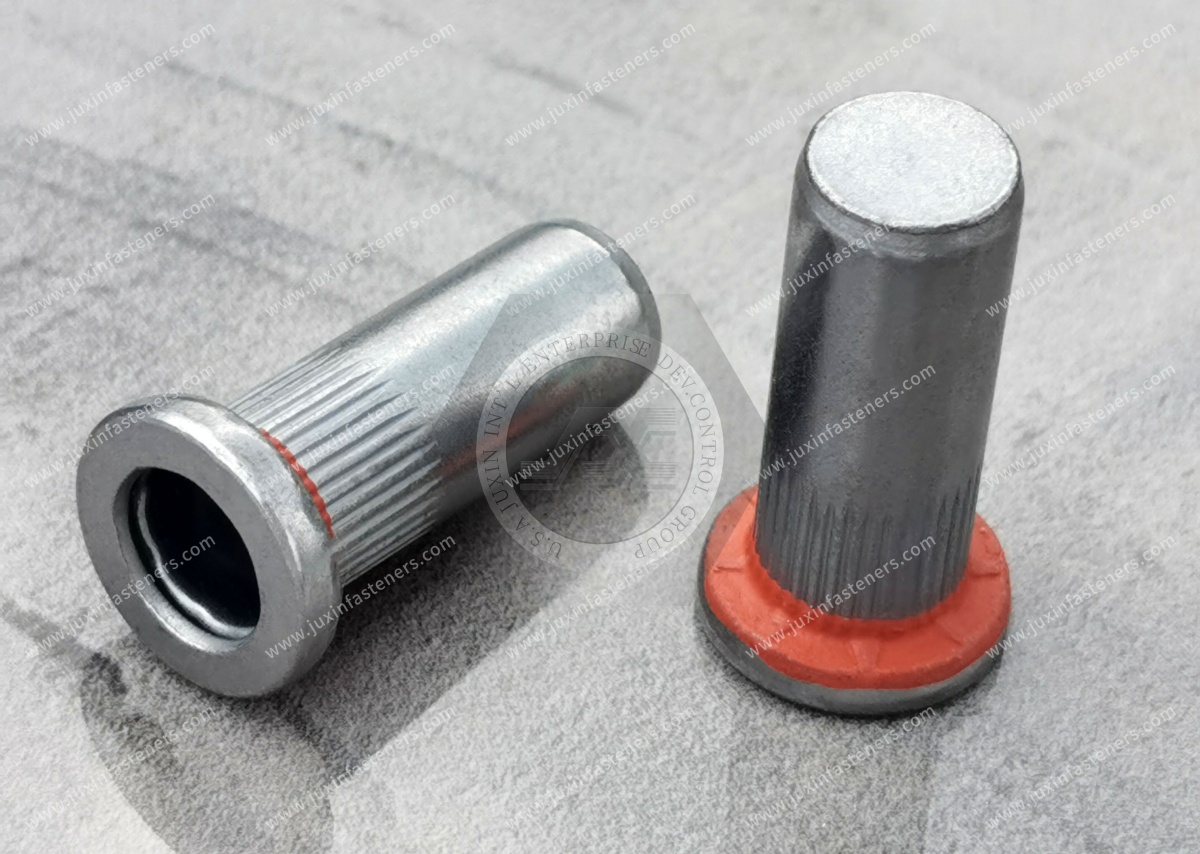
The red material shown on this product is a visible identification feature, but its color does not establish its chemical composition, temperature rating or fluid resistance.
Where specific performance is required, the seal compound, operating temperature, chemical compatibility and acceptance tests should be defined in the approved technical specification.
Anti-Rotation Performance of the Knurled Body
The externally knurled body provides additional mechanical engagement with the surrounding mounting hole.
During setting, the knurled surface interacts with the parent material while the deformable section forms the blind-side retaining bulge.
This engagement can help resist unwanted rotation during tightening or removal of the mating bolt.
Torque-to-turn resistance depends on the installed condition rather than the knurled geometry alone.
A mounting hole that is too large may reduce rotational engagement.
A mounting hole that is too small may prevent correct insertion or damage the surrounding material.
The parent-material strength, panel thickness and setting conditions also affect performance.
Where rotational resistance is a critical design requirement, the installed fastener should be evaluated using the actual production panel and intended assembly method.
Grip Range and Material Stack Thickness
The stated product-family grip range is 0.5–4.0 mm.
Grip range identifies the workpiece thickness or material stack thickness that a particular rivet nut configuration is designed to retain.
The selected body length must correspond to the actual grip thickness.
If the workpiece is outside the specified range, the retaining bulge may not form correctly.
Incorrect bulge formation can reduce axial retention, rotational engagement and installation consistency.
For assemblies containing multiple sheets, the engineer should establish the actual captured thickness and select the appropriate rivet nut configuration.
The thickness of surface coatings and the presence of sealing material should also be considered where they influence the installed geometry.
Mounting-Hole Engineering and Panel Preparation
Mounting-hole geometry is essential to both fastening performance and sealing consistency.
The hole must permit correct insertion while providing suitable engagement for the knurled body.
The flange must also seat against an appropriate surface.
Burrs, excessive hole deformation, uneven coatings or surface contamination may interfere with flange contact and sealing compression.
For punched holes, the punching process should be controlled to achieve consistent dimensions and edge quality.
For drilled holes, appropriate dimensional control and deburring should be considered.
The installation-hole diameter and tolerance must be taken from the approved product drawing rather than inferred solely from the internal thread size.
Blind-Side Clearance and Installed Geometry
Although the product is installed from one accessible side, space is still required behind the panel.
The rivet nut body extends beyond the workpiece, and installation forms a retaining bulge on the blind side.
The designer should verify clearance for the uninstalled body, the final retaining shape and nearby components.
For compact enclosures, this can be a significant design consideration.
The closed-end cavity and overall body length must also be coordinated with the available installation space.
Installation Equipment and Setting Process
Steel closed-end rivet nuts can be installed using compatible manual, pneumatic, hydro-pneumatic or automated setting equipment, subject to the selected fastener and production requirements.
The setting mandrel must match the internal thread.
The nosepiece must support the flange without damaging the sealing material or preventing correct seating.
The tool should be aligned with the mounting hole to promote consistent deformation.
Insufficient setting can result in poor mechanical retention and inadequate sealing compression.
Excessive setting can damage the internal threads, deform the flange, disturb the seal or damage the parent material.
For OEM production, setting parameters should be established through representative trials and controlled during manufacturing.
Engineering Difference Between Sealing and Thread Locking
Sealing and anti-loosening are separate engineering functions.
An underhead sealing material is primarily intended to address the interface between the fastener flange and the parent panel.
A thread-locking compound is intended to influence the behavior of a threaded connection, such as resistance to loosening or rotation.
The two materials may have different chemical formulations, locations, curing mechanisms and performance requirements.
The supplied product information refers to an applied anti-loosening material, while the product photograph shows a red feature beneath the flange.
For accurate product specification, the material should be identified by its actual function and location.
If the material is an underhead seal, it should be specified as such.
If a separate thread-locking feature is required, its location, application method and performance criteria should be defined independently.
This distinction is important for engineering approval, supplier qualification and repeatable OEM production.
Mechanical Performance and Joint Reliability
The performance of an installed rivet nut depends on the complete fastening system.
Relevant characteristics may include torque-to-turn resistance, axial pull-out resistance, thread integrity, panel deformation and the response of the joint under repeated loading.
The knurled body may contribute to rotational resistance.
The flange and retaining bulge contribute to axial retention.
The internal thread must provide the required engagement with the mating bolt.
The parent material must also be capable of sustaining the expected joint loads.
These characteristics should not be treated as interchangeable.
For example, high thread strength does not guarantee adequate rotational retention in an oversized mounting hole.
Similarly, adequate rotational resistance does not establish sealing performance.
Where performance requirements are critical, the acceptance criteria should be defined separately and verified using representative assemblies.
Corrosion Protection and Surface Finish
The supplied product information identifies steel with a natural-color appearance.
The exact material grade and surface treatment should be confirmed for the selected production configuration.
For steel fasteners exposed to corrosive environments, a suitable protective coating may be required.
Electroplated coatings can be specified with reference to ISO 4042 where applicable.
The coating system should be selected according to the service environment, customer specification and compatibility with the sealing material.
For applications involving aluminum panels, the possibility of galvanic corrosion between dissimilar metals should also be evaluated.
A sealing feature should not be assumed to provide complete corrosion protection for the fastener or surrounding assembly.
International Thread and Technical References
Metric thread selection may be based on ISO 261, with applicable thread tolerances defined under ISO 965.
Where Unified inch-thread configurations are requested, ASME B1.1 may provide a relevant reference for the approved design.
For applicable electroplated coating requirements, ISO 4042 may be used as a specification reference.
Where enclosure ingress protection is required, IEC 60529 provides a framework for evaluating the completed enclosure.
These standards should be applied according to the actual product, material, drawing and customer requirements.
Their mention does not independently establish product certification or a specific performance rating.
Engineering Solutions for Electric Vehicle Battery Enclosures
Electric vehicle battery enclosures present a combination of mechanical, environmental and manufacturing challenges.
The fastening points may need to provide retained threads in thin aluminum or steel panels while supporting removable covers and serviceable components.
Some locations may offer access from only one side.
Others may form part of the environmental boundary of the battery housing.
A sealed closed-end rivet nut can be evaluated as one element of the fastening and sealing strategy.
The closed-end construction restricts direct passage through the threaded insert.
The underhead sealing material addresses the flange-to-panel interface.
The knurled body contributes additional mechanical engagement.
However, the suitability of the complete connection depends on the panel material, mounting-hole quality, setting process, sealing material and environmental requirements.
For aluminum battery trays, particular attention should be paid to panel deformation, galvanic compatibility, coating integrity and repeatable sealing compression.
Where the project requires an ingress protection rating, the assembled enclosure must be validated under the applicable test conditions.
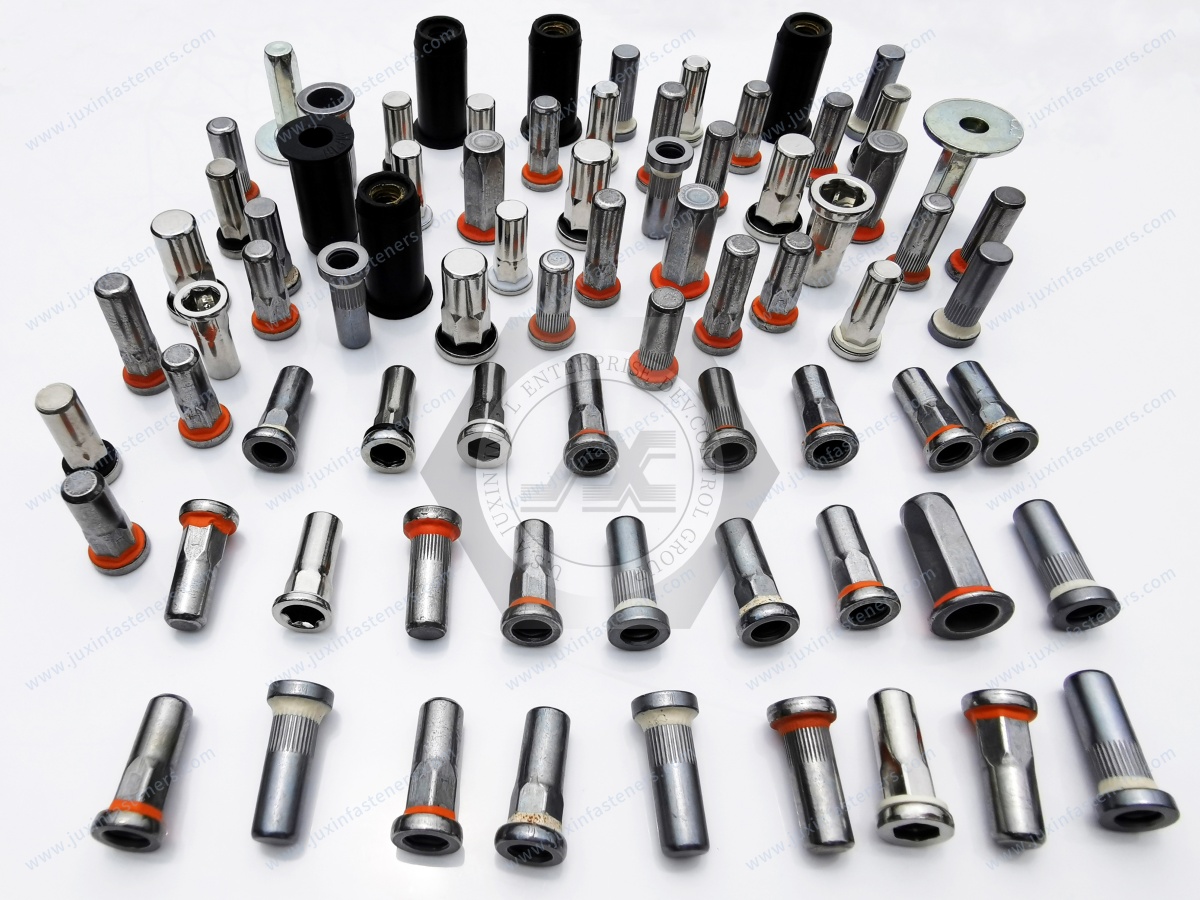
Automotive Body, Bracket and Equipment Applications
Automotive equipment housings, removable brackets, body components and service panels may require retained threaded inserts that can be installed without rear access.
A sealed closed-end configuration may be useful where the fastening point is exposed to moisture or contamination.
The knurled body may help resist insert rotation during assembly and maintenance.
Engineering validation should consider installation repeatability, vibration, corrosion exposure and the mating bolt requirements.
For high-volume automotive programs, process monitoring and traceability may be incorporated according to the customer's manufacturing and quality plan.
Electrical Enclosures and Control Cabinets
Electrical cabinets, control panels and equipment housings may require fastening points in thin sheet-metal walls.
The closed-end cavity can help avoid an unrestricted passage through the threaded insert.
The underhead seal can contribute to the environmental protection strategy when properly specified and installed.
The complete enclosure design must also account for cover gaskets, seams, cable entries, connectors and other potential leakage paths.
HVAC and Industrial Equipment
HVAC housings, ventilation assemblies and industrial machinery covers may require retained threaded connections with one-sided installation capability.
Where moisture or cleaning fluids are present, the underhead sealing feature can be evaluated as part of the overall assembly design.
For machinery subject to repeated servicing, the knurled body may provide additional resistance to insert rotation.
The final selection should reflect the panel material, service conditions, installation method and required joint performance.
OEM Quality Control and Inspection
For production approval, inspection requirements should be established according to the product drawing and intended application.
Dimensional inspection may include thread size, flange geometry, body diameter, body length and closed-end cavity dimensions.
Installation verification may include the final retaining bulge, flange seating, internal thread condition and rotational retention.
For sealed variants, additional inspection may address the location, continuity and condition of the applied sealing material.
Where required, leak testing should use the specified test medium, pressure conditions, duration and acceptance criteria.
The inspection plan should distinguish product-level dimensional conformity from installed-joint performance.
JUXIN FASTENERS Manufacturing Capabilities
JUXIN FASTENERS manufactures industrial fasteners and customer-specific components using production processes selected according to the approved drawing.
Our capabilities include cold heading, cold forming, secondary CNC machining and turning, metal stamping, plastic injection molding and combined manufacturing processes.
For suitable products, cold forming can be combined with secondary machining to achieve functional dimensions and customer-specific tolerances.
OEM projects involving sealing rivet nuts can be reviewed for material selection, flange geometry, knurled body design, grip range,
closed-end cavity dimensions, surface treatment and sealing requirements.
Manufacturing feasibility and inspection arrangements are established according to the customer specification and production quantity.
Technical RFQ Requirements
For an accurate quotation and engineering review, customers should provide the required thread size, panel material, grip thickness,
mounting-hole dimensions, mating bolt details and technical drawing.
For sealing applications, the required sealing function should be clearly defined.
Relevant information may include exposure to water, dust, oils, coolants, cleaning chemicals, temperature variation and pressure.
Where applicable, customers should identify the required leak-test method, acceptance criteria and environmental validation requirements.
Estimated annual demand, order quantity, sample requirements and installation equipment information will support the production review.
A Fastening Solution That Combines Thread Retention and Sealing
A conventional blind rivet nut creates a threaded fastening point in thin sheet metal or hollow sections without requiring access to the rear of the workpiece.
However, applications involving enclosed equipment or exposure to moisture introduce an additional engineering challenge.
Even if a rivet nut has a closed end, a potential leakage path may remain between the flange and the panel surface.
This sealed rivet nut configuration addresses that interface by incorporating a sealing feature beneath the head.
During correct installation, the rivet nut body deforms behind the panel to create mechanical retention.
At the same time, the underhead sealing material is compressed against the panel surface.
The effectiveness of this sealing arrangement depends on the seal material, flange geometry, surface condition, installation parameters and actual service environment.
For OEM engineers, the advantage is the opportunity to combine a retained internal thread and an underhead sealing function within one fastening component.
Closed-End Construction for Enclosure Applications
The closed-end cavity prevents the mating bolt from passing completely through the rivet nut.
This design can be useful in enclosed assemblies where unrestricted bolt penetration is undesirable or where the fastening point forms part of an environmental boundary.
Typical applications include fabricated electrical housings, battery enclosure covers, equipment panels and compact machinery assemblies.
The closed end also requires careful bolt-length selection.
If the mating bolt contacts the bottom of the closed cavity before the joint is properly clamped, the tightening operation may not produce the required preload.
Engineers should therefore evaluate usable thread depth, bolt length, attached component thickness and installation geometry together.
Underhead Sealing for Moisture and Contamination Control
The pre-applied material visible beneath the flange is the principal feature that differentiates this product from an ordinary closed-end knurled rivet nut.
When the insert is correctly installed, the material is intended to form a sealing interface between the rivet nut head and the parent panel.
This may help reduce moisture, dust or other contaminants passing around the fastening point.
For applications involving water, oils, coolants, cleaning fluids or temperature variation, the sealing material must be selected for compatibility with the expected environment.
Sealing performance should be verified using the specified panel material, surface coating, hole geometry and installation method.
An underhead sealing feature does not automatically establish an IP rating for the complete enclosure.
Where a particular ingress protection level is required, the fastening point and complete assembly should be tested under the relevant conditions.
Knurled Body for Improved Rotational Engagement
The externally knurled round body is intended to improve mechanical engagement with the surrounding mounting hole.
During installation, the rivet nut body collapses behind the panel while the knurled surface engages the parent material.
This can help reduce the risk of insert rotation when a mating bolt is tightened or removed.
The effectiveness of the knurled design depends on the panel material, mounting-hole tolerance, body geometry and setting conditions.
For applications involving repeated maintenance or higher tightening torque, torque-to-turn performance should be evaluated using representative installed samples.
Flat Flange Head for Load Distribution
The flanged head provides a bearing surface on the accessible side of the workpiece.
After installation, the flange and the blind-side retaining bulge secure the insert mechanically.
The flange can help distribute contact pressure around the mounting hole and support the surrounding sheet metal.
For sealed variants, the head also provides the interface required to compress the underhead sealing material.
The engineer should review flange contact, sealing compression and panel deformation together rather than treating them as unrelated design requirements.
Engineering Applications
Electric Vehicle Battery Enclosures
Battery trays, battery covers and associated equipment housings may require retained threaded fastening points in thin-wall or hollow-section structures.
A sealed closed-end rivet nut can be evaluated where the assembly needs one-sided installation and where the fastening point forms part of an environmental boundary.
The closed-end construction blocks the direct threaded passage, while the underhead sealing material addresses the flange-to-panel interface.
For battery enclosures, engineers must also consider vibration, thermal cycling, galvanic corrosion, panel deformation and the sealing performance of the complete enclosure.
Automotive Body and Equipment Assemblies
Automotive equipment housings, brackets, body panels and serviceable covers may benefit from mechanically retained threaded inserts.
The knurled body can provide additional rotational engagement, while the underhead seal may help protect the fastening interface against road splash and contamination.
Product selection should reflect the actual panel material, coating system, installation process and environmental exposure.
Electrical Enclosures and Control Cabinets
Electrical cabinets and control equipment often require threaded mounting points in fabricated sheet-metal housings.
Sealed closed-end rivet nuts can be considered for removable covers,
internal brackets and mounting hardware where the fastening point must be evaluated as part of an enclosure sealing strategy.
HVAC and Climate-Control Equipment
Ventilation equipment, climate-control housings and sheet-metal assemblies may require one-sided fastening combined with resistance to moisture ingress.
The sealed rivet nut configuration can be evaluated for these applications when the sealing material is compatible with the expected temperature, moisture and cleaning conditions.
Industrial Machinery and Outdoor Equipment
Industrial equipment covers, machinery housings and outdoor electrical hardware may require fastening points that remain accessible for maintenance.
The knurled body can help resist rotation during servicing, while the closed end and underhead sealing feature can contribute to the environmental protection strategy.
Transportation and Fabricated Structures
Rail equipment housings, transportation brackets and fabricated structural enclosures may require retained threads in sections where rear access is restricted.
A sealed closed-end rivet nut can be considered when the application also requires a controlled fastening interface.
Safety-critical applications must be assessed according to the project-specific mechanical and environmental requirements.
OEM Manufacturing and Engineering Customization
JUXIN FASTENERS operates production workshops and manufactures industrial fasteners and custom components using processes selected according to material, geometry and functional requirements.
Our manufacturing capabilities include cold heading, cold forming, secondary CNC machining and turning, metal stamping, plastic injection molding and combined production processes.
For suitable components, cold forming can be followed by secondary machining to achieve drawing-specific features, dimensions and tolerances.
JUXIN can review OEM requirements involving flange dimensions, knurled body geometry, grip ranges,
closed-end cavity dimensions, material grades, surface treatments and underhead sealing arrangements.
Sealing material selection and application requirements should be defined according to the customer's operating environment and technical specification.
Engineering and Procurement Support
For design engineers, the main considerations include the panel material, grip thickness, mounting-hole geometry, blind-side clearance,
mating bolt length, installation parameters and required sealing performance.
For purchasing managers, sourcing engineers and supplier development teams, the main considerations include material specification,
drawing compliance, process repeatability, inspection requirements, production volume and delivery planning.
JUXIN FASTENERS supports drawing-based OEM inquiries and customer-specific fastening projects.
Request an OEM Quotation
To obtain a technical review and quotation, please provide the required thread size, steel grade, grip thickness,
mounting-hole dimensions, mating bolt details, sealing requirements, technical drawing and estimated order quantity.
Where environmental sealing is critical, please identify the relevant fluid exposure, temperature range, pressure conditions and required test criteria.
JUXIN FASTENERS
Email: info@juxinfasteners.com
Website: www.juxinfasteners.com
Product Packaging
Product Packaging — Steel Closed-End Sealed Knurled Blind Rivet Nuts
Protective Packaging for Sealed Industrial Fasteners
JUXIN FASTENERS provides industrial packaging arrangements for steel closed-end knurled blind rivet nuts with underhead sealing features.
Packaging is selected according to the product dimensions, thread size, sealing material, surface finish, order quantity and customer-specific handling requirements.
For sealed rivet nuts, packaging must protect not only the metal fastener but also the applied sealing feature.
The sealing material should remain suitable for installation and should not be unnecessarily compressed, contaminated or damaged during storage and transportation.
Protection of the Underhead Sealing Feature
The applied material beneath the flange is an important functional element of the product.
Packaging and handling arrangements should minimize abrasion, mechanical damage, contamination and conditions that could affect the sealing material.
Where the compound has specific storage-temperature, shelf-life or handling requirements, these should be established according to the approved material specification.
The visible color of the sealing material does not determine its storage requirements or chemical properties.
Inner Packaging
Suitable protective inner packaging can be arranged according to the selected product and purchase order.
Plastic bags or other appropriate protective materials may be used where compatible with the product and sealing feature.
The quantity per inner package should be selected according to the fastener size, handling requirements and customer instructions.
Where necessary, additional separation or protection may be considered to reduce contact damage during transportation.
Outer Carton Packaging
Standard carton formats used by JUXIN FASTENERS include the following dimensions:
| Carton Type | Dimensions |
|---|---|
| Standard Carton | 29 × 19 × 19.5 cm |
| Compact Carton | 23.5 × 17.5 × 8 cm |
The actual carton selection depends on product size, packing quantity, gross weight and shipment requirements.
Final quantities per carton are confirmed for the specific order.
Pallet Packaging
Palletized packaging can be arranged for larger industrial shipments.
A referenced pallet size is 215 × 100 × 90 cm.
Actual pallet dimensions, loading arrangements and shipment weights should be confirmed according to the order and transportation requirements.
Palletized cartons may be secured and protected as appropriate for the selected shipping method.
OEM Packaging and Labeling
JUXIN FASTENERS can review customer-specific packaging requirements for OEM manufacturing and industrial distribution programs.
Packaging identification may include product descriptions, customer part numbers, thread sizes, material specifications, batch references and order information.
Where the customer requires traceability, inspection documentation or controlled handling of the sealing material, the relevant arrangements should be defined during order confirmation.
Storage and Handling Recommendations
Sealed rivet nuts should be stored under conditions compatible with the specified steel finish and applied sealing compound.
Excessive heat, contamination, unnecessary mechanical pressure and unsuitable chemical exposure should be avoided where they may affect product condition.
If the approved sealing material has a defined shelf life or storage range, those requirements should govern inventory management.
Before use, the fasteners should be inspected as required to confirm that the sealing feature and internal threads remain suitable for installation.
Customized Packaging for Industrial Supply
JUXIN FASTENERS supports packaging arrangements based on customer requirements, including preferred packing quantities, carton identification, product separation and palletized shipments.
The final packaging method is confirmed according to the approved product specification, order quantity and shipping requirements.
Request Packaging Details or an OEM Quotation
Please provide the product drawing or part number, thread size, required quantity, preferred packaging method and destination.
For sealed fasteners, please also identify any special handling, storage or traceability requirements associated with the sealing material.
JUXIN FASTENERS
Email: info@juxinfasteners.com
Website: www.juxinfasteners.com
Product Pictures
Contact Us
Tel.:
+86 020 8621 0320
+86 020 3121 6067
E-mail:
Technical Support:
Navigation
SEND INQUIREY