Call Us
+86 136 6007 9809
Call Us
+86 136 6007 9809

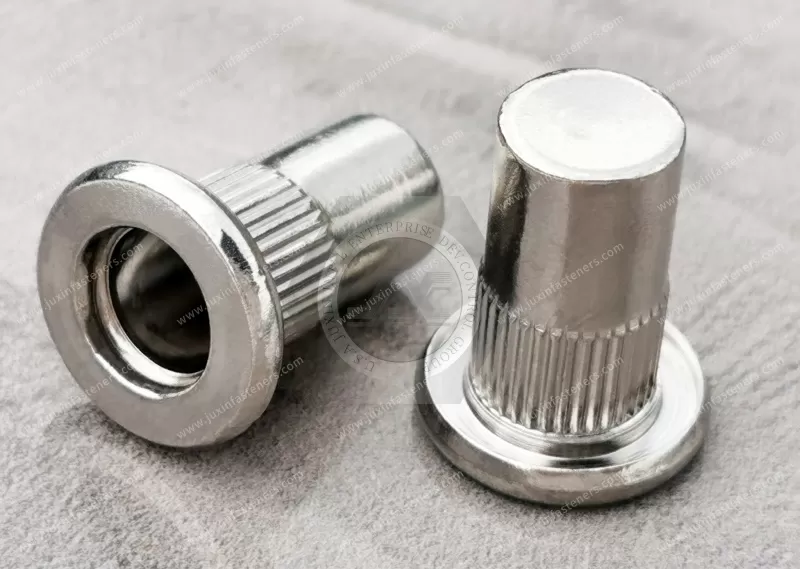
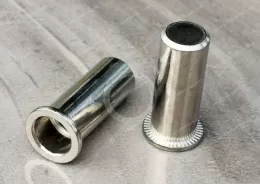
JUXIN FASTENERS supplies M6 stainless steel high flat head closed-end knurled body blind rivet nuts for OEM sheet-metal assemblies requiring reusable internal threads and one-sided installation.
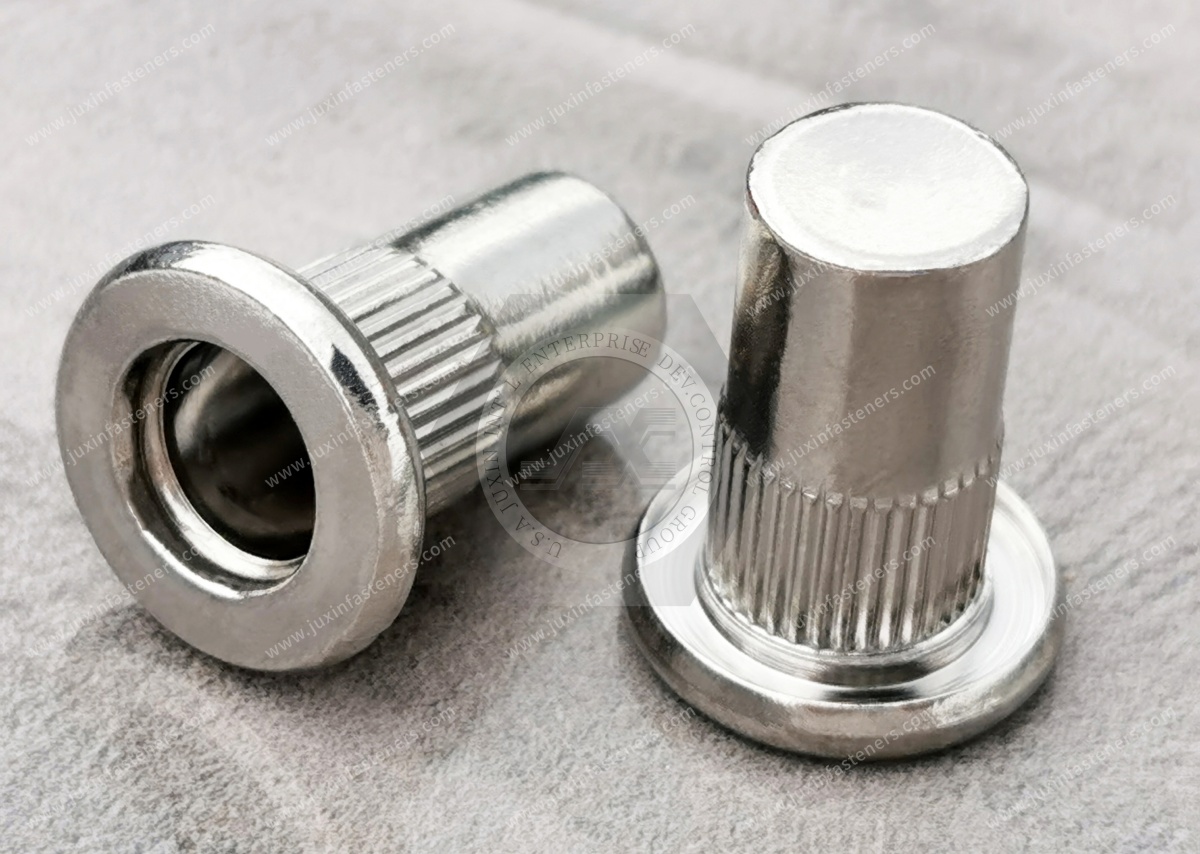
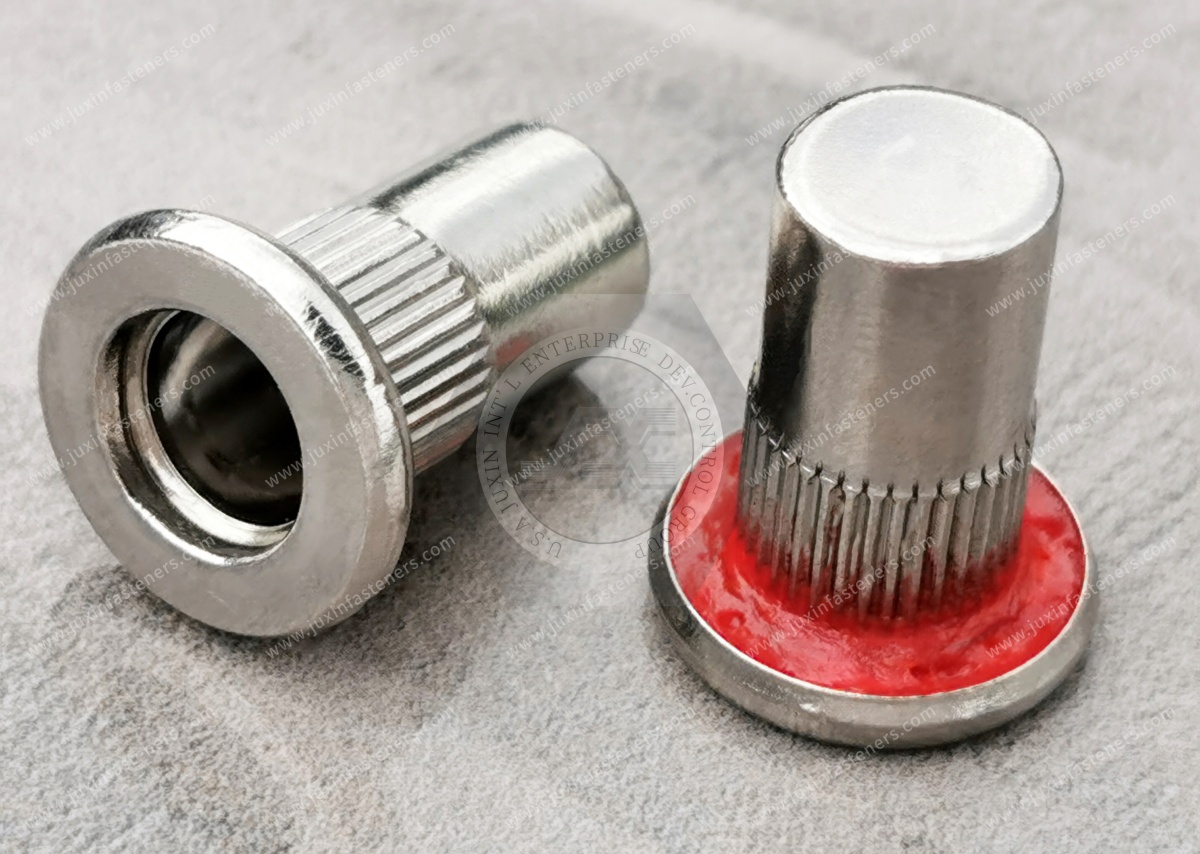
The raised flat-head flange provides panel-side bearing support, while the knurled round body is intended to improve rotational engagement with the surrounding material. The closed-end barrel prevents screw penetration beyond the insert and requires verification of available internal screw depth.
Product Features
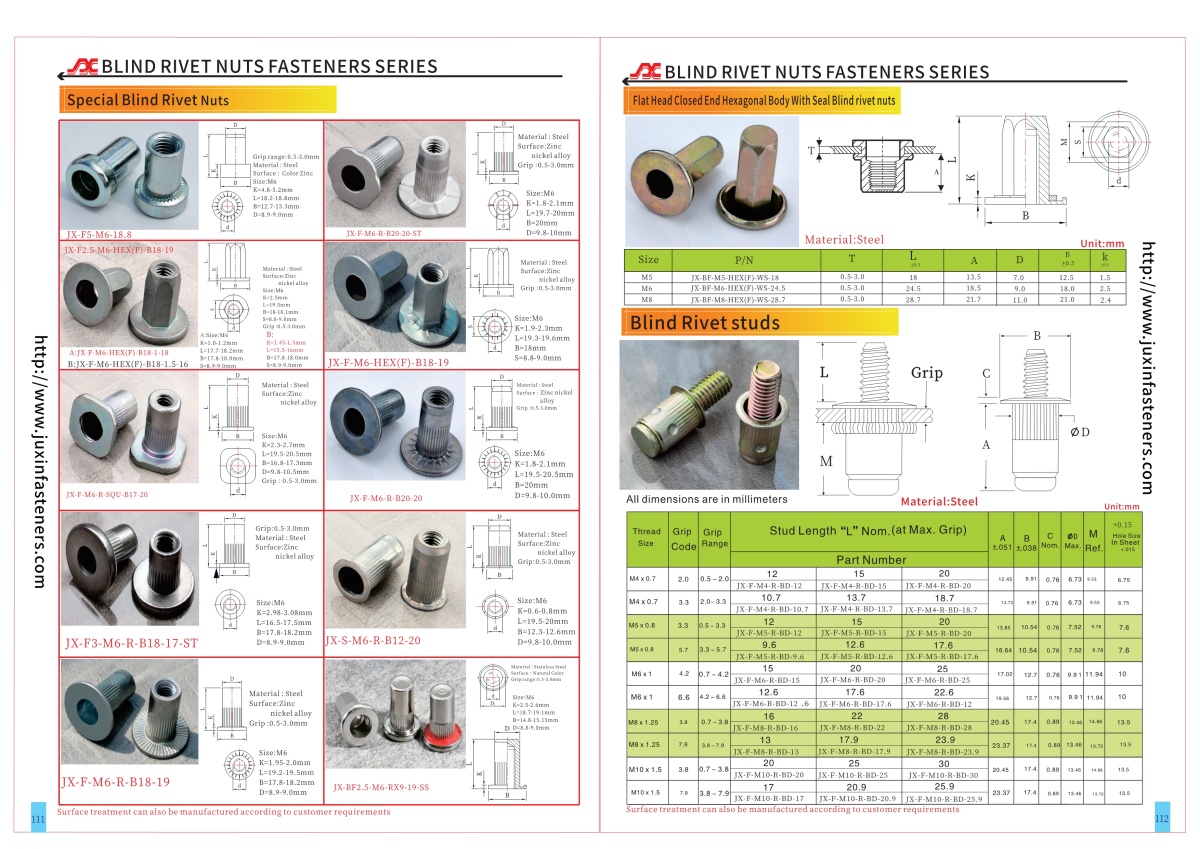
Part No.: JX-BF2.5-M6-RX9-19-SS
Thread size: M6
Material: Stainless steel
Grip range: 0.5–3.0 mm (approx. 0.020–0.118 in)
Head: High flat head / Raised flange
Body: Knurled round body
End: Closed end
Installation: One-sided blind installation
Mounting hole: Per approved drawing
Stainless steel grade: Subject to confirmation
Applications include equipment housings, electrical cabinets, industrial machinery, fabricated brackets, service panels, and OEM sheet-metal components.
Send drawings and purchasing requirements to info@juxinfasteners.com.
Product Specification
M6 Stainless Steel High Flat Head Closed-End Knurled Rivet Nut – Technical Specifications and OEM Fastening Solutions
JUXIN FASTENERS supplies the M6 stainless steel high flat head closed-end knurled body blind rivet nut, part number JX-BF2.5-M6-RX9-19-SS,
for industrial OEM applications requiring reusable internal threads in sheet-metal panels and hollow fabricated structures.
This blind threaded insert combines a raised flat-head flange, an externally knurled round body, and a closed-end threaded barrel.
It is intended for one-sided installation where access to the rear of the parent material is limited or unavailable.
The knurled body is designed to engage the surrounding material during installation, while the closed-end construction prevents the mating screw from extending through the barrel tip.
This product is particularly relevant for engineers and purchasing teams evaluating M6 closed-end rivet nuts for equipment housings, serviceable panels, fabricated brackets, and industrial enclosures.
Product Specifications
Product name: M6 High Flat Head Closed-End Knurled Body Blind Rivet Nut
Part number: JX-BF2.5-M6-RX9-19-SS
Material: Stainless steel
Thread size: M6
Thread pitch: To be confirmed from the approved drawing
Grip range: 0.5–3.0 mm
Approximate inch reference: 0.020–0.118 in
Head configuration: High flat head / Raised flange
Body configuration: Round body with external knurling
End configuration: Closed end
Installation: One-sided blind installation
Mounting-hole geometry: Round hole, dimensions per approved drawing
Stainless steel grade: Subject to confirmation
Flange diameter and thickness: According to approved drawing
Body diameter and length: According to approved drawing
Internal screw depth: According to approved drawing
OEM supply: Subject to drawing and purchasing review
The product part number must not be used as a substitute for a complete dimensional drawing.
Engineering Features and Selection Considerations
High Flat Head and Flange-Bearing Support
The high flat head provides a raised flange-bearing surface against the accessible side of the parent panel.
The flange helps support the installed insert around the mounting hole.
Depending on its actual diameter and thickness, the flange geometry may influence local bearing stress and resistance to pull-through.
However, head height and flange diameter are separate dimensions.
A high flat head does not automatically guarantee a larger bearing diameter or higher mechanical load capacity than another flange design.
For OEM approval, engineers should verify:
Flange outside diameter
Flange thickness
Flange underside geometry
Installed head projection
Parent-panel thickness
Mating component clearance
Required axial retention performance
Where another component must sit directly against the mounting panel, the raised flange may create a local gap or require a corresponding clearance feature.
Knurled Round Body and Anti-Rotation Performance
The external knurling is intended to improve engagement between the rivet nut body and the surrounding parent material.
During installation, the knurled surface can contribute to resistance against insert rotation.
This may be useful for removable covers, equipment panels, and assemblies where the mating screw is periodically loosened or retightened.
Actual spin-out resistance depends on:
Knurl geometry
Body diameter
Mounting-hole fit
Parent-material strength
Grip thickness
Installation deformation
Tightening and service conditions
Knurling does not establish a guaranteed spin-out torque.
Where repeated maintenance or elevated tightening torque is expected, rotational retention should be validated using representative production assemblies.
Round-Hole Installation and Manufacturing Efficiency
A knurled round-body rivet nut is generally designed for installation in a compatible round mounting hole.
Round holes can be manufactured using common drilling, punching, or other approved hole-making processes.
This may simplify fabrication compared with inserts requiring non-round mounting holes.
However, the hole diameter must be selected from the approved product drawing.
A nominal M6 thread does not establish the correct mounting-hole diameter.
For this specific part, the exact hole diameter and tolerance have not been independently confirmed.
Engineers should verify:
Required hole diameter
Hole tolerance
Panel thickness
Hole edge quality
Burr condition
Body insertion clearance
Installation tool compatibility
Oversized or undersized holes can affect seating, deformation, and installed retention.
Closed-End Barrel and Screw Penetration Control
The closed-end barrel prevents the mating screw from extending beyond the insert.
This may be useful where the assembly contains nearby wiring, electronic components, insulation, or mechanical structures.
The closed barrel also closes the direct passage through the threaded insert tip.
However, a closed-end rivet nut does not automatically provide a waterproof or airtight installed joint.
Moisture may still pass around the flange-to-panel interface if that interface is not adequately sealed.
Where an environmental seal is required, the complete assembly should be evaluated, including any specified gasket, sealing washer, or sealing compound.
Screw Bottoming and False Tightening Torque
Closed-end rivet nuts have a finite internal screw cavity.
If the mating screw is too long, the screw tip may contact the closed end before the mating components are properly clamped.
This can produce a false tightening condition.
The measured torque may rise even though the intended joint clamping force has not been achieved.
This risk becomes particularly important when an OEM changes screw length, washer thickness, panel stack-up, or insert supplier.
Engineers should confirm:
Available internal screw depth
Maximum mating screw length
Minimum assembled stack thickness
Washer and spacer tolerances
Required thread engagement
Screw tip clearance
Worst-case tolerance accumulation
The screw should achieve the required thread engagement and joint clamping without bottoming against the closed barrel.
Grip Range: 0.5–3.0 mm
This M6 product is identified with a grip range of 0.5–3.0 mm.
The grip range refers to the parent-material thickness that the selected insert is designed to accommodate.
For assemblies containing more than one material layer at the installation location, the effective grip thickness should be reviewed according to the approved installation arrangement.
The insert should not be installed outside its specified grip range without engineering approval.
Where the parent-panel thickness is close to either grip limit, representative installation trials may be appropriate.
Installed Backside Projection
During installation, a blind rivet nut body deforms behind the parent panel to establish mechanical retention.
The installed backside projection may differ from the uninstalled body length.
For a closed-end insert, engineers must also consider the space occupied by the barrel tip.
This is particularly relevant in:
Compact electrical enclosures
Hollow structural sections
Equipment housings
Double-wall panels
Closely spaced mounting points
A rivet nut may fit the mounting hole but still be unsuitable if its installed body interferes with nearby components.
The required backside clearance should be confirmed from the approved drawing and representative installation.
Installation Tooling and Setting Parameters
Blind rivet nuts are installed using compatible setting tools that deform the insert body behind the parent material.
Tool selection depends on the product geometry, stainless steel material, thread size, and installation requirements.
The installation process should ensure that the flange is properly seated and that the body deformation is consistent.
Production validation should consider:
Correct installation mandrel
Hole preparation
Insert orientation
Flange seating
Setting stroke or force
Installed backside geometry
Internal thread condition
Axial retention
Rotational retention
Under-setting may reduce mechanical retention.
Excessive setting may damage the insert, distort the internal thread, or deform the parent panel.
Installation parameters should be validated for the actual production material.
Stainless Steel Grade and Corrosion Compatibility
The specified material for this product is stainless steel.
The exact stainless steel grade has not been confirmed.
For applications involving moisture, cleaning chemicals, chlorides, or contact with dissimilar metals, the required grade should be identified during engineering review.
Stainless steel does not provide identical corrosion performance in every environment.
Where material traceability or testing documentation is required, the purchasing specification should identify the applicable requirements.
M6 Thread Compatibility
The product is specified with an M6 internal thread.
The exact pitch and tolerance class should be confirmed from the approved drawing.
Where an M6 coarse metric thread is specified, ISO metric thread standards such as ISO 261 and ISO 965 may be relevant.
An M6 metric thread must not be treated as interchangeable with a 1/4-20 UNC thread.
The mating screw specification, thread engagement, and installation torque requirements should be verified for the actual joint.
Axial Retention and Joint Reliability
A knurled rivet nut provides a reusable internal thread, but complete joint performance depends on the installed fastener and the surrounding assembly.
Important factors include:
Parent-material strength
Panel thickness
Hole diameter and tolerance
Flange-bearing geometry
Knurl engagement
Installation deformation
Mating screw specification
Tightening torque
Axial and transverse loads
Vibration
Repeated maintenance
For OEM applications requiring defined pull-out, push-out, or spin-out performance, the relevant test conditions and acceptance criteria should be established.
No specific mechanical performance rating is claimed without supporting test data.
M6 High Flat Head vs. Standard Flat Head Rivet Nuts
High flat head and standard flat head rivet nuts may differ in flange height, diameter, and installed surface projection.
These differences can affect mating component clearance, panel support, and replacement compatibility.
The two configurations should not be treated as interchangeable based solely on the M6 thread size.
Before approving a substitution, engineers should compare the complete flange dimensions and installation requirements.
Knurled Round Body vs. Plain Round Body Rivet Nuts
Knurled round-body inserts incorporate external ribs intended to improve engagement with the surrounding parent material.
Plain round-body inserts rely on their body geometry, installation deformation, and contact with the parent material for retention.
Knurled designs may provide additional rotational engagement under suitable conditions.
However, the actual performance difference depends on the selected products and installation conditions.
A knurled insert should not automatically be considered a direct replacement for a plain-body insert without dimensional and mechanical review.
Knurled Round Body vs. Partial Hex Body Rivet Nuts
Knurled round-body rivet nuts are generally associated with compatible round mounting holes.
Partial hex body rivet nuts may use a non-round section to provide geometric resistance to rotation.
The designs differ in hole preparation, body engagement, and installation requirements.
The correct choice depends on manufacturing capability, parent material, rotational retention requirements, and approved mounting-hole geometry.
Closed-End vs. Open-End M6 Rivet Nuts
Closed-end rivet nuts prevent screw penetration beyond the insert and require verification of internal screw depth.
Open-end rivet nuts permit screw extension through the insert where sufficient backside clearance is available.
Closed-end designs may be considered where screw projection must be restricted.
Open-end designs may be preferable where longer screw engagement or through-screw clearance is required.
The choice should be based on the complete assembly design.
Industrial Applications and OEM Fastening Solutions
Automotive and Commercial Vehicle Components
The M6 closed-end knurled rivet nut may be considered for fabricated brackets, equipment housings, service panels, and selected sheet-metal components.
The knurled body can contribute to rotational engagement, while the closed-end barrel prevents screw penetration beyond the insert.
Application-specific vibration, corrosion, and retention requirements must be verified.
Electrical Cabinets and Control Equipment
Potential applications include control cabinets, electrical enclosures, instrument panels, and equipment mounting structures.
The closed-end design may be useful where screw penetration toward internal components must be restricted.
Electrical clearance and environmental sealing requirements should be evaluated at the assembly level.
Industrial Machinery and Equipment
Potential applications include machine covers, maintenance panels, fabricated brackets, and equipment housings.
For repeatedly serviced assemblies, engineers should evaluate rotational retention and thread condition after repeated screw installation.
HVAC and Appliance Manufacturing
The M6 insert may be considered for equipment cabinets, appliance housings, mounting brackets, and sheet-metal covers.
Panel thickness, flange clearance, and installation consistency should be confirmed.
Transportation and Railway Equipment
Potential applications include non-safety-critical interior panels, fabricated equipment enclosures, and serviceable mounting components.
Relevant mechanical loads, vibration exposure, corrosion requirements, and documentation expectations should be reviewed before approval.
Telecommunications and Electronic Equipment
Potential applications include equipment housings, instrument enclosures, mounting panels, and removable covers.
Internal screw depth and installed backside clearance should be checked against nearby components.
Metal Fabrication and Industrial Enclosures
The insert may provide an M6 threaded connection in suitable fabricated panels and hollow sections where only one-sided installation access is available.
The selected mounting hole and retention requirements should be validated for the actual parent material.
Engineering Selection Checklist
Before approving JX-BF2.5-M6-RX9-19-SS, confirm:
Exact M6 thread pitch and tolerance class
Stainless steel grade
Parent material and panel thickness
Grip range of 0.5–3.0 mm
Approved mounting-hole diameter and tolerance
Flange diameter and head height
Body diameter and length
Knurl geometry
Available internal screw depth
Maximum mating screw length
Installed backside clearance
Installation tool compatibility
Setting stroke or force
Required pull-out and push-out performance
Required spin-out torque
Corrosion and sealing requirements
Inspection and traceability requirements
Engineering Standards and Technical Verification
The approved product drawing should control dimensions, thread requirements, and installation compatibility.
Applicable ISO metric thread standards may include ISO 261 and ISO 965 where relevant.
Relevant ISO, DIN, EN, ASTM, SAE, ASME, or other applicable international standards should be selected according to the actual product, material, inspection, and application requirements.
No specific certification, mechanical performance value, or standard conformity should be assumed without supporting documentation.
OEM Procurement and Supplier Qualification
For purchasing managers and supplier development teams, the part number JX-BF2.5-M6-RX9-19-SS provides a specific reference for quotation and technical review.
However, a part number alone does not establish dimensional interchangeability with another manufacturer's M6 closed-end rivet nut.
Products with the same thread size may differ in flange geometry, body diameter, grip range, knurl design, internal screw depth, and installation requirements.
Before approving an alternative supplier, procurement teams should compare complete dimensional drawings and verify the selected insert in representative production assemblies.
For recurring OEM programs, material specifications, inspection criteria, traceability, packaging, annual demand, and delivery requirements should be established during sourcing.
Custom OEM M6 Closed-End Knurled Rivet Nut RFQ Requirements
Please provide:
Part number: JX-BF2.5-M6-RX9-19-SS
2D drawing or 3D CAD model
Required stainless steel grade
Parent material and panel thickness
Mounting-hole diameter and tolerance
Flange diameter and thickness
Body dimensions and knurl requirements
Available internal screw depth
Mating screw length
Installation method and tooling requirements
Required axial and rotational retention
Environmental and corrosion requirements
Inspection and traceability requirements
Sample or production quantity
Estimated annual demand
Delivery destination
JUXIN FASTENERS supports drawing-based technical reviews and OEM sourcing discussions for M6 stainless steel closed-end knurled blind rivet nuts and related custom fastening components.
Final dimensions, material availability, installation compatibility, performance requirements, and inspection criteria should be confirmed before production approval.
Related Fastening Solutions
Stainless Steel Flat Head Closed-End Partial Hex Body Blind Rivet Nuts
An alternative for applications requiring a partially hexagonal body and a flanged head.
Stainless Steel High Flat Head Closed-End Partial Hex Body Blind Rivet Nuts
An alternative combining a raised flange, partial hex body, and closed-end barrel.
Stainless Steel Thin Head Closed-End Knurled Blind Rivet Nuts
A low-profile alternative where reduced flange projection is important.
Stainless Steel Flat Head Open-End Partial Hex Body Blind Rivet Nuts
An alternative where screw extension through the insert is acceptable.
Stainless Steel Rivet Nuts for Plastic and Composites
A slotted-body alternative for selected softer panels requiring a wider backside bearing structure.
Request an OEM Quotation
For M6 stainless steel high flat head closed-end knurled rivet nuts, part number JX-BF2.5-M6-RX9-19-SS, or drawing-specific OEM threaded inserts,
contact JUXIN FASTENERS with your engineering drawings and purchasing requirements.
Email: info@juxinfasteners.com
Website: www.juxinfasteners.com
JUXIN FASTENERS – Industrial Blind Rivet Nuts and Custom OEM Fastening Solutions.
Product Packaging
Packaging and Delivery – M6 Stainless Steel Closed-End Knurled Rivet Nuts
JUXIN FASTENERS reviews packaging arrangements according to product dimensions, order quantities, handling conditions, and OEM purchasing requirements.
Product Identification
Part number: JX-BF2.5-M6-RX9-19-SS
Thread size: M6
Material: Stainless steel
Grip range: 0.5–3.0 mm
Packaging quantity: Subject to order confirmation
Inner packaging: According to approved packing instructions
Outer packaging: According to shipment requirements
Batch identification: According to agreed traceability requirements
Custom labeling and packaging: Subject to confirmation
Packaging Protection
The raised flange, knurled round body, internal threads, and closed-end barrel should be protected from unnecessary mechanical damage, contamination, and deformation during handling, storage, and transportation.
OEM Supply and Documentation
For recurring OEM programs, packaging quantities, labeling requirements, inspection documentation, material records, and delivery arrangements should be agreed upon before shipment.
Final packaging specifications are confirmed according to the approved purchase order.
For OEM packaging requirements and quotations, contact info@juxinfasteners.com.
Website: www.juxinfasteners.com
Product Pictures
Contact Us
Tel.:
+86 020 8621 0320
+86 020 3121 6067
E-mail:
Technical Support:
Navigation
SEND INQUIREY