
Call Us
+86 136 6007 9809
Call Us
+86 136 6007 9809

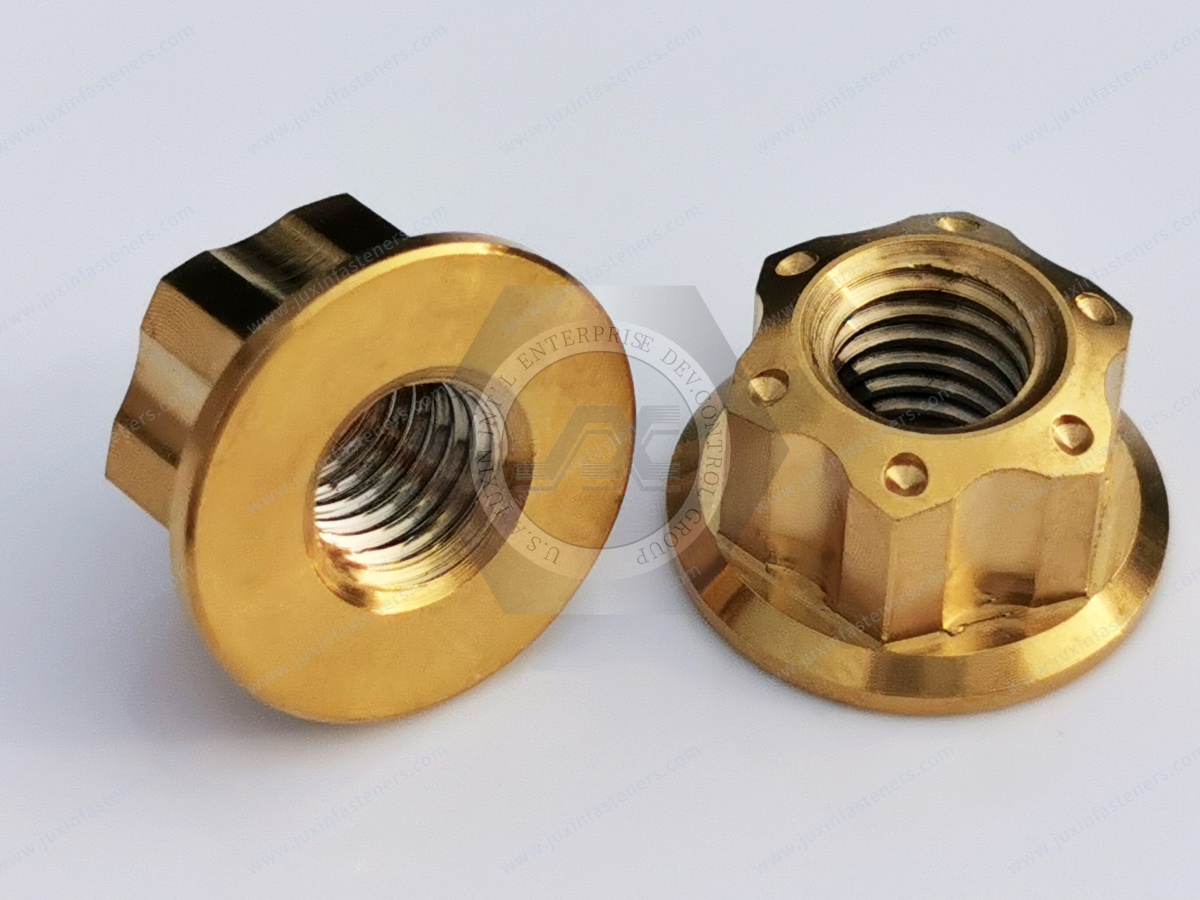
JUXIN FASTENERS manufactures rainbow finish Grade 5 (Ti-6Al-4V) titanium 12-point flange nuts for lightweight, corrosion-resistant and appearance-sensitive OEM fastening applications.
Featuring an external double-hex drive, integrated flange and distinctive iridescent multicolor appearance, these components are relevant to approved motorcycle accessories,
motorsport instrumentation, performance cycling, mountain bike equipment, robotics and precision machinery.
Listed metric sizes include M4, M6, M7, M8, M14, M18 and M20.
JUXIN supports OEM/ODM made-to-drawing manufacturing, custom metric and UNC/UNF thread evaluation, specialized drive geometry, customer-defined surface finishes and industrial batch production.
Material requirements, dimensions and functional performance are established through approved engineering specifications.
Product Specification
Rainbow Grade 5 Titanium 12-Point Flange Nuts
Custom Iridescent Titanium Double-Hex Flange Nuts for Motorcycle, Motorsport, Performance Cycling and Industrial OEM Applications
JUXIN FASTENERS manufactures standard and custom-engineered industrial fasteners for international OEM, Tier-1 and Tier-2 manufacturing programs.
Our rainbow Grade 5 titanium 12-point flange nuts combine a lightweight Ti-6Al-4V alloy body,
an external double-hex drive profile, an integrated bearing flange and a distinctive iridescent multicolor appearance.
Also known as rainbow titanium double-hex nuts, iridescent titanium flange nuts or multicolor titanium 12-point drive nuts,
these components are relevant to OEM projects where material performance, precision geometry, assembly access and appearance-matched hardware are important.
Potential applications include motorcycle accessories, motorsport instrumentation, performance bicycle components, mountain bike accessories,
robotics, precision machinery and selected corrosion-exposed industrial equipment.
JUXIN FASTENERS supports OEM/ODM manufacturing,
made-to-drawing components and industrial batch production based on customer-supplied 2D drawings, 3D CAD models and approved technical specifications.
Our manufacturing capabilities include CNC machining, cold heading, cold forming and product-specific secondary operations.
The actual manufacturing route for each titanium component is selected according to the material condition, component geometry, tolerances and production requirements.
Product Specifications and Engineering Overview
| Parameter | Product Information |
|---|---|
| Product Name | Rainbow Grade 5 Titanium 12-Point Flange Nut |
| Alternative Names | Iridescent Titanium Flange Nut; Titanium Double-Hex Flange Nut |
| Material | Grade 5 Titanium Alloy |
| Alloy Designation | Ti-6Al-4V |
| UNS Designation | R56400 |
| Featured Appearance | Rainbow / Iridescent / Multicolor |
| Drive Configuration | External 12-Point / Double-Hex |
| Bearing Design | Integrated Flange |
| Listed Metric Sizes | M4, M6, M7, M8, M14, M18, M20 |
| Custom Metric Threads | Subject to Engineering Review |
| Custom Inch Threads | UNC / UNF Subject to Feasibility Review |
| Surface Finish | Rainbow Metallic Appearance; Actual Process to Be Confirmed |
| Raw Material Reference | ASTM B348/B348M-25, Where Applicable |
| Metric Thread References | ISO 261, ISO 724 and ISO 965 Series, as Applicable |
| Inch Thread Reference | ASME B1.1, as Applicable |
| Product Design Control | Customer-Approved Engineering Drawings |
| Custom Manufacturing | OEM/ODM and Made-to-Drawing Production |
| Production Model | Industrial Batch Manufacturing |
The listed metric sizes are based on existing product information.
Exact availability of each size, thread pitch, rainbow finish and twelve-point drive configuration must be confirmed against current manufacturing records.
The original M6 motorcycle description represents one application example rather than the complete scope of the product family.
What Is a Rainbow Titanium 12-Point Flange Nut?
A titanium twelve-point flange nut is an internally threaded fastener featuring an external twelve-point drive and an integrated bearing flange.
The twelve-point drive is also commonly described as a double-hex profile.
Compared with a conventional six-point hex drive, the twelve-point configuration provides additional angular positions for engaging correctly matched tooling.
For the same nominal orientation, a twelve-point profile offers engagement positions at 30-degree intervals, while a six-point profile offers positions at 60-degree intervals.
This can be useful in assemblies where access for repositioning a socket or wrench is limited.
The integrated flange provides a bearing surface beneath the nut and may help distribute the compressive force over a suitable mating component.
Actual performance depends on flange geometry, mating material, thread engagement, assembly preload and operating conditions.
12-Point Drive vs. Conventional Hex Drive
| Engineering Factor | 12-Point / Double-Hex | Conventional Hex |
|---|---|---|
| External Drive Points | 12 | 6 |
| Nominal Engagement Interval | 30° | 60° |
| Tooling | Matching 12-Point Tool | Matching Hex Tool |
| Restricted Tool Access | May Offer Repositioning Advantages | Depends on Tool Access |
| Allowable Tightening Torque | Requires Engineering Validation | Requires Engineering Validation |
| Design Consideration | Specialized Geometry and Assembly Access | General Mechanical Assembly |
High-Torque Applications: What Engineers Need to Know
Some motorcycle and motorsport buyers search for high-torque 12-point flange nuts.
However, the twelve-point geometry alone does not establish a higher permissible tightening torque.
Allowable torque depends on the complete fastening system.
Important factors include:
Drive profile geometry.
Tool engagement dimensions.
Titanium alloy material condition.
Internal thread strength.
Mating bolt material and mechanical properties.
Thread engagement length.
Flange bearing pressure.
Lubrication and friction.
Required joint preload.
Dynamic loading and fatigue.
High-torque suitability must be established through the approved design and application-specific testing.
Grade 5 Titanium: Ti-6Al-4V Material Properties
Grade 5 titanium, commonly designated Ti-6Al-4V and UNS R56400, is a titanium alloy containing approximately 6% aluminum and 4% vanadium.
The alloy is valued for its combination of strength-to-weight potential, corrosion resistance and engineering versatility.
The actual mechanical properties depend on the applicable material specification, product form and material condition.
Material Density Comparison
| Material | Approximate Density |
|---|---|
| Grade 5 Titanium | 4.43 g/cm³ |
| Carbon Steel | 7.85 g/cm³ |
| Stainless Steel | 7.9–8.0 g/cm³ |
| 6061 Aluminum | 2.70 g/cm³ |
For equal solid metal volume, Grade 5 titanium is approximately 44% lighter than carbon steel.
Actual finished nut weight depends on the component geometry.
Titanium is denser than aluminum but offers a different combination of mechanical properties.
Why OEM Engineers Specify Titanium Fasteners
Potential engineering benefits include:
High strength-to-weight potential.
Lower density than steel.
Corrosion resistance in many environments.
Compatibility with precision machining.
Specialized drive geometry.
Custom flange dimensions.
Lightweight equipment design.
Customer-specific manufacturing possibilities.
The material must be selected according to the complete joint requirements rather than appearance or density alone.
Rainbow and Iridescent Titanium Surface Finishes
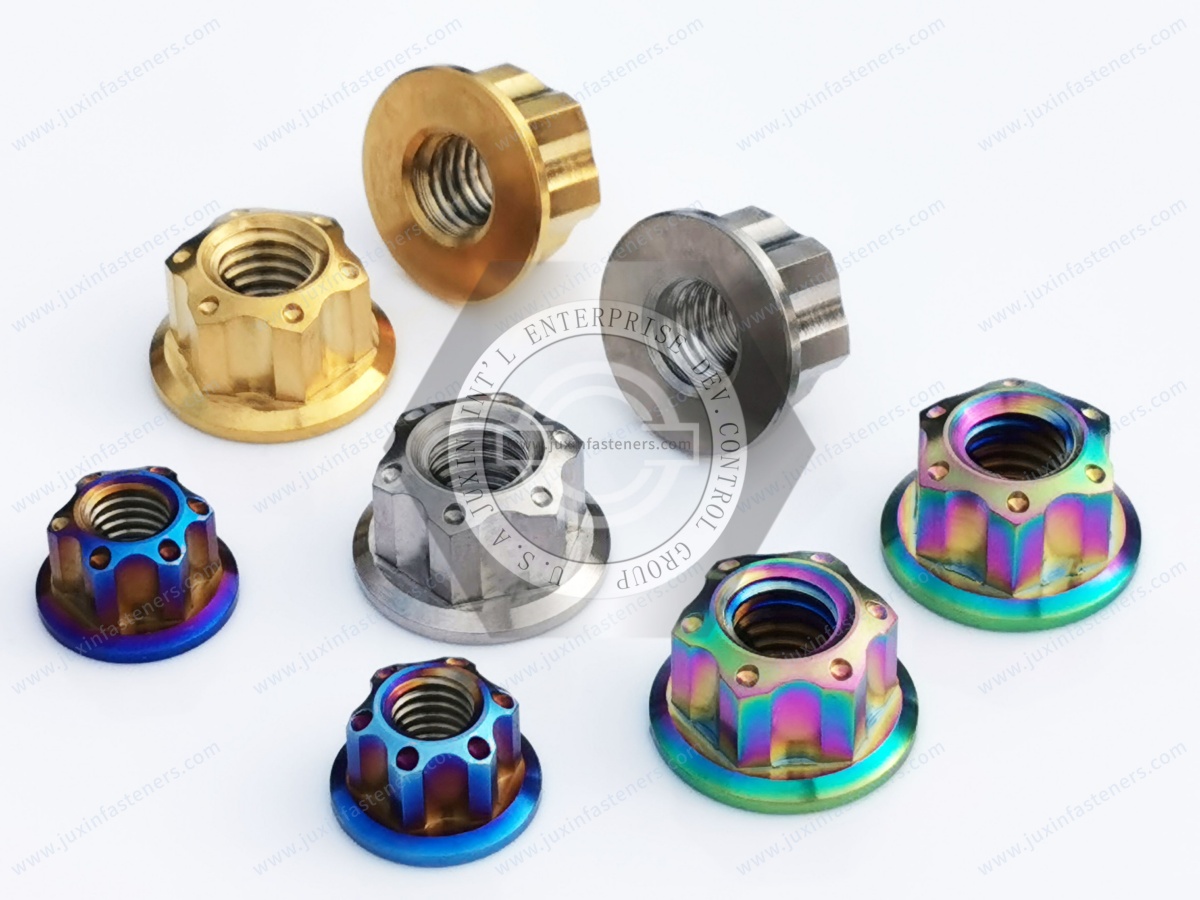
The featured product has a multicolor metallic appearance with blue, purple, gold, green and other reflective tones.
Common commercial descriptions include:
Rainbow Titanium.
Iridescent Titanium.
Multicolor Titanium.
Rainbow Finish Titanium.
Color-Changing Titanium Appearance.
These terms describe the visual appearance rather than a single standardized finishing process.
Titanium Anodizing
Titanium anodizing can produce interference colors associated with controlled oxide-layer formation.
The appearance depends on processing conditions and surface preparation.
Polished Titanium
Polishing changes the surface texture and reflectivity.
It may be used as a preparation step or as a specified final surface condition.
PVD-Coated Titanium
Physical Vapor Deposition is a separate coating process.
Its appearance and functional characteristics depend on the selected coating system.
Other Titanium Coloring Processes
Controlled oxidation and other finishing processes may also produce colored titanium surfaces.
The photograph alone does not establish which process was used.
OEM Rainbow Finish Control
For appearance-sensitive OEM manufacturing, the approved finishing specification should define:
Required finishing process.
Approved physical master sample.
Surface preparation.
Acceptable color distribution.
Gloss and reflectivity.
Cosmetic inspection criteria.
Coating or oxide requirements.
Packaging and handling protection.
Rainbow finishes can exhibit differences in color distribution and reflection.
A digital product image should not be the sole acceptance criterion for production color matching.
Metric Thread Sizes and Inch Diameter References
The listed metric sizes are M4, M6, M7, M8, M14, M18 and M20.
The following table provides standard metric coarse-thread references and nominal inch diameter conversions.
| Metric Thread | Standard Coarse Pitch | Nominal Diameter in Inches |
|---|---|---|
| M4 | 0.70 mm | 0.1575 in |
| M6 | 1.00 mm | 0.2362 in |
| M7 | 1.00 mm | 0.2756 in |
| M8 | 1.25 mm | 0.3150 in |
| M14 | 2.00 mm | 0.5512 in |
| M18 | 2.50 mm | 0.7087 in |
| M20 | 2.50 mm | 0.7874 in |
The pitches shown are standard metric coarse-thread references, not verified production specifications for every listed nut.
The final pitch, thread tolerance, drive dimensions, flange diameter and nut height must follow the approved engineering drawing.
The inch values are nominal diameter conversions only.
They are not equivalent UNC or UNF thread specifications.
Metric Fine Threads for Custom OEM Projects
Some performance equipment requires metric fine threads rather than standard coarse threads.
Examples of common metric fine-thread designations include M8 × 1.0, M10 × 1.25 and M12 × 1.25.
These are engineering examples, not confirmed standard offerings for this rainbow product.
JUXIN FASTENERS can review customer-specific metric thread requirements according to approved drawings and manufacturing feasibility.
UNC and UNF Thread References for American OEM Customers
American manufacturers may specify Unified National Coarse or Unified National Fine threads.
JUXIN FASTENERS can evaluate custom inch-series titanium flange nut designs based on customer-supplied engineering drawings.
| US Nominal Thread | UNC | UNF |
|---|---|---|
| #8 | #8-32 | #8-36 |
| #10 | #10-24 | #10-32 |
| 1/4 in | 1/4-20 | 1/4-28 |
| 5/16 in | 5/16-18 | 5/16-24 |
| 3/8 in | 3/8-16 | 3/8-24 |
| 7/16 in | 7/16-14 | 7/16-20 |
| 1/2 in | 1/2-13 | 1/2-20 |
| 9/16 in | 9/16-12 | 9/16-18 |
| 5/8 in | 5/8-11 | 5/8-18 |
| 3/4 in | 3/4-10 | 3/4-16 |
These are standard inch-series thread designations for engineering reference.
They do not imply that all sizes are stocked or currently manufactured.
Important Thread Compatibility Notice
Metric, UNC, UNF, BSW and BSF are different thread systems.
They must not be directly interchanged.
For example, M6 × 1.0 and 1/4-20 UNC are not interchangeable.
Thread compatibility must be established using the actual mating thread designation and tolerance requirements.
Motorcycle OEM and Custom Motorcycle Accessories
Motorcycle accessory manufacturers may evaluate rainbow titanium flange nuts for selected lightweight and appearance-sensitive assemblies.
Potential applications include:
Approved motorcycle accessory brackets.
Instrumentation mounts.
Non-critical fairing accessories.
Sensor and camera brackets.
Racing electronics accessories.
Lightweight equipment covers.
Custom maintenance fixtures.
Rainbow titanium hardware may coordinate with other multicolor titanium or anodized motorcycle components.
Motorcycle Engineering Requirements
Motorcycle fastening systems may experience vibration, thermal cycling, moisture and repeated maintenance.
Important considerations include:
Joint preload.
Installation torque.
Thread engagement.
Titanium thread galling.
Fatigue loading.
Mating bolt compatibility.
Corrosion exposure.
Service procedures.
These nuts must not automatically replace specified fasteners in braking, steering, wheel retention, suspension or other safety-critical motorcycle systems.
Superbike and Track Motorcycle Equipment
Track-oriented equipment may require lightweight fastening components with specialized drive geometry.
Potential applications include:
Data acquisition equipment.
Racing instrumentation.
Electronics mounting accessories.
Non-critical equipment brackets.
Specialized maintenance fixtures.
The twelve-point drive may offer tool-access advantages in suitable assemblies.
High-load or safety-critical connections require project-specific qualification.
Motocross and Off-Road Motorcycle Accessories
Off-road equipment may experience dirt, water, impact, vibration and frequent disassembly.
Rainbow titanium flange nuts may be evaluated for suitable non-critical accessories where appearance, corrosion resistance and weight are relevant.
Engineers should assess fatigue, galling, preload and maintenance requirements.
Performance Bicycles and Mountain Bike Accessories
Performance bicycle manufacturers may evaluate titanium fasteners for selected lightweight accessories.
Potential applications include:
Bicycle computer brackets.
Lighting accessories.
Sensor mounts.
Approved equipment holders.
Custom cycling equipment fixtures.
Lightweight accessory covers.
Rainbow titanium hardware may complement custom performance cycling products.
For mountain bikes, vibration, impact, moisture and repeated maintenance are important design considerations.
These fasteners must not automatically replace specified hardware in brakes, steering, suspension pivots or wheel retention.
Motorsport and Racing Cars
Motorsport manufacturers may consider titanium 12-point flange nuts for selected auxiliary assemblies where component mass, tool access and specialized geometry are relevant.
Potential applications include:
Data acquisition brackets.
Instrumentation accessories.
Racing electronics supports.
Non-critical equipment fixtures.
Custom test equipment.
Safety-critical motorsport connections require appropriate design validation, testing and formal approval.
RC Racing and Model Engineering
Compact titanium nuts may be relevant to suitable RC racing and model engineering applications.
Potential applications include:
RC equipment accessories.
Lightweight instrument mounts.
Custom model fixtures.
Non-critical electronics supports.
Custom drive geometry and thread dimensions must be reviewed for the actual assembly.
Automotive OEM and EV Auxiliary Equipment
Automotive and electric vehicle manufacturers may evaluate custom titanium fasteners for selected auxiliary components requiring specialized geometry, corrosion resistance or reduced mass.
Potential applications include approved sensor brackets, instrumentation mounts and equipment fixtures.
For EV equipment, engineers must consider electrical isolation, grounding, galvanic compatibility, temperature and fire safety.
These commercial titanium nuts are not automatically suitable for high-voltage terminals, current-carrying connections or safety-critical battery retention.
Aerospace Ground Support and Maintenance Equipment
Grade 5 titanium is used in aerospace engineering, but material grade alone does not qualify a finished fastener for aircraft installation.
Potential applications include:
Ground support equipment.
Maintenance fixtures.
Workshop tooling.
Non-flight-critical instrument accessories.
Aircraft-installed fasteners require applicable aerospace specifications, traceability, inspection and formal engineering approval.
No aerospace certification is claimed for this commercial product.
Rail Transit Equipment
Potential applications include approved auxiliary instrumentation brackets, maintenance fixtures and non-critical equipment accessories.
Rail applications may impose vibration, fatigue, fire, smoke and environmental requirements.
The complete fastening system must be qualified for its intended use.
Robotics and Industrial Automation
Robotics manufacturers may require compact custom nuts with specialized drive geometry.
Potential applications include:
Precision fixtures.
Sensor mounting brackets.
Instrumentation supports.
Robotics accessories.
Lightweight mechanical equipment.
Engineers should evaluate drive geometry, thread tolerances, tool engagement, surface finish and joint loading.
Precision Machinery and CNC Equipment
Custom titanium flange nuts may be relevant to specialized machinery requiring precise dimensions, compact tool access or corrosion-resistant components.
Potential applications include precision instrument mounts, inspection machinery accessories and custom mechanical fixtures.
CNC machining can support specialized drive profiles and customer-defined flange geometry, subject to feasibility review.
Marine and Chemical Processing Equipment
Titanium alloys offer corrosion resistance in many environments.
Potential applications include:
Marine instrumentation accessories.
Corrosion-exposed equipment fixtures.
Inspection assemblies.
Compatible chemical processing equipment accessories.
Titanium is not universally corrosion-proof.
Chemical concentration, temperature, crevice conditions and mating materials must be evaluated.
Electrical Cabinets and Power Electronics
Potential applications include specialized equipment brackets, instrumentation supports and corrosion-exposed auxiliary components.
Electrical conductivity, grounding, contact resistance and thermal behavior require separate engineering assessment.
Titanium should not be selected for electrical connections solely because of its corrosion resistance.
HVAC and Mechanical Equipment
Potential applications include specialized instrumentation brackets, corrosion-exposed equipment accessories and custom mechanical fixtures.
For general-purpose HVAC assemblies, alternative materials may be more economical.
Titanium should be selected when its properties provide a justified engineering benefit.
Medical Equipment and Laboratory Instruments
Custom titanium components may be evaluated for suitable laboratory equipment fixtures and non-patient-contact mechanical assemblies.
Medical applications require review of material specifications, cleaning compatibility, traceability and regulatory requirements.
This commercial titanium flange nut is not automatically sterile, implantable or medical-device certified.
Construction and Industrial Machinery
Potential applications include specialized machinery accessories, precision equipment fixtures and corrosion-exposed mechanical components.
Structural construction connections may require steel fasteners with established mechanical property classes.
Titanium nuts must not replace specified structural fasteners without engineering approval.
Sheet Metal Fabrication and Industrial Enclosures
The integrated flange may provide a suitable bearing surface in fabricated assemblies.
Potential applications include:
Precision sheet metal brackets.
Equipment covers.
Instrument housings.
Custom industrial enclosures.
Auxiliary machinery accessories.
Engineers should verify sheet thickness, hole diameter, flange bearing area and joint preload.
Where only one side of the sheet is accessible, blind rivet nuts or self-clinching fasteners may be more appropriate.
Titanium Thread Galling and Assembly Control
Titanium threaded components may experience galling under unfavorable contact and friction conditions.
Galling can cause thread damage, inconsistent tightening or seizure.
Potential engineering controls include:
Correct mating thread tolerances.
Suitable mating materials.
Appropriate surface finish.
Approved lubrication or anti-seize where permitted.
Clean threads.
Controlled assembly procedures.
Validated tightening torque.
Defined reuse criteria.
Lubrication changes the relationship between installation torque and joint preload.
A dry-thread torque specification must not automatically be applied to a lubricated titanium assembly.
JUXIN FASTENERS – Industrial Titanium Fastener Manufacturing
JUXIN FASTENERS is an industrial fastener manufacturer providing standard and custom-engineered fastening components for global OEM programs.
Our broader manufacturing capabilities include:
Cold heading.
Cold forming.
CNC machining.
Product-specific secondary operations.
Customer-defined surface finishing.
OEM/ODM custom manufacturing.
Made-to-drawing production.
Industrial batch manufacturing.
CNC Machining for Titanium 12-Point Geometry
CNC machining can support specialized twelve-point drive profiles, precision flange dimensions, custom nut heights and other customer-specific geometric features.
Titanium machining requires suitable process planning.
The actual manufacturing route depends on the approved drawing, material condition, tolerances and production quantity.
Cold Heading and Cold Forming
Cold heading and cold forming are part of JUXIN FASTENERS' broader manufacturing capabilities.
However, this does not mean every titanium twelve-point flange nut is cold headed.
Forming feasibility depends on alloy condition, geometry, tooling and production requirements.
Multi-Process Manufacturing
Where technically suitable, forming and CNC machining can be combined.
Other components may require different process routes.
Manufacturing decisions are based on engineering feasibility, mechanical requirements, tolerances, production quantity and cost.
OEM/ODM Custom Rainbow Titanium Flange Nuts
JUXIN FASTENERS supports custom manufacturing based on customer-supplied 2D drawings, 3D CAD models and technical specifications.
Potential customization includes:
Custom twelve-point drive profiles.
Modified flange diameters.
Non-standard nut heights.
Special bearing surfaces.
Metric coarse and fine threads.
Custom UNC and UNF threads.
Grade 5 titanium material requirements.
Customer-defined material condition.
Rainbow finish specifications.
Approved color matching.
Dimensional tolerances.
Mechanical performance requirements.
Inspection and testing criteria.
OEM packaging and identification.
Industrial batch quantities.
All custom requirements are subject to engineering and production feasibility review.
Engineering Support for OEM Teams
Design and Mechanical Engineers
Important requirements include material properties, thread strength, drive geometry, flange dimensions, preload, fatigue and corrosion.
Manufacturing Engineers
Relevant considerations include tool engagement, assembly access, titanium galling, lubrication and installation procedures.
Production Managers
Key concerns include assembly repeatability, dimensional consistency, tooling compatibility, inspection criteria and production handling.
Procurement and Supplier Development Managers
Important factors include drawing review, material specifications, manufacturing feasibility, sample evaluation, quality acceptance and repeat production planning.
Supply Chain Managers
Long-term OEM manufacturing programs require coordination of technical revisions, production quantities, packaging specifications and manufacturing schedules.
Quality Control and Engineering Verification
Depending on the approved project specification, quality planning may include:
Titanium alloy material verification.
Chemical composition documentation.
Material condition verification.
Thread dimensional inspection.
Twelve-point drive profile inspection.
Flange diameter measurement.
Nut height measurement.
Bearing surface inspection.
Rainbow finish appearance verification.
Color distribution inspection.
Tool engagement evaluation.
Mechanical testing where applicable.
Packaging and part identification inspection.
Actual inspection methods, testing requirements, acceptance criteria and documentation must be agreed for each project.
No unverified certification or test result is claimed.
Engineering Risks and Failure Prevention
| Engineering Concern | Potential Risk | Recommended Action |
|---|---|---|
| Incorrect 12-Point Tool | Drive Damage | Verify Tool Profile |
| Excessive Installation Torque | Thread or Joint Damage | Validate Torque and Preload |
| Titanium Thread Galling | Thread Seizure | Review Lubrication and Finish |
| Incorrect Mating Bolt | Thread Damage | Confirm Bolt Specification |
| Severe Vibration | Fatigue or Loosening | Validate Complete Joint |
| Inadequate Bearing Area | Surface Damage | Review Flange Geometry |
| Dissimilar Metal Contact | Galvanic Corrosion | Assess Environment |
| Rainbow Color Variation | Cosmetic Rejection | Approve Master Sample |
| Incorrect Inch Conversion | Thread Mismatch | Verify Thread System |
| Unsupported High-Torque Claim | Joint Failure | Require Application Testing |
Material and Engineering Standards
Grade 5 Titanium Alloy – Ti-6Al-4V / UNS R56400
The specified material is Grade 5 titanium alloy, commonly designated Ti-6Al-4V and UNS R56400.
Material properties and acceptance requirements must be established through the approved raw material specification and purchasing documentation.
ASTM B348/B348M-25 – Raw Material Reference
ASTM B348/B348M-25 specifies requirements for titanium and titanium alloy bars and billets, including Grade 5.
It may be used when the selected raw material form and condition fall within its scope.
This standard does not define the finished twelve-point flange nut geometry or independently certify the mechanical performance of the finished component.
ISO Metric Thread References
ISO 261 and ISO 724 provide references for metric thread selection and basic dimensions.
The ISO 965 series addresses metric thread tolerances.
The applicable thread requirements must be specified in the customer-approved engineering drawing.
ASME B1.1 – Unified Inch Screw Threads
ASME B1.1 provides requirements for Unified inch screw threads, including relevant UNC and UNF thread series.
It is a thread specification rather than a complete twelve-point flange nut product standard.
Customer-Approved Product Design
The twelve-point titanium flange nut is manufactured according to the approved product drawing and agreed technical requirements.
The drawing should define:
Twelve-point drive profile and tool engagement dimensions.
Flange diameter and bearing surface geometry.
Nut height.
Thread designation and tolerance.
Titanium alloy material specification.
Surface finish.
Dimensional tolerances.
Mechanical and functional acceptance criteria.
Inspection and documentation requirements.
Application-Specific Qualification
Aerospace, automotive, motorsport, rail and medical applications may impose requirements beyond material grade and component geometry.
Compliance must be established through applicable specifications, testing and customer approval.
Frequently Asked Questions
What is a rainbow titanium 12-point flange nut?
It is a Grade 5 titanium alloy flange nut with an external twelve-point drive, integrated flange and iridescent multicolor appearance.
What material is used?
The specified material is Grade 5 titanium alloy, Ti-6Al-4V / UNS R56400.
What does double-hex mean?
Double-hex is another name for an external twelve-point drive profile.
Does a twelve-point nut automatically support higher torque?
No. Allowable torque depends on material, geometry, thread engagement, mating components and joint design.
What metric sizes are listed?
M4, M6, M7, M8, M14, M18 and M20.
Can JUXIN manufacture custom sizes?
Yes. JUXIN FASTENERS supports OEM/ODM made-to-drawing manufacturing, subject to engineering feasibility review.
Can custom UNC or UNF threads be manufactured?
Customer-specific inch-series designs can be reviewed. The reference table does not imply existing inventory.
Are metric and inch-series threads interchangeable?
No. Metric, UNC, UNF, BSW and BSF are different thread systems.
Is rainbow titanium always PVD-coated?
No. Rainbow describes the appearance. The actual finishing process must be confirmed.
Does the rainbow finish increase mechanical strength?
The appearance alone does not establish increased mechanical strength or allowable torque.
Is Grade 5 titanium lighter than steel?
Yes. Its density is substantially lower than typical carbon steel.
Is titanium lighter than aluminum?
No. Titanium is denser than aluminum.
Can these nuts be used on motorcycles?
They may be evaluated for approved applications. Safety-critical joints require separately qualified fasteners.
Can these nuts be used on mountain bikes?
They may be considered for suitable engineered accessories. Critical bicycle connections require independent qualification.
Are these aerospace-certified fasteners?
No aerospace certification is claimed for this commercial product.
Does Grade 5 titanium prevent thread galling?
No. Galling risk must be considered during design and assembly.
Can JUXIN manufacture custom twelve-point profiles?
Customer-specific drive geometry can be reviewed against 2D/3D drawings and manufacturing feasibility.
Request a Quote – Rainbow Grade 5 Titanium 12-Point Flange Nut Manufacturer
JUXIN FASTENERS manufactures standard and custom-engineered industrial fasteners for international OEM, Tier-1 and Tier-2 manufacturing programs.
We support custom titanium flange nut projects requiring specialized twelve-point drive geometry, precision dimensions,
approved material specifications, customer-defined finishes and industrial batch production.
Our broader manufacturing capabilities include cold heading, cold forming and CNC machining with product-specific secondary operations.
We welcome technical inquiries from motorcycle accessory manufacturers, motorsport equipment companies,
performance bicycle manufacturers, automotive OEM suppliers, robotics and precision machinery manufacturers, industrial equipment producers and international procurement teams.
Recommended RFQ Information
Required metric or UNC/UNF thread.
Grade 5 titanium material specification.
Customer 2D drawing or 3D CAD model.
Twelve-point drive dimensions.
Flange diameter and nut height.
Mating bolt specification.
Required joint preload and installation conditions.
Rainbow finish requirements and approved color sample.
Mechanical performance requirements.
Inspection and acceptance criteria.
Order quantity and annual forecast.
Packaging and delivery requirements.
Our engineering and manufacturing team can review your specifications and provide quotation support for suitable custom OEM production programs.
JUXIN FASTENERS
Industrial Fastener Manufacturer | OEM/ODM Custom Fastener Manufacturing | CNC Machining & Multi-Process Manufacturing | Made-to-Drawing Production
Email: info@juxinfasteners.com
Website: https://www.juxinfasteners.com/
Product Packaging
Packaging Standard
At Juxin Fasteners, we apply standardized export packaging to ensure product protection, traceability, and compliance with international logistics requirements.
1. Standard Export Packaging
Unless otherwise specified, all products will be packed according to our factory standard export packaging, which includes:
Moisture-resistant inner protection
Poly bag or small box packing as required
Reinforced export cartons
Clear labeling with part number, specification, batch number, and quantity
Palletizing for sea or air shipment when necessary
Our standard packaging is designed to ensure safe transportation, efficient warehousing, and long-distance international shipping.
2. Customized Packaging Options
We also provide customized packaging solutions according to customer requirements, including but not limited to:
Private labeling
Customized barcodes
Specific carton dimensions
Retail packaging
Special pallet configuration
Customer-specific marking and identification
So that you know, customized packaging may involve additional costs and extended lead time depending on the complexity of the requirements.
3. Compliance & Quality Assurance
All packaging processes are controlled under our ISO 9001 quality management system to ensure consistency, traceability, and product integrity throughout the supply chain.
Product Pictures

Contact Us
Tel.:
+86 020 8621 0320
+86 020 3121 6067
E-mail:
Technical Support:
Navigation
SEND INQUIREY


