Call Us
+86 136 6007 9809
Call Us
+86 136 6007 9809

Juxin Fasteners manufactures high-torque 12-point flange nuts for automotive powertrain equipment, industrial turbines, heavy machinery, energy systems, motorsport applications and custom OEM assemblies.
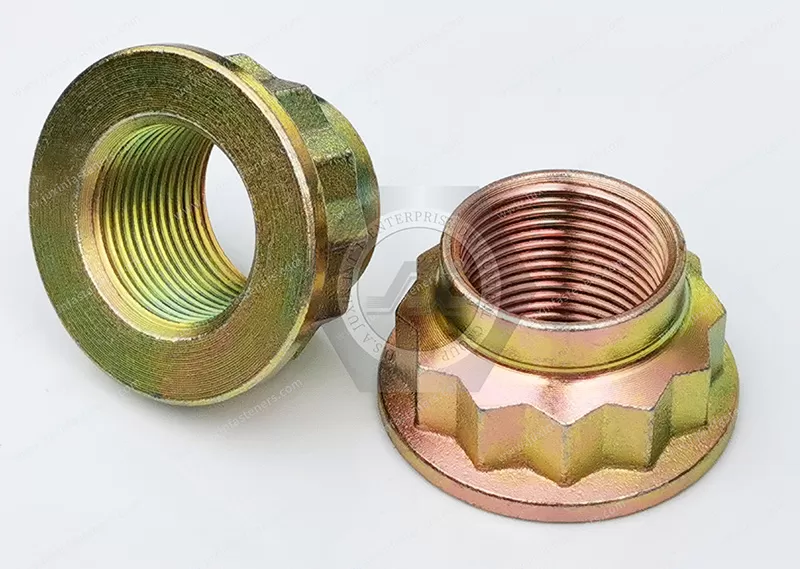
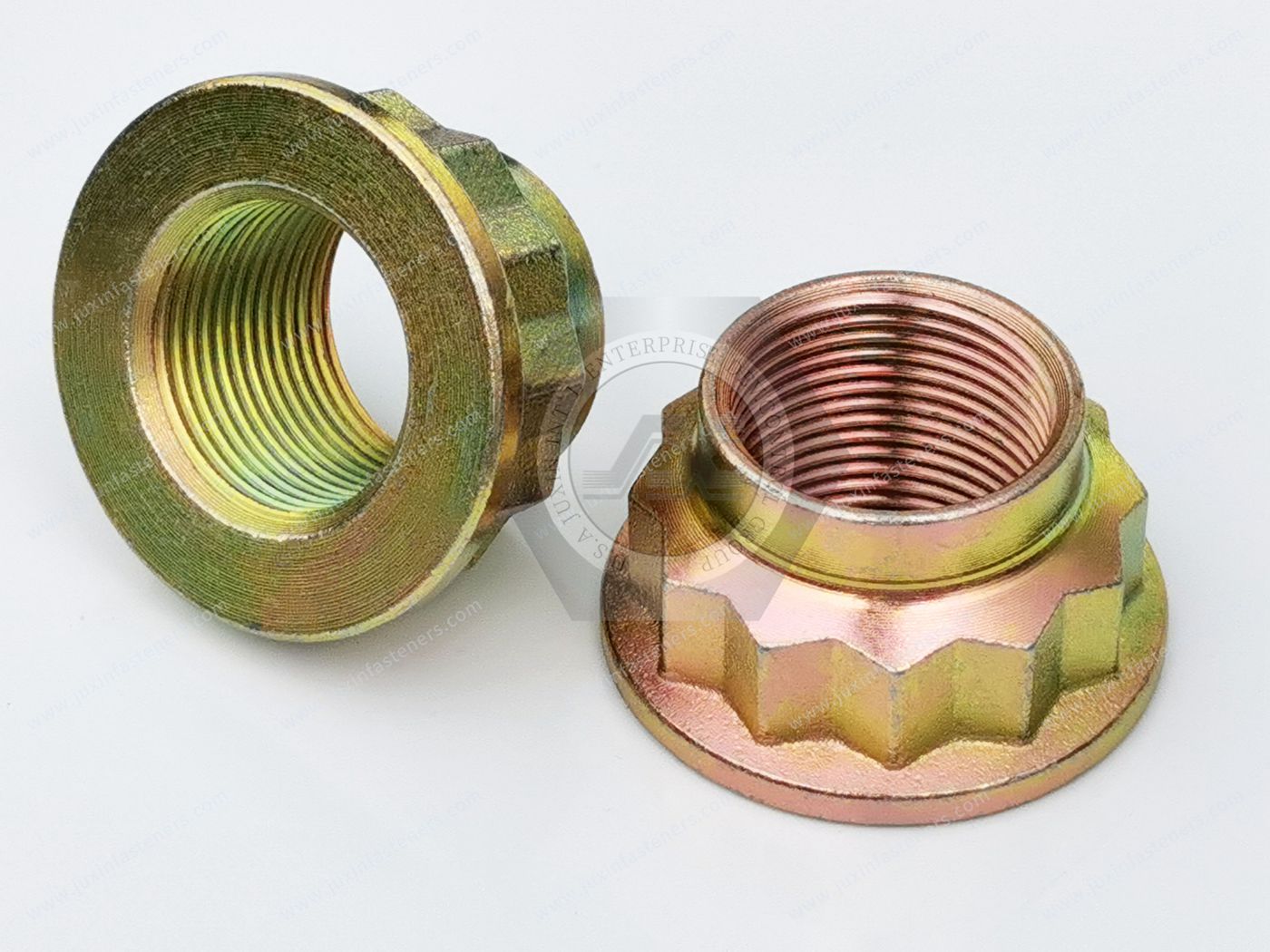
These precision fasteners feature an external twelve-point, double-hex wrenching profile and an integrated bearing flange.
The twelve-point geometry allows engagement by a matching socket at 30-degree intervals, offering installation advantages in applications with restricted wrench swing or limited access.
The integrated flange provides a defined bearing surface and may eliminate the need for a separate plain washer where permitted by the joint design.
Our commonly specified material options include 45# Carbon Steel (Grade 45 Medium-Carbon Steel), 30CrMnSi Alloy Steel, 40CrNiMoA Alloy Steel, 40Cr2MoV Alloy Steel and CH2132 customer-specified material.
Material selection is based on mechanical properties, heat treatment requirements, operating conditions and approved engineering drawings.
Metric nut property classes 8, 10 and 12 can be evaluated according to applicable standards and verified mechanical performance.
The material designation alone does not establish a nut property class.
Custom metric configurations can be evaluated across the requested M8–M52 engineering range, subject to drawing review and manufacturing feasibility.
Unified inch-thread configurations, including UNC and UNF designs, may also be evaluated for North American OEM programs. Metric and inch threads are not interchangeable.
Available surface finishing processes for project review include clear zinc, yellow zinc, black zinc, zinc-nickel alloy coatings, zinc-flake coatings and black finishes.
The selected coating must be compatible with thread tolerance, corrosion requirements, mechanical performance and operating temperature.
A twelve-point drive is not inherently self-locking. Custom all-metal prevailing-torque designs require a separately specified locking mechanism and verified locking performance.
Juxin Fasteners is an industrial fastener manufacturer with cold heading, cold forming, CNC machining and product-specific secondary manufacturing capabilities.
We support OEM/ODM drawing review, manufacturing feasibility assessment, dimensional inspection, sample evaluation and industrial batch production for international engineering, purchasing, production and supply chain teams.
Product Specification
High-Torque 12-Point Flange Nuts for OEM Assemblies
Custom High-Strength Double-Hex Flange Nuts for Automotive, Energy, Turbine and Industrial Machinery Applications
Juxin Fasteners manufactures high-torque 12-point flange nuts for OEM manufacturers requiring precision external wrenching geometry,
high-strength threaded connections and controlled assembly in restricted installation spaces.
Also known as 12-point-drive flange nuts, double-hex flange nuts or 12-point collar nuts, these fasteners combine an external twelve-point drive profile with an integrated bearing flange.
The twelve-point geometry allows engagement by a correctly sized twelve-point socket at 30-degree rotational intervals.
This can be advantageous in assemblies where wrench swing, tool positioning or surrounding component clearance is limited.
The integrated flange provides a defined bearing surface and may reduce the need for a separate plain washer where permitted by the joint design.
Juxin Fasteners manufactures standard and custom-engineered fastening components using cold heading, cold forming, CNC machining and product-specific secondary operations.
We support OEM/ODM made-to-drawing manufacturing, material selection, dimensional inspection and industrial batch production.
Product Technical Specifications
| Parameter | Specification |
|---|---|
| Product Name | High-Torque 12-Point Flange Nut |
| Alternative Name | 12-Point-Drive Flange Nut |
| Alternative Name | Double-Hex Flange Nut |
| Drive Geometry | External Twelve-Point |
| Bearing Feature | Integrated Flange |
| Thread System | ISO Metric / Unified Inch |
| Metric Engineering Range | M8–M52 |
| Nut Property Class References | 8, 10, 12, Subject to Verification |
| Material 1 | 45# Carbon Steel |
| Material 2 | 30CrMnSi Alloy Steel |
| Material 3 | 40CrNiMoA Alloy Steel |
| Material 4 | 40Cr2MoV Alloy Steel |
| Material 5 | CH2132 Customer-Specified Material |
| Surface Finishes | Zinc, Zinc-Nickel, Zinc-Flake, Black Finishes |
| Locking Function | Standard or Custom Locking Design |
| Manufacturing | Cold Forming, CNC Machining and Secondary Operations |
| Production | OEM/ODM Made-to-Drawing Manufacturing |
| Main Applications | Automotive, Energy, Turbine Equipment, Heavy Machinery |
Material grades, mechanical properties, thread tolerances, surface finishes and dimensional requirements must follow the approved customer drawing and applicable engineering specifications.
What Is a High-Torque 12-Point Flange Nut?
A high-torque 12-point flange nut is an internally threaded fastener with an external twelve-point wrenching profile and an integrated flange.
The external geometry is commonly described as a double-hex profile.
Compared with a conventional six-point hex nut, the twelve-point form provides more frequent socket engagement positions.
The integrated flange provides the bearing interface between the nut and the mating component.
Typical features include:
External twelve-point wrenching geometry.
Internal metric or Unified inch thread.
Integrated bearing flange.
Customer-specified nut height.
Controlled twelve-point drive dimensions.
Defined flange diameter and thickness.
Application-specific material grade.
Heat treatment where required.
Customer-specified mechanical properties.
Optional engineered locking mechanism.
The twelve-point profile is a wrenching feature, not a locking mechanism.
Advantages of the Twelve-Point Drive
Thirty-Degree Socket Engagement
The twelve-point geometry permits engagement by a matching socket at 30-degree intervals.
This can improve tool positioning where the installation space is restricted.
Compact Wrenching Access
Certain twelve-point designs may provide a compact wrenching envelope compared with conventional hexagonal designs.
The actual clearance advantage depends on the drive geometry, socket dimensions and assembly layout.
Controlled Torque Transmission
A properly matched twelve-point socket transfers installation torque through the external wrenching surfaces.
Allowable installation torque is determined by the complete fastener design, material strength, thread geometry and joint specification.
The presence of twelve points does not independently guarantee higher permissible torque.
Integrated Flange
The flange provides a defined bearing interface and may reduce the need for a separate plain washer where the joint design permits.
High-Torque Fastening and Joint Preload
High-torque applications require careful control of the relationship between applied tightening torque and achieved bolt preload.
Important factors include:
Thread pitch.
Thread tolerance.
Nut and bolt material.
Surface coating.
Thread friction.
Bearing friction.
Lubrication.
Joint stiffness.
Installation method.
Reuse conditions.
The tightening procedure must be established for the actual bolted joint.
A high-strength nut does not automatically permit a higher tightening torque without corresponding bolt and joint verification.
Integrated Flange Design
The flange provides the bearing interface between the nut and the mating component.
Important flange parameters include:
Flange outside diameter.
Flange thickness.
Bearing face geometry.
Surface flatness.
Surface roughness.
Perpendicularity to the thread axis.
Edge radii.
Contact area.
The flange may distribute bearing load over a larger area than a smaller bearing face, depending on the design.
However, the flange does not automatically create a self-locking connection.
Self-Locking vs. Non-Self-Locking Twelve-Point Nuts
A twelve-point drive is not inherently self-locking.
A self-locking nut requires a defined mechanical feature that provides resistance to rotation independently of ordinary joint preload.
Potential custom locking designs may include:
Controlled all-metal thread deformation.
Special prevailing-torque thread geometry.
Other customer-approved mechanical locking features.
The locking mechanism must be specified in the engineering drawing.
A conventional twelve-point flange nut without a locking feature should not be described as self-locking.
Custom All-Metal Prevailing-Torque Options
For suitable OEM projects, custom all-metal prevailing-torque configurations may be evaluated.
Engineering considerations include:
Locking feature geometry.
Initial prevailing torque.
Reuse performance.
Temperature exposure.
Thread wear.
Mating bolt compatibility.
Proof-load performance.
Installation torque.
Inspection criteria.
Applicable locking performance requirements must be defined by the customer and verified through testing.
Material Options for High-Torque 12-Point Flange Nuts
Juxin Fasteners commonly works with the following customer-specified materials for this product family:
45# Carbon Steel (Grade 45 Medium-Carbon Steel).
30CrMnSi Alloy Steel.
40CrNiMoA Alloy Steel.
40Cr2MoV Alloy Steel.
CH2132 Customer-Specified Material.
Each material must be selected according to the actual mechanical requirements, heat treatment, operating temperature, manufacturing process and approved engineering drawing.
The material designation alone does not establish the finished nut property class.
45# Carbon Steel — Grade 45 Medium-Carbon Steel
45# carbon steel is a medium-carbon steel material used in various industrial mechanical components.
It may be evaluated for twelve-point flange nuts requiring a suitable combination of strength, machinability and heat treatment response.
Engineering considerations include:
Chemical composition.
Material condition.
Heat treatment.
Hardness.
Proof-load requirements.
Thread strength.
Surface integrity.
Manufacturing feasibility.
45# carbon steel should not automatically be described as equivalent to SAE 1045 or EN C45 without verification of the applicable material specifications.
30CrMnSi Alloy Steel
30CrMnSi is a chromium-manganese-silicon alloy steel designation.
It may be evaluated for custom high-strength fastening components where its material characteristics match the required mechanical performance.
Engineering considerations include:
Material composition.
Heat treatment response.
Mechanical strength.
Hardness.
Thread performance.
Surface finishing compatibility.
Application-specific loading.
Direct equivalence to American or European steel grades must not be assumed.
40CrNiMoA Alloy Steel
40CrNiMoA is a chromium-nickel-molybdenum alloy steel designation.
It may be considered for custom engineered fasteners requiring defined mechanical properties and heat treatment.
Important factors include:
Material certification.
Heat treatment specification.
Hardness requirements.
Proof-load performance.
Thread strength.
Dimensional stability.
Surface integrity.
The final material condition must comply with the approved customer specification.
40Cr2MoV Alloy Steel
40Cr2MoV is an alloy steel designation containing chromium, molybdenum and vanadium.
It may be evaluated for specialized fastening applications where its mechanical and heat treatment characteristics match the engineering requirements.
Important considerations include:
Chemical composition.
Heat treatment condition.
Mechanical strength.
Temperature exposure.
Thread performance.
Fatigue requirements.
Surface finishing compatibility.
High-temperature suitability must be established through actual material data and application testing.
CH2132 Customer-Specified Material
CH2132 is retained as the customer-provided material designation.
Before production, the applicable material specification should be confirmed, including:
Material standard.
Chemical composition.
Material condition.
Heat treatment requirements.
Mechanical properties.
Hardness.
Inspection requirements.
Material certification.
No ASTM, SAE or EN equivalent should be assigned without technical verification.
Material Selection Comparison
| Material | Engineering Considerations | Selection Basis |
|---|---|---|
| 45# Carbon Steel | Medium-Carbon Steel, Heat Treatment and Strength | Customer Mechanical Requirements |
| 30CrMnSi | Cr-Mn-Si Alloy Steel | Approved Material and Heat Treatment |
| 40CrNiMoA | Cr-Ni-Mo Alloy Steel | Defined High-Strength Requirements |
| 40Cr2MoV | Cr-Mo-V Alloy Steel | Specialized Mechanical Requirements |
| CH2132 | Customer-Specified Material | Verified Material Specification |
Material selection must be based on actual requirements rather than material name alone.
Nut Property Classes 8, 10 and 12
Metric steel nut property classes may be specified according to the applicable mechanical property standard.
For custom twelve-point flange nuts, relevant requirements may include:
Proof load.
Hardness.
Thread strength.
Material composition.
Heat treatment.
Dimensional requirements.
Product marking.
Inspection and acceptance criteria.
Property classes 8, 10 and 12 are engineering options subject to the governing specification and actual product qualification.
Not every material or nut geometry is automatically suitable for every property class.
Heat Treatment Requirements
Where heat treatment is required, the manufacturing plan should define:
Material condition.
Heat treatment method.
Hardness range.
Mechanical acceptance criteria.
Distortion control.
Surface integrity.
Inspection requirements.
High-strength alloy steel components may require additional process controls.
Metric Thread Sizes: M8–M52
Custom metric twelve-point flange nut designs can be evaluated across the requested M8–M52 engineering range.
| Metric Thread | Standard Coarse Pitch Reference | Nominal Diameter in Inches |
|---|---|---|
| M8 | 1.25 mm | 0.3150 in |
| M10 | 1.50 mm | 0.3937 in |
| M12 | 1.75 mm | 0.4724 in |
| M14 | 2.00 mm | 0.5512 in |
| M16 | 2.00 mm | 0.6299 in |
| M18 | 2.50 mm | 0.7087 in |
| M20 | 2.50 mm | 0.7874 in |
| M22 | 2.50 mm | 0.8661 in |
| M24 | 3.00 mm | 0.9449 in |
| M27 | 3.00 mm | 1.0630 in |
| M30 | 3.50 mm | 1.1811 in |
| M33 | 3.50 mm | 1.2992 in |
| M36 | 4.00 mm | 1.4173 in |
| M39 | 4.00 mm | 1.5354 in |
| M42 | 4.50 mm | 1.6535 in |
| M45 | 4.50 mm | 1.7717 in |
| M48 | 5.00 mm | 1.8898 in |
| M52 | 5.00 mm | 2.0472 in |
The listed pitches are standard coarse-thread references.
Actual thread pitch, tolerance, drive dimensions, flange geometry and manufacturing feasibility must be confirmed against the approved engineering drawing.
Larger sizes may require different manufacturing routes and tooling compared with smaller sizes.
American Inch-Thread Alternatives
Custom Unified inch-thread configurations may be evaluated for North American OEM applications.
| Inch Thread | Series | Threads per Inch | Nominal Diameter |
|---|---|---|---|
| 1/4-20 | UNC | 20 | 0.2500 in |
| 1/4-28 | UNF | 28 | 0.2500 in |
| 5/16-18 | UNC | 18 | 0.3125 in |
| 5/16-24 | UNF | 24 | 0.3125 in |
| 3/8-16 | UNC | 16 | 0.3750 in |
| 3/8-24 | UNF | 24 | 0.3750 in |
| 1/2-13 | UNC | 13 | 0.5000 in |
| 1/2-20 | UNF | 20 | 0.5000 in |
| 5/8-11 | UNC | 11 | 0.6250 in |
| 5/8-18 | UNF | 18 | 0.6250 in |
| 3/4-10 | UNC | 10 | 0.7500 in |
| 3/4-16 | UNF | 16 | 0.7500 in |
| 7/8-9 | UNC | 9 | 0.8750 in |
| 1-8 | UNC | 8 | 1.0000 in |
These are engineering references for potential custom designs rather than confirmed standard stock configurations.
Metric and Inch Threads Are Not Interchangeable
ISO metric, UNC, UNF, BSW and BSF are different thread systems.
Examples:
M8 × 1.25 is not interchangeable with 5/16-18 UNC.
M10 × 1.5 is not interchangeable with 3/8-16 UNC.
M12 × 1.75 is not interchangeable with 1/2-13 UNC.
M16 × 2.0 is not interchangeable with 5/8-11 UNC.
M20 × 2.5 is not interchangeable with 3/4-10 UNC.
Nominal diameter conversions are for reference only.
The correct mating bolt, thread pitch and thread tolerance must be specified.
Surface Finish Options
Potential surface finishes include:
Clear zinc plating.
Yellow zinc finish.
Black zinc finish.
Zinc-nickel alloy coating.
Zinc-flake coating systems.
Black oxide.
Customer-specific protective finishes.
Finish selection should consider:
Corrosion resistance.
Thread fit.
Friction characteristics.
Temperature exposure.
Hydrogen embrittlement susceptibility.
Assembly torque requirements.
Coating thickness.
Customer environmental requirements.
Zinc-flake coatings should not automatically be treated as equivalent to electroplated zinc-nickel coatings.
Thread Tolerance and Coating Allowance
Thread tolerance must be selected according to the applicable thread system and coating process.
Metric thread tolerance classes such as 5H or 5G may be specified for particular engineering designs.
However, the correct tolerance depends on the approved drawing, plating allowance and final functional thread requirements.
The same tolerance class should not be assumed for all coating systems.
High-Strength Fastener Surface Integrity
Depending on material, heat treatment and customer requirements, inspection may include:
Visual inspection.
Thread gauge inspection.
Dimensional inspection.
Hardness testing.
Proof-load testing.
Surface defect inspection.
Magnetic particle inspection where appropriate.
Fluorescent penetrant inspection where appropriate.
Inspection methods, sampling plans and acceptance criteria must be specified by the customer or applicable standard.
A blanket claim of 100% nondestructive testing should not be made unless it is actually required and performed for the specific production order.
Application 1: Automotive Powertrain Equipment
Twelve-point flange nuts may be evaluated for selected automotive powertrain equipment requiring controlled torque transmission and compact wrenching access.
Potential applications include:
Engine accessory mounting.
Powertrain equipment brackets.
Mechanical support assemblies.
Custom drivetrain equipment.
Precision bolted interfaces.
Actual installation suitability depends on joint design and OEM qualification.
Application 2: Motorsport and Racing Equipment
Motorsport equipment may require compact, high-strength fastening solutions.
Twelve-point flange nuts can be considered for custom mechanical assemblies where tool access and defined tightening procedures are important.
Potential applications include:
Racing engine accessories.
Motorsport equipment brackets.
Custom drivetrain components.
Performance equipment mounting.
Each design must be evaluated for service loads, vibration, temperature and fatigue requirements.
Application 3: Automotive Chassis Equipment
Suitable high-strength flange nuts may be evaluated for selected automotive mechanical mounting applications.
Chassis and suspension systems may involve safety-critical joints.
Such applications require approved fastener designs, validated mechanical performance and relevant automotive engineering qualification.
Application 4: Gas Turbine Auxiliary Equipment
Gas turbine equipment may contain mechanical assemblies requiring precision high-strength fastening.
Twelve-point flange nuts may be considered for suitable auxiliary equipment and mounting interfaces.
High-temperature turbine applications require material-specific temperature capability, creep assessment, thermal cycling and engineering qualification.
Ordinary carbon steel property classes must not be assumed suitable for hot-section turbine components.
Application 5: Industrial Power Generation
Potential applications include:
Generator equipment supports.
Mechanical mounting structures.
Power generation machinery.
Industrial drive equipment.
Auxiliary equipment assemblies.
Joint preload, vibration and maintenance requirements must be evaluated.
Application 6: Aerospace Ground Support Equipment
Twelve-point fasteners may be used in specialized aerospace-related equipment.
Juxin Fasteners can evaluate custom components for suitable ground support equipment and non-flight-critical machinery.
Aircraft flight hardware and propulsion applications require separately approved materials, manufacturing controls, traceability and qualification.
No aerospace certification is implied by this product page.
Application 7: Heavy Industrial Machinery
High-strength twelve-point flange nuts may be evaluated for:
Industrial machinery assemblies.
Gearbox equipment.
Mechanical drive systems.
Mining equipment accessories.
High-load equipment brackets.
Precision mechanical connections.
The fastener must be selected according to actual joint loading.
Application 8: Industrial Robotics
Robotics manufacturers may require compact external wrenching geometries for:
Robot equipment mounting.
Mechanical drive assemblies.
Industrial actuator supports.
Custom precision machinery.
The required nut height, socket access and assembly torque should be considered during design.
Application 9: Energy Storage and Electrical Equipment
Selected flange nut designs may be evaluated for mechanical mounting structures in energy equipment.
Potential applications include:
Power equipment support structures.
Steel mechanical mounting brackets.
Industrial electrical enclosures.
Auxiliary equipment assemblies.
Electrical conductivity and grounding requirements must be evaluated separately.
Application 10: Wind Power Equipment
Wind power equipment manufacturers may require high-strength fastening components in selected machinery and auxiliary equipment assemblies.
Fatigue, preload retention, corrosion and maintenance requirements must be evaluated.
Critical wind turbine structural joints require application-specific engineering qualification.
Application 11: Marine Machinery
Marine equipment manufacturers may evaluate suitable twelve-point flange nuts for mechanical assemblies and protected equipment mounting.
Corrosion protection, material compatibility and service conditions must be defined.
Application 12: Petrochemical Equipment
Specialized mechanical equipment used in petrochemical facilities may require high-strength fastening components.
Pressure-containing joints and elevated-temperature applications require separate material selection, applicable design codes and engineering qualification.
Application 13: Custom OEM Machinery
Juxin Fasteners supports custom twelve-point flange nuts for:
Special industrial equipment.
Precision mechanical assemblies.
Machinery development programs.
Equipment modernization.
Custom mechanical fastening systems.
High-strength bolted joint applications.
12-Point vs. 6-Point Flange Nuts
| Feature | 12-Point Flange Nut | 6-Point Flange Nut |
|---|---|---|
| External Drive | Twelve-Point | Hexagonal |
| Socket Engagement Interval | 30° | 60° |
| Main Benefit | Frequent Engagement Positions | Conventional Hex Drive |
| Tooling | Matching 12-Point Socket | Matching Hex Socket |
| Bearing Surface | Integrated Flange | Integrated Flange |
| High-Strength Versions | Design-Specific | Design-Specific |
| Self-Locking | Only If Specifically Designed | Only If Specifically Designed |
Neither drive type is universally stronger.
Selection depends on assembly geometry, material, installation process and required joint performance.
12-Point Flange Nuts vs. All-Metal Lock Nuts
A twelve-point flange nut is defined by its external drive geometry and flange.
An all-metal lock nut is defined by its mechanical locking function.
A custom product can combine both features, but locking performance must be separately engineered and tested.
Manufacturing Capabilities
Juxin Fasteners is an industrial fastener manufacturer supporting custom high-strength fastening components.
Our manufacturing capabilities include:
Cold heading.
Cold forming.
CNC machining.
Precision metal component manufacturing.
Product-specific secondary operations.
Internal threading.
Heat treatment according to project requirements.
Surface finishing.
Dimensional inspection.
Industrial batch manufacturing.
The actual production route depends on the approved engineering drawing, material, geometry, mechanical requirements and production volume.
Larger M48 and M52 designs may require different tooling or machining approaches compared with smaller sizes.
OEM Manufacturing Workflow
A typical custom project may include:
Customer drawing review.
Thread specification confirmation.
Material grade assessment.
Property class or mechanical requirement review.
Twelve-point drive geometry evaluation.
Flange dimension review.
Manufacturing feasibility assessment.
Selected forming or machining process.
Internal thread production.
Heat treatment where specified.
Dimensional and mechanical inspection.
Surface finishing.
Final quality inspection.
OEM packaging and batch delivery.
The actual sequence follows the approved manufacturing plan.
Quality Control
A project-specific inspection plan may include:
Material verification.
Thread gauge inspection.
Twelve-point drive dimensions.
Nut height measurement.
Flange outside diameter.
Flange thickness.
Bearing face inspection.
Concentricity and perpendicularity.
Hardness testing.
Proof-load testing.
Locking performance testing where applicable.
Surface defect inspection.
Coating thickness inspection.
Visual inspection.
Packaging and quantity verification.
Testing frequency and acceptance criteria must be defined by the governing standard or customer agreement.
Engineering Standards and Technical References
ISO 261 / ISO 724
ISO metric screw-thread designations and basic dimensions.
ISO 965 Series
ISO metric screw-thread tolerances.
ISO 898-2
Mechanical properties of specified carbon steel and alloy steel nuts within the applicable scope.
ASME B1.1
Unified inch screw-thread requirements.
ASME B18.2.2
General inch-series nut dimensions for product types within its scope.
Custom twelve-point flange nut geometry requires separate drawing control unless a specifically applicable standard is identified.
ASTM A194
Material and mechanical requirements for certain carbon and alloy steel nuts used in specified high-pressure or high-temperature services, where applicable.
ISO 4042
Electroplated coating systems for fasteners.
SAE Aerospace Fastener Standards
Selected aerospace standards cover specific twelve-point nut configurations, including certain self-locking designs.
These are not blanket specifications for all industrial twelve-point flange nuts.
Customer Engineering Drawings
The controlling specification for drive geometry, flange dimensions, material, threads, mechanical properties, locking features, inspection and acceptance requirements.
References to standards do not independently establish certification or product conformity.
Information for Design and Mechanical Engineers
Engineers should specify:
Thread size and tolerance.
Required nut property class.
Material grade.
Heat treatment requirements.
Twelve-point drive dimensions.
Flange geometry.
Nut height.
Required joint preload.
Locking function, if applicable.
Operating temperature.
Corrosion requirements.
Installation clearance.
Mechanical performance requirements.
Information for Manufacturing Engineers
Manufacturing engineers should evaluate:
Socket compatibility.
Installation clearance.
Torque application.
Tool access.
Thread condition.
Surface coating influence.
Heat treatment consistency.
Assembly repeatability.
Inspection requirements.
Information for Production Managers
Production managers should consider:
Assembly efficiency.
Tool compatibility.
Production repeatability.
Batch consistency.
Inspection requirements.
Production scheduling.
Rework and scrap prevention.
Total manufacturing cost.
Information for Procurement and Supply Chain Managers
Procurement teams should establish:
Approved engineering drawing.
Material specification.
Required nut property class.
Thread designation and tolerance.
Heat treatment requirements.
Surface finish.
Mechanical testing requirements.
Locking performance requirements, if applicable.
Initial order quantity.
Annual purchasing forecast.
Packaging requirements.
Drawing revision control.
Delivery scheduling requirements.
Frequently Asked Questions
What is a high-torque 12-point flange nut?
It is an internally threaded fastener with a twelve-point external wrenching profile and an integrated bearing flange, designed for applications requiring controlled torque transmission.
What is the American name for this product?
Common terms include 12-Point-Drive Flange Nuts, High-Torque 12-Point Flange Nuts and Double-Hex Flange Nuts.
Why use twelve points instead of six?
The twelve-point drive allows socket engagement at 30-degree intervals, which can be useful in restricted installation spaces.
Are all twelve-point flange nuts self-locking?
No. A separate locking mechanism is required.
Can a twelve-point flange nut be manufactured with an all-metal locking feature?
Yes. Custom locking configurations can be evaluated when the mechanism and performance requirements are specified.
What materials does Juxin Fasteners commonly use for this product family?
45# Carbon Steel, 30CrMnSi, 40CrNiMoA, 40Cr2MoV and CH2132 customer-specified material.
Are these materials interchangeable with ASTM, SAE or EN grades?
Not automatically. Material equivalence must be verified through chemical composition, mechanical properties and applicable specifications.
Can property classes 8, 10 and 12 be supplied?
These classes can be evaluated according to the applicable standard, material, product geometry and qualification requirements.
What metric sizes can be reviewed?
Custom engineering designs can be evaluated across the requested M8–M52 range, subject to manufacturing feasibility.
Are inch-thread versions possible?
Yes. Custom UNC and UNF configurations can be evaluated according to approved drawings.
Are metric and inch threads interchangeable?
No. ISO metric, UNC, UNF, BSW and BSF are separate thread systems.
Are these nuts suitable for gas turbines?
They may be suitable for selected turbine equipment assemblies, but high-temperature and critical applications require separate material and joint qualification.
Can these nuts be used in aerospace applications?
Aerospace-related projects require the applicable engineering specifications, approved materials and qualification requirements. No flight-hardware approval is implied.
Does Juxin Fasteners support custom OEM manufacturing?
Yes. Juxin Fasteners supports drawing review, manufacturing feasibility assessment, made-to-drawing production, dimensional inspection and industrial batch manufacturing.
Request a Quote — High-Torque 12-Point Flange Nuts
Juxin Fasteners manufactures industrial fasteners and custom precision metal components for automotive OEMs, industrial equipment manufacturers,
mechanical engineers, manufacturing engineers, production managers, supplier development teams and procurement managers.
We support custom twelve-point flange nuts for automotive, industrial machinery, power generation, energy equipment and specialized OEM fastening applications.
Recommended RFQ Information
2D engineering drawing or 3D CAD model.
Metric or Unified inch-thread designation.
Thread pitch and tolerance.
Required nut property class.
Material grade: 45# Carbon Steel, 30CrMnSi, 40CrNiMoA, 40Cr2MoV or CH2132.
Heat treatment specification.
Twelve-point drive dimensions.
Nut height.
Flange outside diameter.
Flange thickness.
Bearing face requirements.
Locking mechanism, if required.
Prevailing-torque acceptance criteria, if applicable.
Proof-load requirements.
Surface finish and coating specification.
Corrosion and temperature requirements.
Dimensional inspection requirements.
Mechanical testing requirements.
Initial order quantity.
Annual purchasing forecast.
Packaging and delivery requirements.
Please send your engineering drawings and purchasing specifications for technical review and manufacturing quotation.
Juxin Fasteners
Industrial Fastener Manufacturer | High-Torque 12-Point Flange Nuts | Custom Alloy Steel Nuts | OEM/ODM Precision Fastener Manufacturing
Website: https://www.juxinfasteners.com/
Email: info@juxinfasteners.com
Product Packaging
Packaging Standard
At Juxin Fasteners, we apply standardized export packaging to ensure product protection, traceability, and compliance with international logistics requirements.
1. Standard Export Packaging
Unless otherwise specified, all products will be packed according to our factory standard export packaging, which includes:
Moisture-resistant inner protection
Poly bag or small box packing as required
Reinforced export cartons
Clear labeling with part number, specification, batch number, and quantity
Palletizing for sea or air shipment when necessary
Our standard packaging is designed to ensure safe transportation, efficient warehousing, and long-distance international shipping.
2. Customized Packaging Options
We also provide customized packaging solutions according to customer requirements, including but not limited to:
Private labeling
Customized barcodes
Specific carton dimensions
Retail packaging
Special pallet configuration
Customer-specific marking and identification
So that you know, customized packaging may involve additional costs and extended lead time depending on the complexity of the requirements.
3. Compliance & Quality Assurance
All packaging processes are controlled under our ISO 9001 quality management system to ensure consistency, traceability, and product integrity throughout the supply chain.
Product Pictures
Contact Us
Tel.:
+86 020 8621 0320
+86 020 3121 6067
E-mail:
Technical Support:
Navigation
SEND INQUIREY