Call Us
+86 136 6007 9809
Call Us
+86 136 6007 9809

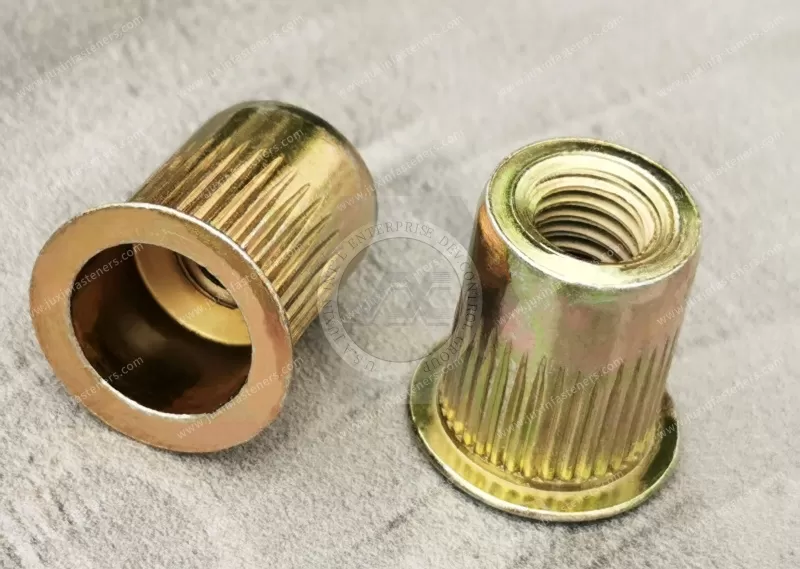
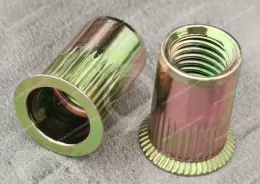
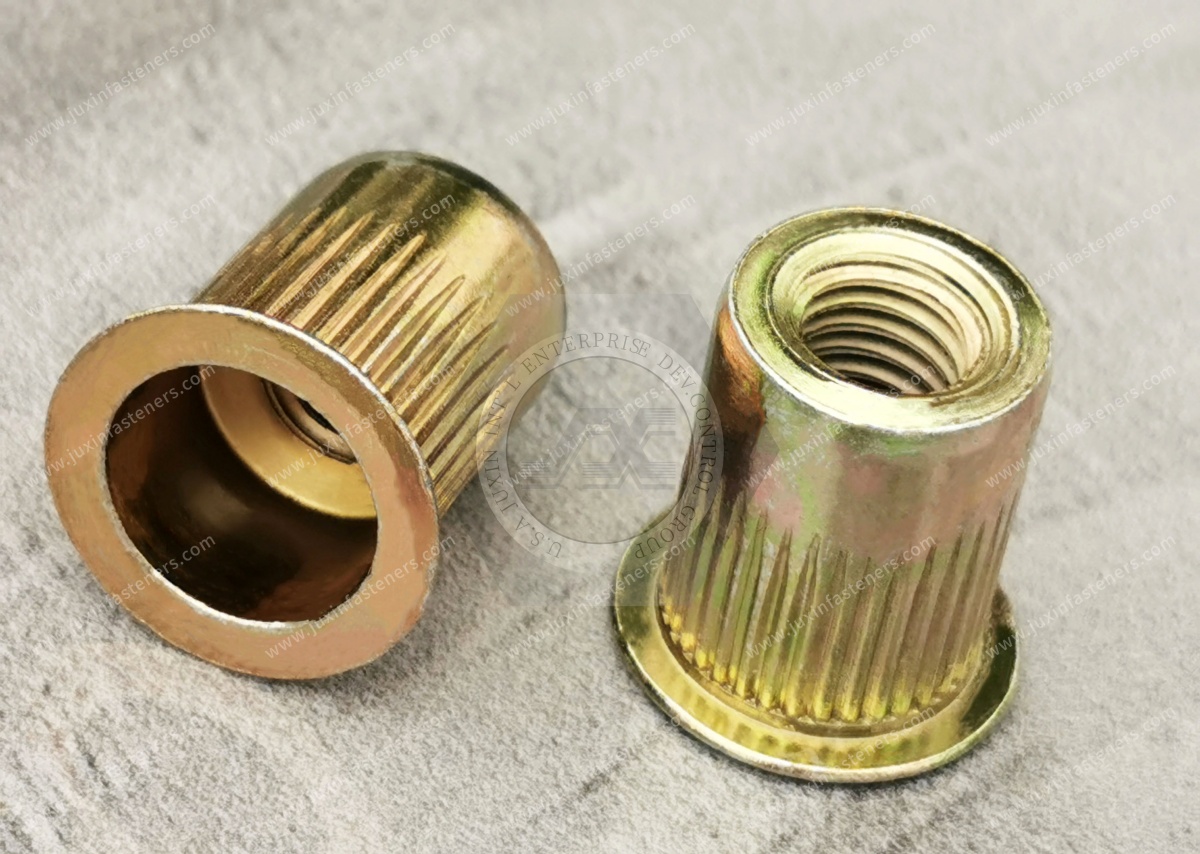
JUXIN FASTENERS manufactures flat head, open-end knurled round body steel blind rivet nuts for creating reusable internal threads in thin sheet metal, hollow sections, and OEM assemblies requiring one-sided installation.
The external knurling or ribs help resist insert rotation in compatible mounting holes. The flat flange provides a bearing surface, while the open-end design allows screw extension where sufficient backside clearance is available.
Product Features
Metric threads: M4, M5, M6, M8, M10, M12
UNC threads: #6-32, #8-32, #10-24, 1/4"-20, 5/16"-18, 3/8"-16, 1/2"-13
UNF threads: #10-32
Material: Steel
Finish: Color zinc plating
Grip range: 0.5–12.7 mm (approx. 0.020–0.500 in), depending on size
Head: Flat head / Flanged head
Body: Knurled / Ribbed round body
End: Open end
Installation: One-sided blind installation
Applications include electrical enclosures, machinery housings, fabricated sheet-metal components, industrial equipment, and OEM assemblies requiring reusable threaded connections.
Product Specification
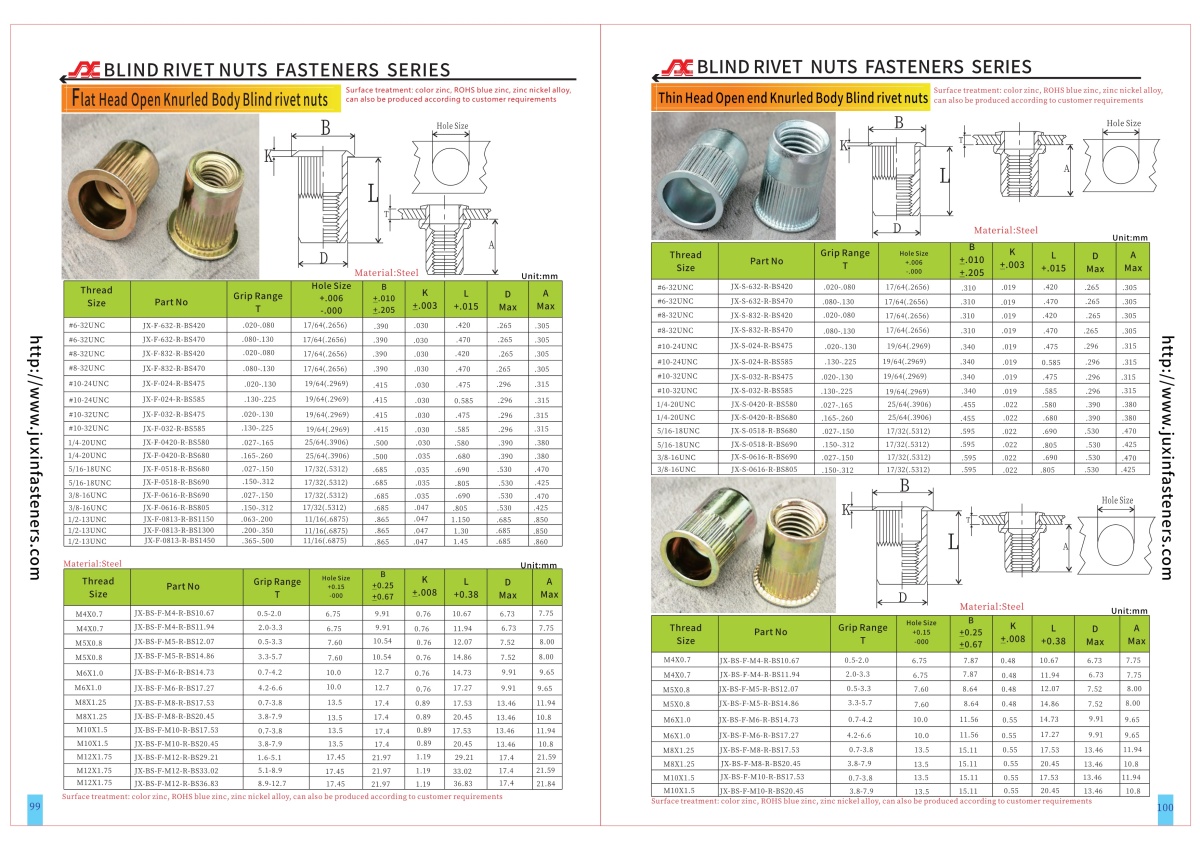
Technical Specifications — Flat Head Open-End Knurled Round Body Blind Rivet Nuts
1. Product Identification
Product Name: Flat Head Open-End Knurled Round Body Blind Rivet Nuts
Alternative Search Terminology: Ribbed Body Rivet Nuts; Knurled Rivet Nuts; Open-End Rivet Nuts; Round Body Blind Rivet Nuts; Steel Threaded Inserts for Sheet Metal.
Product Category: Steel Blind Rivet Nuts
Body Configuration: Round body with external knurling or ribs.
Head Configuration: Flat head / flanged head.
End Configuration: Open end.
Installation Method: Blind installation from one accessible side using suitable rivet nut setting equipment.
Primary Function: To establish a mechanically retained internal thread in a compatible panel, sheet-metal assembly or other specified parent material.
2. Available Thread Sizes
Metric Threads
M4
M5
M6
M8
M10
M12
Unified Inch Threads
#6-32 UNC
#8-32 UNC
#10-24 UNC
#10-32 UNF
1/4-20 UNC
5/16-18 UNC
3/8-16 UNC
1/2-13 UNC
Thread-System Note: #10-32 is a Unified Fine thread (UNF), whereas #10-24 is a Unified Coarse thread (UNC). The mating fastener must match the specified thread series and class.
The product-family introduction identifies M4–M12 and the inch-thread sizes listed above.
An M3 option appears in separate general technical information but is not included in the confirmed product-family list supplied for this page.
M3 availability should therefore be checked before adding it to the published size range.
3. Material and Surface Treatment
| Parameter | Specification |
|---|---|
| Standard Material | Steel |
| Standard Surface Finish | Color Zinc Plating |
| Body Style | Knurled / Ribbed Round Body |
| Head Style | Flat Head |
| End Style | Open End |
| Stated Product-Family Grip Range | 0.5–12.7 mm |
| Installation Access | One-Sided |
| Thread Options | Metric and Unified Inch |
| Custom Manufacturing | Subject to drawing and feasibility review |
Other materials, head styles, finishes and body configurations may be reviewed as separate product variants or custom requirements.
They should not be assumed to be standard specifications for this particular steel flat-head model.
The specified color zinc finish must be confirmed against the actual coating process and customer requirements.
No fixed salt-spray duration or corrosion classification is implied without supporting test evidence.
4. Grip Range and Parent-Material Thickness
Stated product-family grip range: 0.5–12.7 mm.
Grip range refers to the combined material thickness that a particular rivet nut is designed to clamp or retain during installation.
The overall family range must not be interpreted as meaning that every thread size or body length is suitable for every thickness from 0.5 mm to 12.7 mm.
Correct selection requires matching:
Thread size.
Body length.
Deformable section geometry.
Actual material stack thickness.
Parent-material strength.
Required blind-side clearance.
Installation tool and setting parameters.
General technical information mentions installation in materials as thin as 0.25 mm (0.010 in).
This is not established as a validated minimum for the specific product family on this page.
Applications below the stated 0.5 mm family minimum require separate engineering evaluation and product confirmation.
For multi-sheet assemblies, the total clamped material thickness should be considered when selecting the grip range.
5. Hole Preparation and Installation Geometry
The mounting hole is a critical part of the rivet nut joint.
Required dimensional information for each size:
Recommended installation-hole diameter.
Hole-diameter tolerance.
Body outside diameter.
Flange outside diameter.
Flange thickness.
Overall body length.
Grip range.
Minimum blind-side clearance.
Thread engagement depth.
These dimensions must be obtained from the applicable product drawing or dimensional table.
Do not assume that one installation-hole diameter applies to all thread sizes or that a nominal metric hole dimension is automatically suitable for an inch-thread rivet nut.
A hole that is too large may reduce rotational resistance and retention. A hole that is too small may interfere with insertion, damage the coating or distort the parent material.
Hole burrs, panel flatness, coating buildup and material hardness can also influence installation quality.
6. Knurled Body and Torque-to-Turn Resistance
The external knurled or ribbed body is intended to improve mechanical engagement with suitable parent materials.
Torque-to-turn describes the torque required to initiate rotation of an installed insert relative to the surrounding panel under a defined test arrangement.
The actual result depends on:
Knurl profile and body dimensions.
Hole geometry and tolerance.
Panel thickness.
Parent-material hardness.
Setting force or stroke.
Installation consistency.
Test fixture and measurement procedure.
General source material refers to an improvement of up to 50% compared with a plain-body insert.
This percentage is not presented as a guaranteed JUXIN performance value because the corresponding tested part numbers, parent materials and test conditions have not been supplied.
Where anti-rotation performance is a critical design requirement, specify a measurable torque-to-turn acceptance criterion and evaluate samples in the intended parent material.
7. Pull-Out Resistance and Joint Loading
Pull-out resistance is the axial force required to extract the installed insert from the parent material under defined test conditions.
It should not be confused with the tensile strength of the mating bolt or the strength of the internal thread.
Pull-out performance is influenced by the blind-side deformation, flange geometry, material thickness, parent-material properties and installation process.
For load-bearing joints, the engineer should evaluate:
Axial tensile loading.
Shear and transverse loading.
Bolt preload and tightening torque.
Parent-material deformation.
Thread stripping.
Insert rotation.
Fatigue and vibration.
Repeated service or maintenance cycles.
No universal pull-out load, shear strength or installation torque is claimed for this entire product family.
Application-specific requirements should be evaluated against the relevant drawing, test data and assembly conditions.
8. Head Style and Load Distribution
This product uses a flat flanged head.
The flange provides a bearing surface on the accessible side of the panel and contributes to positioning and load distribution.
Head diameter and thickness affect:
Contact pressure on the panel.
Installed head projection.
Clearance with mating parts.
Local deformation around the mounting hole.
The available bearing area.
Other rivet nut families may include low-profile heads, countersunk heads and alternative flange configurations.
These should be selected as separate geometries rather than treated as interchangeable dimensions.
If a near-flush installation is required, review a dedicated low-profile or countersunk design and the corresponding panel preparation.
9. Open-End Configuration and Bolt Engagement
An open-end rivet nut permits a mating screw or bolt to extend through the threaded body, subject to the surrounding assembly geometry.
This can offer flexibility where different bolt engagement lengths are required.
However, an open-end rivet nut does not provide a closed cavity or a sealing barrier through the threaded bore.
For applications requiring water, dust or contaminant protection, consider a suitable closed-end or sealing configuration and validate the complete joint, including the flange-to-panel interface.
Thread engagement should be established based on the fastener material, mating bolt, loading and available space.
Do not assume that unlimited bolt penetration is acceptable simply because the insert is open-ended.
10. Installation Methods
Depending on the selected size and production requirements, compatible blind rivet nut installation equipment may include:
Manual hand-operated setting tools.
Pneumatic or hydro-pneumatic setting equipment.
Suitable production-line or automated installation systems.
Equipment compatibility must be verified for the actual thread size, insert geometry and material.
A typical installation sequence is:
Prepare the specified mounting hole.
Check the hole dimensions, burr condition and panel thickness.
Fit the appropriate mandrel or installation tooling.
Insert the rivet nut with the flange seated against the panel.
Apply the specified setting stroke or force to deform the blind-side section.
Remove or release the setting mandrel.
Inspect the installed flange, deformation and thread condition.
Verify the assembly against the required installation and retention criteria.
Insufficient setting can cause poor retention or rotation. Excessive setting may damage the insert, threads or parent material.
11. Installation in Coated or Painted Panels
Blind rivet nuts may be considered for pre-coated or painted sheet-metal assemblies where the process has been validated.
To reduce the risk of coating damage:
Control hole quality and burr formation.
Consider the coating thickness when establishing hole dimensions.
Use suitable installation tooling.
Avoid unnecessary flange movement or excessive setting force.
Inspect the surrounding coating after installation.
Installation without coating damage cannot be guaranteed for every paint or plating system.
If the joint is required to provide electrical continuity, grounding or bonding, verify the electrical resistance of the complete installed assembly.
Knurling alone does not guarantee electrical contact through insulating coatings.
12. Applicable International Engineering References
The following references may be relevant to drawing definition, thread selection, surface treatment and application validation.
They are engineering references, not claims of product certification.
| Reference | Engineering Relevance |
|---|---|
| ISO 261 | ISO general-purpose metric thread series |
| ISO 965 | Metric thread tolerance system |
| ASME B1.1 | Unified inch screw thread requirements |
| ISO 4042 | Electroplated coating systems for fasteners, where applicable |
| ASTM B117 | Salt-spray test practice when specified by the customer |
| Customer-Approved Drawing | Product-specific dimensions, tolerances and acceptance requirements |
A standard should only be listed as a contractual product requirement when the relevant specification, revision, inspection criteria and compliance evidence have been established.
13. Engineering Applications
Automotive and Transportation: Sheet-metal brackets, equipment covers and suitable serviceable assemblies.
Electrical and Control Equipment: Cabinet hardware, mounting brackets, enclosure components and support structures.
Industrial Machinery: Machine guards, fabricated housings, access panels and equipment frames.
HVAC and Appliances: Sheet-metal assemblies requiring a retained female thread.
Electronics and Equipment Enclosures: Threaded attachment points for metal housings and support brackets.
General Metal Fabrication: One-sided threaded fastening in suitable panels and fabricated sections.
Each application must be evaluated for its actual mechanical loads, installation geometry, environmental conditions and service requirements.
14. OEM Custom Manufacturing and Technical Review
JUXIN FASTENERS supports standard fastener production and drawing-specific OEM component manufacturing.
Our broader manufacturing capabilities include cold heading, cold forming, secondary CNC machining and turning,
metal stamping, plastic injection molding and combined manufacturing routes where appropriate.
For custom rivet nut projects, JUXIN can review requested thread sizes, body and flange dimensions, grip ranges, material choices, surface finishes and application-specific requirements.
The production method for a particular custom part will depend on its geometry, material, tolerances, tooling and volume.
Information Required for Quotation
Product drawing or dimensional specification.
Metric or Unified thread designation.
Material and finish.
Installation-hole diameter and tolerance.
Panel material and grip thickness.
Required installation method.
Torque-to-turn, pull-out or other performance targets, if applicable.
Sample and production quantities.
Annual demand and delivery expectations.
Inspection, documentation and packaging requirements.
Why Choose a Knurled Round Body Rivet Nut?
1. Reliable Internal Threads in Thin-Walled Components
Thin sheet metal may not provide enough material thickness for a sufficiently engaged tapped thread.
A blind rivet nut creates a dedicated threaded attachment point without requiring a separate loose nut behind the panel.
This makes the component useful for removable covers, brackets, housings, equipment frames and other assemblies where service access is important.
2. One-Sided Installation
Blind rivet nuts can be installed when the rear side of the assembly is inaccessible.
The insert is placed through a prepared hole and set using a compatible installation tool.
The deformable body section forms a retaining bulge on the blind side of the material, securing the insert within its specified grip range.
This is especially valuable for enclosed sections, fabricated box structures, equipment housings and completed assemblies where rear-side access is restricted.
3. Knurled Body for Improved Rotational Resistance
The external knurling or ribs are designed to interact with the parent material during installation.
In suitable applications, this geometry helps resist insert rotation when a mating bolt is tightened or removed.
However, rotational resistance is a system-level property. The installer must consider:
Hole diameter and dimensional tolerance.
Parent-material strength and hardness.
Sheet thickness and grip range.
Knurl or rib geometry.
Installation stroke or setting force.
Bolt tightening torque and service loading.
For demanding applications, torque-to-turn and pull-out testing should be performed on representative production assemblies.
4. Flat Flange Head for Load Distribution
The flat head provides a bearing surface on the accessible side of the panel.
Compared with a reduced-head design, a larger flange can distribute local contact pressure over a greater area, depending on the actual head dimensions.
The flange also helps position the insert during installation.
Designers should account for head projection above the panel surface when mating components require a flush fit.
5. Metric and Inch Thread Options
JUXIN offers this product family in both metric and Unified inch-thread configurations.
Metric sizes are suitable for equipment designed around ISO metric fastening systems.
Unified thread options serve machinery and assemblies using common American inch-thread conventions.
The thread designation must match the mating bolt. Metric and Unified thread systems are not interchangeable.
6. Steel Construction with Zinc-Plated Finish
The steel body provides a practical combination of formability, mechanical strength and cost efficiency for many industrial fastening applications.
Color zinc plating offers a protective surface finish for suitable service environments.
Corrosion performance depends on the plating system, coating thickness, passivation, installation damage and exposure conditions.
For applications involving salt spray, outdoor exposure, dissimilar metals or specific corrosion requirements,
the required coating performance should be established during engineering review and RFQ.
Engineering Applications and Industry Solutions
Automotive Components and Vehicle Equipment
Knurled round body rivet nuts can be used for suitable brackets, sheet-metal attachments, covers, interior structures and serviceable equipment mounts.
Engineering teams should evaluate vibration, installation repeatability, joint loading, material compatibility and the possibility of insert rotation during repeated bolt servicing.
Electrical Enclosures and Control Cabinets
A blind rivet nut provides a threaded attachment point for brackets, mounting plates, cable-management hardware and removable enclosure components.
For painted or coated panels, hole preparation and installation must be controlled to avoid unacceptable coating damage.
Where electrical bonding or grounding is required, continuity must be verified through the complete joint design rather than assumed from the knurled body alone.
Industrial Machinery and Equipment Frames
Suitable applications include machinery guards, access panels, support brackets, fabricated frames and equipment covers.
A permanently retained female thread can simplify assembly and maintenance, particularly when the back of a fabricated section cannot be reached.
HVAC, Appliances and Light Fabrication
These rivet nuts are suitable for evaluation in thin-sheet assemblies where production teams require repeatable fastening and service access.
The design must account for panel thickness, material strength, installation-tool access and the loads transmitted through the threaded connection.
Electronics, Cabinets and Equipment Housings
Knurled body rivet nuts can provide attachment points for metal enclosures, support brackets and equipment housings.
Engineers should consider available installation clearance, the risk of local panel deformation and the effects of repeated assembly and disassembly.
Engineering Selection: Knurled Round Body vs. Alternative Rivet Nuts
Knurled or Ribbed Round Body: A useful option when a round mounting hole is preferred and additional rotational resistance is desirable.
Smooth Round Body: May be suitable where installation simplicity and lower hole-forming complexity are more important than enhanced mechanical engagement with the panel.
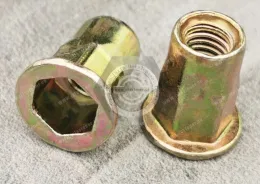
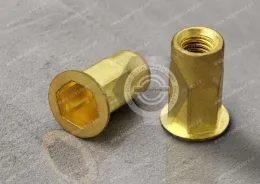
Full-Hex Body: Can offer strong geometric resistance to rotation in a correctly prepared hexagonal hole, but requires compatible hole geometry.
Half-Hex Body: Combines a hexagonal anti-rotation section with a round body section and requires corresponding installation and hole-design consideration.
Closed-End Rivet Nut: Provides a closed threaded cavity where protection against direct passage through the insert is needed. A closed end alone does not establish a sealed panel joint.
Low-Profile Head: Consider where head projection must be minimized. It is a separate head-style option and should not be assumed equivalent to the flat-head product shown here.
The best choice depends on the actual joint design, installation access, loading and production method.
Manufacturing Flexibility for OEM Custom Rivet Nuts
JUXIN FASTENERS is an industrial fastener and custom component manufacturer with production workshops and more than 20 years of industry experience.
Our manufacturing capabilities include cold heading, cold forming,
secondary turning and CNC machining, metal stamping, plastic injection molding and multi-process production, as applicable to different product families.
For drawing-specific metal fasteners, manufacturing routes may combine cold forming with secondary machining or other required operations.
The actual production route is selected according to part geometry, material, tolerances, tooling and production volume.
For custom rivet nut requirements, our team can review:
Metric or Unified thread specifications.
Body diameter, body length and knurl geometry.
Flange diameter and head height.
Grip range and installation-hole requirements.
Material and surface-finish requirements.
Installation equipment compatibility.
Packaging, identification and batch requirements.
Customer drawings and target order quantities.
Our manufacturing flexibility is intended to support customers' engineering and purchasing requirements—not to require customers to adapt their designs to a single manufacturing process.
OEM Procurement and RFQ Support
For an efficient technical review and quotation, please provide:
A 2D drawing or 3D model, if available.
Thread size and required thread standard.
Panel material and thickness.
Installation-hole dimensions and tolerances.
Required grip range and head dimensions.
Expected tightening torque, pull-out load or rotational-resistance requirements, where applicable.
Surface finish and corrosion-resistance expectations.
Estimated order quantities, annual usage and packaging requirements.
For standard product inquiries, please identify the requested size and quantity.
For custom parts, JUXIN can review the drawing and manufacturing requirements before quotation.
Contact JUXIN FASTENERS
Email: info@juxinfasteners.com
Website: www.juxinfasteners.com
JUXIN FASTENERS — Flexible Manufacturing for Standard and Custom Industrial Fasteners.
Product Packaging
Product Packaging — Knurled Round Body Blind Rivet Nuts
Standard Packaging
JUXIN FASTENERS packages steel flat head open-end knurled round body blind rivet nuts for industrial distribution, OEM production and international shipment.
The standard packaging arrangement consists of:
Inner Packaging: Plastic bags.
Outer Packaging: Corrugated cartons.
Shipment Packaging: Palletized cartons where required.
Packaging quantities and configurations are determined according to the rivet nut size, weight, order quantity and customer requirements.
Standard Carton Dimensions
| Packaging Type | Dimensions |
|---|---|
| Carton Option 1 | 29 × 19 × 19.5 cm |
| Carton Option 2 | 23.5 × 17.5 × 8 cm |
| Pallet Dimensions | 215 × 100 × 90 cm |
The listed dimensions are standard packaging references supplied for this product family. Final carton selection, carton weight, packing quantity and pallet configuration are subject to order-specific confirmation.
OEM and Customer-Specific Packaging
For OEM manufacturers, assembly plants, procurement departments and industrial distributors, JUXIN FASTENERS can review customized packaging requirements, including:
Quantity per inner bag.
Quantity per carton.
Product segregation by size or part number.
Customer part-number identification.
Carton and shipment labels.
Batch or lot identification.
Packaging suitable for production-line handling.
Customer-specified packing instructions.
Palletization and shipment preparation.
Any specific labeling, traceability or packaging standard should be communicated during the quotation or order-confirmation process.
Product Protection and Handling
Packaging should be selected to help protect the threaded inserts from unnecessary handling damage, contamination and surface-finish deterioration during storage and transportation.
For zinc-plated steel rivet nuts, appropriate dry storage and protection against prolonged moisture exposure are recommended.
Customers with automated feeding, assembly-line dispensing or special logistics requirements should provide their packaging specifications for review.
International OEM Orders
JUXIN FASTENERS supports standard and drawing-specific industrial fastener orders for international customers.
For packaging quotations, please provide the product size, order quantity, preferred packing quantity, labeling requirements and destination.
Contact JUXIN FASTENERS
Email: info@juxinfasteners.com
Website: www.juxinfasteners.com
Flexible Manufacturing. Customer-Focused Packaging. Reliable OEM Cooperation.
Product Pictures
Tags
Contact Us
Tel.:
+86 020 8621 0320
+86 020 3121 6067
E-mail:
Technical Support:
Navigation
SEND INQUIREY