Call Us
+86 136 6007 9809
Call Us
+86 136 6007 9809

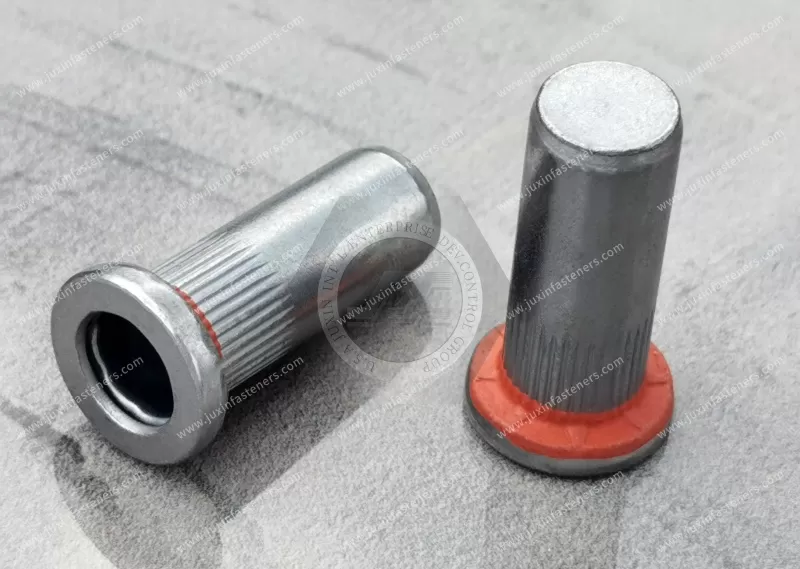
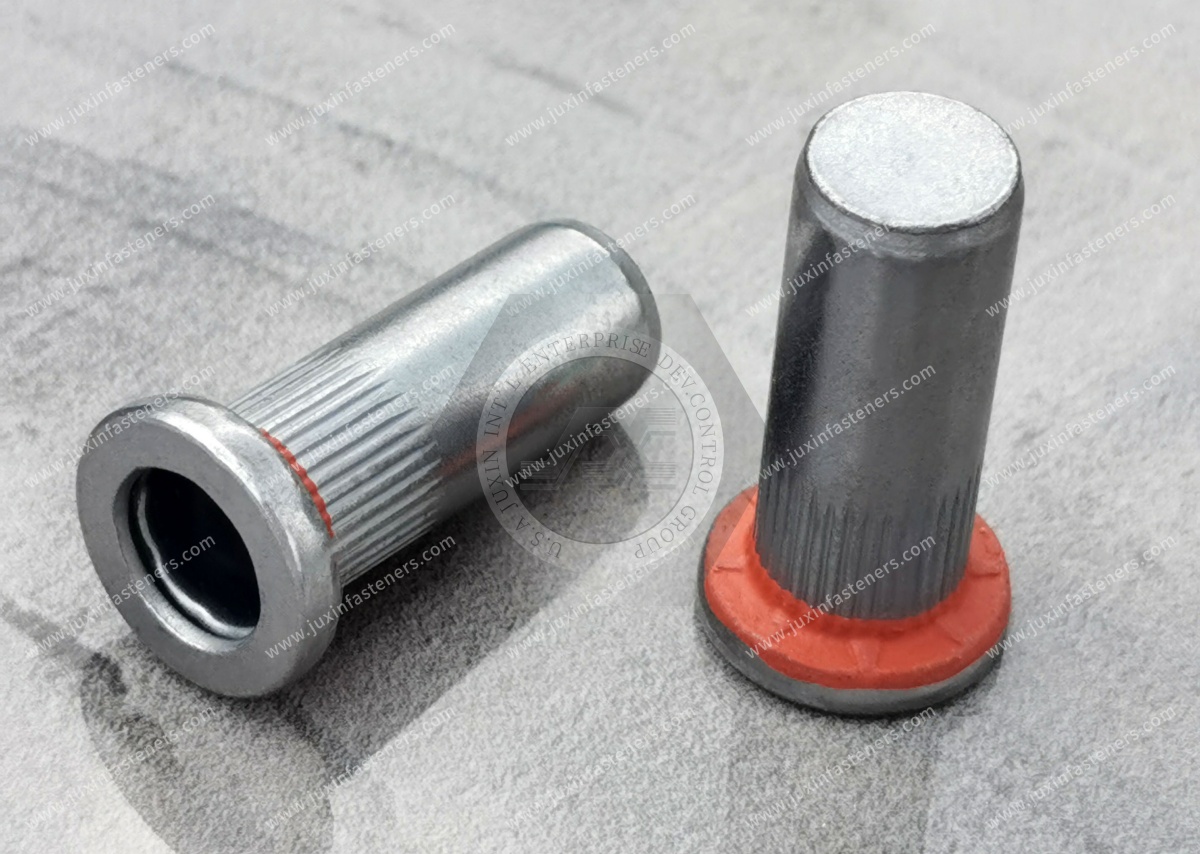
JUXIN FASTENERS supplies Steel Sealing Twist-Resistant Rivet Nuts featuring a high flat-head flange, closed-end barrel, knurled round body, and under-flange sealing element.
Designed for one-sided installation in thin sheet-metal assemblies, the knurled body helps resist rotation, while the closed end and flange seal support application-specific contamination control.
Thread Size: M6
Material: Steel
Grip Range: 0.5–2.5 mm
Surface Treatment: Color Zinc or RoHS Blue Zinc
Head Type: High Flat Head
Body Type: Knurled Round Body
End Type: Closed End
Seal: Under-Flange Sealing Element
Product Specification
Product Specifications
Product Name: Steel Sealing Twist-Resistant Rivet Nuts
Alternative Product Names: Closed-End Sealing Rivet Nuts; Sealed Knurled Blind Rivet Nuts; High Flat Head Closed-End Knurled Body Rivet Nuts; Gasketed Blind Threaded Inserts
Confirmed Thread Size: M6
Material: Steel
Grip Range: 0.5–2.5 mm (0.020–0.098 in, approximate)
Head Type: High Flat Head
Body Type: Knurled / Ribbed Round Body
End Configuration: Closed End
Sealing Feature: Under-Flange Sealing Element
Surface Treatment: Color Zinc or RoHS Blue Zinc
Installation: One-Sided Blind Installation
Mounting Hole: Round Hole, dimensions subject to the approved drawing
Seal Material: To be confirmed against the approved specification
Thread Pitch: To be confirmed against the approved drawing
Mechanical and Sealing Performance: Subject to application-specific validation
Product Overview
JUXIN FASTENERS supplies steel sealing twist-resistant rivet nuts for automotive OEMs, electric vehicle component manufacturers, and industrial equipment producers requiring threaded attachment points with rotational resistance and contamination-control features.
Unlike a conventional open-end blind rivet nut, this configuration combines a closed-end threaded barrel with an under-flange sealing element.
The knurled round body provides mechanical engagement with a compatible mounting hole, helping resist insert rotation during repeated screw installation and removal.
The high flat-head flange provides front-side bearing support and accommodates the sealing element at the panel interface.
These features make the product relevant to applications where engineers must evaluate threaded retention, serviceability, moisture exposure, and assembly reliability together.
Sealing Twist-Resistant Rivet Nuts: What Does the Name Mean?
In North American industrial purchasing terminology, "sealing twist-resistant rivet nuts" describes a functional combination of sealing and rotational retention.
The sealing function is associated with the under-flange sealing element and the closed-end barrel.
The twist-resistant function is associated with the knurled or ribbed body engaging the prepared mounting hole.
These functions must be evaluated separately.
A product may provide good rotational retention without meeting a specified leakage requirement. Similarly, a sealing element does not establish adequate resistance to installation or removal torque.
For automotive OEM qualification, both characteristics should be included in the engineering review.
Automotive and Electric Vehicle Applications
Electric vehicles contain numerous sheet-metal housings, electrical equipment compartments, brackets, and serviceable components where contamination control and threaded attachment may be required.
Potential applications for sealing twist-resistant rivet nuts include:
EV battery system accessory mounting panels
Battery management system (BMS) equipment housings
Electric vehicle power electronics enclosures
Automotive electrical control unit housings
Vehicle thermal management equipment
Automotive body sheet-metal assemblies
Exterior equipment mounting panels
Automotive underbody equipment housings
Commercial electric vehicle component enclosures
Removable inspection and service covers
Automotive equipment brackets exposed to road spray
Selected charging equipment enclosures
These are potential engineering applications, not claims of qualification for every listed system.
For high-voltage battery assemblies, sealing rivet nuts must be evaluated against the actual enclosure requirements, including water ingress, electrical isolation, thermal cycling, mechanical loading, and applicable safety criteria.
A sealed rivet nut should not be assumed to establish an enclosure-level IP rating without complete assembly testing.
Closed-End Design and Contamination Control
The closed-end barrel distinguishes this product from open-end blind rivet nuts.
An open-end rivet nut has a through-opening at the rear of the threaded barrel.
A closed-end configuration terminates the barrel, potentially reducing a leakage path through the insert itself.
This can be beneficial in applications where engineers want to limit the movement of water, dust, or other contaminants through a threaded attachment point.
However, the closed end does not automatically seal the interface between the flange and the parent panel.
That interface requires separate consideration.
The closed-end geometry also limits available screw insertion depth. Engineers must verify mating screw length and internal clearance to avoid bottoming out the screw.
Under-Flange Seal: How the Sealing System Works
The under-flange sealing element is positioned between the rivet nut flange and the parent-panel surface.
During installation, the sealing element is intended to contact the surrounding panel and help close the interface around the mounting hole.
The resulting sealing performance depends on:
Seal material
Seal thickness and geometry
Compression after installation
Flange seating
Panel flatness
Surface roughness
Hole-edge condition
Temperature exposure
Chemical compatibility
Aging and compression-set behavior
The product image indicates an under-flange sealing feature, but the exact material composition must be confirmed before publication of a material-specific claim.
PVC foam, elastomeric materials, and other sealing compounds have different mechanical and chemical characteristics.
The seal must not be described as PVC foam unless that material has been verified for this product.
Similarly, claims of gas-tight, watertight, waterproof, or leak-free performance require appropriate test evidence.
For automotive applications, the seal specification should be defined according to the actual operating environment.
Why Sealing Performance Must Be Evaluated at the Joint Level
A sealed blind rivet nut is only one component of the enclosure sealing system.
Leakage may occur through several potential paths:
Between the flange and panel
Through damaged or uneven sealing material
Around an oversized or distorted mounting hole
Through defects in the surrounding sheet-metal assembly
Through other unsealed enclosure interfaces
The presence of a sealing element does not eliminate these possibilities.
For an EV enclosure, the engineering team should define the required ingress-protection or leakage performance and validate the completed assembly.
IEC 60529 and ISO 20653 may be relevant references for enclosure ingress-protection requirements, depending on the automotive application.
Neither standard establishes an automatic rating for this product merely because it includes a seal.
Knurled Body and Twist-Resistant Performance
The external knurled body is intended to resist rotation after installation.
When the insert is set in a correctly sized round mounting hole, the knurled surface can engage the parent material.
This helps resist the rotational forces transferred during mating screw tightening and removal.
For automotive service applications, rotational retention is particularly important because a spinning rivet nut can complicate maintenance or require panel repair.
Performance depends on:
Knurl geometry
Parent-material hardness
Mounting-hole diameter
Hole tolerance
Panel thickness
Installation stroke or force
Backside deformation
Mating screw torque
The knurled body does not guarantee unlimited resistance to rotation.
A twist-resistant rivet nut should also not be confused with a prevailing-torque locknut or a vibration-resistant screw-locking system.
The insert may resist rotation while the mating screw still requires a separate locking strategy.
High Flat Head and Seal Compression
The high flat-head flange provides the front-side contact surface required for installation and sealing-element support.
For sealed applications, flange geometry is especially important because the flange influences how the sealing element contacts the parent panel.
Engineers should evaluate:
Flange diameter
Flange thickness
Seal position
Seal compression
Local panel deformation
Installed flange projection
Clearance to mating components
Excessive deformation or poor flange seating may compromise the intended seal.
The installation process should be validated to provide both mechanical retention and suitable sealing-element contact.
The high flat-head configuration is not flush-mounted.
Metric Sizes M3–M8 and Inch Reference
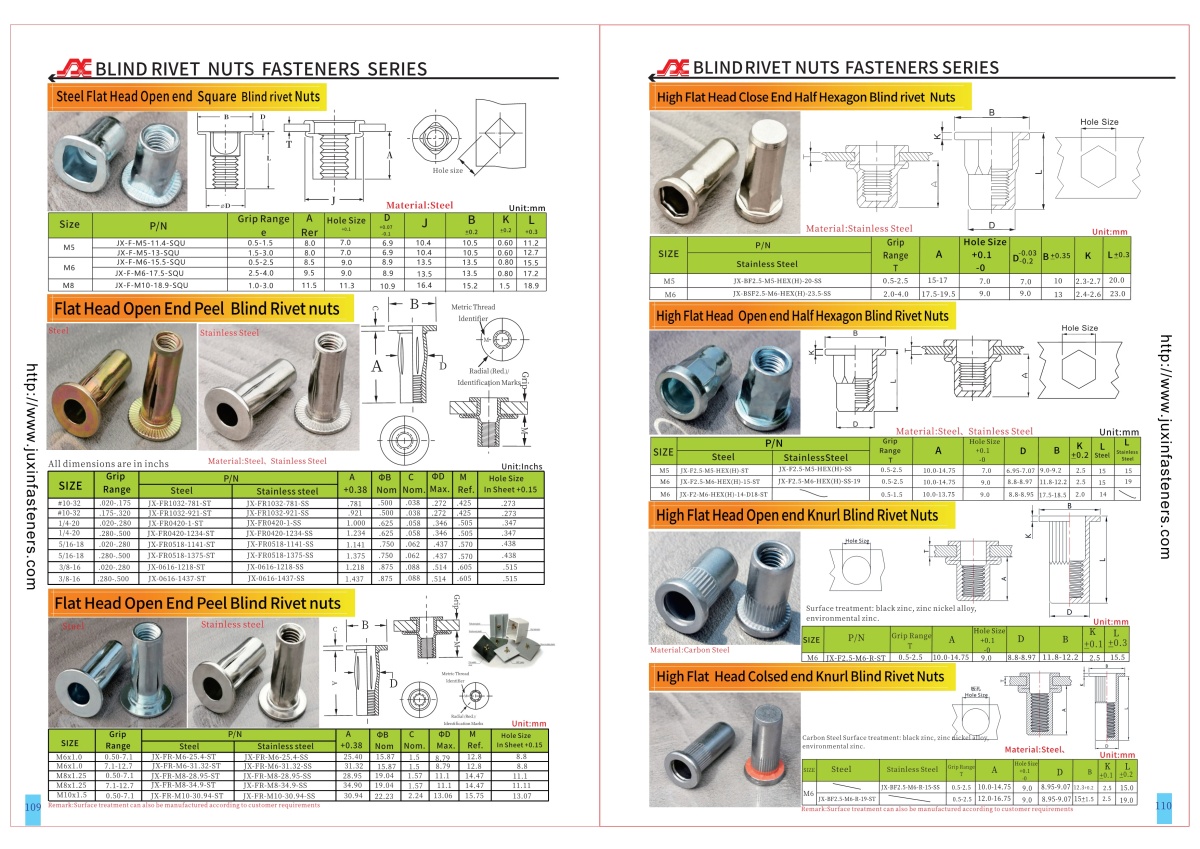
The currently confirmed product specification is M6.
The following table provides common metric thread-size references for engineers and purchasing teams evaluating the broader M3–M8 nominal-size range.
These are nominal thread references, not a declaration that every size is available in this sealed product design.
| Metric Size | Nominal Diameter (mm) | Approximate Diameter (in) | Common ISO Coarse Pitch |
|---|---|---|---|
| M3 | 3.0 | 0.1181 | 0.5 mm |
| M4 | 4.0 | 0.1575 | 0.7 mm |
| M5 | 5.0 | 0.1969 | 0.8 mm |
| M6 | 6.0 | 0.2362 | 1.0 mm |
| M7 | 7.0 | 0.2756 | 1.0 mm |
| M8 | 8.0 | 0.3150 | 1.25 mm |
M7 is less commonly specified than several neighboring metric sizes in many industrial applications.
For M3, M4, M5, M7, or M8 sealing twist-resistant rivet nuts, the product design, dimensions, grip range, sealing configuration, and supply availability must be confirmed separately.
The M6 grip range of 0.5–2.5 mm must not be applied automatically to other thread sizes.
Metric and UNC/UNF Thread Compatibility
For North American sourcing teams, approximate nominal diameter comparisons can help identify the general size category.
However, metric threads and Unified inch threads use different thread specifications.
Examples include:
M3: 0.1181 in nominal diameter; not interchangeable with #4-40 UNC
M4: 0.1575 in nominal diameter; not interchangeable with #8-32 UNC
M5: 0.1969 in nominal diameter; not interchangeable with #10-32 UNF
M6: 0.2362 in nominal diameter; not interchangeable with 1/4-20 UNC or 1/4-28 UNF
M7: 0.2756 in nominal diameter; no direct UNC/UNF equivalent
M8: 0.3150 in nominal diameter; not interchangeable with 5/16-18 UNC or 5/16-24 UNF
These comparisons are for dimensional orientation only.
They do not indicate that the listed Unified thread versions are available.
Applicable thread references include ISO 261 and ISO 965 for metric threads and ASME B1.1 for Unified inch threads.
The approved drawing must specify the actual thread form, pitch, and tolerance.
Mounting-Hole Design and Installation
The knurled round-body configuration is intended for installation in a compatible round hole.
The hole may be drilled or punched using an approved manufacturing process.
For automotive production, the hole should be evaluated for:
Diameter and tolerance
Roundness
Burr condition
Edge quality
Parent-material thickness
Coating buildup
Surface flatness around the flange
Compatibility with the knurled body
A hole that is too large may reduce rotational retention.
A hole that is too small may interfere with insertion or damage the fastener or panel.
Burrs, surface irregularities, and local distortion may also affect the sealing element.
The correct hole dimensions must be established from the approved product drawing.
One-Sided Blind Installation
These sealing rivet nuts are installed using compatible blind rivet nut setting equipment.
The tool applies axial force to deform the body behind the parent panel, creating mechanical retention.
The installation must also establish the required flange and sealing-element contact.
A typical engineering validation process should examine:
Correct hole preparation
Insert positioning
Tool and mandrel compatibility
Setting force or stroke
Backside deformation
Flange seating
Seal compression
Internal thread condition
Spin-out resistance
Axial retention
Leakage performance where required
Under-setting may reduce mechanical retention or leave the sealing element insufficiently compressed.
Over-setting may damage the insert, distort the panel, or adversely affect the sealing element.
The appropriate installation parameters must be established for the actual product and parent material.
Closed-End Screw-Length Selection
Closed-end rivet nuts require special attention to screw length.
Unlike open-end designs, the mating screw cannot extend indefinitely through the barrel.
If the screw bottoms out before the joint is properly clamped, the installer may encounter misleading torque readings or damage the threaded insert.
Engineering teams should verify:
Available internal thread depth
Required thread engagement
Screw length
Joint stack-up
Washer thickness
Installation tolerances
Thermal expansion effects where relevant
A screw that is too short may provide insufficient engagement.
A screw that is too long may contact the closed end before achieving the intended joint clamp load.
This is an important distinction when replacing an open-end rivet nut with a closed-end sealing version.
Mechanical Retention and Sealing Qualification
Automotive OEM validation should distinguish between mechanical retention and sealing performance.
Mechanical retention may include:
Pull-out resistance
Push-out resistance
Spin-out torque
Internal thread integrity
Repeated assembly performance
Sealing evaluation may include:
Water ingress testing
Air or gas leakage testing where applicable
Seal compression verification
Thermal cycling
Aging
Chemical exposure
Corrosion exposure
Vibration conditioning
The exact test methods and acceptance criteria must be established according to the customer application.
No numerical leakage rate, IP rating, mechanical retention value, or durability result is claimed without supporting product-specific evidence.
Surface Treatment and Automotive Corrosion Requirements
The specified base material is steel.
The listed surface-treatment options are Color Zinc and RoHS Blue Zinc.
The exact coating thickness, passivation chemistry, corrosion requirements, and restricted-substance declarations must be confirmed against the approved finishing specification.
For automotive OEM programs, coating appearance alone is insufficient to establish performance or regulatory compliance.
Color Zinc does not automatically indicate a particular chromium chemistry.
Blue Zinc appearance does not independently prove RoHS compliance.
Relevant coating and testing references may include ISO 4042, ISO 9227, and ASTM B117 where applicable to the agreed requirements.
For susceptible high-strength steel grades, electroplating-related hydrogen embrittlement should also be evaluated.
The coating must be considered together with the seal material, parent-panel material, and operating environment.
Sealing Material Compatibility in Electric Vehicles
EV assemblies may encounter water, road salt, automotive cleaning agents, oils, coolants, and temperature variation.
The suitability of a sealing material depends on the actual chemical and thermal exposure.
For example, a seal suitable for occasional water splash may not necessarily be appropriate for continuous immersion, elevated temperatures, or prolonged exposure to automotive fluids.
Engineers should confirm:
Seal material identification
Operating temperature range
Fluid compatibility
Compression-set requirements
Aging resistance
Installation compression
Required service life
These requirements should be defined before claiming compatibility with a particular automotive environment.
Galvanic Corrosion and Mixed-Material Assemblies
Electric vehicles frequently combine steel, aluminum alloys, and other materials.
When zinc-plated steel rivet nuts are installed in aluminum panels, galvanic corrosion may be a concern under wet conditions.
Engineers should evaluate:
Parent-panel alloy
Coating system
Seal coverage
Electrical contact paths
Mating screw material
Moisture exposure
Environmental sealing
Protective finishes
An under-flange sealing element may reduce exposure at a particular interface, but it should not be assumed to eliminate galvanic corrosion throughout the joint.
Sealing Rivet Nuts vs. Standard Closed-End Rivet Nuts
A conventional closed-end rivet nut provides a blind threaded insert with a closed barrel.
A sealing closed-end rivet nut adds an under-flange sealing feature intended to address the panel interface.
The distinction is important because a closed barrel alone does not establish a complete seal around the mounting hole.
For OEM engineers, the selection decision should consider:
Required contamination control
Installation geometry
Available flange clearance
Seal material compatibility
Mechanical retention
Environmental exposure
Inspection and testing requirements
Where no sealing requirement exists, a standard closed-end rivet nut may be a suitable alternative.
Where an ingress requirement exists, the sealing design should be evaluated as part of the complete enclosure.
Sealing Rivet Nuts vs. Open-End Knurled Rivet Nuts
An open-end knurled rivet nut permits screw projection through the barrel.
A closed-end sealing rivet nut restricts screw depth but provides a closed barrel and an additional sealing element at the flange.
For automotive engineering, the main trade-offs include:
Screw-length flexibility
Backside clearance
Sealing requirements
Flange geometry
Installation compatibility
Product cost
Inspection requirements
The two designs should not be treated as directly interchangeable without engineering review.
Automotive OEM and Tier 1 Supplier Qualification
For automotive purchasing programs, qualification should be based on the approved part specification rather than a generic product description.
Recommended review items include:
Approved dimensional drawing
M6 thread specification
Steel material grade
Coating specification
Seal material specification
Knurl geometry
Flange and barrel dimensions
Grip range
Mounting-hole dimensions
Installation parameters
Spin-out performance
Axial retention
Leakage requirements
Environmental validation
Inspection criteria
Traceability and labeling
Customer-specific programs may require dimensional inspection reports, material declarations, coating documentation, first article inspection, PPAP submissions, or additional automotive quality records.
Such requirements must be confirmed during supplier qualification.
No specific automotive certification, PPAP approval, or validated sealing rating is implied without documented evidence.
High-Volume Automotive Procurement Considerations
For purchasing managers and supplier development engineers, sealing twist-resistant rivet nuts should be evaluated using both unit cost and total assembly cost.
Important considerations include:
Consistency of the knurled body
Seal material and dimensional consistency
Installation process capability
Round-hole preparation
Assembly cycle time
Retention and leakage inspection
Rework risk
Packaging protection
Batch traceability
Annual purchasing volume
Engineering change management
A lower-priced insert may create additional costs if the sealing element is inconsistent or installation parameters require frequent adjustment.
For high-volume EV programs, the technical specification should be agreed before production purchasing quantities are finalized.
Other Industrial Applications
Beyond automotive and electric vehicle assemblies, sealing twist-resistant rivet nuts may be evaluated for:
Outdoor electrical enclosures
Industrial control cabinets
HVAC equipment housings
Commercial vehicle equipment
Agricultural machinery
Industrial automation enclosures
Outdoor telecommunications equipment
Service access panels
Fabricated sheet-metal housings
Industrial equipment exposed to moisture or contaminants
The product must be evaluated against the actual environmental and mechanical requirements of each application.
Related Fastening Solutions
Steel High Flat Head Open-End Knurled Body Blind Rivet Nuts
A related configuration for applications requiring knurled round-body engagement without a closed-end sealing arrangement.
Steel High Flat Head Open-End Partial Hex Body Blind Rivet Nuts
An alternative for assemblies requiring a different anti-rotation body geometry.
Steel Flat Head Open-End Square Body Blind Rivet Nuts
An alternative for compatible square-hole mounting arrangements.
Stainless Steel Closed-End Blind Rivet Nuts
A material and end-configuration alternative for applications where stainless steel construction is specified.
These product families should be compared using approved drawings and application-specific requirements.
OEM RFQ and Engineering Information
For an automotive OEM quotation or technical evaluation, please provide:
Required nominal thread size
Product drawing or 3D CAD model
Parent-panel material and thickness
Mounting-hole dimensions
Required grip range
Flange and body dimensions
Closed-end internal depth requirements
Seal material and geometry
Required sealing performance
Operating temperature range
Chemical and environmental exposure
Spin-out torque requirements
Pull-out and push-out requirements
Surface-treatment specification
Installation equipment information
Inspection and traceability requirements
Prototype or production quantities
Estimated annual demand
Delivery destination
For sizes other than the confirmed M6 configuration, please provide the required dimensions so that design and supply feasibility can be reviewed.
Request an Automotive OEM Quotation
Looking for steel sealing twist-resistant rivet nuts, closed-end knurled blind rivet nuts, or custom sealed threaded inserts for electric vehicle components?
JUXIN FASTENERS supports drawing-based technical and commercial discussions for OEM fastener sourcing.
Send your drawings, required specifications, and estimated purchasing quantities for review.
Email: info@juxinfasteners.com
Website: www.juxinfasteners.com
Product Packaging
Product Packaging
JUXIN FASTENERS arranges packaging for steel sealing twist-resistant rivet nuts according to confirmed order quantities, product dimensions, sealing-element protection requirements, and OEM customer specifications.
Packaging Configuration
Inner Packaging: Protective bags or suitable containers, as agreed.
Outer Packaging: Cartons according to confirmed shipping requirements.
Pallet Packaging: Subject to shipment and logistics arrangements.
Custom OEM Packaging: According to approved customer requirements.
Quantity per Package: Confirmed during order processing.
Protection of Sealing Components
Packaging should protect the closed-end barrel, knurled body, internal threads, zinc-plated surface, and under-flange sealing element during handling, storage, and transportation.
Special attention should be given to preventing unnecessary compression, displacement, contamination, or damage to the sealing element.
Packaging materials and storage conditions should be reviewed where the approved seal material has specific handling requirements.
Product Identification
Where required, packaging labels may include:
Product name
Customer or supplier part number
Thread size
Steel material specification
Surface-treatment designation
Grip range
Sealing material designation
Lot or batch number
Package quantity
Customer purchase order number
Automotive OEM Packaging and Traceability
For automotive OEM and Tier 1 purchasing programs, packaging and identification can be agreed according to customer-specific logistics requirements.
Where required, packaging arrangements may address:
Lot traceability
Batch segregation
Barcode labeling
Surface-treatment identification
Seal-material identification
Inspection documentation
Handling and storage instructions
Customer-specific packaging specifications
Different product sizes, coating variants, and sealing-material configurations should be clearly identified to reduce the risk of mixing.
Final packaging quantities, carton configurations, labeling formats, and shipment arrangements are confirmed before delivery.
Product Pictures
Tags
Contact Us
Tel.:
+86 020 8621 0320
+86 020 3121 6067
E-mail:
Technical Support:
Navigation
SEND INQUIREY