Call Us
+86 136 6007 9809
Call Us
+86 136 6007 9809

Juxin Fasteners manufactures custom four-lobe furniture threaded insert nuts for OEM furniture hardware and engineered fastening assemblies.
Originally developed for a furniture manufacturing customer, this special nut features an internally threaded metal body and a distinctive four-lobe exterior geometry.
The identified thread size is M6, with carbon steel and stainless steel listed as material options.
Unlike conventional hex nuts, standard T-nuts or generic expansion anchors, this component is a customer-specific formed threaded part.
Its final installation method, retention mechanism and mating-component requirements must be confirmed against the original drawing or assembly.
Juxin Fasteners supports custom fastener manufacturing from 2D drawings, 3D CAD models and physical samples, using suitable combinations of cold heading, cold forming, CNC machining and secondary operations.
Custom metric and Unified inch-thread variants can be evaluated for furniture OEMs and industrial equipment manufacturers.
Product Specification
Custom Four-Lobe Furniture Threaded Insert Nuts
M6 Custom-Formed Threaded Nuts for Furniture OEM Manufacturing
Juxin Fasteners manufactures custom four-lobe furniture threaded insert nuts for furniture manufacturers, industrial furniture hardware suppliers and OEM equipment builders.
Originally developed for a furniture manufacturing customer, this specialized metal fastener features a central female thread and a distinctive four-lobe exterior profile.
The supplied product is identified as an M6 threaded component, with carbon steel and stainless steel material options.
Unlike conventional hex nuts, the component has a specially formed external geometry intended for a customer-specific fastening assembly.
The original product designation was Expansion Nut.
However, expansion behavior and installation method must be verified against the mating assembly before the product can be described as an expanding or press-fit fastener.
Juxin Fasteners is an industrial fastener manufacturer providing OEM/ODM production from engineering drawings and physical samples.
Our manufacturing capabilities include cold heading, cold forming, CNC machining and product-specific secondary operations,
selected or combined according to component design, material, tolerances and production requirements.
Product Specifications
| Parameter | Description |
|---|---|
| Product Name | Custom Four-Lobe Furniture Threaded Insert Nut |
| Original Product Name | Expansion Nut |
| Product Type | Custom-Formed Internally Threaded Nut |
| Application Background | Custom Furniture OEM Project |
| Identified Thread Size | M6 |
| Metric Coarse Thread Reference | M6 × 1.0, Subject to Drawing Confirmation |
| Material Options | Carbon Steel; Stainless Steel |
| Exterior Geometry | Four-Lobe Formed Profile |
| Surface Finish | According to Customer Specification |
| Installation Method | To Be Confirmed from Assembly Drawing |
| Retention Mechanism | Customer-Specific; Verification Required |
| Manufacturing | OEM/ODM Made-to-Drawing |
| Customization | Based on Drawings and Samples |
The supplied information does not establish a universal dimensional standard for this special-shaped component.
What Is a Four-Lobe Furniture Threaded Insert Nut?
A four-lobe furniture threaded insert nut is a specialized internally threaded metal component with a nonstandard external profile.
The four-lobe geometry distinguishes it from conventional hex nuts, round threaded inserts and standard pronged T-nuts.
The internal thread provides a connection point for a compatible externally threaded fastener.
The exterior geometry may be designed to interface with a specific furniture component, cavity or mating feature.
However, the actual retention principle must be determined from the assembly design.
Depending on the original engineering requirements, a custom insert may be designed for controlled positioning, anti-rotation, mechanical retention or another fastening function.
These functions should not be assumed without dimensional and assembly verification.
Why Furniture Manufacturers Use Custom Threaded Nuts
Furniture OEMs often require fastening components that cannot be adequately served by standard catalog nuts.
Typical engineering requirements include:
Custom exterior geometry
Compact installation dimensions
Repeatable threaded connections
Compatibility with furniture frames
Controlled component positioning
Consistent assembly processes
Suitable corrosion protection
Cost-effective batch production
A custom formed nut can be developed around the furniture manufacturer's actual assembly rather than forcing the product design to accommodate a standard fastener.
Four-Lobe External Geometry
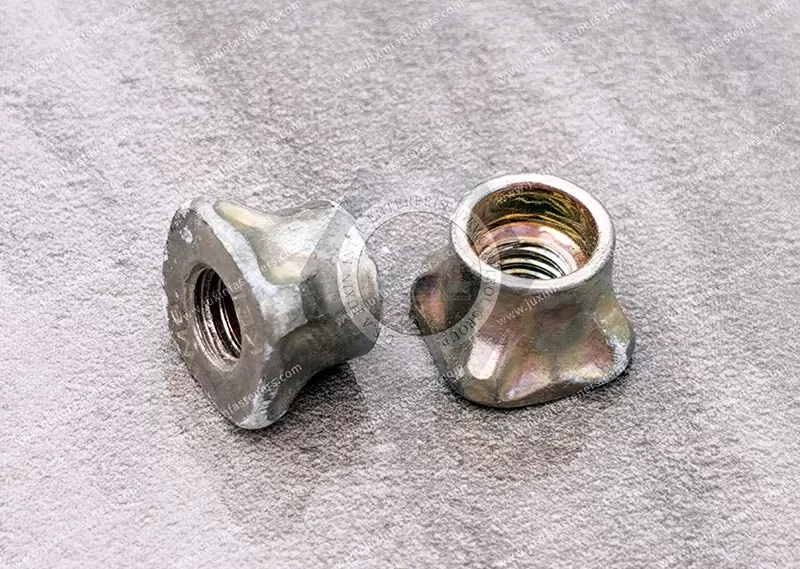
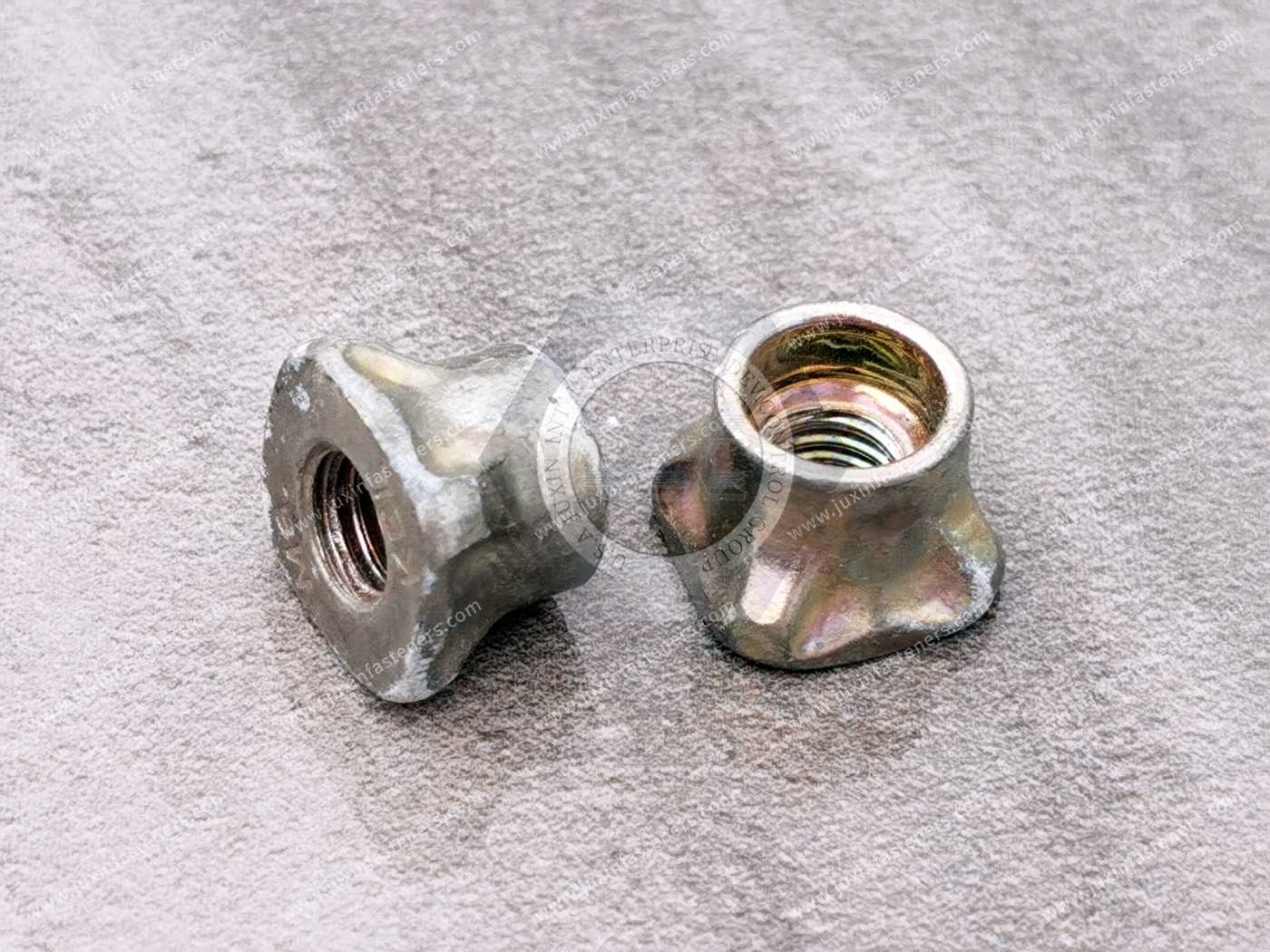
The photographed component has four distinct rounded external lobes surrounding a centrally threaded body.
This geometry is an important identifying feature.
For custom manufacturing, engineers should specify:
Maximum external width
Minimum external width
Lobe profile and radius
Overall component height
Internal thread size
Thread engagement length
Contact surfaces
Dimensional tolerances
Orientation requirements
The exterior profile should be defined through an approved drawing rather than estimated from a product photograph.
M6 Internal Thread
The identified product size is M6.
For a standard ISO metric coarse thread, M6 × 1.0 specifies a nominal diameter of 6 mm and a pitch of 1.0 mm.
However, the actual thread pitch and tolerance class of the original customer part must be confirmed.
A suitable mating bolt or stud must have the corresponding thread designation.
Metric and Inch Thread References
Custom thread variants can be evaluated according to the customer's application and engineering drawing.
| Thread Designation | Thread System | Nominal Diameter | Pitch or TPI | Status |
|---|---|---|---|---|
| M6 × 1.0 | ISO Metric | 6.00 mm | 1.00 mm | Identified M6 Product; Pitch to Confirm |
| M5 × 0.8 | ISO Metric | 5.00 mm | 0.80 mm | Custom Design Evaluation |
| M8 × 1.25 | ISO Metric | 8.00 mm | 1.25 mm | Custom Design Evaluation |
| #10-24 UNC | Unified Inch | 4.83 mm | 24 TPI | Custom Design Evaluation |
| 1/4-20 UNC | Unified Inch | 6.35 mm | 20 TPI | Custom Design Evaluation |
| 1/4-28 UNF | Unified Inch | 6.35 mm | 28 TPI | Custom Design Evaluation |
| 5/16-18 UNC | Unified Inch | 7.94 mm | 18 TPI | Custom Design Evaluation |
| 5/16-24 UNF | Unified Inch | 7.94 mm | 24 TPI | Custom Design Evaluation |
The additional sizes are engineering references for potential OEM customization, not confirmed existing product variants.
M6 × 1.0 and 1/4-20 UNC are not interchangeable.
Metric, UNC and UNF threads must be specified and manufactured according to their respective thread systems.
Carbon Steel Furniture Threaded Nuts
Carbon steel may be selected for furniture hardware requiring a particular combination of mechanical properties, manufacturing suitability and production economics.
Important selection factors include:
Steel grade
Formability
Thread strength
Required heat treatment, if applicable
Surface finish
Environmental exposure
Assembly loading
The finished mechanical properties depend on the approved material and processing specification.
Stainless Steel Furniture Threaded Nuts
Stainless steel may be evaluated where the furniture application requires improved corrosion resistance.
Potential material options include 304-type and 316-type stainless steels, subject to engineering and manufacturing review.
The exact grade must be selected according to environmental exposure, required mechanical properties and production feasibility.
Surface Treatment Options
Depending on the material and customer specification, suitable finishes may include:
Zinc plating
Zinc-nickel plating
Nickel plating
Black oxide
Customer-specified protective coatings
Stainless steel surface finishing
Each finish must be evaluated for the intended material and operating environment.
No particular coating thickness, corrosion-test duration or salt spray performance is claimed without verified product data.
Furniture OEM Applications
Custom threaded nuts can be evaluated for furniture assemblies requiring nonstandard metal fastening components.
Potential application areas include:
Metal furniture frames
Furniture leg connections
Table and desk support structures
Seating frame hardware
Adjustable furniture assemblies
Modular furniture connectors
Industrial furniture equipment
The original component's compatibility with each application must be confirmed from the mating structure.
Metal Furniture Frame Connections
Metal furniture frames may require specially shaped nuts to suit a particular frame section, cavity or mechanical interface.
For these applications, the engineering drawing should define:
Mating frame geometry
Installation direction
Thread alignment
Available clearance
Required retention
Expected service loads
Assembly method
The component should not be described as a universal metal tube insert unless its installation and retention have been validated for the relevant tube geometry.
Furniture Legs and Adjustable Supports
Furniture manufacturers commonly use threaded hardware to connect legs, glides and leveling components.
A custom threaded nut may be developed for a proprietary support assembly where standard catalog inserts are unsuitable.
The design must account for:
Axial loading
Lateral loading
Mating fastener engagement
Rotation resistance
Installation access
Repeated adjustment
Serviceability
Office and Commercial Furniture
Potential OEM projects include custom fastening components for:
Office desks
Commercial seating
Workstations
Storage furniture
Display fixtures
Modular furniture systems
The component geometry and material should be selected according to the actual furniture construction.
Industrial Equipment and Machinery
The same custom-manufacturing approach can support special-shaped threaded nuts for industrial equipment.
Potential applications include:
Equipment frame connections
Special mounting brackets
Mechanical adjustment assemblies
Proprietary structural interfaces
Custom fixture hardware
A furniture-specific design should not be transferred to industrial equipment without engineering validation.
Furniture Threaded Insert Nuts vs. Standard T-Nuts
Standard pronged T-nuts typically have a flange and pointed prongs intended to engage suitable wood-based components.
The photographed four-lobe nut has a different exterior geometry.
It should not automatically be classified as a conventional four-prong T-nut.
Furniture Threaded Insert Nuts vs. Rivet Nuts
A rivet nut is generally installed through a prepared hole and mechanically deformed to create a captive thread.
The installation behavior of this custom four-lobe component has not been established.
Therefore, it should not be presented as a blind rivet nut.
Furniture Threaded Insert Nuts vs. Weld Nuts
Weld nuts are designed for attachment through a specified welding process.
The photographed component has no confirmed welding specification.
It should not be classified as a weld nut without supporting engineering documentation.
Furniture Threaded Insert Nuts vs. Expanding Tube Connectors
Expanding tube connectors commonly use an expansion mechanism to secure an assembly inside a hollow profile.
The photographed custom nut may belong to a related furniture connection application, but no expanding mechanism has been verified.
The distinction is important for engineering selection and product identification.
Engineering Information Required for Custom Manufacturing
A customer-specific threaded nut should be defined through a complete engineering specification.
Important information includes:
External Geometry
Overall dimensions, lobe profile, radii, height and contact surfaces.
Internal Thread
Thread system, nominal diameter, pitch, tolerance class and usable thread engagement.
Material
Specified steel or stainless steel grade and required mechanical properties.
Surface Finish
Coating type, thickness, appearance and corrosion requirements.
Assembly Interface
Mating material, installation method, clearance, retention mechanism and loading conditions.
Production Requirements
Order quantity, annual demand, dimensional inspection and packaging.
Custom Manufacturing from Drawings and Samples
Juxin Fasteners supports manufacturing development based on customer drawings and physical samples.
For custom four-lobe nuts, the manufacturing process is selected according to:
Material properties
Component shape
Required thread accuracy
Forming feasibility
Dimensional tolerances
Surface requirements
Production quantity
Cold heading, cold forming, CNC machining and secondary operations may be used individually or combined where technically appropriate.
The actual manufacturing route must be confirmed during engineering review.
Quality Inspection and Assembly Validation
Depending on the approved specification, inspection may include:
Material identification
Thread gauging
Overall height measurement
External profile measurement
Lobe geometry inspection
Surface finish inspection
Dimensional tolerance verification
Mating component fit checks
Functional installation testing
Retention or load testing, where required
Acceptance criteria must be agreed before production.
Relevant Engineering References
The following standards may be useful when specifying individual technical features of a custom threaded component.
| Standard | Relevance |
|---|---|
| ISO 261 | ISO Metric Screw Thread General Plan |
| ISO 965 Series | ISO Metric Screw Thread Tolerances |
| ASME B1.1 | Unified Inch Screw Threads |
| ISO 898-2 | Mechanical Properties of Carbon and Alloy Steel Nuts, Where Applicable |
| ISO 3506-2 | Mechanical Properties of Stainless Steel Nuts, Where Applicable |
| ASTM B117 | Salt Spray Testing, When Specified |
These references do not establish a universal dimensional standard for the photographed four-lobe furniture nut.
Product conformity must be assessed against the actual drawing and applicable requirements.
Frequently Asked Questions
What is a custom four-lobe furniture threaded insert nut?
It is a specially shaped internally threaded metal component with four external lobes, manufactured for a customer-specific furniture fastening application.
Is this product a standard expansion nut?
The original product was identified as an expansion nut, but its actual expansion or retention mechanism has not been verified.
What thread size is identified?
M6 is the confirmed nominal thread designation supplied for this product.
Is M6 the same as 1/4-20 UNC?
No. They have different thread diameters and pitches and are not interchangeable.
Can this part be manufactured in stainless steel?
Stainless steel is listed as a material option. The exact grade and manufacturing feasibility must be confirmed.
Is this the same as a four-prong T-nut?
No. The visible geometry differs from a conventional pronged furniture T-nut.
Can it be installed in a metal tube?
That depends on the original assembly design. Tube dimensions, installation method and retention requirements must be verified.
Can the four-lobe profile be customized?
Juxin Fasteners can evaluate custom exterior profiles according to customer drawings and samples.
Can Juxin Fasteners manufacture inch-thread versions?
Custom UNC and UNF designs can be evaluated for OEM manufacturing.
What information is required for an accurate quotation?
A dimensioned drawing or sample, material specification, thread requirements, mating assembly details, finish and estimated order quantity.
Does Juxin Fasteners support repeat OEM production?
Yes. Juxin Fasteners supports made-to-drawing industrial fastener manufacturing for OEM and long-term production requirements.
Request a Quote — Custom Furniture Threaded Insert Nuts
Juxin Fasteners manufactures custom threaded fastening components for furniture OEMs, industrial equipment manufacturers and engineering procurement teams.
We support special-shaped nuts developed from 2D engineering drawings, 3D CAD models and physical samples.
For a manufacturing quotation, please provide:
Product drawing or physical sample
Customer part number
Intended furniture or equipment application
Mating component drawing
Thread size and pitch
External lobe geometry
Overall dimensions and tolerances
Carbon steel or stainless steel grade
Surface finish requirements
Installation and retention method
Required mechanical performance
Inspection and acceptance criteria
Initial order quantity
Estimated annual demand
Packaging requirements
Target delivery schedule
Our engineering team can review the product geometry, material and manufacturing feasibility for OEM/ODM batch production.
Juxin Fasteners
Industrial Fastener Manufacturer | Custom Furniture Threaded Insert Nuts | Made-to-Drawing OEM Fasteners
Website: https://www.juxinfasteners.com/
Email: info@juxinfasteners.com
Product Packaging
Packaging Standard
At Juxin Fasteners, we apply standardized export packaging to ensure product protection, traceability, and compliance with international logistics requirements.
1. Standard Export Packaging
Unless otherwise specified, all products will be packed according to our factory standard export packaging, which includes:
Moisture-resistant inner protection
Poly bag or small box packing as required
Reinforced export cartons
Clear labeling with part number, specification, batch number, and quantity
Palletizing for sea or air shipment when necessary
Our standard packaging is designed to ensure safe transportation, efficient warehousing, and long-distance international shipping.
2. Customized Packaging Options
We also provide customized packaging solutions according to customer requirements, including but not limited to:
Private labeling
Customized barcodes
Specific carton dimensions
Retail packaging
Special pallet configuration
Customer-specific marking and identification
So that you know, customized packaging may involve additional costs and extended lead time depending on the complexity of the requirements.
3. Compliance & Quality Assurance
All packaging processes are controlled under our ISO 9001 quality management system to ensure consistency, traceability, and product integrity throughout the supply chain.
Product Pictures
Contact Us
Tel.:
+86 020 8621 0320
+86 020 3121 6067
E-mail:
Technical Support:
Navigation
SEND INQUIREY