Call Us
+86 136 6007 9809
Call Us
+86 136 6007 9809

Juxin Fasteners manufactures steel tube-connecting nuts with spring-steel retaining clips for press-fit installation inside round metal and plastic tubing.
The clips engage the tube wall to retain the threaded insert without welding, providing an internal connection point for compatible bolts or threaded studs.
Metric M6, M8 and M10 and inch 1/4-20, 5/16-18 and 3/8-16 configurations support furniture frames, tubular equipment structures, display fixtures and OEM assemblies.
Carbon steel, 65Mn spring-steel components, zinc-plated finishes and custom tube-fit dimensions are available for engineering evaluation and batch manufacturing.
Product Specification
Tube-Connecting Nuts for Round Metal and Plastic Tubes
Juxin Fasteners manufactures tube-connecting nuts with spring-steel retaining clips for threaded connections inside round metal and plastic tubing.
These specialized fasteners are designed to be pressed into the ends of compatible hollow tubes, providing an internal threaded connection without welding.
The retaining clips engage the inside wall of the tube to help hold the connector in position during assembly.
Also known as round tube-connecting nuts, tube end nuts, press-fit tube connector nuts and spring-clip tube nuts, these components are used in tubular furniture frames, equipment structures, display fixtures and other OEM assemblies.
Juxin Fasteners supports metric M6, M8 and M10 and Unified inch 1/4-20, 5/16-18 and 3/8-16 thread configurations, with drawing-based customization for industrial manufacturing customers.
Product Design – Spring-Clip Tube-Connecting Nuts
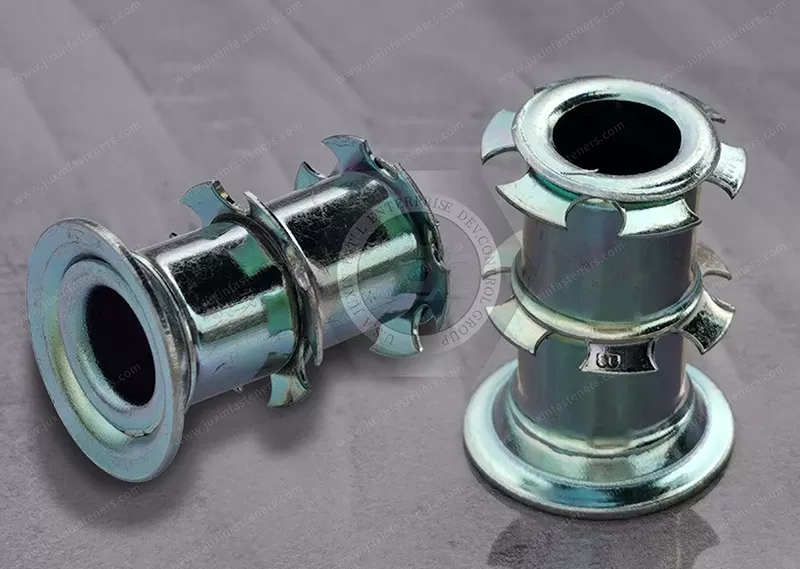
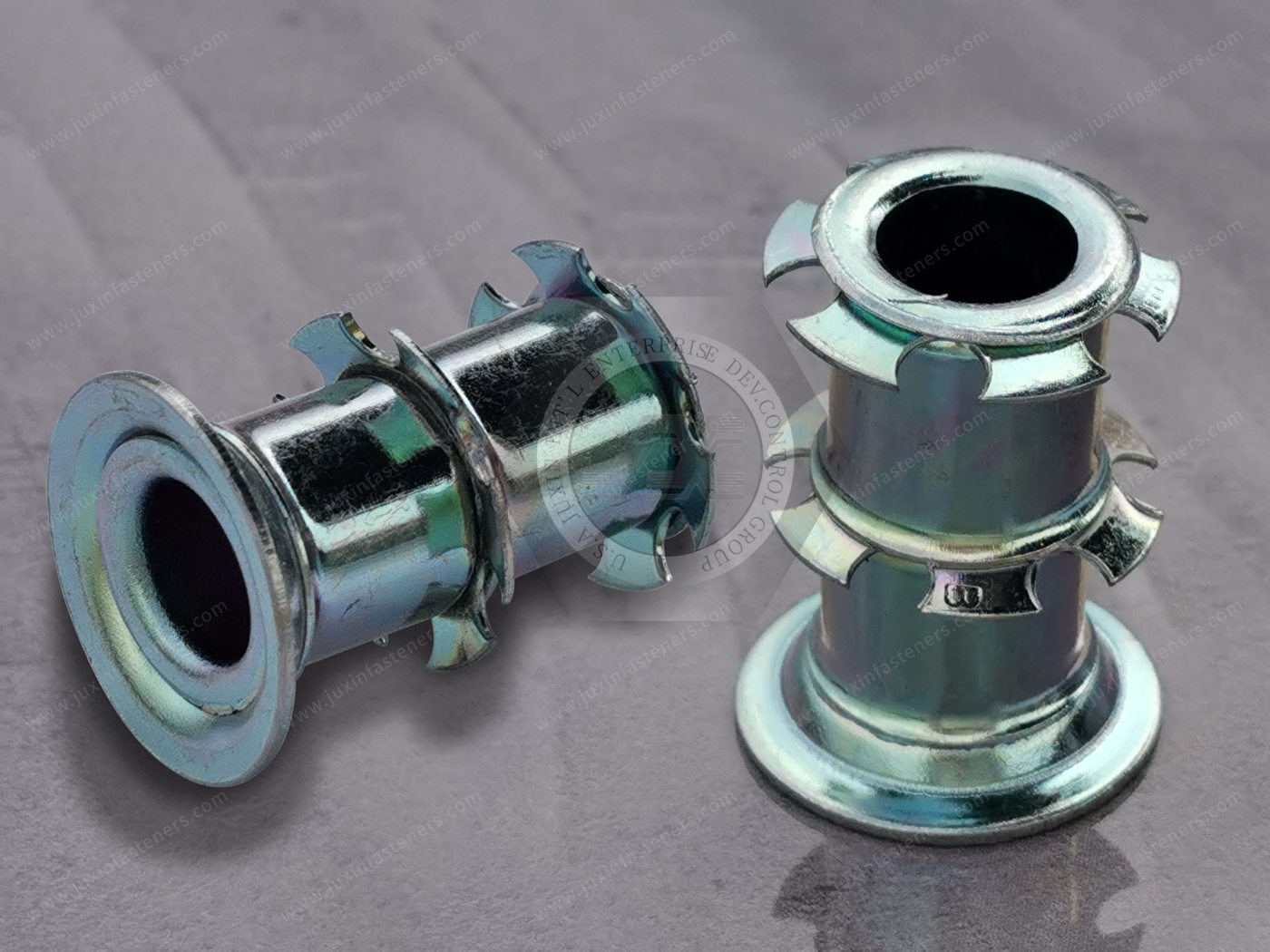
The product consists of a cylindrical steel body with an internal machine thread and retaining features designed to engage the inside of a round tube.
The pictured design incorporates two sets of outward-facing retaining clips positioned along the cylindrical body.
A formed end flange provides an external locating feature at the tube opening.
The connector is inserted into the tube until the required installation position is reached.
During installation, the retaining clips deflect and engage the internal tube wall.
This provides mechanical retention without requiring the connector body to be welded to the tube.
A compatible bolt or threaded stud can then engage the internal thread.
Key Product Features
Designed for round metal and plastic tubing.
Press-fit installation inside hollow tube ends.
Spring-steel retaining clips.
Two retaining clip groups in the pictured design.
Internally threaded steel body.
Flanged end geometry.
No welding required for the intended press-fit installation.
Zinc-plated steel finish.
Metric and Unified inch thread options.
Custom tube-fit dimensions for OEM manufacturing.
Suitable for repeat-order industrial production.
Retention strength depends on the tube dimensions, wall material, clip geometry, interference and installation conditions.
Technical Specifications – Tube-Connecting Nuts
| Specification | Product Details |
|---|---|
| Product Name | Tube-Connecting Nuts |
| Product Category | Threaded Tube End Fasteners |
| Installation | Internal Press Fit |
| Tube Shape | Round |
| Compatible Substrates | Suitable Metal and Plastic Tubes |
| Body Material | Carbon Steel |
| Spring Component | 65Mn Spring Steel |
| Surface Finish | Zinc Plating |
| Metric Threads | M6, M8, M10 |
| Inch Threads | 1/4-20, 5/16-18, 3/8-16 UNC |
| Retaining Design | Spring Clips |
| Connection | Internal Female Thread |
| Tube Fit | According to Tube ID and Wall Thickness |
| Manufacturing | OEM / ODM Batch Production |
| Customization | Thread, Body, Clips, Flange and Tube Fit |
| Quality Control | Dimensional, Thread and Assembly Inspection |
The exact clip hardness, body dimensions, tube compatibility and mechanical performance must be confirmed against approved drawings and installation tests.
Metric Tube-Connecting Nuts – M6, M8 and M10
Metric configurations are suitable for tubular equipment and furniture assemblies using ISO metric machine screws or threaded studs.
| Thread Size | Nominal Diameter | Coarse Pitch | Inch Diameter Reference |
|---|---|---|---|
| M6 × 1.0 | 6 mm | 1.0 mm | 0.2362 in |
| M8 × 1.25 | 8 mm | 1.25 mm | 0.3150 in |
| M10 × 1.5 | 10 mm | 1.5 mm | 0.3937 in |
The inch measurements are diameter conversions only and do not indicate compatible Unified inch threads.
M6 Tube-Connecting Nuts
M6 configurations are relevant to compact tubular furniture, display frames and lightweight equipment structures where the tube dimensions and required retention strength are appropriate.
M8 Tube-Connecting Nuts
M8 configurations can be considered for larger tubular frames, equipment supports and modular metal structures.
M10 Tube-Connecting Nuts
M10 configurations may be used in larger tubular assemblies requiring an appropriately sized internal connector and validated mechanical performance.
Thread size alone does not determine the tube connector's pull-out resistance or load capacity.
UNC Inch Tube-Connecting Nuts for North American OEMs
Unified inch threads are important for North American tubular furniture and industrial equipment manufacturing.
Juxin Fasteners supports the following specified thread configurations.
| Inch Thread | Series | Nominal Diameter | Threads per Inch |
|---|---|---|---|
| 1/4-20 | UNC | 0.2500 in | 20 |
| 5/16-18 | UNC | 0.3125 in | 18 |
| 3/8-16 | UNC | 0.3750 in | 16 |
1/4-20 UNC Tube-Connecting Nuts
A common Unified coarse thread configuration for tubular furniture components, fixtures and general equipment assemblies.
5/16-18 UNC Tube-Connecting Nuts
Suitable for evaluation in medium-size tubular structures requiring a larger internal threaded connection.
3/8-16 UNC Tube-Connecting Nuts
Relevant to larger tubular equipment assemblies where the tube internal diameter and wall thickness can accommodate the required connector geometry.
Custom UNF Thread Options
For customers requiring Unified fine threads, Juxin Fasteners can evaluate drawing-based configurations such as:
1/4-28 UNF.
5/16-24 UNF.
3/8-24 UNF.
These are custom engineering reference options, not confirmed standard configurations for the pictured product.
Availability depends on the tube connector design and production requirements.
Metric and Inch Thread Compatibility
Metric, UNC and UNF thread systems are not directly interchangeable.
For example:
M6 × 1.0 is not interchangeable with 1/4-20 UNC.
M8 × 1.25 is not interchangeable with 5/16-18 UNC.
M10 × 1.5 is not interchangeable with 3/8-16 UNC.
1/4-20 UNC is not interchangeable with 1/4-28 UNF.
All engineering drawings must specify the exact thread designation and tolerance requirements.
Tube Diameter and Wall Thickness – Critical Selection Parameters
Selecting the correct tube-connecting nut requires more than identifying the internal thread size.
The connector must match the actual tube geometry.
Important dimensions include:
Tube outside diameter (OD).
Tube inside diameter (ID).
Tube wall thickness.
Connector body outside diameter.
Retaining clip outside diameter.
Clip engagement position.
Overall connector length.
Insertion depth.
Flange outside diameter.
Internal thread size and usable depth.
The tube inside diameter is especially important because the retaining clips must engage the internal wall with appropriate interference.
Two tubes with the same outside diameter may have different inside diameters because of different wall thicknesses.
A connector selected only by tube outside diameter may therefore fit incorrectly.
Common North American Round Tube Diameter References
North American OEM customers frequently specify tubing dimensions in inches.
| Tube Outside Diameter | Metric Conversion |
|---|---|
| 5/8 in | 15.875 mm |
| 3/4 in | 19.050 mm |
| 7/8 in | 22.225 mm |
| 1 in | 25.400 mm |
| 1-1/8 in | 28.575 mm |
| 1-1/4 in | 31.750 mm |
| 1-1/2 in | 38.100 mm |
| 2 in | 50.800 mm |
These are common tubing diameter references, not confirmed fit sizes for every Juxin Fasteners tube-connecting nut.
For quotation, customers should provide the actual tube inside diameter, outside diameter and wall thickness.
Tube-Connecting Nut Installation Method
Step 1 – Verify Tube Dimensions
Measure the tube inside diameter and wall thickness.
Confirm that the connector's retaining clips are compatible with the tube material and internal geometry.
Step 2 – Inspect the Tube End
Check for excessive burrs, deformation or surface damage that could interfere with installation.
Prepare the tube end according to the approved assembly procedure.
Step 3 – Align the Connector
Position the tube-connecting nut concentrically with the tube opening.
Avoid misalignment that could deform the retaining clips or damage the tube.
Step 4 – Press the Connector into the Tube
Apply controlled axial installation force using a suitable fixture or installation tool.
The retaining clips deflect and engage the tube's inner wall.
Installation force must be established through testing for the selected tube and connector combination.
Step 5 – Verify Seating Position
Confirm that the connector is seated to the specified depth and that the flange is correctly positioned.
Step 6 – Install the Mating Fastener
Engage a compatible machine screw or threaded stud with the connector's internal thread.
Apply the specified tightening torque without exceeding the retention capacity of the installed connector.
Spring-Steel Retaining Clips – How They Work
The retaining clips are responsible for the mechanical engagement between the connector and the tube wall.
The clips deflect during insertion and apply contact force against the tube's internal surface.
Depending on the clip geometry, the edges may also provide resistance to withdrawal.
The retaining performance depends on:
Clip material.
Clip thickness.
Heat treatment.
Clip angle.
Tube internal diameter.
Tube wall material.
Surface finish.
Installation depth.
Direction of applied load.
A higher insertion force does not automatically mean greater pull-out resistance.
The complete assembly must be tested.
65Mn Spring Steel – Retaining Clip Material
65Mn is a high-carbon manganese spring steel used in applications requiring elastic deformation and spring properties after appropriate processing and heat treatment.
For tube-connecting nuts, spring-steel clips can provide the elastic engagement required during press-fit installation.
Important material and processing factors include:
Spring hardness.
Elastic recovery.
Fatigue behavior.
Clip thickness consistency.
Heat treatment.
Corrosion protection.
Edge geometry.
The actual clip hardness and heat-treatment requirements must be defined by the approved drawing or manufacturing specification.
Carbon Steel Body – Internal Thread Support
The carbon steel body provides the internally threaded connection.
Its geometry and material properties influence:
Internal thread strength.
Available thread engagement.
Body deformation resistance.
Installation alignment.
Connection durability.
The body material and clip material serve different mechanical functions and should not be treated as interchangeable.
Zinc-Plated Finish and Corrosion Protection
Zinc plating provides sacrificial corrosion protection for compatible steel components.
It is commonly used for indoor industrial hardware, furniture fasteners and equipment assemblies that may experience occasional humidity.
Corrosion performance depends on:
Zinc coating thickness.
Passivation system.
Surface preparation.
Service environment.
Exposure duration.
Handling and installation damage.
Zinc plating should not be assumed suitable for continuous saltwater exposure or severe chemical environments without testing.
For specific OEM programs, corrosion performance may be evaluated using ASTM B117 or another customer-defined test procedure.
The required exposure duration and acceptance criteria must be specified by the customer.
Tube-Connecting Nuts for Metal Tubes
Steel and aluminum tubing are widely used in industrial equipment and furniture manufacturing.
Press-fit tube-connecting nuts may provide internal threads without welding the connector to the tube.
Potential benefits include:
Reduced welding operations.
Internal threaded mounting points.
Compatibility with tubular frame designs.
Repeatable installation with suitable fixtures.
Reduced need for separate external brackets.
However, thin-walled metal tubes may deform during insertion or tightening.
Tube wall strength and connector retention must be evaluated.
Tube-Connecting Nuts for Plastic Tubes
Suitable plastic tubes can also accept specially matched press-fit connectors.
However, plastic materials may behave differently from metal during installation and service.
Important considerations include:
Plastic material grade.
Tube wall thickness.
Local deformation.
Creep under sustained loading.
Temperature exposure.
Retaining clip contact pressure.
Long-term pull-out resistance.
Plastic tube compatibility must be confirmed through assembly testing.
Tube-Connecting Nuts vs. Other Tube Fastening Solutions
| Fastener Type | Installation | Main Difference |
|---|---|---|
| Tube-Connecting Nut | Press Fit | Spring clips grip inside round tubing |
| Weld-On Tube Nut | Welding | Permanent welded threaded connection |
| Threaded Tube Insert | Design-Dependent Press Fit or Screw-In | Different retention geometry |
| Rivet Nut | Rivet Setting | Deformation-based retention in a prepared hole |
| Tube Coupling Nut | Threaded Engagement | Joins compatible threaded components |
| Compression Tube Fitting | Compression Connection | Primarily designed for fluid or gas tubing systems |
Tube-connecting nuts are intended for mechanical fastening in tubular structures.
They are not pressure-rated fluid connectors and should not be used as substitutes for hydraulic or pneumatic tube fittings.
Industrial Applications – Tubular Furniture Manufacturing
Furniture manufacturing is an important application area for internal tube fasteners.
Potential applications include:
Metal chair frames.
Office furniture.
Tables with tubular legs.
Adjustable furniture supports.
Metal shelving.
Commercial seating.
Modular furniture structures.
Tubular furniture accessories.
A tube-connecting nut can provide an internal threaded mounting point for suitable bolts, studs or connected components.
For furniture engineers, tube wall thickness, connector retention and repeated assembly requirements are important design factors.
Office Furniture and Commercial Seating
Commercial furniture manufacturers often use tubular steel frames and modular metal components.
Potential applications include:
Office chair components.
Desk support frames.
Seating accessories.
Partition supports.
Modular workstation structures.
Where the fastener is part of a load-bearing or safety-related seating connection, the complete assembly must be validated against the applicable requirements.
Retail Displays and Store Fixtures
Tube-connecting nuts may be used in modular retail structures requiring internal threaded connections.
Applications include:
Display racks.
Retail shelving.
Exhibition structures.
Product display frames.
Store fixture supports.
Modular merchandising equipment.
For OEM manufacturers, consistent tube dimensions and repeatable connector installation can support efficient batch assembly.
Industrial Equipment and Machinery
Round tubular components are used in machinery accessories, equipment supports and fabricated industrial structures.
Potential applications include:
Equipment stands.
Tubular support frames.
Machine accessories.
Removable equipment brackets.
Light-duty industrial fixtures.
Assembly workstations.
The suitability of a press-fit tube connector depends on the actual load direction and retention requirements.
Fitness and Recreational Equipment
Tubular frames are common in fitness and recreational products.
Potential applications include:
Noncritical equipment accessories.
Removable support components.
Equipment covers.
Adjustable mounting accessories.
Tubular frame attachments.
Primary load-bearing or safety-critical connections require specific mechanical validation.
Medical Equipment and Mobility Products
Certain medical equipment accessories and mobility-related products use tubular structures.
Tube-connecting nuts may be considered for noncritical accessories, removable brackets and suitable frame attachments.
Use in patient-supporting or safety-critical assemblies requires appropriate design qualification and regulatory compliance.
Automotive and Transportation Accessories
Tube-connecting nuts may be evaluated for selected tubular automotive accessories and transportation equipment components.
Potential applications include:
Noncritical tubular brackets.
Interior accessory structures.
Equipment supports.
Removable tubular attachments.
Automotive applications involving vibration, fatigue or occupant safety require engineering approval and application-specific testing.
Outdoor Equipment and Garden Products
Round tubing is widely used in garden furniture, recreational structures and outdoor equipment.
Potential applications include:
Outdoor furniture frames.
Garden equipment accessories.
Tubular support structures.
Removable frame components.
For outdoor applications, corrosion protection and material compatibility require particular attention.
Standard zinc plating may not provide sufficient protection for prolonged outdoor exposure.
Design Considerations for Mechanical and Structural Engineers
Tube Inside Diameter
The inside diameter determines whether the retaining clips can engage the tube wall correctly.
Tube Wall Thickness
Wall thickness influences the available inside diameter and the tube's resistance to deformation.
Retaining Clip Geometry
Clip angle, thickness and engagement diameter affect installation force and retention.
Thread Engagement
The internal thread must provide sufficient engagement with the mating fastener.
Axial Pull-Out Resistance
The connector must resist withdrawal under the expected axial loading.
Rotational Resistance
The installed connector must resist rotation during bolt tightening and service.
Tube Deformation
Excessive interference or installation force may deform thin-walled tubing.
Vibration Performance
Retaining clips alone do not guarantee vibration resistance.
Repeated Assembly
The threaded connection and installed connector should be evaluated for the expected number of assembly and removal cycles.
Environmental Conditions
Corrosion, temperature and material aging may influence long-term retention.
Assembly Validation and Mechanical Testing
Depending on the customer application, relevant testing may include:
Installation force measurement.
Axial pull-out testing.
Rotational resistance testing.
Thread stripping resistance.
Bolt tightening torque testing.
Tube deformation inspection.
Vibration testing.
Fatigue testing.
Corrosion testing.
Repeated assembly testing.
Temperature exposure testing.
Testing should use the actual production tube material, dimensions and connector configuration.
No universal load rating should be assigned without verified test data.
OEM Manufacturing Capabilities – Juxin Fasteners
Juxin Fasteners is an industrial fastener manufacturer supporting OEM and ODM production of specialized metal fastening components.
Our manufacturing capabilities include cold heading, cold forming, CNC machining and secondary metalworking operations.
For tube-connecting nuts, the manufacturing route is selected according to the approved design, material requirements, retaining clip geometry and production quantity.
Depending on the product configuration, manufacturing may involve:
Steel body forming.
Precision machining.
Internal threading.
Spring-steel component forming.
Heat treatment where required.
Component assembly.
Surface finishing.
Dimensional inspection.
Functional assembly verification.
Drawing-Based Custom Manufacturing
Juxin Fasteners can evaluate customized requirements for:
Metric M6, M8 and M10 threads.
UNC inch threads.
Custom UNF threads.
Tube inside diameters.
Tube outside diameters.
Tube wall thicknesses.
Connector body dimensions.
Retaining clip dimensions.
Retaining clip material.
Spring hardness.
Flange diameter.
Connector overall length.
Installation depth.
Zinc-plating requirements.
Custom packaging.
OEM part identification.
All configurations are subject to engineering review and manufacturing feasibility confirmation.
Quality Control and Inspection
Inspection requirements may include:
Internal thread GO/NO-GO gauge inspection.
Connector body outside diameter.
Overall length.
Flange dimensions.
Retaining clip geometry.
Retaining clip material verification.
Spring hardness where specified.
Surface finish inspection.
Coating thickness where specified.
Visual inspection.
Installation fit verification.
Pull-out or rotational testing when required.
Batch identification.
Drawing-based dimensional inspection.
For metric threads, applicable ISO thread requirements may be specified.
For Unified inch threads, ASME B1.1 may be used as the thread specification reference.
Final acceptance criteria must be defined by the approved customer drawing.
Production Efficiency for OEM Assembly
For production managers and manufacturing engineers, tube-connecting nut selection can influence assembly efficiency and consistency.
Important considerations include:
Controlled tube dimensions.
Repeatable connector positioning.
Consistent insertion force.
Compatible installation fixtures.
Reduced welding operations.
Reliable internal thread alignment.
Reduced tube damage.
Stable batch dimensions.
Efficient inspection methods.
Repeatable assembly cycle times.
A validated press-fit installation process can improve consistency in high-volume tubular frame manufacturing.
International OEM Procurement and Supply
Juxin Fasteners supports international B2B customers requiring tube-connecting nuts and customized threaded tube components.
Our manufacturing programs are relevant to:
Furniture OEM manufacturers.
Commercial seating manufacturers.
Tubular equipment manufacturers.
Metal fabrication companies.
Retail fixture manufacturers.
Industrial equipment manufacturers.
Automotive component manufacturers.
We support technical and purchasing inquiries from:
Design engineers.
Mechanical and structural engineers.
Manufacturing engineers.
Production managers.
Procurement development specialists.
Purchasing specialists.
Procurement managers.
Supply chain managers.
For international procurement, important requirements include approved drawings, tube dimensions, thread specifications, material grades, retaining clip performance, inspection requirements and estimated annual demand.
Juxin Fasteners supports manufacturing customers in North America, South America, Europe and other international markets.
Frequently Asked Questions
What are tube-connecting nuts?
Tube-connecting nuts are internally threaded fasteners designed to be installed inside hollow tubes, providing threaded attachment points for compatible bolts or studs.
How are spring-clip tube-connecting nuts installed?
They are pressed into a compatible tube opening, allowing the retaining clips to engage the internal tube wall.
Do tube-connecting nuts require welding?
The press-fit spring-clip design is intended to provide retention without welding.
Can tube-connecting nuts be used in plastic tubes?
Yes, when the connector and tube material are compatible and the required retention performance has been validated.
What is the difference between a tube-connecting nut and a rivet nut?
A spring-clip tube-connecting nut is retained by clips engaging the inside of a tube. A conventional rivet nut is typically installed by deforming its body within a prepared hole.
What is the difference between tube-connecting nuts and compression tube fittings?
Tube-connecting nuts provide mechanical threaded connections in tubular structures. Compression tube fittings are designed primarily to connect and seal fluid or gas tubing.
Are tube-connecting nuts suitable for round tubing?
Yes. This product is specifically designed for compatible round tubes.
Can Juxin Fasteners manufacture M6, M8 and M10 tube-connecting nuts?
Juxin Fasteners supports these metric thread configurations, subject to the required tube-fit dimensions and approved product design.
Are 1/4-20, 5/16-18 and 3/8-16 available?
These Unified coarse thread configurations are included in the product specification. Exact tube-fit combinations should be confirmed before ordering.
Are M6 and 1/4-20 interchangeable?
No. They use different thread dimensions and pitches.
Can Juxin Fasteners manufacture custom tube-connecting nuts?
Yes. Juxin Fasteners can evaluate drawing-based requirements for thread sizes, body dimensions, retaining clips, flange geometry and tube compatibility.
What determines the pull-out strength of a tube-connecting nut?
Pull-out resistance depends on the retaining clip design, tube material, tube inside diameter, wall thickness and installation conditions.
What information is required for an OEM quotation?
Please provide the tube outside diameter, inside diameter, wall thickness, material, thread size, connector dimensions, surface finish, estimated order quantity and any required mechanical performance criteria.
Request an OEM Manufacturing Quote – Tube-Connecting Nuts
Juxin Fasteners manufactures tube-connecting nuts for round metal and plastic tubing, including spring-clip designs for furniture frames, industrial equipment, display fixtures and other OEM applications.
We support metric and Unified inch thread configurations, drawing-based customization, material selection, dimensional inspection and repeat-order batch manufacturing.
For technical evaluation and quotation, please provide your 2D/3D drawings, tube dimensions, thread specifications, material requirements and estimated annual purchasing quantity.
Manufacturer: Juxin Fasteners
Product: Tube-Connecting Nuts for Round Metal and Plastic Tubes
Materials: Carbon Steel Body + 65Mn Spring-Steel Components
Metric Threads: M6, M8, M10
Inch Threads: 1/4-20, 5/16-18, 3/8-16 UNC
Installation: Internal Press Fit with Spring Clips
Surface Finish: Zinc Plating
Tube Compatibility: According to Approved Tube Dimensions and Assembly Testing
Manufacturing: OEM / ODM, Drawing-Based Custom Manufacturing and Batch Production
Email: info@juxinfasteners.com
Website: www.juxinfasteners.com
Send your engineering drawings, tube inside diameter, tube wall thickness, thread specifications and estimated annual demand to request an OEM tube-connecting nut manufacturing quotation from Juxin Fasteners.
Product Packaging
Packaging Standard
At Juxin Fasteners, we apply standardized export packaging to ensure product protection, traceability, and compliance with international logistics requirements.
1. Standard Export Packaging
Unless otherwise specified, all products will be packed according to our factory standard export packaging, which includes:
Moisture-resistant inner protection
Poly bag or small box packing as required
Reinforced export cartons
Clear labeling with part number, specification, batch number, and quantity
Palletizing for sea or air shipment when necessary
Our standard packaging is designed to ensure safe transportation, efficient warehousing, and long-distance international shipping.
2. Customized Packaging Options
We also provide customized packaging solutions according to customer requirements, including but not limited to:
Private labeling
Customized barcodes
Specific carton dimensions
Retail packaging
Special pallet configuration
Customer-specific marking and identification
So that you know, customized packaging may involve additional costs and extended lead time depending on the complexity of the requirements.
3. Compliance & Quality Assurance
All packaging processes are controlled under our ISO 9001 quality management system to ensure consistency, traceability, and product integrity throughout the supply chain.
Product Pictures
Contact Us
Tel.:
+86 020 8621 0320
+86 020 3121 6067
E-mail:
Technical Support:
Navigation
SEND INQUIREY