
Call Us
+86 136 6007 9809
Call Us
+86 136 6007 9809

Juxin Fasteners manufactures custom all-metal self-locking hex nuts with captive rotating washers for German automotive OEM programs, Tier-1 suppliers and industrial equipment manufacturers.
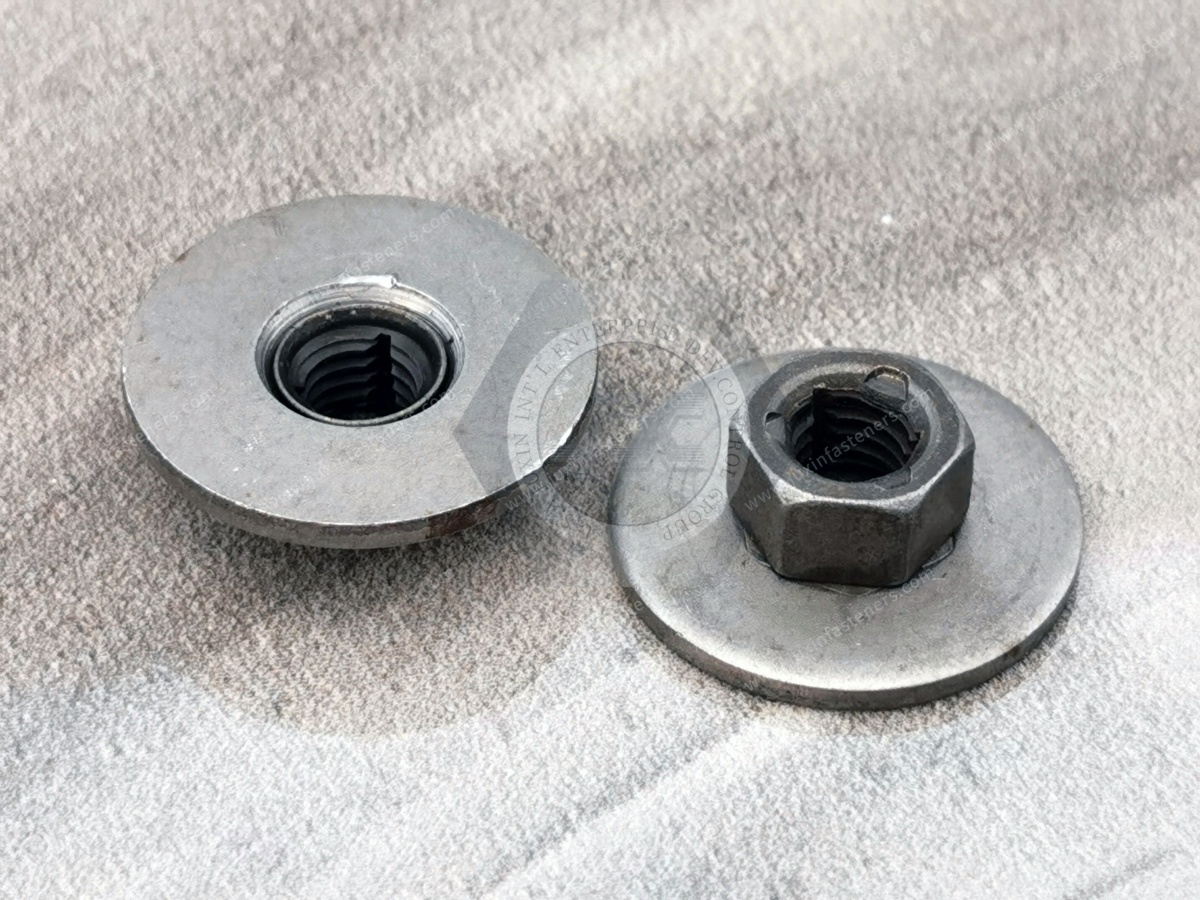
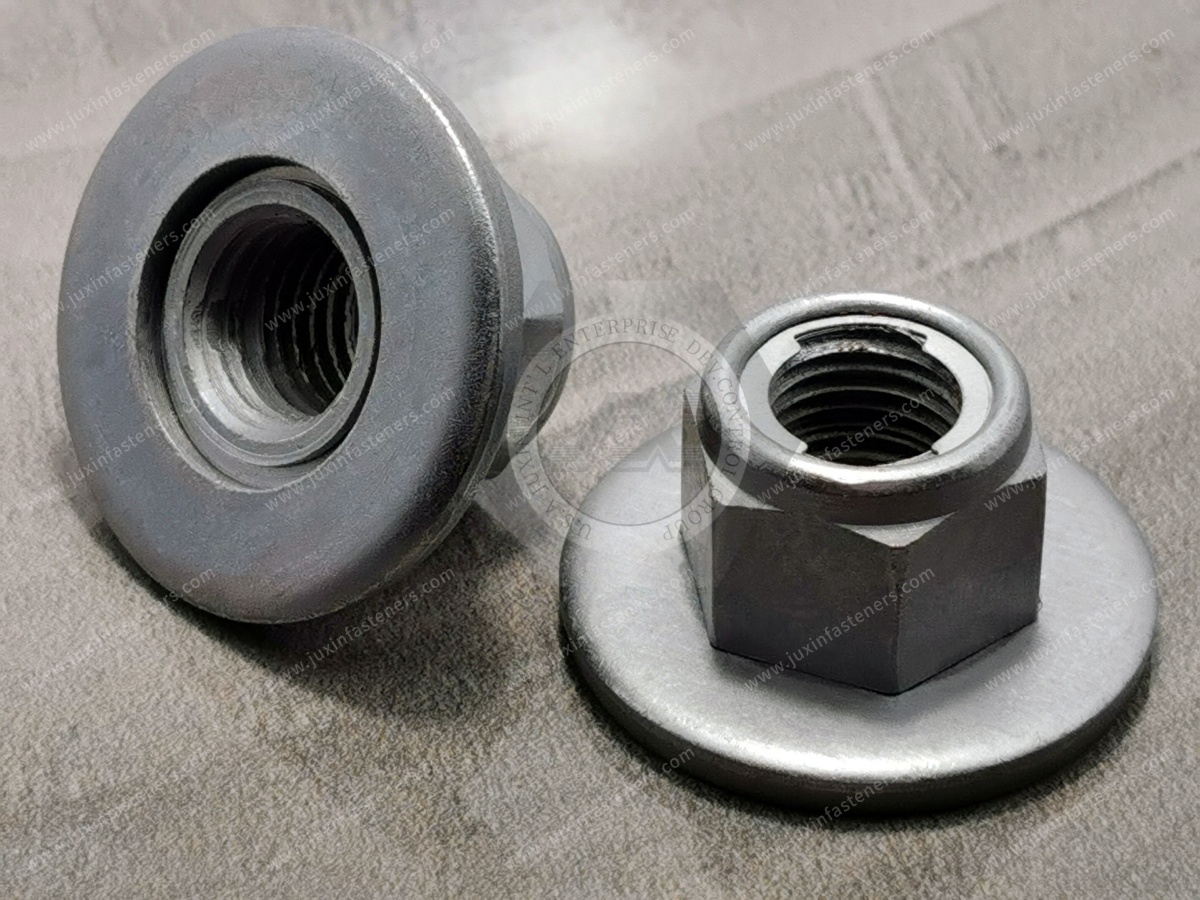
This engineered nut assembly combines a hexagonal steel nut, a metallic prevailing-torque locking feature and a captive washer mechanically retained to the nut while remaining free to rotate.
Unlike an integral flange nut or conventional Keps nut, the washer is a separate component with controlled retention and rotation.
Available thread sizes include M4, M5, M6, M8, M10 and M12, plus #8-32, #10-32, 1/4-20 UNC, 5/16-18 UNC, 3/8-16 UNC and 1/2-13 UNC.
Material options include specified carbon steels and spring steel locking components according to customer drawings.
Surface treatment options include zinc-nickel coatings with specified 720–1000-hour salt spray requirements and environmentally compliant colored zinc finishes with a specified 192-hour requirement.
Test method, corrosion acceptance criteria and coating system must be confirmed for each configuration.
Juxin Fasteners supports OEM/ODM manufacturing, cold heading, forming, washer assembly, mechanical retention and made-to-drawing industrial production.
Product Specification
All-Metal Self-Locking Hex Nuts with Captive Rotating Washers
Automotive Prevailing Torque Lock Nut Assemblies | Free-Rotating Captive Washers | Zinc-Nickel Coating Options
Juxin Fasteners manufactures custom all-metal self-locking hex nuts with captive rotating washers for automotive OEM programs,
Tier-1 and Tier-2 suppliers, industrial machinery manufacturers and engineered fastening applications.
This specialized fastener combines a hexagonal nut, a metallic prevailing-torque locking feature and a separately manufactured washer that is mechanically retained to the nut.
The washer remains captive during handling and assembly while being able to rotate relative to the nut.
Unlike a conventional hex flange nut, the bearing washer is not an integral part of the nut body.
Unlike a standard Keps nut with an external-tooth lock washer, this design uses a smooth captive washer configuration and a separate metallic thread-locking feature.
Juxin Fasteners manufactures these custom nut assemblies for automotive applications requiring controlled locking performance, defined bearing geometry, corrosion protection and consistent production quality.
Product Specifications
| Parameter | Specification |
|---|---|
| Product Name | All-Metal Self-Locking Hex Nuts with Captive Rotating Washers |
| Alternative Names | Captive Washer Lock Nuts; Rotating Washer Hex Nuts; Prevailing Torque Washer Nut Assemblies |
| Product Category | All-Metal Self-Locking Nuts |
| Design | Custom OEM Nut and Washer Assembly |
| Locking Mechanism | Metallic Prevailing-Torque Feature |
| Washer Design | Captive, Free-Rotating |
| Washer Profile | Smooth Conical or Drawing-Specified |
| Nut Materials | Carbon Steel, Including Specified Grade 35 Steel or Other Approved Grades |
| Locking Components | Spring Steel, Including 65Mn Where Specified |
| Metric Threads | M4, M5, M6, M8, M10, M12 |
| Inch Threads | #8-32, #10-32, 1/4-20, 5/16-18, 3/8-16, 1/2-13 |
| Coating Options | Zinc-Nickel; Trivalent Chromate Zinc Plating; Other Approved Finishes |
| Zinc-Nickel Salt Spray Requirement | 720–1000 Hours, Configuration Dependent |
| Colored Zinc Salt Spray Requirement | 192 Hours, Configuration Dependent |
| Manufacturing | Cold Heading, Forming, Threading, Washer Assembly and Retention |
| Customization | OEM/ODM Made-to-Drawing |
All mechanical, dimensional, coating and performance requirements are subject to the approved engineering drawing and customer specifications.
What Is a Captive Rotating Washer Lock Nut?
A captive rotating washer lock nut is a multi-component fastening assembly.
It incorporates a threaded hexagonal nut and a washer that is permanently retained to the nut through a mechanical assembly feature.
The washer cannot normally separate from the nut during handling, but it can rotate relative to the nut body.
This construction differs from a one-piece flange nut.
The washer may remain relatively stationary against the bearing surface while the nut turns during tightening, depending on joint friction and the assembly conditions.
This can influence bearing friction, installation torque and the distribution of contact pressure.
The actual torque–clamp force relationship must be validated for the application.
Three Functional Elements of the Assembly
1. Hexagonal Nut Body
The hexagonal body provides wrenching surfaces for installation.
The nut material and geometry determine the available thread engagement and mechanical load capacity.
2. Metallic Self-Locking Feature
A metallic locking element or specially formed locking region creates interference with the mating bolt thread.
This produces prevailing torque during installation and removal.
The exact locking geometry is controlled by the customer drawing.
3. Captive Rotating Washer
The washer is mechanically retained to the nut while allowing relative rotation.
Its smooth bearing surface and specified profile influence load distribution and contact behavior.
The washer retention design must prevent unintended separation during handling and assembly.
All-Metal Prevailing Torque Locking Mechanism
The self-locking function is provided by a metallic feature acting on the mating thread.
Depending on the approved design, the locking mechanism may use a spring steel element, localized thread interference or a custom formed locking configuration.
The locking feature creates resistance to rotation even before the joint is fully clamped.
This is known as prevailing torque.
Prevailing torque must be distinguished from installation torque and the torque required to generate the specified bolt preload.
The required prevailing-on and prevailing-off torque values should be defined by the customer.
Why a Rotating Washer Matters
A captive rotating washer offers several potential manufacturing and assembly benefits.
These include:
Retention of the washer with the nut during handling.
Reduced risk of missing separate washers.
Simplified parts feeding.
Controlled washer orientation.
Defined bearing geometry.
Potential reduction of surface scuffing compared with aggressive toothed washers.
Suitability for automated fastening processes.
The washer is not guaranteed to remain stationary during tightening.
Its behavior depends on friction, surface condition, coating and joint geometry.
Captive Washer vs. Integral Flange Nut
| Feature | Captive Rotating Washer Lock Nut | Integral Flange Lock Nut |
|---|---|---|
| Bearing Component | Separate Washer | Integral Flange |
| Washer Rotation | Relative Rotation Permitted | Not Applicable |
| Washer Retention | Mechanical Assembly | One-Piece Construction |
| Locking Feature | Metallic Prevailing Torque | Depends on Design |
| Bearing Geometry | Washer-Controlled | Flange-Controlled |
| Manufacturing | Multi-Component Assembly | Nut Manufacturing |
| Typical Selection | Custom Automotive Assemblies | General Flange Fastening |
These products should not be substituted without reviewing the joint design and torque–clamp force requirements.
Captive Washer vs. Keps Nut
A conventional Keps nut, also known as a K-lock nut, commonly incorporates a captive external-tooth lock washer.
The present product uses a smooth washer and a metallic prevailing-torque locking feature.
The two designs rely on different locking and bearing mechanisms.
They should not be described as identical products.
NF E 25-415 Conical Washer Reference
NF E 25-415 is a relevant French standard for hexagon nut and conical washer assemblies.
The current 2022 edition covers hexagon regular nuts with captive smooth conical washers within its specified scope.
For custom automotive assemblies, NF E 25-415 may be used as a reference for relevant washer and nut geometry.
However, the addition of a metallic prevailing-torque locking mechanism may create a customer-specific product outside the standard configuration.
Conformity must be established from the complete approved drawing.
NF E 25-417:1986 Reference
NF E 25-417:1986 describes a prevailing-torque hexagon nut assembly with a non-metallic locking insert and conical washer.
This differs from the metallic locking construction described on this page.
Therefore, NF E 25-417 should not be claimed as a direct product conformity standard unless the supplied configuration includes the required non-metallic locking feature and satisfies the applicable requirements.
Automotive OEM Custom Design
This product family is suitable for customer-engineered automotive fastening programs.
The nut, washer and locking element can be specified as a complete assembly.
Important design parameters include:
Nut width across flats.
Nut height.
Internal thread.
Locking element geometry.
Washer outside diameter.
Washer thickness.
Washer cone angle.
Washer hardness.
Retention geometry.
Rotational freedom.
Prevailing torque.
Coating requirements.
Packaging and feeding orientation.
The final configuration is controlled by the approved automotive engineering drawing.
Metric Thread Specifications
The specified metric range includes:
| Thread | Nominal Diameter | Standard Coarse Pitch |
|---|---|---|
| M4×0.7 | 4 mm | 0.70 mm |
| M5×0.8 | 5 mm | 0.80 mm |
| M6×1.0 | 6 mm | 1.00 mm |
| M8×1.25 | 8 mm | 1.25 mm |
| M10×1.5 | 10 mm | 1.50 mm |
| M12×1.75 | 12 mm | 1.75 mm |
These are nominal metric coarse-thread references.
Fine-thread and special-thread configurations may be evaluated according to customer drawings.
The actual washer diameter and nut dimensions depend on the approved product configuration.
American UNC Thread Specifications
The specified inch-thread range includes:
| Thread | Thread Series | Nominal Diameter | Pitch Equivalent |
|---|---|---|---|
| #8-32 | UNC | 0.1640 in | 0.7938 mm |
| #10-32 | UNF | 0.1900 in | 0.7938 mm |
| 1/4-20 | UNC | 0.2500 in | 1.2700 mm |
| 5/16-18 | UNC | 0.3125 in | 1.4111 mm |
| 3/8-16 | UNC | 0.3750 in | 1.5875 mm |
| 1/2-13 | UNC | 0.5000 in | 1.9538 mm |
The #10-32 thread belongs to the Unified Fine series.
Unified inch-thread dimensions and tolerances should be specified according to ASME B1.1.
Actual product availability and thread class must be confirmed for each configuration.
Metric and Inch Threads Are Not Interchangeable
Metric and Unified threads have different nominal diameters, pitches and tolerance systems.
For example, M6×1.0 and 1/4-20 UNC are not interchangeable.
The mating bolt must match the approved nut thread.
Carbon Steel Nut Materials
The nut body may be manufactured from specified carbon steel grades selected according to the required mechanical properties and forming characteristics.
The supplied material references include grade 35 steel and other cold-heading steel options.
Material designations such as A3 and M08AL require clarification against the approved chemical and mechanical specifications.
They should not be treated as automatically equivalent to ASTM, SAE or EN grades.
Spring Steel Locking Components
Spring steel may be used for the metallic locking feature where required by the approved design.
The supplied material options include 65Mn.
Important considerations include:
Elastic properties.
Hardness.
Heat treatment.
Fatigue behavior.
Locking element geometry.
Surface condition.
Assembly retention.
Compatibility with the mating bolt.
The locking component and nut body may require different material and process specifications.
Nut and Washer Material Selection
The washer material and mechanical properties must be selected according to the application.
Relevant parameters include:
Washer hardness.
Elastic recovery.
Cone geometry.
Bearing load.
Surface finish.
Corrosion compatibility.
Rotational freedom.
Retention strength.
A conical washer should not automatically be assumed to provide a specified spring force without testing.
Zinc-Nickel Plating for Automotive Applications
Zinc-nickel alloy plating is an important corrosion protection option for automotive fasteners.
Juxin Fasteners offers customer-specified zinc-nickel finishes for this product family.
The supplied corrosion resistance requirements include 720–1000 hours of salt spray testing, depending on the approved coating system.
Important coating parameters include:
Zinc-nickel alloy composition.
Coating thickness.
Passivation.
Sealer or topcoat.
Corrosion acceptance criteria.
Friction coefficient.
Coating coverage.
Hydrogen embrittlement risk where applicable.
The salt spray requirement must identify the test method and failure criterion.
A 720-hour or 1000-hour laboratory result must not be interpreted as an equivalent number of hours in actual service.
Colored Zinc Plating
An additional surface treatment option is environmentally compliant colored zinc plating with a specified 192-hour salt spray requirement.
The exact coating system should be defined by the customer.
Relevant parameters include:
Zinc coating thickness.
Trivalent chromate passivation.
Sealer where required.
Friction behavior.
Corrosion test acceptance criteria.
Appearance requirements.
Colored zinc and zinc-nickel finishes should not be considered equivalent corrosion protection systems.
Coating Selection
| Surface Treatment | Specified Salt Spray Requirement | Typical Engineering Consideration |
|---|---|---|
| Zinc-Nickel Alloy | 720 Hours | Automotive Corrosion Protection |
| Zinc-Nickel Alloy | Up to 1000 Hours | Higher Customer-Specified Corrosion Requirement |
| Colored Zinc | 192 Hours | Cost and Corrosion Protection Balance |
| Black Finish | Drawing-Specified | Appearance and Environmental Requirements |
| Other Coatings | Subject to Review | Customer-Specific Applications |
The stated durations are supplied product requirements, not independently verified test results for every size and configuration.
Testing should be performed according to ISO 9227 or another customer-approved method, with clearly defined acceptance criteria.
Hydrogen Embrittlement Considerations
High-strength steel components can be susceptible to hydrogen embrittlement during certain electroplating processes.
The risk depends on material strength, processing history, coating method and applied stress.
Where relevant, the coating specification should address hydrogen embrittlement risk, process controls and required verification.
Prevailing Torque Performance
Prevailing torque is a critical functional characteristic of an all-metal self-locking nut.
Important requirements may include:
First installation prevailing-on torque.
First removal prevailing-off torque.
Repeated installation and removal performance.
Thread condition.
Locking element deformation.
Lubrication and coating effects.
ISO 2320 provides functional requirements and test methods for applicable prevailing-torque steel nuts.
Custom product geometry or thread sizes outside its scope require separately defined acceptance criteria.
Repeated Installation and Removal
Prevailing torque may decrease with repeated use.
The allowable number of installation and removal cycles must be established according to the approved specification.
The product should not be described as indefinitely reusable.
Torque–Clamp Force Relationship
The applied tightening torque is influenced by several factors.
These include:
Thread friction.
Bearing friction.
Prevailing torque.
Coating.
Lubrication.
Washer rotation.
Bolt properties.
Joint geometry.
The captive rotating washer can influence the bearing interface, but it does not guarantee a fixed coefficient of friction.
Automotive assembly programs should validate torque–clamp force behavior under representative conditions.
Washer Retention and Rotational Freedom
The captive washer is mechanically retained to the nut.
The retention feature must prevent unintended separation during normal handling and assembly.
Depending on the customer specification, testing may include:
Washer retention force.
Axial movement.
Rotational freedom.
Washer deformation.
Dimensional inspection.
Functional assembly testing.
The washer should not be described as permanently fixed to the nut body.
Automotive Body and Chassis Components
German automotive OEM and Tier-1 programs may require custom self-locking nut assemblies for selected body and chassis components.
Potential applications include:
Steel mounting brackets.
Automotive body structures.
Equipment support interfaces.
Underbody components.
Vehicle assembly hardware.
Suitability must be established through the approved OEM drawing and joint validation.
Automotive Suspension and Vibration-Sensitive Assemblies
Metallic prevailing-torque nuts may be considered where a defined locking function is required.
The assembly must be evaluated for:
Dynamic loading.
Joint preload.
Prevailing torque.
Washer bearing performance.
Corrosion exposure.
Fatigue and durability.
Service requirements.
Safety-critical automotive applications require specific qualification and testing.
Electric Vehicle Equipment
Electric vehicle manufacturers may use custom lock nut assemblies in suitable structural brackets, equipment mounting interfaces and fabricated components.
The correct design depends on the required load, operating environment and assembly process.
Battery-related and safety-critical applications require additional engineering validation.
Commercial Vehicles and Heavy Equipment
Commercial vehicle manufacturers may require fastening systems that combine a locking function and controlled bearing interface.
Potential applications include:
Steel mounting structures.
Equipment brackets.
Vehicle accessory assemblies.
Fabricated support components.
The joint must be designed for its actual loading and service conditions.
Industrial Machinery
Industrial equipment manufacturers may use captive washer self-locking nuts in suitable assemblies requiring defined locking performance and simplified washer handling.
Potential applications include:
Machinery brackets.
Equipment mounting points.
Industrial enclosures.
Automated machinery assemblies.
Fabricated steel components.
Rail and Transportation Equipment
Transportation equipment may require custom locking nut assemblies with controlled mechanical properties and corrosion protection.
Application-specific vibration, fatigue and safety requirements must be verified.
Agricultural and Construction Equipment
Agricultural and construction machinery may require self-locking fasteners for equipment exposed to vibration, moisture and demanding service conditions.
Material, coating and locking performance must be selected according to the application.
Automated Assembly and Production Efficiency
Captive washer nut assemblies can simplify parts management in high-volume production.
Potential benefits include:
Reduced separate washer handling.
More consistent component presentation.
Simplified assembly logistics.
Controlled washer retention.
Compatibility with customer-specific automated feeding systems.
Actual production efficiency depends on the feeding equipment, washer geometry and assembly process.
Cold Heading and Forming
Juxin Fasteners supports cold heading and cold forming for suitable nut and washer components.
The manufacturing route is selected according to:
Material grade.
Nut geometry.
Washer design.
Production quantity.
Dimensional requirements.
Locking feature design.
Washer Assembly and Mechanical Retention
The captive washer is assembled to the nut through a mechanical retention process.
The retention design must allow the specified washer movement while preventing unintended separation.
Important controls include:
Retention feature dimensions.
Washer alignment.
Rotational freedom.
Axial clearance.
Assembly deformation.
Surface finish after assembly.
The process must follow the approved drawing.
CNC Machining and Secondary Operations
CNC machining may be used for special geometries or drawing-specific requirements.
Secondary processes may include:
Thread manufacturing.
Locking element production.
Heat treatment where specified.
Washer forming.
Mechanical assembly.
Surface treatment.
Inspection.
Not every product requires every process.
OEM/ODM Custom Manufacturing
Juxin Fasteners supports made-to-drawing manufacturing for automotive and industrial customers.
Customization may include:
Metric or Unified threads.
Nut dimensions.
Locking feature geometry.
Washer outside diameter.
Washer cone angle.
Washer thickness.
Retention geometry.
Rotational clearance.
Material specifications.
Mechanical properties.
Coating system.
Prevailing torque requirements.
Packaging for automated assembly.
All custom designs are subject to engineering feasibility review.
Quality Inspection and Testing
Depending on the approved customer specification, inspection may include:
Material verification.
Thread gauging.
Nut dimensions.
Washer dimensions.
Washer retention.
Rotational freedom.
Prevailing-on torque.
Prevailing-off torque.
Repeated-use testing.
Proof-load testing.
Coating thickness.
Corrosion testing.
Torque–clamp force testing.
Packaging inspection.
The actual inspection plan and acceptance criteria must be agreed with the customer.
Production Manager Considerations
Production managers should evaluate:
Nut feeding orientation.
Washer retention consistency.
Rotational freedom.
Installation torque.
Assembly equipment compatibility.
Coating friction consistency.
Rework requirements.
Inspection frequency.
Batch traceability requirements.
Packaging and delivery scheduling.
These factors affect production efficiency and assembly reliability.
Purchasing and Supplier Development Requirements
Purchasing managers and supplier development engineers should verify:
Approved 2D or 3D drawing.
Nut and washer materials.
Thread designation.
Required mechanical properties.
Locking mechanism.
Prevailing torque specification.
Washer retention requirements.
Coating system.
Corrosion test requirements.
Initial order quantity.
Estimated annual demand.
Production approval requirements.
Delivery schedule.
Relevant International Standards
The following standards may be relevant depending on the approved design:
NF E 25-415:2022: Hexagon nut and captive conical washer assemblies.
NF E 25-417:1986: Historical reference for non-metallic insert self-locking nut and conical washer assemblies; not automatically applicable to this all-metal locking design.
ISO 2320: Functional properties of applicable prevailing-torque steel nuts.
ISO 898-2: Mechanical properties of applicable carbon steel and alloy steel nuts.
ISO 261: ISO metric screw-thread general plan.
ISO 965 Series: ISO metric screw-thread tolerances.
ASME B1.1: Unified inch screw threads.
ISO 16047: Torque–clamp force testing.
ISO 9227: Salt spray corrosion testing.
The customer drawing and approved technical specifications remain controlling.
Reference to these standards does not independently establish product certification or conformity.
Frequently Asked Questions
What is an all-metal self-locking nut with a captive rotating washer?
It is a multi-component nut assembly combining a metallic prevailing-torque locking feature and a mechanically retained washer that can rotate relative to the nut.
Is the washer permanently attached?
The washer is captive, but it remains free to rotate according to the approved design.
Is this an ordinary flange lock nut?
No. The washer is a separate retained component rather than an integral flange.
Is this a Keps nut?
Not in the conventional external-tooth washer sense. This design has a different locking and bearing arrangement.
Does the washer provide the self-locking function?
The specified product uses a metallic thread-locking feature. The washer primarily provides the defined bearing interface.
Does the product contain a nylon locking insert?
The described configuration uses a metallic locking mechanism. Non-metallic locking inserts should not be assumed unless specified on the drawing.
What metric sizes are available?
M4, M5, M6, M8, M10 and M12 are included in the specified range.
What inch-thread sizes are available?
The specified range includes #8-32, #10-32, 1/4-20, 5/16-18, 3/8-16 and 1/2-13.
Are metric and UNC/UNF threads interchangeable?
No. Thread diameter, pitch and tolerance must match the mating bolt.
What is the advantage of a captive washer?
It keeps the washer with the nut during handling and may simplify assembly logistics.
Can the washer rotate during tightening?
The washer is designed to permit relative rotation, but actual behavior depends on the bearing interface and joint conditions.
What corrosion protection options are available?
The specified options include zinc-nickel alloy coatings and colored zinc finishes.
Does zinc-nickel plating guarantee 1000 hours of corrosion resistance?
Not for every configuration. The required salt spray duration, test method and acceptance criteria must be specified and verified.
Can the product be used in automotive applications?
Yes, where the approved engineering design, material, locking performance and coating requirements support the application.
Can Juxin Fasteners manufacture custom washer dimensions?
Yes. Custom washer geometry and retention designs can be evaluated according to customer drawings.
Can the nut be reused?
Reuse depends on the approved prevailing-torque requirements and the locking performance after repeated installation and removal.
Request a Quote — Automotive Captive Washer Lock Nuts
Juxin Fasteners is an industrial fastener manufacturer supporting automotive OEMs,
Tier-1 and Tier-2 suppliers, industrial machinery manufacturers, mechanical engineers, manufacturing engineers, production managers, purchasing managers and supplier development teams.
Our manufacturing capabilities include cold heading, cold forming, CNC machining where required, washer forming, mechanical assembly and appropriate secondary operations.
We support OEM/ODM fastener manufacturing, made-to-drawing production and industrial batch manufacturing.
Recommended RFQ Information
2D engineering drawing or 3D CAD model.
Metric or Unified thread designation.
Thread tolerance.
Nut material and property class.
Locking element material.
Washer material.
Washer outside diameter and thickness.
Washer profile and cone angle.
Retention geometry.
Washer rotational and axial clearance.
Prevailing-on and prevailing-off torque requirements.
Repeated installation and removal requirements.
Proof-load requirements.
Coating specification.
Salt spray test method and acceptance criteria.
Torque–clamp force requirements.
Inspection and approval requirements.
Sample requirements.
Initial order quantity.
Estimated annual demand.
Packaging and delivery requirements.
Please send your engineering drawings and technical specifications for manufacturing feasibility review and quotation.
Juxin Fasteners
Industrial Fastener Manufacturer | Automotive Captive Washer Lock Nuts | All-Metal Prevailing Torque Nuts | Custom Rotating Washer Assemblies | OEM/ODM Manufacturing
Website: https://www.juxinfasteners.com/
Email: info@juxinfasteners.com
Product Packaging
Packaging Standard
At Juxin Fasteners, we apply standardized export packaging to ensure product protection, traceability, and compliance with international logistics requirements.
1. Standard Export Packaging
Unless otherwise specified, all products will be packed according to our factory standard export packaging, which includes:
Moisture-resistant inner protection
Poly bag or small box packing as required
Reinforced export cartons
Clear labeling with part number, specification, batch number, and quantity
Palletizing for sea or air shipment when necessary
Our standard packaging is designed to ensure safe transportation, efficient warehousing, and long-distance international shipping.
2. Customized Packaging Options
We also provide customized packaging solutions according to customer requirements, including but not limited to:
Private labeling
Customized barcodes
Specific carton dimensions
Retail packaging
Special pallet configuration
Customer-specific marking and identification
So that you know, customized packaging may involve additional costs and extended lead time depending on the complexity of the requirements.
3. Compliance & Quality Assurance
All packaging processes are controlled under our ISO 9001 quality management system to ensure consistency, traceability, and product integrity throughout the supply chain.
Product Pictures


Contact Us
Tel.:
+86 020 8621 0320
+86 020 3121 6067
E-mail:
Technical Support:
Navigation
SEND INQUIREY


