Call Us
+86 136 6007 9809
Call Us
+86 136 6007 9809

JUXIN FASTENERS manufactures stainless steel Spring-Stop Locknuts for OEM equipment requiring a metal spring prevailing-torque locking mechanism and material selection suited to the service environment.
Also known in the North American industrial fastener market as Fuji-style locknuts, these hex nuts use an elastic metal locking feature rather than a nylon insert or external cotter pin.
This stainless steel product family is intended for engineering evaluation in outdoor equipment, industrial machinery,
HVAC systems, telecommunications cabinets, electrical enclosures, cleaning equipment and other assemblies exposed to moisture or repeated maintenance.
Stainless steel grade, locking spring material, corrosion compatibility, prevailing-torque requirements and reuse performance must be confirmed against the customer's specification.
A2/304 and A4/316 grades are material options for technical evaluation, not automatic claims about every available product.
JUXIN supports made-to-drawing OEM/ODM manufacturing, metric thread configurations, custom UNC/UNF designs, dimensional inspection and batch production for international industrial customers.
Product Specification
Stainless Steel Spring-Stop Locknuts
Corrosion-Resistant Material Selection, Metal Spring Locking and OEM Manufacturing for Industrial Equipment
JUXIN FASTENERS manufactures standard and custom industrial fasteners for OEM manufacturers, Tier-1 and Tier-2 suppliers,
design engineers, mechanical engineers, production managers, supplier development teams and international procurement organizations.
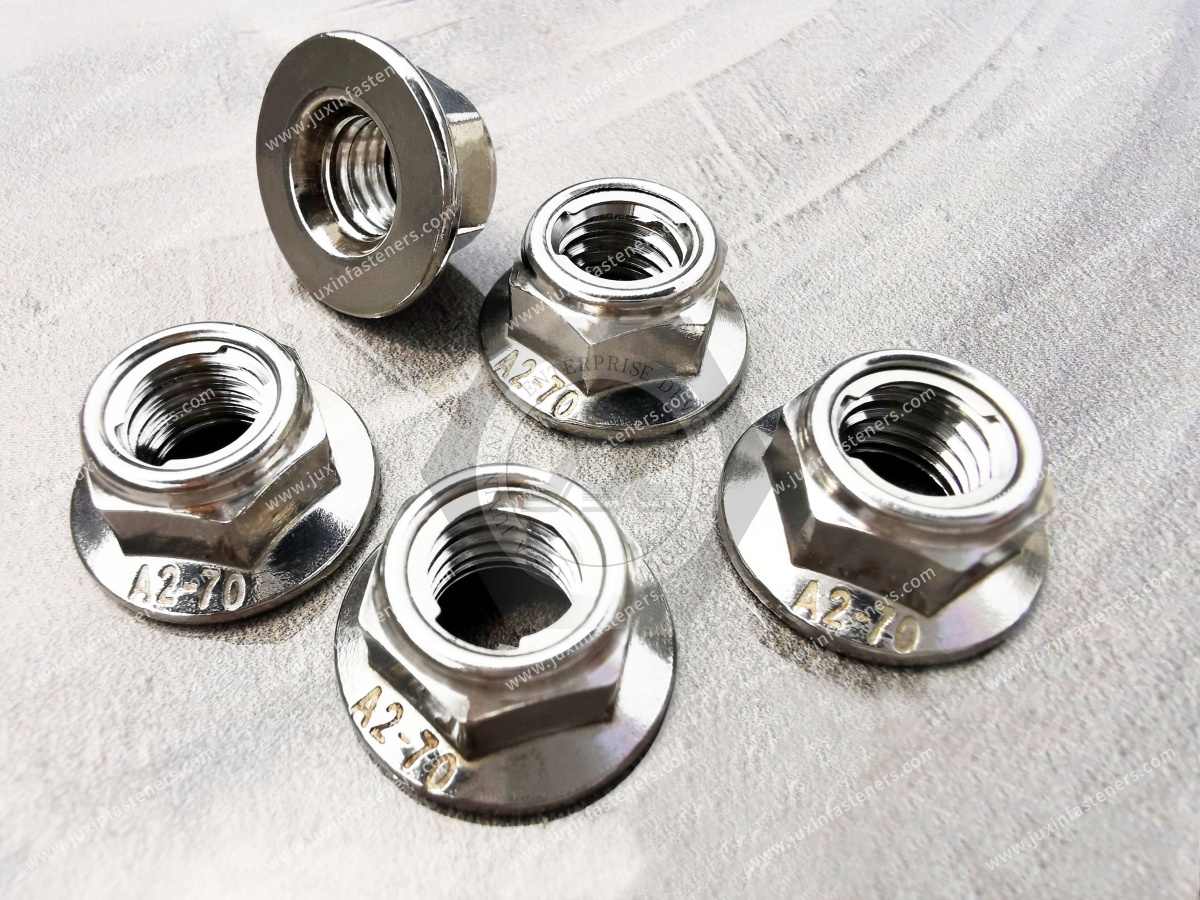
Our stainless steel Spring-Stop Locknuts combine a stainless steel hexagonal nut body with a metal spring locking feature designed to generate prevailing torque during installation.
In the North American industrial fastener market, related products are also called Fuji locknuts or Fuji-style spring locking nuts.
Unlike nylon-insert locknuts, this locking mechanism does not rely on a polymer insert.
Unlike slotted castle nuts, it does not require a transverse hole in the mating bolt or a separate cotter pin.
For stainless steel versions, however, the engineering decision involves more than the nut body material.
The material of the spring locking element, corrosion compatibility, thread condition, installation friction and required prevailing torque must also be considered.
JUXIN supports made-to-drawing fastener manufacturing, custom thread requirements, material selection, secondary processing and industrial batch production.
Product Specifications
| Parameter | Specification |
|---|---|
| Product Name | Stainless Steel Spring-Stop Locknut |
| Related Market Name | Fuji-Style Spring Locknut |
| Nut Body Material | Stainless Steel |
| Spring Locking Element | Metal Spring; Exact Material to Be Confirmed |
| Locking Mechanism | Spring-Generated Prevailing Torque |
| Thread System | ISO Metric; Custom Inch Series Subject to Review |
| Stainless Grades | A2/304 and A4/316 Options Subject to Confirmation |
| Typical Finish | Customer-Specified Stainless Steel Surface Condition |
| Nylon Insert | Not Used |
| Cotter Pin | Not Required |
| OEM Production | Standard and Made-to-Drawing |
| Functional Acceptance | Customer-Approved Prevailing-Torque Specification |
The finished product must be evaluated against its actual drawing, material requirements and functional acceptance criteria.
What Is a Stainless Steel Spring-Stop Locknut?
A stainless steel Spring-Stop Locknut is a hexagonal prevailing-torque nut with an elastic metal locking feature.
When the mating bolt engages the locking element, the element deflects and develops contact pressure.
This creates rotational resistance that helps restrict unintended nut rotation.
The stainless steel nut body provides a material option for environments where corrosion resistance is important.
However, the locking performance depends on the complete nut assembly, not solely on the stainless steel body.
Why Stainless Steel Changes the Engineering Decision
Compared with a carbon steel Spring-Stop Locknut, a stainless steel version introduces additional design considerations:
Resistance to moisture and atmospheric corrosion.
Corrosion compatibility between the nut body and spring element.
Thread friction and galling.
Stainless steel mechanical property requirements.
Surface condition and cleaning requirements.
Potential galvanic interactions.
Prevailing-torque stability after environmental exposure.
These factors can influence service life and installation reliability.
Stainless Steel Nut Body vs. Spring Locking Element
A Spring-Stop Locknut consists of more than one functional feature.
The nut body and the spring locking component may have different material requirements.
For example, the spring element must provide the required elastic behavior while maintaining adequate strength and environmental durability.
An OEM drawing should therefore identify the material of each component.
A stainless steel nut body does not automatically prove that the spring element is stainless steel.
If the spring material differs from the nut body, the corrosion behavior of the complete assembly must be evaluated.
A2/304 vs. A4/316 Stainless Steel
Stainless steel grades should be selected according to the operating environment and mechanical requirements.
| Selection Factor | A2 / 304 Stainless Steel | A4 / 316 Stainless Steel |
|---|---|---|
| General Atmospheric Exposure | Common Engineering Option | Common Engineering Option |
| Moisture Exposure | Application-Dependent | Application-Dependent |
| Chloride-Containing Environments | More Limited Resistance | Generally Improved Resistance |
| Marine-Adjacent Equipment | Requires Environmental Review | Often Preferred for Evaluation |
| Cleaning Chemicals | Chemical Compatibility Required | Chemical Compatibility Required |
| Cost Consideration | Often Lower | Often Higher |
| Spring Element Compatibility | Must Be Verified | Must Be Verified |
These are general material-selection considerations.
They do not establish that a specific JUXIN product is currently available in every listed grade.
Actual material designations and mechanical properties must be confirmed for each order.
Why Stainless Steel Does Not Mean Corrosion-Proof
Stainless steel can still experience corrosion.
Potential mechanisms include:
Pitting corrosion.
Crevice corrosion.
Galvanic corrosion.
Stress corrosion cracking in susceptible conditions.
Corrosion of dissimilar spring components.
Surface contamination from processing or handling.
Corrosion resistance depends on material grade, environment, geometry, surface condition and maintenance.
Corrosion at the Spring Locking Interface
The spring locking feature is a critical functional area.
If moisture or contaminants accumulate around the spring element, corrosion may affect its movement and contact pressure.
Possible consequences include:
Increased installation torque.
Reduced spring elasticity.
Inconsistent removal torque.
Localized corrosion.
Difficult disassembly.
Premature loss of locking performance.
For corrosive environments, the entire locking mechanism should be evaluated rather than considering the nut body alone.
Metal Spring Locking vs. Nylon-Insert Locking
| Feature | Stainless Spring-Stop Locknut | Stainless Nylon-Insert Locknut |
|---|---|---|
| Locking Element | Metal Spring | Polymer Insert |
| Prevailing-Torque Principle | Elastic Metal Contact | Polymer Thread Interference |
| Polymer Insert | No | Yes |
| Temperature Limit | Depends on Complete Metal Assembly | Depends in Part on Polymer |
| Reuse | Requires Cycle Testing | Requires Cycle Testing |
| Corrosion Performance | Depends on All Components | Depends on All Components |
| Typical Selection | Metal Spring Locking Required | Nylon-Insert Locking Specified |
Neither design should automatically replace the other.
Stainless Spring-Stop Locknuts vs. Distorted-Thread Nuts
Conventional all-metal distorted-thread locknuts generate prevailing torque through controlled deformation of the nut's threaded region.
Spring-Stop Locknuts use a distinct elastic metal locking feature.
Both are metal-based locking solutions, but their geometry, torque behavior and production requirements may differ.
An OEM should not substitute one for the other solely because both are described as all-metal locknuts.
Metric Thread Selection
The previous carbon steel Spring-Stop product family includes M5, M6, M8, M10 and M12.
These are useful metric reference sizes when discussing the stainless steel version.
However, the actual stainless steel size range must be confirmed independently.
| Metric Thread | Standard Coarse Pitch | Nominal Diameter in Inches |
|---|---|---|
| M5 | 0.80 mm | 0.1969 in |
| M6 | 1.00 mm | 0.2362 in |
| M8 | 1.25 mm | 0.3150 in |
| M10 | 1.50 mm | 0.3937 in |
| M12 | 1.75 mm | 0.4724 in |
The listed thread pitches are ISO metric coarse-thread references.
They are not confirmation of current stainless steel stock.
The inch values are nominal diameter conversions only.
They are not equivalent Unified thread sizes.
Custom Metric Fine Threads
Some equipment manufacturers specify metric fine threads.
Potential engineering references include:
| Metric Thread | Pitch |
|---|---|
| M6 × 0.75 | 0.75 mm |
| M8 × 1.0 | 1.00 mm |
| M10 × 1.25 | 1.25 mm |
| M12 × 1.25 | 1.25 mm |
| M12 × 1.5 | 1.50 mm |
Custom fine-thread Spring-Stop designs require review of the nut geometry and spring engagement.
These references do not indicate confirmed availability.
American UNC and UNF Thread References
American OEM manufacturers may specify stainless steel spring locking nuts using Unified inch-series threads.
JUXIN can review these requirements separately against approved drawings.
| Nominal Size | UNC Coarse Thread | UNF Fine Thread |
|---|---|---|
| #8 | #8-32 | #8-36 |
| #10 | #10-24 | #10-32 |
| 1/4 in | 1/4-20 | 1/4-28 |
| 5/16 in | 5/16-18 | 5/16-24 |
| 3/8 in | 3/8-16 | 3/8-24 |
| 7/16 in | 7/16-14 | 7/16-20 |
| 1/2 in | 1/2-13 | 1/2-20 |
| 9/16 in | 9/16-12 | 9/16-18 |
| 5/8 in | 5/8-11 | 5/8-18 |
| 3/4 in | 3/4-10 | 3/4-16 |
These are standard thread references, not a confirmed product inventory.
Custom inch-series production requires separate dimensional and functional validation.
Metric, UNC and UNF Threads Are Not Interchangeable
Examples:
M6 × 1.0 is not interchangeable with 1/4-20 UNC.
M8 × 1.25 is not interchangeable with 5/16-18 UNC.
M10 × 1.5 is not interchangeable with 3/8-16 UNC.
M12 × 1.75 is not interchangeable with 1/2-13 UNC.
Metric, UNC, UNF, BSW and BSF are distinct thread systems.
Nominal diameter similarity does not establish compatibility.
Stainless Steel Thread Galling
Galling is an important consideration in stainless steel threaded assemblies.
It can occur when contacting metal surfaces experience adhesive wear during tightening or removal.
Potential contributing factors include:
High contact pressure.
Thread surface condition.
Installation speed.
Lubrication.
Material pairing.
Repeated installation.
Prevailing-torque resistance.
A Spring-Stop Locknut introduces additional resistance through its locking feature.
Therefore, thread galling and locking torque should be considered together.
Reducing Galling Risk During Installation
Engineering controls may include:
Specifying compatible mating materials.
Verifying thread tolerances.
Using suitable approved lubrication.
Controlling installation speed.
Avoiding cross-threading.
Monitoring torque behavior.
Evaluating surface treatments.
Testing repeated installation cycles.
Lubrication can change the relationship between applied torque and joint preload.
It may also influence prevailing torque.
Any lubrication change should be included in assembly validation.
Prevailing Torque and Joint Preload
Prevailing torque is the resistance generated by the locking feature before the nut seats against the joint.
Joint preload is generated during final tightening.
These are different quantities.
The total installation torque includes both the locking resistance and the torque associated with joint clamping.
For stainless steel assemblies, friction variation can be significant.
Therefore, a free-spinning hex nut tightening specification should not automatically be applied to a Spring-Stop Locknut.
Recommended Functional Verification
An OEM approval program may include:
First-installation prevailing torque.
First-removal prevailing torque.
Subsequent removal prevailing torque.
Reuse-cycle performance.
Thread damage inspection.
Spring-element retention.
Proof-load performance.
Corrosion exposure.
Functional testing after environmental conditioning.
The acceptance criteria must be defined by the applicable product specification.
Repeated Assembly and Maintenance
Spring-Stop Locknuts are often considered where repeated installation and removal may be necessary.
However, stainless steel construction does not guarantee unlimited reuse.
Locking performance may change due to:
Spring fatigue.
Thread wear.
Surface damage.
Corrosion.
Lubrication variation.
Installation errors.
Thermal exposure.
The allowable reuse cycles should be established through testing.
Outdoor Industrial Equipment
Stainless steel Spring-Stop Locknuts may be considered for suitable outdoor mechanical assemblies.
Potential applications include:
Equipment mounting brackets.
External machinery accessories.
Serviceable mechanical fixtures.
Weather-exposed support hardware.
The complete locking assembly must be evaluated for moisture, corrosion, vibration and mechanical loading.
HVAC Equipment Manufacturing
HVAC systems may contain assemblies exposed to condensation, humidity and repeated servicing.
Potential applications include:
Equipment brackets.
Fan accessory mounting.
Serviceable mechanical covers.
Auxiliary machinery fixtures.
Vibration, corrosion and maintenance requirements must be reviewed.
Telecommunications Equipment and Outdoor Cabinets
Telecommunications equipment may require fasteners for outdoor enclosures and auxiliary mounting systems.
Potential applications include:
Cabinet mounting accessories.
External support brackets.
Equipment frames.
Serviceable fixture connections.
Where electrical grounding or bonding is required, the joint must be separately qualified.
Electrical Enclosures and Power Equipment
Stainless steel Spring-Stop Locknuts may be evaluated for suitable mechanical connections in power distribution equipment.
Potential uses include:
Enclosure accessories.
Instrumentation brackets.
External mounting fixtures.
Serviceable equipment supports.
Electrical conductivity, grounding and temperature requirements must be evaluated separately.
AI Data Center Infrastructure
Potential applications include selected mechanical accessories in data center equipment.
Examples include:
Equipment mounting brackets.
Auxiliary cabinet hardware.
Serviceable mechanical fixtures.
For thin sheet metal assemblies, self-clinching nuts, rivet nuts or other captive fastening solutions may be more suitable.
The fastener should be selected according to the actual enclosure design.
Industrial Washdown Equipment
Equipment exposed to frequent cleaning may require stainless steel fasteners.
Potential applications include:
External machinery brackets.
Equipment covers.
Serviceable mechanical accessories.
Cleaning chemicals, moisture retention and spring-element corrosion must be considered.
Food Processing Machinery
Stainless steel Spring-Stop Locknuts may be evaluated for suitable non-food-contact mechanical assemblies.
Food-contact or hygienic applications require separate material, cleanability and regulatory qualification.
No food-contact certification is implied.
Pharmaceutical Equipment
Potential applications include suitable external equipment fixtures.
Requirements may include cleaning compatibility, contamination control and material documentation.
The complete locking assembly must be evaluated for the intended environment.
Marine and Coastal Equipment
A4/316 stainless steel may be considered where improved resistance to certain chloride-containing environments is required.
However, the spring locking element and any dissimilar metal interfaces also require corrosion assessment.
No universal seawater compatibility is claimed.
Renewable Energy Equipment
Potential applications include selected mechanical accessories for solar, energy storage and other outdoor energy equipment.
Factors to review include:
Moisture.
Temperature cycling.
Vibration.
Corrosion.
Long-term inspection access.
Structural or safety-critical uses require specific engineering qualification.
Industrial Automation and Robotics
Potential applications include:
Equipment brackets.
Sensor mounts.
Protective covers.
Serviceable fixtures.
Auxiliary mechanical supports.
Dynamic loading and repeatability requirements must be reviewed.
Semiconductor Equipment
Potential applications are limited to suitable external mechanical fixtures.
Cleanroom, vacuum, outgassing and contamination requirements must be separately validated.
Stainless steel alone does not establish semiconductor-equipment suitability.
Medical Equipment
Potential applications include suitable external or non-patient-contact mechanical assemblies.
Medical-device applications require product-specific regulatory and engineering qualification.
No medical-device certification is claimed.
When Stainless Steel Spring-Stop Locknuts May Not Be Appropriate
An alternative fastener may be required when:
The spring element is not suitable for the environment.
The required preload exceeds the nut's mechanical capability.
Prevailing torque cannot be controlled.
Thread galling cannot be adequately managed.
The required reuse performance is not achieved.
The application requires a different locking principle.
The assembly requires special regulatory qualification.
Selection must be based on the complete joint design.
Common Failure Modes and Engineering Responses
| Potential Problem | Engineering Concern | Recommended Review |
|---|---|---|
| Thread Seizure | Stainless Steel Galling | Material Pairing, Lubrication and Installation |
| Loss of Locking Torque | Spring Wear or Damage | Reuse-Cycle Testing |
| Corrosion Near Spring | Dissimilar Material Exposure | Spring Material and Environmental Testing |
| Excessive Tightening Torque | Friction and Locking Resistance | Assembly Torque Validation |
| Inconsistent Removal Torque | Wear, Coating or Lubrication | Functional Test Procedure |
| Thread Stripping | Incompatible Strength Selection | Nut and Bolt Mechanical Properties |
| Unexpected Corrosion | Incorrect Stainless Grade | Service Environment Review |
JUXIN FASTENERS OEM Manufacturing Capabilities
JUXIN FASTENERS is an industrial fastener manufacturer supporting international OEM/ODM programs.
Our broader manufacturing capabilities include:
Cold heading and cold forming.
CNC machining.
Internal threading.
Secondary machining.
Product-specific assembly operations.
Customer-defined surface finishing.
Manufacturing according to 2D and 3D drawings.
Industrial batch production.
The manufacturing route for stainless steel Spring-Stop Locknuts depends on the approved nut geometry, material, spring construction and production quantity.
OEM Customization Options
JUXIN can review:
Metric coarse-thread designs.
Metric fine-thread designs.
UNC and UNF inch-series threads.
A2/304 stainless steel nut bodies.
A4/316 stainless steel nut bodies.
Spring-element material requirements.
Custom hex dimensions.
Custom nut height.
Prevailing-torque performance requirements.
Reuse-cycle requirements.
Surface condition and finishing.
Customer-defined inspection plans.
OEM part numbering.
Industrial packaging.
Annual purchasing programs.
Availability and feasibility must be confirmed against the actual engineering requirements.
Quality Control for Stainless Steel Spring-Stop Locknuts
A product-specific quality plan may include:
Nut body material verification.
Spring material verification.
Thread gauge inspection.
Nut dimensional inspection.
Spring-element retention inspection.
Prevailing-torque testing.
Reuse-cycle testing.
Thread galling assessment.
Surface condition inspection.
Corrosion testing where specified.
Packaging and traceability review.
Testing requirements and acceptance limits must be agreed before production.
Applicable Engineering Standards
ISO 7719:2025
Specifies regular-height all-metal prevailing-torque hexagon nuts with metric coarse threads in steel and stainless steel.
Its applicability depends on the actual nut geometry and performance requirements.
ISO 7042:2025
Specifies high all-metal prevailing-torque hexagon nuts with metric coarse threads in steel and stainless steel.
High and regular nut designs should not be confused.
ISO 3506-2
Provides mechanical property requirements for specified corrosion-resistant stainless steel nuts.
The correct grade and property class must be selected.
ASME B18.16.6
Provides requirements for defined inch-series prevailing-torque locknut configurations.
Its applicability to a custom stainless Spring-Stop design must be verified rather than assumed.
ASME B1.1
Provides Unified inch screw-thread requirements, including UNC and UNF.
ISO 261, ISO 724 and ISO 965
Provide relevant metric thread selection, basic dimensions and tolerance references.
Important Standard Qualification Note
A Spring-Stop Locknut should not automatically be declared compliant with ISO 7719, ISO 7042, DIN 980 or ASME B18.16.6 merely because it uses a metal locking element.
The actual geometry, materials, mechanical properties and functional testing must meet the applicable requirements.
Frequently Asked Questions
What is a stainless steel Spring-Stop Locknut?
It is a stainless steel hex nut with a metal spring locking feature that generates prevailing torque.
Are Spring-Stop Locknuts called Fuji locknuts in the United States?
Yes. Fuji locknuts is a market term used for related spring locking designs. JUXIN uses Fuji-style descriptively and does not claim affiliation with the brand.
Is the spring element also stainless steel?
Not necessarily. Its exact material must be confirmed for the specified product.
Can the nut body be made from 304 or 316 stainless steel?
A2/304 and A4/316 options can be evaluated against the customer drawing and manufacturing requirements.
Are these nuts suitable for marine equipment?
Only where the complete nut assembly, including the spring element, is suitable for the actual environment.
Can stainless Spring-Stop Locknuts be reused?
Reuse depends on verified prevailing-torque performance after repeated installation and removal.
Do these nuts prevent stainless steel galling?
No. Galling risk must be addressed through material selection, surface condition, lubrication and installation control.
Can JUXIN manufacture custom UNC or UNF versions?
Custom inch-series designs can be reviewed according to approved drawings.
Are metric and inch threads interchangeable?
No. Metric, UNC and UNF are different thread systems.
Are stainless Spring-Stop Locknuts suitable for high temperatures?
The operating temperature range depends on the complete nut assembly and must be validated.
Are these identical to DIN 980 distorted-thread locknuts?
Not necessarily. The locking structure and performance requirements may differ.
Does JUXIN support OEM manufacturing?
Yes. JUXIN supports custom fastener manufacturing and industrial batch production according to approved requirements.
Request a Quote — Stainless Steel Spring-Stop Locknut Manufacturer
JUXIN FASTENERS manufactures standard and custom industrial fasteners for international OEM, Tier-1 and Tier-2 manufacturing programs.
For stainless steel Spring-Stop Locknut projects, our engineering and manufacturing teams can review the required material, thread system, locking feature, dimensional requirements and industrial production quantities.
Recommended RFQ Information
Metric or UNC/UNF thread designation.
Nut body material grade.
Spring locking element material.
Nut height and width across flats.
Spring locking feature drawing.
Mating bolt material and thread tolerance.
Required prevailing-torque range.
First-installation and removal torque limits.
Required reuse-cycle performance.
Operating temperature.
Corrosion environment.
Surface finish requirements.
Installation and lubrication conditions.
Applicable standards.
Inspection and testing requirements.
Order quantity and annual forecast.
Packaging and delivery requirements.
Please send your 2D drawings, 3D CAD models and technical purchasing requirements for manufacturing review and quotation.
JUXIN FASTENERS
Industrial Fastener Manufacturer | OEM/ODM Custom Fastener Manufacturing | Cold Heading, Cold Forming and CNC Machining
Website: https://www.juxinfasteners.com/
Email: info@juxinfasteners.com
Product Packaging
Packaging Standard
At Juxin Fasteners, we apply standardized export packaging to ensure product protection, traceability, and compliance with international logistics requirements.
1. Standard Export Packaging
Unless otherwise specified, all products will be packed according to our factory standard export packaging, which includes:
Moisture-resistant inner protection
Poly bag or small box packing as required
Reinforced export cartons
Clear labeling with part number, specification, batch number, and quantity
Palletizing for sea or air shipment when necessary
Our standard packaging is designed to ensure safe transportation, efficient warehousing, and long-distance international shipping.
2. Customized Packaging Options
We also provide customized packaging solutions according to customer requirements, including but not limited to:
Private labeling
Customized barcodes
Specific carton dimensions
Retail packaging
Special pallet configuration
Customer-specific marking and identification
So that you know, customized packaging may involve additional costs and extended lead time depending on the complexity of the requirements.
3. Compliance & Quality Assurance
All packaging processes are controlled under our ISO 9001 quality management system to ensure consistency, traceability, and product integrity throughout the supply chain.
Product Pictures


Contact Us
Tel.:
+86 020 8621 0320
+86 020 3121 6067
E-mail:
Technical Support:
Navigation
SEND INQUIREY