
Call Us
+86 136 6007 9809
Call Us
+86 136 6007 9809

Juxin Fasteners manufactures automotive prevailing torque hex lock nuts with captive rotating washers for German automotive OEM programs, Tier-1 suppliers and engineered industrial assemblies.
This custom fastening assembly combines a carbon steel hex nut, a metallic thread-locking feature and a mechanically retained washer that remains free to rotate relative to the nut.
The smooth washer provides a drawing-defined bearing interface, while the metallic locking feature generates prevailing torque independently of the washer.
The specified range includes M4–M12 metric sizes and selected UNC/UNF inch threads. Zinc-nickel alloy coating options are available for customer-specified 720–1000-hour salt spray requirements.
Other surface finishes are subject to the approved drawing and coating specification.
Juxin Fasteners supports OEM/ODM manufacturing, cold heading, washer forming, mechanical retention, secondary processing and batch production.
Automotive projects can specify prevailing torque, washer retention, torque–clamp force behavior, coating friction and corrosion testing requirements.
Product Specification
Automotive Prevailing Torque Lock Nuts with Captive Conical Washers
Zinc-Nickel Plated All-Metal Lock Nut Assemblies for Automotive OEM Production
Juxin Fasteners manufactures custom automotive prevailing torque lock nuts with captive rotating washers for German automotive OEM programs,
Tier-1 and Tier-2 suppliers, and industrial equipment manufacturers.
These engineered fastener assemblies combine a hexagonal steel nut, a metallic thread-locking mechanism and a mechanically retained washer that remains free to rotate relative to the nut body.
The metallic locking feature generates prevailing torque through controlled interference with the mating bolt thread.
The captive washer provides a separate bearing interface and eliminates the need to handle a loose washer during assembly.
Unlike a one-piece hex flange nut, this product uses a separately manufactured washer retained by a mechanical assembly process.
Juxin Fasteners supports OEM/ODM manufacturing based on customer 2D drawings, 3D CAD models and technical specifications.
Product Specifications
| Parameter | Specification |
|---|---|
| Product Name | Automotive Prevailing Torque Lock Nuts with Captive Conical Washers |
| Product Category | All-Metal Self-Locking Nuts |
| Alternative Names | Automotive Captive Washer Lock Nuts; Rotating Washer Lock Nut Assemblies |
| Nut Configuration | Hexagonal |
| Locking Mechanism | Metallic Prevailing-Torque Feature |
| Washer Configuration | Captive and Free-Rotating |
| Washer Profile | Smooth Conical, Where Specified |
| Nut Material | Customer-Specified Carbon Steel |
| Locking Component | Spring Steel, Including 65Mn Where Specified |
| Metric Threads | M4, M5, M6, M8, M10, M12 |
| Inch Threads | #8-32, #10-32, 1/4-20, 5/16-18, 3/8-16, 1/2-13 |
| Primary Coating Option | Zinc-Nickel Alloy |
| Salt Spray Requirement | 720–1000 Hours, According to Specification |
| Alternative Coating | Colored Zinc with Specified 192-Hour Requirement |
| Manufacturing | Cold Heading, Forming, Threading, Washer Assembly |
| Customization | OEM/ODM Made-to-Drawing |
Final dimensions, mechanical properties, coating specifications and functional acceptance criteria must follow the approved customer drawing.
Engineered for Automotive OEM Assembly
Automotive fastening applications require more than the correct thread size.
Engineers must evaluate the complete joint, including the locking mechanism, bearing interface, material properties, coating friction and assembly process.
A captive washer prevailing torque nut can combine two distinct functions:
A metallic locking feature that resists unintentional nut rotation.
A retained washer that provides a controlled bearing surface during tightening.
These functions must be evaluated separately.
The washer is not the sole source of thread locking, and the locking feature does not automatically establish the required joint preload.
Metallic Prevailing Torque Locking
The locking mechanism creates resistance to rotation through controlled contact with the mating bolt thread.
Depending on the approved design, this may involve a spring steel locking element or another customer-specified metallic locking geometry.
The required locking performance may include:
First installation prevailing-on torque.
First removal prevailing-off torque.
Repeated installation and removal performance.
Thread condition after testing.
Locking element deformation.
Performance after surface treatment.
Prevailing torque is not the same as the total tightening torque required to generate the specified clamp load.
Captive Free-Rotating Washer Design
The washer is mechanically retained to the nut while permitting relative rotation.
Its purpose is to provide a defined bearing interface and simplify component handling during assembly.
Important design parameters include:
Washer outside diameter.
Washer inside diameter.
Washer thickness.
Washer cone angle, where applicable.
Bearing surface condition.
Washer material and hardness.
Retention geometry.
Axial clearance.
Rotational freedom.
The washer must remain retained during normal handling and installation.
Actual washer movement during tightening depends on friction and joint conditions.
Smooth Conical Washer Configuration
Where the customer drawing specifies a smooth conical washer, the washer geometry can influence bearing contact and elastic behavior.
The washer should not be assumed to provide a particular spring force or compensate for unlimited joint relaxation.
Relevant requirements include:
Cone height.
Washer thickness.
Material properties.
Deflection under load.
Permanent deformation.
Bearing surface contact.
Retention after assembly.
Any spring or load-maintaining function must be verified against the approved specification.
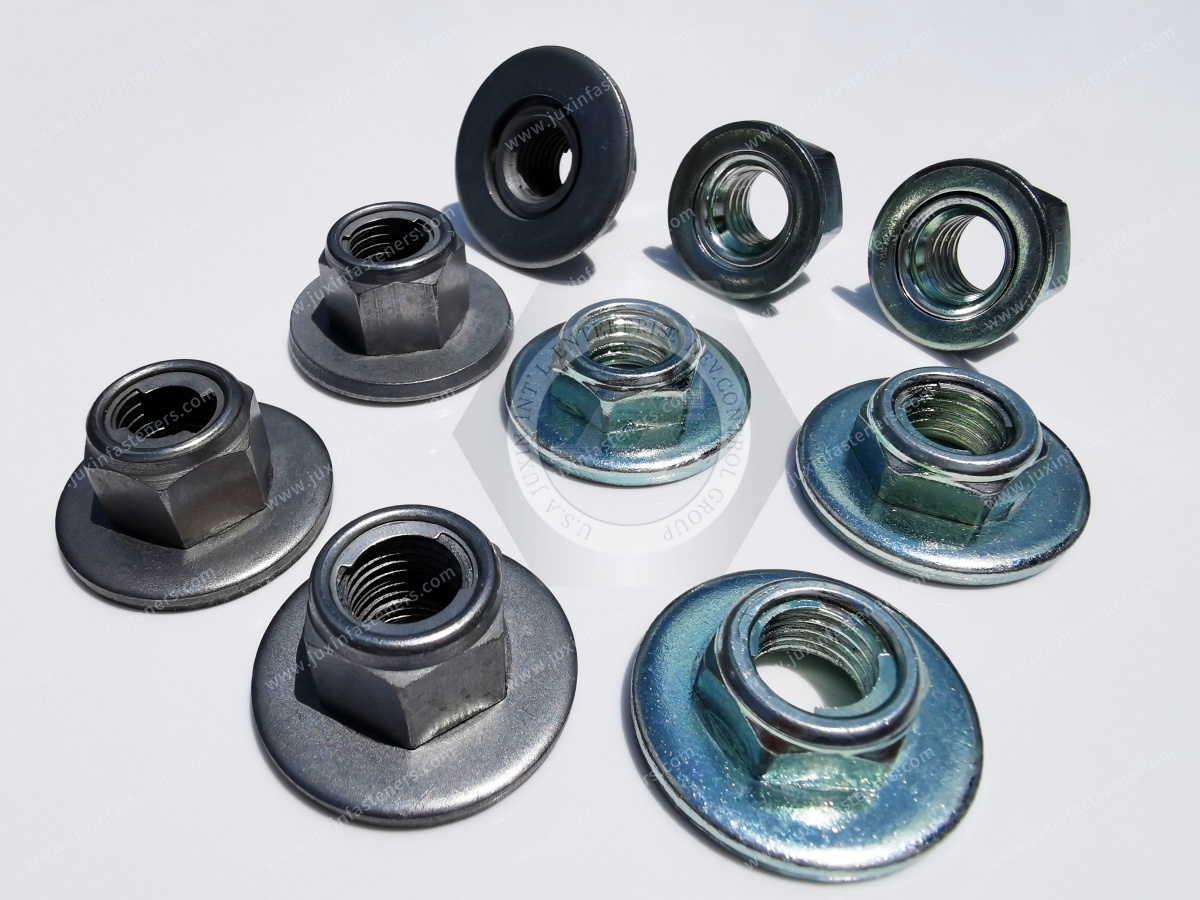
Difference from Conventional Flange Lock Nuts
A conventional flange nut has an integral bearing flange.
This product has a separate washer retained to the nut.
The washer may rotate relative to the nut, creating a different bearing interface.
The two designs should not be considered interchangeable without reviewing:
Bearing diameter.
Installation torque.
Clamp load.
Coating friction.
Joint settlement.
Washer retention.
Assembly clearance.
Difference from Keps and K-Lock Nuts
Conventional Keps nuts commonly incorporate an external-tooth lock washer.
The present product uses a smooth captive washer and a metallic prevailing-torque thread-locking feature.
The locking mechanisms and bearing surfaces are different.
Selection should follow the approved engineering drawing rather than a general product name.
Metric Thread Range
| Thread | Nominal Diameter | Coarse Pitch |
|---|---|---|
| M4×0.7 | 4 mm | 0.70 mm |
| M5×0.8 | 5 mm | 0.80 mm |
| M6×1.0 | 6 mm | 1.00 mm |
| M8×1.25 | 8 mm | 1.25 mm |
| M10×1.5 | 10 mm | 1.50 mm |
| M12×1.75 | 12 mm | 1.75 mm |
These are standard metric coarse-thread references.
Special metric threads may be evaluated according to customer drawings.
Washer dimensions, nut height and locking geometry are product-specific and must not be inferred from thread size alone.
Unified Inch-Thread Range
| Thread | Series | Nominal Diameter | Pitch Equivalent |
|---|---|---|---|
| #8-32 | UNC | 0.1640 in | 0.7938 mm |
| #10-32 | UNF | 0.1900 in | 0.7938 mm |
| 1/4-20 | UNC | 0.2500 in | 1.2700 mm |
| 5/16-18 | UNC | 0.3125 in | 1.4111 mm |
| 3/8-16 | UNC | 0.3750 in | 1.5875 mm |
| 1/2-13 | UNC | 0.5000 in | 1.9538 mm |
Unified inch threads should be specified according to ASME B1.1.
Actual availability, thread class and product dimensions must be confirmed for the selected configuration.
Metric and Unified inch threads are not interchangeable.
Materials for Automotive Lock Nut Assemblies
The nut body and metallic locking component may require different material specifications.
Potential material requirements include:
Carbon steel nut body.
Customer-specified mechanical property class.
Spring steel locking component.
Drawing-defined washer material.
Heat treatment where required.
Controlled hardness and forming characteristics.
The supplied material references include grade 35 carbon steel and 65Mn spring steel.
Final material equivalence and mechanical properties must be verified according to the approved engineering specification.
Zinc-Nickel Plating for Automotive Fasteners
Zinc-nickel alloy plating is an important coating option for corrosion-sensitive automotive applications.
Juxin Fasteners offers zinc-nickel coated custom lock nut assemblies for customer-specified corrosion requirements.
The supplied product requirements include 720–1000 hours of salt spray resistance, depending on the approved coating system.
Important coating characteristics include:
Alloy composition.
Coating thickness.
Passivation.
Sealer or topcoat.
Coefficient of friction.
Coating coverage.
Corrosion acceptance criteria.
Hydrogen embrittlement risk, where applicable.
The specified test duration must be associated with a defined test method and failure criterion.
720-Hour and 1000-Hour Salt Spray Requirements
A corrosion requirement should identify:
Applicable test method.
Coating specification.
Test duration.
White corrosion acceptance criterion.
Red corrosion acceptance criterion.
Test sample condition.
Whether the component is tested before or after assembly.
ISO 9227 is a relevant reference for salt spray testing.
A laboratory salt spray duration does not directly predict outdoor service life.
Alternative Colored Zinc Finish
A colored zinc coating may be selected for applications with different corrosion, appearance and cost requirements.
The supplied alternative finish includes a 192-hour salt spray requirement.
The actual performance depends on the coating system and acceptance criteria.
Zinc-nickel and colored zinc finishes should not be assumed to provide equivalent corrosion protection.
Coating Friction and Installation Torque
Automotive coating systems can influence thread and bearing friction.
This affects the relationship between applied torque and resulting clamp load.
Relevant factors include:
Thread coating.
Bearing surface coating.
Lubrication.
Topcoat.
Prevailing torque.
Washer rotation.
Surface roughness.
Mating bolt condition.
The required tightening torque must be validated for the complete joint.
Torque–Clamp Force Testing
For automotive assembly programs, the relationship between installation torque and clamp force may be evaluated using an approved test procedure.
The test arrangement should represent the actual nut, bolt, washer, coating and bearing surfaces.
ISO 16047 provides relevant torque–clamp force testing principles for fasteners within its scope.
Because this product includes a prevailing-torque locking feature, the appropriate method and any deviations must be defined for the actual assembly.
Washer Retention Testing
The washer must remain attached to the nut during handling, transportation and installation.
Depending on the customer specification, inspection may include:
Washer pull-off resistance.
Washer axial movement.
Rotational freedom.
Retention feature deformation.
Washer alignment.
Visual examination.
The acceptance values must be established by the approved engineering drawing.
Automotive Body and Mounting Brackets
Automotive manufacturers may use custom prevailing torque lock nut assemblies for suitable steel mounting brackets and vehicle body components.
Relevant requirements include:
Joint preload.
Locking performance.
Bearing geometry.
Corrosion protection.
Assembly accessibility.
Production consistency.
Applications must be approved according to the vehicle manufacturer's engineering requirements.
Automotive Chassis and Underbody Equipment
Underbody assemblies may require corrosion-resistant fastening systems with defined locking performance.
For these applications, engineers should evaluate:
Vibration exposure.
Mechanical loading.
Joint stiffness.
Coating performance.
Prevailing torque.
Washer retention.
Durability requirements.
Safety-critical applications require project-specific qualification.
Electric Vehicle Components
Electric vehicle equipment may require custom lock nut assemblies for suitable structural brackets and mounting interfaces.
The assembly must be selected according to the actual mechanical, environmental and electrical requirements.
Battery-related applications require appropriate engineering validation.
Commercial Vehicles and Industrial Equipment
Commercial vehicle and industrial machinery manufacturers may use captive washer lock nuts where controlled locking performance and simplified washer handling are beneficial.
Potential applications include:
Equipment mounting brackets.
Fabricated steel components.
Industrial machinery assemblies.
Vehicle accessory mounts.
Equipment support structures.
Automated Assembly Applications
A captive washer design can reduce the need to feed and position a separate washer.
This may support automated assembly systems where nut orientation, washer retention and dimensional consistency are important.
Production engineers should evaluate:
Automatic feeding compatibility.
Washer retention during feeding.
Installation tool access.
Torque control.
Coating consistency.
Inspection requirements.
Rework procedures.
Cold Heading and Nut Manufacturing
Juxin Fasteners supports cold heading and cold forming for suitable nut designs.
Manufacturing process selection depends on the material, geometry, production quantity and mechanical requirements.
Operations may include:
Nut body forming.
Internal thread manufacturing.
Locking feature production.
Washer forming.
Mechanical retention assembly.
Surface treatment.
Inspection.
Not every configuration requires the same manufacturing sequence.
Custom Washer Assembly and Retention
The washer is mechanically retained through a drawing-controlled assembly feature.
The retention process must maintain the required washer freedom of movement without allowing unintended separation.
Important process controls include:
Retention dimensions.
Assembly deformation.
Washer alignment.
Rotational clearance.
Axial movement.
Final inspection.
OEM/ODM Manufacturing Capabilities
Juxin Fasteners supports custom manufacturing based on 2D drawings, 3D CAD models and engineering specifications.
Customization may include:
Metric or Unified threads.
Nut dimensions.
Metallic locking feature geometry.
Washer profile.
Washer diameter and thickness.
Washer material.
Retention design.
Prevailing torque requirements.
Coating system.
Corrosion requirements.
Packaging for automated assembly.
Custom manufacturing feasibility is evaluated before production.
Quality Control and Functional Verification
Depending on the approved specification, testing and inspection may include:
Material verification.
Thread gauging.
Nut dimensions.
Washer dimensions.
Washer retention.
Washer rotational freedom.
Prevailing-on torque.
Prevailing-off torque.
Repeated installation performance.
Mechanical property testing.
Coating thickness.
Salt spray testing.
Torque–clamp force evaluation.
Inspection requirements and acceptance criteria must be agreed with the customer.
Production Manager Considerations
Production managers should evaluate:
Nut and washer feeding orientation.
Installation torque consistency.
Washer retention.
Coating friction variation.
Assembly cycle time.
Rework requirements.
Functional inspection.
Batch traceability.
Packaging and delivery scheduling.
These factors can influence assembly reliability and production efficiency.
Purchasing and Supplier Development
Automotive purchasing and supplier development teams should provide:
Approved engineering drawing.
Nut and washer materials.
Thread designation.
Locking mechanism specification.
Mechanical properties.
Prevailing torque requirements.
Washer retention requirements.
Coating specification.
Corrosion acceptance criteria.
Initial order quantity.
Estimated annual demand.
Required production approval documentation.
Delivery schedule.
Relevant International Standards
Depending on the approved design, relevant references may include:
NF E 25-415:2022: Hexagon nut and captive conical washer assemblies.
NF E 25-417:2021: Prevailing-torque hexagon nuts with non-metallic inserts and captive conical washers; a separate design reference.
ISO 2320:2015: Functional properties of applicable prevailing-torque steel nuts.
ISO 898-2: Mechanical properties of applicable carbon steel and alloy steel nuts.
ISO 261: ISO metric screw-thread general plan.
ISO 965 Series: ISO metric screw-thread tolerances.
ASME B1.1: Unified inch screw threads.
ISO 16047: Torque–clamp force testing within the applicable scope.
ISO 9227: Salt spray corrosion testing.
These standards are referenced for engineering purposes. Their inclusion does not independently establish conformity of a custom product.
Frequently Asked Questions
What is an automotive captive washer lock nut?
It is a nut assembly combining a locking mechanism with a mechanically retained washer designed for an engineered fastening application.
Is the washer free to rotate?
Yes. The specified design retains the washer while allowing relative rotation.
What provides the self-locking function?
A metallic locking feature creates prevailing torque through controlled interference with the mating bolt thread.
Is this a nylon insert lock nut?
No. The described configuration uses a metallic locking mechanism.
Is this a conventional hex flange nut?
No. The washer is a separate component rather than an integral flange.
Is the washer a sealing component?
No sealing performance is claimed without a specific sealing design and validation.
What metric sizes are included?
M4, M5, M6, M8, M10 and M12.
What American thread sizes are included?
#8-32, #10-32, 1/4-20, 5/16-18, 3/8-16 and 1/2-13.
Are metric and inch threads interchangeable?
No. The mating bolt must match the approved thread designation.
What corrosion protection options are available?
Zinc-nickel and customer-specified alternative coatings.
Does every zinc-nickel nut meet 1000 hours of salt spray resistance?
No. Performance depends on the approved coating system, test conditions and acceptance criteria.
Can the nut be reused?
Reuse depends on the locking performance after repeated installation and removal under the approved specification.
Can Juxin Fasteners manufacture custom automotive versions?
Yes. Custom materials, threads, washer geometry, locking features and coating requirements can be evaluated from customer drawings.
Request a Quote — Automotive Captive Washer Lock Nuts
Juxin Fasteners manufactures custom automotive fasteners for OEMs, Tier-1 and Tier-2 suppliers, mechanical engineers, manufacturing engineers,
production managers, purchasing managers and supplier development teams.
We support cold heading, cold forming, suitable secondary manufacturing processes, mechanical washer assembly and industrial batch production.
For an accurate manufacturing feasibility review and quotation, please provide:
2D engineering drawing or 3D CAD model.
Metric or Unified thread specification.
Nut material and mechanical property requirements.
Metallic locking feature design.
Washer material and dimensions.
Washer cone angle, where applicable.
Washer retention and rotational requirements.
Prevailing torque specification.
Installation and removal cycle requirements.
Coating specification.
Salt spray test method and acceptance criteria.
Torque–clamp force requirements.
Inspection and production approval requirements.
Initial order quantity and estimated annual demand.
Packaging and delivery requirements.
Please send your engineering drawings and technical specifications for OEM/ODM manufacturing review and quotation.
Juxin Fasteners
Automotive Fastener Manufacturer | Prevailing Torque Lock Nuts | Captive Rotating Washer Assemblies | Zinc-Nickel Coated Fasteners | Custom OEM Manufacturing
Website: https://www.juxinfasteners.com/
Email: info@juxinfasteners.com
Product Packaging
Packaging Standard
At Juxin Fasteners, we apply standardized export packaging to ensure product protection, traceability, and compliance with international logistics requirements.
1. Standard Export Packaging
Unless otherwise specified, all products will be packed according to our factory standard export packaging, which includes:
Moisture-resistant inner protection
Poly bag or small box packing as required
Reinforced export cartons
Clear labeling with part number, specification, batch number, and quantity
Palletizing for sea or air shipment when necessary
Our standard packaging is designed to ensure safe transportation, efficient warehousing, and long-distance international shipping.
2. Customized Packaging Options
We also provide customized packaging solutions according to customer requirements, including but not limited to:
Private labeling
Customized barcodes
Specific carton dimensions
Retail packaging
Special pallet configuration
Customer-specific marking and identification
So that you know, customized packaging may involve additional costs and extended lead time depending on the complexity of the requirements.
3. Compliance & Quality Assurance
All packaging processes are controlled under our ISO 9001 quality management system to ensure consistency, traceability, and product integrity throughout the supply chain.
Product Pictures


Contact Us
Tel.:
+86 020 8621 0320
+86 020 3121 6067
E-mail:
Technical Support:
Navigation
SEND INQUIREY


