
Call Us
+86 136 6007 9809
Call Us
+86 136 6007 9809

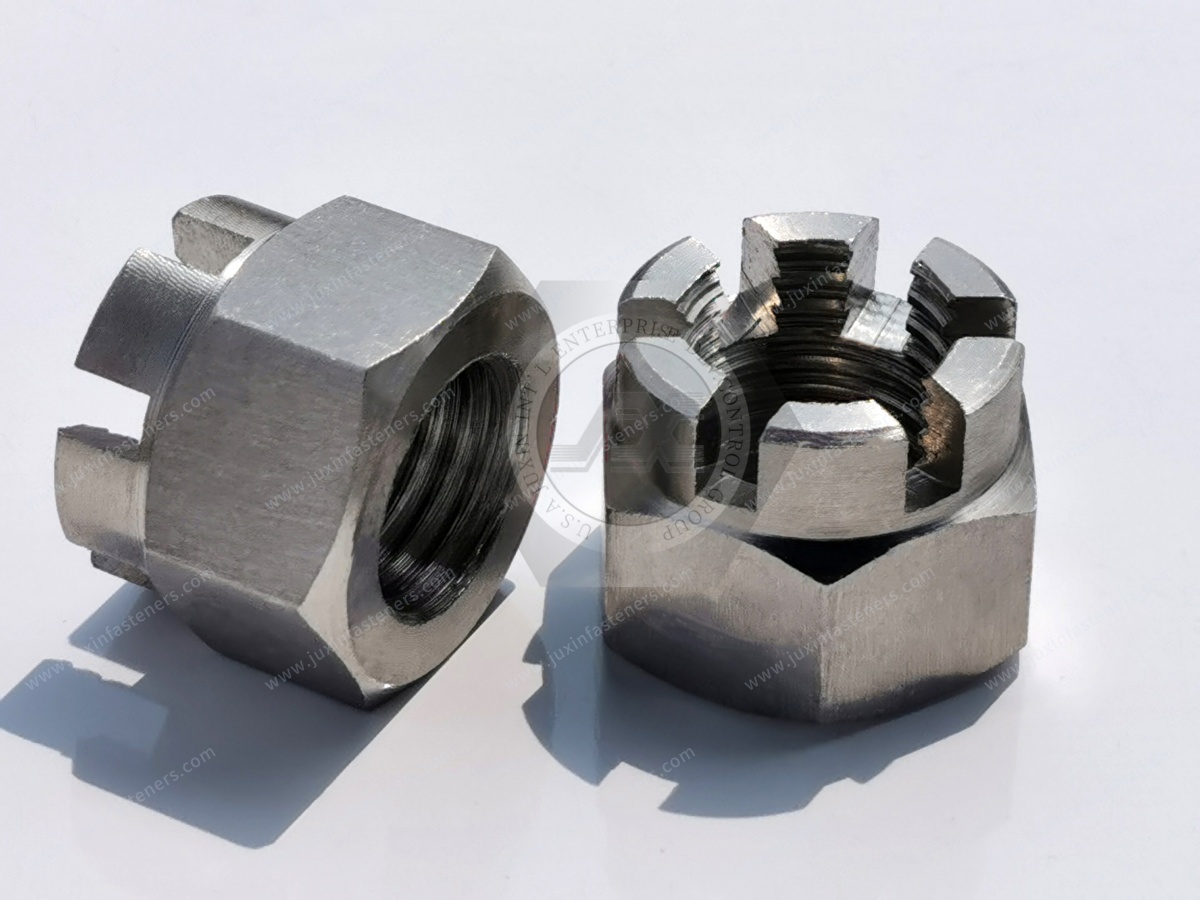
JUXIN FASTENERS manufactures DIN 935-1 metric coarse thread hex slotted and castle nuts for industrial machinery, agricultural equipment, mechanical linkages, shaft assemblies and serviceable mechanical joints.
Designed for use with compatible drilled bolts, studs or threaded shafts, these nuts are mechanically secured by a correctly specified cotter pin or split pin.
Unlike prevailing-torque locknuts, their locking function depends on an external pin and properly aligned slots.
Material options include carbon steel and stainless steel, with customer-defined zinc plating, zinc-nickel plating, black zinc, yellow zinc and zinc flake coating systems.
DIN 935-1 covers metric coarse and fine threads in product grades A and B; this page specifically focuses on metric coarse-thread configurations.
JUXIN supports OEM/ODM manufacturing, custom dimensions, thread and slot inspection, surface treatment and industrial batch production.
American UNC/UNF slotted and castle nut designs can also be evaluated separately according to ASME B18.2.2 or approved customer drawings.
Metric and inch-series threads are not interchangeable.
Product Specification
DIN 935-1 Metric Coarse Thread Hex Slotted and Castle Nuts
OEM Manufacturing of Cotter Pin Locking Nuts for Industrial Machinery, Mechanical Linkages and Equipment Maintenance
JUXIN FASTENERS manufactures standard and custom industrial fasteners for OEM manufacturers, Tier-1 and Tier-2 suppliers, mechanical engineers,
production managers, procurement development teams and global supply chain organizations.
Our DIN 935-1 metric coarse thread hex slotted and castle nuts are designed for mechanical locking assemblies using compatible drilled bolts, threaded studs or shafts and correctly specified cotter pins.
This product family focuses on metric coarse-pitch threads, also referred to as standard metric threads in many industrial purchasing specifications.
The locking system provides a mechanical means of restricting nut rotation after installation.
It differs from nylon-insert and all-metal prevailing-torque locknuts because the locking function depends on an external cotter pin rather than friction generated by the nut itself.
JUXIN supports carbon steel and stainless steel manufacturing, custom machining, threading, slot production, customer-defined coatings and industrial batch orders.
Product Specifications
| Parameter | Specification |
|---|---|
| Product Name | Metric Coarse Thread Hex Slotted and Castle Nuts |
| Primary Standard | DIN 935-1 |
| Thread System | ISO Metric Coarse Thread |
| Product Grades | A and B |
| Material Options | Carbon Steel, Stainless Steel |
| Locking Method | Cotter Pin / Split Pin |
| Mating Component | Drilled Bolt, Stud or Threaded Shaft |
| Surface Treatments | Zinc, Zinc-Nickel, Black Zinc, Yellow Zinc, Zinc Flake |
| Other Thread Systems | Custom UNC / UNF Designs Subject to Review |
| Geometry | Hex Slotted or Castle Configuration |
| Dimensions | Applicable Standard or Approved Drawing |
| Manufacturing | Standard and Custom OEM Production |
| Inspection | Customer-Approved Quality Requirements |
The exact material property class, nut geometry, coating, thread tolerance and locking arrangement must be specified for each order.
What Is a Metric Coarse Thread Castle Nut?
A metric coarse thread castle nut is a mechanically locking nut with a standard metric thread pitch and a slotted or castellated structure.
It is installed on a compatible threaded component with a transverse hole.
A cotter pin passes through the aligned nut slots and hole to mechanically restrict rotation.
The pin is a separate locking component.
A castle nut is not inherently a prevailing-torque nut.
DIN 935-1 Coarse Thread vs. Fine Thread
DIN 935-1 covers both metric coarse and metric fine pitch threads.
This product page is dedicated to the coarse-thread version.
| Selection Factor | Metric Coarse Thread | Metric Fine Thread |
|---|---|---|
| Pitch | Standard Coarse Series | Smaller Pitch |
| Typical Selection | General Machinery and Standard Metric Assemblies | Specific Fine-Thread Designs |
| Mating Bolt | Metric Coarse Thread | Matching Metric Fine Thread |
| Assembly Requirement | Standard Pitch Compatibility | Exact Fine-Pitch Compatibility |
| SEO Product Family | This Page | Separate Fine-Pitch Product Page |
The correct choice depends on the equipment drawing, mating thread and assembly requirements.
Coarse and fine threads of the same nominal diameter are not interchangeable.
DIN 935-1 Product Grades A and B
DIN 935-1 specifies product grades A and B.
These are dimensional product grades.
They are not mechanical property classes.
The standard generally assigns product grade A to nominal thread diameters up to M16 and product grade B to larger nominal diameters.
For example:
Product Grade A concerns dimensional classification.
Product Grade B concerns dimensional classification.
Property Class 8 concerns mechanical properties under an applicable steel nut standard.
These designations must not be confused.
Metric Coarse Thread Size Reference
The following table provides common ISO metric coarse-thread designations and their nominal inch diameter conversions.
| Metric Thread | Coarse Pitch | Nominal Diameter in Inches |
|---|---|---|
| M4 | 0.70 mm | 0.1575 in |
| M5 | 0.80 mm | 0.1969 in |
| M6 | 1.00 mm | 0.2362 in |
| M8 | 1.25 mm | 0.3150 in |
| M10 | 1.50 mm | 0.3937 in |
| M12 | 1.75 mm | 0.4724 in |
| M14 | 2.00 mm | 0.5512 in |
| M16 | 2.00 mm | 0.6299 in |
| M18 | 2.50 mm | 0.7087 in |
| M20 | 2.50 mm | 0.7874 in |
| M22 | 2.50 mm | 0.8661 in |
| M24 | 3.00 mm | 0.9449 in |
| M27 | 3.00 mm | 1.0630 in |
| M30 | 3.50 mm | 1.1811 in |
These are metric coarse-thread references.
The exact nut configuration and dimensions must be verified against DIN 935-1 and the approved drawing.
The inch values are diameter conversions only and do not represent equivalent American thread sizes.
American UNC and UNF Thread References
American industrial buyers may specify inch-series slotted or castle nuts according to ASME B18.2.2 or approved drawings.
| Nominal Size | UNC Coarse Thread | UNF Fine Thread |
|---|---|---|
| 1/4 in | 1/4-20 | 1/4-28 |
| 5/16 in | 5/16-18 | 5/16-24 |
| 3/8 in | 3/8-16 | 3/8-24 |
| 7/16 in | 7/16-14 | 7/16-20 |
| 1/2 in | 1/2-13 | 1/2-20 |
| 9/16 in | 9/16-12 | 9/16-18 |
| 5/8 in | 5/8-11 | 5/8-18 |
| 3/4 in | 3/4-10 | 3/4-16 |
| 7/8 in | 7/8-9 | 7/8-14 |
| 1 in | 1-8 | 1-12 |
These are standard Unified thread references, not a confirmed inventory list.
Custom UNC and UNF designs require separate review of thread geometry, nut dimensions, slot dimensions and manufacturing feasibility.
Important: Metric and Inch Threads Are Not Interchangeable
Metric coarse threads, metric fine threads, UNC, UNF, BSW and BSF are different thread systems.
Examples:
M6 × 1.0 is not interchangeable with 1/4-20 UNC.
M8 × 1.25 is not interchangeable with 5/16-18 UNC.
M10 × 1.5 is not interchangeable with 3/8-16 UNC.
M12 × 1.75 is not interchangeable with 1/2-13 UNC.
Nominal diameter similarity does not establish thread compatibility.
The mating thread designation, pitch, tolerance and dimensional standard must be verified.
How Cotter Pin Locking Works
A typical mechanical locking assembly includes:
A compatible externally threaded bolt, stud or shaft.
A correctly sized slotted or castle nut.
A transverse hole in the mating threaded component.
A suitable cotter pin.
The nut is installed according to the approved equipment assembly procedure.
The nut slots are aligned with the transverse hole.
The cotter pin is inserted and secured.
The installed pin restricts further nut rotation.
A cotter pin does not create the original joint preload.
The required clamping force or bearing adjustment must be achieved by the approved installation procedure.
Cotter Pin Locking vs. Prevailing-Torque Locking
| Feature | Slotted / Castle Nut | Nylon-Insert Locknut | All-Metal Prevailing-Torque Nut |
|---|---|---|---|
| Locking Principle | External Mechanical Pin | Polymer Insert Friction | Metal Deformation Friction |
| Drilled Bolt Required | Typically Yes | No | No |
| External Locking Component | Cotter Pin | No | No |
| Locking Torque Generated by Nut | Not Inherently | Yes | Yes |
| Installation Procedure | Slot and Hole Alignment | Prevailing-Torque Control | Prevailing-Torque Control |
| Selection | Application-Specific | Application-Specific | Application-Specific |
The correct system depends on the joint design, service environment and equipment manufacturer's requirements.
Engineering Detail: Slot Alignment and Thread Pitch
The final position of a castle nut must permit the locking pin to pass through the slot and transverse hole.
This introduces an important assembly consideration.
For a six-slot nut and a single transverse hole, nominal slot-alignment positions occur at 60-degree intervals.
The theoretical axial movement between adjacent positions is:
Axial Movement = Thread Pitch / 6
| Metric Coarse Pitch | Approximate Axial Movement per 60° |
|---|---|
| 1.00 mm | 0.167 mm |
| 1.25 mm | 0.208 mm |
| 1.50 mm | 0.250 mm |
| 1.75 mm | 0.292 mm |
| 2.00 mm | 0.333 mm |
| 2.50 mm | 0.417 mm |
| 3.00 mm | 0.500 mm |
This is a simplified geometric calculation for six evenly spaced slots and a single transverse hole.
Actual alignment positions depend on slot count, hole arrangement, tolerances and installation geometry.
It is not an instruction to loosen or overtighten the nut to achieve alignment.
The equipment manufacturer's approved installation procedure must control the final assembly.
Why Slot Alignment Must Be Considered During Design
A mismatch between nut slots and the transverse hole can lead to:
Cotter pin installation difficulty.
Incorrect final tightening position.
Excessive or insufficient joint preload.
Bearing adjustment errors.
Damaged slots or pins.
Increased production rework.
Mechanical engineers should review the nut and mating component as one fastening system.
Designing the Drilled Bolt and Nut Together
A complete engineering drawing package should identify:
Bolt or shaft thread.
Transverse hole diameter.
Hole location from the reference surface.
Nut height.
Slot width.
Slot depth.
Slot count.
Cotter pin dimensions.
Required assembly position.
Final tightening or adjustment procedure.
A nut drawing alone may not be sufficient to validate the complete locking arrangement.
Carbon Steel Material Options
Carbon steel may be selected for industrial machinery where the required mechanical properties and environmental protection can be achieved.
Potential specifications include:
Customer-defined mechanical property class.
Zinc electroplating.
Zinc-nickel coating.
Zinc flake coating.
Other approved surface treatments.
The material and property class must be compatible with the mating component and application loads.
Stainless Steel Material Options
Stainless steel may be selected where corrosion resistance is important.
Potential options include customer-specified A2 or A4 stainless steel, subject to the required product configuration and manufacturing feasibility.
Stainless steel performance depends on grade, processing, environment and mechanical properties.
Corrosion resistance must be evaluated for the actual service conditions.
Surface Treatment Options
| Finish | Technical Consideration |
|---|---|
| Clear Zinc Plating | Customer-Defined Corrosion Protection |
| Blue-Passivated Zinc | Zinc Coating With Specified Passivation |
| Yellow Zinc | Specified Color and Passivation System |
| Black Zinc | Black Appearance With Defined Coating Requirements |
| Zinc-Nickel Alloy | Corrosion Protection Subject to Approved Specification |
| Zinc Flake Coating | Coating System Subject to Fit and Functional Review |
The descriptions "environmentally friendly color zinc" and "environmentally friendly blue zinc" are not complete coating specifications.
Customers should identify coating thickness, passivation, restricted-substance requirements and corrosion acceptance criteria.
Dacromet is a trade-related coating designation and should not automatically be treated as equivalent to every zinc flake coating.
Coating Considerations for Slotted Nuts
Coatings may influence:
Internal thread fit.
Slot clearance.
Cotter pin installation.
Surface appearance.
Corrosion performance.
Assembly friction.
Coating requirements should be reviewed before production.
For high-strength steel components, hydrogen embrittlement risk associated with certain coating processes may require additional engineering controls.
Industrial Machinery Applications
Metric coarse-thread slotted and castle nuts may be relevant to machinery using standard metric threaded components.
Potential applications include:
Mechanical pivots.
Linkage connections.
Adjustable mechanical joints.
Shaft retention.
Serviceable equipment assemblies.
The complete assembly must be validated for loading, vibration and maintenance conditions.
Agricultural Machinery Manufacturing
Agricultural equipment may use mechanical locking arrangements in suitable linkage and pivot assemblies.
Potential applications include:
Implement adjustment mechanisms.
Equipment articulation joints.
Serviceable mechanical connections.
Selected shaft-retention systems.
Mud, moisture, impact, corrosion and maintenance frequency must be considered.
Construction and Heavy Equipment Manufacturing
Construction machinery manufacturers may specify cotter pin locking systems in selected mechanical assemblies.
Relevant engineering considerations include:
Shock loading.
Fatigue.
Joint movement.
Pin retention.
Coating performance.
Inspection access.
Safety-critical assemblies require application-specific qualification.
Automotive Manufacturing
Potential applications include approved mechanical linkage and pivot assemblies.
Automotive steering, suspension and wheel-related joints can be safety-critical.
Only fasteners meeting the vehicle manufacturer's approved drawing, mechanical performance and installation requirements should be used.
Motorcycle Manufacturing
Castle nuts may be encountered in selected motorcycle mechanical retention systems.
The correct nut, mating shaft, transverse hole and cotter pin must be specified together.
An unqualified industrial nut must not be substituted for a safety-critical motorcycle fastener.
Motorsport Equipment
Motorsport applications may involve mechanical locking arrangements requiring positive retention and inspection access.
Vibration, shock, fatigue and maintenance requirements must be evaluated.
Use must follow the equipment manufacturer's approved specification.
Rail Transit Equipment
Selected rail mechanical assemblies may use positive locking systems.
These applications can require vibration, fatigue, material traceability and regulatory qualification.
JUXIN supports made-to-drawing manufacturing review; application suitability must be independently established.
Marine Machinery
Carbon steel with suitable protection or stainless steel may be evaluated for selected marine mechanical assemblies.
Relevant factors include:
Saltwater exposure.
Galvanic corrosion.
Crevice corrosion.
Mechanical loading.
Inspection and maintenance.
Energy and Power Equipment
Some energy equipment uses mechanical linkages, adjustment mechanisms or shaft-retention systems.
Where slotted nuts are specified, engineers must review mechanical loads, operating environment and installation requirements.
Industrial Automation and Robotics
Potential applications include selected mechanical pivots, serviceable joints and maintenance-accessible retention assemblies.
Dynamic loading and fatigue must be evaluated.
When a Metric Coarse-Thread Castle Nut Is Not Appropriate
An alternative locking system may be needed when:
The mating component has no transverse hole.
The assembly cannot accommodate cotter pin installation.
Required preload cannot be achieved at an acceptable alignment position.
Access for inspection is inadequate.
The application requires a different locking principle.
The fastener does not meet the specified mechanical property requirements.
Selection should be based on the complete joint design.
Common Production and Installation Problems
| Problem | Potential Cause | Recommended Engineering Review |
|---|---|---|
| Nut Will Not Fit Bolt | Incorrect Thread Pitch | Verify Thread Designation |
| Pin Cannot Pass Through | Slot/Hole Misalignment | Check Assembly Geometry |
| Pin Does Not Fit Slot | Incorrect Pin or Slot Size | Verify Both Dimensions |
| Excessive Tightening | Incorrect Alignment Procedure | Review Installation Instructions |
| Inadequate Joint Preload | Incorrect Assembly Adjustment | Validate Required Preload |
| Corrosion | Inadequate Material or Coating | Review Exposure Conditions |
| Thread Damage | Incorrect Fit or Torque | Inspect Threads and Procedure |
| Repeated Production Rework | Uncontrolled Assembly Variables | Establish Inspection Criteria |
JUXIN FASTENERS Manufacturing Capabilities
JUXIN FASTENERS is an industrial fastener manufacturer supporting standard and custom OEM/ODM production.
Our broader manufacturing capabilities include:
Cold heading and cold forming.
CNC machining.
Internal threading.
Slot machining.
Secondary processing.
Customer-defined surface finishing.
Manufacturing according to 2D and 3D drawings.
Industrial batch production.
The manufacturing route depends on material, geometry, tolerance requirements and production quantity.
OEM Customization Options
JUXIN can review:
DIN 935-1 metric coarse-thread designs.
Custom metric dimensions.
Separate metric fine-thread requirements.
UNC and UNF inch-series designs.
Special nut heights.
Special slot widths and depths.
Carbon steel property classes.
Stainless steel grades.
Zinc, zinc-nickel and zinc flake coatings.
OEM part numbering.
Customer-defined packaging.
Annual production programs.
All requirements are subject to engineering and manufacturing feasibility review.
Quality Inspection for Coarse-Thread Slotted and Castle Nuts
Depending on the approved inspection plan, checks may include:
Material verification.
Thread gauge inspection.
Thread pitch confirmation.
Width across flats.
Nut height.
Slot width.
Slot depth.
Slot position.
Surface treatment.
Coating thickness.
Functional fit with the mating component.
Packaging and identification.
Mechanical performance testing must follow the applicable specification.
Applicable Standards and Engineering References
DIN 935-1
Hexagon slotted and castle nuts with metric coarse and fine pitch threads, product grades A and B.
This page focuses on the metric coarse-thread configuration.
The applicable edition, dimensional requirements and amendments must be verified.
DIN 935-3
A separate product category covering specified metric coarse-thread hex slotted nuts of product grade C.
DIN 935-3 must not be treated as automatically interchangeable with DIN 935-1.
ASME B18.2.2
American inch-series nut standard covering defined hex nut configurations, including slotted and castle nut designs.
The correct dimensional table must be specified.
ASME B1.1
Reference for Unified inch screw threads, including UNC and UNF.
ISO Metric Thread Standards
Relevant references include:
ISO 261 — Metric thread selection.
ISO 724 — Basic metric thread dimensions.
ISO 965 series — Metric thread tolerances.
BS 3692, JIS B 1170 and SAE References
These standards may be relevant to specific customer or regional requirements.
Their applicability must be verified against the exact product design.
They are not automatically equivalent to DIN 935-1.
Frequently Asked Questions
What is a DIN 935-1 metric coarse-thread castle nut?
It is a slotted or castellated hex nut using a specified metric coarse thread and dimensional requirements under DIN 935-1.
What is the difference between coarse and fine threads?
Coarse threads have a larger pitch than fine threads of the same nominal diameter.
The mating bolt must use the same thread designation.
Are DIN 935-1 coarse and fine nuts interchangeable?
No. The thread pitch must match the mating component.
Are slotted nuts and castle nuts the same?
They share a mechanical locking principle but may have different geometries.
How is a castle nut locked?
A cotter pin passes through the nut slots and a transverse hole in the mating threaded component.
Are castle nuts prevailing-torque locknuts?
No. Conventional castle nuts rely on an external locking pin.
Does JUXIN manufacture carbon steel versions?
Yes. Carbon steel designs can be evaluated according to the required mechanical and coating specifications.
Are stainless steel options available?
Stainless steel manufacturing requirements can be reviewed against customer drawings.
Can JUXIN manufacture UNC or UNF slotted nuts?
Custom inch-series designs can be evaluated separately.
Are metric and American inch threads interchangeable?
No. Metric, UNC and UNF are different thread systems.
Are cotter pins included with the nuts?
Cotter pins must be specified separately unless explicitly included in the quotation.
Can these nuts be used in automotive or heavy machinery?
Only when the fastener and complete locking assembly meet the equipment manufacturer's engineering and safety requirements.
Does JUXIN support OEM batch production?
Yes. JUXIN supports made-to-drawing fastener manufacturing and industrial batch orders.
Request a Quote — DIN 935-1 Metric Coarse Thread Slotted and Castle Nut Manufacturer
JUXIN FASTENERS manufactures standard and custom industrial fasteners for OEM, Tier-1 and Tier-2 manufacturing programs.
We support metric coarse-thread slotted and castle nut projects for industrial machinery, agricultural equipment,
construction machinery, mechanical linkages and other engineered assemblies.
Our manufacturing capabilities include cold heading, cold forming, CNC machining, threading, slot machining,
secondary processing and customer-defined surface treatment.
Recommended RFQ Information
DIN 935-1 or customer standard.
Metric coarse thread designation.
Nut geometry: slotted or castle configuration.
Required nut height and hex dimensions.
Slot width, depth and quantity.
Mating bolt or shaft drawing.
Transverse hole size and location.
Cotter pin size and material.
Carbon steel or stainless steel grade.
Required mechanical property class.
Surface treatment specification.
Required joint preload or assembly procedure.
Inspection and acceptance criteria.
Order quantity and annual forecast.
Packaging and delivery requirements.
Please send your 2D drawings, 3D CAD files and purchasing requirements for engineering review and quotation.
JUXIN FASTENERS
Industrial Fastener Manufacturer | OEM/ODM Custom Fastener Manufacturing | Cold Heading, Cold Forming and CNC Machining
Website: https://www.juxinfasteners.com/
Email: info@juxinfasteners.com
Product Packaging
Packaging Standard
At Juxin Fasteners, we apply standardized export packaging to ensure product protection, traceability, and compliance with international logistics requirements.
1. Standard Export Packaging
Unless otherwise specified, all products will be packed according to our factory standard export packaging, which includes:
Moisture-resistant inner protection
Poly bag or small box packing as required
Reinforced export cartons
Clear labeling with part number, specification, batch number, and quantity
Palletizing for sea or air shipment when necessary
Our standard packaging is designed to ensure safe transportation, efficient warehousing, and long-distance international shipping.
2. Customized Packaging Options
We also provide customized packaging solutions according to customer requirements, including but not limited to:
Private labeling
Customized barcodes
Specific carton dimensions
Retail packaging
Special pallet configuration
Customer-specific marking and identification
So that you know, customized packaging may involve additional costs and extended lead time depending on the complexity of the requirements.
3. Compliance & Quality Assurance
All packaging processes are controlled under our ISO 9001 quality management system to ensure consistency, traceability, and product integrity throughout the supply chain.
Product Pictures


Contact Us
Tel.:
+86 020 8621 0320
+86 020 3121 6067
E-mail:
Technical Support:
Navigation
SEND INQUIREY


