Call Us
+86 136 6007 9809
Call Us
+86 136 6007 9809

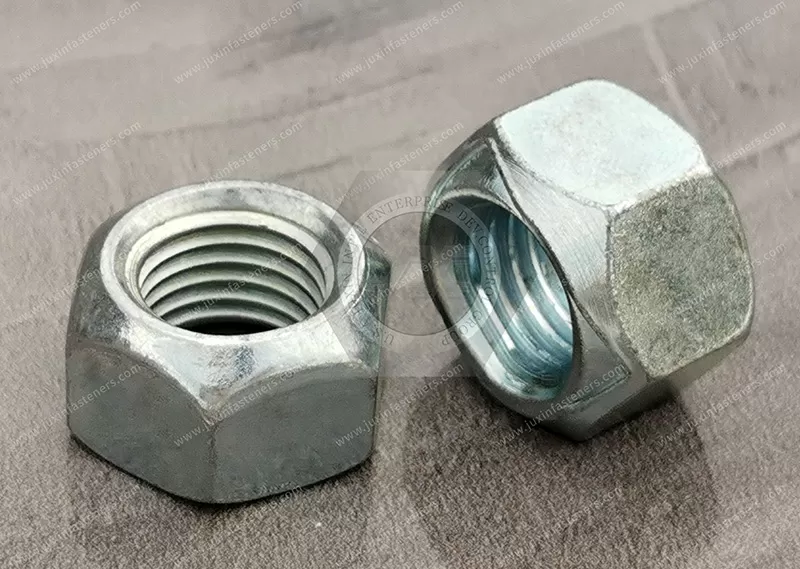
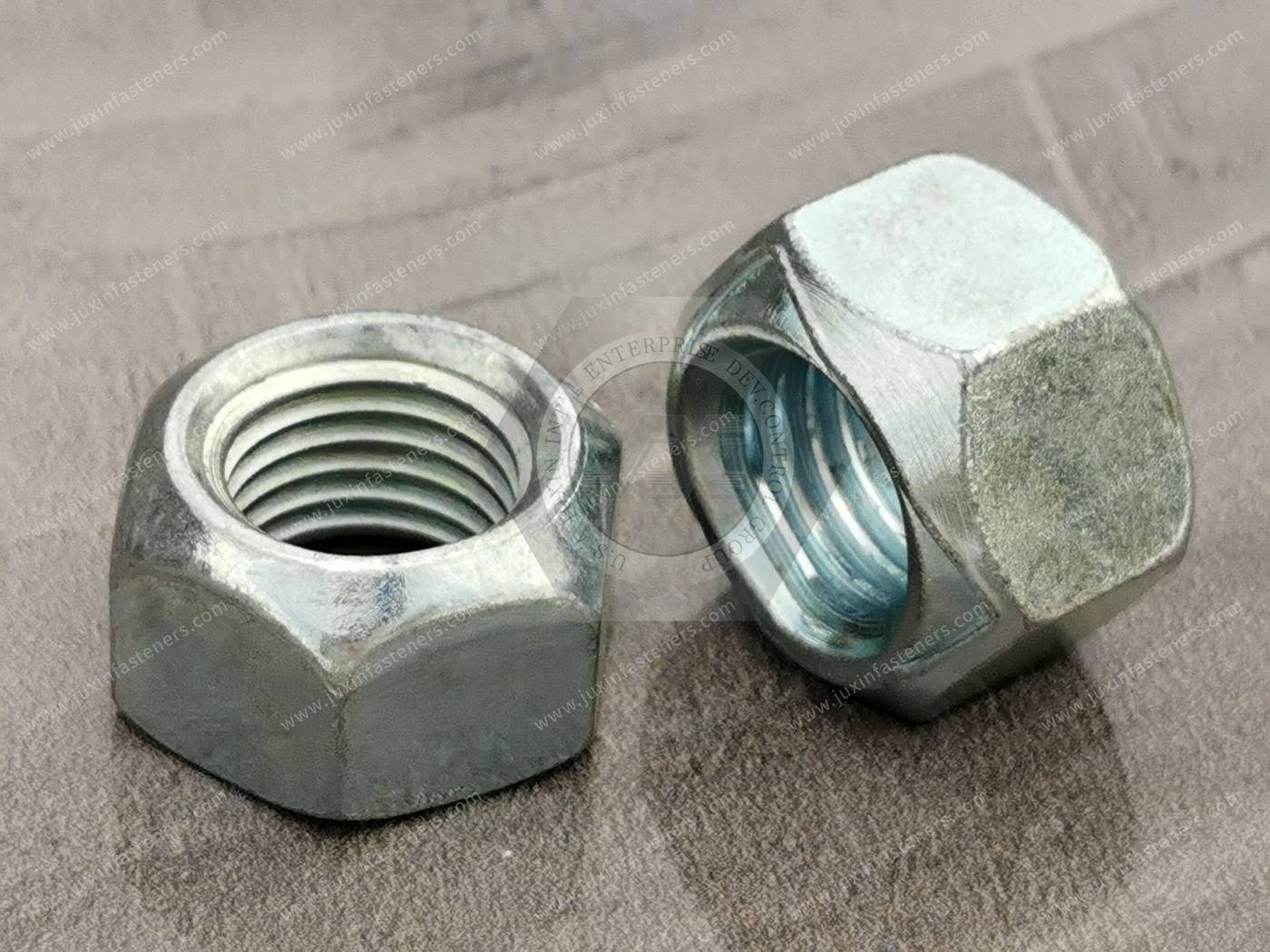
JUXIN FASTENERS supplies high-strength carbon steel Hex Metal-Stop Locknuts for demanding OEM mechanical assemblies.
This Class 10-focused product uses a top-lock distorted-thread mechanism to generate all-metal prevailing torque without a nylon insert.
The featured finish is RoHS-compliant iridescent zinc plating for customer-specified corrosion protection and restricted-substance requirements.
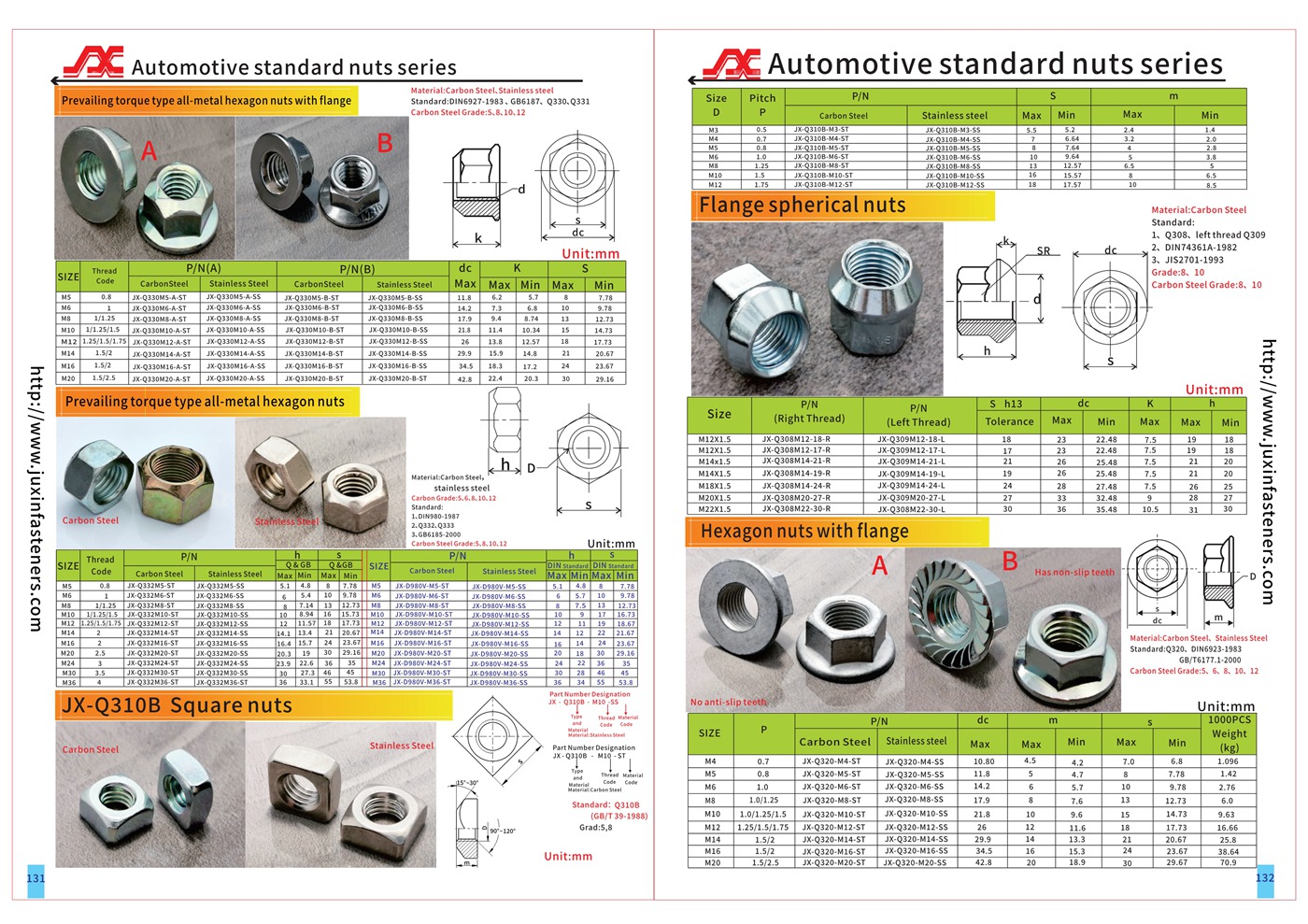
The original product family lists M5–M20 and property classes 5, 6, 8 and 10; the high-strength designation applies specifically to verified Class 10 variants.
Review DIN 980 historical references, ISO 7719 and ISO 7042 dimensional selection, bolt compatibility, ISO 2320 functional testing, installation engineering and custom high-volume RFQs.
Product Specification
High-Strength Hex Metal-Stop Locknuts – Class 10 Top-Lock Distorted-Thread Locking Solutions
RoHS-Compliant Iridescent Zinc-Plated All-Metal Locknuts for OEM Machinery and High-Strength Bolted Assemblies
JUXIN FASTENERS supplies high-strength carbon steel Hex Metal-Stop Locknuts for OEM manufacturers requiring all-metal prevailing-torque locking,
controlled mechanical properties and consistent production fastening performance.
The featured high-strength configuration is intended for Property Class 10 applications, subject to confirmation against the approved engineering drawing and mechanical test requirements.
These non-flanged hexagon locknuts use controlled deformation of the upper internal thread region to generate resistance against rotation on a compatible mating bolt.
The featured surface finish is RoHS-compliant iridescent zinc plating, specified to meet the customer's applicable coating and restricted-substance requirements.
In American industrial catalogs, related products are commonly called High-Strength Steel Top-Lock Distorted-Thread Locknuts.
Additional sourcing terminology includes High-Strength Hex Metal-Stop Locknuts, Class 10 All-Metal Locknuts, DIN 980 Type V Lock Nuts and High-Strength Prevailing-Torque Hex Nuts.
JUXIN FASTENERS supports drawing-based inquiries for automotive Tier-1 and Tier-2 suppliers, industrial machinery manufacturers,
heavy equipment producers, mechanical design engineers, manufacturing engineers, production managers and global procurement teams.
Product Specifications
Product Name: High-Strength Hex Metal-Stop Locknuts
Primary Technical Description: Class 10 Top-Lock Distorted-Thread Hexagon Nuts
Material: Carbon Steel
Featured Mechanical Property Class: Class 10, Subject to Verification
Original Product Family Property Classes: 5, 6, 8 and 10
Featured Surface Treatment: RoHS-Compliant Iridescent Zinc Plating
Original Listed Thread Sizes:
M5
M6
M8
M10
M12
M14
M16
M20
Product Configuration: Non-Flanged Hexagon Nut
Locking Mechanism: Controlled Upper-Thread Deformation
Locking Principle: All-Metal Prevailing Torque
Historical Standard Reference: DIN 980:1987
Related Product Standards: ISO 7042, ISO 7719 and ISO 10513, Depending on Configuration
Functional Testing Reference: ISO 2320, Where Applicable
Mechanical Properties: ISO 898-2
Electroplated Coating Reference: ISO 4042
Manufacturing Basis: Approved Customer Engineering Drawings and Technical Specifications
The original catalog includes several strength classes. The high-strength Class 10 designation applies only to variants verified to meet the specified mechanical requirements.
Not every size, coating and property class combination is automatically available.
What Are High-Strength Hex Metal-Stop Locknuts?
High-strength Hex Metal-Stop Locknuts are all-metal hexagon locking nuts designed to provide prevailing-torque resistance in mechanically demanding bolted joints.
The featured design uses a top-lock distorted-thread configuration.
A portion of the internal thread near the upper end of the nut is deliberately deformed.
As a compatible bolt advances through the nut, this distorted section creates interference with the mating thread.
The resulting resistance helps prevent unintended nut rotation.
Unlike nylon-insert locknuts, the locking mechanism does not depend on a polymer insert.
Unlike spring-stop locknuts, the featured design does not require a separate spring ring or spring-prong locking element.
The product has a conventional hexagon exterior without an integrated flange.
How the Top-Lock Distorted-Thread Mechanism Works
The locking action is created by controlled deformation of the nut's upper thread region.
During installation, the mating bolt first engages the lower, relatively undeformed threads.
This allows the bolt to establish thread alignment before reaching the locking section.
As the bolt advances into the distorted region, additional contact pressure and friction develop.
This creates prevailing-on torque.
During removal, the distorted region continues to resist rotation.
The remaining resistance is evaluated through prevailing-off torque.
Engineering Characteristics
All-metal locking construction.
No nylon insert.
Locking interference near the upper threaded section.
Guided initial engagement from the intended entry side.
Resistance to unintended rotation.
Conventional hexagon wrenching geometry.
Suitability for selected high-strength mechanical assemblies.
The exact locking geometry and performance requirements must be confirmed from the approved specification.
Why Property Class 10 Matters
Property Class 10 is relevant to higher-strength metric steel fastening systems.
The mechanical property class identifies specific nut strength requirements under the applicable standard.
However, the designation does not establish the strength of the entire bolted joint by itself.
A Class 10 nut must be evaluated together with:
Mating bolt property class.
Thread engagement.
Joint geometry.
Applied preload.
External loading.
Operating temperature.
Fatigue requirements.
Locking torque.
Coating and friction.
Class 8 vs. Class 10 Locknuts
Class 8 and Class 10 are distinct nut mechanical property classes.
Class 10 may be required for selected higher-strength applications.
Class 8 may be appropriate for many medium-strength industrial fastening systems.
The correct selection depends on the applicable mechanical standard and the mating bolt.
Important Compatibility Note
A Class 10 nut is often associated with suitable Class 10.9 bolt applications, subject to the relevant standard and joint design.
However, this does not mean that every Class 10 nut can be used with every Class 10.9 bolt without verification.
Thread fit, nut geometry, proof load, coating and locking interference must be considered.
SAE Grade 8 and ISO Class 10.9 belong to different strength classification systems and should not be treated as directly interchangeable designations.
High-Strength Top-Lock Nuts vs. Medium-Strength Top-Lock Nuts
Both product families can use the same general distorted-thread locking principle.
Their mechanical strength requirements differ.
High-Strength Class 10 Version
May be selected for appropriately designed higher-strength bolted assemblies.
Medium-Strength Class 8 Version
May be suitable for many general machinery and equipment applications.
Engineering Selection Factors
Nut property class.
Bolt property class.
Required proof load.
Thread engagement.
Joint preload.
Prevailing-torque requirements.
Installation conditions.
Operating loads.
Corrosion protection.
A high-strength nut is not automatically the best choice for every assembly.
Top-Lock vs. Center-Lock Distorted-Thread Nuts
Top-lock and center-lock nuts use related metallic interference principles.
Top-Lock Nuts
The locking feature is positioned near the top of the nut.
The lower threads engage the bolt before the distorted locking section.
Center-Lock Nuts
The locking feature is positioned closer to the center of the nut.
Some center-lock designs can be installed from either side.
Engineering Differences
Locking feature position.
Installation direction.
Thread starting.
Prevailing torque.
Nut geometry.
Assembly accessibility.
Functional testing requirements.
The designs should not be substituted without engineering review.
Metal-Stop vs. Spring-Stop Locknuts
Metal-stop and spring-stop locknuts should not be assumed to have identical locking mechanisms.
The featured high-strength metal-stop nut uses controlled thread deformation.
Spring-stop locknuts may use metallic spring prongs or separate friction rings.
These mechanisms may differ in installation behavior, reuse performance and manufacturing requirements.
All-Metal Locknuts vs. Nylon-Insert Locknuts
Nylon-insert locknuts use polymer interference to generate locking resistance.
All-metal distorted-thread locknuts use metallic thread interference.
Potential Advantages of All-Metal Designs
No nylon locking insert.
Compatibility with selected elevated-temperature applications.
Metallic prevailing-torque locking.
Conventional hexagon form.
Suitability for selected industrial vibration environments.
Engineering Limitations
All-metal construction does not establish unlimited temperature capability.
Installation torque can be higher than for a conventional hex nut.
Repeated installation may reduce locking performance.
The correct design must be selected through joint-specific engineering evaluation.
DIN 980:1987 and International Product Standards
DIN 980:1987 is a historical German standard associated with all-metal prevailing-torque hexagon nuts.
The standard has been withdrawn.
For modern OEM specifications, the applicable ISO product standard must be selected according to the nut geometry and thread configuration.
ISO 7042
Relevant to specified high all-metal prevailing-torque hexagon nuts with metric coarse-pitch threads.
ISO 7719:2025
Covers regular prevailing-torque all-metal hexagon nuts with metric coarse-pitch threads.
ISO 10513
Relevant to specified high prevailing-torque all-metal hexagon nuts with metric fine-pitch threads.
Standard Verification Requirements
The approved drawing should establish:
Overall nut height.
Width across flats.
Thread diameter.
Thread pitch.
Product grade.
Property class.
Locking feature.
Applicable standard edition.
A historical DIN 980 reference does not automatically establish conformity to every current ISO standard.
ISO 2320 and Prevailing-Torque Performance
Prevailing torque is the rotational resistance generated by the locking feature before significant joint clamp force develops.
Prevailing-On Torque
Resistance encountered as the nut advances along the mating bolt.
Prevailing-Off Torque
Resistance encountered during removal after the joint clamp force has been relieved.
Clamp Force
The compressive force generated in the joint through bolt tension.
Prevailing torque and clamp force are different engineering quantities.
ISO 2320 provides relevant functional requirements and test methods for prevailing-torque steel nuts within its scope.
High-Strength Locking Performance
For Class 10 OEM applications, locking performance must be evaluated together with the mechanical properties of the nut and mating bolt.
Potential requirements include:
Minimum prevailing-off torque.
Maximum prevailing-on torque.
Proof-load performance.
Thread integrity.
Coating compatibility.
Repeated installation requirements, if permitted.
Actual limits must follow the applicable standard and customer specification.
Can High-Strength Metal-Stop Locknuts Be Reused?
Many commercial top-lock distorted-thread locknuts are designated non-reusable.
Repeated installation may change the distorted thread geometry and reduce prevailing torque.
For critical OEM applications, the approved maintenance procedure should determine whether replacement is required after removal.
Reuse should not be assumed.
Where reuse is permitted, the product must satisfy the specified remaining locking performance and inspection requirements.
Available Metric Thread Sizes
The original product range lists:
M5
M6
M8
M10
M12
M14
M16
M20
Common metric coarse-thread references include:
M5 × 0.8
M6 × 1.0
M8 × 1.25
M10 × 1.5
M12 × 1.75
M14 × 2.0
M16 × 2.0
M20 × 2.5
These are reference designations.
The actual thread pitch and available Class 10 combinations must be confirmed.
Metric Fine-Pitch Requirements
Some OEM assemblies require metric fine-pitch threads.
Fine-pitch designs must be reviewed separately for:
Thread dimensions.
Nut geometry.
Mechanical property class.
Locking performance.
Applicable product standard.
Manufacturing feasibility.
A fine-pitch nut should not be assumed to meet a coarse-pitch product standard.
Metric vs. UNC and UNF Threads
American procurement teams may search for similar high-strength locknuts using UNC or UNF terminology.
However, the original product range is metric.
Metric and Unified inch-series threads are not directly interchangeable.
For example:
M6 × 1.0 is not interchangeable with 1/4"-20 UNC.
M8 × 1.25 is not interchangeable with 5/16"-18 UNC.
M10 × 1.5 is not interchangeable with 3/8"-16 UNC.
Inch-series requirements must be reviewed as separate products.
RoHS-Compliant Iridescent Zinc Plating
The featured high-strength metal-stop locknut uses a zinc-plated finish specified for RoHS-compliant applications.
The surface may exhibit yellow, gold, green or other iridescent tones.
The exact appearance depends on the plating and passivation system.
Relevant American Coating Terms
Iridescent Zinc Plating.
Yellow Iridescent Zinc Plating.
Color Zinc Plating.
RoHS-Compliant Zinc Plating.
Trivalent Chromium Passivation, Where Specified.
RoHS and Passivation Chemistry
RoHS restricts certain hazardous substances, including hexavalent chromium, in covered electrical and electronic equipment.
A RoHS-compliant iridescent zinc coating should use an approved coating system that meets the applicable requirements.
Trivalent chromium passivation may be used in such systems.
However, coating appearance alone cannot prove RoHS compliance.
Supplier declarations and applicable test documentation should support the claim.
Corrosion Protection
Zinc plating provides sacrificial corrosion protection to carbon steel.
Actual corrosion performance depends on:
Zinc coating thickness.
Passivation chemistry.
Sealer or topcoat.
Surface preparation.
Environmental exposure.
Handling and installation damage.
No specific salt spray duration is established by the supplied product information.
Corrosion test duration and acceptance criteria should be specified by the customer.
ISO 4042 and Coating Requirements
ISO 4042 provides relevant requirements for electroplated coating systems on fasteners.
The approved coating specification should define:
Coating metal.
Coating thickness.
Passivation type.
Corrosion performance.
Surface appearance.
Friction characteristics.
Environmental compliance.
Hydrogen embrittlement risk controls where applicable.
Hydrogen Embrittlement Considerations for High-Strength Steel
Hydrogen embrittlement is an important consideration for certain high-strength steel fasteners exposed to electroplating and related processing.
Risk depends on material strength, hardness, manufacturing process and operating stresses.
Potential process controls may include:
Appropriate material selection.
Controlled surface preparation.
Qualified electroplating procedures.
Hydrogen embrittlement relief treatments where required.
Process validation.
Customer-specific testing.
The applicable controls must be established by the engineering and coating specifications.
Coating Effects on Prevailing Torque
The locking mechanism relies on controlled metallic interference.
Coating thickness and friction may affect:
Installation torque.
Thread fit.
Prevailing-on torque.
Prevailing-off torque.
Mating thread wear.
Clamp-force consistency.
For OEM production, the finished coated nut should be evaluated according to the approved functional requirements.
Other Coating Options
The original product family lists additional surface treatments:
Clear zinc plating.
Blue-passivated zinc plating.
Black zinc plating.
Yellow zinc plating.
Zinc-nickel alloy plating.
Zinc-flake coating.
Dacromet-type coating.
These may be considered for customer-specific requirements.
Availability and suitability must be confirmed for the selected property class and locking design.
Industrial Applications and Engineering Solutions
1. Automotive Mechanical Assemblies
Automotive OEMs and Tier-1 suppliers may require high-strength prevailing-torque nuts for selected mechanical connections.
Potential applications include:
Mechanical support brackets.
Equipment mounting assemblies.
Auxiliary structural hardware.
Selected vibration-exposed connections.
Engineering Challenge
Dynamic loading and vibration may contribute to unintended fastener rotation.
Potential Solution
A verified Class 10 top-lock nut may provide metallic prevailing-torque resistance where the joint design and customer approval permit.
Safety-critical connections require dedicated validation.
2. Commercial Vehicles and Transportation Equipment
Commercial vehicles contain mechanical assemblies exposed to vibration and repeated loading.
Engineering Challenge
The joint may require higher mechanical strength and controlled locking performance.
Potential Solution
A Class 10 all-metal locking nut may be evaluated with the correct mating bolt and joint specification.
3. Heavy Equipment and Construction Machinery
Construction machinery may experience shock loads, vibration and demanding service conditions.
Engineering Challenge
Mechanical joints require appropriate preload and retention.
Potential Solution
A high-strength top-lock nut may be considered where its mechanical and functional performance satisfy the approved design.
4. Agricultural Machinery
Agricultural equipment operates under vibration, dirt and moisture exposure.
Engineering Challenge
Mechanical connections may experience repeated loading and environmental exposure.
Potential Solution
A properly specified high-strength metal-stop nut with an approved coating may be evaluated for suitable equipment assemblies.
5. Industrial Machinery and Equipment
Industrial machinery contains numerous bolted joints.
Potential applications include:
Equipment frames.
Mechanical brackets.
Machine supports.
Industrial drive assemblies.
Engineering Challenge
Repeated machine operation may affect joint retention.
Potential Solution
A Class 10 prevailing-torque nut may be evaluated where higher mechanical strength is required.
6. Industrial Automation and Robotics
Automated production equipment may contain high-load mechanical mounting points.
Engineering Challenge
The assembly requires consistent installation torque and mechanical retention.
Potential Solution
A high-strength metal-stop nut may be considered with appropriate tightening procedures and functional inspection.
7. Pumps, Compressors and Mechanical Drives
Pumps and compressors may generate vibration during operation.
Engineering Challenge
Mechanical supports and mounting connections may require reliable retention.
Potential Solution
A suitable Class 10 top-lock nut may be evaluated according to the joint loading and equipment requirements.
8. Rail and Transportation Systems
Rail equipment may contain mechanically demanding fastening applications.
Engineering Challenge
Dynamic loading and long service intervals can increase the importance of joint reliability.
Potential Solution
A qualified high-strength all-metal locking nut may be considered where permitted by the relevant equipment specifications.
Rail-specific approvals must be verified separately.
9. Electric Vehicle Equipment
EV equipment manufacturers may require high-strength mechanical fasteners for selected support assemblies.
Engineering Challenge
Vibration, structural loading and environmental exposure can affect fastener selection.
Potential Solution
A verified Class 10 metal-stop nut may be evaluated for suitable mechanical connections.
High-voltage and battery safety requirements must be addressed separately.
10. Industrial Electrification and Power Equipment
Power equipment manufacturers may require high-strength mechanical mounting hardware.
Engineering Challenge
Equipment vibration and installation consistency may affect fastening reliability.
Potential Solution
A properly specified high-strength locknut may be considered for suitable mechanical support connections.
Electrical bonding and insulation requirements must be evaluated independently.
11. HVAC and Thermal Management Equipment
HVAC systems contain fans, pumps and mechanical support structures.
Engineering Challenge
Vibration and repeated operation may affect bolted joints.
Potential Solution
A Class 10 top-lock nut may be evaluated where the joint requires the corresponding mechanical strength.
12. AI Data Center Mechanical Infrastructure
AI data centers contain mechanical equipment associated with cooling and power systems.
Engineering Challenge
Selected support assemblies may experience vibration during continuous operation.
Potential Solution
A high-strength prevailing-torque nut may be considered for suitable mechanical joints where the design requires it.
13. Renewable Energy Equipment
Renewable energy equipment may include mechanical support structures exposed to vibration and environmental conditions.
Engineering Challenge
The joint may require higher strength and corrosion protection.
Potential Solution
A specified Class 10 locking nut with a qualified coating system may be evaluated according to the approved engineering requirements.
14. General OEM Equipment Manufacturing
OEM manufacturers may require custom high-strength locknuts for specialized machinery and fabricated assemblies.
Engineering Challenge
Standard locking hardware may not meet the required combination of strength, dimensions, coating and prevailing torque.
Potential Solution
A drawing-based Class 10 metal-stop locknut may be evaluated for the specific application.
Installation Engineering for High-Strength Locknuts
Correct installation is essential.
Step 1: Verify the Mating Bolt
Confirm the thread size, pitch, mechanical property class and coating.
Step 2: Inspect the Locknut
Check the threads and locking feature for damage.
Step 3: Confirm Installation Direction
Top-lock designs should be installed from the intended thread entry side.
Step 4: Start the Threads Correctly
Avoid cross-threading.
Step 5: Engage the Locking Section
The distorted upper threads generate prevailing torque.
Step 6: Apply the Approved Tightening Method
Use the specified torque or tensioning procedure.
Step 7: Verify the Joint
Confirm the required seating and joint condition.
Important Assembly Considerations
Mating bolt compatibility.
Prevailing torque.
Thread engagement.
Tool capability.
Coating friction.
Clamp-force requirements.
Locking feature integrity.
Reuse restrictions.
Production Management and Assembly Efficiency
For production managers, high-strength metal-stop nuts influence both component quality and assembly performance.
Relevant factors include:
Nut orientation.
Thread starting.
Prevailing-on torque.
Final tightening torque.
Assembly tool capacity.
Cycle time.
Coating friction.
Cross-threading prevention.
Inspection requirements.
Rework.
Lot-to-lot consistency.
Repeat-order supply stability.
The production process should be validated using the actual nut and mating bolt combination.
Common Engineering Problems and Troubleshooting
Problem 1: Excessive Installation Torque
Possible causes include excessive locking interference, incompatible threads or coating friction.
Problem 2: Insufficient Prevailing Torque
Possible causes include incorrect deformation geometry or manufacturing variation.
Problem 3: Thread Stripping
Possible causes include incompatible mechanical properties, insufficient engagement or excessive loading.
Problem 4: Inconsistent Clamp Force
Possible causes include friction variation or unsuitable tightening procedures.
Problem 5: Coating Damage
Possible causes include excessive thread interference or unsuitable installation conditions.
Problem 6: Corrosion
Possible causes include inadequate coating protection or environmental exposure.
Problem 7: Reduced Locking Performance After Removal
Possible causes include thread wear or changes in the distorted locking region.
Problem 8: Joint Loosening
Possible causes include inadequate preload, joint settlement or insufficient locking performance.
Corrective action should be based on the actual engineering specification and joint conditions.
Quality Inspection and OEM Validation
Quality requirements should follow the approved drawing and customer specification.
Dimensional Inspection
Potential inspection characteristics include:
Thread diameter.
Thread pitch.
Nut height.
Width across flats.
Locking feature geometry.
Critical dimensional tolerances.
Mechanical Inspection
Carbon steel material verification.
Property Class 10 verification.
Applicable proof-load testing.
Heat treatment verification where required.
Prevailing-Torque Inspection
Prevailing-on torque.
Prevailing-off torque.
Functional locking performance.
Repeated installation testing where specified.
Coating Inspection
Zinc coating specification.
Coating thickness.
Passivation chemistry.
Iridescent appearance.
Corrosion performance.
RoHS compliance documentation.
Friction characteristics.
Hydrogen Embrittlement Risk Management
For relevant high-strength plated fasteners, process requirements may include qualified electroplating controls and applicable hydrogen embrittlement risk mitigation.
OEM Documentation
Depending on customer requirements, documentation may include:
Approved engineering drawings.
Material specifications.
Mechanical property reports.
Dimensional inspection reports.
Prevailing-torque test reports.
Coating specifications.
RoHS declarations.
Corrosion test reports.
First article inspection.
Production traceability.
Process control records.
PPAP documentation where applicable.
These are potential customer-defined deliverables and must be supported by the appropriate production and inspection records.
Custom High-Strength Hex Metal-Stop Locknuts to Engineering Drawings
JUXIN FASTENERS supports OEM inquiries for Class 10 top-lock distorted-thread hex nuts and related high-strength all-metal prevailing-torque fasteners.
Custom requirements may include:
Metric thread diameter.
Thread pitch.
Nut height.
Width across flats.
Property class.
Locking deformation geometry.
Prevailing-torque limits.
Iridescent zinc coating.
RoHS compliance requirements.
Coating thickness.
Corrosion performance.
Friction requirements.
Inspection criteria.
Packaging.
Production volume.
Manufacturing feasibility and quotation depend on the approved technical specifications.
Frequently Asked Engineering and Procurement Questions
What are High-Strength Hex Metal-Stop Locknuts?
They are all-metal locking hexagon nuts. The featured design uses a top-lock distorted-thread mechanism and is intended for verified Class 10 applications.
What is the common American technical name?
High-Strength Steel Top-Lock Distorted-Thread Locknuts is a recognized American industrial catalog designation.
What does Property Class 10 mean?
It identifies specified nut mechanical properties under the applicable metric fastener standard.
Are Class 10 nuts compatible with Class 10.9 bolts?
They may be suitable for properly specified Class 10.9 bolted assemblies, subject to the applicable standards and joint design.
Is Class 10 the same as SAE Grade 8?
No. They belong to different mechanical property classification systems.
Are these nuts DIN 980 compliant?
DIN 980:1987 is the historical reference. Exact compliance must be confirmed from the approved drawing.
What is the difference between ISO 7042 and ISO 7719?
ISO 7042 covers specified high prevailing-torque all-metal hexagon nuts, while ISO 7719 covers regular prevailing-torque all-metal hexagon nuts.
Are these nuts the same as spring-stop locknuts?
No. The featured design uses controlled thread deformation rather than a separate spring locking element.
Do these nuts contain nylon?
No. The featured locking mechanism is all-metal.
Can high-strength top-lock nuts be reused?
Reuse must follow the approved specification. Many commercial top-lock distorted-thread nuts are designated non-reusable.
What is iridescent zinc plating?
It is a zinc coating system with a passivated surface that may produce a yellow or multicolored appearance.
Does iridescent zinc plating automatically meet RoHS?
No. Compliance depends on the actual coating chemistry and supporting documentation.
What metric sizes are listed?
M5, M6, M8, M10, M12, M14, M16 and M20.
Are these nuts suitable for heavy equipment?
They may be suitable for selected applications when the joint design and mechanical requirements are satisfied.
Can metric nuts be used on UNC bolts?
No. Metric and UNC threads are not directly interchangeable.
Can JUXIN FASTENERS evaluate custom Class 10 locknut drawings?
Yes. Customer-specific inquiries can be reviewed according to the supplied drawings and production requirements.
Request a Custom High-Strength Hex Metal-Stop Locknut RFQ
JUXIN FASTENERS supports OEM sourcing and technical inquiries for high-strength Class 10 metal-stop locknuts, top-lock distorted-thread nuts and custom all-metal prevailing-torque fasteners.
For a new OEM program or an existing production component, please provide:
2D engineering drawing or 3D CAD file.
Required standard and edition.
Metric thread diameter and pitch.
Required Property Class 10 designation.
Mating bolt specification.
Nut height and width across flats.
Locking deformation geometry.
Prevailing-on torque requirements.
Prevailing-off torque requirements.
RoHS-compliant coating specification.
Passivation and coating thickness requirements.
Corrosion resistance criteria.
Friction requirements.
Operating environment.
Quality and inspection requirements.
Initial order quantity.
Estimated annual production volume.
Target delivery schedule.
Our team can review the technical specifications and discuss manufacturing feasibility, engineering clarification and quotation.
JUXIN FASTENERS
Website: https://www.juxinfasteners.com/
Email: info@juxinfasteners.com
Submit Your Engineering Drawings for a Custom High-Strength Class 10 Hex Metal-Stop Locknut RFQ.
Product Packaging
Packaging Standard
At Juxin Fasteners, we apply standardized export packaging to ensure product protection, traceability, and compliance with international logistics requirements.
1. Standard Export Packaging
Unless otherwise specified, all products will be packed according to our factory standard export packaging, which includes:
Moisture-resistant inner protection
Poly bag or small box packing as required
Reinforced export cartons
Clear labeling with part number, specification, batch number, and quantity
Palletizing for sea or air shipment when necessary
Our standard packaging is designed to ensure safe transportation, efficient warehousing, and long-distance international shipping.
2. Customized Packaging Options
We also provide customized packaging solutions according to customer requirements, including but not limited to:
Private labeling
Customized barcodes
Specific carton dimensions
Retail packaging
Special pallet configuration
Customer-specific marking and identification
So that you know, customized packaging may involve additional costs and extended lead time depending on the complexity of the requirements.
3. Compliance & Quality Assurance
All packaging processes are controlled under our ISO 9001 quality management system to ensure consistency, traceability, and product integrity throughout the supply chain.
Product Pictures
Contact Us
Tel.:
+86 020 8621 0320
+86 020 3121 6067
E-mail:
Technical Support:
Navigation
SEND INQUIREY