
Call Us
+86 136 6007 9809
Call Us
+86 136 6007 9809

Juxin Fasteners manufactures stainless steel spring-stop locknuts for vibration-sensitive industrial fastening applications.
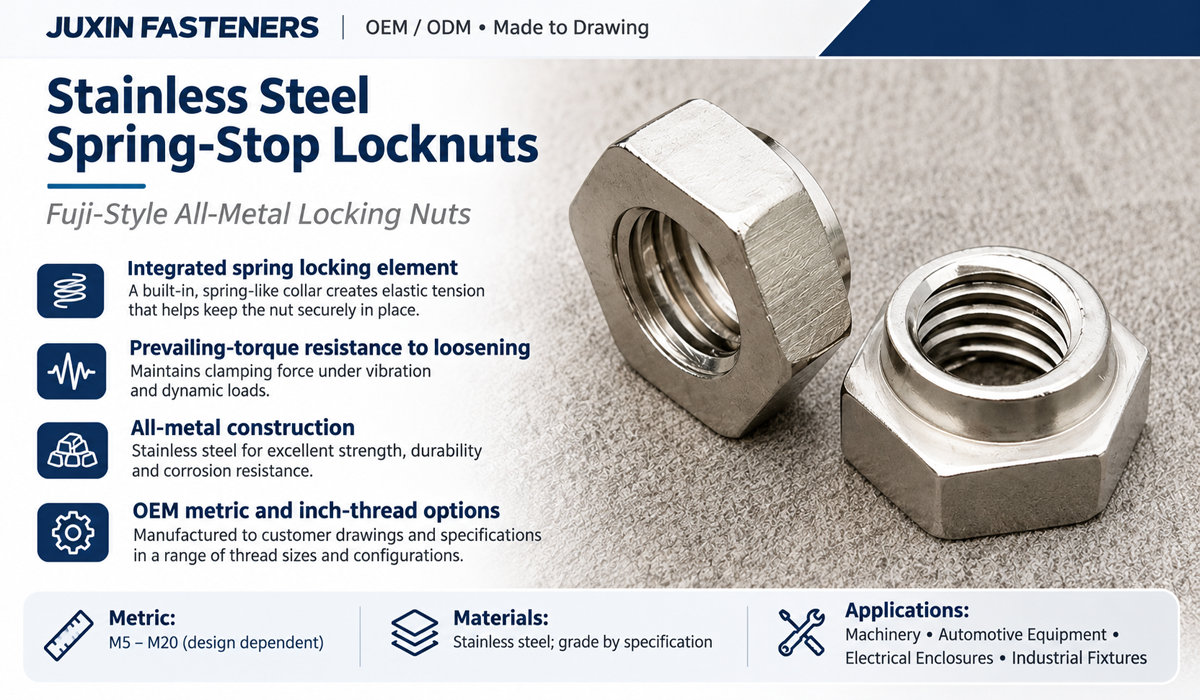
Also known in industrial catalogs as Fuji-style locknuts or all-metal spring-lock hex nuts, these fasteners use an integrated metal spring locking element to create prevailing torque against the mating bolt thread.
Unlike nylon-insert locknuts, the locking mechanism does not depend on a polymer insert.
Metric sizes include M5, M6, M8, M10, M12, M14, M16 and M20, subject to product confirmation.
Custom UNC and UNF inch-thread designs can be evaluated according to customer drawings.
Applications include industrial machinery, automotive equipment, electrical systems, transportation equipment, renewable energy and selected maintenance-intensive assemblies.
Juxin Fasteners supports OEM/ODM manufacturing, material selection, cold forming, CNC machining, spring-element assembly and dimensional inspection according to approved technical specifications.
Product Specification
Stainless Steel Spring-Stop Locknuts for Vibration-Resistant OEM Assemblies
Fuji-Style All-Metal Hex Locknuts with Integrated Spring Locking Elements
Juxin Fasteners manufactures stainless steel spring-stop locknuts for industrial machinery, automotive equipment, electrical systems, transportation equipment and custom OEM fastening applications.
These all-metal locking nuts incorporate a spring locking element at one end of the hexagonal nut body.
During installation, the spring element interacts with the mating bolt thread to generate prevailing torque, helping resist unintentional rotation under vibration and dynamic operating conditions.
In North American industrial catalogs, this type of fastener is commonly described as a spring-stop locknut, Fuji-style locknut or all-metal spring-lock hex nut.
Unlike conventional nylon-insert locknuts, the locking function does not rely on a polymer insert.
Juxin Fasteners supports OEM/ODM manufacturing of metric and customer-specified inch-thread versions based on approved drawings, material specifications and application requirements.
Product Specifications
| Parameter | Specification |
|---|---|
| Product Name | Stainless Steel Spring-Stop Locknuts |
| Alternative Names | Fuji-Style Locknuts; All-Metal Spring-Lock Hex Nuts |
| Product Category | All-Metal Self-Locking Nuts |
| Nut Body | Hexagonal |
| Locking Mechanism | Integrated Metal Spring Locking Element |
| Main Material | Stainless Steel |
| Material Grades | Customer-Specified Stainless Steel Grades |
| Surface Finish | Natural Stainless Steel Finish; Other Finishes by Specification |
| Metric Sizes | M5, M6, M8, M10, M12, M14, M16, M20 |
| Inch Threads | Custom UNC and UNF Designs by Engineering Review |
| Thread Direction | Right-Hand Unless Otherwise Specified |
| Manufacturing | Cold Forming, CNC Machining and Secondary Operations |
| Customization | OEM/ODM Made-to-Drawing Manufacturing |
Material grades, mechanical properties, locking torque, thread tolerances and dimensional requirements must be confirmed against the approved product drawing.
What Is a Stainless Steel Spring-Stop Locknut?
A stainless steel spring-stop locknut is an internally threaded hexagonal nut that incorporates a metal spring element to resist loosening.
The locking element is positioned at one end of the nut.
As the nut engages the mating bolt, the spring feature produces resistance to relative rotation.
This resistance is known as prevailing torque.
The locking action is generated by the interaction between the metal spring element and the mating thread, rather than by a nylon insert or a permanently deformed hexagonal nut body.
Spring-stop locknuts are commonly associated with Fuji-style locking designs.
The exact spring configuration may differ between manufacturers and product variants.
How the Spring-Stop Locking Mechanism Works
1. Initial Thread Engagement
The nut is started on the mating bolt using the correctly matched internal and external threads.
The nut should engage without cross-threading.
2. Spring Element Engagement
As installation progresses, the metal spring locking element contacts the mating bolt thread.
The spring feature deflects according to its design and produces frictional resistance.
3. Prevailing Torque Generation
The locking element continues to resist rotation as the nut advances.
This prevailing torque helps reduce the risk of unintentional loosening.
4. Joint Tightening
The nut is tightened to the specified assembly condition using the appropriate tool and procedure.
Prevailing torque must be considered when determining the installation torque needed to achieve the required joint preload.
5. Removal and Reinstallation
Some spring-stop locknut designs are suitable for repeated installation and removal.
However, reuse depends on the condition of the spring element, the mating thread and the specified prevailing-torque acceptance limits.
Unlimited reuse or unchanged locking performance must not be assumed.
Integrated Metal Spring Locking Element
The metal spring element is the defining feature of this fastener.
Depending on the approved design, it may incorporate retaining tabs, spring fingers or a specially formed locking ring.
Its purpose is to create controlled interference with the mating thread.
Critical engineering parameters may include:
Spring material
Spring geometry
Retention method
Initial prevailing torque
Removal prevailing torque
Reuse performance
Thread compatibility
Operating temperature
Corrosion exposure
The spring material and nut body material should be specified separately when they differ.
Stainless Steel Material Selection
Stainless steel may provide useful corrosion resistance for industrial assemblies exposed to moisture and demanding service conditions.
Possible grades for engineering evaluation include 304 and 316 stainless steel.
304 Stainless Steel
304 stainless steel is commonly used in general industrial equipment and fastening applications.
It offers corrosion resistance in many indoor, humid and selected outdoor environments.
Material selection should consider the operating temperature, mechanical load and environmental exposure.
316 Stainless Steel
316 stainless steel generally offers improved resistance to certain chloride-containing environments compared with 304 stainless steel.
It may be considered for selected outdoor, marine-adjacent and chemical-processing equipment.
However, 316 stainless steel is not immune to crevice corrosion, pitting or other corrosion mechanisms.
The spring locking element must also be suitable for the same operating environment.
Spring Material Compatibility
An all-metal spring-stop locknut may contain more than one metallic material.
For example, the nut body and spring element may require different material properties.
The spring must retain appropriate elasticity and locking performance throughout the specified operating conditions.
The complete assembly should be evaluated for corrosion compatibility, thermal exposure and mechanical durability.
Natural Stainless Steel Finish
The product shown has a bright metallic appearance consistent with a natural or mechanically finished metal surface.
The exact surface condition and stainless steel grade cannot be confirmed from a photograph alone.
Where required, stainless steel components may be passivated according to an approved specification.
Passivation is not a substitute for selecting the correct material for the service environment.
Metric Thread Sizes
The following metric sizes are identified for this product family.
| Metric Thread | Standard Coarse Pitch | Nominal Diameter in Inches |
|---|---|---|
| M5 | 0.80 mm | 0.197 in |
| M6 | 1.00 mm | 0.236 in |
| M8 | 1.25 mm | 0.315 in |
| M10 | 1.50 mm | 0.394 in |
| M12 | 1.75 mm | 0.472 in |
| M14 | 2.00 mm | 0.551 in |
| M16 | 2.00 mm | 0.630 in |
| M20 | 2.50 mm | 0.787 in |
These are standard ISO metric coarse-thread references.
Fine-thread designs, special thread pitches and product-specific dimensional requirements must be confirmed before manufacturing.
Unified Inch-Thread Options for North American OEMs
For customers using Unified inch threads, custom UNC and UNF spring-stop locknuts can be evaluated.
| Inch Thread | Series | Threads per Inch |
|---|---|---|
| #10-24 | UNC | 24 |
| #10-32 | UNF | 32 |
| 1/4-20 | UNC | 20 |
| 1/4-28 | UNF | 28 |
| 5/16-18 | UNC | 18 |
| 5/16-24 | UNF | 24 |
| 3/8-16 | UNC | 16 |
| 3/8-24 | UNF | 24 |
| 7/16-14 | UNC | 14 |
| 7/16-20 | UNF | 20 |
| 1/2-13 | UNC | 13 |
| 1/2-20 | UNF | 20 |
| 5/8-11 | UNC | 11 |
| 5/8-18 | UNF | 18 |
| 3/4-10 | UNC | 10 |
| 3/4-16 | UNF | 16 |
These inch-thread designations are engineering references for potential custom manufacturing.
They do not indicate that every size is an established production item or available from inventory.
Actual manufacturing feasibility depends on the nut geometry, spring locking element, material and order requirements.
Metric and Unified inch threads are not directly interchangeable.
Thread Tolerances and Mating Bolt Compatibility
The spring-stop locking mechanism must function with the specified mating bolt thread.
Important considerations include:
Internal thread tolerance
External thread tolerance
Bolt material
Bolt strength class
Thread coating
Thread engagement
Spring interference
Installation torque
Prevailing torque
Incorrect thread combinations may cause excessive resistance, damaged threads or inadequate locking performance.
Spring-Stop Locknuts vs. Nylon-Insert Locknuts
Both designs are intended to resist unintentional loosening, but they use different mechanisms.
| Feature | Spring-Stop Locknut | Nylon-Insert Locknut |
|---|---|---|
| Locking Element | Metal Spring Feature | Polymer Insert |
| Locking Mechanism | Spring-Induced Prevailing Torque | Polymer-to-Thread Interference |
| High-Temperature Considerations | No Nylon Insert; Metal Properties Still Limit Service | Polymer Temperature Limit Applies |
| Reuse | Subject to Spring Condition and Torque Verification | Subject to Insert Condition and Torque Verification |
| Typical Selection Factor | Metal Locking Mechanism and Vibration Resistance | General-Purpose Prevailing-Torque Fastening |
Neither design should be selected solely by its product name.
Required preload, temperature, vibration and reuse criteria must be considered.
Spring-Stop Locknuts vs. Distorted-Thread Locknuts
Distorted-thread locknuts create prevailing torque through a deliberately deformed thread or nut geometry.
Spring-stop locknuts instead use a distinct metal spring locking feature.
| Feature | Spring-Stop Locknut | Distorted-Thread Locknut |
|---|---|---|
| Locking Mechanism | Integrated Metal Spring | Deformed Thread Geometry |
| Locking Element | Separate or Integrated Spring Feature | Nut Body or Thread Deformation |
| Primary Design Focus | Spring Elasticity and Interference | Controlled Thread Deformation |
| Reuse | Design and Test Dependent | Design and Test Dependent |
These are different all-metal locking nut families and should be specified separately.
Spring-Stop Locknuts vs. Locknuts with Spring-Lock Washers
A spring-stop locknut is not necessarily the same product as a nut assembled with a spring-lock washer.
A conventional spring-lock washer acts at the bearing surface of the joint.
A spring-stop locknut generates prevailing torque through a locking feature interacting with the bolt thread.
The installation method and mechanical performance are different.
This distinction is important when reviewing customer drawings and catalog descriptions.
Vibration Resistance and Joint Reliability
Spring-stop locknuts are used in applications where resistance to loosening is important.
The locking element creates resistance to relative rotation, but it does not eliminate the need for correct joint design.
Engineers should evaluate:
Required clamp load
Joint stiffness
Bolt preload
Dynamic loading
Transverse vibration
Thermal cycling
Surface settlement
Thread engagement
Prevailing-torque performance
A locking nut cannot compensate for an incorrectly designed or insufficiently preloaded joint.
Automotive and EV Manufacturing Applications
Automotive and electric vehicle equipment may require locking fasteners for vibration-sensitive assemblies.
Potential applications include:
Equipment mounting brackets
Vehicle accessory assemblies
Production fixtures
Mechanical supports
Selected serviceable connections
Manufacturing equipment
Safety-critical applications require OEM approval and appropriate validation.
Locking performance must be verified for the actual bolt, joint and service conditions.
Industrial Machinery and Automation
Industrial machinery may experience vibration, repeated operation and dynamic mechanical loading.
Spring-stop locknuts may be considered for:
Machinery mounting assemblies
Industrial automation equipment
Mechanical brackets
Equipment supports
Selected vibration-sensitive connections
Maintenance-accessible machinery components
Production managers should evaluate assembly torque, inspection requirements and replacement procedures.
Rail Transit Equipment
Rail transit equipment may involve repeated vibration and demanding maintenance requirements.
Potential applications include selected:
Equipment brackets
Auxiliary machinery
Interior mechanical assemblies
Noncritical equipment supports
Maintenance fixtures
Railway fastening applications require relevant engineering validation, material specifications and operating-condition approval.
No universal rail qualification is implied.
Electrical Equipment and Control Cabinets
Electrical equipment manufacturers may use locking fasteners in assemblies exposed to equipment vibration.
Potential applications include:
Electrical enclosure supports
Control cabinet brackets
Equipment mounting frames
Industrial electrical accessories
Mechanical support components
The fastener must be compatible with the electrical and mechanical requirements of the complete assembly.
Electrical bonding and grounding should be evaluated separately.
AI Data Centers and Power Infrastructure
Data center equipment includes power distribution systems, mechanical supports and serviceable infrastructure.
Spring-stop locknuts may be evaluated for selected mechanical assemblies where vibration resistance is required.
Potential applications include:
Power equipment mounting structures
Mechanical support brackets
Auxiliary equipment frames
Cooling equipment supports
Industrial service assemblies
For server racks and critical power infrastructure, the joint must be engineered according to its structural, electrical and maintenance requirements.
Renewable Energy and Energy Storage
Wind power, solar equipment and energy storage systems may include mechanical connections exposed to vibration, temperature changes and environmental conditions.
Spring-stop locknuts can be considered where an all-metal prevailing-torque mechanism is appropriate.
Material selection should account for:
Environmental corrosion
Temperature variation
Vibration
Required preload
Inspection access
Long-term maintenance
Application suitability requires validation.
Marine and Offshore Equipment
Marine-related equipment may require corrosion-resistant fasteners.
Stainless steel spring-stop locknuts can be evaluated for selected mechanical assemblies.
The corrosion resistance of the complete fastener, including the spring element, must be considered.
Saltwater exposure does not automatically make every stainless steel grade suitable.
Chemical Processing Equipment
Chemical-processing facilities may require fastening components exposed to moisture, cleaning chemicals or other aggressive environments.
The selected stainless steel grade must be compatible with the actual chemicals and service temperature.
Chemical compatibility should be established through appropriate engineering review.
Food Processing and Hygienic Equipment
Stainless steel fasteners may be used in food-processing machinery and related equipment.
Potential applications include:
Machinery brackets
Equipment frames
Mechanical supports
Serviceable non-product-contact assemblies
Hygienic suitability depends on the complete equipment design, surface condition and cleaning requirements.
The stainless steel material alone does not establish food-contact approval.
Construction and Infrastructure Equipment
Spring-stop locknuts may be considered for selected equipment and mechanical support connections.
However, structural steelwork, bridges and seismic connections may be subject to specific fastening standards and approval requirements.
A general-purpose spring-stop locknut should not automatically be substituted for a specified structural fastening system.
Aerospace and Defense Equipment
Aerospace and defense equipment may require specialized locking fasteners.
Such applications demand strict material, traceability, qualification and testing requirements.
Juxin Fasteners can evaluate made-to-drawing manufacturing inquiries, but no aerospace or defense certification is implied.
Manufacturing Processes
Juxin Fasteners combines fastener forming and precision machining capabilities for OEM manufacturing projects.
Depending on the product design, manufacturing may involve:
Cold heading
Cold forming
CNC machining
Internal threading
Spring element fabrication or sourcing
Locking element assembly
Dimensional inspection
Functional locking torque testing
The process route depends on the required material, geometry, spring design and production quantity.
Spring Element Assembly
The locking element must be correctly positioned and retained within the nut assembly.
Its design may require specialized forming, assembly or retention operations.
The approved drawing should define the locking element's geometry and attachment method.
Manufacturing feasibility and tooling requirements must be reviewed before production.
Quality Control and Performance Verification
Spring-stop locknuts require more than conventional dimensional inspection.
Depending on customer requirements, inspection and testing may include:
Material verification
Thread gauging
Hexagon dimensions
Nut height
Spring element geometry
Spring retention
Initial prevailing torque
Removal prevailing torque
Repeated installation performance
Proof load, where applicable
Surface finish inspection
Corrosion testing, when specified
Test methods, sample quantities and acceptance limits must be agreed upon before production.
Relevant International Standards
The following standards may be relevant to the product or its engineering evaluation.
| Standard | Engineering Application |
|---|---|
| ISO 261 | ISO Metric Screw-Thread General Plan |
| ISO 724 | Basic Dimensions of ISO Metric Screw Threads |
| ISO 965 Series | ISO Metric Screw-Thread Tolerances |
| ASME B1.1 | Unified Inch Screw Threads |
| ISO 2320 | Prevailing-Torque Type Steel Nuts — Mechanical and Performance Properties |
| ISO 3506-2 | Mechanical Properties of Corrosion-Resistant Stainless Steel Nuts |
| ISO 9227 | Corrosion Tests in Artificial Atmospheres — Salt Spray Tests |
| DIN 980 | Related All-Metal Prevailing-Torque Nut Designs, Subject to Verification |
ISO 2320 may provide relevant prevailing-torque test concepts, but its applicability and acceptance requirements must be checked for the specific stainless steel spring-stop design.
DIN 980 should not be claimed as a dimensional or performance certification without verification.
Product conformity must be established against the applicable standard and approved customer specification.
Engineering Selection Checklist
Before specifying stainless steel spring-stop locknuts, engineers should confirm:
Nut body material
Spring element material
Thread diameter and pitch
Thread tolerance
Nut dimensions
Bolt strength and material
Required joint preload
Initial prevailing torque
Removal prevailing torque
Permitted reuse cycles
Temperature range
Corrosion exposure
Assembly torque procedure
Inspection requirements
These factors determine whether the fastener is appropriate for the intended application.
OEM and Custom Manufacturing
Juxin Fasteners supports custom industrial fastener manufacturing based on approved engineering drawings and technical requirements.
Potential customization includes:
Metric coarse threads
Metric fine threads
UNC threads
UNF threads
Special hexagon dimensions
Modified nut heights
Customer-specific spring locking geometry
Stainless steel material selection
Special surface finishes
Defined prevailing-torque requirements
Custom inspection criteria
Customer part identification
Industrial batch production
Manufacturing feasibility and production requirements are evaluated during quotation.
Frequently Asked Questions
What is a stainless steel spring-stop locknut?
It is an all-metal locking nut with a spring feature that generates prevailing torque against the mating bolt thread.
Is a spring-stop locknut the same as a Fuji locknut?
Fuji-style locknut is a common industrial catalog term for spring-based all-metal locking nuts. Exact construction may vary by design.
How does the locking mechanism work?
A metal spring element interacts with the mating thread and creates resistance to rotation.
Does this locknut contain nylon?
The spring-stop design described here uses a metal locking mechanism rather than a nylon insert.
Can spring-stop locknuts be reused?
Some designs permit reuse, but continued suitability depends on the spring condition and required prevailing-torque performance.
Are spring-stop locknuts suitable for vibration?
They are designed to resist loosening, but the complete bolted joint must be properly engineered and validated.
What metric sizes are offered?
The product family identifies M5, M6, M8, M10, M12, M14, M16 and M20. Exact configurations require confirmation.
Can Juxin Fasteners manufacture inch-thread versions?
Custom UNC and UNF designs can be evaluated according to customer drawings and engineering requirements.
Are metric and inch threads interchangeable?
No. Thread dimensions and pitch must match the mating fastener.
What stainless steel grades can be used?
Material selection is based on the customer specification. Grades such as 304 and 316 can be evaluated for suitable designs.
Can these locknuts operate at higher temperatures than nylon-insert nuts?
An all-metal locking mechanism avoids the temperature limitations of nylon inserts, but the actual operating temperature depends on the nut and spring materials.
Do these locknuts meet DIN 980?
Compliance must be verified against the relevant standard and product specification. A Fuji-style appearance alone does not establish conformity.
Can the spring locking mechanism be customized?
Customer-specific locking designs can be evaluated, subject to manufacturing feasibility and performance validation.
Can Juxin Fasteners manufacture from customer drawings?
Yes. Juxin Fasteners supports OEM/ODM made-to-drawing industrial fastener manufacturing.
Request a Quote — Stainless Steel Spring-Stop Locknuts
Juxin Fasteners is an industrial fastener manufacturer supporting OEM, Tier-1 and Tier-2 manufacturing programs.
Our manufacturing capabilities include cold heading, cold forming, CNC machining and appropriate secondary operations.
We support custom all-metal locking nuts, stainless steel spring-stop locknuts and precision fastening components according to approved customer drawings.
Recommended RFQ Information
2D engineering drawing or 3D CAD model
Customer part number
Physical sample, if available
Metric or Unified thread designation
Thread pitch or threads per inch
Nut body material grade
Spring element material specification
Hexagon width across flats
Nut height
Locking element geometry
Internal thread tolerance
Mating bolt specification
Required prevailing-torque values
Permitted reuse cycles
Operating temperature
Vibration and loading requirements
Corrosion exposure
Surface finish
Inspection and testing requirements
Initial order quantity
Estimated annual demand
Packaging requirements
Required delivery schedule
Please send your drawings, samples or technical specifications for engineering review and quotation.
Juxin Fasteners
Industrial Fastener Manufacturer | Stainless Steel Spring-Stop Locknuts | Fuji-Style All-Metal Locking Nuts | OEM Fastener Manufacturing
Website: https://www.juxinfasteners.com/
Email: info@juxinfasteners.com
Product Packaging
Packaging Standard
At Juxin Fasteners, we apply standardized export packaging to ensure product protection, traceability, and compliance with international logistics requirements.
1. Standard Export Packaging
Unless otherwise specified, all products will be packed according to our factory standard export packaging, which includes:
Moisture-resistant inner protection
Poly bag or small box packing as required
Reinforced export cartons
Clear labeling with part number, specification, batch number, and quantity
Palletizing for sea or air shipment when necessary
Our standard packaging is designed to ensure safe transportation, efficient warehousing, and long-distance international shipping.
2. Customized Packaging Options
We also provide customized packaging solutions according to customer requirements, including but not limited to:
Private labeling
Customized barcodes
Specific carton dimensions
Retail packaging
Special pallet configuration
Customer-specific marking and identification
So that you know, customized packaging may involve additional costs and extended lead time depending on the complexity of the requirements.
3. Compliance & Quality Assurance
All packaging processes are controlled under our ISO 9001 quality management system to ensure consistency, traceability, and product integrity throughout the supply chain.
Product Pictures

Contact Us
Tel.:
+86 020 8621 0320
+86 020 3121 6067
E-mail:
Technical Support:
Navigation
SEND INQUIREY


