Call Us
+86 136 6007 9809
Call Us
+86 136 6007 9809

Rivet Nuts in Automotive Manufacturing: Engineering Application Solutions for Thin Sheet, Lightweight Structures, and High-Reliability Joints
In modern automotive engineering, the demand for lightweight structures, multi-material joining, and post-coating assembly capability is rapidly increasing. Traditional fastening methods such as welded nuts or tapped threads often fail to meet these requirements due to thermal distortion, coating damage, limited accessibility, or low thread reliability.
Product Specification
Rivet Nuts in Automotive Manufacturing: Engineering Application Solutions for Thin Sheet, Lightweight Structures, and High-Reliability Joints
In modern automotive engineering, the demand for lightweight structures, multi-material joining, and post-coating assembly capability is rapidly increasing. Traditional fastening methods such as welded nuts or tapped threads often fail to meet these requirements due to thermal distortion, coating damage, limited accessibility, or low thread reliability.
To address these challenges, rivet nuts (blind rivet nuts / threaded inserts for sheet metal) have become a widely adopted solution in automotive body-in-white, chassis systems, and lightweight structural assemblies.
These industrial rivet nut fastening systems provide a robust internal thread in thin sheets or closed profiles without welding, enabling high-strength, vibration-resistant, and corrosion-protected connections.
1. Why Rivet Nuts Are Essential in Automotive Structural Design
In automotive manufacturing, rivet nuts are developed to solve three core engineering problems:
Joining dissimilar materials (steel, aluminum, stainless steel, composites, plastics)
Avoiding heat distortion from welding processes
Providing reliable threads in thin sheets and closed hollow structures
Compared with welded nuts, automotive rivet nut fasteners offer:
No thermal damage to base material
No deformation of thin sheet metal or tubular structures
No damage to pre-painted or pre-treated surfaces
No risk of thread stripping in low-thickness materials
Post-paint installation capability without thread contamination
In addition, advanced coatings such as zinc-nickel-plated rivet nuts provide high corrosion resistance that meets ISO 9227 salt spray requirements in automotive environments.
2. Types and Structural Designs of Rivet Nuts
In automotive applications, rivet nuts are mainly classified into:
Press-in rivet nuts (clinching / press-fit types)
Blind rivet nuts (pull-type installation)
Each type is designed for different structural and load conditions.
2.1 Press-in Rivet Nuts (Clinching Type)
Press-in rivet nuts provide high resistance to torque-out forces and are widely used in automotive body structures.
Structural variations include:
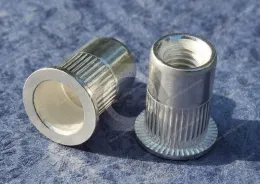
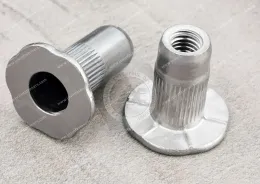
(1) Knurled body rivet nuts (serrated press-in type)
Cylindrical body with knurled surface
Installed by pressing into pre-punched holes
Knurls embed into sheet metal, creating plastic deformation locking
Ideal for thin sheet applications (ISO/DIN sheet metal standards)
(2) Clinch deformation rivet nuts (roll-form type)
Nut and sheet deform together during installation
Suitable for thicker sheet metal
Provides high mechanical interlock strength
(3) Self-piercing press-in rivet nuts (no-hole type)
Directly pierces the sheet during installation
Eliminates pre-drilling process
Common in high-volume automotive production lines
2.2 Blind Rivet Nuts (Pull-Type Rivet Nuts)
Blind rivet nuts are widely used in closed sections where only one-sided access is available.
Common structural designs:
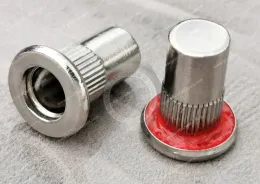
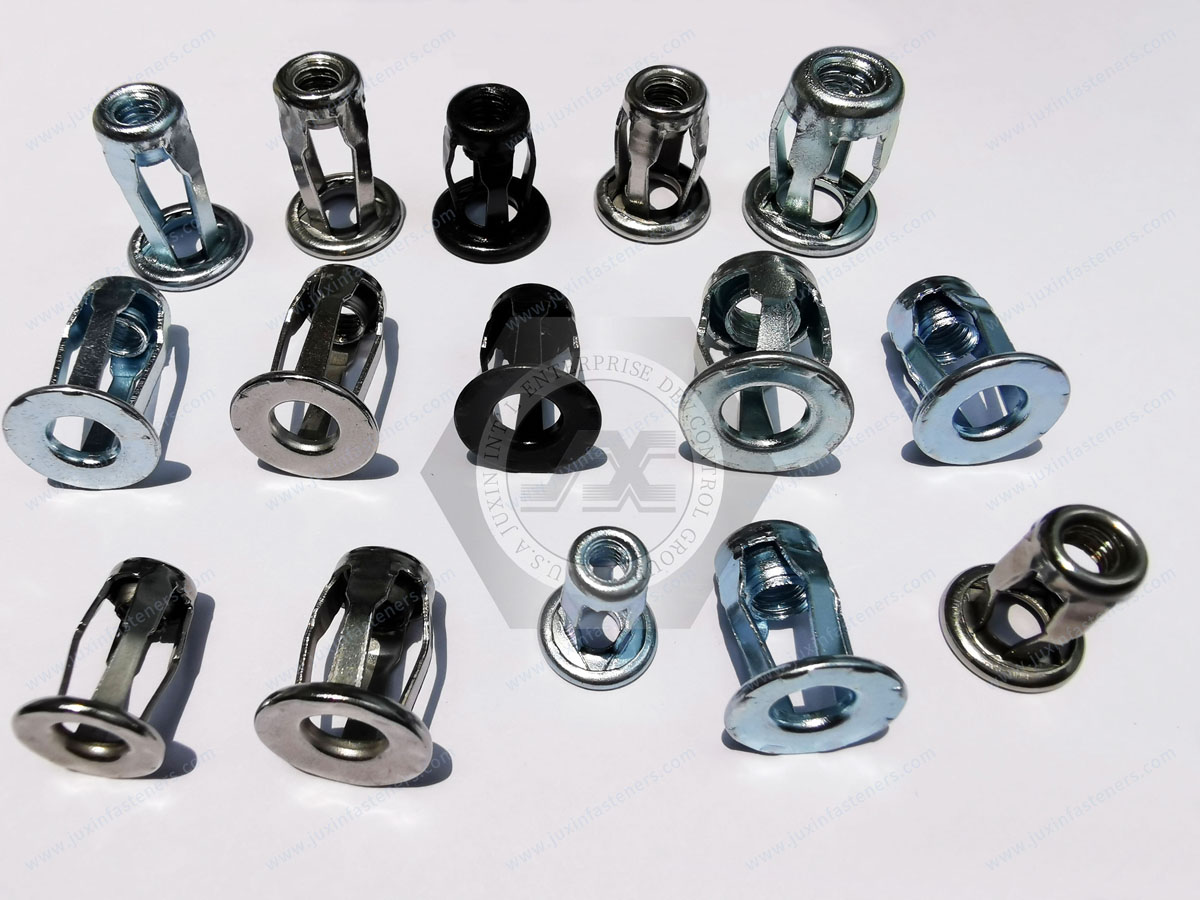
(1) Knurled body blind rivet nut
Improves torque resistance in soft materials such as aluminum, magnesium, plastics, composites, and wood-based structures
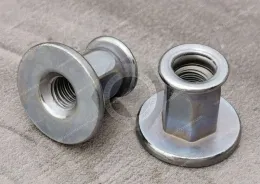
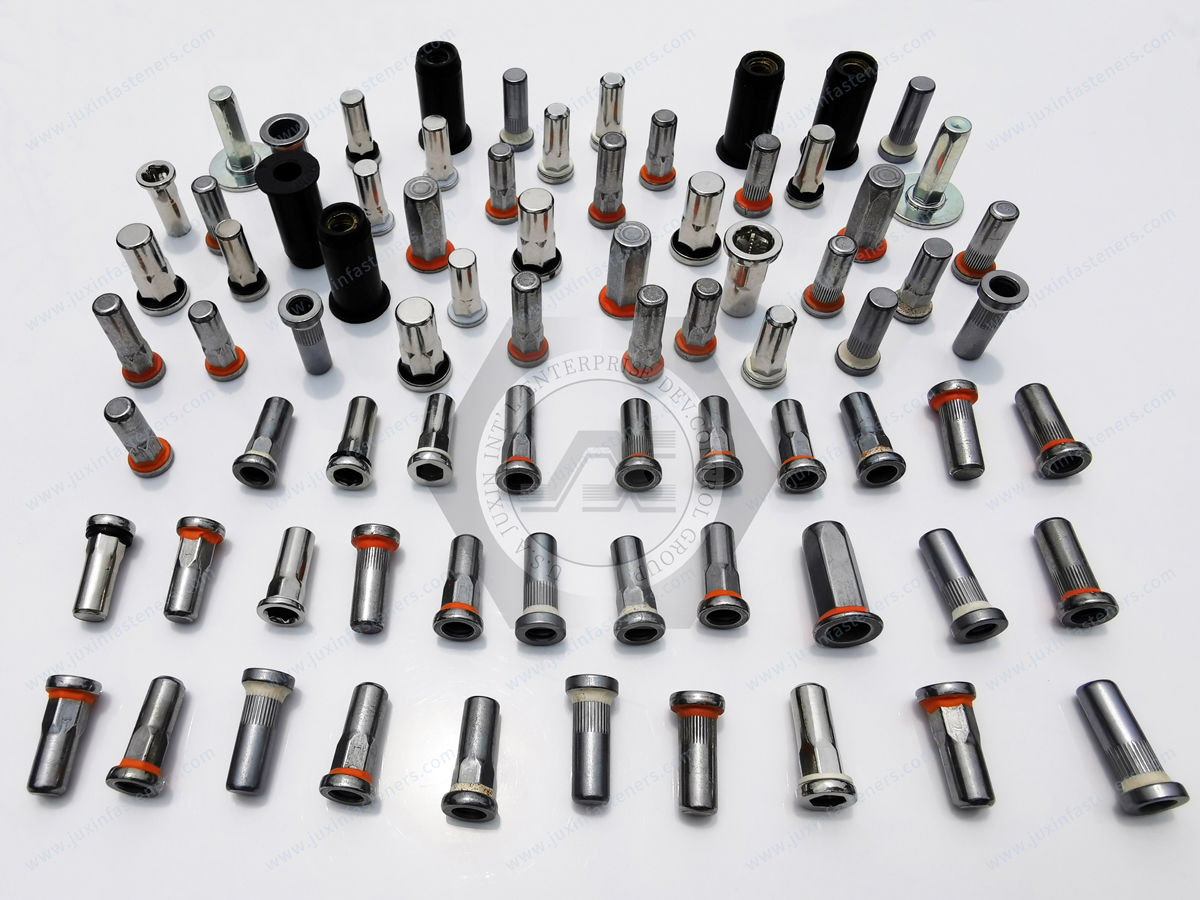
(2) Hex-body rivet nut (anti-rotation design)
Hexagonal geometry provides strong anti-rotation locking
Suitable for automotive chassis components under vibration and torsional loads
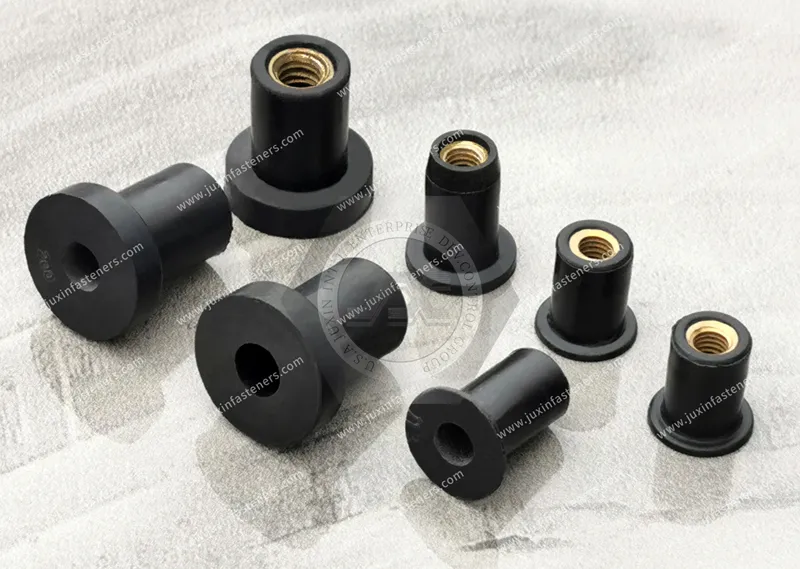
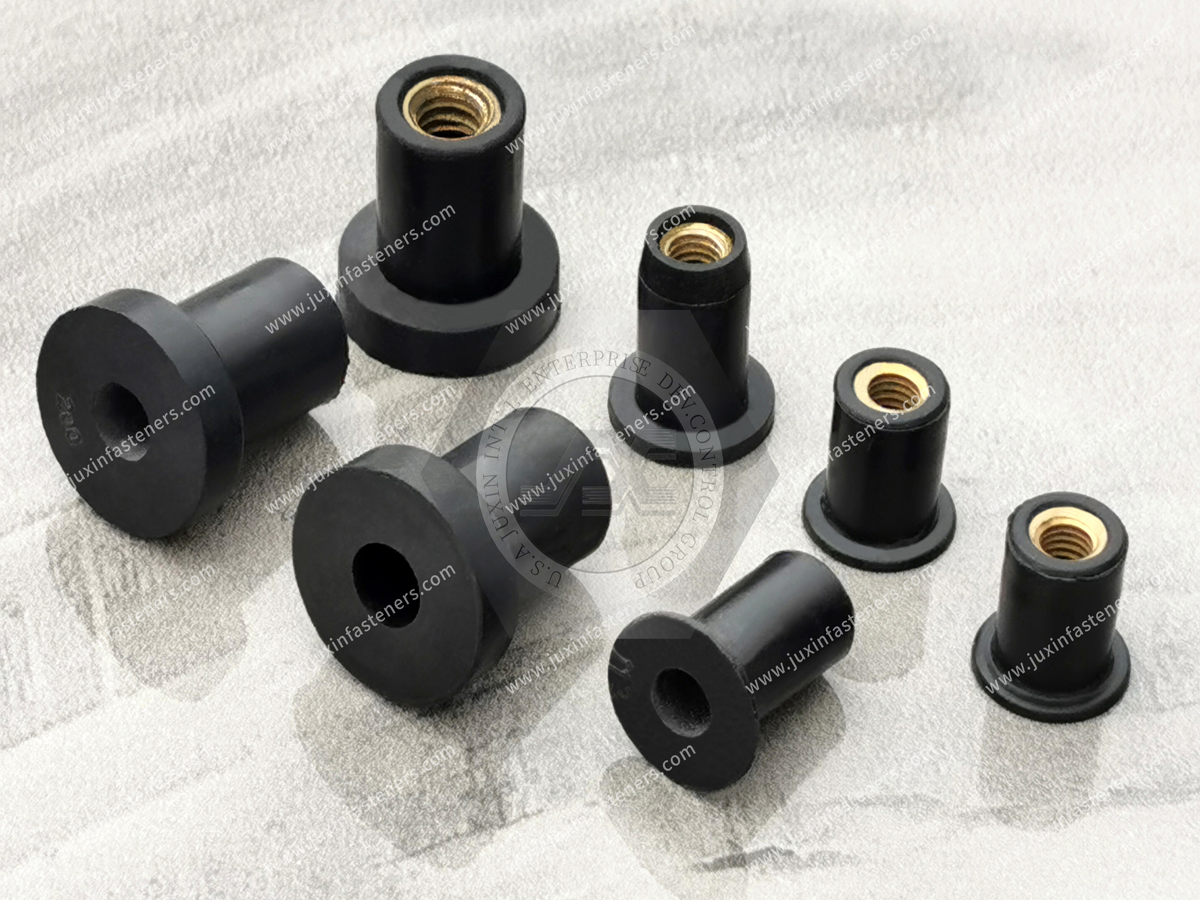
(3) Large flange rivet nut
Enlarged bearing surface distributes load
Ideal for thin sheets and soft materials requiring high pull-out resistance
(4) Square-body rivet nut
Maximum anti-rotation performance
Used in automotive body-in-white applications requiring high torque resistance
3. Key Selection Criteria for Rivet Nut Fasteners
Correct selection of automotive rivet nuts and threaded inserts is critical for structural integrity and long-term durability.
3.1 Mechanical Load Requirements
Engineering design must define:
Tensile load capacity
Shear load resistance
Torque-out resistance
3.2 Thread Size and Friction Coefficient Control
Standard rivet nut thread sizes range from:
Metric: M3 to M12
Imperial threads available for global OEM platforms
In automotive engineering, controlled-friction-coefficient fasteners (µ-controlled rivet nuts) are essential for consistent torque-tension behavior.
3.3 Sheet Thickness Compatibility
Rivet nut selection must ensure:
Proper grip range (sheet thickness compatibility)
Stable deformation during installation
No over-compression or insufficient expansion
3.4 Installation Hole Diameter
Manufacturers provide precise hole size specifications based on ISO/DIN design guidelines.
Important considerations:
Hole tolerance must match rivet nut geometry
Coating thickness (paint/e-coat) must be included in design allowance
Post-coating shrinkage must not block installation
3.5 Torque Resistance and Geometry Influence
Anti-rotation performance depends on geometry:
Round body → lowest torque resistance
Knurled body → medium resistance
Hex body → high resistance
Square body → maximum torque resistance
3.6 Corrosion Resistance Strategy
Material selection must consider the risk of galvanic corrosion.
Common solutions:
Zinc-nickel plated rivet nuts (preferred in automotive OEM standards)
Stainless steel rivet nuts for harsh environments
Aluminum rivet nuts for lightweight structures
Material compatibility with the base sheet is critical to avoid galvanic corrosion in mixed-metal assemblies.
3.7 Special Design Variants
Automotive applications often require:
Low-profile head rivet nuts
Large flange designs
Closed-end rivet nuts (sealed type)
Countersunk rivet nuts
3.8 Waterproofing Requirements
Water ingress protection depends on:
Rivet nut body sealing design
Interface sealing between sheet and fastener
Additional sealing compounds or gaskets when required
4. Mechanical Performance and Testing Standards
The performance of rivet nut fastening systems is evaluated using key mechanical parameters:
Installation pull-out force
Head retention strength
Torque-to-turn resistance
Torque-to-strip failure
Shear strength
Push-out force
Testing and validation are typically conducted in accordance with:
ISO fastener testing standards
DIN structural fastener specifications
Automotive OEM internal validation protocols
Supplier engineering specifications
These tests ensure reliability under vibration, thermal cycling, and dynamic loading conditions.
5. Automotive Applications of Rivet Nuts
Automotive rivet nut fastening solutions are widely used in:
Body-in-white (BIW) structures
Automotive chassis systems
Battery enclosures for EV platforms
Interior structural mounting points
Lightweight aluminum body panels
Closed-section tubular frames
Composite material assemblies
Their ability to provide high-strength threaded joints without welding makes them essential for modern vehicle lightweight design strategies.
6. Engineering Summary: Why Rivet Nuts Are the Preferred Solution
Rivet nuts solve multiple engineering challenges simultaneously:
Enable threading in thin or hollow structures
Eliminate welding-related deformation and heat damage
Support multi-material automotive design
Improve assembly efficiency in coated or painted parts
Provide reliable anti-vibration threaded connections
From ISO/DIN-based structural design perspectives, rivet nuts represent a critical fastening technology for next-generation automotive manufacturing, especially in electric vehicles and lightweight platforms.
Conclusion
As automotive structures evolve toward lightweight, modular, and multi-material architectures, rivet nut fasteners and threaded insert systems have become indispensable engineering solutions.
By selecting the correct rivet nut type—press-in, blind, hex, square, or flange—and aligning it with ISO/DIN-based design principles, engineers can significantly improve:
Structural reliability
Assembly efficiency
Corrosion resistance
Long-term fatigue performance
In modern automotive fastening engineering, rivet nuts are not just an alternative to welding—they are a core enabling technology for advanced vehicle design.

Product Packaging
Packaging Standard
At Juxin Fasteners, we apply standardized export packaging to ensure product protection, traceability, and compliance with international logistics requirements.
1. Standard Export Packaging
Unless otherwise specified, all products will be packed according to our factory standard export packaging, which includes:
Moisture-resistant inner protection
Poly bag or small box packing as required
Reinforced export cartons
Clear labeling with part number, specification, batch number, and quantity
Palletizing for sea or air shipment when necessary
Our standard packaging is designed to ensure safe transportation, efficient warehousing, and long-distance international shipping.
2. Customized Packaging Options
We also provide customized packaging solutions according to customer requirements, including but not limited to:
Private labeling
Customized barcodes
Specific carton dimensions
Retail packaging
Special pallet configuration
Customer-specific marking and identification
So that you know, customized packaging may involve additional costs and extended lead time depending on the complexity of the requirements.
3. Compliance & Quality Assurance
All packaging processes are controlled under our ISO 9001 quality management system to ensure consistency, traceability, and product integrity throughout the supply chain.
Product Pictures
Contact Us
Tel.:
+86 020 8621 0320
+86 020 3121 6067
E-mail:
Technical Support:
Navigation
SEND INQUIREY