Call Us
+86 136 6007 9809
Call Us
+86 136 6007 9809

Joining two sheet-metal components at approximately 90 degrees appears simple until enclosure space, assembly access,
surface finish, dimensional alignment and serviceability all become design constraints.
A conventional solution may use a bent flange, separate angle bracket, welded feature, loose nut or other secondary hardware.
Product Specification
Joining two sheet-metal components at approximately 90 degrees appears simple until enclosure space, assembly access, surface finish,
dimensional alignment and serviceability all become design constraints.
A conventional solution may use a bent flange, separate angle bracket, welded feature, loose nut or other secondary hardware.
Each approach can work.
But each also changes the geometry, manufacturing sequence and assembly process.
Right-angle fasteners provide another option by creating a threaded attachment point oriented for perpendicular assembly
without necessarily requiring a conventional internal angle bracket or large bent mounting flange.
For engineers, however, the real question is not:
“Can I put a thread at 90 degrees?”
It is:
“Can I position the thread axis accurately enough, maintain screw access, control the perpendicular panel stack-up and transfer the required loads through the complete assembly?”
That distinction turns right-angle fastening from a simple hardware choice into an engineered panel-joining system.
This matters in AI server chassis, network equipment, electrical cabinets, power electronics, semiconductor equipment, industrial automation,
EV electronics, HVAC equipment, medical equipment, food-service equipment and many other fabricated sheet-metal assemblies.
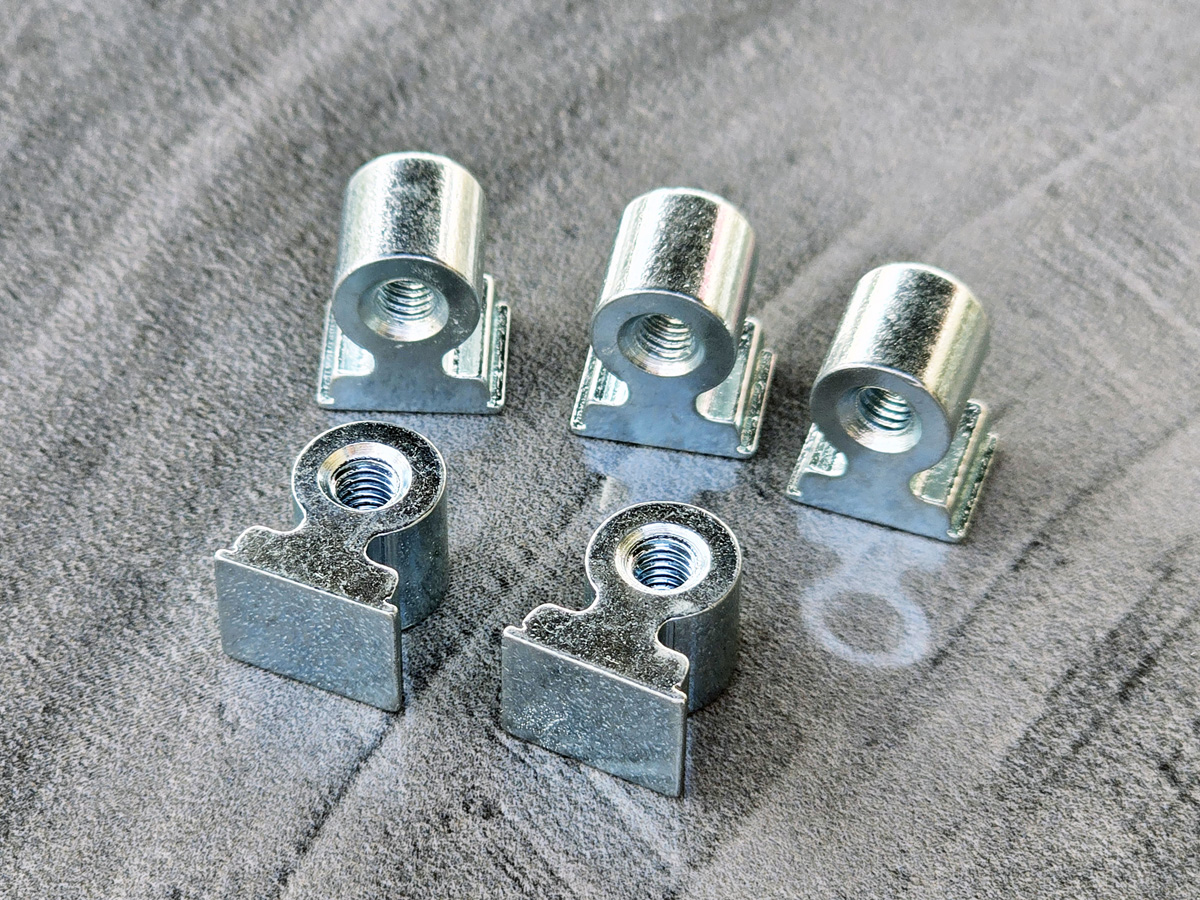
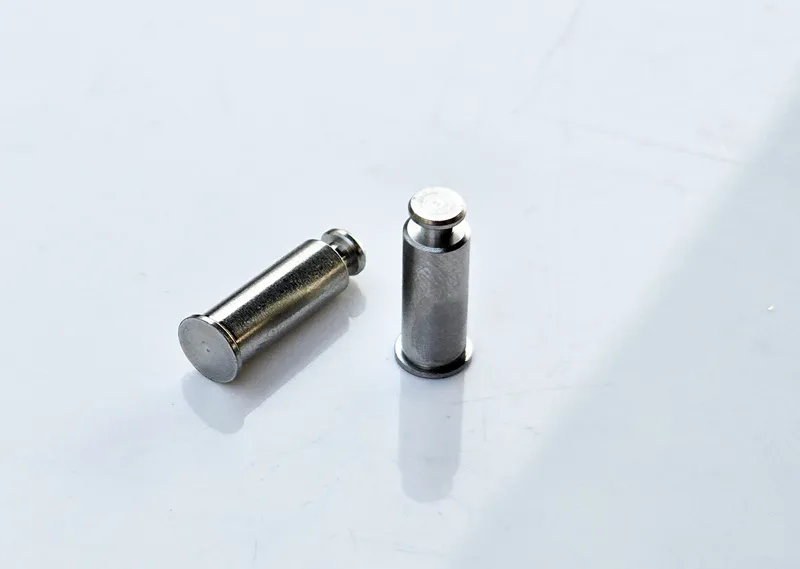
A right-angle fastener is an engineered panel fastener that provides a threaded attachment axis oriented approximately parallel to the host panel surface, allowing another panel or component to be fastened in a perpendicular relationship.
Depending on the specific design, the fastener may use a self-clinching, press-in or another engineered attachment architecture to become retained in the host sheet.
The basic functional relationship can be represented as:
Host Panel → Retained Right-Angle Fastener → Perpendicular Thread Axis → Mating Panel → Screw
The important feature is not simply the fastener body shape.
It is the orientation and location of the threaded axis relative to the host panel datum.
With a conventional self-clinching nut, the thread axis is normally perpendicular to the host sheet.
With a right-angle threaded fastener, the thread axis is redirected so that the mating screw approaches approximately parallel to the host sheet.
This allows a second component to be attached in a perpendicular arrangement.
That change in thread direction can eliminate the need for some traditional attachment features in suitable designs.
Potential design benefits may include:
reducing separate angle brackets;
reducing loose nuts;
avoiding some bent fastening flanges;
providing a thread where backside nut access is difficult;
simplifying selected chassis geometries;
creating removable 90-degree panel joints;
and improving packaging flexibility.
These are design possibilities, not universal outcomes.
Bent flanges are widely used and often remain the correct solution.
A flange can provide:
panel stiffness;
a fastening surface;
edge reinforcement;
alignment;
and structural continuity.
However, a flange also occupies space.
In compact electronic equipment, its geometry may interfere with:
PCBs;
cable routing;
connectors;
airflow paths;
power modules;
cooling components;
neighboring brackets;
or service access.
A right-angle fastener can provide a local threaded attachment point without requiring the same continuous flange geometry.
But removing a flange may also remove stiffness.
Therefore, a right-angle fastener should not automatically be treated as a structural substitute for every bent flange.
The designer must evaluate both fastening and panel stiffness.
A separate angle bracket can be highly flexible because it allows standard screws, nuts or threaded inserts to be used.
However, it also adds:
another component;
additional mounting holes;
extra hardware;
assembly operations;
tolerance interfaces;
and BOM management.
A right-angle fastener may consolidate some of these functions into the host panel.
Whether that produces a better design depends on:
volume;
panel geometry;
required strength;
manufacturing process;
assembly access;
serviceability;
and cost.
The goal should not be “remove every bracket.”
The goal is to determine whether the bracket is performing functions that can be provided more efficiently by another architecture.
Welding can create permanent panel joints and may provide important structural functions.
Right-angle threaded hardware creates a fundamentally different joint.
Potential reasons to consider a threaded alternative can include:
need for disassembly;
sensitivity to thermal distortion;
manufacturing sequence;
prefinished panels;
access requirements;
modular assembly;
component replacement;
or supplier production strategy.
However:
Right-angle fastener ≠ universal replacement for welding.
If the weld provides structural stiffness, sealing, electrical continuity or another system-level function, replacing it requires complete engineering review.
One of the highest-value dimensions in a right-angle fastener is often the relationship between the threaded axis and the host-panel datum.
If the thread centerline is too high or too low relative to the intended mating hole, the screw may not enter correctly.
Possible results include:
difficult screw starting;
cross-threading;
forced panel alignment;
panel distortion;
visible gap;
inconsistent corner geometry;
or assembly rejection.
For second-source qualification, matching the nominal thread size alone is therefore insufficient.
M5 is not enough information.
The thread must also be in the correct three-dimensional location.
A right-angle joint can involve several functional datums:
Datum A: host-panel surface
Datum B: host-panel edge
Datum C: right-angle fastener thread axis
Datum D: mating-panel hole
Datum E: mating-panel locating surface
The assembly works only when these relationships remain compatible after manufacturing variation.
That means engineers should consider:
fastener dimensional tolerance;
mounting-hole position;
installed fastener position;
host-sheet thickness;
sheet flatness;
panel bend tolerance;
mating-hole position;
mating-panel thickness;
and final assembly alignment.
This is one reason a right-angle fastener should be evaluated as part of the chassis geometry rather than as an isolated component.
Suppose the screw hole in the mating panel appears perfectly aligned with the fastener thread in nominal CAD geometry.
Production parts may still experience variation from:
laser cutting;
punching;
forming;
bending;
fastener installation;
coating;
panel flatness;
and dimensional tolerances.
These variations accumulate.
If the joint has insufficient alignment allowance, the operator may need to force the panels together before the screw can start.
That can create false assembly confidence because the screw is being used to pull geometry into position rather than simply clamp an already aligned joint.
A better design separates:
Location → Alignment → Fastening → Clamp
where practical.
This is where another Engineered Metal Panel Fasteners solution becomes relevant.
If the main challenge is tolerance misalignment rather than perpendicular thread creation, a Floating Self-Clinching Nut may be more appropriate in another part of the assembly.
A floating thread can provide controlled lateral accommodation.
A right-angle fastener provides the required thread orientation.
These are different functions.
In complex chassis assemblies, both may appear in the same equipment:
Right-Angle Fastener → Creates Perpendicular Thread Axis
Floating Self-Clinching Nut → Helps Accommodate Selected Hole Misalignment
This is why fastener selection should start with the engineering problem rather than the product name.
A right-angle thread is only useful if the screw can actually reach it.
Mechanical designers should evaluate:
screw insertion direction;
driver approach angle;
screwdriver or bit diameter;
tool length;
nearby walls;
PCB position;
cable routing;
connectors;
cooling components;
neighboring screws;
and maintenance access.
A CAD model may show enough room for the screw itself but not enough room for the installation tool.
This becomes particularly important in:
1U/2U electronic chassis;
dense network equipment;
compact power electronics;
semiconductor machinery;
control cabinets;
and tightly packaged appliances.
Screw access is part of fastener selection.
The mating screw must provide suitable engagement without creating interference elsewhere.
Review:
mating-panel thickness;
washer thickness where applicable;
available thread engagement;
fastener thread depth;
internal clearance;
screw-tip position;
and surrounding components.
The correct screw length is application-specific.
Longer is not automatically better.
Depending on the application, right-angle fasteners may use metric or Unified inch machine threads.
Relevant international thread standards may include applicable ISO metric thread standards or ASME B1.1 for Unified inch threads.
However, thread standards define only the threaded interface.
They do not define:
right-angle fastener body geometry;
mounting interface;
thread centerline height;
panel compatibility;
installed envelope;
or joint performance.
Therefore, two fasteners with the same nominal thread can still be mechanically incompatible.
Where the right-angle fastener uses self-clinching installation, the host sheet becomes part of the retention system.
Important variables include:
host-sheet material;
thickness;
material condition or hardness;
mounting-hole geometry;
edge distance;
bend proximity;
local flatness;
installation access;
tooling;
and surface condition.
There is no universal panel range or installation force suitable for every right-angle fastener.
The specific product geometry and host-sheet combination control the requirement.
Right-angle hardware is frequently positioned near panel edges because the thread must face an adjacent perpendicular component.
That makes edge geometry especially important.
If a self-clinching feature is installed too close to a free edge, the sheet may not provide the intended material support around the mounting feature.
Possible issues can include:
local distortion;
edge bulging;
incomplete seating;
reduced retention;
or dimensional shift.
The required minimum edge relationship must come from the specific fastener design rather than a generic universal number.
Many right-angle joints occur near bends.
But the region near a bend is not geometrically equivalent to a flat sheet.
Potential issues include:
curved material;
local work hardening;
reduced tooling access;
non-parallel installation surfaces;
dimensional variation;
and interference between the fastener body and bend radius.
The mounting location should therefore be reviewed relative to:
bend tangent;
bend radius;
formed flange;
tooling;
and final panel geometry.
It is common to summarize self-clinching technology by saying the host sheet must be softer than the fastener.
That principle can be useful, but it should not replace product-specific material compatibility.
Actual suitability depends on:
fastener material;
fastener hardness;
host-sheet alloy;
sheet condition;
sheet hardness;
thickness;
mounting geometry;
and installation process.
Carbon steel, stainless steel and aluminum sheet require appropriate fastener selection.
Do not assume one right-angle fastener design works in every sheet material.
A right-angle fastener may change the order in which a chassis is manufactured.
A possible workflow might be:
Flat Sheet Fabrication → Fastener Installation → Forming / Assembly → Surface Finishing Where Appropriate → Final Screw Assembly
But the correct sequence depends on the product and finish system.
For example:
some fasteners may need installation before coating;
some finishes may affect mounting-hole dimensions;
coating may affect electrical contact;
installed hardware may influence forming access;
and subsequent processes may damage threads.
Therefore, there should be no blanket rule that right-angle fasteners are always installed before or after finishing.
The process plan should be reviewed for the specific part.
A right-angle threaded joint can experience several different loads:
screw tension;
joint clamp;
shear between panels;
moment from offset loads;
peel-type loading;
vibration;
shock;
and loads transferred into the host sheet.
The fastener itself is only one part of the system.
A simplified load path may be:
Mating Panel → Screw → Right-Angle Thread → Fastener Body → Fastener-to-Sheet Interface → Host Panel
But contact between the two panels may also carry part of the load.
The real load distribution depends on joint geometry.
This distinction is important.
Push-out, pull-out, torque-out or other retention characteristics describe particular fastener-to-sheet behaviors under defined conditions.
They do not automatically equal:
complete joint tensile strength;
joint shear strength;
fatigue life;
vibration resistance;
chassis stiffness;
or equipment structural rating.
If mechanical performance is critical, requirements should be defined at the correct assembly level.
AI servers, GPU systems, storage platforms, network switches and rack-mounted power equipment operate with increasingly dense mechanical packaging.
Potential right-angle-fastener applications include suitable:
chassis side structures;
internal divider plates;
card-cage structures;
power-module mounting walls;
fan and cooling-control structures;
serviceable subassemblies;
internal rails;
and equipment brackets.
The benefit is not automatically “more airflow.”
The more accurate engineering opportunity is packaging flexibility.
Where a continuous bent flange or separate bracket occupies critical space, a localized right-angle threaded attachment may free selected areas for:
PCB clearance;
cable routing;
connectors;
fan paths;
heat sinks;
or cooling hardware.
Whether airflow actually improves depends on the complete chassis design.
Liquid-cooling systems and Cooling Distribution Units combine mechanical, electrical and control assemblies in compact cabinets.
Potential applications include:
internal control partitions;
electrical mounting panels;
serviceable covers;
sensor brackets;
control enclosures;
cable-management structures;
and non-pressure-bearing internal sheet-metal assemblies.
Right-angle fasteners can provide removable perpendicular attachment where welding or large brackets are undesirable.
They should not automatically be used as pressure-boundary or fluid-sealing components.
Electrical equipment contains:
control panels;
power modules;
busbar compartments;
inverter structures;
switching equipment;
PDU assemblies;
UPS systems;
battery backup equipment;
and internal dividers.
Potential right-angle applications include:
divider mounting;
internal rails;
removable side panels;
electronic module brackets;
control-box structures;
and service-access assemblies.
A right-angle fastener does not automatically provide electrical grounding, bonding or insulation.
Those requirements must be evaluated at the complete assembly level.
Network and communication equipment often combines dense electronics with compact sheet-metal chassis.
Potential applications include:
network switch enclosures;
communication cabinets;
rack-mounted communication equipment;
antenna electronics;
base-station-associated equipment;
internal subframes;
and serviceable modules.
Right-angle hardware can create localized perpendicular threads without requiring a separate nut behind the joint.
For outdoor communication equipment, corrosion and environmental sealing remain separate design requirements.
Semiconductor equipment contains precision automation, controls, power electronics, sensors and serviceable modules.
Potential applications include suitable:
control enclosures;
electronic subframes;
equipment covers;
internal partitions;
automation-module housings;
and instrument chassis.
Right-angle fastening may simplify removable perpendicular panel construction.
Generic industrial hardware should not be described as cleanroom-qualified, vacuum-compatible or semiconductor-process compatible without specific validation.
Industrial machinery uses fabricated sheet-metal structures around:
controls;
motors;
electronics;
safety systems;
sensors;
drives;
and service areas.
Right-angle fasteners may support:
control-box construction;
internal mounting structures;
removable equipment covers;
brackets;
dividers;
and modular subassemblies.
The design should still consider vibration, tool access, panel stiffness and service procedures.
Robot controllers, automation equipment, inspection systems and production machinery often use compact modular control enclosures.
Potential applications include:
I/O module structures;
controller housings;
power-electronics chassis;
vision-system enclosures;
removable internal panels;
and service-access structures.
Right-angle threaded hardware can reduce reliance on separate loose angle brackets in selected locations.
For moving equipment, dynamic loads require assembly-level validation.
Automotive and EV systems contain many fabricated enclosures and electronics assemblies.
Potential applications may include suitable:
control-unit housings;
charging equipment;
inverter enclosures;
electronics boxes;
interior equipment;
service brackets;
and manufacturing or diagnostic equipment.
Right-angle hardware may provide compact removable attachment.
It should not automatically be described as crash-qualified, vibration-proof or suitable for structural battery retention.
Battery and stationary energy-storage systems combine:
electrical controls;
BMS equipment;
power distribution;
thermal management;
service panels;
and cabinet structures.
Potential right-angle-fastener applications may include suitable internal:
control compartments;
electronic subassemblies;
non-sealing divider panels;
service structures;
and equipment brackets.
If the joint is part of a critical battery enclosure boundary, environmental sealing and structural requirements must be evaluated separately.
Rail equipment contains electrical, communication and control systems requiring long-term service access.
Potential applications include:
control cabinets;
electronic enclosures;
communication equipment;
internal divider panels;
and serviceable chassis.
Right-angle fasteners can support removable perpendicular joints.
They do not independently establish compliance with rail vibration, fire or structural requirements.
HVAC equipment frequently contains:
control electronics;
sensors;
drives;
power equipment;
electrical compartments;
and service panels.
Potential right-angle applications include:
control-box corners;
internal dividers;
removable panels;
mounting rails;
and electronic module supports.
If the panel is part of an air or water boundary, the fastening system must be evaluated separately for sealing.
Right-angle geometry alone does not create an airtight or waterproof joint.
Suitable applications may include:
diagnostic equipment;
laboratory instruments;
medical carts;
equipment enclosures;
internal electronic modules;
and service panels.
Right-angle fasteners may help create compact removable chassis structures.
The hardware itself does not establish medical-device certification, sterilization compatibility, biocompatibility or cleanroom qualification.
Instruments and meters often use compact housings with:
PCBs;
displays;
sensors;
power supplies;
connectors;
and communication modules.
Localized right-angle threaded points can reduce the need for separate internal brackets where packaging space is limited.
Thread centerline accuracy and screw access can be particularly important in small housings.
Commercial food-service equipment is an important application area for engineered panel fasteners because the equipment often combines sheet-metal housings with electrical, heating, refrigeration, control and service systems.
Potential right-angle-fastener applications include suitable:
control-box structures;
internal electrical compartments;
service panels;
display or controller housings;
heating-control enclosures;
refrigeration-control structures;
internal divider plates;
and equipment brackets.
For example, a serviceable electrical enclosure inside commercial cooking, dispensing, refrigeration or food-preparation equipment may require a compact 90-degree threaded attachment where a loose nut is difficult to reach during maintenance.
A right-angle fastener can provide a retained threaded feature within the sheet-metal architecture.
However, the product should not automatically be described as:
food-contact approved;
washdown-rated;
waterproof;
sanitary-certified;
or suitable for cleaning chemicals.
Those requirements depend on the actual equipment location, material, finish and validation requirements.
Electronic appliances use high-volume sheet-metal and enclosure assemblies.
Potential applications include:
internal control housings;
display structures;
power-module brackets;
removable covers;
and equipment partitions.
Right-angle hardware may simplify selected assembly locations where conventional nuts or brackets create handling or space problems.
Vending machines, kiosks and ATMs contain serviceable electronics, payment systems, displays, power supplies and communication equipment.
Potential applications include:
internal equipment chassis;
controller housings;
service doors;
electronic subassemblies;
and internal partitions.
Right-angle threaded hardware may reduce loose components during assembly or maintenance.
Security-sensitive joints may require separate controlled-access or tamper-resistant fastening strategies.
Construction and off-highway equipment uses control boxes, displays, electrical enclosures and service panels exposed to demanding operating environments.
Right-angle fasteners may be considered for suitable removable panel and enclosure structures.
Shock, vibration, contamination and corrosion requirements should be separately defined.
Right-angle threaded hardware may be applicable to suitable aerospace-related tooling, ground-support equipment, electronic enclosures and non-flight-critical structures where program requirements permit.
Generic industrial hardware should not be represented as aerospace-certified or flight-qualified without the required program evidence.
Right-angle fasteners affect both the hardware drawing and the fabricated panel.
Sheet-metal engineers should review:
mounting-hole geometry;
edge distance;
bend location;
bend radius;
flatness;
fastener body clearance;
screw approach;
mating-hole location;
installation-tool access;
coating;
and final assembly sequence.
This is especially important where multiple right-angle joints determine chassis squareness.
A right-angle fastener provides a threaded attachment architecture.
It does not automatically guarantee a perfect 90-degree enclosure.
Final squareness may depend on:
panel cutting;
bend accuracy;
locating features;
assembly fixtures;
fastener position;
screw clearance;
panel stiffness;
and tightening sequence.
If perpendicularity is critical, the chassis should include appropriate locating and datum features rather than expecting the screw to establish all geometry.
Depending on fastener material and design, finish options may include:
trivalent clear zinc;
trivalent yellow zinc;
black zinc;
zinc-nickel;
nickel;
black nickel where validated;
and stainless-steel passivation.
Hexavalent chromium should not be specified.
Finish selection should consider:
corrosion environment;
appearance;
mating materials;
dimensional impact;
electrical requirements where applicable;
wear;
and manufacturing sequence.
Color alone is not a complete coating specification.
A laboratory salt-spray requirement, where applicable, should not be interpreted directly as expected service life.
Right-angle fasteners belong to a broader Engineered Metal Panel Fasteners Solutions system.
The correct product depends on the engineering problem.
The primary problem is retaining the screw with a removable service panel so loose hardware is reduced during access and maintenance.
The primary problem is controlled lateral thread movement to accommodate selected assembly misalignment.
The primary problem is a permanent female thread with closed-end geometry, controlled screw projection or blind-side thread closure.
The primary problem is hang-and-slide, insert-and-translate or temporary module positioning before final retention.
The primary problem is creating a usable threaded attachment axis for a perpendicular panel or component.
The design problem is direct joining or retention between panel surfaces using an architecture specifically intended for panel-to-panel assembly.
Standard architectures cannot meet the required geometry, mounting method, material, finish or assembly sequence.
These topics should be connected through internal links as their corresponding website pages become available.
Right-angle fasteners are strong candidates for second-source development because their function can appear simple while several dimensions remain critical.
A procurement team should not qualify a replacement using only:
thread size;
material;
finish;
and overall appearance.
The replacement may also need to preserve:
mounting interface;
thread-axis location;
thread centerline height;
body envelope;
host-panel relationship;
screw approach;
mating-panel alignment;
installed position;
and assembly sequence.
Critical dimensions and interfaces match the approved requirement.
Some non-critical geometry may differ while required form, fit, function, installation and assembly remain acceptable after validation.
One or more features are intentionally changed, such as body geometry, material, finish or thread-centerline position.
A new right-angle fastener is engineered around the actual enclosure or equipment requirements.
A functional equivalent is not automatically identical.
Depending on the design, review:
thread system;
thread size;
thread pitch;
thread tolerance/class where specified;
usable thread depth;
thread centerline position;
body width;
body height;
body length;
mounting geometry;
mounting-hole requirement;
host-panel thickness;
host-panel material;
installed height;
edge relationship;
mating-panel position;
screw access;
material;
finish;
and application environment.
If the customer's drawing specifies retention or mechanical performance requirements, those should be reviewed as part of the project.
Where an original drawing is unavailable, an existing physical sample can support development.
A practical workflow is:
Physical Sample → Dimensional Review → Functional Review → Critical Feature Identification → Material / Finish Information Review
→ Drawing Confirmation → Manufacturing Feasibility → Prototype / Sample Development → Customer Validation → Production
For a right-angle fastener, sample review should pay particular attention to:
thread-axis position;
thread centerline;
body envelope;
mounting interface;
installed orientation;
and mating-panel relationship.
Where possible, provide the mating panel or assembly drawing as well as the fastener sample.
A fastener sample by itself may not reveal:
intended panel thickness;
screw approach;
mating-hole position;
edge relationship;
required joint clearance;
or final load path.
A physical sample alone may also not establish exact alloy chemistry, heat treatment, hardness or coating chemistry.
A complete RFQ should describe both the fastener and the perpendicular assembly.
Provide where available:
2D drawing;
3D model;
physical sample;
thread size;
thread pitch;
thread tolerance/class where required;
thread depth;
thread-centerline position;
body dimensions;
mounting geometry;
and installed envelope.
Specify:
panel material;
panel thickness;
material condition or hardness where relevant;
mounting-hole geometry;
edge distance;
bend location;
bend radius;
surface finish;
and installation access.
Provide:
mating-panel material;
mating-panel thickness;
screw-clearance-hole geometry;
hole position;
panel orientation;
assembly datum;
and any locating features.
Define:
screw insertion direction;
driver access;
required service access;
joint function;
locating method;
assembly sequence;
disassembly requirement;
and nearby components.
Where applicable, define customer requirements for:
fastener retention;
joint loads;
vibration;
shock;
repeated service;
and other assembly-level performance.
Do not assume a generic product value applies to every panel material and thickness.
Specify:
fastener material;
surface finish;
corrosion requirement;
appearance requirement;
restricted-substance requirements;
mating materials;
and environmental exposure.
Include:
prototype/sample quantity;
initial production quantity;
estimated annual usage;
packaging requirements;
traceability requirements where applicable;
target schedule;
and long-term supply expectations.
OEM procurement and supplier-development teams should evaluate more than unit price.
Relevant supplier capabilities may include:
drawing review;
understanding of perpendicular assembly geometry;
manufacturing feasibility;
material control;
thread control;
dimensional inspection;
surface-finish control;
sample development;
production capacity;
high-volume scalability;
inspection planning;
packaging;
change communication;
and long-term supply capability.
For suitable high-volume fastener programs, automatic optical sorting may be used for compatible externally measurable characteristics depending on product geometry and inspection requirements.
It should not be represented as verification of complete joint performance.
JUXIN FASTENERS supports Engineered Metal Panel Fasteners Solutions for OEM manufacturers, equipment builders, sheet-metal fabricators and industrial supply chains.
Right-angle fastener projects can be developed from:
customer 2D drawings;
3D models;
physical samples;
host-panel drawings;
mating-panel information;
custom dimensions;
specified materials;
specified surface finishes;
and application-specific requirements.
The appropriate manufacturing route depends on:
geometry;
mounting architecture;
thread;
material;
tolerances;
finish;
secondary operations;
tooling;
and production quantity.
There is no universal manufacturing method or production-volume threshold suitable for every right-angle fastener.
Prototype or sample evaluation can be used before volume production so the customer can verify:
installation;
thread alignment;
screw access;
mating-panel fit;
perpendicular assembly;
serviceability;
and compatibility with the actual equipment.
A right-angle-fastener project can be reduced to a practical engineering decision path:
Why does the assembly require a perpendicular threaded attachment?
→ Is the current solution a bent flange, bracket, welded feature, loose nut or another architecture?
→ Which functions does the existing architecture perform besides fastening?
→ Can those functions be preserved if the architecture changes?
→ Which panel carries the right-angle fastener?
→ What is the required thread-axis orientation?
→ What is the required thread centerline relative to the panel datums?
→ Where is the mating-panel screw hole?
→ Can the screw and installation tool reach the thread?
→ What tolerance stack exists between the two panels?
→ What host-sheet material and thickness are used?
→ Are edge distance and bend proximity compatible with the mounting method?
→ What loads pass through the joint?
→ Is the fastener providing attachment, location, structural support or a combination?
→ What material and finish suit the environment?
→ Which dimensions are critical for second-source qualification?
→ How will the sample be validated in the actual chassis?
→ What production and supply requirements apply?
This decision path turns the sourcing question from:
“Do you manufacture a 90-degree clinch nut?”
into:
“Can this right-angle fastening architecture position the thread correctly, fit the panel manufacturing process, provide usable screw access and perform the required assembly function?”
That is the more useful question for mechanical engineers, design engineers, sheet-metal engineers, procurement teams and supplier-development managers.
For right-angle fasteners, 90-degree threaded mounts, custom panel fasteners, replacement hardware, functional equivalents or second-source programs,
send your available 2D drawing, 3D model, physical sample, host-panel information, mating-panel drawing and application requirements to:
JUXIN FASTENERS can review the available information and evaluate an appropriate sample-development and manufacturing path for your engineered metal panel fastener project.
Product Packaging
Packaging Standard
At Juxin Fasteners, we apply standardized export packaging to ensure product protection, traceability, and compliance with international logistics requirements.
1. Standard Export Packaging
Unless otherwise specified, all products will be packed according to our factory standard export packaging, which includes:
Moisture-resistant inner protection
Poly bag or small box packing as required
Reinforced export cartons
Clear labeling with part number, specification, batch number, and quantity
Palletizing for sea or air shipment when necessary
Our standard packaging is designed to ensure safe transportation, efficient warehousing, and long-distance international shipping.
2. Customized Packaging Options
We also provide customized packaging solutions according to customer requirements, including but not limited to:
Private labeling
Customized barcodes
Specific carton dimensions
Retail packaging
Special pallet configuration
Customer-specific marking and identification
So that you know, customized packaging may involve additional costs and extended lead time depending on the complexity of the requirements.
3. Compliance & Quality Assurance
All packaging processes are controlled under our ISO 9001 quality management system to ensure consistency, traceability, and product integrity throughout the supply chain.
Product Pictures
Contact Us
Tel.:
+86 020 8621 0320
+86 020 3121 6067
E-mail:
Technical Support:
Navigation
SEND INQUIREY