Call Us
+86 136 6007 9809
Call Us
+86 136 6007 9809

Product Specification
Self-clinching fasteners provide permanent threaded attachment points in thin sheet metal where conventional tapping may not offer sufficient thread engagement and loose nuts,
washers, or additional assembly operations are undesirable.
These engineered fastening components are commonly used in electronic enclosures, server chassis, AI data center equipment, telecommunications cabinets,
power distribution systems, industrial machinery, precision sheet metal fabrications, and other OEM assemblies.
Self-clinching nuts, studs, and standoffs are installed into appropriately prepared sheet metal using controlled pressing force.
Depending on the fastener design, the installation process causes the surrounding sheet material to plastically deform and engage with designated retention features.
The resulting mechanical engagement helps resist axial displacement and rotation during subsequent assembly.
However, successful installation depends on more than nominal thread size.
The fastener geometry, sheet material hardness, sheet thickness, mounting-hole dimensions, minimum edge distance, press tooling, and installation conditions must all be considered.
For OEM design engineers, manufacturing engineers, production managers,
and procurement teams, selecting the correct self-clinching fastener is essential to achieving reliable assembly performance and consistent high-volume production.
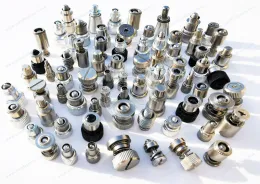
JUXIN FASTENERS supplies industrial fastening components, including self-clinching nuts, studs, standoffs, and drawing-based fastening solutions for international OEM applications.
This engineering guide examines self-clinching fastener selection, thin sheet metal design limitations, material compatibility, installation processes,
mechanical retention, manufacturing defects, industrial applications, and OEM sourcing considerations.
Self-clinching fasteners are mechanically installed components designed to create permanent threaded or unthreaded attachment features in suitable sheet metal.
They are also commonly described using terms such as press-in fasteners, clinch fasteners, and sheet metal insertion fasteners.
The term "press-fit fastener" is sometimes used in commercial searches, although not every press-fit component operates through the same self-clinching mechanism.
During installation, a suitable press applies controlled force to the fastener and surrounding sheet metal.
Depending on the product design, the installation process causes the sheet material to flow into an undercut, groove, or other retention feature.
This mechanical engagement provides resistance to movement after installation.
Many self-clinching fasteners use displacement of the parent sheet material rather than deformation of the fastener body as the primary retention mechanism.
The fastener must generally be harder than the host sheet material for the intended clinching process to function correctly.
However, the required hardness relationship depends on the specific fastener series and material combination.
Potential advantages include:
Permanent threaded attachment points in suitable thin sheet metal.
Reduced need for loose nuts during subsequent assembly.
Installation without resistance welding.
Compatibility with selected automated press operations.
Repeatable component positioning.
Reduced backside hardware handling.
Integration into precision sheet metal fabrication.
Availability of different threaded and unthreaded configurations.
These benefits depend on selecting a compatible fastener and controlling the installation process.
Different self-clinching fasteners serve different mechanical and assembly functions.
The three principal product families are self-clinching nuts, self-clinching studs, and self-clinching standoffs.
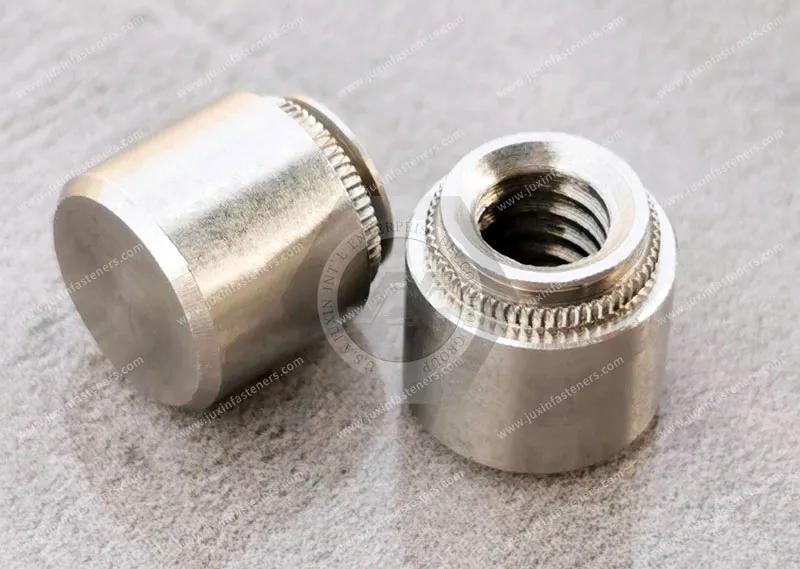
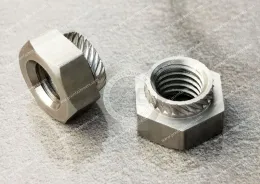
Self-clinching nuts provide internal threads in suitable sheet metal.
They are commonly used when the parent sheet is too thin to provide sufficient direct thread engagement.
During installation, the fastener's retention features engage with the surrounding sheet material.
The installed nut then accepts a mating screw or bolt.
Potential applications include:
Electronic equipment enclosures.
Industrial control cabinets.
Server chassis.
Telecommunications equipment.
Sheet metal brackets.
Precision fabricated assemblies.
Self-clinching nut designs may differ in thread size, installation geometry, material compatibility, and mechanical performance.
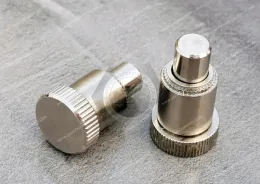
Self-clinching studs provide externally threaded attachment points.
They are commonly selected where a permanently mounted stud is preferred over inserting a separate bolt during final assembly.
Depending on the product design, the stud head may be installed flush with the sheet surface.
Applications may include mounting brackets, electronic equipment, internal supports, and sheet metal assemblies.
Engineers should consider:
Stud diameter.
Thread length.
Head geometry.
Sheet thickness.
Installation direction.
Applied tensile and shear loads.
Clearance for installation tooling.
A self-clinching stud should not automatically be considered interchangeable with a welded stud.
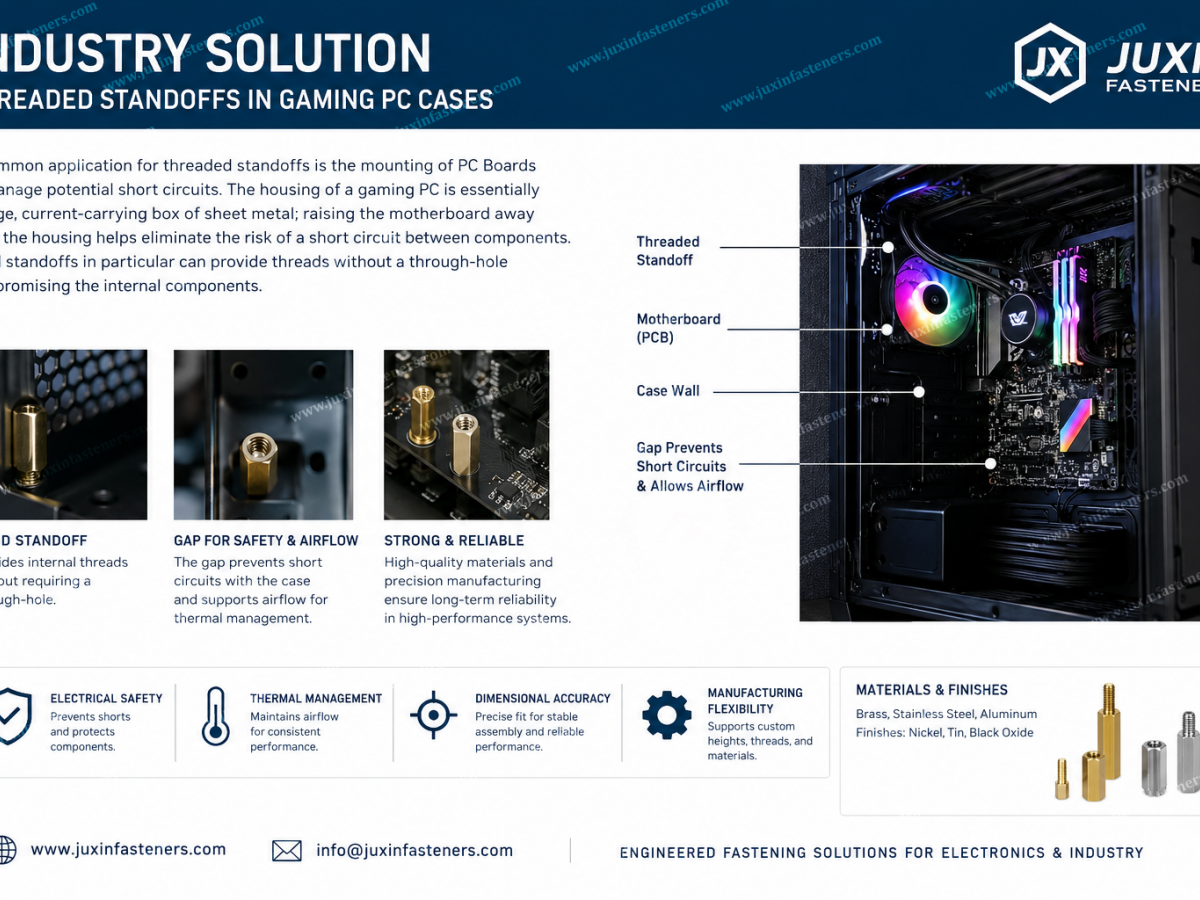
Self-clinching standoffs provide controlled spacing and attachment features in sheet metal assemblies.
They are particularly useful in equipment requiring separation between structural panels and mounted components.
Potential applications include:
Printed circuit board mounting.
Server and networking equipment.
Electronic modules.
Power supply assemblies.
Electrical enclosures.
Industrial automation controls.
Important dimensions may include:
Internal thread designation.
Standoff outside diameter.
Overall length.
Installed height.
Mounting-hole dimensions.
Head or retention geometry.
Critical perpendicularity requirements.
Standoff length should be selected according to the actual assembly clearance and component positioning requirements.
Related products may include:
Flush-head threaded studs.
Unthreaded locating pins.
Self-clinching spacers.
Panel fastening components.
Specialty sheet metal insertion fasteners.
The installation method and mechanical requirements must be confirmed for each specific product.
The hardness of the host sheet material is one of the most important factors in self-clinching fastener selection.
Successful clinching requires sufficient plastic deformation of the surrounding sheet material.
If the host sheet is too hard for the selected fastener, the material may not flow adequately into the retention features.
This can result in incomplete installation or reduced mechanical retention.
Self-clinching fasteners rely on a controlled mechanical interaction between the fastener and the parent sheet.
The fastener's retention features must engage with the surrounding material.
If the sheet is excessively hard, the required deformation may not occur.
Potential consequences include:
Insufficient material flow.
Reduced push-out resistance.
Reduced torque-out resistance.
Incomplete seating.
Fastener damage.
Local sheet deformation.
Installation equipment overload.
Aluminum is commonly used in lightweight electronic enclosures, equipment housings, and precision sheet metal components.
However, aluminum alloys differ significantly in hardness, strength, and forming characteristics.
For example, an annealed aluminum alloy may behave differently from a precipitation-hardened alloy.
The exact alloy and temper should be identified before selecting a self-clinching fastener.
The designation "aluminum sheet" alone is not sufficient for engineering validation.
Cold-rolled low-carbon steel is widely used in industrial enclosures and fabricated sheet metal products.
Applicable material specifications may include EN 10130 or ASTM A1008/A1008M, depending on the actual grade and procurement requirements.
However, different grades and processing conditions may produce different hardness and forming behavior.
The selected self-clinching fastener must be compatible with the actual sheet material.
Stainless steel sheet can present additional installation challenges because of its mechanical properties and hardness.
A conventional self-clinching fastener intended for relatively soft aluminum or mild steel should not automatically be used in stainless steel.
Specialized fastener designs may be required.
Engineers must verify the permitted host sheet hardness and installation requirements for the specific product.
There is no single Rockwell hardness limit that applies to every self-clinching nut, stud, and standoff.
Permitted hardness depends on:
Fastener design.
Fastener material.
Host sheet material.
Sheet thickness.
Retention geometry.
Installation requirements.
Hardness limits must be obtained from the applicable product specifications.
An HRB value from one fastener family should not be applied automatically to another.
Sheet thickness directly influences the amount of material available for mechanical retention.
The selected sheet must provide sufficient material for the fastener's clinching features to engage properly.
If the sheet is thinner than the specified minimum, the fastener may not develop the intended retention.
Possible consequences include:
Incomplete material engagement.
Reduced axial retention.
Reduced rotational resistance.
Local sheet distortion.
Unacceptable fastener seating.
Self-clinching nuts, studs, and standoffs do not necessarily share the same minimum sheet thickness.
Even within one product family, the permitted thickness may vary according to thread size, material, and geometry.
Some specialized fasteners are designed for particularly thin sheet metal, while others require thicker material.
A universal minimum thickness of 0.8 mm or 1.0 mm should not be assumed.
Engineering drawings often specify nominal sheet thickness.
However, actual material thickness may vary within the applicable material tolerance.
For example, a nominal 1.0 mm sheet may have an actual thickness that differs from exactly 1.0 mm.
The selected fastener must remain compatible with the permitted sheet thickness range.
Local sheet thickness may change during forming operations.
Bending, drawing, and other fabrication processes can affect local geometry and material condition.
Where fasteners are installed near formed features, engineers should verify the actual installation area rather than relying solely on the original sheet specification.
Mounting-hole preparation is essential to successful self-clinching installation.
The fastener and receiving hole must be dimensionally compatible.
An oversized hole may reduce the material available for clinching.
An undersized hole may interfere with insertion or cause unacceptable deformation.
The required hole diameter depends on the specific fastener design.
Each product family may have its own installation-hole dimensions and tolerances.
Engineers should use the approved product drawing rather than applying a universal hole tolerance.
Poor hole roundness may cause uneven material flow during installation.
This can influence fastener seating and mechanical retention.
Hole geometry should be controlled according to the selected product requirements.
Punching is commonly used in high-volume sheet metal fabrication.
However, punch and die condition can influence:
Hole diameter.
Burr formation.
Edge deformation.
Hole roundness.
Local material condition.
Tool wear may introduce dimensional variation over time.
Production managers should establish appropriate hole inspection and tooling maintenance procedures.
Laser cutting may be suitable for certain sheet metal manufacturing operations.
However, the cut edge can differ from a punched edge in surface condition, geometry, and local thermal effects.
The acceptability of laser-cut holes should be confirmed for the selected self-clinching fastener.
A laser-cut hole should not automatically be considered equivalent to a specified punched hole.
Burrs and hole-edge conditions can influence seating and material flow.
For many conventional self-clinching designs, installation guidance specifies a preferred relationship between the fastener and the punched-hole entry or die side.
The required orientation should be confirmed from the product-specific installation instructions.
Incorrect orientation may reduce retention or cause installation defects.
Before production, verify:
Hole diameter.
Hole tolerance.
Hole roundness.
Burr condition.
Sheet thickness.
Material hardness.
Hole position.
Local sheet flatness.
Installation direction.
These characteristics should be incorporated into the approved manufacturing process.
Minimum edge distance is another critical design requirement.
If a self-clinching fastener is installed too close to a sheet edge, the surrounding material may not provide sufficient support during installation or service.
Minimum edge distance is commonly specified as the distance between the mounting-hole center and the nearest relevant sheet edge or feature,
although the exact reference convention must follow the product specification.
The required distance depends on the fastener geometry and sheet material.
Potential problems include:
Sheet edge bulging.
Local deformation.
Reduced retention.
Visible surface distortion.
Cracking.
Interference with adjacent components.
Self-clinching fasteners installed near bends require additional attention.
Bending may affect local material properties and available installation space.
The press tooling must also have sufficient access to the installation location.
Closely spaced fasteners may interact through local sheet deformation.
Engineers should consider:
Hole spacing.
Sheet stiffness.
Press tooling access.
Installation sequence.
Local deformation.
Assembly clearance.
A fixed edge-distance multiplier should not be applied to every self-clinching fastener.
The correct minimum distance should be taken from the applicable product specifications and validated for the actual sheet geometry.
Self-clinching fasteners generally require controlled pressing rather than impact installation.
The selected equipment must apply suitable force while maintaining proper alignment.
Many self-clinching fasteners require a controlled squeezing action between suitable press tooling surfaces.
Parallel and properly aligned tooling helps distribute installation force according to the fastener design.
Misalignment may cause incomplete seating or local deformation.
Hydraulic presses may be used where controlled force and suitable tooling are required.
The installation equipment should provide adequate capacity and control for the selected fastener.
Pneumatic equipment may be suitable for certain self-clinching applications.
However, available force and process control must be compatible with the actual fastener requirements.
Servo-controlled systems may offer programmable force and displacement control.
For high-volume OEM production, these systems can support process monitoring and repeatability when properly configured.
The selection of press equipment depends on the application and manufacturing requirements.
Installation force must be sufficient to achieve the required material flow and fastener seating.
Insufficient force may leave the fastener incompletely installed.
Excessive force may damage the sheet or fastener.
There is no single installation force applicable to all self-clinching fasteners.
The correct force depends on the product, material, thickness, and installation conditions.
Tooling should be designed to support the sheet and fastener correctly.
Important considerations include:
Punch geometry.
Anvil geometry.
Fastener alignment.
Clearance for threaded features.
Support beneath the installation area.
Access to the workpiece.
Tooling wear.
Incorrect tooling can damage internal threads, deform studs, or produce inconsistent seating.
Impact installation does not provide the same controlled material flow as a properly designed pressing process.
Hammering can cause misalignment, incomplete clinching, or damage.
Installation methods should follow the requirements of the selected fastener.
Self-clinching fastener performance is commonly evaluated using axial and rotational retention characteristics.
However, these characteristics must be distinguished from the strength of the complete bolted assembly.
Push-out resistance describes the force required to displace an installed fastener from the parent sheet in a defined axial test configuration.
The test direction and method must be specified because different loading directions can produce different results.
Factors influencing push-out resistance include:
Fastener geometry.
Sheet material.
Sheet thickness.
Hole dimensions.
Installation conditions.
Material flow.
Test configuration.
A push-out value should not be assumed from nominal thread size alone.
Torque-out resistance describes the resistance of the installed fastener to rotation relative to the parent sheet.
This characteristic is important when the mating screw is tightened or removed.
Torque-out resistance depends on:
Retention geometry.
Host sheet material.
Hole dimensions.
Installation quality.
Local deformation.
Applied torque conditions.
Thread strength is a separate consideration.
An installed fastener may have adequate rotational retention while its internal thread or mating screw becomes the limiting element.
The allowable tightening torque must therefore be established for the complete joint.
The complete assembly may be affected by:
Screw strength.
Thread engagement.
Fastener retention.
Sheet stiffness.
Joint geometry.
Applied loads.
Vibration.
Thermal cycling.
Assembly preload.
Push-out and torque-out values alone do not establish the overall structural capacity of the finished assembly.
The material of the self-clinching fastener must be compatible with the host sheet and service environment.
Carbon steel is commonly used for self-clinching nuts, studs, and standoffs.
Depending on the application, surface treatments may be specified for corrosion protection.
The material and coating should be selected according to the product design and customer requirements.
Stainless steel self-clinching fasteners may be considered for applications requiring particular corrosion resistance characteristics.
However, stainless steel fastener material does not automatically mean compatibility with stainless steel sheet.
The hardness relationship and installation geometry must be verified.
Aluminum self-clinching components may be considered for certain lightweight assemblies.
Their suitability depends on the actual alloy, material properties, host sheet, and loading requirements.
When selecting a fastener, consider:
Host sheet hardness.
Fastener hardness.
Mechanical loading.
Corrosion exposure.
Galvanic compatibility.
Operating temperature.
Surface treatment.
Installation requirements.
The material combination should be evaluated as a complete system.
Surface treatment requirements should be established according to the intended operating environment.
Zinc plating may provide corrosion protection for suitable carbon steel fasteners.
However, coating thickness and processing conditions must be compatible with dimensional and functional requirements.
Zinc-nickel coatings may be considered for applications with more demanding corrosion protection requirements.
Actual coating availability and performance must be confirmed for the selected fastener.
Stainless steel fasteners may have specified surface finish or passivation requirements.
The exact treatment should be defined by the customer specification.
Dissimilar metals can experience galvanic corrosion under suitable environmental conditions.
Engineers should consider the material combination, moisture exposure, and protective treatments.
ASTM B117 may be used where salt spray testing is specified.
However, a particular salt spray duration does not directly establish real-world service life.
Any corrosion resistance claim should be supported by appropriate product or assembly test evidence.
Server chassis and AI data center equipment often require compact, repeatable fastening solutions in precision sheet metal structures.
Potential applications include:
Server chassis panels.
Internal equipment brackets.
Power supply housings.
Electronic module supports.
Cable management structures.
Equipment mounting assemblies.
Printed circuit board supports.
Engineers should evaluate:
Thin sheet metal thickness.
Local sheet stiffness.
Fastener installation access.
Component spacing.
Serviceability.
Thermal conditions.
Assembly repeatability.
Self-clinching standoffs may provide controlled mounting heights for electronic components.
The required standoff length depends on the assembly geometry and clearance requirements.
Electrical isolation, grounding, and creepage or clearance requirements must be addressed separately where applicable.
A metal standoff alone does not establish electrical compliance.
For high-volume server enclosure manufacturing, production managers should consider:
Automated feeding.
Press installation cycle time.
Hole manufacturing consistency.
Installation inspection.
Assembly sequence.
Tooling maintenance.
Scrap and rework reduction.
Consistent fastener dimensions and controlled installation are important to repeatable production.
Self-clinching fasteners may be used in suitable fabricated metal components for electrical equipment.
Potential applications include:
Electrical cabinets.
Power distribution enclosures.
Control panels.
UPS equipment housings.
Power electronics assemblies.
Industrial automation cabinets.
Equipment mounting brackets.
Important considerations include:
Mechanical loading.
Sheet material compatibility.
Installation geometry.
Corrosion protection.
Thermal exposure.
Electrical grounding requirements.
Maintenance access.
Where electrical safety or grounding requirements apply, the complete assembly must be evaluated according to the applicable equipment standards.
The presence of a self-clinching fastener does not independently establish grounding continuity or regulatory compliance.
Self-clinching nuts and standoffs may provide threaded mounting points for suitable telecommunications equipment housings.
Selection considerations include compact installation geometry, corrosion exposure, serviceability, and production consistency.
Self-clinching fasteners may be used in machine covers, control enclosures, brackets, and fabricated sheet metal components.
Engineers should consider vibration, maintenance frequency, mechanical loads, and the suitability of the host sheet.
HVAC manufacturers may use self-clinching fasteners in suitable cabinets, access panels, and equipment mounting structures.
Production requirements may include efficient assembly, repeatable installation, and corrosion protection.
Self-clinching fasteners may be considered for selected automotive electronic housings and fabricated components.
However, automotive applications must be validated according to the relevant customer requirements and service conditions.
Suitable self-clinching fasteners may be used in equipment housings and fabricated support structures.
Where cleaning, sterilization, corrosion, or regulated product requirements apply, additional validation may be necessary.
Understanding common failure modes helps engineers establish suitable installation and inspection procedures.
Possible causes:
Oversized mounting hole.
Inadequate material flow.
Incorrect host sheet hardness.
Insufficient installation force.
Unsuitable fastener geometry.
Excessive applied torque.
Recommended engineering review:
Verify the fastener drawing, hole dimensions, sheet material, installation conditions, and assembly torque.
Possible causes:
Incorrect sheet thickness.
Insufficient clinching engagement.
Incorrect hole dimensions.
Incomplete installation.
Excessive axial loading.
Recommended engineering review:
Evaluate the installed geometry, parent sheet, and specified retention requirements.
Possible causes:
Insufficient edge distance.
Excessive installation force.
Inadequate sheet support.
Incorrect tooling.
Local sheet geometry.
Recommended engineering review:
Check the minimum edge distance, installation tooling, and sheet design.
Possible causes:
Incorrect installation force.
Hole preparation defects.
Fastener misalignment.
Burr interference.
Incorrect tooling.
Recommended engineering review:
Inspect the mounting hole, fastener geometry, press alignment, and installation process.
Possible causes:
Excessive installation loading.
Incorrect punch or anvil geometry.
Misalignment.
Mechanical interference.
Incorrect fastener selection.
Recommended engineering review:
Verify tooling clearance and inspect thread functionality before and after installation.
Possible causes:
Fastener dimensional variation.
Sheet hardness variation.
Hole manufacturing variation.
Press setting changes.
Tool wear.
Material thickness variation.
Recommended engineering review:
Compare the affected batches against the approved specifications and evaluate the complete installation process.
Self-clinching fasteners are not the only method of creating threaded attachment points in sheet metal.
The correct fastening solution depends on material compatibility, installation access, production volume, and mechanical requirements.
| Fastening Solution | Installation Principle | Main Engineering Considerations |
|---|---|---|
| Self-clinching nut | Press installation into compatible sheet metal | Sheet hardness, thickness, hole size, edge distance |
| Self-clinching stud | Press installation of externally threaded component | Stud geometry, sheet compatibility, installation access |
| Self-clinching standoff | Press installation of spacing component | Mounting height, sheet compatibility, alignment |
| Blind rivet nut | Mechanical deformation using a setting tool | Grip range, hole geometry, backside clearance |
| Weld nut | Resistance welding or another specified welding process | Weldable material, welding access, process validation |
| Loose nut and bolt | Mechanical assembly | Access, handling, assembly time |
| Direct tapped hole | Thread formation in parent material | Material thickness, thread engagement, strength |
They may be suitable when:
The sheet material is compatible with the clinching process.
A permanent threaded attachment point is required.
Press installation equipment is available.
Welding is undesirable.
Controlled assembly geometry is important.
The installation location provides sufficient edge distance and tooling access.
Blind rivet nuts may be considered when access is available from only one side and the assembly geometry supports the required setting process.
Weld nuts may be appropriate when the parent material is weldable and the production process supports the required welding operation.
The preferred fastening solution should satisfy the actual mechanical and manufacturing requirements at an acceptable total installed cost.
A fastener should not be selected solely because its unit price is lower.
For production managers, the performance of a self-clinching fastener must be evaluated within the complete manufacturing process.
Automated installation may require compatible feeding and positioning systems.
Relevant considerations include:
Fastener dimensions.
Orientation.
Surface condition.
Thread protection.
Feeding equipment.
Installation sequence.
Total installation cycle time may include:
Fastener feeding.
Workpiece positioning.
Tool alignment.
Pressing.
Part release.
Inspection.
Transfer to the next operation.
The shortest pressing time does not necessarily produce the lowest total manufacturing cost.
Where suitable equipment is available, production monitoring may include:
Installation force.
Press displacement.
Fastener presence.
Installation position.
Process alarms.
Periodic dimensional checks.
Monitoring requirements should be defined according to the application and production system.
Incorrect installation can create additional costs through:
Damaged sheet metal.
Thread defects.
Misaligned components.
Rejected assemblies.
Production interruptions.
Rework operations.
Consistent fastener geometry and controlled installation can help reduce these risks.
A practical cost evaluation should include:
Fastener unit cost.
Hole manufacturing.
Press equipment.
Tooling.
Installation labor.
Inspection.
Scrap.
Rework.
Production downtime.
For long-term OEM programs, manufacturing consistency may be more important than a small difference in component price.
Self-clinching fastener quality should be evaluated against the approved engineering drawing and purchasing specification.
Relevant characteristics may include:
Thread designation.
Thread functionality.
Head dimensions.
Shank dimensions.
Retention geometry.
Overall length.
Standoff height.
Surface condition.
Burrs and visible defects.
Important characteristics may include:
Material grade.
Sheet thickness.
Hardness.
Hole dimensions.
Hole position.
Burr condition.
Local flatness.
After installation, relevant checks may include:
Seating condition.
Alignment.
Sheet deformation.
Thread functionality.
Installed height.
Push-out resistance, where specified.
Torque-out resistance, where specified.
Mechanical retention testing should be performed using defined methods and representative material conditions.
Test results depend on the fastener, sheet material, installation process, and test configuration.
Generic retention values should not replace application-specific validation.
OEM customers may request:
Dimensional inspection reports.
Material identification.
Lot information.
Surface treatment specifications.
Mechanical test records.
Customer-specific approval documents.
The availability of particular documentation must be confirmed for the actual product and order.
No certification, approval, or testing capability should be assumed without verification.
Self-clinching fasteners may be specified with metric or inch-based threads, depending on the product design and customer requirements.
Common metric designations used in industrial fastening applications include:
M3 × 0.5
M4 × 0.7
M5 × 0.8
M6 × 1.0
These are examples of metric coarse thread designations, not a complete list of available self-clinching products.
ISO 68-1 defines the basic profile for ISO metric screw threads, while applicable ISO 261 and ISO 965 provisions address thread size selection and tolerance requirements.
North American OEM drawings may specify UNC or UNF threads.
ASME B1.1 is a relevant reference for Unified inch screw threads.
BSW and BSF are different thread systems and may be encountered in legacy or specialized applications.
They must not be treated as interchangeable with metric or Unified threads.
An M4 nominal diameter is approximately 0.1575 inches.
An M5 nominal diameter is approximately 0.1969 inches.
An M6 nominal diameter is approximately 0.2362 inches.
These conversions are dimensional references only.
They do not establish compatibility with UNC, UNF, BSW, or BSF threads.
Custom inch-thread or nonstandard self-clinching fastener requirements should be submitted with engineering drawings for feasibility review.
Actual available sizes, materials, and configurations must be confirmed before quotation.
For international OEM procurement, a clear technical specification helps reduce quotation errors and supplier qualification delays.
A complete RFQ should identify the required fastener and the conditions under which it will be installed.
Specify whether the application requires:
Self-clinching nut.
Self-clinching stud.
Self-clinching standoff.
Other drawing-defined clinching component.
Provide:
Thread designation.
Thread pitch.
Overall dimensions.
Stud or standoff length.
Critical tolerances.
Product drawing or reference part number.
Identify:
Sheet material grade.
Sheet thickness.
Material hardness, where relevant.
Hole dimensions.
Minimum edge distance.
Surface condition.
Provide:
Installation method.
Press equipment, where known.
Tooling constraints.
Installation direction.
Production sequence.
Required inspection characteristics.
Specify any required:
Push-out resistance.
Torque-out resistance.
Thread performance.
Applied service loads.
Environmental conditions.
Customer-specific validation.
Acceptance criteria should be defined according to the actual engineering requirements.
Identify the required fastener material and surface treatment.
Where alternative materials are acceptable, the permitted options should be stated.
Include:
Prototype or sample quantity.
Initial production quantity.
Estimated annual purchasing volume.
Packaging requirements.
Delivery destination.
Target lead time.
Drawing revision.
This information helps suppliers evaluate manufacturing feasibility, production planning, and quotation requirements.
For international purchasing managers and supply chain development teams, selecting a self-clinching fastener supplier involves more than comparing catalog dimensions.
The supplier must be evaluated against the technical and commercial requirements of the OEM program.
Custom or drawing-defined self-clinching fasteners may require specific dimensions, materials, or retention features.
The feasibility of nonstandard designs should be evaluated before production commitments are made.
Critical dimensions should remain consistent with the approved drawing and agreed inspection criteria.
Variation in retention geometry may affect installation behavior.
The material specification should be clearly defined.
Substituting a different material or hardness condition may influence clinching performance.
Coating requirements should be specified according to the application.
Changes in surface treatment may affect dimensions, corrosion protection, and installation behavior.
Long-term OEM programs may require scheduled purchasing quantities and coordinated delivery arrangements.
Relevant commercial considerations include:
MOQ.
Production lead time.
Sample requirements.
Order quantity.
Annual forecast.
Packaging.
Delivery schedule.
Engineering changes.
Actual terms must be confirmed during quotation.
A replacement self-clinching fastener should not be approved solely because it has the same thread size and nominal dimensions.
Engineers should also verify:
Retention geometry.
Installation-hole compatibility.
Host sheet hardness requirements.
Minimum sheet thickness.
Edge-distance requirements.
Installation force.
Mechanical retention.
Tooling compatibility.
Where necessary, production trials and qualification testing should be completed before approving the alternative.
The minimum thickness depends on the fastener series, geometry, material, and installation requirements.
There is no universal minimum thickness applicable to every self-clinching nut, stud, or standoff.
Certain self-clinching fasteners are designed for compatible stainless steel sheet applications.
However, conventional designs intended for softer materials may not be suitable.
The host sheet hardness and product specifications must be verified.
The surrounding sheet material must deform sufficiently to engage with the fastener's retention features.
Excessive hardness can prevent adequate material flow.
Conventional self-clinching fasteners generally require controlled pressing rather than impact installation.
The approved installation method should follow the product specifications.
Push-out resistance concerns axial displacement of the installed fastener under defined test conditions.
Torque-out resistance concerns rotation of the fastener within the parent sheet.
These are different mechanical characteristics.
Possibly, depending on the sheet material, geometry, mechanical requirements, and manufacturing process.
The replacement must be evaluated for installation compatibility and joint performance.
Suitable self-clinching standoffs may be used in server chassis and electronic equipment assemblies when the sheet material, thickness, mounting geometry, and mechanical requirements are compatible.
Not automatically.
Fastener retention in the sheet and vibration resistance of the complete bolted joint are separate engineering considerations.
Certain product designs may be available with Unified inch threads.
The actual thread designation, geometry, material, and manufacturing availability must be confirmed.
A complete RFQ should include the fastener drawing, thread designation, material, dimensions, host sheet specifications, installation requirements, order quantity, and delivery requirements.
JUXIN FASTENERS supports international B2B sourcing inquiries for industrial self-clinching fasteners, sheet metal fastening components, and drawing-based OEM fastening requirements.
Whether your project involves server chassis, AI data center equipment, telecommunications cabinets, electrical enclosures, industrial machinery, power distribution systems,
or custom fabricated sheet metal assemblies, selecting the correct self-clinching fastener is important to manufacturing efficiency and assembly reliability.
For self-clinching nuts, studs, standoffs, and related OEM fastening components, please provide the following information:
2D engineering drawing or 3D CAD model, where available.
Required fastener type and configuration.
Internal or external thread designation.
Critical dimensions and tolerances.
Host sheet material grade.
Sheet thickness and hardness requirements.
Mounting-hole dimensions.
Minimum edge-distance constraints.
Installation equipment and process requirements.
Material and surface treatment specifications.
Push-out, torque-out, or other performance requirements, where applicable.
Inspection and quality documentation requirements.
Prototype or sample quantity.
Initial production order quantity.
Estimated annual purchasing volume.
Target delivery schedule and destination.
For custom self-clinching fasteners, please identify any deviations from standard product geometry, material requirements, or installation conditions.
Our team can review the submitted specifications and confirm applicable sourcing, manufacturing feasibility, product selection, and quotation requirements.
Company: JUXIN FASTENERS
Website: www.juxinfasteners.com
Email: info@juxinfasteners.com
Contact JUXIN FASTENERS with your engineering drawings, technical specifications, and purchasing requirements to request a quotation for self-clinching nuts,
self-clinching studs, self-clinching standoffs, and related OEM sheet metal fastening components.
Product Packaging
Packaging Standard
At Juxin Fasteners, we apply standardized export packaging to ensure product protection, traceability, and compliance with international logistics requirements.
1. Standard Export Packaging
Unless otherwise specified, all products will be packed according to our factory standard export packaging, which includes:
Moisture-resistant inner protection
Poly bag or small box packing as required
Reinforced export cartons
Clear labeling with part number, specification, batch number, and quantity
Palletizing for sea or air shipment when necessary
Our standard packaging is designed to ensure safe transportation, efficient warehousing, and long-distance international shipping.
2. Customized Packaging Options
We also provide customized packaging solutions according to customer requirements, including but not limited to:
Private labeling
Customized barcodes
Specific carton dimensions
Retail packaging
Special pallet configuration
Customer-specific marking and identification
So that you know, customized packaging may involve additional costs and extended lead time depending on the complexity of the requirements.
3. Compliance & Quality Assurance
All packaging processes are controlled under our ISO 9001 quality management system to ensure consistency, traceability, and product integrity throughout the supply chain.
Product Pictures
Contact Us
Tel.:
+86 020 8621 0320
+86 020 3121 6067
E-mail:
Technical Support:
Navigation
SEND INQUIREY