
Call Us
+86 136 6007 9809
Call Us
+86 136 6007 9809

Nov. 21, 2026
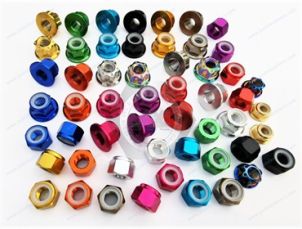
In robotics end-effectors, agricultural and commercial UAV platforms, motorsport subframes, portable diagnostic equipment, recreational mobility hardware, and lightweight aluminum extrusion assemblies, every gram of parasitic hardware weight matters. Replacing standard carbon-steel or stainless-steel prevailing-torque nuts with aluminum nylon-insert lock nuts can reduce nut mass by roughly 60% to 65% while allowing durable color-coded anodizing for visual assembly poka-yoke and corrosion resistance.
Yet aluminum lock nuts are frequently misapplied when buyers substitute them one-for-one for steel ISO 10511 / ISO 7040 lock nuts without adjusting mechanical load expectations, thread engagement, or galvanic-corrosion controls. Because aluminum alloys have significantly lower tensile strength, shear strength, and elastic modulus than Class 8 or Class 10 steel nuts, applying full steel-bolt tightening torque strips aluminum nut threads immediately.
Engineering Trade-Offs: Aluminum vs. Carbon Steel vs. Stainless Nylon-Insert Lock Nuts
| Engineering Criterion | Aluminum Alloy Nylon-Insert Lock Nuts (e.g., 6061-T6 / 7075-T6 / 2024 per drawing) | Carbon Steel Nylon-Insert Lock Nuts (ISO 10511 / ISO 7040; Class 8 / 10) | Stainless Steel Nylon-Insert Lock Nuts (A2 / A4; ISO 3506 series context) |
|---|---|---|---|
| Relative Hardware Mass | Lowest (~2.7–2.8 g/cm³); major mass reduction on multi-fastener lightweight platforms | High (~7.85 g/cm³) | High (~7.9–8.0 g/cm³) |
| Proof Load & Thread-Stripping Capacity | Significantly lower than Class 8/10 steel; governed by exact alloy/temper (7075-T6 > 2024-T4 > 6061-T6); never substitute directly into full-preload Class 10.9 joints | High proof load matched to Class 8.8 or 10.9 bolts per ISO 898-2 | Moderate-to-high (matched to A2/A4 stainless bolts; verify mechanical property class) |
| Prevailing-Torque & Temperature Limits | Polymer insert provides rotational retention; thermal limit governed by exact insert polymer and alloy aging (ISO 2320 applies to steel nuts—define project test criteria for aluminum) | ISO 2320 lists −50°C to +120°C typical range for steel nuts with non-metallic insert (not a universal guarantee); declining torque on reuse | Polymer-limited thermal ceiling; higher thread galling risk against stainless bolts without lubrication |
| Galvanic Compatibility on Aluminum Frames | Excellent match with aluminum brackets/extrusions and aluminum bolts; verify mating steel/stainless bolt exposure in wet salt environments | Requires intact zinc-nickel (ISO 4042) or zinc-flake (ISO 10683) barrier to protect mating aluminum | Noble potential relative to aluminum frames; inspect crevice/area ratio in wet coastal environments |
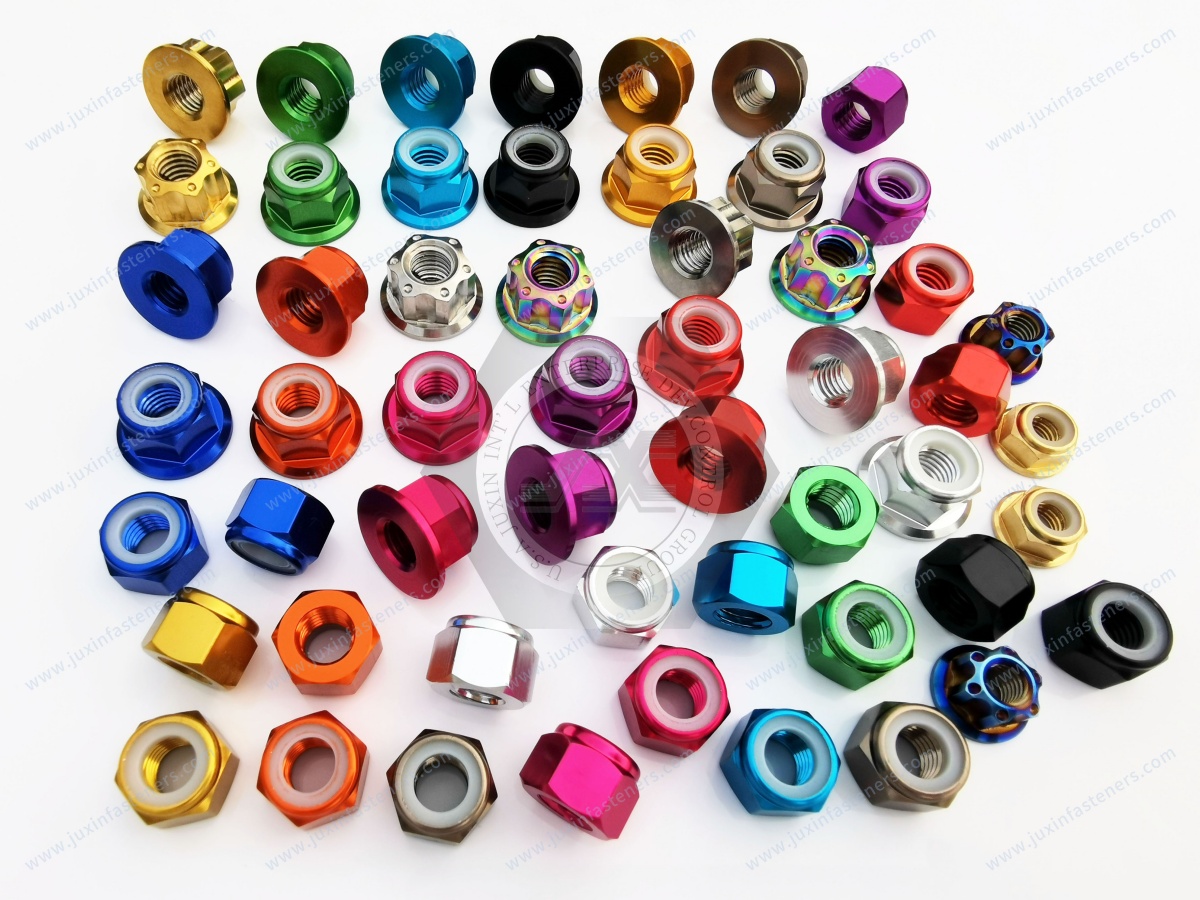
| Color Anodizing & Visual Coding | Supports clear, black, red, blue, gold, or custom sulfuric/hard anodizing for assembly verification and aesthetics | Limited to metallic/black coatings or paint | Limited to metallic passivated or black-oxide/PVD finishes |
Key Engineering Boundaries: Alloy Selection, Anodizing, and Galvanic Control
Alloy Selection (6061-T6 vs. 7075-T6 vs. 2024-T4): Not all aluminum lock nuts perform alike. 6061-T6 offers strong corrosion resistance, clean bright anodizing appearance, and good formability/machinability for light-duty covers, brackets, and robotics guards. 7075-T6 provides substantially higher yield and thread-shear strength for demanding lightweight assemblies, though its higher zinc/copper chemistry requires careful stress-corrosion and anodizing-appearance review. 2024-T4 offers strong fatigue/machining properties but lower bare corrosion resistance, making protective anodizing essential.
Anodizing Thickness, Thread Fit, and Visual Consistency: Sulfuric acid anodizing (such as Type II per MIL-A-8625 / ISO 7599 context) builds an oxide film partly into and partly above the aluminum surface, while hardcoat anodizing (Type III) adds substantially thicker buildup. Because anodizing narrows internal thread pitch diameters—and because the nylon collar must be crimped AFTER anodizing and dye sealing so hot acid baths do not attack the polyamide insert—2D drawings must specify clearly whether thread gauging applies before or after anodizing, and verify batch-to-batch color tolerance when color-coded nuts serve as assembly poka-yoke.
Preventing Thread Stripping and Mating-Bolt Galvanic Attack: When pairing an aluminum lock nut with a titanium, stainless steel, or coated steel bolt, always down-rate installation torque to match the aluminum nut's verified proof load rather than the stronger steel bolt's maximum torque table. In wet or salt-spray environments, pairing a small bare aluminum nut (small anode) with a large bare stainless bolt (cathode) can accelerate aluminum thread corrosion unless protective anodizing and appropriate assembly sealants/anti-seize are validated.
Safety-Critical Substitution Prohibition: Aluminum nylon-insert lock nuts must never be dropped into safety-critical primary structural, braking, suspension, or high-temperature joints originally engineered for Class 8.8/10.9 steel lock nuts without full structural re-calculation and destructive validation by the OEM.
Manufacturing Routes & Quality Verification at Juxin Fasteners
Depending on nut hex/flange geometry, alloy formability, anodizing sequence, and annual volume, aluminum nylon-insert lock nuts are manufactured via CNC turning from certified hexagonal/round bar stock (common for 7075-T6, custom flange geometries, and low-to-medium volumes) or cold forming combined with CNC secondary tapping/crimping operations where alloy ductility and batch volume justify tooling.
Critical production quality controls include alloy-grade verification, pre- and post-anodize internal thread gauging (ISO 965 6H or ASME B1.1 2B), controlled crimping of the nylon insert without cracking the anodized rim, batch color-consistency inspection, and agreed prevailing-torque and proof-load verification according to customer drawing specifications.
Direct Engineering Q&A
Does changing the anodizing color of an aluminum nylon-insert lock nut change its mechanical strength? No. Standard Type II color anodizing dyes affect appearance, identification, and surface corrosion protection—not bulk tensile or thread-shear strength. Mechanical strength is governed by the aluminum alloy and temper (such as 6061-T6 vs. 7075-T6) and nut geometry.
Does ISO 2320 govern prevailing-torque testing for aluminum nylon-insert lock nuts? The applicability of ISO 2320 must be checked against the current edition and product material; do not assume an aluminum nut is certified under the steel-nut requirements. While its prevailing-torque test concepts (first installation max, first removal min, and reuse decay awareness) are often referenced as a test methodology baseline, exact torque targets and proof-load criteria for aluminum lock nuts must be defined on the customer drawing and agreed before batch production.
Aluminum Lock Nut OEM Drawing Review & RFQ Checklist
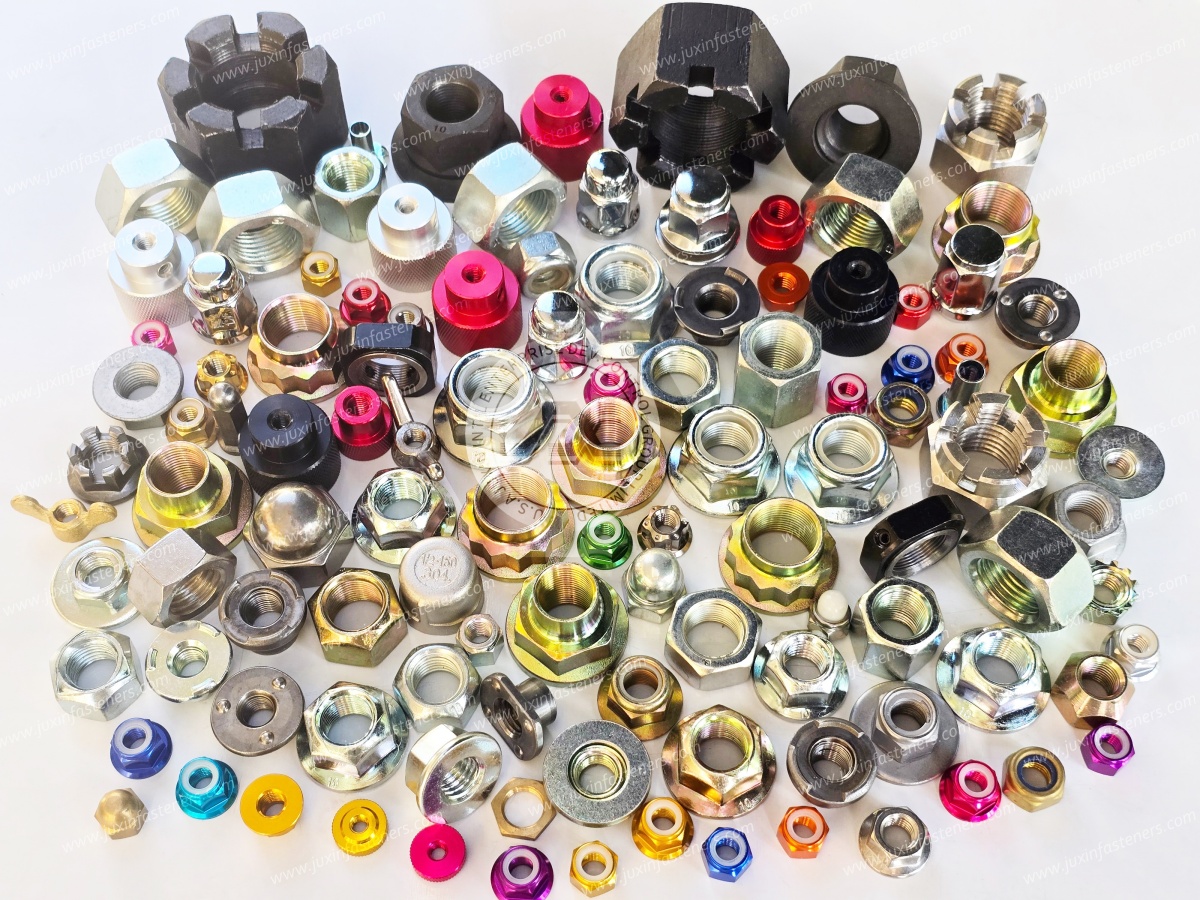
As an industrial fastener manufacturer and custom lock nut manufacturer, Juxin Fasteners evaluates custom-engineered and standard-profile aluminum nylon-insert lock nuts, flanged aluminum nuts, and matching CNC/cold-formed lightweight hardware for global OEM programs. Email info@juxinfasteners.com with:
2D & 3D Drawings: 2D PDF drawing (with revision level) and 3D STEP/IGES model showing thread standard (Metric or UNC/UNF), hex/flange style, height, and critical tolerances.
Aluminum Alloy & Anodizing Spec: Exact alloy/temper (6061-T6, 7075-T6, 2024-T4), anodize type (Type II clear/color vs. Type III hardcoat), color standard (e.g., Pantone/RAL sample reference), and post-anodize gauge rule.
Insert & Operating Conditions: Nylon insert grade/color, continuous operating temperature, mating bolt material, vibration environment, and required prevailing-torque or proof-load verification criteria.
Samples & Production Volume: First Article Inspection (FAI) requirements, prototype sample quantity, protective scratch-free packaging, and Estimated Annual Usage (EAU).
 MORE NEWS
Contact Us
Tel.:
+86 020 8621 0320
+86 020 3121 6067
E-mail:
Technical Support:
Navigation
SEND INQUIREY