
Call Us
+86 136 6007 9809
Call Us
+86 136 6007 9809

Nov. 21, 2026
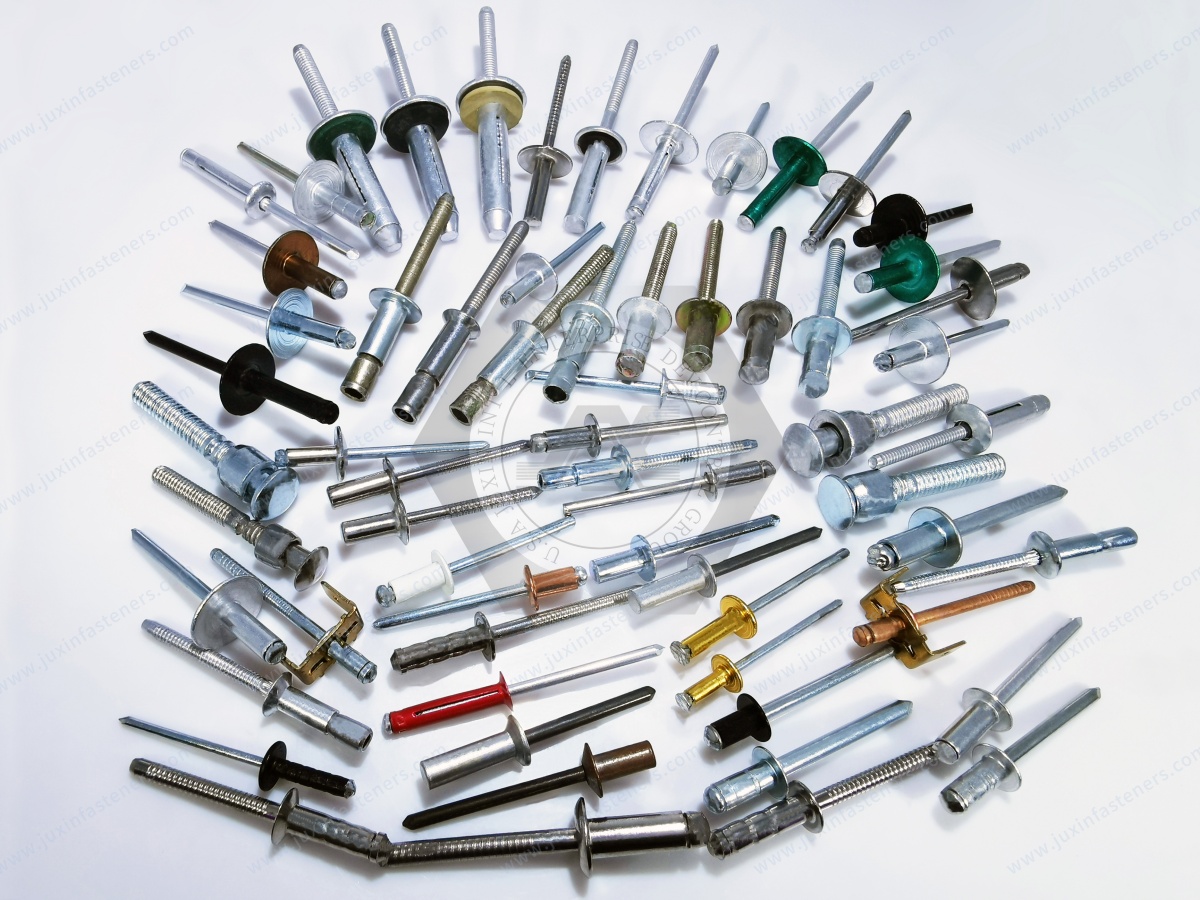
When OEM assemblies join sheet-metal panels, tubular frames, HVAC cabinets, solar racking, or commercial trailer bodies from a single accessible side without needing a removable internal thread, blind rivets remain one of the fastest, most repeatable mechanical joining methods in industrial manufacturing. Unlike blind rivet nuts (which install a permanent female thread for a mating bolt), a blind rivet permanently clamps two or more layers together by pulling a headed mandrel through a hollow rivet body until the stem breaks at an engineered neck.
Yet on real production lines, treating all blind rivets as generic commodity pop rivets leads directly to costly assembly defects: rattled mandrel heads dropping into live electronics, structural joints loosening under shear vibration, rivets pulling straight through fiberglass or thin aluminum skins, and unexpected red rust caused by mismatched steel mandrels left inside aluminum bodies.
How Blind Rivet Joints Fail in Industrial Production
Diagnosing blind-rivet joint failures starts with separating mechanical geometry issues from installation and corrosion errors:
Grip-Range Mismatch (Under-Setting or Over-Setting): Every blind rivet has a specified total sheet-thickness grip window; some multi-grip designs cover wider ranges. If the stacked panels—including paint or galvanizing buildup—fall below minimum grip, the blind-side bulb fails to draw tight, leaving axial play. If thickness exceeds maximum grip, the mandrel snaps prematurely inside the hole before forming an adequate rear upset.
Mandrel Head Drop-Out Under Vibration: In conventional open-end rivets, the broken mandrel head is retained primarily by friction inside the deformed tail. Under sustained cyclic vibration (as in vehicle bodies, blowers, or agricultural machinery), the loose mandrel head can shake free—reducing shear capacity and creating foreign-object debris (FOD) inside electrical enclosures.
Oversized Holes and Weak Blind-Side Bearing Area: Drilling or punching holes beyond the rivet's specified tolerance prevents radial shank expansion from filling the hole tightly, drastically reducing single-shear stiffness and allowing joint slippage.
Soft-Substrate Pull-Through and Galvanic Corrosion: A narrow standard upset bulb concentrates high local stress on thin aluminum, composites, or plastics, tearing through the rear sheet. Meanwhile, pairing an aluminum rivet body with a plain carbon-steel mandrel in a damp outdoor assembly traps a dissimilar-metal corrosion cell directly inside the wet rivet tail.
Engineering Comparison: Five Core Blind Rivet Architectures
Matching rivet architecture to joint load, substrate ductility, and tolerance stack-up avoids over-engineering while preventing field failures:
| Blind Rivet Architecture | Mandrel & Expansion Mechanics | Hole & Grip-Range Tolerance | Best-Fit OEM Applications | Key Boundaries & Verification Needs |
|---|---|---|---|---|
| Standard Open-End Blind Rivets (e.g., ISO 15977 / ISO 15983 / ISO 15979) | Hollow open body; mandrel expands tail and breaks; stem head held mainly by friction | Strict grip range and tight hole tolerance required | General light-to-medium sheet-metal enclosures, ducts, covers, non-structural brackets | Not watertight; mandrel head can loosen under heavy vibration; verify mandrel alloy for corrosion |
| Closed-End (Sealed) Blind Rivets (e.g., ISO 15978 / ISO 15984) | Solid cup-shaped tail fully encapsulates the mandrel head inside the blind side | Strict grip range; requires controlled hole sizing | Outdoor cabinets, refrigeration panels, electrical boxes where mandrel FOD must be eliminated | Prevents mandrel drop-out and closes center bore; NOT by itself a full IP67/waterproof seal without flange-interface sealing validation |
| Structural / High-Strength Blind Rivets (Mechanically Locked Mandrel) | Internal mechanical locking ring or collar locks retained mandrel stem solidly across the shear plane | Moderate hole-fill capability; verify exact grip specification | Commercial vehicle frames, solar structures, rail subassemblies, heavy machinery guards | Higher setting force required (verify heavy-duty tooling); confirm shear/tensile targets on actual production sheet thickness |
| Multi-Grip Blind Rivets | Staged-deformation body expands radially to fill irregular holes and clamp across wider thickness ranges | Broad grip range; forgiving of minor sheet thickness or oversized hole variation | Mixed-gauge sheet metal, painted panels, high-mix OEM lines consolidating SKU count | Shear capacity varies by design and is not necessarily comparable with locked-mandrel structural rivets; verify blind-side protrusion clearance |
| Peel / Tri-Fold & Bulb-Tite Blind Rivets | Rivet body splits into 3 or 4 wide petals/bulbs behind the rear sheet to distribute clamping stress | Wide rear bearing footprint; accommodates soft or brittle rear layers | Fiberglass (FRP), polycarbonate, plastics, thin aluminum skins, HVAC insulation panels | Wide rear petal footprint requires blind-side radial clearance; verify clamping force does not crush brittle composites |
Material Pairing, Corrosion Compatibility, and Standards Context
Blind rivet performance depends as much on the body-to-mandrel metallurgy as on nominal diameter (typically 2.4 mm to 6.4 mm in standard series, or larger in structural designs):
Body / Mandrel Alloy Combinations: Common industrial pairings include Aluminum/Steel (economical dry indoor use), All-Aluminum (lightweight, lower shear strength, eliminates internal steel-aluminum galvanic cell), Steel/Steel (higher strength with zinc or zinc-nickel protection), and All-Stainless 304/304 or 316/316 (outdoor, coastal, washdown, and chemical exposure). Never specify an aluminum rivet with an uncoated carbon-steel mandrel for coastal or continuously wet outdoor cabinets, as the retained steel head can rust and stain the exterior face.
Standards & Verification Boundaries: Metric open-end and closed-end blind rivets reference international standards such as the ISO 15977–15984 series (with mechanical test methods governed by ISO 14589; verify current active editions against controlled copies). Published catalog shear and tensile numbers are measured in standardized hardened test plates—real OEM joint capacity in thin aluminum or mild steel is frequently governed by sheet-bearing tear-out rather than rivet-shank fracture and must be validated on actual production sheet coupons.
Assembly Tooling, Hole Quality, and OEM Manufacturing Controls
Hole Sizing and Burr Orientation: Punch or drill holes strictly within the rivet's specified diameter range (typically nominal diameter +0.1 mm to +0.2 mm for standard rivets, depending on diameter and type). Keep the two sheets tightly clamped together before pulling the trigger so the rivet body does not expand between the layers (inter-sheet jacking).
Setting Tool Jaw Maintenance & Stroke Check: Worn pulling jaws slip on hard stainless mandrels, causing double-stroking and uneven stem break-off. On structural and closed-end rivets, monitor nosepiece alignment so the rivet flange sits completely flush against the outer panel.
Cold Forming & Quality Inspection at Juxin Fasteners: Manufacturing consistent blind rivets demands tight process control using suitable cold forming or other product-specific processes for the rivet body and mandrel, depending on design, controlled heat treatment of high-strength mandrels, assembly crimping, and dimensional inspection paired with batch pull-to-break load testing.
Direct Engineering Q&A
When should an OEM upgrade from standard open-end rivets to structural locked-mandrel blind rivets? Upgrade to structural blind rivets when the joint carries high cyclic single-shear or vibration loads, when mandrel head retention across the shear plane is required for joint strength, or when eliminating loose mandrel drop-out is critical—provided the assembly line has heavy-duty setting tools rated for the higher pull force.
Do closed-end blind rivets automatically make a sheet-metal panel waterproof? No. Closed-end rivets seal the center bore and trap the mandrel head inside the closed cup, preventing debris drop-out and through-bore leakage, but moisture can still pass beneath the flange head unless an under-head sealing washer, gasket, or validated sealant is verified on the complete assembly.
Blind Rivet OEM Drawing Review & RFQ Checklist
As an industrial fastener manufacturer, Juxin Fasteners evaluates standard and custom made-to-drawing blind-rivet requirements, including open-end, closed-end, structural, multi-grip, peel, and bulb-type designs, subject to manufacturing feasibility for global OEM batch production. Send your specifications to info@juxinfasteners.com including:
Rivet Type & Dimensions: 2D PDF drawing or standard reference (ISO 15977–15984 or OEM spec), nominal diameter, head style (dome, countersunk, large flange), and body length.
Joint Stack & Substrate: Minimum and maximum combined sheet thickness (including paint/coating), mating sheet materials, and punched vs. drilled hole diameter.
Body / Mandrel Material & Finish: Exact body and mandrel alloys (e.g., Al/Al, Steel/Steel, 304/304, 316/316), coating or passivation needs, and outdoor/washdown corrosion exposure.
Testing & Supply Scope: Required shear/tensile coupon validation, mandrel break-load reports, First Article Inspection (FAI), prototype samples, and Estimated Annual Usage (EAU).
 MORE NEWS
Contact Us
Tel.:
+86 020 8621 0320
+86 020 3121 6067
E-mail:
Technical Support:
Navigation
SEND INQUIREY