
Call Us
+86 136 6007 9809
Call Us
+86 136 6007 9809

Nov. 27, 2026
Reliable cable management involves more than keeping a wire harness visually tidy.
A routing clip must hold the harness in its intended position without creating sharp contact points, obstructing a service connector or transferring excessive load to a terminal.
Printed circuit board supports must maintain the specified clearance and help prevent board movement without placing unintended stress on the circuit board.
Juxin Fasteners is an industrial fastener manufacturer supporting standard and made-to-drawing hardware for OEM assemblies.
Alongside cold-headed, cold-formed and CNC-machined metal components, we evaluate engineering plastic cable management products and PCB mounting hardware against the customer’s actual drawing, resin specification, assembly process and annual quantity.
For data center equipment, telecom cabinets, control panels, medical instruments and appliance assemblies, mounting architecture often matters more than a generic fastener description.
The correct choice balances access during installation, panel preparation, maintenance requirements and retention under representative service conditions.
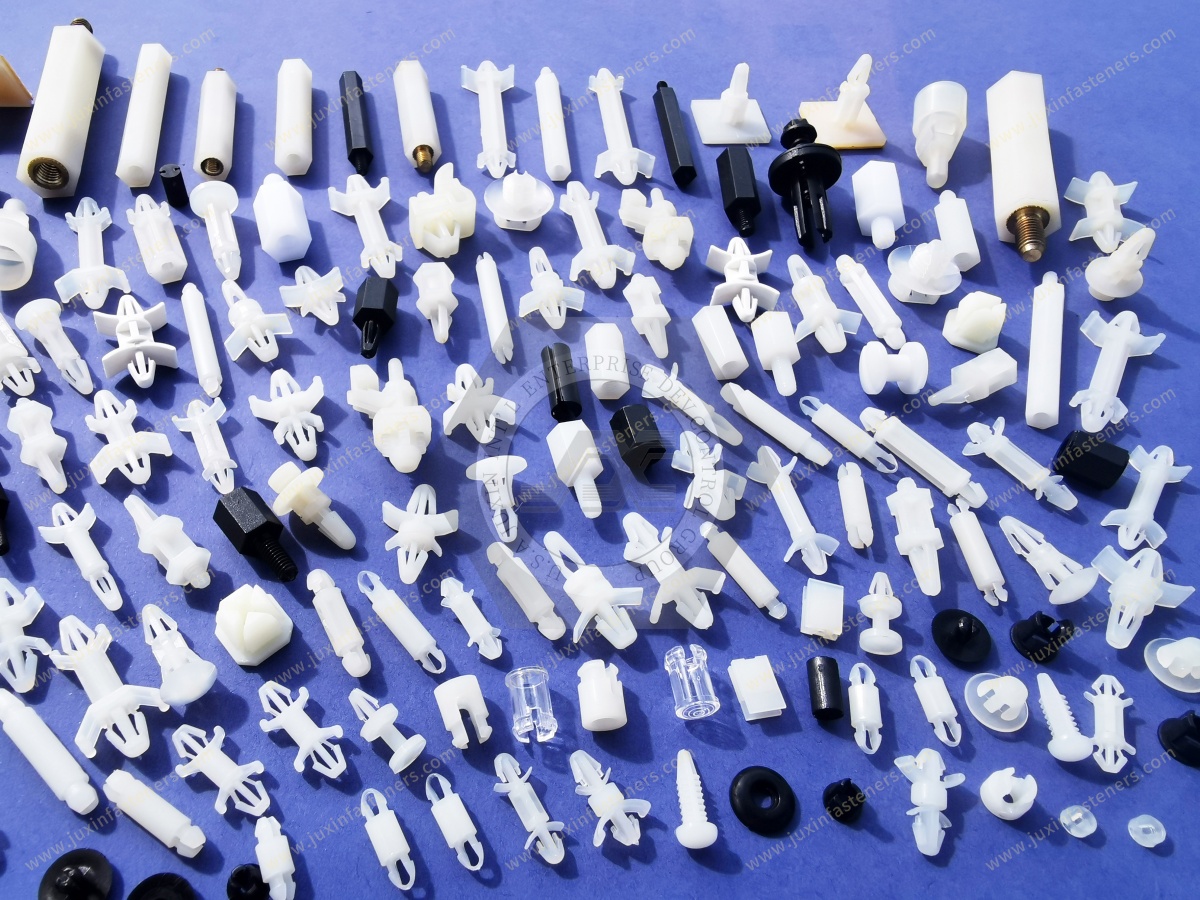
Wire routing and board support options
Screw-mount and rivet-mount cable tie bases use a mechanical attachment to a prepared panel.
They may be appropriate where adhesive performance would be difficult to qualify or where routine inspection is needed. Confirm the mounting hole, fastener head clearance, tie width and the routing envelope.
The mechanical fixing itself must be evaluated for the service load and panel construction.
Fir-tree or arrowhead push mounts and snap-in clips may reduce installation steps in suitable punched holes.
Retaining features must match the hole geometry and sheet thickness.
A clip that fits during a factory trial can still loosen if the production hole or coating thickness varies; test the permitted tolerance extremes.
Sheet-metal edge clips may attach without an additional mounting hole.
Their grip depends on the edge profile, permitted panel thickness, coating and retention feature.
Review the cable exit angle and any potential abrasion points. For particularly sensitive wiring, assess protective bushings or other suitable routing features.
PCB mounting hardware includes snap-in supports, threaded standoffs and unthreaded spacers.
Distinguish a part that supports the board from one that provides a defined threaded fixing.
The relationship among chassis thickness, PCB hole diameter, board thickness, component height and required clearance must be specified.
Comparing mounting architectures
No mounting category is universally the most vibration-resistant or durable.
Evaluate the selected hardware with the actual substrate, installation sequence, load direction, environment and maintenance requirements.
| Mounting method | Assembly interface | Selection and validation |
|---|---|---|
| Screw or rivet mount | Prepared panel hole and mating fastener | Check attachment strength, hole tolerance, tool access and harness clearance |
| Fir-tree or snap-in mount | Hole or slot matching the retention feature | Check panel grip, insertion force, retention and removal requirements |
| Edge clip | Compatible sheet-metal flange or edge | Check edge thickness, coating damage, grip and abrasion |
| Adhesive mount | Suitable prepared surface | Check adhesive chemistry, surface compatibility, dwell time, temperature and aged retention |
| PCB standoff or spacer | Board and chassis mounting features | Check stack-up, alignment, board support and electrical clearance |
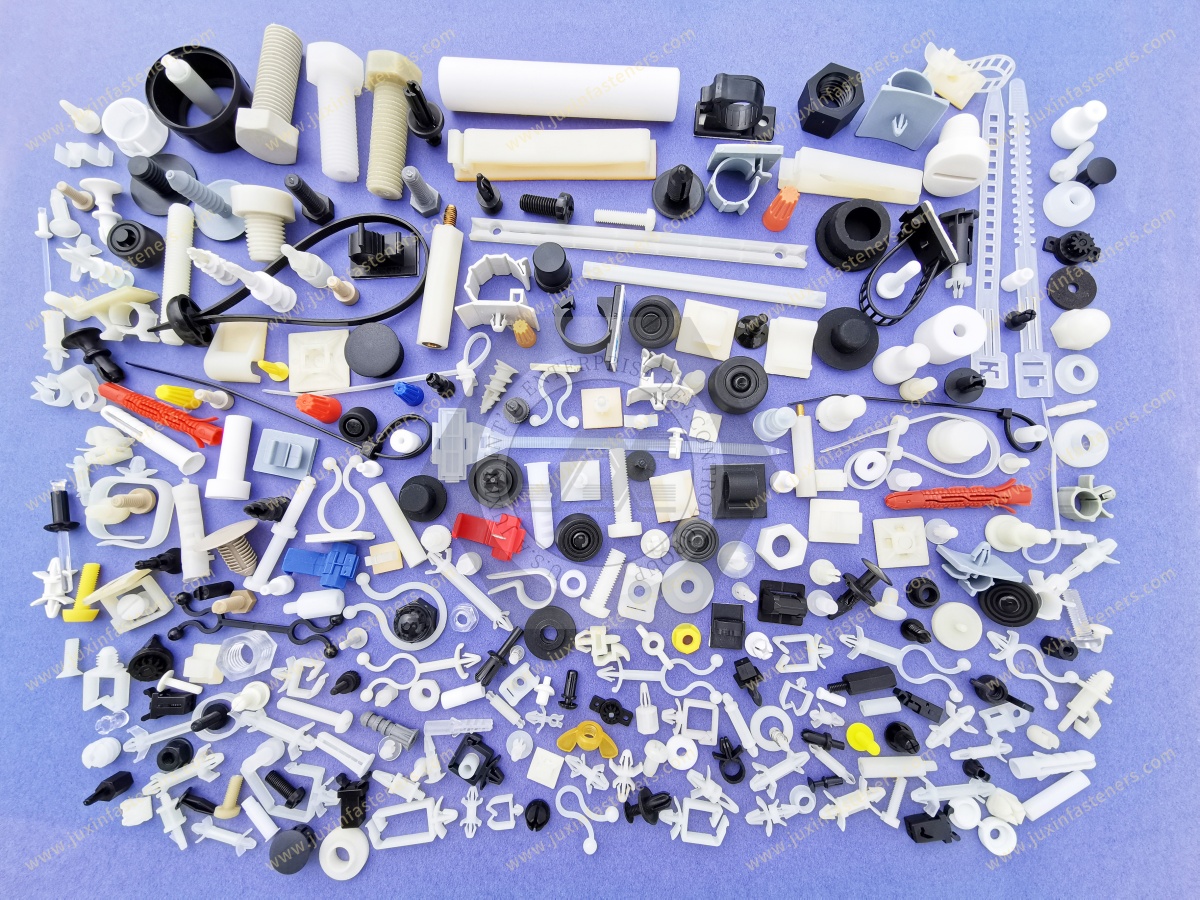
Materials and production verification
Natural or black PA66, UV-stabilized formulations and flame-retardant grades may be considered where the application requires them.
Specify the exact resin and relevant documentation rather than assuming that color, a generic PA66 designation or a flame-retardant label establishes outdoor durability or equipment compliance.
Polymer stiffness, moisture sensitivity and temperature-dependent behavior affect the retention features.
For adhesive-backed hardware, describe the substrate, coating and permitted surface preparation.
Bond performance depends on the adhesive system, surface condition, installation temperature, bonding time and service exposure.
Use supplier-approved instructions and verify aged retention on representative coated panels.
Avoid describing adhesive bases as universally suitable or unsuitable for vibration without test evidence.
Board supports need a controlled tolerance stack. Excessive support height can bend the PCB during assembly; insufficient height may create clearance problems.
Evaluate service access to connectors and ensure that the routing system does not interfere with fans, removable modules or airflow paths.
Production quality checks can cover dimensions, visual condition, insertion or retention performance and sample fit, where agreed.
Request a cable management and PCB hardware quotation
Juxin Fasteners reviews custom clip profiles, board-support geometry and mounting features for industrial batch programs.
For metal or hybrid components, the appropriate manufacturing route depends on the required material, geometry and production volume.
Plastic hardware tooling and resin options are assessed for the individual project.
Submit the following to info@juxinfasteners.com:
2D/3D drawings, existing part reference, and panel or board mounting details.
Panel and PCB thickness, hole or edge geometry, standoff height, cable bundle size and clearance.
Required resin, color, environmental exposure, flammability or electrical requirements and servicing conditions.
Installation process, acceptance criteria, sample quantity and estimated annual usage.
 MORE NEWS
Contact Us
Tel.:
+86 020 8621 0320
+86 020 3121 6067
E-mail:
Technical Support:
Navigation
SEND INQUIREY