
Call Us
+86 136 6007 9809
Call Us
+86 136 6007 9809

Nov. 28, 2026
JUXIN FASTENERS is an industrial fastener manufacturer supporting standard and made-to-drawing fastening components for OEM equipment.
Our multi-process manufacturing capabilities include cold heading, cold forming and CNC machining, with product-specific secondary operations selected through engineering review.
Washer and retaining ring requirements are evaluated against geometry, material, tolerances, production volume and intended function.
An engineered washer is not a universal remedy for a loose joint.
Clamp-load relaxation, rotational loosening, electrical continuity and axial retention are different design problems.
Selecting the component by its function helps avoid unnecessary hardware, assembly rework and premature wear.
Choose the mechanism before specifying the standard
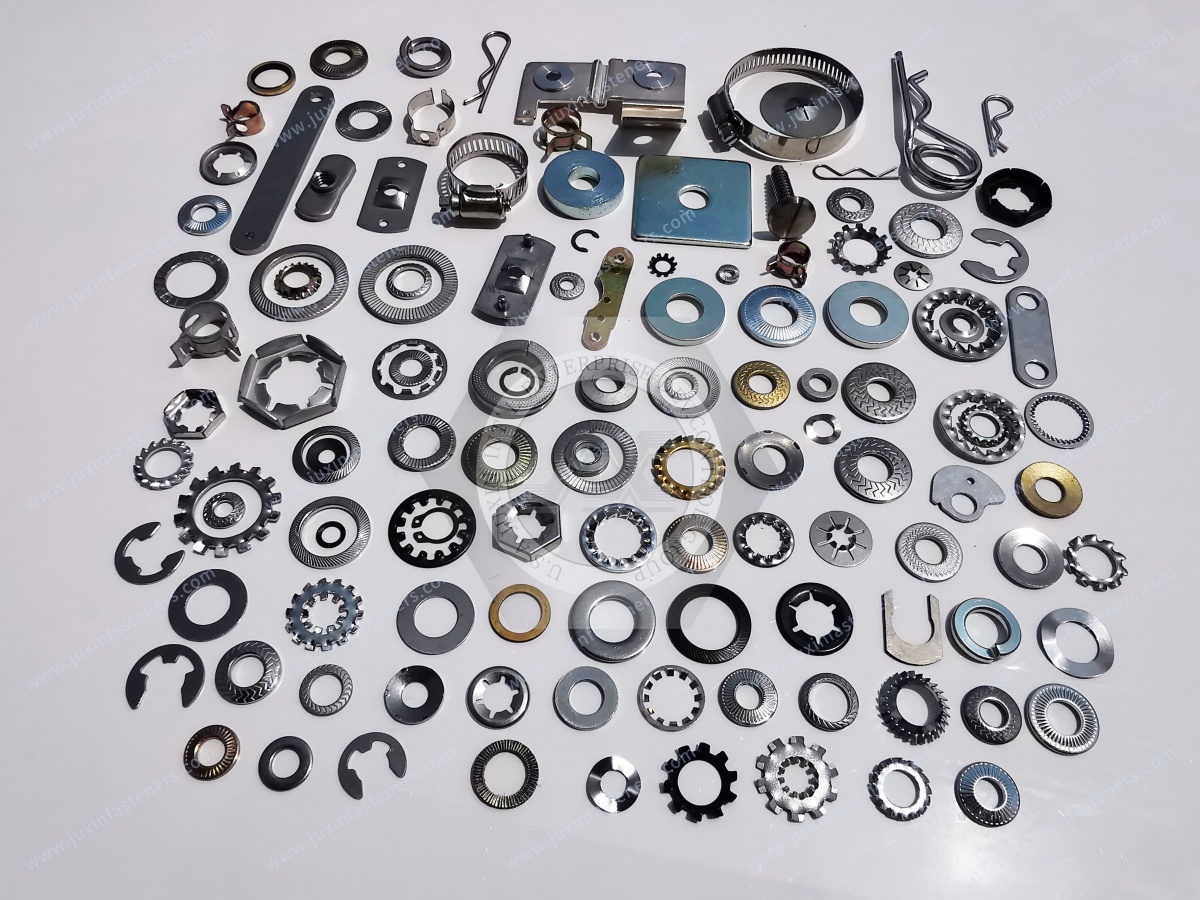
Wedge-lock washer pairs use interacting cam surfaces and external serrations to resist relative rotation under suitable joint conditions.
The cam geometry is designed to oppose loosening rotation;
DIN 25201-4 may be a relevant requirement for railway-related bolted joints, but conformity and vibration performance must be assessed for the actual washer system and joint.
Conical spring washers, including designs specified to DIN 6796, provide axial elastic deflection within a defined working range.
They may compensate for limited settling or relaxation; they are not substitutes for a properly designed preload or validated locking method.
Conventional split spring washers and toothed washers should not be assumed to provide reliable locking under severe transverse vibration.
Toothed washers can provide local contact pressure and resistance to rotation.
For electrical bonding, the coating, substrate, contact resistance, corrosion exposure and bonding design must be considered together.
Coating penetration alone does not establish electrical compliance.
For retaining rings, choose shaft-mounted external rings (e.g. DIN 471), bore-mounted internal rings (e.g. DIN 472) or E-clips (e.g. DIN 6799), as appropriate to the drawing.
Compare assembly functions and interfaces
Use this matrix to separate design objectives. Each family still requires load and geometry verification against the selected size, material and applicable specification.
| Joint requirement | Candidate component | What to verify |
|---|---|---|
| Rotation under vibration | Wedge-lock washer pair | Joint surfaces, clamp load, installation direction, representative vibration test |
| Limited preload relaxation | Conical spring washer | Load-deflection curve, working deflection, seating and temperature |
| Electrical bonding | Toothed / bonding washer | Contact resistance, coating compatibility, corrosion and bonding requirements |
| Axial retention | External or internal retaining ring / E-clip | Groove diameter, width, edge distance, axial capacity and installation clearance |
| Spacing or sealing | Custom shim or sealing washer | Flatness, thickness, bearing surface and sealing validation |
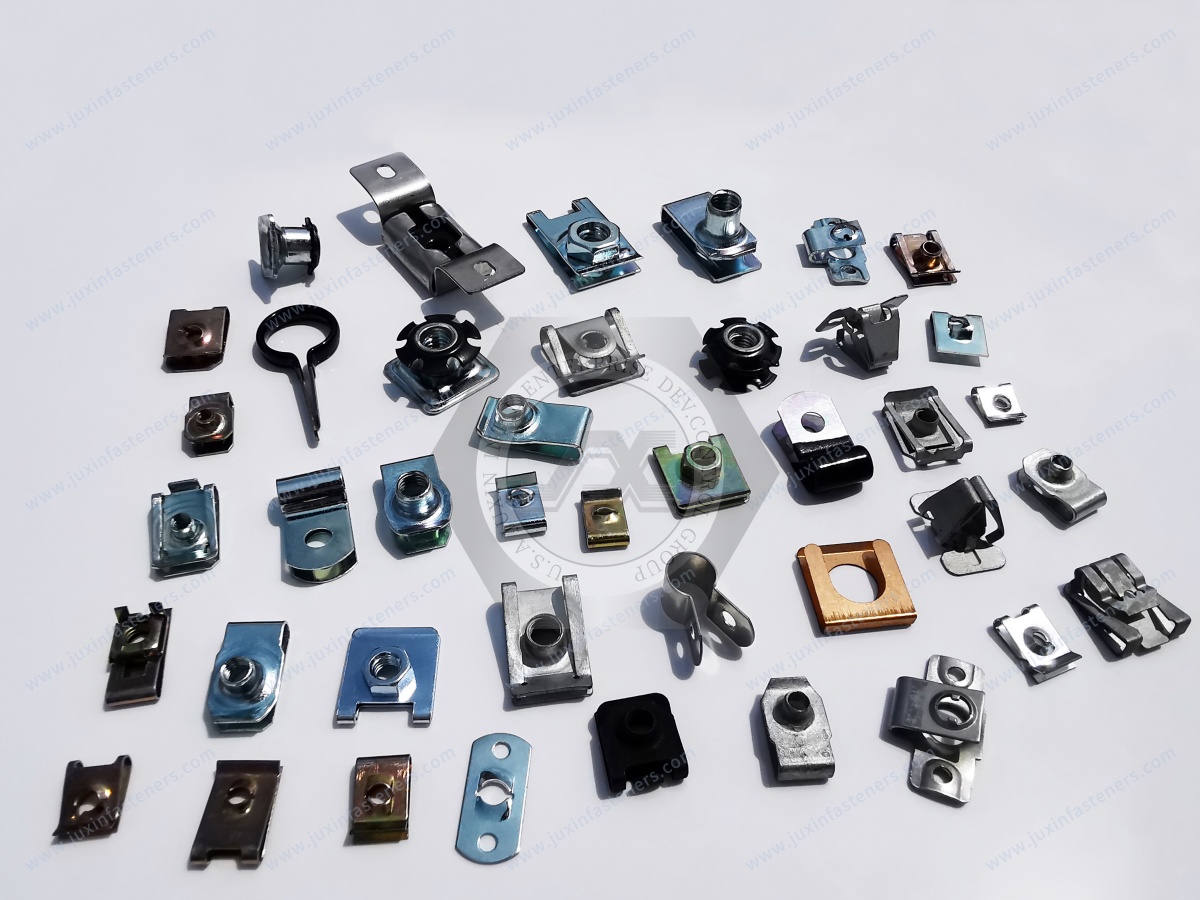
Manufacturing and drawing details that affect fit
Spring steel and stainless steel are common candidates for elastic components; copper or brass may suit certain sealing or electrical interfaces.
Specify the actual material grade rather than assuming two national grades are interchangeable.
Hardness, heat treatment, residual stress, finish and surface integrity can change both spring response and fatigue behaviour.
Coating choices should account for corrosion exposure, dimensional allowance and material/process compatibility.
For retaining rings, inspect the groove and mating shaft or housing as a system.
A ring that fits the nominal diameter may still be unsuitable if the groove is too wide, the shoulder is weak or assembly access is restricted.
For washers, confirm seating area, bore clearance and whether a serrated face is acceptable on the mating finish.
Consider stamping or other forming routes, machining and finishing according to the approved drawing; the process is not prescribed for every product.
Request an OEM quotation with the application details
Send the 2D drawing or 3D model, target standard and revision, material grade, thickness, mating part dimensions, surface treatment, required load or deflection and estimated annual volume.
For vibration or electrical bonding applications, include the intended test method and acceptance criteria.
JUXIN FASTENERS can review manufacturing feasibility and sample requirements before production release. Contact info@juxinfasteners.com.
 MORE NEWS
Contact Us
Tel.:
+86 020 8621 0320
+86 020 3121 6067
E-mail:
Technical Support:
Navigation
SEND INQUIREY