Call Us
+86 136 6007 9809
Call Us
+86 136 6007 9809

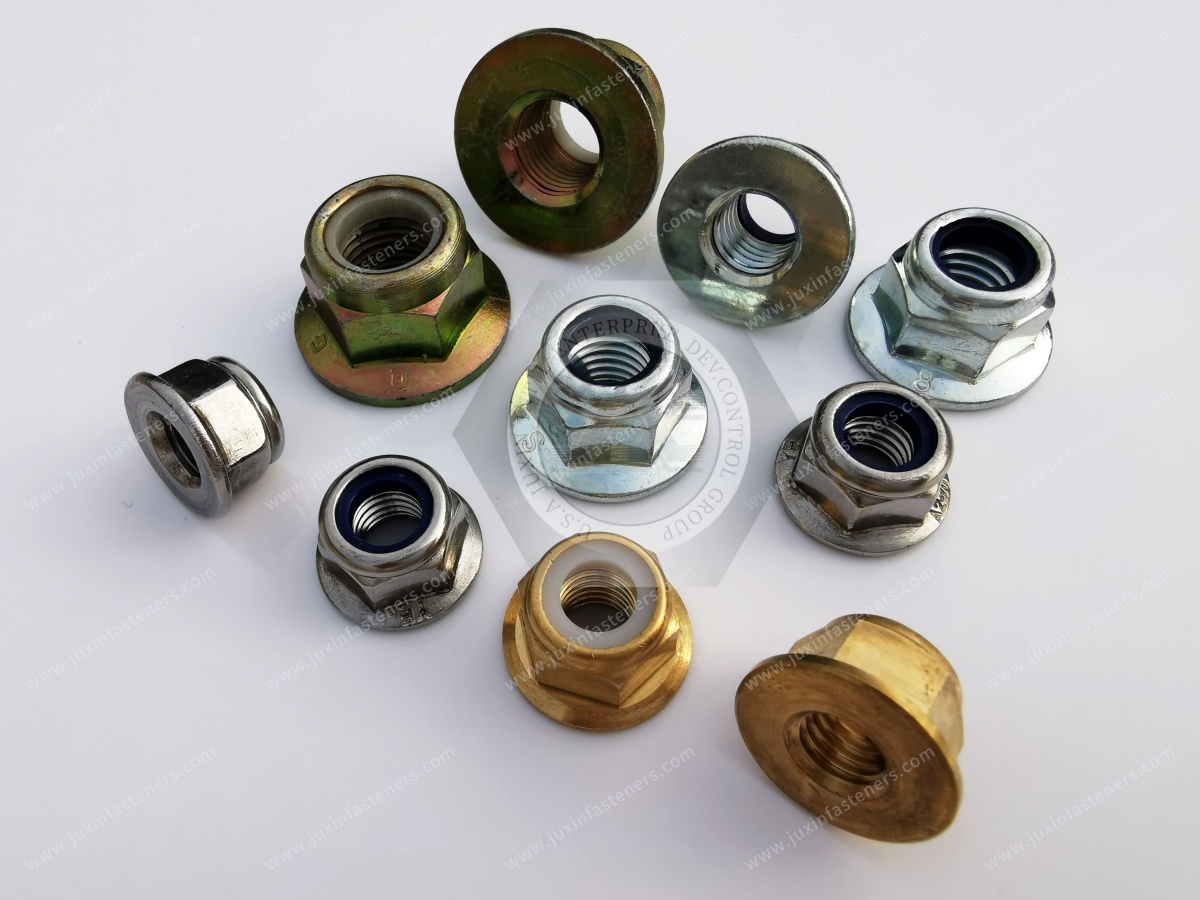
Prevailing torque lock nuts are widely used in industrial bolted assemblies where resistance to unintended nut rotation is important during vibration, dynamic loading, repeated operation, or maintenance.
Two major product categories are nylon-insert lock nuts and all-metal prevailing torque lock nuts.
Product Specification
Prevailing torque lock nuts are widely used in industrial bolted assemblies where resistance to unintended nut rotation is important during vibration, dynamic loading, repeated operation, or maintenance.
Two major product categories are nylon-insert lock nuts and all-metal prevailing torque lock nuts.
Both designs incorporate a locking feature that generates resistance to rotation independently of the clamping force developed after the nut is seated against the joint.
However, their locking mechanisms, temperature limitations, friction characteristics, installation behavior, and reuse considerations differ significantly.
For mechanical engineers, manufacturing engineers, production managers, and industrial procurement teams,
selecting the appropriate lock nut requires evaluating the complete bolted joint rather than comparing the fasteners solely by material or appearance.
A nylon-insert lock nut may be suitable for many general industrial assemblies, while an all-metal lock nut may be preferred where polymer temperature limitations,
environmental exposure, or application-specific requirements make nylon inserts unsuitable.
Neither design automatically guarantees resistance to vibration-induced joint loosening.
JUXIN FASTENERS supplies industrial locking nuts, including nylon-insert lock nuts, all-metal locking nuts, and drawing-based OEM fastening components for international manufacturing applications.
This engineering guide compares their mechanical locking principles, prevailing torque characteristics, operating temperature considerations, vibration performance,
installation requirements, material selection, corrosion protection, production efficiency, and OEM procurement specifications.
A prevailing torque lock nut is a threaded fastener designed to create rotational resistance through an integrated locking feature.
Unlike a conventional free-spinning hex nut, a prevailing torque lock nut develops resistance as it engages with the mating bolt threads, even before its bearing surface contacts the joint.
This resistance is commonly referred to as prevailing torque.
Prevailing torque is the torque required to rotate the locking nut along the mating thread when the nut is not yet generating clamp load through contact with the joint.
The locking mechanism creates frictional interference between the nut and bolt.
This interference can help resist unintended rotation during service.
However, prevailing torque does not directly represent the clamp load in the joint.
Clamp load is generated when tightening produces tensile loading in the bolt and compressive loading between the assembled components.
Prevailing torque is the additional rotational resistance created by the locking feature.
The two must be distinguished during joint design and torque specification.
A lock nut can generate measurable prevailing torque while the completed joint still has insufficient preload.
Similarly, a correctly preloaded joint may lose clamp force through settlement, relaxation, or other mechanisms even if the nut retains its locking feature.
Potential applications include:
Industrial machinery.
Automotive components.
Agricultural equipment.
Railway equipment.
HVAC machinery.
Electrical equipment.
Power generation equipment.
Industrial automation.
Maintenance-intensive mechanical assemblies.
Selection must reflect the actual operating environment, mechanical loading, and applicable engineering requirements.
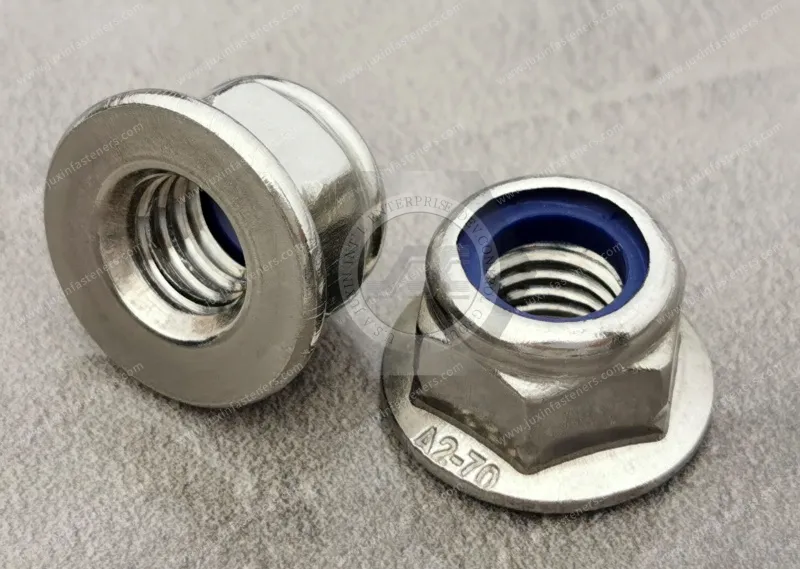
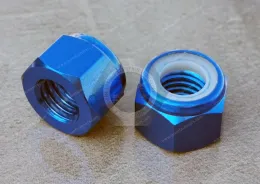
Nylon-insert lock nuts incorporate a polymer locking element, commonly a nylon ring, retained within a designated portion of the nut.
They are also frequently described as nylon lock nuts, nylon-insert prevailing torque nuts, elastic stop nuts, or Nyloc-type nuts.
The term Nyloc is widely recognized commercially, but it should not be treated as a universal technical specification for every nylon-insert locking nut.
As the mating bolt advances through the nut, its external thread engages with the nylon insert.
The polymer deforms around the thread profile and creates frictional resistance.
This resistance contributes to prevailing torque during installation and removal.
The nylon ring is not intended to replace proper bolt preload.
Depending on the applicable product standard, nylon-insert lock nuts may be available in different heights, strength classes, materials, and thread configurations.
Examples include:
DIN 985-style low-profile nylon-insert lock nuts.
ISO 10511 prevailing torque type hexagon thin nuts with non-metallic inserts.
ISO 7040 prevailing torque type hexagon nuts with non-metallic inserts.
Other drawing-defined nylon-insert lock nuts.
Nylon-insert flange lock nuts where the required design is available.
These configurations should not be assumed to be dimensionally or mechanically interchangeable.
Potential advantages include:
Integrated prevailing torque locking feature.
No separate lock washer required for the locking mechanism.
Availability in common industrial thread configurations.
Suitability for many general-purpose bolted assemblies.
Compatibility with controlled manual and automated assembly.
The locking performance depends on the polymer insert, mating thread, temperature, exposure conditions, and assembly history.
Potential limitations include:
Polymer temperature sensitivity.
Changes in prevailing torque after repeated use.
Chemical compatibility concerns.
Insert damage during installation.
Variation in friction characteristics.
The selected product should be evaluated under the actual service conditions.
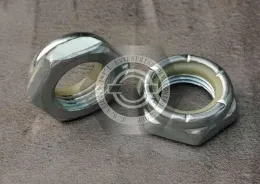
All-metal prevailing torque lock nuts generate rotational resistance through controlled interference between metallic thread features.
They do not rely on a nylon locking ring.
Different all-metal designs use different locking mechanisms.
Distorted-thread lock nuts incorporate a controlled deformation of a designated thread region.
As the mating bolt engages with the deformed section, interference produces prevailing torque.
The distortion may be located near the top of the nut or in another engineered locking region.
Some all-metal lock nuts use controlled deformation near the upper portion of the nut.
This creates interference as the bolt advances through the locking section.
Certain designs use an intentionally modified nut or thread geometry to generate rotational resistance.
The exact mechanism depends on the product design.
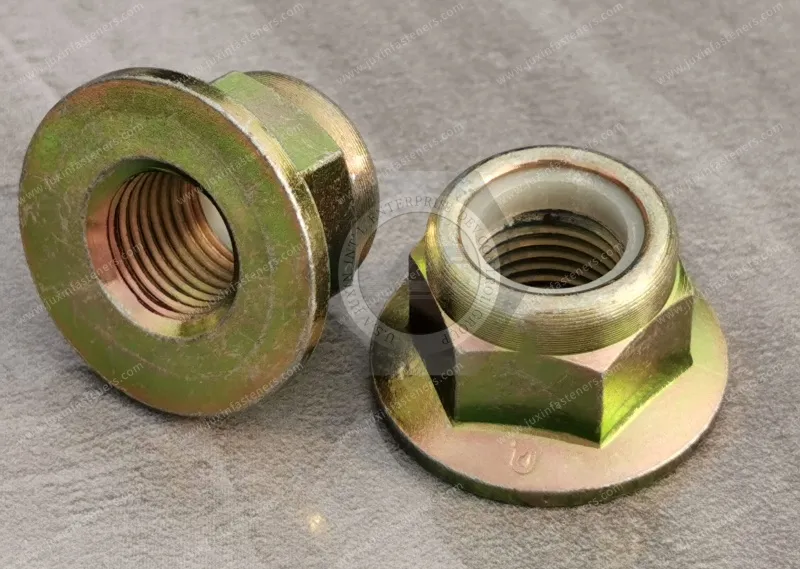
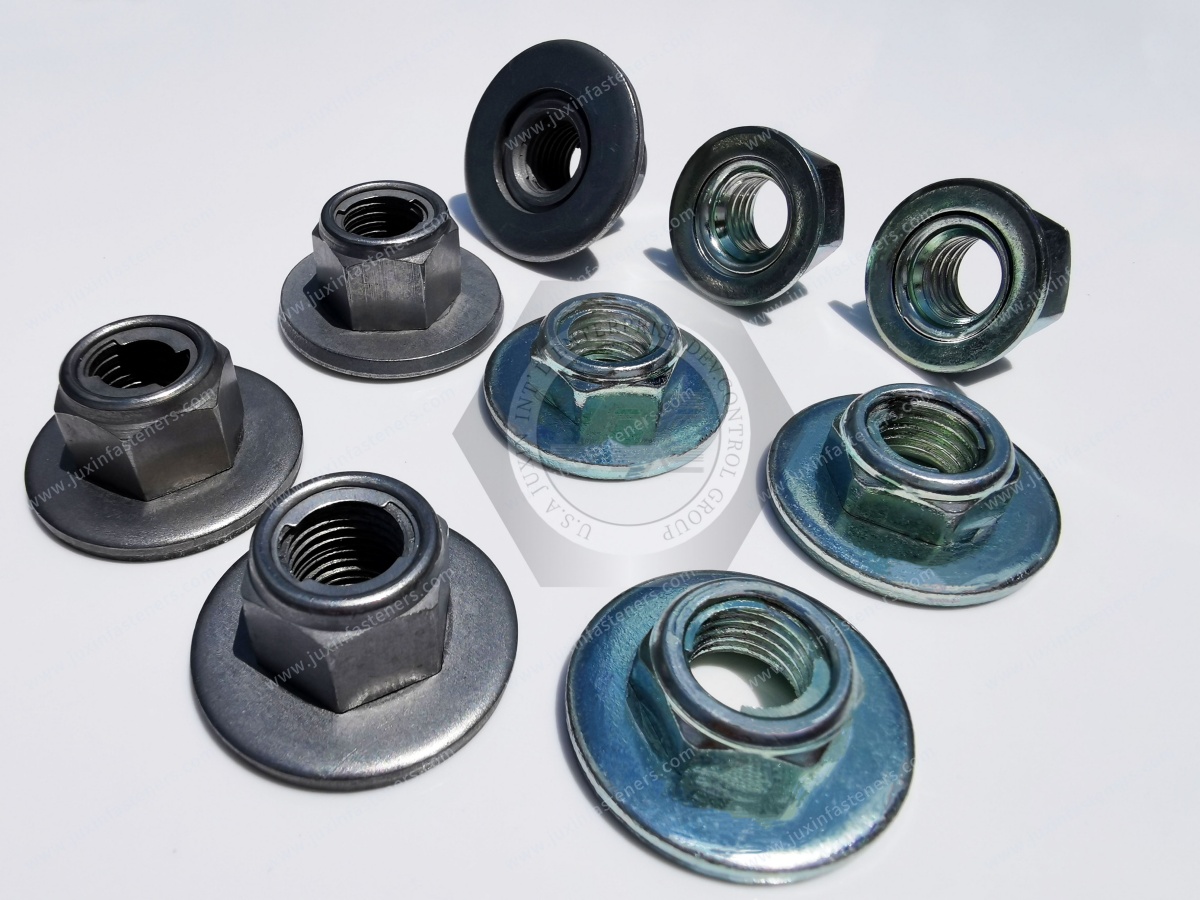
All-metal locking nuts may also incorporate a flange.
The flange provides a bearing surface, while the locking mechanism is established by the designed thread interference.
A flange alone does not make a conventional nut a prevailing torque lock nut.
Potential advantages include:
No polymer locking insert.
Suitability for selected elevated-temperature applications.
Different locking geometries for specific assembly requirements.
Compatibility with applications where polymer materials are undesirable.
Availability of specialized industrial configurations.
All-metal locking nuts may introduce:
Higher or different prevailing torque characteristics.
Thread wear during repeated use.
Potential galling in certain material combinations.
Sensitivity to coatings and lubrication.
Increased installation torque requirements.
Application-specific temperature and corrosion limitations.
The absence of nylon does not eliminate the need for engineering validation.
The following comparison describes general engineering differences. Actual performance depends on the specific product design and test conditions.
| Engineering Factor | Nylon-Insert Lock Nuts | All-Metal Lock Nuts |
|---|---|---|
| Locking mechanism | Polymer-to-thread interference | Metal-to-metal thread interference |
| Locking element | Nylon or specified polymer | Engineered metallic deformation |
| Prevailing torque | Depends on insert geometry and condition | Depends on deformation geometry and material |
| Elevated temperature | Limited by polymer and complete fastener design | Potentially suitable for higher temperatures, subject to material and coating |
| Vibration performance | Requires joint-level validation | Requires joint-level validation |
| Repeated assembly | May lose prevailing torque through insert wear or deformation | May lose prevailing torque through metallic wear or deformation |
| Thread galling | Depends on mating materials and thread conditions | Metal interference may increase galling concerns |
| Corrosion protection | Depends on nut material and coating | Depends on nut material and coating |
| Installation control | Must account for prevailing torque | Must account for prevailing torque |
| Typical selection priority | Suitable temperature and general industrial locking requirements | Applications requiring a compatible metal-only locking mechanism |
There is no universal answer.
Nut strength depends on material, property class, thread geometry, dimensions, and applicable specifications.
Locking performance and mechanical strength are different characteristics.
An all-metal lock nut is not automatically stronger than a nylon-insert lock nut simply because its locking feature is metallic.
Neither type is universally superior.
The complete joint must be evaluated for preload retention, transverse movement, vibration conditions, and locking performance.
Vibration-related loosening is a major consideration in industrial fastening applications.
However, vibration resistance is frequently oversimplified in product descriptions.
Bolted joints may experience loss of preload or unintended rotation due to:
Transverse cyclic loading.
Relative movement between clamped components.
Joint settlement.
Embedment of contacting surfaces.
Material relaxation.
Thermal cycling.
Insufficient initial preload.
Inappropriate joint geometry.
Different mechanisms may occur independently or together.
Prevailing torque provides rotational resistance through the locking feature.
This can help resist unintended nut rotation.
However, it does not prevent every mechanism that can reduce clamp load.
A nylon-insert lock nut should not be described as providing general vibration damping simply because it contains a polymer ring.
The primary purpose of the insert is to create frictional interference with the mating thread.
Its contribution to joint performance must be evaluated according to the actual application.
All-metal locking mechanisms can provide useful rotational resistance.
However, there is no universal engineering basis for claiming that all-metal lock nuts outperform nylon-insert lock nuts in every high-vibration application.
Comparative performance depends on the selected designs, mating threads, preload, test method, and service conditions.
Where vibration resistance is a critical requirement, the complete bolted joint should be evaluated using an appropriate test method.
DIN 65151 is associated with transverse vibration testing of bolted joints, while ISO 16130 addresses a vibration test method for fasteners.
The applicable method and acceptance criteria must be selected according to the engineering requirements.
Test results from one joint configuration should not automatically be transferred to a different assembly.
Operating temperature is one of the most important differences between nylon-insert and all-metal lock nuts.
Nylon is a polymer whose mechanical properties and dimensional behavior depend on temperature, moisture, exposure duration, and material formulation.
At elevated temperatures, changes in the nylon insert may affect prevailing torque.
The actual permissible service temperature depends on:
Nylon grade.
Insert design.
Exposure duration.
Mechanical loading.
Environmental conditions.
Required locking performance.
A commonly quoted temperature limit should not be applied universally to every nylon-insert lock nut.
All-metal lock nuts do not contain a polymer locking insert.
This may make them suitable for certain applications where a nylon-insert design is unsuitable.
However, the maximum service temperature is still limited by factors such as:
Base material.
Mechanical property class.
Heat treatment.
Surface coating.
Thread condition.
Applied stress.
Required preload.
Exposure duration.
An all-metal lock nut should not automatically be rated for 300°C or higher without product-specific supporting information.
Repeated heating and cooling can influence joint performance through differential thermal expansion, relaxation, and changes in material properties.
The locking mechanism alone cannot compensate for an incorrectly designed joint.
All-metal locking nuts may be evaluated for:
Industrial heating equipment.
Engine-adjacent components.
Certain exhaust-related assemblies.
Power generation machinery.
Thermal processing equipment.
The actual temperature and loading conditions must be reviewed before selecting a product.
Low-temperature service requires evaluation of the complete fastening system.
Polymer behavior may change at low temperatures.
The effect depends on the nylon formulation, moisture condition, and service environment.
A nylon-insert lock nut should not automatically be considered unsuitable for all sub-zero applications.
All-metal lock nuts may avoid polymer-related limitations, but metallic materials also have temperature-dependent mechanical characteristics.
For demanding low-temperature applications, material toughness and joint requirements may need specific evaluation.
Relevant conditions include:
Humidity.
Salt exposure.
Industrial chemicals.
Cleaning agents.
Lubricants.
Temperature cycling.
Outdoor weathering.
The selected material, coating, and locking feature must be compatible with the expected exposure.
A common engineering mistake is treating prevailing torque as equivalent to bolt tightening torque or clamp load.
These quantities are related but are not interchangeable.
Prevailing torque is the resistance generated by the locking feature while the nut rotates along the mating thread without bearing against the joint.
Tightening torque is the torque applied during assembly to develop the required bolt tension and joint clamp load.
For a prevailing torque lock nut, the applied torque includes the effects of the locking mechanism and the friction associated with generating preload.
A torque specification developed for a free-spinning nut may not produce the intended preload when applied without adjustment to a prevailing torque nut.
The locking feature consumes part of the applied torque.
However, simply adding a fixed prevailing torque value to a conventional torque specification is not a universal solution.
The torque-preload relationship depends on thread friction, bearing friction, lubrication, coating, geometry, and the specific assembly.
Where preload is important, engineers should establish an appropriate tightening procedure using relevant testing or validated joint data.
ISO 16047 provides a framework for torque/clamp force testing of threaded fasteners.
The applicable test conditions must be defined.
Production managers should consider:
Tightening equipment capability.
Torque measurement.
Prevailing torque variation.
Assembly speed.
Tool calibration.
Thread lubrication.
Joint seating behavior.
Rework procedures.
These factors influence both assembly reliability and production efficiency.
Repeated installation and removal may affect the locking performance of prevailing torque nuts.
During repeated assembly, the nylon insert may experience deformation, wear, or changes in its engagement with the mating thread.
This may reduce or otherwise change prevailing torque.
All-metal locking nuts may also experience changes in prevailing torque after repeated installation.
Potential causes include:
Metallic thread wear.
Changes in locking geometry.
Surface coating damage.
Galling.
Plastic deformation.
A statement that nylon lock nuts can be reused three to five times, or that all-metal lock nuts can always be reused more frequently, is not universally valid.
Reuse depends on the specific standard, product, assembly conditions, and remaining locking performance.
For production or maintenance applications, the permitted reuse procedure should be defined by the applicable engineering specification.
Where reuse is allowed, the remaining prevailing torque and thread condition may need verification.
For safety-critical applications, replacement requirements must follow the approved maintenance or engineering instructions.
International OEM purchasing requires clear identification of the applicable fastener standard.
DIN 985 is a widely recognized legacy designation for low-profile prevailing torque hexagon nuts with non-metallic inserts.
It remains common in industrial purchasing terminology.
However, a product described commercially as DIN 985 should be checked against the actual drawing and specified requirements.
ISO 10511 covers prevailing torque type hexagon thin nuts with non-metallic inserts.
It is relevant when specifying the corresponding product configuration.
ISO 7040 covers prevailing torque type hexagon nuts with non-metallic inserts.
The dimensional configuration and applicable requirements differ from those of thin-nut designs.
ISO 2320 addresses functional properties of prevailing torque type steel nuts.
It is particularly relevant to specified prevailing torque performance and testing requirements within its scope.
The applicable edition, nut type, property class, and test conditions must be confirmed.
ISO 898-2 addresses mechanical properties of specified carbon steel and alloy steel nuts.
Its applicability depends on the product and scope of the standard.
It should not be applied automatically to stainless steel nuts.
ISO 3506-2 is relevant to mechanical properties of corrosion-resistant stainless steel nuts within its scope.
Material designations and mechanical property requirements must be verified for the selected product.
North American OEM drawings may specify Unified inch threads according to ASME B1.1.
The applicable lock nut product specification must be identified separately.
A thread standard alone does not define the complete lock nut geometry or locking performance.
DIN, ISO, and ASME designations should not be treated as automatically interchangeable.
Differences may involve:
Nut height.
Across-flats dimensions.
Bearing geometry.
Locking feature.
Mechanical properties.
Prevailing torque requirements.
Test methods.
Replacement products should be evaluated against the approved drawing and applicable standard.
Lock nuts must match the mating bolt thread specification.
Common metric examples include:
M4 × 0.7
M5 × 0.8
M6 × 1.0
M8 × 1.25
M10 × 1.5
M12 × 1.75
These are illustrative thread designations and do not establish availability in every lock nut configuration.
Some industrial applications use metric fine threads.
The required pitch must be specified explicitly.
For example, M10 × 1.5 and M10 × 1.25 are different thread configurations.
Unified Coarse and Unified Fine threads are commonly specified in North American engineering drawings.
Examples include 1/4-20 UNC and 3/8-16 UNC.
The actual lock nut design and availability must be confirmed.
BSW and BSF are distinct British thread systems.
They may be encountered in legacy machinery or specialized applications.
They are not directly interchangeable with ISO metric or Unified threads.
M6 nominal diameter is approximately 0.2362 inches.
M8 nominal diameter is approximately 0.3150 inches.
M10 nominal diameter is approximately 0.3937 inches.
These are dimensional conversions only.
They do not establish thread compatibility or product interchangeability.
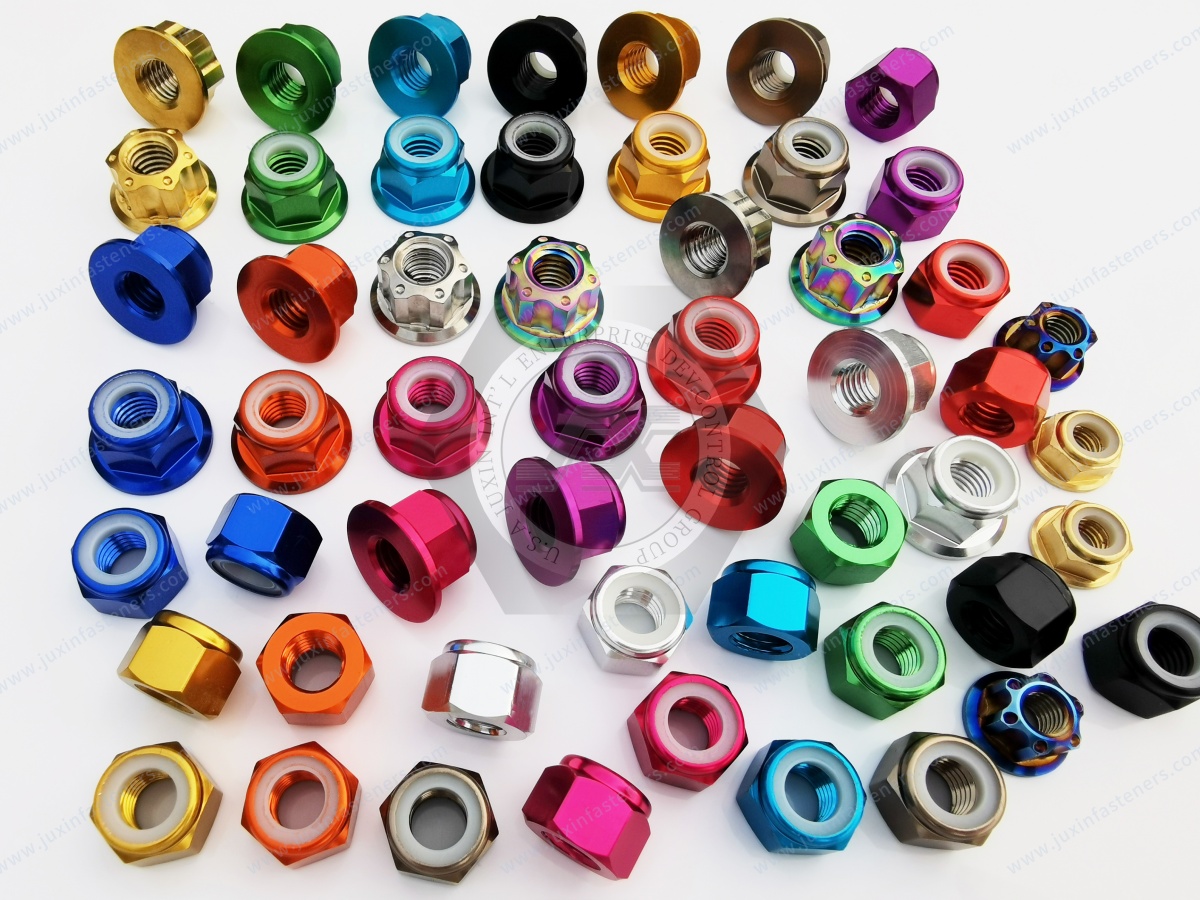
Carbon steel locking nuts are widely used in industrial machinery and equipment.
Material selection should consider the required mechanical property class, mating bolt, coating, and service conditions.
Applicable property classes depend on the fastener design and governing standard.
The required nut property class must be compatible with the mating bolt and joint requirements.
A locking nut should not automatically be assumed to meet property class 8, 10, or 12.
Zinc plating may provide corrosion protection for suitable carbon steel nuts.
However, coating thickness and surface condition can influence thread friction and assembly behavior.
Zinc-nickel coatings may be specified for particular corrosion protection requirements.
Actual coating availability, compatibility, and performance must be confirmed.
Zinc-flake systems may be considered for selected industrial fastening applications.
The coating specification should address thickness, friction characteristics, corrosion performance, and compatibility with the locking feature.
Hot-dip galvanizing should not be treated as a universal finish for standard prevailing torque lock nuts.
Coating thickness, thread allowances, dimensional compatibility, and the locking mechanism require specific evaluation.
The process should be used only where the selected fastener design and applicable specification permit it.
Stainless steel locking nuts may be considered where corrosion resistance is an important requirement.
A2 stainless steel is commonly associated with 304-type stainless steel fastener materials.
However, the exact material designation and mechanical properties must follow the applicable specification.
A4 stainless steel is commonly associated with molybdenum-containing 316-type stainless steel fastener materials.
A4 may be considered for selected environments requiring improved corrosion resistance.
However, it is not universally immune to corrosion.
These combine a stainless steel nut body with a polymer locking insert.
The service limitations of both materials must be considered.
These rely on metallic interference to generate prevailing torque.
The selected design must be evaluated for thread friction, galling, material properties, and locking performance.
Stainless steel threaded fasteners may be susceptible to galling under certain conditions.
Risk factors can include:
Material pairing.
Surface condition.
High contact pressure.
Installation speed.
Lubrication.
Thread geometry.
Repeated assembly.
All-metal prevailing torque designs may require particular attention to this issue.
Corrosion resistance and mechanical strength are separate selection criteria.
A stainless steel lock nut should not automatically be treated as a direct replacement for a high-strength carbon steel lock nut.
Industrial fastening applications may involve oils, coolants, cleaning agents, moisture, or chemical exposure.
Nylon behavior depends on the specific polymer grade and chemical environment.
Some substances may affect its mechanical properties or dimensions.
Chemical compatibility should be verified for the intended service conditions.
All-metal locking nuts avoid the nylon insert but remain subject to corrosion and other environmental effects.
Material selection must reflect the actual exposure.
Conventional nylon-insert lock nuts should not automatically be considered fluid-tight or pressure-tight.
The nylon insert is primarily intended to generate prevailing torque.
A locking feature is not equivalent to a validated sealing system.
Where a joint requires protection against liquid or gas leakage, an appropriate sealing design and validation procedure are necessary.
The complete assembly should be evaluated rather than relying solely on the presence of a nylon insert.
Machinery assemblies may experience vibration, dynamic loading, and repeated maintenance.
Selection considerations include:
Required preload.
Locking performance.
Thread strength.
Temperature.
Maintenance requirements.
Corrosion exposure.
Both nylon-insert and all-metal designs may be suitable depending on the application.
Automotive assemblies may require locking nuts for brackets, equipment mounts, and selected mechanical components.
The choice depends on temperature exposure, vibration, corrosion, mechanical loading, and customer specifications.
High-temperature or safety-critical applications require product-specific validation.
Railway assemblies may experience cyclic loading, vibration, and demanding environmental conditions.
Lock nut selection must follow the relevant engineering and approval requirements.
No general-purpose lock nut should be described as railway-certified without supporting evidence.
Agricultural equipment may experience vibration, dust, moisture, and outdoor exposure.
Relevant factors include corrosion protection, maintenance frequency, and locking performance.
HVAC assemblies may use locking nuts in suitable brackets, motor supports, and equipment structures.
Engineers should consider vibration, service temperature, and maintenance requirements.
Lock nuts may be used in mechanical support structures, equipment enclosures, and suitable mounting assemblies.
For electrical applications, grounding and electrical safety requirements must be evaluated separately.
A lock nut does not independently establish electrical compliance.
Mechanical assemblies in power electronics equipment may experience temperature changes, vibration, and long operating periods.
Fastener selection should consider the actual joint design and thermal environment.
Industrial locking nuts may be used in suitable equipment mounting structures, racks, brackets, and related mechanical assemblies.
Selection considerations include assembly repeatability, service access, vibration exposure, and corrosion protection.
Possible causes:
Insufficient initial preload.
Joint settlement.
Transverse cyclic loading.
Incorrect locking nut selection.
Loss of prevailing torque.
Incorrect assembly procedure.
Recommended engineering review:
Evaluate the complete bolted joint, including preload, loading conditions, and locking feature performance.
Possible causes:
Excessive temperature exposure.
Repeated assembly.
Chemical exposure.
Insert damage.
Incorrect mating thread.
Recommended engineering review:
Verify the polymer specification, operating environment, assembly history, and prevailing torque requirements.
Possible causes:
Excessive interference.
Incorrect thread compatibility.
Galling.
Surface coating issues.
Inappropriate installation conditions.
Recommended engineering review:
Inspect the thread geometry, material combination, coating, lubrication, and tightening process.
Possible causes:
High prevailing torque.
Thread damage.
Incorrect coating.
Mismatched threads.
Galling.
Tooling or process issues.
Recommended engineering review:
Measure prevailing torque under defined conditions and compare the results with the applicable specification.
Possible causes:
Variation in prevailing torque.
Friction variation.
Coating inconsistency.
Tool calibration.
Lubrication variation.
Assembly process variation.
Recommended engineering review:
Evaluate the torque-preload relationship and establish suitable production controls.
Possible causes:
Unsuitable material.
Inadequate surface protection.
Environmental exposure.
Coating damage during assembly.
Galvanic interaction.
Recommended engineering review:
Review the material and coating specification against the actual service environment.
Production managers must consider the effect of locking nuts on assembly speed, repeatability, and quality.
Locking nuts may be incorporated into automated assembly processes where the product geometry and equipment are compatible.
Important considerations include:
Nut dimensions.
Orientation.
Feeding reliability.
Surface condition.
Thread engagement.
Assembly access.
Prevailing torque affects the torque required during installation.
Assembly equipment must be capable of handling the expected torque range.
The mating bolt must engage correctly with the nut's locking feature.
Required thread protrusion and engagement should follow the applicable product and joint specifications.
A universal protrusion rule should not replace the approved drawing or assembly instructions.
Installation speed can influence friction, heat generation, and galling risk in certain material combinations.
The appropriate speed should be established for the specific product and assembly.
Production monitoring may include:
Fastener identification.
Thread verification.
Prevailing torque checks.
Tightening torque.
Assembly angle.
Tool calibration.
Periodic inspection.
The complete cost of a locking nut assembly may include:
Fastener price.
Assembly time.
Tooling.
Inspection.
Rework.
Thread damage.
Maintenance.
Replacement frequency.
Production downtime.
The lowest unit price does not necessarily provide the lowest total manufacturing cost.
International OEM procurement requires a clear technical specification and reliable commercial communication.
Specify the required locking mechanism.
Examples include:
Nylon-insert lock nut.
Distorted-thread all-metal lock nut.
Top-lock all-metal nut.
All-metal flange lock nut.
Drawing-defined specialty locking nut.
Identify the relevant DIN, ISO, ASME, or customer-specific standard.
The standard edition should be confirmed where necessary.
Provide:
Thread designation.
Nominal diameter.
Pitch.
Thread tolerance requirements.
Mating bolt specification.
Specify:
Required property class.
Prevailing torque requirements.
Proof load requirements, where applicable.
Reuse requirements, if permitted.
Required test methods.
Application-specific acceptance criteria.
Identify:
Carbon steel or stainless steel requirements.
Applicable material grade.
Coating specification.
Corrosion requirements.
Lubrication requirements.
Surface treatment restrictions.
Provide:
Minimum and maximum operating temperature.
Vibration conditions.
Mechanical loading.
Chemical exposure.
Corrosion environment.
Maintenance requirements.
Include:
Prototype quantity.
Initial production quantity.
Estimated annual demand.
Packaging requirements.
Delivery destination.
Target lead time.
Drawing revision.
This information supports more accurate product selection and quotation.
For OEM purchasing programs, dimensional conformity alone may not be sufficient.
The locking feature must also satisfy the agreed functional requirements.
Relevant characteristics include:
Thread size and pitch.
Across-flats dimensions.
Nut height.
Bearing surface.
Locking feature geometry.
Flange dimensions, where applicable.
Material requirements should be established according to the applicable standard and customer specification.
Where required, mechanical property verification may include proof load or other relevant tests.
The test method and acceptance criteria must match the selected product specification.
Prevailing torque testing should follow the applicable standard and specified conditions.
ISO 2320 is relevant to functional testing of prevailing torque type steel nuts within its scope.
The actual test requirements depend on the nut type, size, property class, and standard edition.
Where specified, inspection may address:
Coating thickness.
Surface condition.
Corrosion performance.
Thread functionality.
Friction-related requirements.
OEM customers may request:
Dimensional inspection reports.
Material information.
Lot identification.
Mechanical test reports.
Prevailing torque test results.
Coating specifications.
Customer-specific documentation.
The availability of particular documents or certifications must be confirmed for the actual order.
A practical engineering selection process should begin with the complete joint requirements.
Determine the minimum and maximum temperatures and exposure duration.
If the operating conditions exceed the validated limits of the nylon insert, evaluate an appropriate alternative.
Identify the required bolt preload, joint loads, and vibration conditions.
Determine whether a nylon-insert or all-metal prevailing torque mechanism is suitable.
Specify the mating bolt, thread system, property class, and applicable standard.
Select suitable materials and surface treatments.
Consider installation equipment, prevailing torque, tightening procedure, and production consistency.
Determine whether the nut is intended for single use or permitted reuse under an approved procedure.
Where required, evaluate preload retention, locking performance, and environmental durability under representative conditions.
Consider fastener price, assembly time, inspection, maintenance, and potential rework.
Provide the approved drawing, quantity, quality requirements, and delivery schedule for quotation.
Neither type is universally better.
Selection depends on operating temperature, mechanical requirements, locking performance, material compatibility, and assembly conditions.
Nylon-insert lock nuts generate prevailing torque that can help resist unintended rotation.
However, they do not guarantee that the complete bolted joint will maintain preload under vibration.
Certain all-metal designs may be suitable for elevated-temperature applications.
The actual permissible temperature depends on material, coating, mechanical loading, and product specifications.
The applicable temperature limit depends on the nylon insert material and the complete product specification.
A universal maximum temperature should not be assumed.
Reuse may be permitted under certain product and application requirements.
The remaining prevailing torque and condition of the locking feature must satisfy the applicable criteria.
Not necessarily.
Service life depends on temperature, loading, environmental exposure, thread condition, and assembly history.
Not automatically.
The dimensions, mechanical requirements, and applicable standards must be compared.
Suitable stainless steel locking nuts may be used in outdoor applications.
However, corrosion resistance depends on the material grade, environment, and complete assembly design.
Conventional nylon-insert lock nuts should not automatically be considered waterproof or pressure-tight.
A separate validated sealing solution may be necessary.
Prevailing torque is resistance generated by the locking feature before clamp load is developed.
Tightening torque is the applied torque used to assemble the joint and establish the required preload.
Potentially, but thread galling, material compatibility, locking torque, and assembly conditions must be evaluated.
Provide the applicable standard or drawing, locking mechanism, thread size, material, property class, coating, operating conditions, quantity, and delivery requirements.
JUXIN FASTENERS supports international B2B sourcing inquiries for industrial nylon-insert lock nuts, all-metal prevailing torque lock nuts, distorted-thread locking nuts, and drawing-based OEM fastening components.
Whether your application involves industrial machinery, automotive equipment, agricultural machinery, railway equipment, HVAC systems, electrical equipment,
or other mechanical assemblies, selecting the appropriate locking mechanism is important to assembly reliability and manufacturing efficiency.
For nylon-insert and all-metal lock nut RFQs, please provide:
2D engineering drawing or applicable product standard.
Required lock nut type and locking mechanism.
Thread designation and pitch.
Material and mechanical property class.
Surface treatment or coating specification.
Mating bolt specification.
Required prevailing torque characteristics.
Operating temperature range.
Vibration and mechanical loading conditions.
Corrosion and chemical exposure requirements.
Reuse requirements, where applicable.
Required inspection and test documentation.
Prototype or sample quantity.
Initial production order quantity.
Estimated annual purchasing volume.
Packaging and delivery requirements.
Target delivery schedule and destination.
For custom locking nuts, please identify any nonstandard dimensions, locking feature requirements, or special material specifications.
Our team can review the submitted technical requirements and confirm applicable product sourcing, manufacturing feasibility, and quotation requirements.
Company: JUXIN FASTENERS
Website: www.juxinfasteners.com
Email: info@juxinfasteners.com
Contact JUXIN FASTENERS with your engineering drawings, technical specifications, and purchasing requirements to request a quotation for nylon-insert lock nuts,
all-metal prevailing torque lock nuts, and related OEM industrial fastening components.
Product Packaging
Packaging Standard
At Juxin Fasteners, we apply standardized export packaging to ensure product protection, traceability, and compliance with international logistics requirements.
1. Standard Export Packaging
Unless otherwise specified, all products will be packed according to our factory standard export packaging, which includes:
Moisture-resistant inner protection
Poly bag or small box packing as required
Reinforced export cartons
Clear labeling with part number, specification, batch number, and quantity
Palletizing for sea or air shipment when necessary
Our standard packaging is designed to ensure safe transportation, efficient warehousing, and long-distance international shipping.
2. Customized Packaging Options
We also provide customized packaging solutions according to customer requirements, including but not limited to:
Private labeling
Customized barcodes
Specific carton dimensions
Retail packaging
Special pallet configuration
Customer-specific marking and identification
So that you know, customized packaging may involve additional costs and extended lead time depending on the complexity of the requirements.
3. Compliance & Quality Assurance
All packaging processes are controlled under our ISO 9001 quality management system to ensure consistency, traceability, and product integrity throughout the supply chain.
Product Pictures
Contact Us
Tel.:
+86 020 8621 0320
+86 020 3121 6067
E-mail:
Technical Support:
Navigation
SEND INQUIREY