Call Us
+86 136 6007 9809
Call Us
+86 136 6007 9809

Nylon-insert lock nuts are widely used in HVAC equipment, ventilation systems, industrial machinery, electrical equipment,
equipment enclosures and other assemblies where designers need a threaded nut that provides prevailing torque without relying on a separate locking washer.
Product Specification
Nylon-insert lock nuts are widely used in HVAC equipment, ventilation systems, industrial machinery, electrical equipment,
equipment enclosures and other assemblies where designers need a threaded nut that provides prevailing torque without relying on a separate locking washer.
They are commonly searched under several names:
Nylon-insert lock nut
Nylon insert nut
Nyloc nut
Nylon lock nut
Polymer-insert lock nut
Prevailing-torque nylon nut
DIN 985 lock nut
DIN 985 nylon-insert lock nut
Despite their familiar appearance, nylon-insert lock nuts should not be selected by thread size alone.
The locking behavior depends on the interaction between:
Nut + Polymer Insert + Mating Bolt + Thread + Temperature + Surface Condition + Assembly Process
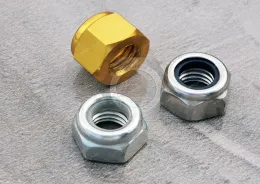
JUXIN FASTENERS supplies nylon-insert locking nuts for industrial OEM applications, including carbon-steel, stainless-steel,
aluminum and titanium configurations where appropriate to the customer drawing and application.
Typical applications can include:
HVAC air handling units
Ventilation equipment
Fan assemblies
Motor mounting
Equipment enclosures
Electrical equipment
Commercial food-service equipment
Refrigeration equipment
Industrial machinery
Automotive assemblies
Rail-related equipment
Light structural equipment
Repeated-service assemblies
The central engineering principle is:
A nylon-insert lock nut provides prevailing torque. It does not absorb vibration and it does not replace correct bolted-joint design.
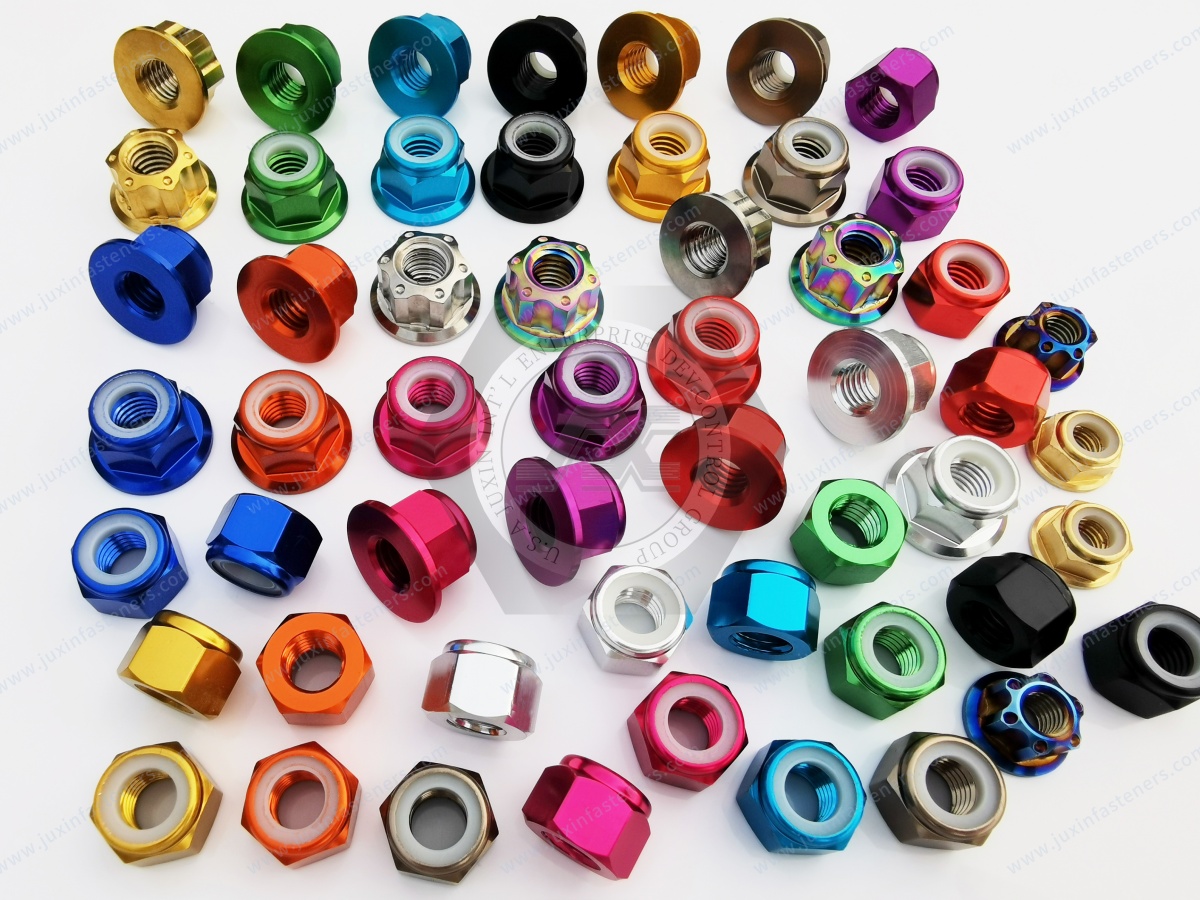
A nylon-insert lock nut contains a polymer locking element retained in the upper portion of the nut.
As the mating bolt enters the polymer insert, the bolt thread forms an interference relationship with the insert.
This creates resistance to rotation known as:
Prevailing torque
Prevailing torque exists independently from the final bearing condition of the assembled joint.
That makes the nut fundamentally different from a conventional free-running hex nut.
The terms are sometimes confused.
A nylon insert does not function like:
Rubber vibration isolation
Elastomeric damping
Spring suspension
Structural vibration absorber
It does not absorb the vibration produced by an HVAC fan or motor.
Instead, the polymer insert creates frictional resistance to rotation between the nut and mating bolt.
Therefore:
Nylon-insert lock nut = prevailing-torque locking device
not:
Nylon-insert lock nut = vibration damper
This distinction matters when engineers diagnose a loosening joint.
Bolted joints in equipment such as:
Fans
Blowers
Pumps
Motors
Compressors
Conveyors
Machinery
can experience dynamic loading.
Self-loosening behavior can be influenced by relative movement within the joint, particularly when transverse movement reduces the frictional conditions that normally resist rotation.
The solution is not simply to specify a “stronger nut.”
Engineers should consider:
Initial preload
Joint stiffness
Bolt length
Bearing surfaces
Mating materials
External loading
Locking architecture
A prevailing-torque lock nut can add resistance to rotation, but the joint must still be designed correctly.
This is one of the most important distinctions in lock nut engineering.
A nylon-insert lock nut can resist free rotation.
But clamp load can still change because of:
Embedment
Joint settlement
Gasket relaxation
Plastic deformation
Thermal expansion
Creep in mating materials
Surface changes
Therefore:
Resistance to nut rotation and preservation of joint preload are related but different engineering problems.
A lock nut cannot compensate for every mechanism that reduces clamp load.
DIN 985 is one of the most recognized references associated with prevailing-torque hex nuts containing a non-metallic insert.
For projects specifying DIN 985 or a customer-controlled equivalent requirement, engineers and procurement teams should still confirm:
Thread
Dimensions
Nut material
Mechanical requirements
Insert material
Surface finish
Mating bolt
Application temperature
Required prevailing-torque behavior
The standard designation should not replace the complete project specification.
A procurement request that says:
“M6 nyloc nut”
does not necessarily provide enough information for OEM sourcing.
A better request may define:
M6 × 1.0 + DIN 985 + Material + Finish + Mating Bolt + Quantity
and any project-specific requirements.
This reduces the risk of receiving a visually similar lock nut with different:
Nut height
Insert geometry
Material
Coating
Mechanical properties
Assembly behavior
Two nuts can both be:
M6 × 1.0 nylon-insert lock nuts
and still differ in:
Nut height
Across-flats dimension
Insert geometry
Material
Finish
Mechanical requirement
Prevailing-torque behavior
For replacement or alternate-source projects, thread size alone is not enough.
HVAC systems can contain:
Air handling units
Ventilation fans
Fan-coil units
Motor assemblies
Blower assemblies
Filter housings
Dampers
Control enclosures
Refrigeration equipment
Equipment frames
Different fastener locations can have very different service conditions.
A nylon-insert lock nut may be appropriate in one area while an all-metal lock nut is more suitable elsewhere.
The equipment should therefore be divided by fastening environment rather than treated as one generic HVAC application.
Fan and motor areas can experience:
Vibration
Repeated starting and stopping
Dynamic loading
Service maintenance
A nylon-insert lock nut may provide useful prevailing torque where the temperature and other environmental conditions are compatible with the polymer insert.
But the complete joint still needs appropriate preload and structural stiffness.
Some HVAC components require periodic:
Filter replacement
Inspection
Motor service
Belt service
Cleaning
Where a threaded lock nut is repeatedly removed, service-cycle requirements should be considered.
A nylon-insert lock nut should not automatically be assumed to retain identical prevailing torque indefinitely after repeated reuse.
Areas near:
Heating elements
Hot-air sections
Commercial cooking equipment
Exhaust systems
may expose the locking insert to elevated temperatures.
This changes the selection process.
The relevant question becomes:
Is the polymer locking element suitable for the actual temperature and exposure duration?
If not, an all-metal prevailing-torque lock nut may be more appropriate.
Polymer properties are temperature dependent.
The usable temperature of a nylon-insert lock nut cannot be defined responsibly from the nut body alone.
Engineers should consider:
Polymer grade
Continuous operating temperature
Peak temperature
Exposure duration
Thermal cycling
Mechanical load
Required prevailing torque
Therefore, JUXIN FASTENERS does not apply one universal temperature range to every nylon-insert lock nut configuration.
A nut exposed briefly to a temperature spike is not experiencing the same condition as a nut operating continuously at that temperature.
An engineering specification should distinguish between:
Continuous Operating Temperature
and:
Short-Duration Peak Temperature
when temperature is critical.
This provides much more useful information than simply writing:
“Maximum temperature: X°C.”
An all-metal prevailing-torque lock nut may be considered where:
Operating temperature makes polymer inserts unsuitable
The customer drawing specifies all-metal locking
The application prohibits polymer locking elements
The OEM has a validated all-metal joint architecture
This does not mean all-metal lock nuts are automatically superior.
They have different:
Friction characteristics
Thread interaction
Assembly torque behavior
Galling considerations
Reuse behavior
The locking technology should follow the application.
| Selection Factor | Nylon-Insert Lock Nut | All-Metal Prevailing-Torque Lock Nut |
|---|---|---|
| Locking mechanism | Polymer interference | Metallic locking feature |
| Prevailing torque | Yes | Yes |
| Polymer component | Yes | No |
| Elevated-temperature suitability | Polymer limits must be reviewed | Often considered where polymer is unsuitable |
| Mating-thread interaction | Polymer-to-thread interference | Metal-to-metal locking interaction |
| Reuse | Must be evaluated | Must be evaluated |
| Stainless galling considerations | Still relevant | Particularly important in some metal-to-metal configurations |
| Typical selection driver | General industrial prevailing torque | All-metal or elevated-temperature requirement |
Neither architecture should be described as universally better.
Prevailing torque and tightening torque are not interchangeable.
When installing a nylon-insert lock nut, applied torque is influenced by:
Thread friction
Polymer prevailing torque
Bearing friction
Torque required to stretch the bolt and develop preload
Therefore:
Applied installation torque ≠ prevailing torque
and:
Prevailing torque ≠ clamp load
These quantities should remain separate in engineering discussions.
Suppose an assembly originally uses a free-running nut.
The OEM changes it to a nylon-insert lock nut but leaves the tightening tool at exactly the same torque setting.
The resulting clamp load may change because part of the applied torque is now used to overcome the polymer locking resistance.
This matters in:
Automated screwdriving
Torque-controlled assembly
Production-line substitutions
Alternate supplier qualification
Do not change nut architecture without reviewing the assembly process.
A nylon-insert lock nut cannot be evaluated independently from its mating bolt.
The interaction can be influenced by:
Thread size
Thread pitch
Bolt material
Bolt strength
Bolt coating
Thread surface condition
Thread damage
This is why supplier qualification should not evaluate only the nut.
For a controlled OEM application, procurement teams should ideally provide:
Nut Drawing + Mating Bolt Specification
rather than only:
“Quote M8 DIN 985.”
This becomes particularly useful when prevailing-torque requirements are part of the acceptance criteria.
Carbon-steel nylon lock nuts are widely applicable across general industrial equipment.
The required mechanical properties and surface finish should follow:
Customer drawing
Mating bolt
Joint requirement
Environmental exposure
Applicable specification
Protective finishes may be specified according to the application.
The coating should not be treated only as a color requirement because surface condition can affect assembly friction.
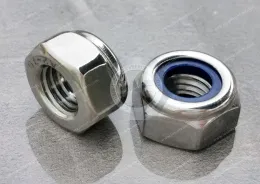
JUXIN FASTENERS supplies stainless steel nylon-insert lock nuts for appropriate OEM and industrial applications.
Potential uses can include:
HVAC equipment
Food-service equipment
Electrical equipment
Outdoor equipment
Machinery
Equipment enclosures
Stainless material selection should follow the actual corrosion environment and customer specification.
A stainless lock nut should not automatically be described as immune to corrosion.
304- and 316-family stainless materials may be considered depending on the project requirement.
Selection should account for:
Environmental exposure
Chlorides
Cleaning chemicals
Temperature
Mating material
Customer drawing
316-family stainless can provide advantages in some corrosive environments, but it is not automatically required for every humid or washdown application.
Galling can occur in stainless threaded assemblies.
Factors can include:
Nut material
Bolt material
Surface finish
Thread fit
Installation speed
Lubrication
Applied load
Using a nylon-insert nut does not make galling physically impossible.
The metallic nut thread still engages the metallic bolt thread before and during final tightening.
It is tempting to assume that because the locking element is polymer, the thread pair is protected from metal-to-metal galling.
That is incorrect.
The normal internal nut threads still engage the bolt.
Therefore, stainless-to-stainless applications should still evaluate galling risk.
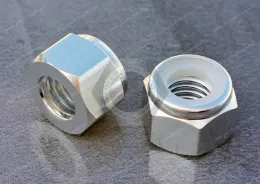
JUXIN FASTENERS can supply aluminum nylon-insert lock nut configurations for appropriate applications.
Potential reasons for selecting aluminum can include:
Weight reduction
Material compatibility
Customer-specific equipment requirements
However, aluminum nut selection should consider:
Mating bolt material
Thread strength
Required preload
Galvanic compatibility
Service environment
Lightweight does not automatically mean suitable for a highly loaded joint.
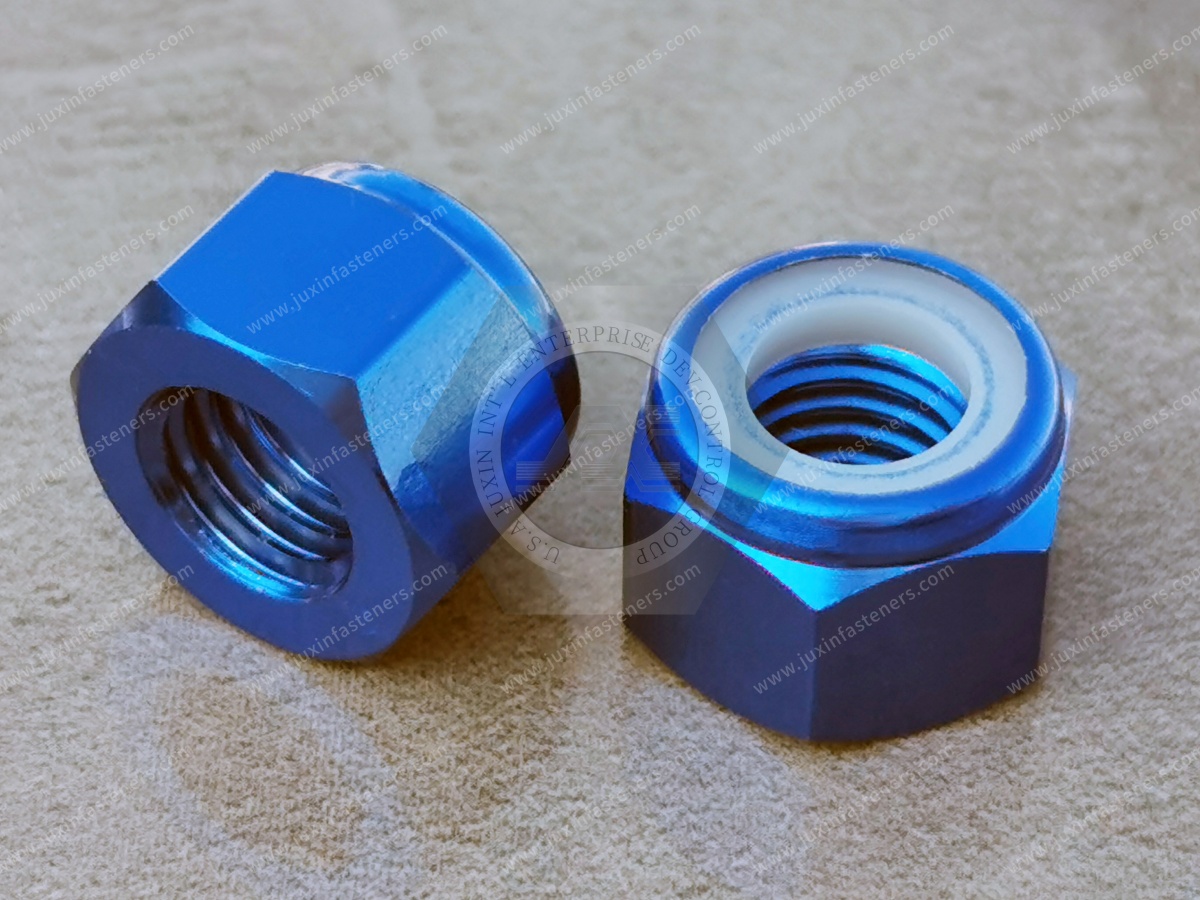
Titanium nylon-insert lock nuts can be considered for specialized applications requiring a combination of:
Low mass
Corrosion resistance
Customer-specified titanium hardware
But titanium should not be specified simply because it is perceived as a premium material.
The complete joint should justify the material.
Consider:
Mating fastener
Required load
Thread behavior
Cost
Environment
Galling
OEM specification
For the same thread size, a project may potentially use:
Carbon steel
Stainless steel
Aluminum
Titanium
These materials have very different:
Strength
Weight
Corrosion behavior
Cost
Thread interaction
Galvanic behavior
Therefore:
Material should follow the joint requirement, not the marketing hierarchy of the material.
The locking element is commonly a polyamide-based material in many nylon-insert lock nut designs.
But the exact polymer requirement should be controlled when its properties are important.
Relevant factors can include:
Temperature
Moisture
Chemical exposure
Aging
Required prevailing torque
JUXIN FASTENERS should not describe every insert as “100% virgin nylon” unless that requirement is actually specified and verified for the supplied product.
Procurement specifications often define the metallic nut carefully while describing the insert simply as:
“nylon.”
For demanding applications, this can be incomplete.
The polymer insert is the component creating the locking effect.
Where environmental exposure matters, the insert deserves the same engineering attention as the metal body.
HVAC and ventilation systems can operate in humid environments.
Moisture can influence both:
Metallic corrosion
Polymer behavior
The actual effect depends on material and exposure.
Therefore, the environment should be considered when defining long-term locking performance.
Nylon-insert lock nuts used in:
Food equipment
Cleaning equipment
Industrial machinery
HVAC systems
may encounter oils, detergents, cleaners or other chemicals.
Chemical compatibility should be evaluated against the actual substance.
Do not assume that a generic nylon insert is universally resistant to every chemical environment.
Carbon-steel lock nuts may use customer-specified protective coatings.
Possible requirements can address:
Corrosion resistance
Appearance
Friction
Compatibility with mating hardware
Where zinc, zinc-nickel or another coating is required, the drawing or purchase specification should define the expected system.
JUXIN FASTENERS should not attach one universal salt-spray rating to every plated nylon-insert lock nut.
Where a customer specifies ASTM B117 testing, the RFQ should include:
Coating system
Required test duration
White corrosion criteria where applicable
Red corrosion criteria where applicable
Acceptance method
ASTM B117 is a laboratory test method.
Its duration should not be presented as a direct prediction of equipment service life.
The word HVAC covers many environments.
An indoor control cabinet and an outdoor condensing unit do not have the same corrosion exposure.
Therefore:
Application Location → Environment → Material/Finish
is a better selection sequence than:
HVAC → Zinc-Nickel
This prevents unnecessary cost and inappropriate specification.
Nylon-insert lock nuts are often removed during equipment maintenance.
However, prevailing torque can change with repeated installation and removal.
The amount of change can depend on:
Polymer
Thread condition
Temperature
Bolt coating
Installation history
Contamination
Therefore, the word:
“Reusable”
should not be treated as unlimited reuse.
Instead of asking:
“Can this nylon lock nut be reused?”
define:
Number of installation/removal cycles
Required prevailing torque after each cycle
Mating bolt
Assembly conditions
That converts a vague expectation into a measurable engineering requirement.
ISO 2320 is relevant to specified prevailing-torque type steel nuts and their functional properties within its applicable scope.
Where an OEM drawing or purchase specification references ISO 2320, the exact product and test requirements should be reviewed.
JUXIN FASTENERS should not claim that every nylon-insert lock nut automatically complies with ISO 2320 simply because it contains a polymer locking element.
The required standard should be identified during RFQ review.
Customers may specify transverse-vibration or other joint testing for vibration-sensitive applications.
A defined test can provide useful comparative information.
However, a laboratory test result applies to the defined test configuration.
It should not be interpreted as proof that a nut will never loosen in every HVAC, fan or machinery joint.
Actual joint performance depends on the complete assembly.
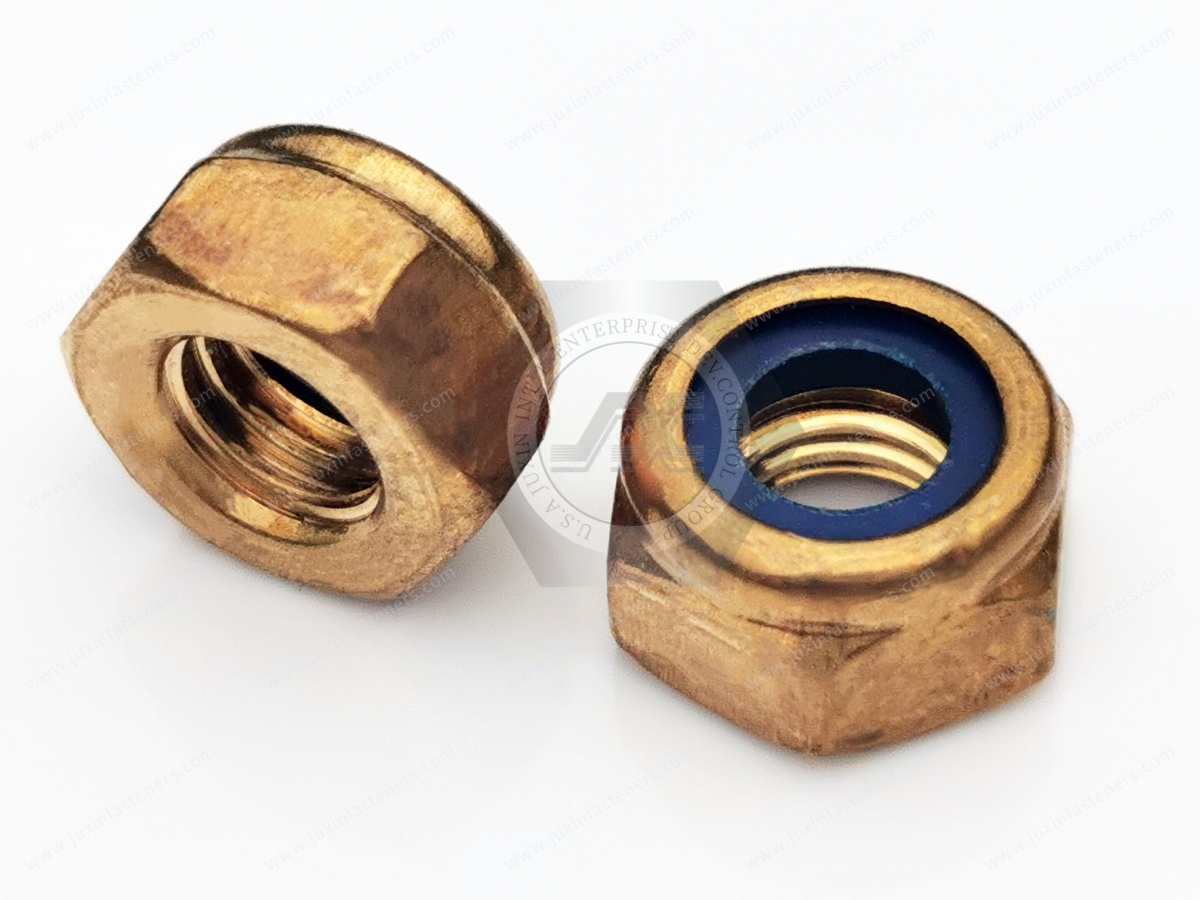
A standard hex nut can be suitable where the joint does not require prevailing torque.
A nylon-insert lock nut adds a polymer locking element.
This can be useful where the OEM wants resistance to free nut rotation.
But it also adds:
Prevailing torque
Polymer temperature considerations
Reuse considerations
Additional assembly friction
The locking feature should be specified because it is needed, not simply because it appears safer.
This is one of the most common sourcing decisions.
Choose based on:
Temperature
Environmental exposure
Mating thread
Assembly process
OEM specification
Reuse expectations
Material compatibility
Do not make the decision based only on:
“All-metal is stronger.”
That oversimplifies the joint.
These two products create resistance through different mechanisms.
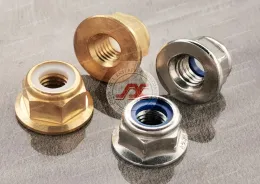
Creates prevailing torque through polymer-to-thread interference.
Uses serrations at the bearing interface.
The serrated flange can also affect:
Surface coating
Friction
Surface marking
The products should not be treated as interchangeable simply because both are marketed as locking nuts.
Threadlocking compounds provide another method of controlling unwanted thread movement.
The choice can depend on:
Assembly process
Cure requirements
Maintenance
Contamination
Temperature
Production volume
A nylon-insert lock nut integrates the locking element into the nut itself.
That can simplify some production environments, but the correct method remains application dependent.
Lock washers and prevailing-torque nuts use different mechanical principles.
The correct architecture depends on the joint.
A designer should not automatically stack multiple locking devices without understanding how each affects:
Bearing surface
Friction
Joint stiffness
Assembly torque
More locking components do not automatically create a better joint.
Consider:
Nylon Lock Nut + Serrated Washer + Threadlocker
This may appear extremely secure.
But adding multiple friction-changing components can also complicate:
Torque control
Service
Disassembly
Surface condition
Process repeatability
The objective is not maximum locking features.
The objective is a controlled joint.
The mating bolt should provide sufficient thread engagement for the nut and locking insert to function as intended.
The exact requirement depends on the joint design and applicable specification.
Engineers should avoid a condition where the bolt engages only part of the nut but does not properly engage the locking insert.
This is especially important when changing:
Nut height
Washer thickness
Bracket thickness
Bolt length
This sounds obvious, but it is an important assembly check.
If the bolt is too short to engage the polymer insert properly, the assembly may look complete while the intended prevailing-torque feature is not fully functioning.
Therefore, bolt length should be reviewed whenever the nut architecture changes.
Damaged or heavily burred bolt ends can damage the polymer insert during initial installation.
For reliable assembly, consider:
Thread condition
Lead-in
Coating buildup
Burrs
Damage from handling
A locking nut cannot compensate for a defective mating thread.
Nylon-insert lock nuts may be used in automated or semi-automated assembly.
Production engineers should consider:
Nut feeding
Orientation
Driver speed
Torque strategy
Bolt alignment
Cross-thread prevention
Prevailing-torque variation
For high-volume OEM applications, assembly behavior can be as important as dimensional conformity.
A lock nut can be dimensionally correct and still perform poorly if:
Bolt alignment is incorrect
Driver speed is unsuitable
Mating threads are damaged
Torque settings are copied from a free-running nut
The bolt does not engage the insert sufficiently
Supplier qualification should therefore include actual assembly evaluation where the joint is critical.
Consider a fan motor mounted to a steel bracket.
The joint may experience:
Motor vibration
Start/stop cycles
Temperature changes
Service removal
An engineer selecting a nylon-insert lock nut should review:
Bolt size
Bolt material
Bracket geometry
Required preload
Operating temperature
Vibration environment
Maintenance frequency
Corrosion environment
Tightening method
The application cannot be reduced to:
“Use a vibration-proof nyloc nut.”
An electrical enclosure may use nylon-insert lock nuts for:
Internal brackets
Fan assemblies
Cable supports
Equipment mounting
But a removable outer access panel may be better served by:
Captive panel screw architecture
Self-clinching hardware
Cage nuts
Other service-oriented fastening methods
Fastener selection should follow the function of each joint.
Design engineers should review the application in this order:
Define diameter and pitch.
DIN 985 or another controlled specification where required.
Define material, strength and finish.
Determine required preload and locking function.
Review continuous and peak exposure.
Dry, humid, outdoor, chemical exposure or washdown.
Carbon steel, stainless steel, aluminum, titanium or customer-specified material.
Define coating where required.
Specify service-cycle expectations.
Define prevailing-torque, corrosion, vibration or assembly tests where necessary.
This is a more reliable selection process than choosing from thread size alone.
For efficient technical review and quotation, provide:
Nut type
DIN 985 or drawing reference where applicable
Thread size
Thread pitch
Metric or inch thread
Nut material
Required mechanical properties where specified
Mating bolt material
Mating bolt finish
Surface finish
Insert requirement where controlled
Continuous operating temperature
Peak temperature where relevant
Corrosion environment
Chemical exposure where relevant
Prevailing-torque requirement where specified
Reuse-cycle requirement where specified
Vibration-test requirement where specified
Prototype quantity
Annual quantity
Packaging requirement
For OEM replacement parts, send the controlled 2D drawing whenever possible.
Do not compare only:
M8 DIN 985 + stainless + price.
Compare:
Standard or drawing
Nut dimensions
Thread
Nut material
Insert specification
Surface finish
Mating bolt
Prevailing-torque requirement
Temperature requirement
Reuse requirement
Inspection criteria
Sample approval
Production consistency
A visually identical lock nut is not necessarily a functionally identical lock nut.
For an existing OEM nylon lock nut, a practical supplier-development path can follow:
Existing Part Review → Drawing Review → Mating Bolt Review → Material & Insert Requirement → Surface Finish
→ Sample → Assembly Evaluation → Required Prevailing-Torque Validation → Golden Sample Approval → Production
Where the OEM specifies:
ISO 2320 testing
Reuse testing
Corrosion testing
Vibration testing
Torque requirements
the applicable test method and acceptance criteria should be confirmed before validation.
Standard DIN 985 configurations cover many applications.
Some OEM projects may require:
Special material
Special finish
Non-standard thread
Special nut height
Custom external geometry
Special insert requirement
Special packaging
Drawing-controlled dimensions
JUXIN FASTENERS can review drawing-based nylon-insert lock nut requirements against actual manufacturing capability.
For OEM-specific or custom locking nut projects, JUXIN FASTENERS can follow a structured approval path:
Application Requirement → Nut & Mating Bolt Review → Drawing Confirmation → Material / Insert / Finish Review
→ Sample → Assembly Evaluation → Required Functional Validation → Golden Sample Approval → Production
The objective is not merely to match the appearance of the original nut.
The objective is to match the required dimensional and functional interface with the customer's mating bolt and assembly process.
This page should connect directly to the JUXIN FASTENERS locking-fastener knowledge cluster.
Related solutions include:
All-Metal Prevailing-Torque Lock Nuts for High-Vibration Industrial Assemblies — when an all-metal locking architecture is required
Lock Nuts & Flange Lock Nuts for Food and Agricultural Machinery — application-level selection across nylon-insert, all-metal and flange locking systems
Fuji-Style All-Metal Flange Lock Nuts — all-metal flange locking for drawing-controlled OEM applications
Self-Clinching Fasteners for Telecom Cabinets & AI Data Center Enclosures — permanent thin-sheet threaded attachment
Blind Rivet Nuts for Sheet Metal Enclosures & One-Sided Assembly — blind-side female threads
Captive Panel Screws & Retained Fasteners for Serviceable Equipment Panels — retained hardware for frequently serviced panels
The internal decision path should be:
Need polymer prevailing torque → Nylon-Insert Lock Nut
Need all-metal prevailing torque → All-Metal Lock Nut
Need locking + integrated flange → Flange Lock Nut / Fuji-Style Lock Nut
Need permanent female thread in thin sheet → Self-Clinching Nut
Need blind-side female thread → Rivet Nut
Need screw retained with removable panel → Captive Panel Fastening
This gives engineers a functional path instead of forcing them to browse unrelated fastener categories.
If you are sourcing nylon-insert lock nuts for:
HVAC equipment
Ventilation equipment
Fan assemblies
Motors
Pumps
Equipment enclosures
Electrical equipment
Food-service equipment
Refrigeration systems
Industrial machinery
Automotive equipment
Rail-related assemblies
send us:
Drawing / Standard + Thread + Nut Material + Mating Bolt + Finish + Temperature + Environment + Quantity
For stainless assemblies, include the mating bolt material and finish where possible.
For repeated-service applications, specify the required installation/removal cycle expectation.
For controlled prevailing-torque applications, include the test requirement and acceptance criteria.
JUXIN FASTENERS can review requirements for:
DIN 985 nylon-insert lock nuts
Carbon-steel nylon-insert lock nuts
Stainless steel nylon-insert lock nuts
Aluminum nylon-insert lock nuts
Titanium nylon-insert lock nuts
Metric nylon lock nuts
Inch-thread nylon lock nuts
Drawing-based OEM nylon-insert locking nuts
A nylon-insert lock nut should not be selected because it is described as “vibration-proof.”
It should be selected because its prevailing-torque architecture, material, polymer insert, mating bolt, temperature range and assembly behavior fit the actual joint.
JUXIN FASTENERS
Website: www.juxinfasteners.com
Engineering & RFQ: info@juxinfasteners.com
Product Packaging
Packaging Standard
At Juxin Fasteners, we apply standardized export packaging to ensure product protection, traceability, and compliance with international logistics requirements.
1. Standard Export Packaging
Unless otherwise specified, all products will be packed according to our factory standard export packaging, which includes:
Moisture-resistant inner protection
Poly bag or small box packing as required
Reinforced export cartons
Clear labeling with part number, specification, batch number, and quantity
Palletizing for sea or air shipment when necessary
Our standard packaging is designed to ensure safe transportation, efficient warehousing, and long-distance international shipping.
2. Customized Packaging Options
We also provide customized packaging solutions according to customer requirements, including but not limited to:
Private labeling
Customized barcodes
Specific carton dimensions
Retail packaging
Special pallet configuration
Customer-specific marking and identification
So that you know, customized packaging may involve additional costs and extended lead time depending on the complexity of the requirements.
3. Compliance & Quality Assurance
All packaging processes are controlled under our ISO 9001 quality management system to ensure consistency, traceability, and product integrity throughout the supply chain.
Product Pictures
Hot Products
Contact Us
Tel.:
+86 020 8621 0320
+86 020 3121 6067
E-mail:
Technical Support:
Navigation
SEND INQUIREY