Call Us
+86 136 6007 9809
Call Us
+86 136 6007 9809

Stainless Steel Large Flange Blind Rivets
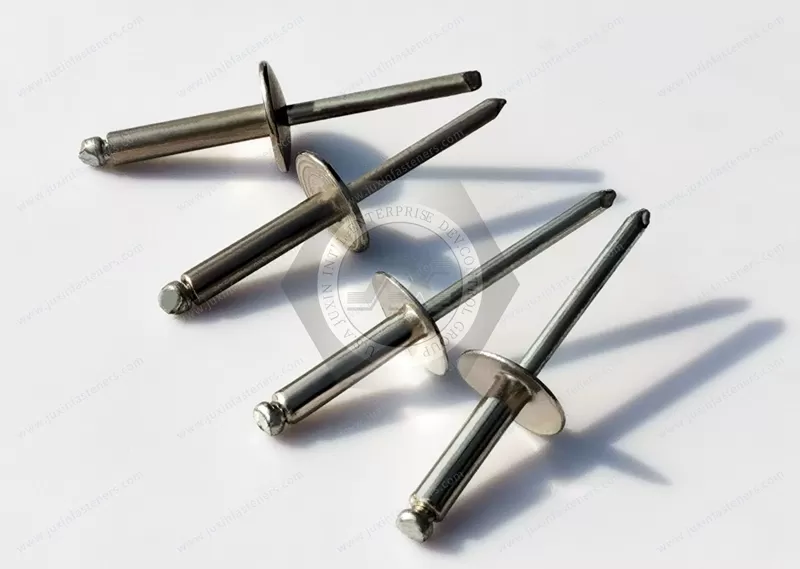
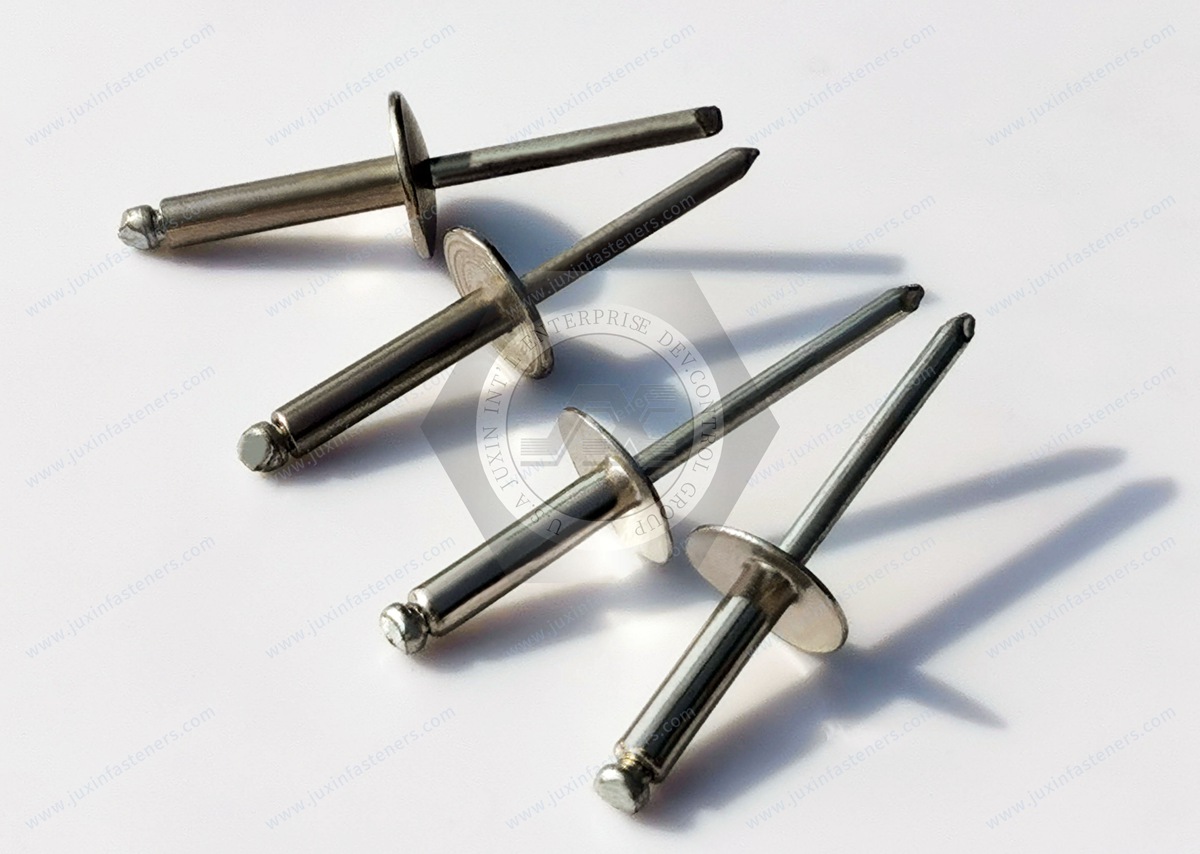
JUXIN FASTENERS supplies open-end large flange blind rivets with stainless steel bodies and either stainless steel or steel mandrels.
The enlarged dome head provides a wider bearing surface for compatible thin-sheet and panel assemblies.
Designed for one-sided installation, these rivets are suitable for OEM equipment enclosures, machinery panels and industrial assemblies where head-side support and material compatibility are important.
Product Specification
Stainless Steel Open-End Large Flange Blind Rivets
Product Overview
JUXIN FASTENERS supplies stainless steel open-end large flange blind rivets for industrial sheet-metal fastening, equipment manufacturing and OEM assembly applications.
These blind rivets feature a stainless steel rivet body and an enlarged dome head, with stainless steel or steel pull mandrel options.
The large flange, also described as a wide flange or large head, provides a wider bearing surface against the accessible side of the joined material than a comparable standard dome head.
This design can be useful where head-side load distribution, thin-panel support and one-sided installation are important engineering requirements.
Unlike conventional two-sided solid riveting, blind riveting allows installation when the rear side of the assembly cannot be reached by a second installation tool.
Material Configurations
| Configuration | Rivet Body | Pull Mandrel | Head Style |
|---|---|---|---|
| A | Stainless Steel | Stainless Steel | Large Flange Dome Head |
| B | Stainless Steel | Steel | Large Flange Dome Head |
Configuration A — Stainless Steel Body + Stainless Steel Mandrel
This version uses stainless steel for both the rivet body and pull mandrel.
It may be considered where the customer specifies stainless steel components for material compatibility or corrosion-related design requirements.
Actual performance depends on the stainless steel grades, surface conditions, mating materials and operating environment.
Configuration B — Stainless Steel Body + Steel Mandrel
This version uses a stainless steel rivet body with a steel pull mandrel.
The mandrel material and finish should be evaluated according to the required installation characteristics, mechanical performance and service environment.
This configuration must not be described as an all-stainless-steel blind rivet.
Material Grade Clarification
The existing product description refers to 18-8 stainless steel.
However, the exact stainless steel grade and its applicability to each component must be confirmed from the approved drawing or material specification.
The designation 18-8 should not automatically be treated as proof of a specific ASTM, EN or ISO material grade.
Stainless steel may also exhibit magnetic behavior depending on grade and processing condition. Neither configuration should be assumed to be nonmagnetic.
Product Features
Stainless steel rivet body
Stainless steel or steel pull mandrel options
Large flange dome head
Open-end blind rivet construction
One-sided installation
Wider head-side bearing contact
Suitable for compatible thin-sheet and panel assemblies
Corrosion suitability dependent on material grade and environment
OEM drawing-based dimensional requirements subject to technical review
Technical Specifications
| Parameter | Specification |
|---|---|
| Product Type | Open-End Blind Rivet |
| Head Style | Large Flange Dome Head |
| Rivet Body Material | Stainless Steel |
| Mandrel Material | Stainless Steel or Steel |
| Stainless Steel Grade | To be confirmed |
| Rivet Body Diameter (d) | Refer to original PDF/CAD |
| Rivet Body Length (L) | Refer to original PDF/CAD |
| Large Flange Diameter (D) | Refer to original PDF/CAD |
| Flange Head Height (H) | Refer to original PDF/CAD |
| Recommended Hole Diameter | According to selected rivet size |
| Minimum Grip Thickness | According to selected rivet size |
| Maximum Grip Thickness | According to selected rivet size |
| Shear Strength | According to verified product data |
| Tensile Strength | According to verified product data |
| Surface Finish | According to approved specification |
Technical Documentation
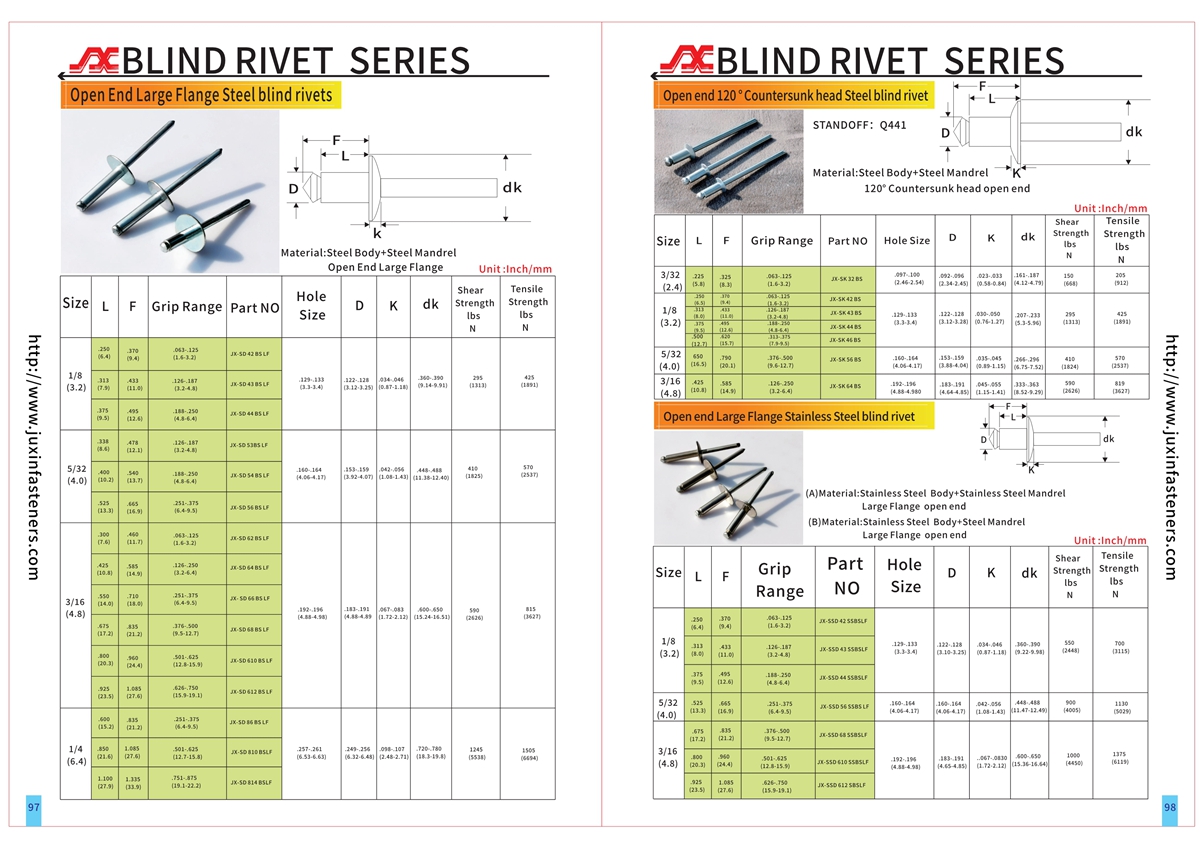
Refer to the existing JUXIN product PDF/CAD specification, pages 97–98.
The original engineering drawing and dimensional tables govern the actual sizes, tolerances, material requirements and mechanical performance values.
Large Flange Head — Engineering Function and Bearing Area
The enlarged flange is the defining head feature of this product.
Compared with a standard dome head of the same nominal rivet body diameter, a larger flange provides additional contact area against the accessible panel.
For a given head-side force, a larger effective bearing area can reduce average contact pressure.
This is particularly relevant where the panel material is relatively thin, soft or susceptible to localized deformation.
The actual benefit depends on the complete joint design.
Important parameters include:
Flange outside diameter
Rivet body diameter
Head height and profile
Panel thickness
Panel material and stiffness
Mounting-hole diameter
Rivet spacing and edge distance
Direction and magnitude of applied loads
A large flange does not automatically increase the rivet's rated shear or tensile strength.
The original product description mentions a head diameter approximately 50% larger than a standard dome head. This dimensional comparison must be verified before it is used as a confirmed product specification.
Large Flange vs. Standard Dome Head Blind Rivets
| Engineering Factor | Large Flange Blind Rivet | Standard Dome Head Blind Rivet |
|---|---|---|
| Head Bearing Area | Enlarged | Conventional |
| Head Projection | Protruding | Protruding |
| Main Design Benefit | Wider head-side support | General fastening |
| Thin-Panel Consideration | May improve bearing distribution | Requires evaluation of standard head support |
| Hole Coverage | Potentially greater | More limited |
| Main Verification | Flange diameter, hole geometry and panel support | Head geometry, hole fit and joint performance |
The two head styles should not be substituted without reviewing the application requirements.
Thin Sheet Metal, Soft Materials and Hole Coverage
Large flange stainless steel blind rivets may be considered when joining thin metal panels or compatible materials with relatively low local bearing strength.
The enlarged head can help distribute the applied head-side force across a wider area.
For example, a thin stainless steel cover panel may be fastened to a supporting frame where access is available from only one side.
In this application, the engineer should verify:
Panel thickness
Mounting-hole diameter
Flange overlap
Material stack-up
Blind-side retaining formation
Local panel deformation
Required joint strength
A large flange may also cover some nonstandard openings, but visible coverage does not guarantee an acceptable mechanical joint.
Oversized or irregular holes require engineering evaluation of rivet body support, flange overlap and installed performance.
Grip Range and Material Stack-Up
Grip range is the combined thickness of the materials that a selected blind rivet is designed to fasten.
The total material stack-up must fall within the rivet's specified minimum and maximum grip thickness.
Rivet body length and grip range are different parameters.
For OEM selection, evaluate:
Minimum and maximum assembly thickness
Rivet body diameter
Rivet body length
Mounting-hole diameter
Large flange dimensions
Blind-side clearance
Panel material properties
Required joint performance
This product is identified as an open-end large flange blind rivet.
It should not be classified as a multi-grip rivet unless the original product documentation confirms that design.
Metric and Inch Diameter Reference
Common nominal blind rivet diameter references include:
| Metric Diameter | Approximate Inch Reference |
|---|---|
| 2.4 mm | 3/32 in |
| 3.2 mm | 1/8 in |
| 4.0 mm | 5/32 in |
| 4.8 mm | 3/16 in |
| 6.4 mm | 1/4 in |
These are general nominal references, not a confirmed list of available sizes for this JUXIN product.
Metric and inch-designated blind rivets must be checked for actual dimensions, tolerances, grip ranges and mounting-hole compatibility before substitution.
Stainless Steel Material Selection and Corrosion Considerations
Stainless steel is commonly selected for industrial fastening applications where corrosion resistance and material compatibility are important.
However, stainless steel performance varies by grade and service environment.
Important factors include:
Stainless steel alloy grade
Mandrel material
Surface condition
Mating panel material
Chloride exposure
Moisture and condensation
Cleaning chemicals
Temperature and service conditions
Where stainless steel contacts aluminum or other dissimilar metals, galvanic corrosion should be evaluated under the expected environmental conditions.
Stainless steel is not universally immune to corrosion.
For marine, outdoor, food-processing or chemically exposed equipment, the customer should specify the required material grade and environmental performance.
No salt spray rating, corrosion lifetime or chemical compatibility is claimed without verified supporting data.
Installation Method
These large flange open-end blind rivets require a compatible blind riveting tool and nosepiece.
A typical installation process is:
Prepare the mounting holes according to the approved drawing.
Confirm the combined material thickness is within the selected rivet's grip range.
Align the components to be joined.
Insert the rivet through the prepared holes.
Seat the large flange against the accessible panel.
Engage the mandrel using the compatible riveting tool.
Pull the mandrel to deform the rivet body on the blind side.
Complete the setting operation at the designed mandrel break point.
Inspect the flange seating and installed joint condition.
The tool must be compatible with the selected rivet diameter, mandrel material and setting requirements.
Installation Quality and Common Failure Risks
| Potential Problem | Engineering Check |
|---|---|
| Rivet does not set correctly | Verify grip range and installation tooling |
| Flange does not seat evenly | Check hole alignment, burrs and panel flatness |
| Panel deforms around the head | Review flange bearing area and panel stiffness |
| Loose or inconsistent joint | Check hole diameter, grip selection and setting process |
| Premature corrosion | Review material grades, mandrel finish and environment |
| Incorrect rivet selection | Verify part number, material combination and drawing |
For production approval, installation conditions should be validated using the actual assembly materials and selected rivet configuration.
Industrial Applications & Engineering Fastening Solutions
Large flange stainless steel blind rivets can serve different industrial applications when the selected material grade, rivet dimensions, joint design and installation requirements are suitable.
The following examples describe potential engineering uses rather than certified application approvals.
1. Container Manufacturing — Metal Panels and Equipment Compartments
Container manufacturing may involve sheet-metal panels, internal fittings, equipment compartments and noncritical accessory connections.
Large flange blind rivets may be considered where one-sided installation is necessary and a wider head-side bearing surface is beneficial.
For outdoor containers, engineers should evaluate stainless steel grade, moisture exposure, dissimilar-metal contact and the required joint loading.
Structural container joints must follow their own approved design and qualification requirements.
2. AI Data Center Cabinet Manufacturing — Server Racks and Cooling Equipment Enclosures
AI data center infrastructure uses metal cabinets, server racks, electrical enclosures and liquid-cooling equipment housings.
Large flange stainless steel blind rivets may be considered for compatible enclosure covers, auxiliary brackets and sheet-metal panels.
The wider flange may be useful where thin metal panels require additional head-side support.
Engineers should check electrical bonding requirements, panel thickness, installation access and any restrictions on loose particles or retained mandrel components.
Blind rivets should not be assumed to provide electrical continuity or liquid-tight sealing.
3. Electrical Power Equipment Manufacturing — Switchgear and Control Cabinets
Electrical equipment manufacturing includes switchgear housings, power distribution cabinets, control panels and equipment enclosures.
Large flange blind rivets may be suitable for approved nonconductive-function mechanical connections such as covers and supporting panels.
Design considerations include:
Sheet-metal thickness
Panel vibration
Head-side bearing support
Corrosion exposure
Electrical clearance
Grounding and bonding requirements
Mechanical fastening suitability must be evaluated separately from electrical safety requirements.
4. Telecommunications Equipment Manufacturing — Outdoor and Indoor Equipment Cabinets
Telecommunications equipment often requires metal housings, protective panels and mounting brackets.
Stainless steel large flange blind rivets may be considered for compatible panel assemblies requiring one-sided installation.
For outdoor telecommunications cabinets, material selection should consider humidity, coastal exposure and galvanic compatibility.
The joint must also meet the required enclosure protection and serviceability criteria.
5. Semiconductor Equipment Manufacturing — Equipment Covers and Auxiliary Panels
Semiconductor manufacturing equipment uses precision metal housings, covers and auxiliary sheet-metal components.
Large flange blind rivets may be considered for non-process-critical enclosure assemblies where permanent fastening is acceptable.
Engineering evaluation should include:
Particle generation requirements
Surface cleanliness
Material compatibility
Installation debris control
Maintenance access
Vibration and panel stability
Cleanroom or process-chamber suitability must not be assumed without specific qualification.
6. Medical Equipment Manufacturing — Instrument Enclosures and Equipment Panels
Medical equipment manufacturing may involve stainless steel housings, carts, instrument cabinets and auxiliary equipment covers.
Large flange stainless steel blind rivets may be considered for approved non-patient-contact mechanical assemblies.
The selection process should address:
Material traceability
Cleaning and disinfectant exposure
Surface condition
Accessibility for cleaning
Joint inspection
Product-specific regulatory and quality requirements
No medical-device approval, biocompatibility or sterilization compatibility is implied.
7. Food Processing Machinery Manufacturing — Stainless Steel Guards and Equipment Panels
Food machinery commonly uses stainless steel sheet-metal covers, guards and equipment housings.
Large flange stainless steel blind rivets may be considered for suitable non-product-contact assemblies.
The engineer should assess:
Cleaning chemical compatibility
Moisture exposure
Crevice formation
Hygienic design requirements
Accessibility for cleaning
Corrosion resistance of the mandrel configuration
Open-end blind rivets are not inherently sealed or hygienic fasteners.
For direct food-contact areas or high-hygiene zones, the fastener design and material must meet the applicable equipment requirements.
8. Marine Equipment Manufacturing — Auxiliary Housings and Panels
Marine equipment can expose fasteners to moisture, salt and dissimilar-metal contact.
Stainless steel large flange blind rivets may be considered for compatible auxiliary equipment housings, protective covers and noncritical panels.
The required stainless steel grade and mandrel material should be selected for the actual environment.
An unspecified 18-8 stainless steel designation is not sufficient evidence of suitability for severe chloride or seawater exposure.
9. Rail Transit Equipment Manufacturing — Interior and Auxiliary Equipment Assemblies
Rail transit equipment includes interior panels, electrical equipment cabinets and auxiliary enclosures.
Large flange blind rivets may be considered for noncritical components where one-sided fastening and head-side support are required.
Vibration, fatigue, fire and smoke requirements, material traceability and project-specific approvals must be evaluated where applicable.
No railway certification or approval for safety-critical joints is claimed.
10. Automotive Manufacturing — Body Accessories and Equipment Panels
Automotive OEM and Tier-1 manufacturing may require permanent fastening of approved sheet-metal accessories, brackets and equipment covers.
Large flange blind rivets can be evaluated where panel bearing support and limited rear-side access are design considerations.
Engineering requirements may include:
Vibration and fatigue performance
Material stack-up
Corrosion exposure
Installation consistency
Production inspection
Automotive-specific customer specifications
Suitability for crash-critical or other safety-critical automotive joints requires separate engineering validation.
11. Motorcycle, Bicycle and Racing Vehicle Manufacturing
Motorcycles, bicycles and racing vehicles use metal covers, guards, brackets and auxiliary assemblies.
Large flange blind rivets may be considered for suitable noncritical attachments where a wider bearing surface is beneficial.
For these applications, vibration, fatigue, weight, panel material and maintenance requirements are important.
They should not be assumed suitable for frames, braking systems, suspension components or other safety-critical structures without qualification.
12. HVAC Equipment Manufacturing — Thin Sheet-Metal Housings
HVAC manufacturing uses thin metal panels, fan housings, protective covers and equipment enclosures.
Large flange stainless steel blind rivets may be considered where wider head-side support and one-sided assembly are useful.
Selection should consider:
Sheet-metal thickness
Vibration
Condensation
Corrosion exposure
Air leakage requirements
Production installation efficiency
An open-end blind rivet is not inherently airtight or watertight.
13. Energy Equipment Manufacturing — Storage and Power Conversion Enclosures
Energy equipment includes battery storage cabinets, power conversion systems, renewable-energy equipment housings and industrial power cabinets.
Large flange blind rivets may be considered for compatible noncritical enclosure and panel connections.
The engineer should evaluate environmental exposure, electrical isolation, thermal movement, vibration and equipment safety requirements.
14. Electronics and Electrical Appliance Manufacturing
Electronics and appliance production may use thin sheet-metal panels, housings and supporting brackets.
Large flange blind rivets may be suitable where the assembly requires one-sided permanent fastening and a wider head bearing area.
The selection process should consider panel deformation, appearance, assembly tooling and electrical safety requirements.
15. Leisure Equipment and Outdoor Fencing Manufacturing
Leisure equipment and outdoor metal fencing may use thin metal panels, covers and auxiliary brackets.
Stainless steel large flange blind rivets can be evaluated where moisture exposure and wider head-side support are relevant.
For fencing and outdoor structures, engineers should confirm environmental compatibility, vandal resistance, load requirements and whether permanent blind riveting is appropriate.
16. Aerospace Equipment Manufacturing — Noncritical Auxiliary Assemblies
Aerospace-related equipment may include ground-support equipment, tooling cabinets, inspection fixtures and nonflight-critical enclosures.
Large flange stainless steel blind rivets may be considered for such assemblies only where the engineering specification permits them.
No aircraft structural, flight-critical or aerospace-qualified application is claimed.
Any use in regulated aerospace hardware requires the applicable drawing, material, traceability, testing and approval requirements.
Industry Application Selection Matrix
| Application Requirement | Engineering Consideration |
|---|---|
| Thin or relatively soft panel | Evaluate large flange bearing support |
| Limited rear-side access | Consider one-sided blind riveting |
| Humid or corrosive environment | Specify stainless steel grades and mandrel materials |
| Multiple panel thicknesses | Select the correct grip range for each assembly |
| Vibration exposure | Validate installed joint performance |
| Electrical enclosure | Verify bonding, grounding and clearance requirements |
| Hygienic equipment | Evaluate cleaning, crevices and material suitability |
| Safety-critical assembly | Require application-specific engineering qualification |
Production Engineering and Assembly Efficiency
For production managers and manufacturing engineers, large flange blind rivets can offer a practical fastening option where one-sided access and consistent head-side seating are required.
Important production considerations include:
Correct rivet diameter and length
Grip-range selection
Mounting-hole preparation
Compatible riveting tools
Consistent mandrel setting
Flange seating inspection
Blind-side formation
Material identification
Fastener packaging and handling
The appropriate configuration should be validated under actual production conditions before full-scale assembly.
Mechanical Performance and Joint Reliability
Shear strength and tensile strength are separate mechanical characteristics.
The actual performance of a large flange stainless steel blind rivet depends on:
Rivet body diameter
Stainless steel body grade
Mandrel material and grade
Grip thickness
Mounting-hole geometry
Large flange dimensions
Panel material and stiffness
Edge distance and rivet spacing
Installation quality
A larger flange may improve head-side bearing support in a suitable joint, but it does not automatically establish higher rivet shear or tensile strength.
For demanding OEM applications, the installed joint should be evaluated under the relevant loading and environmental conditions.
International Standards and Technical References
International blind rivet standards distinguish products according to construction, head geometry, rivet body material, mandrel material and dimensional requirements.
Large flange stainless steel blind rivets must be evaluated against the actual scope of any specified ISO, DIN, EN, ASTM or other applicable standard.
A standard covering a conventional dome head rivet does not automatically establish conformity for every enlarged-flange configuration.
The approved engineering drawing, material specification and agreed customer requirements remain the controlling references until compliance has been verified.
Inspection and Quality Requirements
Relevant inspection characteristics may include:
Rivet body diameter and length
Large flange diameter and head height
Stainless steel material grade
Mandrel material and dimensions
Surface condition
Recommended mounting-hole diameter
Grip range
Head seating
Blind-side formation
Mandrel break condition
Shear and tensile performance where specified
Corrosion requirements where specified
Packaging and traceability requirements
Inspection methods and acceptance criteria should follow the approved drawing and customer requirements.
OEM Procurement and Supplier Development Considerations
For purchasing managers, procurement development teams and supply chain managers, sourcing large flange stainless steel blind rivets requires more than matching the product name.
The technical RFQ should distinguish between:
Stainless steel body + stainless steel mandrel
Stainless steel body + steel mandrel
These are different material configurations and should not be treated as automatically interchangeable.
Procurement teams should also verify:
Actual stainless steel grades
Available diameter and length combinations
Large flange dimensions
Grip range
Required mechanical performance
Surface finish and corrosion requirements
Drawing revisions
Inspection and traceability requirements
Packaging specifications
Purchasing quantity and annual forecast
For alternative-source evaluation, compare the approved technical requirements rather than relying only on nominal rivet diameter or commercial descriptions.
Frequently Asked Questions
What is a stainless steel large flange blind rivet?
It is a blind rivet with a stainless steel body and an enlarged head that provides a wider bearing surface against the accessible panel.
What is the difference between large flange and standard dome head blind rivets?
A large flange rivet has a wider head-side contact area. The actual dimensional difference depends on the selected product.
Are stainless steel large flange blind rivets suitable for thin sheet metal?
They may be suitable where the wider bearing surface helps support the panel. Hole geometry, panel thickness and installed joint performance must still be verified.
What is the difference between stainless steel and steel mandrels?
The mandrel material differs, which can affect installation behavior, corrosion considerations and mechanical characteristics. Both configurations use stainless steel rivet bodies.
Are these blind rivets fully stainless steel?
Only the configuration with a stainless steel body and stainless steel mandrel is identified as using stainless steel for both components. Actual grades must still be confirmed.
Can large flange blind rivets be used in marine equipment?
Potentially, depending on the stainless steel grade, mandrel material, mating materials and environmental exposure. Marine suitability is not automatic.
Are open-end blind rivets watertight?
No. Open-end construction should not be assumed to provide a sealed or watertight joint.
Are these rivets suitable for food or medical equipment?
They may be considered for appropriate equipment assemblies, but hygiene, material, cleaning, regulatory and application-specific requirements must be evaluated.
Does a larger flange increase shear strength?
Not automatically. The flange affects the head-side bearing interface, while shear performance depends on the actual rivet construction and materials.
Can JUXIN supply custom stainless steel large flange blind rivets?
Customer-specific engineering drawings and technical requirements can be submitted for review and quotation.
Request an OEM Stainless Steel Large Flange Blind Rivet Quotation
JUXIN FASTENERS supplies industrial blind rivets for OEM manufacturing, equipment assembly and bulk purchasing projects.
For an accurate technical review and quotation, please provide:
Rivet body diameter and length
Large flange diameter and head height
Required grip range
Mounting-hole diameter and tolerance
Stainless steel body grade
Stainless steel or steel mandrel requirements
Surface finish and corrosion requirements
2D engineering drawings or 3D CAD files
Required shear and tensile performance
Installation and environmental conditions
Inspection and quality requirements
Packaging specifications
Expected order quantity and annual demand forecast
Target delivery schedule
Email: info@juxinfasteners.com
Website: https://www.juxinfasteners.com/
JUXIN FASTENERS — Industrial Stainless Steel Blind Rivets and Custom Fastening Solutions for Global OEM Applications.
Product Packaging
Packaging Standard
At Juxin Fasteners, we apply standardized export packaging to ensure product protection, traceability, and compliance with international logistics requirements.
1. Standard Export Packaging
Unless otherwise specified, all products will be packed according to our factory standard export packaging, which includes:
Moisture-resistant inner protection
Poly bag or small box packing as required
Reinforced export cartons
Clear labeling with part number, specification, batch number, and quantity
Palletizing for sea or air shipment when necessary
Our standard packaging is designed to ensure safe transportation, efficient warehousing, and long-distance international shipping.
2. Customized Packaging Options
We also provide customized packaging solutions according to customer requirements, including but not limited to:
Private labeling
Customized barcodes
Specific carton dimensions
Retail packaging
Special pallet configuration
Customer-specific marking and identification
So that you know, customized packaging may involve additional costs and extended lead time depending on the complexity of the requirements.
3. Compliance & Quality Assurance
All packaging processes are controlled under our ISO 9001 quality management system to ensure consistency, traceability, and product integrity throughout the supply chain.
Product Pictures
Contact Us
Tel.:
+86 020 8621 0320
+86 020 3121 6067
E-mail:
Technical Support:
Navigation
SEND INQUIREY