Call Us
+86 136 6007 9809
Call Us
+86 136 6007 9809

Industrial original equipment manufacturers (OEMs) assembling electronic enclosures, control panels, instrumentation, electrical equipment,
and light mechanical equipment frequently specify threaded fasteners where electrical separation, weight reduction, corrosion considerations,
chemical compatibility, or non-metallic construction are important design priorities.
Product Specification
Industrial original equipment manufacturers (OEMs) assembling electronic enclosures, control panels, instrumentation, electrical equipment,
and light mechanical equipment frequently specify threaded fasteners where electrical separation, weight reduction, corrosion considerations,
chemical compatibility, or non-metallic construction are important design priorities.
While selecting a screw or bolt is essential, securing the joint also requires evaluating the mating internal thread.
Plastic nuts, plastic hex nuts, nylon nuts, nylon hex nuts, and specialized polymer locking hardware can be considered
when engineers need a non-metallic mating component or a fastening interface with characteristics different from conventional metal nuts.
However, successfully integrating polymer internal threads requires evaluating material properties, thread geometry, engagement,
installation conditions, clamping requirements, environmental exposure, and torque limits rather than treating nuts as generic hardware accessories.
When a nylon washer, plastic flat washer, insulating washer, or spacer is incorporated for load distribution, surface protection,
electrical separation, or mounting geometry, selecting the correct mating nut helps complete the fastening assembly architecture.
Depending on the application, engineers may also evaluate plastic screws, nylon screws, plastic bolts, nylon bolts, shoulder washers,
plastic spacers, PCB spacers, or threaded standoffs as part of the same polymer fastening system.
JUXIN FASTENERS supports industrial fastening and custom component requirements through engineering review, manufacturing coordination,
multi-SKU bill of materials (BOM) consolidation, and production quality control. This guide examines the engineering principles,
material selection criteria, product-family considerations, and procurement requirements for specifying plastic and nylon nuts in industrial OEM applications.
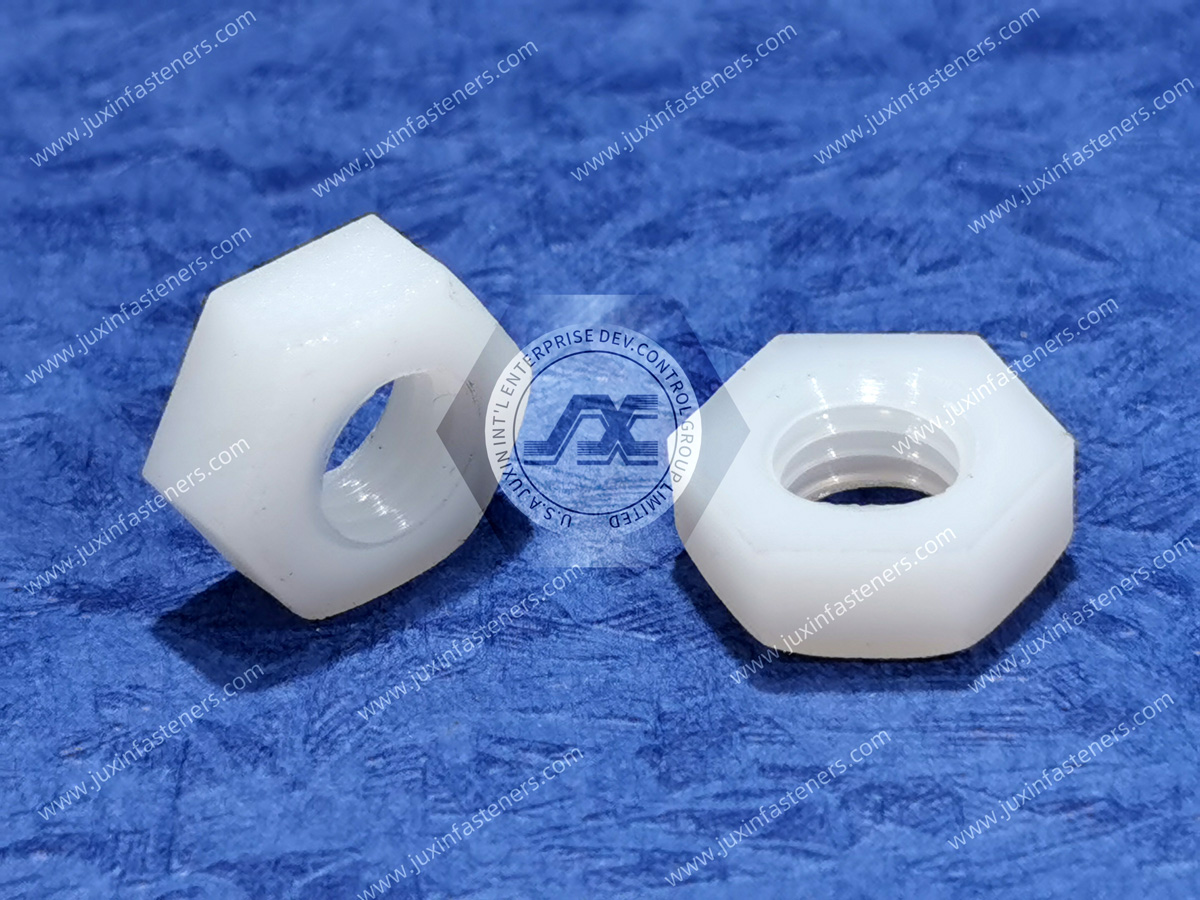
Design engineers can consider plastic nuts, nylon hex nuts, and related polymer nut designs when an application requires a non-metallic mating component and
the mechanical and environmental requirements are compatible with the selected polymer.
Typical considerations include:
Securing threaded joints while providing electrical separation where the selected polymer and assembly design are suitable for the required isolation function.
Reducing direct metal-to-metal contact where galvanic interaction between dissimilar conductive materials is an engineering concern.
Reducing assembly weight in applications such as instrumentation panels, electronic equipment, portable equipment,
and selected aerospace or transportation components where the application requirements permit polymer fastening hardware.
Supporting tool-free or low-force manual adjustment using suitable configurations such as wing nuts or thumb nuts where service access and adjustment are part of the design.
Providing a polymer fastening interface where chemical compatibility, non-metallic construction, surface protection,
or weight reduction is more important than the mechanical characteristics of a conventional metal nut.
The important engineering question is not simply "Can a plastic nut replace a metal nut?"
It is:
Does the selected polymer, thread geometry, engagement, installation method, environmental exposure, and joint load provide sufficient performance for the specific assembly?
Internal polymer threads behave differently from metallic threads under mechanical stress.
Using standard metal nuts in sensitive polymer or composite assemblies can create specific interface and material-selection concerns.
High installation torque or excessive joint loading can damage internal polymer threads.
Depending on the material, geometry, thread engagement, and loading condition, thread deformation or stripping may become a limiting failure mode.
Engineers should therefore evaluate:
Thread size and pitch
Thread engagement
Nut geometry
Polymer grade
Applied preload
Installation method
Repeated assembly requirements
Temperature and environmental exposure
A specific allowable torque or thread-stripping load should not be assumed without verified product and application data.
Dynamic machinery and equipment can experience cyclic loading or vibration that may contribute to fastener loosening.
Nylon lock nuts and other polymer locking configurations can introduce prevailing resistance against the mating screw thread.
However, the actual locking performance depends on the nut design, material, mating thread, installation condition, temperature, vibration environment, reuse requirements, and other joint variables.
Therefore, a nylon locking nut should not automatically be treated as a universal solution for every vibration-sensitive joint.
Tightening a nut directly against a relatively soft plastic panel can concentrate load at the contact area and potentially contribute to local deformation.
Depending on the assembly design, plastic flat washers, nylon washers, insulating washers, or insulating cup washers may be used to distribute contact pressure or create separation between components.
For applications requiring a shoulder or controlled electrical interface, a nylon shoulder washer may be more appropriate than a conventional flat washer.
When dissimilar conductive metals are in contact in the presence of a suitable electrolyte, galvanic corrosion can become an engineering consideration.
A non-metallic plastic or nylon nut can reduce direct metallic contact at the nut interface. However, using a polymer nut does not automatically eliminate every galvanic-corrosion pathway in an entire assembly.
Engineers should evaluate the complete joint, including:
Screw or bolt material
Washer material
Nut material
Panel or substrate
Coatings
Moisture or electrolyte exposure
Other conductive contact paths
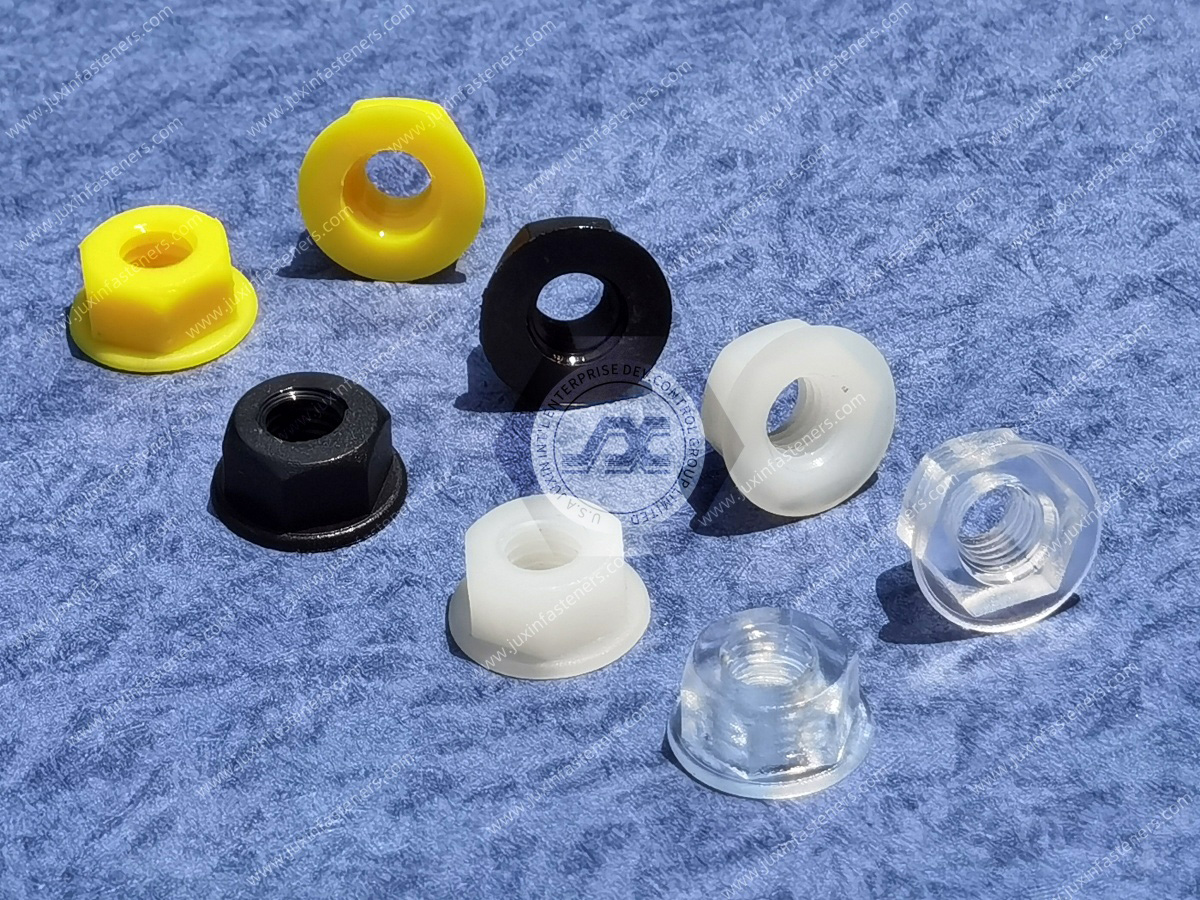
Polymer selection influences the mechanical behavior, dimensional stability, environmental compatibility, and service conditions of plastic nuts, nylon hex nuts, and locking components.
| Polymer Family | Typical Industrial Grades | General Engineering Characteristics | Potential Applications | Engineering & Sourcing Considerations |
|---|---|---|---|---|
| Nylon / Polyamide | PA6, PA66, unfilled or glass-filled grades | Good strength-to-weight characteristics and useful toughness; moisture absorption can influence dimensions and mechanical behavior | Electrical equipment, control panels, electronic housings, machinery and general industrial assemblies | Evaluate moisture uptake, dimensional changes, creep, thread behavior, and required material grade |
| POM / Acetal | Homopolymer / copolymer acetal | High rigidity, low friction, and good dimensional stability for many precision applications | Precision mechanisms, equipment housings, sliding mechanisms, selected mechanical assemblies | Evaluate friction, thread performance, chemical compatibility, and long-term loading |
| PVDF | Polyvinylidene fluoride | Strong chemical and environmental resistance characteristics for selected applications | Chemical processing equipment, semiconductor-related equipment, selected outdoor or corrosive environments | Confirm compatibility with the actual chemicals, temperature, geometry, and manufacturing requirements |
| PEEK | Polyetheretherketone | High-performance engineering polymer with strong temperature and wear characteristics compared with many commodity polymers | High-temperature industrial equipment, specialized electronics, aerospace-related components and demanding machinery | Higher material and processing cost; application-specific validation and tooling considerations may be required |
Nylon is one of the most common polymer families considered for industrial plastic fastening components.
PA6 and PA66 can provide useful combinations of mechanical performance, toughness, processability, and cost for many applications.
However, nylon is hygroscopic. Moisture absorption can influence dimensional stability and mechanical behavior.
This matters when a plastic nut is used in a close-tolerance thread or when the assembly operates in changing humidity conditions.
Glass-filled nylon can provide different stiffness and dimensional characteristics from unfilled grades, but engineers should specify the actual verified resin grade rather than assuming all glass-filled nylon materials have the same performance.
POM can be considered where dimensional stability, rigidity, and low-friction characteristics are important.
It may be useful for selected precision fastening and mechanical components, but the actual thread design, loading condition, chemical environment, and manufacturing process still need to be evaluated.
PVDF can be considered for applications where chemical or environmental resistance is a major selection driver.
Its suitability should be determined against the actual chemical concentration, exposure time, temperature, stress condition, and component geometry rather than based only on the polymer name.
PEEK is a high-performance engineering polymer used where demanding thermal, mechanical, chemical, or dimensional requirements justify its higher material and processing cost.
It should be selected based on the actual application requirements and verified material data rather than simply assuming that PEEK is necessary whenever temperatures are elevated.
Every polymer material has operational boundaries. Plastic nuts and nylon hex nuts may not be suitable when the application requires:
Sustained high structural clamping preload that may exceed the long-term compressive or thread-retention capability of the selected polymer.
High installation torque or repeated assembly conditions that could cause thread damage, deformation, or loss of functional performance.
Continuous or intermittent temperature exposure beyond the verified operating range of the selected polymer grade.
Very tight dimensional stability requirements in high-humidity or submerged environments where moisture absorption may affect nylon dimensions or mechanical behavior.
Specialized chemical resistance against strong acids, oxidizing agents, solvents, or other aggressive environments where the selected polymer has not been validated.
High structural load requirements where a metal fastening system is more appropriate.
Highly controlled safety-critical joints where application-specific validation and verified mechanical data are required before changing from metallic to polymer fastening hardware.
Plastic nuts should be selected because their material and interface characteristics fit the joint—not simply because they are lighter or non-metallic.
When the mechanical requirement exceeds the verified capability of the selected polymer, engineers should consider another material, another fastening architecture, or a hybrid assembly.
The terminology used for polymer nuts can overlap, but the engineering function is not identical.
"Plastic nuts" is a broad product category covering nuts manufactured from polymer materials.
They can include:
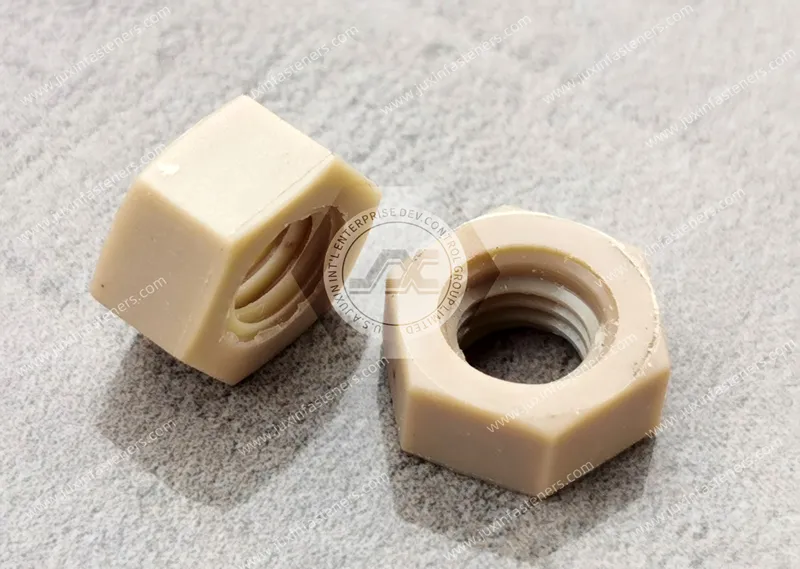
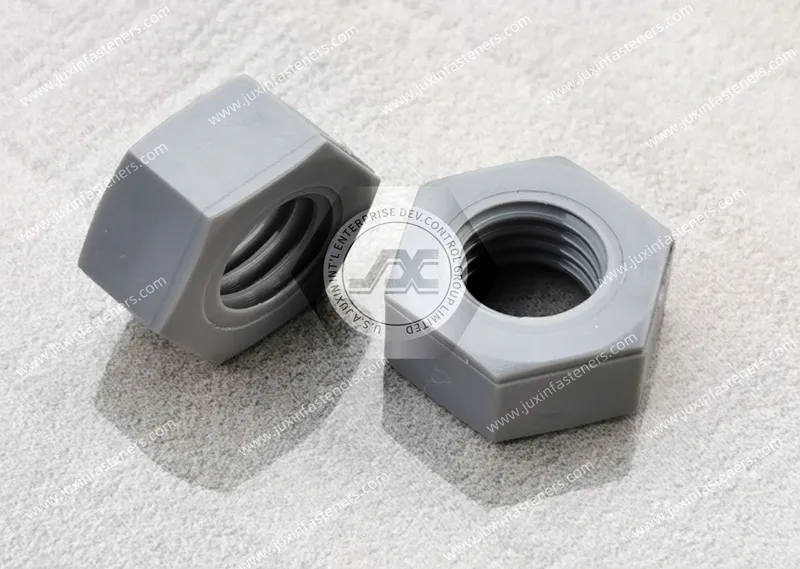
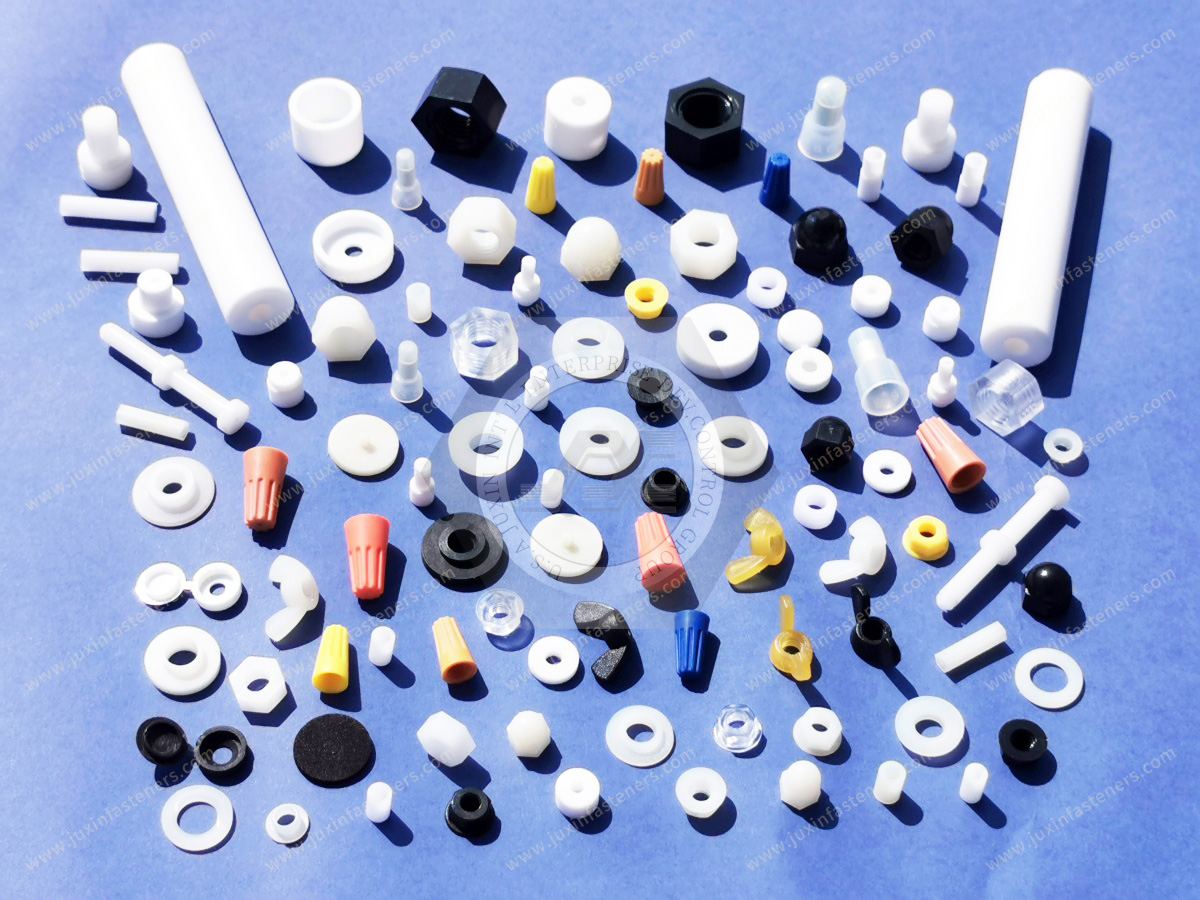
Plastic hex nuts
Plastic threaded nuts
Plastic flange nuts
Plastic lock nuts
Plastic wing nuts
Custom polymer nuts
Nylon hex nuts are a specific type of plastic nut using nylon/polyamide material and a hexagonal external profile for wrench installation.
They may be suitable for applications requiring a lightweight, non-metallic mating component, provided the material and joint requirements are compatible.
Nylon lock nuts incorporate a polymer locking feature that increases resistance to rotation on the mating thread.
Their actual prevailing torque and resistance to loosening depend on the specific design, material, thread pairing, installation history, and operating environment.
A plastic flange nut incorporates an enlarged bearing surface below the nut body.
This geometry can distribute contact over a larger area than a conventional hex nut and may be useful where local surface loading is a concern.
Where frequent manual adjustment is required, plastic wing nuts or thumb-style configurations may be considered.
These are generally application-driven components rather than universal replacements for structurally loaded hex nuts.
The mating fastener is an important part of the engineering decision.
A plastic nut does not operate independently from the screw or bolt.
Depending on the assembly, engineers may evaluate:
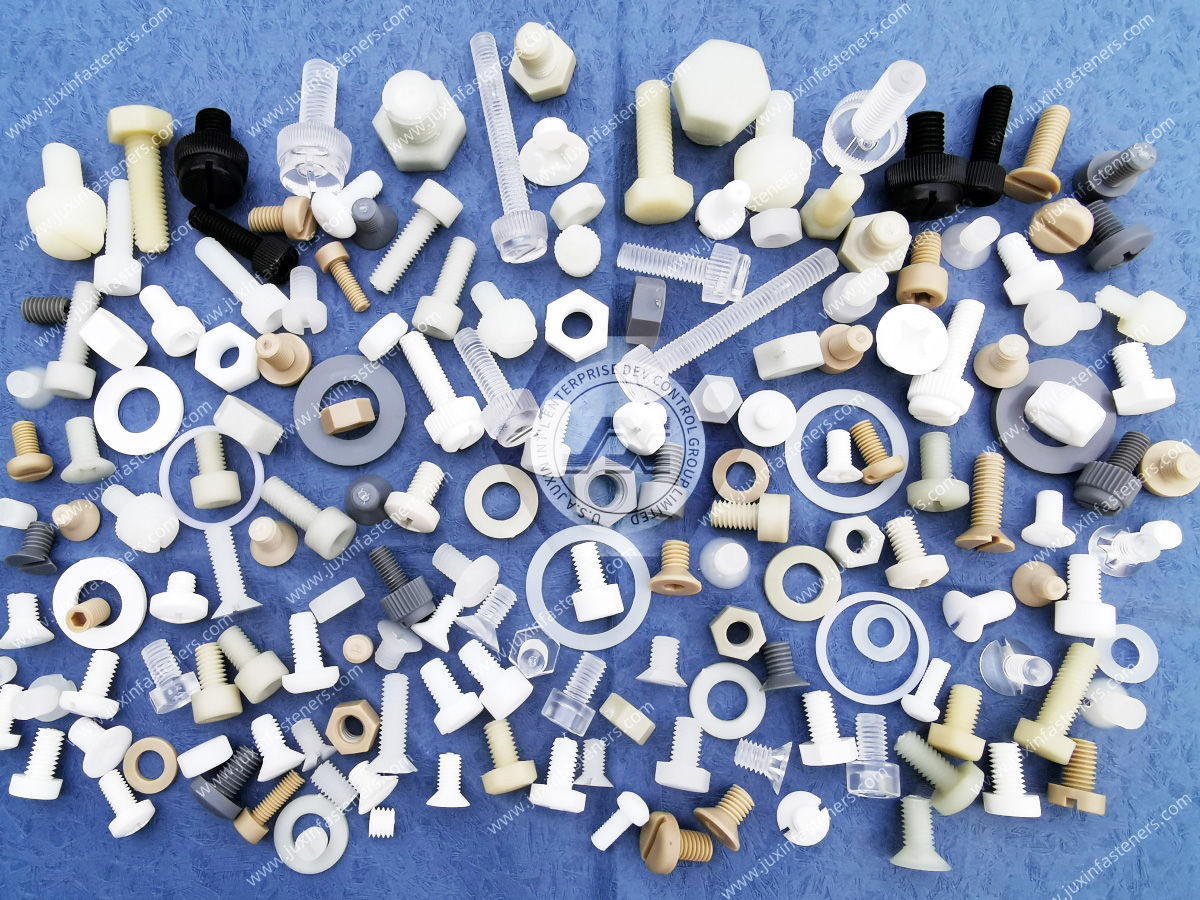
Plastic screws
Nylon screws
Plastic machine screws
Nylon machine screws
Plastic bolts
Nylon bolts
Metal screws with polymer nuts
Metal bolts with polymer nuts
A polymer nut paired with a metallic screw can behave differently from a polymer nut paired with a polymer screw because thread friction, stiffness, wear, installation torque, and repeated assembly behavior can change.
For a complete polymer fastening assembly, engineers may also evaluate:
Plastic Screw / Nylon Screw → Washer → Panel or Component → Plastic Nut / Nylon Nut
or, where required:
Screw / Bolt → Shoulder Washer → Panel → Polymer Nut
The correct combination depends on the joint function, electrical requirements, mechanical loading, environment, and assembly process.
Thread selection should match the mating screw or bolt and the actual product drawing.
Common industrial requirements may involve:
ISO metric threads
DIN-related dimensional requirements
ASME/ANSI Unified Thread requirements
UNC
UNF
Other customer-specific thread specifications
The article should not imply that every plastic nut automatically conforms to every ISO, DIN, ASME, or ANSI requirement.
For OEM production, the drawing should identify the required thread form, nominal size, pitch or thread designation, tolerance requirements, and mating component.
For international supply, engineers should provide the actual thread specification rather than relying only on descriptions such as "M6 plastic nut" or "1/4-inch nylon nut."
Submitting a comprehensive Request for Quotation (RFQ) streamlines technical evaluation, tooling review, sampling, and production planning.
Procurement managers and design engineers should prepare a complete technical package covering:
Specify the required nut type, such as:
Standard plastic hex nut
Plastic hex nut
Nylon hex nut
Nylon lock nut
Plastic flange nut
Wing nut
Thumb nut
Custom plastic threaded nut
Other custom polymer nut
Include the applicable standard reference where required.
Provide 2D technical drawings and, where available, 3D CAD files specifying:
Thread size
Thread pitch
Thread designation
Nut height
Across-flats dimension
Across-corners dimension where relevant
Bearing surface geometry
Chamfers
Tolerances
Critical dimensions
Specify the exact polymer family and, where required, the resin grade.
Examples may include:
PA6
PA66
Unfilled nylon
Glass-filled nylon
POM
PVDF
PEEK
Other customer-specified polymer
Also specify:
Color
Natural or black material
Custom color requirement
Surface or appearance requirements
Customer-approved material alternatives, if any
Do not substitute a material grade without customer approval where the grade is functionally critical.
Provide relevant application requirements, such as:
Installation method
Expected assembly torque
Reuse requirements
Joint loading
Temperature exposure
Humidity
Water exposure
Chemical exposure
Electrical isolation requirements
Vibration environment
Dimensional stability requirements
Where a numerical performance requirement is critical, it should be specified and validated against the actual product and application rather than assumed from a generic polymer table.
Procurement teams should also provide:
Annual volume
Initial order quantity
Batch quantities
Forecast requirements
Multi-SKU BOM
Packaging requirements
Kit packaging requirements where applicable
Labeling requirements
Inspection requirements
Sample requirements
Delivery expectations
Before releasing a plastic nut for production, engineers should verify the complete fastening interface rather than only the nut dimensions.
Confirm the actual polymer family and grade.
Confirm:
Thread designation
Pitch
Thread tolerance
Mating screw compatibility
Required engagement
Determine whether the nut is primarily intended for:
General fastening
Electrical separation
Lightweight construction
Surface protection
Manual adjustment
Locking
Corrosion/material-contact control
Equipment mounting
Evaluate:
Temperature
Humidity
Water exposure
Chemicals
UV exposure where applicable
Vibration
Repeated assembly
Consider:
Installation torque
Clamping requirement
Thread stripping risk
Thread deformation
Creep
Long-term preload retention
Substrate deformation
No universal torque, thread engagement, preload, pull-out, or stripping value should be assigned without product-specific engineering data.
Confirm:
Drawing interpretation
Tooling feasibility
Molded or machined production route
Critical dimensions
Thread formation
Inspection method
Sampling requirements
Production scalability
The correct plastic nut is the result of matching material + thread + geometry + joint load + environment + manufacturing process.
Plastic nuts are often only one component in a larger fastening architecture.
A nylon washer or plastic flat washer may be used where the assembly requires a non-metallic bearing surface or load distribution.
An insulating washer or nylon insulating washer can be considered when electrical separation between components is part of the design requirement.
A shoulder washer can provide a more controlled interface around a fastener passing through a panel or component.
This can be useful where the design requires separation around the fastener shank or protection of the mounting hole.
Where the engineering requirement is to maintain a defined physical distance rather than simply distribute clamping load, a plastic spacer or nylon spacer may be more appropriate than a washer.
Electronic assemblies may use PCB spacers, plastic standoffs, or threaded standoffs to establish mounting geometry between a PCB, enclosure, bracket, or secondary component.
Depending on the assembly, engineers may consider:
Male-to-female standoffs
Female-to-female standoffs
Male-to-male standoffs
Threaded plastic standoffs
PCB standoffs
This distinction is important:
A washer primarily supports an interface or distributes contact load.
A spacer primarily maintains physical separation.
A standoff is a mounting component designed to establish a defined mounting distance and may incorporate internal or external threads.
These functions should not be treated as interchangeable.
Plastic and nylon nuts can be considered across a range of OEM applications where their material characteristics match the engineering requirements.
Plastic nuts can be used in selected enclosure and panel assemblies where electrical separation, weight, surface protection, or corrosion considerations are important.
Electronic equipment may combine plastic nuts with:
Nylon screws
Nylon washers
PCB spacers
Plastic standoffs
Shoulder washers
The exact configuration depends on the board, enclosure, mounting structure, and electrical requirements.
Telecommunications cabinets, antenna-related equipment, and communication equipment can contain polymer fastening components where weight,
electrical separation, environmental exposure, and assembly design permit.
Automotive and EV assemblies may use plastic or nylon fastening components for selected non-structural applications, electrical interfaces, cable management, panels, brackets, and equipment housings.
The material and fastening design must be validated for the actual vehicle environment rather than assuming all nylon components are suitable for automotive use.
Plastic nuts, washers, spacers, and insulating components may be considered in selected battery and energy-storage equipment where electrical separation,
mounting geometry, weight, and material compatibility are relevant.
Application-specific thermal, electrical, mechanical, and safety requirements must be evaluated before material selection.
Instrumentation panels and control equipment may use plastic nuts and polymer fastening components where non-metallic construction, electrical separation, lightweight assemblies, or surface protection are required.
HVAC control systems, panels, sensors, electrical enclosures, and selected mounting assemblies may use plastic fastening components when the environmental and mechanical requirements are compatible.
Selected semiconductor and electronic manufacturing equipment may require polymer components because of chemical exposure, electrical separation, cleanliness, or material compatibility considerations.
The exact polymer must be selected according to the actual process environment and customer requirements.
Price alone is not enough when plastic nuts are part of an engineered OEM assembly.
The supplier should be able to review:
Thread specifications
Critical dimensions
Tolerances
Material requirements
Assembly interfaces
Special geometry
The supplier should clearly identify the supplied material and support customer requirements for material documentation where required.
OEM buyers should understand whether the supplier can support the required manufacturing process, tooling, custom geometry, thread production, and production volume.
Depending on the drawing requirements, inspection may include dimensional verification, thread checking, visual inspection, and other customer-specified controls.
Critical inspection requirements should be agreed before production rather than assumed.
A capable OEM supplier should be able to support the transition from:
Drawing → Prototype / Sample → Validation → Production → Repeat Supply
For OEM customers purchasing multiple polymer fastening components, sourcing several related products from one qualified supplier may simplify:
Supplier management
BOM administration
Packaging
Shipment consolidation
Quality communication
Forecast coordination
This can include plastic nuts, nylon nuts, plastic screws, nylon screws, plastic bolts, nylon bolts, washers, spacers, and standoffs where the supplier's actual manufacturing scope supports them.
International OEM sourcing also requires clear communication on:
Drawings
Revision control
Samples
Production schedules
Packaging
Shipping
Quality issues
Forecast changes
Repeat orders
A plastic nut supplier should be evaluated not only as a source of commodity hardware, but also according to its ability to interpret engineering requirements,
control materials and dimensions, manage custom production, and support repeat OEM supply.
Nylon hex nuts can provide a non-metallic fastening interface, lower density, and electrical separation characteristics when the selected material and assembly design are suitable.
They may also reduce direct metallic contact in applications where galvanic interaction is a concern.
However, they should not automatically be considered a replacement for metal nuts in highly loaded or high-temperature joints.
Custom plastic nuts can be designed around standard metric or inch-based thread requirements where supported by the manufacturing process and customer drawing.
The actual thread standard, size, pitch, tolerance, and mating component should be specified in the RFQ.
JUXIN FASTENERS should not claim universal compliance with every ISO, DIN, ASME, or ANSI thread standard unless the specific product and drawing requirements have been verified.
Nylon lock nuts incorporate a polymer locking feature that creates additional resistance against rotation on the mating thread.
The effectiveness of the locking function depends on the specific nut design, material, thread pairing, installation condition, reuse, temperature, and vibration environment.
For critical vibration applications, engineers should validate the actual assembly rather than assuming that every nylon lock nut provides the same locking performance.
The answer depends on the actual polymer grade, geometry, loading condition, exposure duration, and environmental conditions.
Standard nylon grades have different temperature capabilities from high-performance polymers such as PEEK or PVDF.
Engineers should use verified material and product data for the actual application rather than relying on a generic temperature number.
A flange nut incorporates an enlarged bearing surface that can distribute contact over a wider area than a conventional hex nut.
This may be useful where the mounting substrate is relatively soft or where the joint geometry benefits from a larger bearing area.
A plastic nut may be considered when non-metallic construction, electrical separation, weight reduction, corrosion/material-contact considerations,
or chemical compatibility are important and the joint's mechanical and environmental requirements are compatible with the selected polymer.
No.
Depending on the application, a plastic nut may be paired with a metal screw, while other assemblies may use nylon or another polymer screw.
The correct combination depends on thread compatibility, load, friction, installation method, environment, electrical requirements, and service conditions.
A shoulder washer may be considered when the design requires separation around the fastener shank or controlled positioning/protection of a mounting hole.
A flat washer is primarily used to provide a bearing interface or distribute contact load.
The two products should not be treated as automatically interchangeable.
A plastic spacer primarily establishes physical separation between components.
A plastic standoff is generally a mounting component designed to maintain a defined distance and may incorporate internal or external threads.
PCB spacers and threaded standoffs are therefore often selected according to the mounting architecture rather than simply replacing a washer.
Procurement teams should provide:
2D technical drawings
3D CAD files where available
Thread specification
Material grade
Dimensions and tolerances
Color requirements
Application environment
Installation requirements
Annual volume
Initial order quantity
Packaging requirements
Multi-SKU BOM information
Inspection requirements
Complete technical information allows the supplier to evaluate manufacturability, tooling, material selection, inspection, and production requirements before quotation.
Selecting plastic nuts, nylon hex nuts, nylon lock nuts, and custom polymer fastening components requires more than matching a thread size.
The engineering decision should consider:
Material → Thread → Geometry → Joint Load → Environment → Assembly Method → Manufacturing → Inspection
For assemblies that also require plastic screws, nylon screws, plastic bolts, nylon bolts, nylon washers, insulating washers, shoulder washers,
plastic spacers, PCB spacers, or threaded standoffs, evaluating the complete fastening system can help avoid interface problems during production.
JUXIN FASTENERS supports OEM customers with drawing review, custom fastening component evaluation, manufacturing coordination, multi-SKU BOM sourcing, sampling, and production supply.
Submit your 2D/3D CAD files, technical requirements, annual volume projections, and relevant application information to info@juxinfasteners.com for engineering review and an OEM quotation.
Product Packaging
Packaging Standard
At Juxin Fasteners, we apply standardized export packaging to ensure product protection, traceability, and compliance with international logistics requirements.
1. Standard Export Packaging
Unless otherwise specified, all products will be packed according to our factory standard export packaging, which includes:
Moisture-resistant inner protection
Poly bag or small box packing as required
Reinforced export cartons
Clear labeling with part number, specification, batch number, and quantity
Palletizing for sea or air shipment when necessary
Our standard packaging is designed to ensure safe transportation, efficient warehousing, and long-distance international shipping.
2. Customized Packaging Options
We also provide customized packaging solutions according to customer requirements, including but not limited to:
Private labeling
Customized barcodes
Specific carton dimensions
Retail packaging
Special pallet configuration
Customer-specific marking and identification
So that you know, customized packaging may involve additional costs and extended lead time depending on the complexity of the requirements.
3. Compliance & Quality Assurance
All packaging processes are controlled under our ISO 9001 quality management system to ensure consistency, traceability, and product integrity throughout the supply chain.
Product Pictures
Contact Us
Tel.:
+86 020 8621 0320
+86 020 3121 6067
E-mail:
Technical Support:
Navigation
SEND INQUIREY