Call Us
+86 136 6007 9809
Call Us
+86 136 6007 9809

Electronic equipment manufacturers, PCB assembly engineers, electrical enclosure designers and medical equipment OEMs
often require fastening components that provide mechanical attachment without introducing unnecessary electrical conductivity, weight or corrosion-related problems.
Nylon and engineering plastic fasteners can offer practical alternatives to metallic hardware in selected applications.
Product Specification
Electronic equipment manufacturers, PCB assembly engineers, electrical enclosure designers and medical equipment OEMs
often require fastening components that provide mechanical attachment without introducing unnecessary electrical conductivity, weight or corrosion-related problems.
Nylon and engineering plastic fasteners can offer practical alternatives to metallic hardware in selected applications.
However, replacing a metal screw with a plastic screw is not simply a material substitution.
The complete fastening system must account for:
Mechanical loading
Electrical insulation requirements
Operating temperature
Long-term creep
Moisture absorption
Chemical exposure
Flame-retardancy requirements
PCB mounting geometry
Assembly torque
Installation method
Service frequency
Material compatibility
JUXIN FASTENERS supplies nylon and engineering plastic fastening components for industrial OEM applications, including:
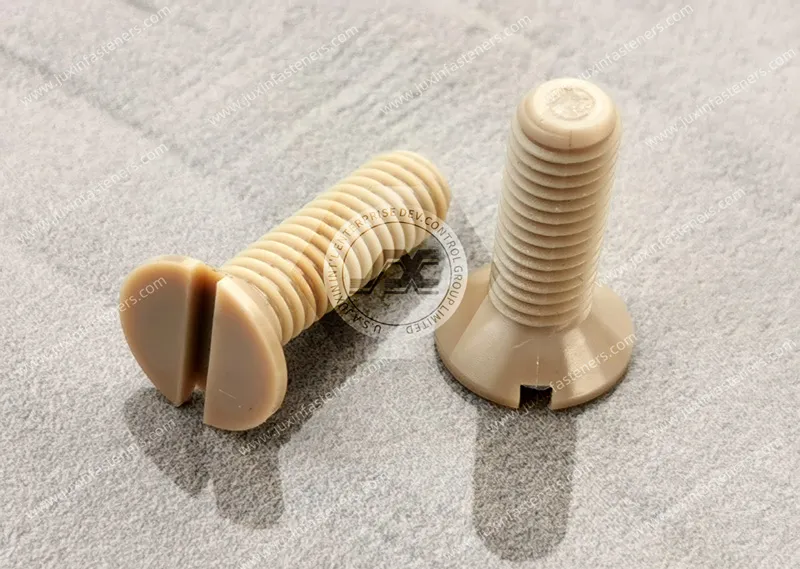
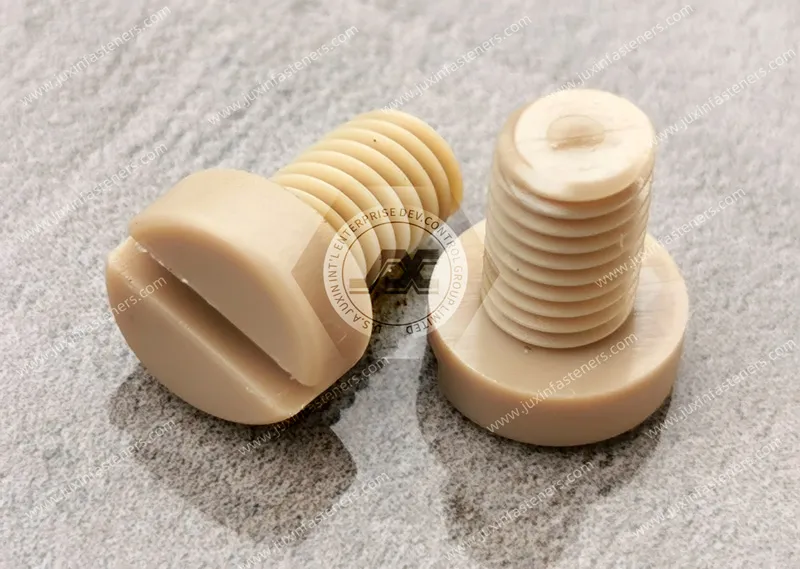
Nylon screws and bolts
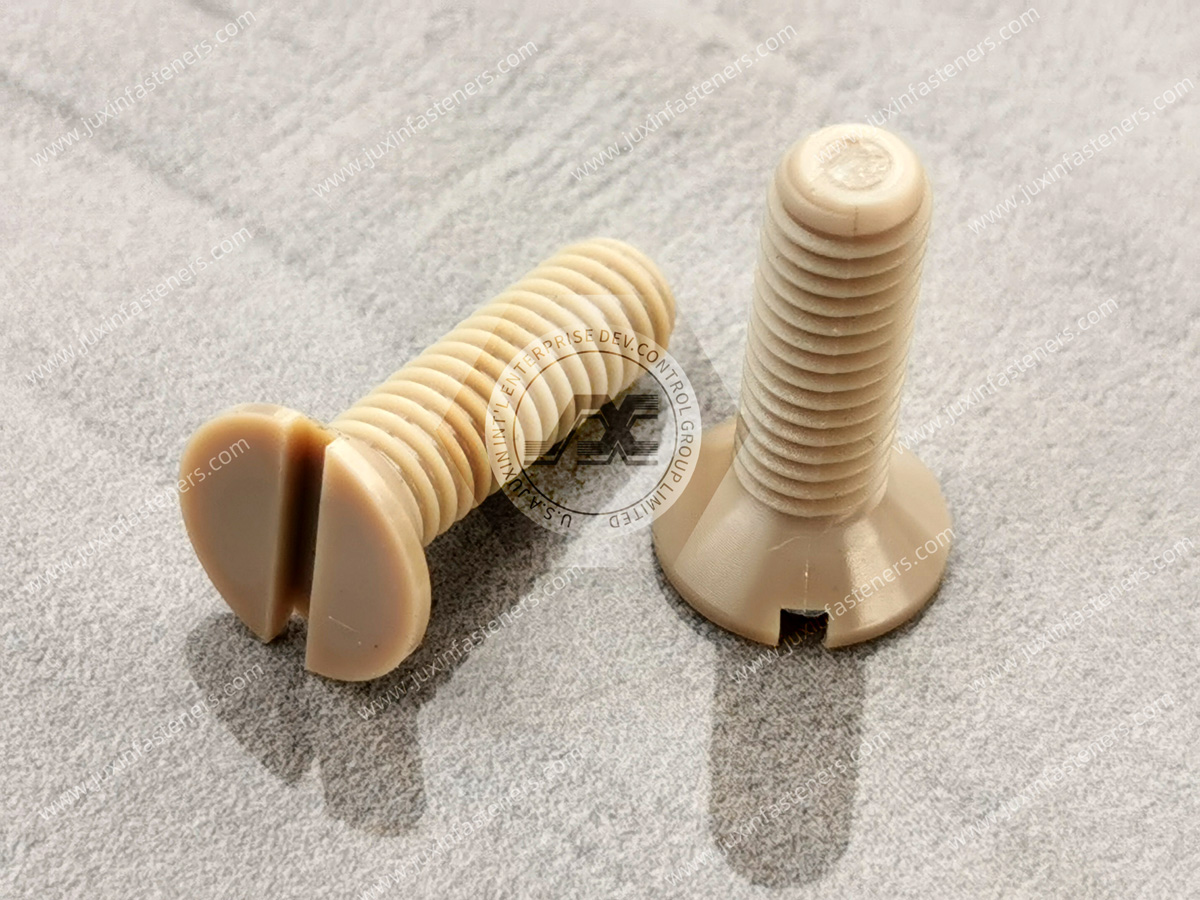
Plastic machine screws
Nylon nuts
Plastic washers
Insulating washers
Nylon spacers
PCB supports and standoffs
Circuit board mounting hardware
Nylon snap rivets
Plastic push rivets
Plastic blind rivets
Snap-in fasteners
Plastic screw grommets
Plastic automotive clips
Drawing-based custom plastic components
Material options may include PA6, PA66, POM, PC, PP, PVDF, PEEK and other engineering polymers where appropriate to the actual component and project requirements.
The central engineering question is not simply:
“Should we replace metal fasteners with nylon?”
A more useful question is:
“Which fastening function must remain mechanical, which interface must be electrically isolated, and what will happen to the polymer over the equipment's service life?”
A plastic fastener performs within a complete assembly.
Its behavior can depend on:
Fastener geometry
Thread engagement
Substrate material
Clamp load
Installation torque
Temperature
Humidity
Environmental exposure
Assembly sequence
Expected service life
Two components made from PA66 may perform differently because of their geometry, manufacturing method and operating conditions.
Therefore:
PA66 alone is not a complete fastener specification.
For OEM sourcing, material grade and functional requirements should be considered together.
| Product Family | Primary Function | Typical Application | Critical Selection Factor |
|---|---|---|---|
| Nylon machine screws | Threaded attachment | Electronic housings, PCB accessories | Torque and thread engagement |
| Nylon hex nuts | Nonmetallic threaded fastening | Electrical assemblies | Thread strength and creep |
| Nylon washers | Bearing interface or electrical separation | PCB and enclosure joints | Compression and insulation geometry |
| Plastic spacers | Controlled separation | Electronic modules | Height and compressive loading |
| PCB supports and standoffs | Board positioning and retention | Circuit board assemblies | Board hole, chassis hole and spacing |
| Nylon snap rivets | Snap-in mechanical retention | Covers and lightweight panels | Hole geometry and retention |
| Plastic push rivets | Push-in fastening | Panels and covers | Installation and removal requirements |
| Plastic blind rivets | One-sided plastic fastening | Selected panel assemblies | Grip range and installation method |
| Plastic screw grommets | Screw receiving or panel interface | Equipment housings | Panel thickness and screw compatibility |
| Custom plastic fasteners | Drawing-controlled function | OEM equipment | Material, geometry and validation |
These products are not interchangeable simply because they are nonmetallic.
An insulating washer and a PCB standoff may both be made from nylon.
But they solve different problems.
An insulating washer may separate conductive surfaces around a fastening point.
A PCB standoff establishes a physical separation distance and may also retain the board.
A plastic screw provides threaded attachment.
A snap rivet provides mechanical retention without a conventional screw-and-nut arrangement.
The correct product depends on the required function.
Nylon screws are used in selected assemblies where nonmetallic threaded hardware is beneficial.
Potential applications include:
Electronic enclosure covers
PCB accessories
Instrument housings
Electrical control equipment
Lightweight brackets
Laboratory equipment
Equipment panels
Available configurations depend on the drawing and product range and may include different head styles, threads and lengths.
The main engineering considerations are:
Tensile loading
Shear loading
Thread strength
Installation torque
Bearing stress
Temperature
Long-term relaxation
Metal screws generally offer higher mechanical strength and stiffness than common nylon screws of comparable dimensions.
Plastic screws can provide advantages in applications requiring:
Electrical separation
Low mass
Nonmetallic construction
Corrosion-related material compatibility
Reduced magnetic interaction where relevant
However, plastic screws should not be selected for a high-load joint solely because they provide insulation.
The load path must be evaluated first.
Consider an electronic enclosure with a metal chassis and PCB mounting bracket.
A nylon screw may satisfy the electrical separation objective.
But if the joint requires high preload, the screw may experience excessive deformation or long-term relaxation.
The design may instead require:
A metallic screw with an insulating sleeve
An insulating washer arrangement
A nonmetallic spacer with a separate structural fastener
A different PCB mounting architecture
This is why electrical and mechanical requirements should be reviewed independently.
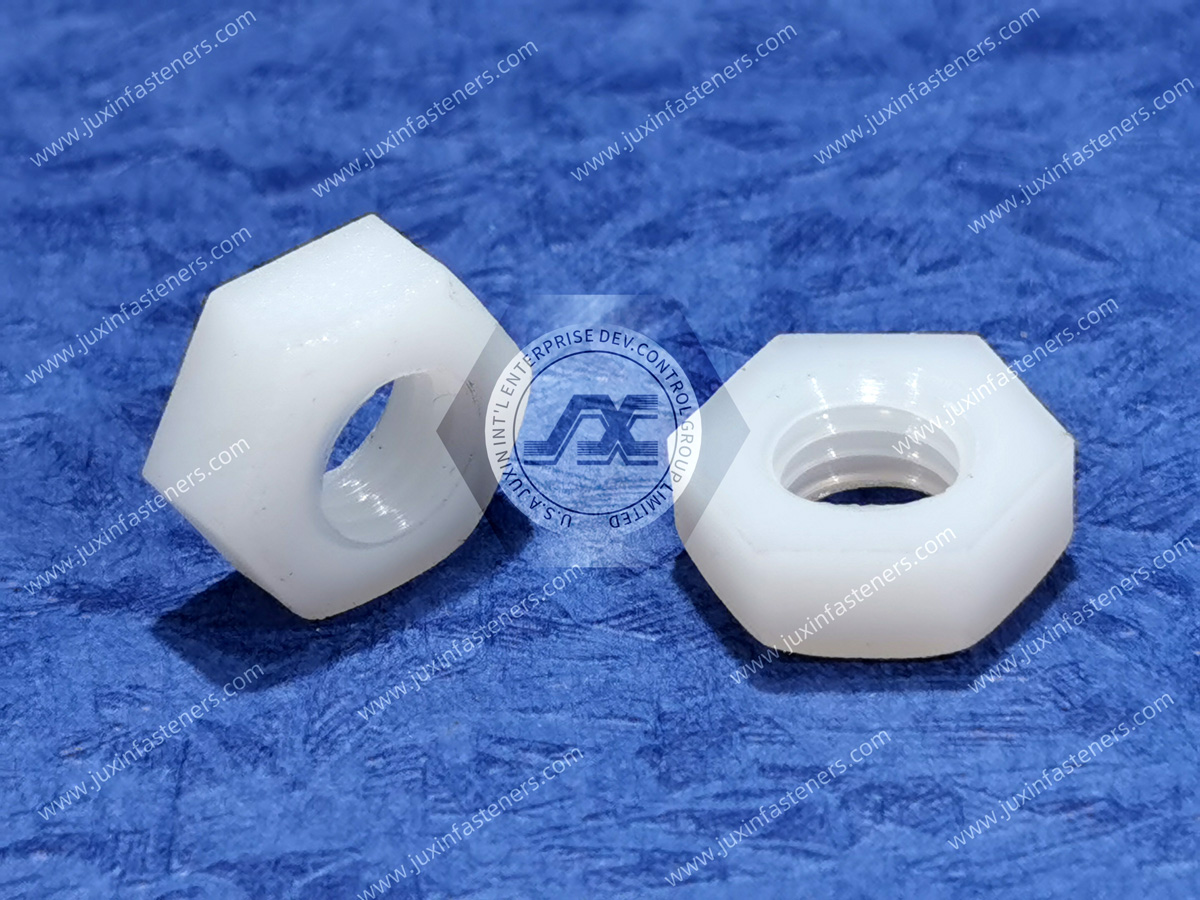
Nylon nuts can be used with compatible threaded components where a nonmetallic nut is appropriate.
Applications may include:
Instrumentation
Lightweight assemblies
Electrical equipment
Selected PCB mounting systems
Plastic enclosure assemblies
The designer should evaluate:
Thread size
Mating screw material
Thread engagement
Installation torque
Compressive loading
Temperature
Repeated disassembly
A nylon nut should not be treated as a direct strength-equivalent replacement for a steel nut.
Nylon washers can provide a nonmetallic interface between components.
Depending on geometry, they may be used for:
Electrical separation
Surface protection
Spacing
Bearing-load distribution
Reducing direct contact between dissimilar metals
However, washer geometry determines the actual isolation function.
A flat washer may not prevent contact through the screw shank or hole wall.
Consider a steel screw passing through an aluminum panel.
Adding a nylon washer beneath the screw head may separate the head from the panel.
But the screw shank can still contact the panel inside the mounting hole.
If complete electrical isolation is required, the assembly may also need:
An insulating shoulder washer
An insulating sleeve
A controlled clearance hole
A different mounting design
The entire conductive path must be reviewed.
PCB spacers and standoffs establish separation between:
PCB and chassis
PCB and PCB
PCB and mounting bracket
Electronic module and enclosure
This spacing can be important for:
Component clearance
Connector alignment
Mechanical support
Assembly access
Electrical spacing
Cable routing
Thermal architecture
JUXIN FASTENERS supplies PCB mounting hardware and plastic support components for relevant electronic assemblies.
A standoff creates physical separation.
But the electrical insulation requirement may depend on both:
Clearance: shortest distance through air
Creepage: shortest distance along an insulating surface
These distances depend on the actual electrical design and applicable safety requirements.
A nominal 10 mm standoff height does not automatically establish a compliant electrical insulation system.
Engineers should evaluate the complete assembly, including board traces, conductive hardware, contamination and operating environment.
Snap-in PCB supports can simplify assembly where a threaded fastening system is unnecessary.
Typical functions include:
Board retention
Board positioning
Controlled spacing
Reduced loose-hardware handling
Tool-reduced assembly in suitable designs
However, PCB support posts are geometry-sensitive components.
An RFQ should include:
PCB mounting-hole diameter
Chassis mounting-hole diameter
PCB thickness
Chassis thickness
Required spacing
Installation direction
Retention requirement
Removal requirement
A snap-in support may connect a PCB to a chassis.
That means the component has two functional interfaces:
PCB Interface + Chassis Interface
A supplier cannot confirm compatibility from the overall support height alone.
For example, a support post may fit the PCB hole but fail to retain properly in the chassis hole.
Or it may fit both holes but provide the wrong board spacing.
Therefore, procurement teams should specify both interfaces.
Plastic snap rivets and push rivets provide mechanical retention without a conventional threaded nut-and-bolt assembly.
Potential applications include:
Lightweight covers
Electronic housings
Accessory panels
Equipment trim
Plastic-to-plastic joints
Plastic-to-sheet-metal joints
Selection depends on:
Hole diameter
Panel thickness
Grip range
Head diameter
Installation force
Retention requirement
Service removal
Material
A plastic screw provides threaded fastening.
A snap rivet provides a snap-fit retention mechanism.
The choice depends on whether the application requires:
Controlled threaded tightening
Frequent disassembly
Rapid push-in installation
Tool access
Defined retention force
Reusable attachment
A snap rivet is not automatically a substitute for a threaded fastener in a loaded joint.
A plastic rivet may require relatively low insertion force.
That does not automatically mean it has high retention force.
The relationship depends on:
Barb geometry
Leg flexibility
Hole diameter
Panel thickness
Material stiffness
Temperature
For snap-fit components, engineers should define the installation and removal requirements separately.
PA6 and PA66 are commonly used engineering polyamides.
They may be suitable for many plastic fastening components.
However, their performance can be affected by:
Moisture conditioning
Temperature
Load
Geometry
Additives
Processing conditions
Polyamide absorbs moisture, which can affect dimensional and mechanical behavior.
Therefore, a plastic fastener drawing should identify the material grade where the application requires controlled performance.
A nylon fastener may be evaluated immediately after manufacturing.
The same fastener may later absorb moisture during storage or service.
This can change:
Stiffness
Dimensions
Flexibility
Mechanical response
For snap-fit hardware, these changes can influence insertion and retention behavior.
For threaded hardware, they may influence fit and mechanical response.
Where these differences matter, the OEM should define the conditioning state used for validation.
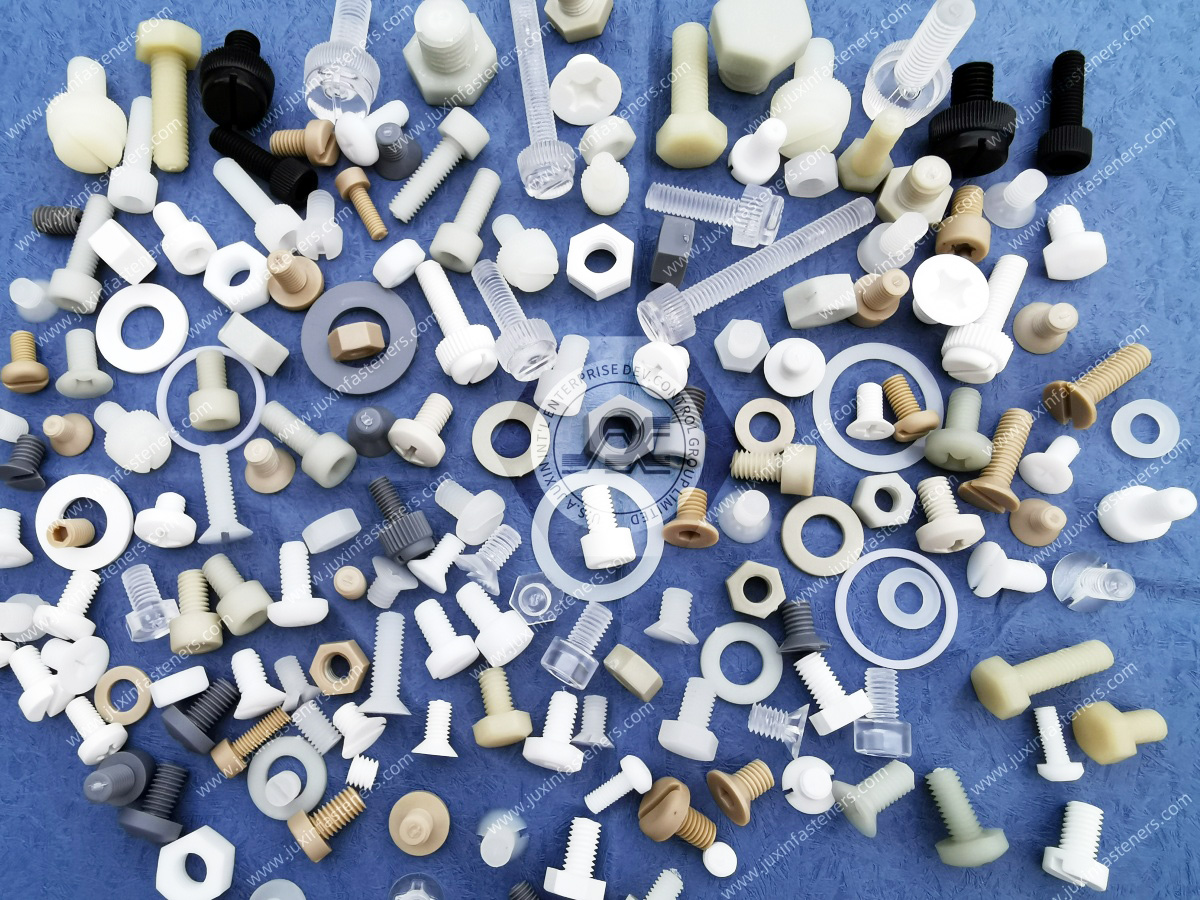
POM, also known as acetal, may be considered for selected components requiring dimensional stability, low friction or repeated mechanical movement.
Potential applications include:
Plastic clips
Sliding interfaces
Mechanical supports
Equipment components
However, POM should not automatically replace nylon.
Material selection should consider:
Required flexibility
Chemical environment
Temperature
Mechanical loading
Part geometry
Polycarbonate can be considered for selected molded components, depending on mechanical, temperature and environmental requirements.
Other polymers such as PP may be suitable for different flexibility or chemical-exposure conditions.
The appropriate material should be selected from the application rather than from a generic ranking of plastic performance.
PVDF may be considered for selected applications requiring particular chemical-resistance characteristics.
Potential applications can include:
Laboratory equipment
Chemical-handling equipment
Specialized electrical equipment
Industrial enclosures
But chemical compatibility must still be evaluated against:
Chemical type
Concentration
Temperature
Exposure duration
Mechanical stress
PVDF is not automatically resistant to every industrial or laboratory chemical.
PEEK may be considered where an engineering application justifies its material properties and cost.
Potential selection drivers include:
Temperature requirements
Mechanical performance
Chemical environment
Dimensional requirements
Specialized equipment design
However, PEEK should not be specified simply because an application involves medical or semiconductor equipment.
A less expensive polymer may be sufficient.
Material selection should follow the actual limiting requirement.
If the main problem is:
Electrical insulation → review electrical properties and geometry
Creep → review stress, temperature and material behavior
Chemical exposure → review compatibility
Snap-fit retention → review flexibility and geometry
Flame requirement → review the exact grade and thickness
High temperature → review thermal and mechanical performance
A material with a higher purchase price is not automatically the correct solution.
Electronic equipment may require flame-retardant materials.
UL 94 classifications such as V-0 and V-2 are frequently referenced in material selection.
However, the rating depends on the specific material grade and tested thickness or specimen conditions.
A component made from PA66 is not automatically UL 94 V-0.
A buyer requesting flame-retardant plastic hardware should identify:
Exact polymer grade
Required flame classification
Applicable thickness
Color where relevant
Supporting material documentation
Product geometry
Other electrical or environmental requirements
The finished component's suitability must be evaluated against the OEM's actual specification.
A material flammability classification does not establish that an entire fastener assembly or finished electrical product meets every applicable safety requirement.
Depending on the application, the OEM may need to consider other requirements relating to:
Electrical insulation
Tracking resistance
Operating temperature
Mechanical retention
Enclosure construction
End-product safety
JUXIN FASTENERS should not present one polymer material classification as universal equipment compliance.
Engineering plastics are often selected because they are electrically insulating under appropriate conditions.
But actual insulation performance can depend on:
Material grade
Moisture
Temperature
Contamination
Part thickness
Geometry
Voltage
Electrical stress
Where the OEM requires a specific dielectric property, the requirement should be included in the drawing or purchase specification.
A nylon screw can remove one potential metallic conductive path.
But electrical failure may still occur through:
Inadequate clearance
Surface contamination
Moisture
Damaged insulation
Incorrect assembly
Other conductive components
Plastic fasteners support electrical design; they do not replace electrical safety engineering.
Metal and plastic fasteners can affect an equipment assembly differently.
However, nylon hardware should not be described as automatically eliminating electromagnetic interference.
EMI and EMC performance depends on the complete electrical and enclosure design.
In some equipment, metallic fasteners may be intentionally used for grounding or bonding.
Replacing those components with plastic fasteners could interrupt a required conductive path.
An electronic enclosure may contain two nearby joints:
Joint A: Requires electrical isolation.
Joint B: Requires a reliable bonding connection.
A plastic fastener may be appropriate for Joint A.
It may be inappropriate for Joint B.
Therefore, engineers should identify whether each fastening point requires:
Isolation
Grounding
Bonding
Mechanical retention only
This prevents incorrect substitutions.
Plastic materials can exhibit time-dependent deformation under sustained load.
This behavior is commonly described as creep.
In a threaded joint, creep and stress relaxation can influence:
Clamp load
Joint spacing
Thread engagement
Retention
Long-term assembly stability
The effect depends on:
Polymer
Temperature
Stress
Time
Geometry
Environment
A nylon screw may pass initial torque inspection.
That does not establish that the same clamp load will remain after prolonged service.
For load-sensitive assemblies, engineers should consider:
Sustained stress
Operating temperature
Service duration
Joint material
Expected relaxation
Plastic fasteners should be selected according to their long-term functional requirements, not only their initial installation performance.
There is no single universal tightening torque suitable for every nylon screw.
The correct torque depends on:
Thread size
Material grade
Screw geometry
Nut material
Mating thread
Joint stiffness
Lubrication or surface condition
Required clamp load
Applying metal-fastener tightening values to plastic screws can damage the fastener or joint.
A steel screw and a nylon screw with the same nominal thread size do not have equivalent mechanical behavior.
For OEM production, torque requirements should be established using the actual:
Fastener + Mating Component + Joint + Assembly Method
rather than thread diameter alone.
Plastic fastening components may be useful in selected medical equipment and laboratory assemblies.
Potential applications include:
Diagnostic equipment housings
Instrument covers
PCB mounting
Internal electronics
Laboratory equipment
Nonmetallic spacers
Lightweight accessory panels
However, medical equipment applications require careful distinction.
Fasteners used in an external equipment housing are not automatically suitable for:
Implantable devices
Direct patient-contact applications
Sterile fluid pathways
Validated sterilization environments
Those applications may require additional material and regulatory controls outside ordinary industrial fastener specifications.
Cleaning and disinfection processes vary.
Potential exposure may include:
Alcohol-based cleaners
Detergents
Oxidizing disinfectants
Other equipment-specific chemicals
Compatibility depends on:
Exact chemical
Concentration
Temperature
Contact time
Cleaning frequency
Mechanical stress
No generic PA66, PVDF or PEEK fastener should be described as universally resistant to all medical cleaning chemicals.
Routine surface disinfection and validated sterilization are different processes.
A plastic fastener that performs acceptably during routine wiping may not be suitable for repeated steam sterilization or another demanding process.
The OEM should identify the actual exposure.
Potential applications include:
PLC enclosures
Control modules
Sensor assemblies
Instrument panels
Communication equipment
Power electronics
Electrical cabinets
Small equipment housings
Selection should begin with the actual fastening function.
For example:
PCB positioning → PCB support
Board-to-chassis spacing → standoff
Electrical separation → insulating washer or sleeve architecture
Lightweight cover retention → plastic snap rivet
Nonmetallic threaded attachment → nylon screw and nut
Reusable metal thread in a plastic housing → threaded insert
This functional classification improves both design and sourcing.
Not every plastic housing should use a plastic screw.
Where repeated assembly or higher thread strength is required, the designer may consider a metal threaded insert installed into the plastic housing.
JUXIN FASTENERS supplies threaded insert solutions for plastic, including heat-set and ultrasonic insert configurations for appropriate applications.
This is a different fastening architecture from a nylon screw.
These are different engineering solutions.
Plastic Screw
The threaded fastener itself is plastic.
Metal Threaded Insert
The housing is plastic, but the internal reusable thread is metal.
A metal insert may be useful where the design requires stronger or more durable threaded engagement.
However, it also introduces:
Metal-to-plastic interface considerations
Boss geometry requirements
Installation process requirements
Possible electrical conductivity
The correct architecture depends on the joint.
For suitable thermoplastic housings, heat-set threaded inserts can provide a metal thread.
But they require compatible:
Polymer
Boss geometry
Hole dimensions
Insert design
Installation conditions
Direct plastic threads may still be suitable for lower-load or less frequently serviced applications.
Engineers should choose the fastening architecture before finalizing the housing design.
Plastic washers or spacers may be used to separate dissimilar metallic components.
This can help interrupt direct electrical contact at selected interfaces.
However, galvanic corrosion depends on the complete environment and conductive pathways.
A plastic washer does not automatically eliminate every galvanic corrosion risk.
Other conductive paths and moisture exposure may still exist.
When isolating dissimilar metals, evaluate:
Fastener head
Washer
Screw shank
Hole wall
Nut
Other structural contacts
Moisture paths
A single plastic washer may not provide complete separation.
Plastic hardware can reduce component mass compared with many metallic fasteners.
This may be useful in:
Portable equipment
Electronic modules
Instrumentation
Selected automotive assemblies
Lightweight enclosures
But the actual mass reduction depends on component geometry and material density.
A universal percentage reduction should not be claimed without comparing the actual parts.
Potential failure mechanisms include:
Thread stripping
Tensile fracture
Shear failure
Head deformation
Creep
Stress relaxation
Snap-feature fracture
Chemical cracking
Thermal deformation
Installation damage
The relevant failure mode depends on the fastener design.
A snap rivet may remain intact while the panel hole deforms.
A nylon screw may remain intact while a plastic housing thread strips.
A PCB support may remain intact while the circuit board mounting hole is damaged.
Therefore, engineering validation should evaluate the complete assembly, not only the loose component.
PCB mounting systems may involve several interacting dimensions:
Board thickness
Board hole size
Chassis hole size
Standoff height
Connector position
Enclosure tolerance
Component clearance
An incorrect spacer height can create stress even if the spacer itself meets its drawing.
This is why PCB mounting hardware should be reviewed within the assembly stack-up.
A standoff may be dimensionally correct.
But if the chassis and PCB mounting positions are misaligned, the assembled board may experience bending.
Therefore, PCB mounting validation should consider:
Part Dimension + Mounting Hole Geometry + Stack-Up + Assembly Sequence
not only the individual component drawing.
Plastic hardware may be used in automated or semi-automated production.
Relevant considerations include:
Part orientation
Feeding method
Installation force
Driver torque
Snap engagement
Material flexibility
Component damage
Packaging
Automation compatibility should be evaluated using the actual component geometry and assembly equipment.
JUXIN FASTENERS should not claim that every plastic fastener is automatically suitable for bowl feeding or robotic installation.
Plastic fasteners may be specified in different colors depending on product requirements.
However, pigments and additives can affect material behavior.
Where performance requirements are critical, the OEM should identify:
Material grade
Color
Additive requirement
Flame classification where applicable
Environmental requirements
A color change should not automatically be treated as a purely cosmetic substitution.
Depending on the application, OEM drawings may reference relevant international standards and test methods.
Examples include:
ISO or DIN dimensional references for applicable fastener designs
ASME/ANSI thread requirements for specified inch-thread components
UL 94 for relevant material flammability classification
ASTM D543 for specified chemical-resistance evaluation of plastics
Applicable ASTM or ISO polymer testing methods where required
Customer-specific electrical, mechanical and environmental requirements
The correct standard depends on the actual component and test objective.
Not every plastic fastener has a directly applicable metal-fastener standard.
JUXIN FASTENERS does not treat generic nylon hardware as automatically compliant with every ISO, DIN, ASME, BS, EN, UL or ASTM requirement.
The controlled drawing and purchase specification remain the primary references.
Design engineers should begin with the following questions.
Threaded fastening, snap retention, spacing, PCB support or electrical isolation?
FR-4 PCB, ABS housing, PC enclosure, aluminum chassis or sheet steel?
Tensile, shear, compression, vibration or repeated service loading?
Identify the conductive path and electrical design requirement.
Consider continuous operation and peak exposure.
Humidity, chemicals, UV, cleaning or outdoor exposure?
PA6, PA66, POM, PC, PP, PVDF, PEEK or another drawing-specified polymer?
Specify the exact grade and relevant test requirements.
Manual, push-in, threaded, press-fit or automated?
Define maintenance expectations.
This sequence helps engineers select the correct product family before choosing a material.
For accurate technical review and quotation, provide:
Product type
Product drawing or existing part number
Material
Material grade where controlled
Color
Thread size and pitch where applicable
Overall dimensions
Head dimensions
PCB hole size where applicable
Chassis hole size where applicable
Panel thickness
Required spacing height
Installation method
Required retention force where specified
Operating temperature
Electrical insulation requirement where specified
Flame classification where required
Chemical exposure
UV exposure where relevant
Reuse requirement
Prototype quantity
Annual purchasing quantity
Packaging requirements
For custom OEM parts, a 2D drawing and available 3D model can significantly improve technical review.
Do not compare only:
PA66 + M4 + black + price.
Compare:
Actual product geometry
Material grade
Color and additives
Dimensional tolerances
Thread compatibility
Mechanical function
Installation behavior
Temperature requirement
Environmental exposure
Required material documentation
Sample approval
Production consistency
Two plastic fasteners made from nominally similar polymers may not be functionally interchangeable.
A substitute supplier may offer the same nominal polymer.
But the part may differ in:
Molding shrinkage
Snap geometry
Surface finish
Dimensional stability
Additives
Assembly force
Retention behavior
Therefore, alternative sourcing should validate the actual component and assembly interface.
For existing OEM plastic fastening components, a practical qualification process can follow:
Existing Part Review → Drawing & Application Review → Material Confirmation → Functional Interface Review → Sample
→ Installation Evaluation → Required Mechanical / Electrical / Environmental Validation → Golden Sample Approval → Production
The OEM should define applicable acceptance criteria before testing.
This is especially important for:
Snap-fit PCB supports
Plastic rivets
Flame-classified components
Electrically insulating hardware
Custom molded parts
Standard plastic fasteners cover many industrial applications.
Custom parts may be required for:
Special PCB hole sizes
Nonstandard panel thickness
Special standoff height
Unique snap-fit geometry
Special head dimensions
Custom thread
Material substitution
Restricted assembly space
Special color
Customer-specific environmental requirements
JUXIN FASTENERS can review drawing-based custom plastic component requirements against actual product and manufacturing feasibility.
For OEM-specific plastic fasteners, the development path can follow:
Application Requirement → Fastening Function Selection → Material Review → Drawing Confirmation → Sample
→ Assembly Evaluation → Required Functional Validation → Golden Sample Approval → Production
The objective is to confirm more than appearance.
The approved part should match the intended:
Geometry + Material + Installation Interface + Functional Requirement
This page connects to the wider JUXIN FASTENERS product and application architecture.
Related solutions include:
Fastening Solutions for Medical Device Housings & Laboratory Equipment — equipment-level selection across stainless, self-clinching, PCB and plastic hardware
Heat-Set Threaded Inserts for Plastic Housings & Thermoplastic Assemblies — metal threads for suitable plastic bosses
Self-Clinching Standoffs for AI Server Chassis & Electronic Enclosures — metallic threaded standoffs installed into sheet metal
Self-Clinching Fasteners for Telecom Cabinets & AI Data Center Enclosures — permanent fastening in thin metal sheets
Blind Rivet Nuts for Sheet Metal Enclosures & One-Sided Assembly — blind-side threaded attachment
PCB Supports and Circuit Board Mounting Hardware — detailed selection of snap-in supports, spacers and mounting posts
Nylon Snap Rivets and Plastic Push Rivets — nonthreaded plastic panel fastening
Nylon Screws, Nuts and Washers — nonmetallic threaded and insulating hardware
Custom CNC Machined Components — drawing-based metallic alternatives where plastic hardware is unsuitable
The internal product-selection path should be:
Need nonmetallic threaded fastening → Nylon Screws / Nuts
Need electrical separation → Plastic Insulating Washers / Spacers
Need PCB mounting and spacing → PCB Supports / Standoffs
Need snap-in panel retention → Nylon Snap Rivets / Plastic Push Rivets
Need reusable metal threads in plastic → Heat-Set / Ultrasonic Threaded Inserts
Need permanent threaded attachment in sheet metal → Self-Clinching Fasteners
This helps engineers move from a functional requirement to the appropriate product category.
If you are sourcing plastic fastening components for:
PCB assemblies
Industrial electronics
Electrical control equipment
Medical equipment housings
Laboratory instruments
Telecom equipment
Server electronics
Automotive electronics
Commercial equipment
Industrial enclosures
send us:
Drawing + Product Type + Material + Mounting Dimensions + Functional Requirement + Environment + Quantity
For PCB supports, include both PCB and chassis mounting-hole information.
For threaded nylon hardware, include the mating component and assembly requirements.
For electrical insulation, provide the relevant electrical design requirement.
For flame-retardant components, specify the required material grade and supporting documentation.
JUXIN FASTENERS can review requirements for:
Nylon screws and bolts
Nylon nuts
Plastic washers
Insulating washers
Nylon spacers
PCB supports and standoffs
Plastic snap rivets
Nylon push rivets
Plastic blind rivets
Plastic screw grommets
Engineering plastic components
Drawing-based custom plastic fasteners
The objective is not simply to replace metal with plastic.
The objective is to select a fastening architecture that satisfies the mechanical, electrical, environmental,
assembly and long-term service requirements of the equipment.
JUXIN FASTENERS
Website: www.juxinfasteners.com
Engineering & RFQ: info@juxinfasteners.com
Product Packaging
Packaging Standard
At Juxin Fasteners, we apply standardized export packaging to ensure product protection, traceability, and compliance with international logistics requirements.
1. Standard Export Packaging
Unless otherwise specified, all products will be packed according to our factory standard export packaging, which includes:
Moisture-resistant inner protection
Poly bag or small box packing as required
Reinforced export cartons
Clear labeling with part number, specification, batch number, and quantity
Palletizing for sea or air shipment when necessary
Our standard packaging is designed to ensure safe transportation, efficient warehousing, and long-distance international shipping.
2. Customized Packaging Options
We also provide customized packaging solutions according to customer requirements, including but not limited to:
Private labeling
Customized barcodes
Specific carton dimensions
Retail packaging
Special pallet configuration
Customer-specific marking and identification
So that you know, customized packaging may involve additional costs and extended lead time depending on the complexity of the requirements.
3. Compliance & Quality Assurance
All packaging processes are controlled under our ISO 9001 quality management system to ensure consistency, traceability, and product integrity throughout the supply chain.
Product Pictures
Contact Us
Tel.:
+86 020 8621 0320
+86 020 3121 6067
E-mail:
Technical Support:
Navigation
SEND INQUIREY