Call Us
+86 136 6007 9809
Call Us
+86 136 6007 9809

Aerospace equipment, avionics systems, unmanned aerial vehicles, defense electronics, radar systems, secure communication equipment,
and selected satellite subsystems impose demanding requirements on fastening hardware.
Product Specification
Aerospace equipment, avionics systems, unmanned aerial vehicles, defense electronics, radar systems, secure communication equipment,
and selected satellite subsystems impose demanding requirements on fastening hardware.
Engineers may need to balance weight reduction, electrical isolation, corrosion resistance, non-magnetic behavior, vibration performance,
thermal cycling, chemical exposure, dimensional stability, and long-term mechanical retention within the same assembly.
Engineering polymers such as PA66, POM, PVDF, PEEK,
and application-specific reinforced polymers can provide practical alternatives to metallic hardware in selected aerospace and defense equipment applications.
Potential components include:
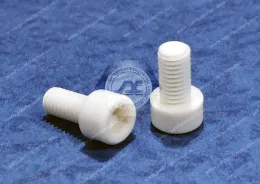
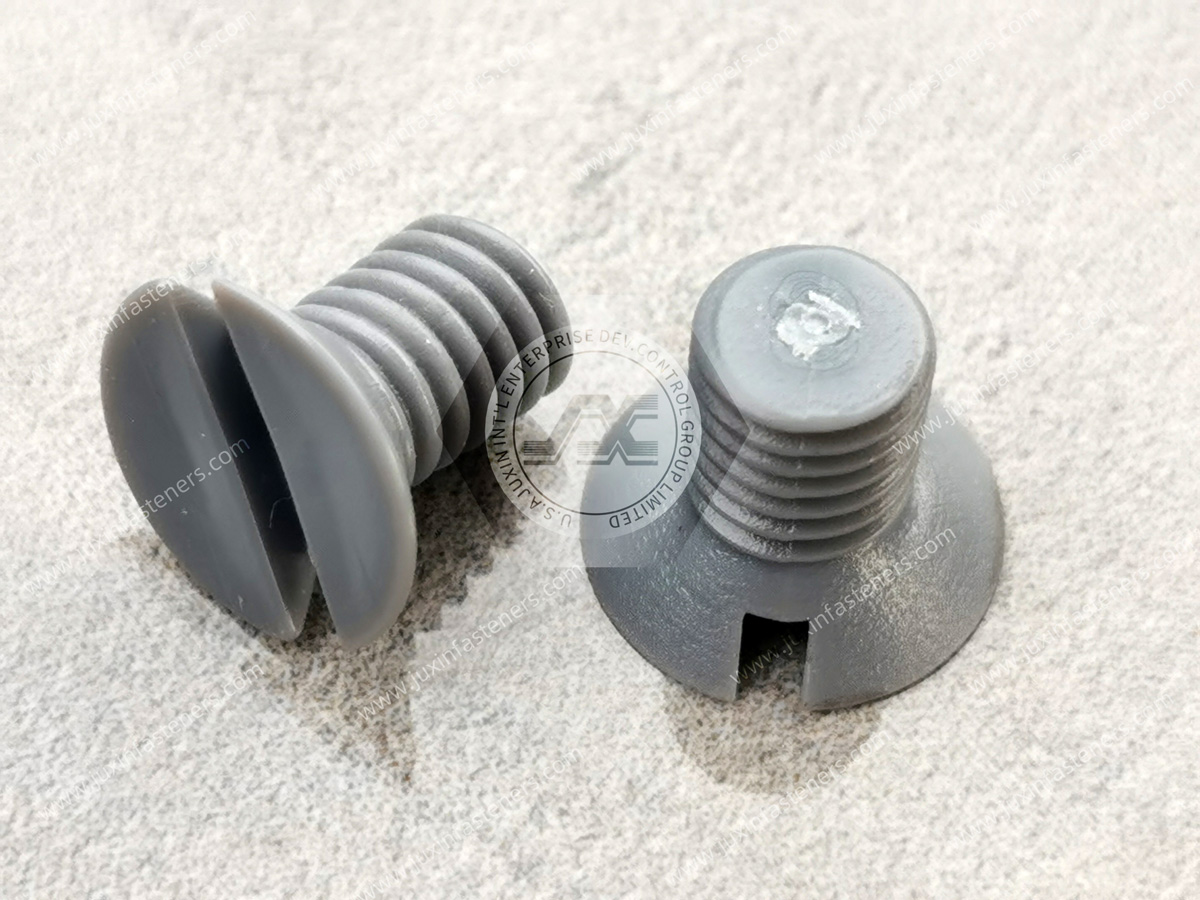
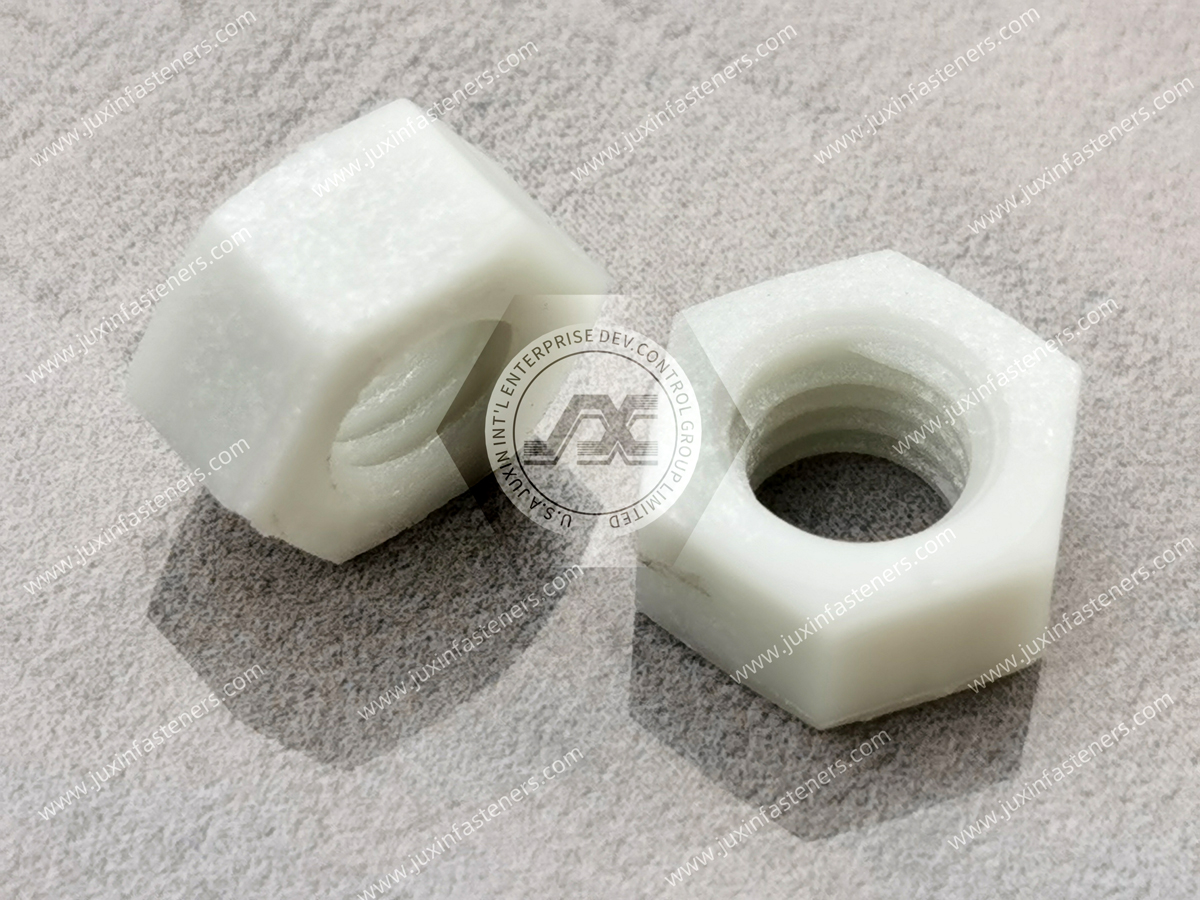
nylon machine screws and plastic threaded fasteners;
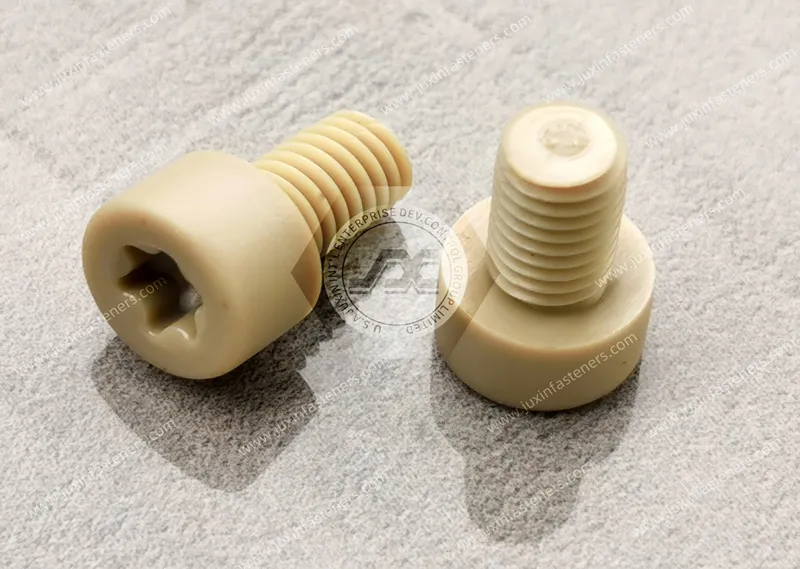
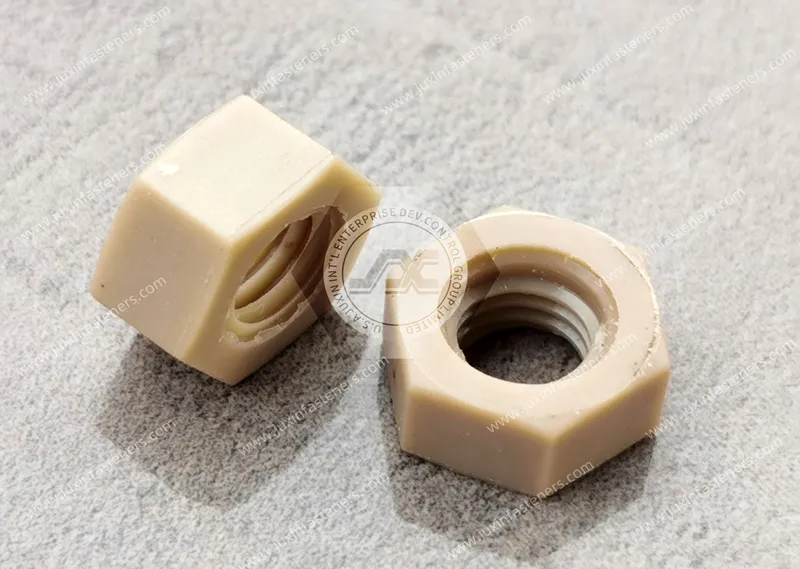
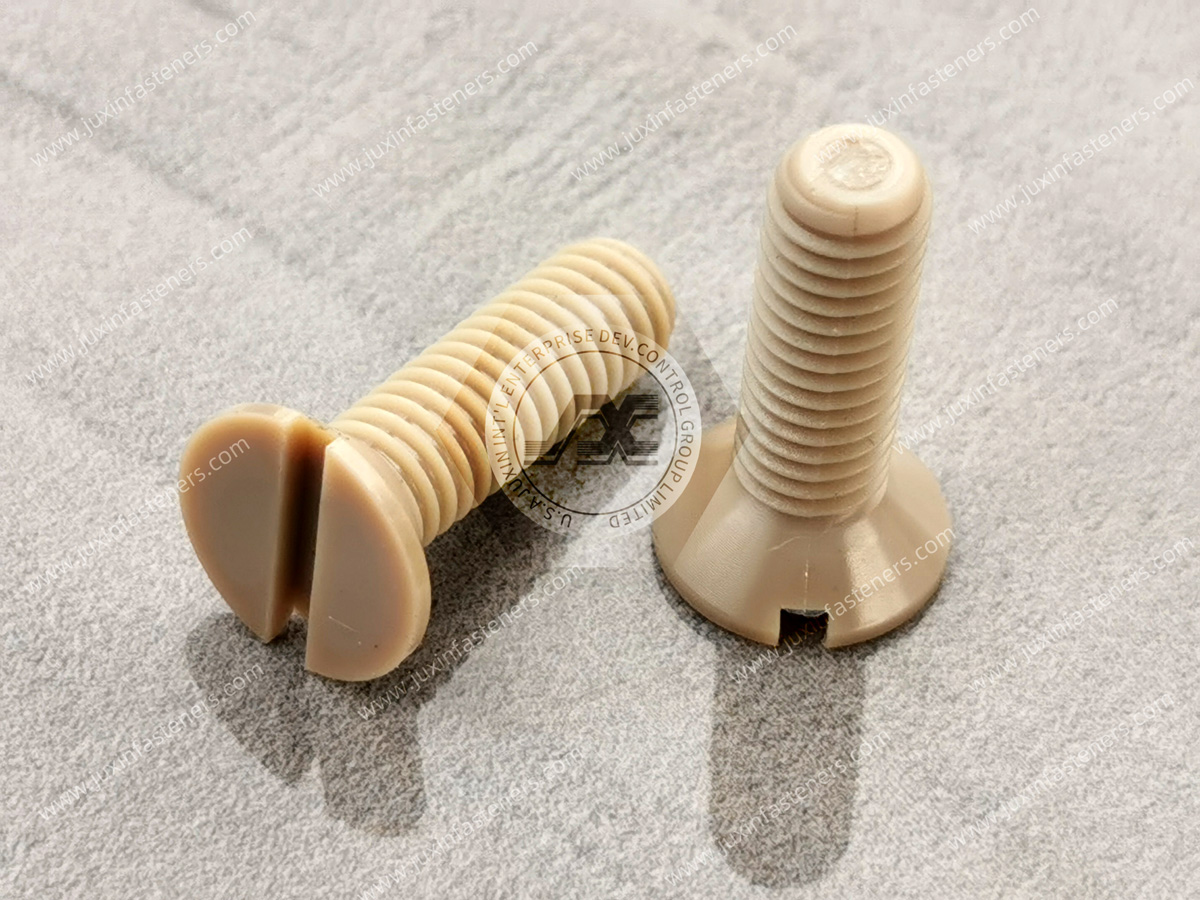
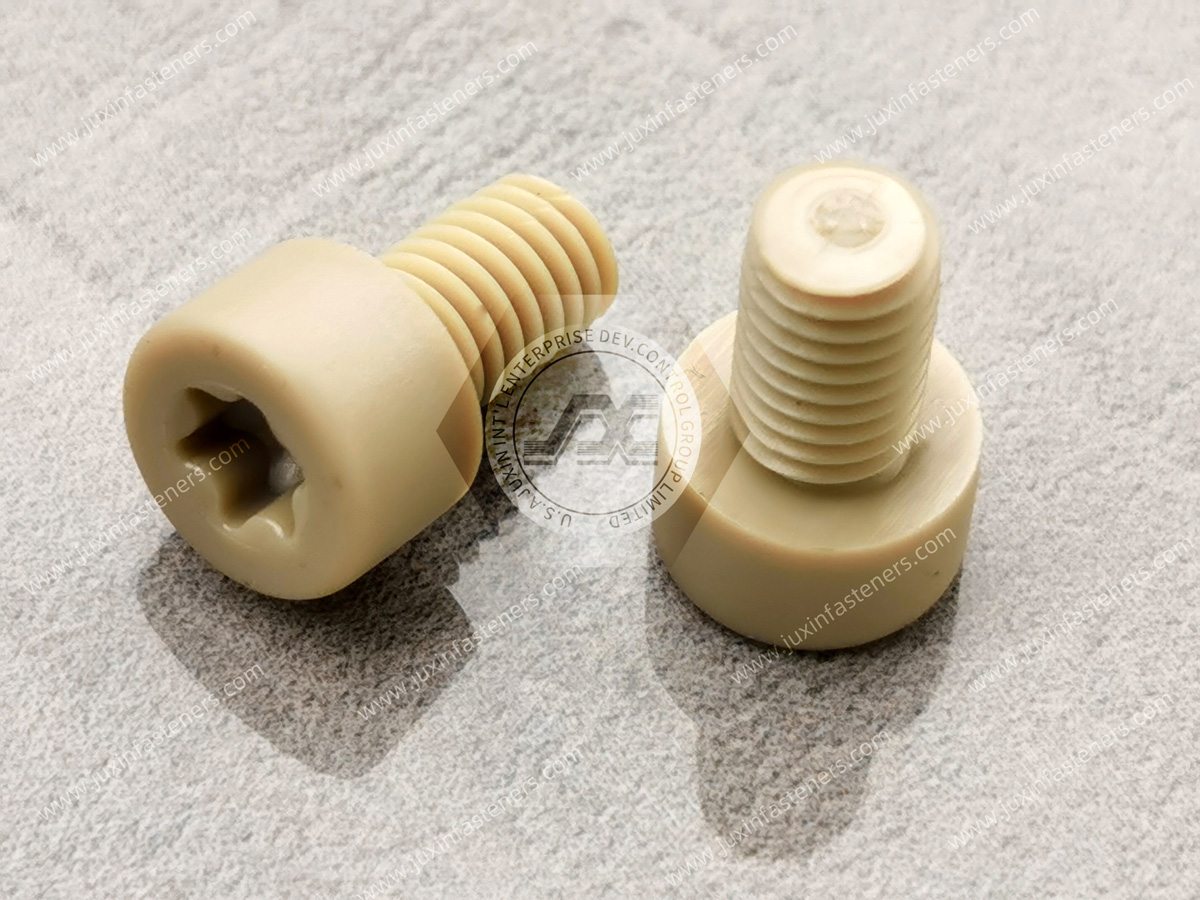
PEEK screws, nuts, and washers;
insulating shoulder washers;
plastic spacers and standoffs;
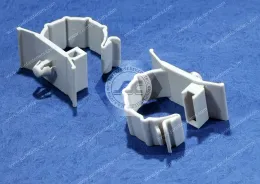
snap-fit PCB supports;
nylon cable clamps and P-clips;
cable bushings and grommets;
panel plugs and push fasteners;
custom molded plastic fasteners.
However, a polymer fastener should never be selected simply because it is lightweight.
The correct engineering sequence is:
Application Zone → Mechanical Load → Temperature → Vibration → Chemical Environment → Electrical Requirement → Material → Geometry → Qualification
Juxin Fasteners supports standard and drawing-specific plastic fastening components for industrial and equipment applications, including selected aerospace, avionics,
UAV, defense electronics, communication, test-equipment, and related projects.
Where aerospace or defense qualification, material certification, flammability, smoke and toxicity performance, vacuum compatibility, traceability,
or customer-specific approval is required, those requirements should be defined during RFQ review and validated for the specific component and application.
The engineering case for plastic hardware is not simply that plastic weighs less than metal.
A correctly selected polymer component can combine several functions:
Fastening + Electrical Isolation + Surface Protection + Corrosion Separation + Weight Reduction
For example, a metallic screw passing through a conductive enclosure may require a separate insulating bushing or shoulder washer. In a suitable low- or moderate-load application, a polymer fastener may provide mechanical retention and electrical isolation within the same component.
This means the real engineering value comes from functional integration rather than material density alone.
For design engineers, the question should therefore not be:
“Can we replace this metal screw with plastic?”
A better question is:
“What mechanical, electrical, environmental, and assembly functions must this fastening point perform?”
That distinction is especially important in aerospace, UAV, avionics, and defense equipment.
The term “aerospace plastic fastener” does not describe a single performance class.
A fastener inside a protected avionics enclosure experiences completely different conditions from a component installed on an external UAV structure,
near a high-temperature zone, inside ground-support equipment, or in a vacuum-sensitive space system.
For example:
Primary requirements may include:
electrical isolation;
PCB spacing;
low component mass;
vibration resistance;
controlled flammability performance.
The design may prioritize:
weight reduction;
vibration resistance;
thermal cycling;
compact assembly;
field serviceability.
Requirements may include:
electrical isolation;
cable retention;
shock and vibration resistance;
environmental durability;
ruggedized enclosure integration.
Additional considerations may include:
outgassing;
vacuum compatibility;
thermal cycling;
contamination control;
material traceability.
Therefore:
Aerospace Industry ≠ Aerospace Qualification ≠ One Material Specification
Each application requires its own engineering and qualification review.
Modern avionics equipment contains densely packaged PCBs, sensor electronics, communication modules, power electronics, control processors, and navigation systems.
Plastic hardware may be used for:
PCB mounting;
electrical isolation;
component spacing;
cable routing;
panel retention;
enclosure hardware.
Potential solutions include Nylon Machine Screws, Insulating Shoulder Washers, Plastic Spacers and Standoffs, and Snap-Fit PCB Supports.
In these applications, the primary engineering advantage is often electrical isolation, assembly simplification, or weight reduction rather than maximum structural strength.
Mass management is especially important in UAV platforms because component weight contributes directly to total aircraft mass and payload allocation.
Plastic hardware may be considered for selected non-primary-structural applications such as:
electronics mounting;
sensor brackets;
cable routing;
inspection covers;
interior panels;
payload electronics;
camera systems;
communication modules.
Potential products include lightweight polymer screws, nylon nuts, plastic washers, PEEK fasteners, cable clamps, bushings, spacers, and panel fasteners.
However, replacing a metal fastener with plastic should not be based on density alone.
The engineer must evaluate:
Required Load / Allowable Polymer Stress / Temperature / Creep / Vibration / Safety Factor
Carbon-fiber composites, fiberglass laminates, engineered plastics, and coated panels can be damaged by excessive localized bearing pressure from metallic hardware.
Polymer fasteners, washers, and bushings can provide:
softer contact surfaces;
electrical separation;
reduced scratching;
corrosion separation;
controlled bearing pressure.
Products such as nylon flat washers, plastic finishing washers, insulating shoulder washers, and selected polymer screws may therefore be useful around sensitive panel interfaces.
Carbon-fiber composite assemblies require additional consideration because carbon fiber is electrically conductive and can contribute to galvanic corrosion when coupled with certain metals in the presence of an electrolyte.
A polymer washer, shoulder washer, or bushing can help interrupt direct conductive contact, but the complete joint—including coatings,
fastener material, moisture exposure, edge conditions, and structural requirements—must be evaluated.
Defense electronics and ruggedized equipment frequently require secure internal cable and wire-harness retention under shock and vibration.
Potential polymer cable-management components include:
Heavy-Duty Nylon Cable Clamps and P-Clips;
adjustable cable clamps;
cable tie mounts;
nylon snap bushings;
strain-relief components;
wire harness clips.
These components can support signal wiring, power wiring, coaxial cables, sensor harnesses, and communication cables.
The cable-management design should evaluate bundle diameter, bend radius, vibration, abrasion, mounting-hole geometry, installation torque, and operating temperature.
Polymer fasteners may also be considered where engineers need to reduce unintended conductive paths around sensitive electronics.
Potential applications include:
sensor mounting;
antenna-related electronics;
instrumentation;
navigation modules;
PCB support;
cable routing.
However, it is important to distinguish electrical insulation from EMI shielding.
A plastic screw is electrically non-conductive, but it does not automatically improve the overall EMI/EMC performance of a system.
EMI/EMC behavior depends on the complete architecture, including grounding, bonding, enclosure design, shielding, cable routing, and connector interfaces.
PEEK is a high-performance engineering thermoplastic that may be considered for demanding equipment applications because of its combination of mechanical strength,
elevated-temperature capability, chemical resistance, electrical insulation, and dimensional stability.
Potential components include:
PEEK screws;
PEEK nuts;
PEEK washers;
PEEK spacers;
PEEK standoffs;
custom PEEK components.
Potential application zones may include selected avionics equipment, test systems, instrumentation, high-temperature electronics, vacuum-supporting equipment, and precision assemblies.
However:
PEEK does not automatically mean aerospace-qualified.
The exact resin grade, processing route, finished-component requirements, traceability, test data, and customer specification must be reviewed for each project.
PA66 is widely used for plastic fastening and support components requiring electrical insulation, moderate mechanical strength, fatigue resistance, low weight, and economical molded geometry.
Potential components include:
nylon machine screws;
nylon nuts;
nylon washers;
plastic spacers;
PCB supports;
cable clamps;
bushings.
PA66 is hygroscopic.
Moisture absorption can affect dimensions, stiffness, impact behavior, and long-term mechanical properties.
This should be considered when components operate across wide humidity conditions or where tight dimensional tolerances are required.
Glass reinforcement can increase polymer stiffness, strength, dimensional stability, and creep resistance.
However, reinforcement can also change impact behavior, surface characteristics, abrasion behavior, electrical characteristics, and molding performance.
Glass-filled polymer should therefore not automatically be considered a superior substitute for unfilled nylon.
For assemblies contacting delicate composites, wire insulation, optical components, or sensitive surfaces, the more abrasive characteristics of some reinforced materials may be undesirable.
POM may be considered for applications requiring:
dimensional stability;
low moisture absorption;
low friction;
wear resistance;
repeatable mechanical movement.
Potential uses include selected adjustment mechanisms, guides, retainers, and precision equipment hardware.
Its suitability must still be evaluated against temperature, flammability, chemical exposure, and customer-specific requirements.
PVDF and other engineering polymers may be considered where chemical resistance, electrical isolation, and environmental resistance are important.
Material selection should always be based on the exact fluid or chemical, concentration, temperature, exposure duration, and mechanical stress.
Engineering polymers have substantially lower density than common metallic fastener materials.
However, density alone does not determine the final weight-saving benefit.
A meaningful comparison should consider:
Fastener Mass + Required Fastener Size + Washer/Bushing Requirements + Joint Geometry + Safety Factor
A polymer screw may require a different diameter or geometry to achieve the required mechanical performance.
Conversely, a polymer component may eliminate separate insulating hardware.
Therefore the relevant engineering metric is:
Total Assembly Mass
rather than fastener density alone.
A common sourcing mistake is assuming that because a polymer offers a favorable strength-to-weight ratio,
it can directly replace a steel, stainless steel, aluminum, or titanium fastener of the same dimensions.
This is incorrect.
Engineers must compare:
tensile load;
shear load;
bearing load;
clamp load;
thread strength;
temperature;
creep;
fatigue;
vibration;
impact.
For primary structural or safety-critical joints, polymer substitution requires rigorous application-specific engineering validation.
Unlike metallic fasteners, engineering thermoplastics exhibit viscoelastic behavior.
Under sustained preload, polymer components may experience:
creep;
stress relaxation;
clamp-load reduction.
These effects generally become more important as temperature, preload, and service duration increase.
For aerospace and defense equipment, this deserves particular attention because repeated thermal cycling can alter joint preload over the operating lifecycle.
Design engineers should therefore evaluate long-term material behavior rather than relying only on short-term tensile-strength values.
Polymer fasteners generally have higher coefficients of thermal expansion than metals.
An aerospace assembly may combine:
polymer fasteners;
aluminum structures;
stainless steel;
titanium;
carbon-fiber composites;
ceramics;
PCB laminates.
During temperature cycling, each material expands and contracts differently.
Potential consequences include:
clamp-load variation;
joint loosening;
panel distortion;
clearance changes;
increased bearing stress.
Thermal stack-up should therefore be evaluated for the complete assembly rather than the fastener alone.
Engineering polymers can provide useful damping characteristics.
However:
Vibration damping does not automatically mean vibration retention.
A plastic fastener can still loosen, creep, fatigue, or fail if the joint is incorrectly designed.
Engineers should evaluate:
vibration spectrum;
amplitude;
frequency;
shock loading;
fastener preload;
thread engagement;
joint stiffness;
locking strategy.
Where a formal vibration or shock specification applies, testing should be performed according to the project or customer qualification requirements.
Aerospace and defense equipment can encounter:
fuels;
lubricants;
hydraulic fluids;
cleaning agents;
de-icing chemicals;
solvents;
coolants;
moisture.
Polymer compatibility depends on the exact chemical, concentration, temperature, exposure duration, and mechanical stress.
Therefore:
General chemical resistance does not equal approved aerospace fluid compatibility.
The actual service environment must be evaluated.
Another important distinction is between generic polymer flammability data and aerospace qualification.
UL 94 classifications such as V-0, V-1, or V-2 can provide useful material information for certain electrical and electronic applications.
However:
UL 94 classification does not automatically establish compliance with aerospace flammability requirements.
Aircraft interiors, aerospace equipment, and defense programs may require different test methods and acceptance criteria for flame propagation, smoke density, toxicity, or heat release.
Where such requirements apply, the exact standard and acceptance criteria should be identified during RFQ review.
Polymer fasteners intended for satellite or vacuum equipment require additional consideration.
Potential concerns include:
outgassing;
absorbed moisture;
volatile additives;
condensable materials;
thermal cycling;
radiation;
contamination.
For vacuum-sensitive applications, material screening may include recognized test methods such as ASTM E595 when specified by the project.
However:
Base resin data does not automatically qualify the finished fastener.
Finished-component behavior can also be influenced by the exact resin grade, pigments, fillers, processing aids, molding conditions, machining, cleaning, handling, and packaging.
The project should therefore define the required validation method.
Polymer fasteners are useful where engineers wish to avoid ferromagnetic metallic hardware.
Potential applications include selected sensors, navigation equipment, instrumentation, test equipment, and magnetic-field-sensitive electronics.
However, “non-magnetic” should not automatically be interpreted as qualification for a specific aerospace, defense, or scientific system.
The complete equipment specification must still be reviewed.
| Application Zone | Primary Engineering Requirement | Potential Polymer Direction |
|---|---|---|
| Avionics Enclosure | Electrical Isolation / Low Mass | PA66 / PEEK / Application-Specific Polymer |
| PCB Mounting | Isolation / Controlled Spacing | PA66 / PEEK |
| UAV Electronics | Low Mass / Vibration | PA66 / PEEK / Reinforced Polymer |
| Composite Panels | Surface Protection / Isolation | PA66 / POM / Application-Specific Polymer |
| Ruggedized Communications | Cable Retention / Vibration | PA66 |
| Precision Instrumentation | Dimensional Stability | POM / PEEK |
| Higher-Temperature Equipment | Thermal Performance | PEEK / Qualified High-Performance Polymer |
| Vacuum / Space Equipment | Outgassing / Thermal Cycling | Project-Specified Qualified Polymer |
This matrix is intended for initial material screening only.
Final material selection must be based on the actual application environment and qualification requirements.
Possible causes include polymer creep, elevated temperature, excessive initial preload, and thermal cycling.
Possible causes include excessive installation torque, impact loading, unsuitable resin selection, chemical attack, or low-temperature brittleness.
Possible causes include insufficient bearing area, excessive torque, abrasive reinforced materials, or unsuitable washer geometry.
Possible causes include incorrect bundle diameter, excessive vibration, elevated temperature, or mounting misalignment.
Possible causes include moisture absorption, thermal expansion, and chemical exposure.
Possible causes include unsuitable resin grades, additives, absorbed moisture, cleaning residues, or packaging contamination.
Understanding these failure modes before sourcing reduces the risk of approving a dimensionally correct but functionally unsuitable component.
Second-source qualification should compare more than dimensional interchangeability.
A structured review should include:
OEM part number and drawing revision;
geometry and critical dimensions;
thread specification;
material family and exact resin grade where required;
reinforcement or filler;
color requirements;
mechanical load;
installation torque;
operating temperature;
vibration and shock;
chemical and fluid exposure;
electrical requirements;
flammability requirements;
vacuum or outgassing requirements where applicable;
traceability requirements;
packaging requirements;
customer-specific qualification requirements.
A replacement part should not be approved solely because it physically fits the assembly.
Procurement and supplier-development teams may submit:
proprietary OEM part numbers;
existing supplier numbers;
applicable NAS, NASM, MS, or AN references;
2D engineering drawings;
3D CAD models;
physical samples.
These references can be used to understand the requested geometry and application.
However, a polymer component should not be described as compliant with, interchangeable with,
or certified to an aerospace or military specification unless all applicable dimensional, material, performance, documentation, and qualification requirements have been verified.
This distinction is particularly important in aerospace sourcing.
Provide the existing drawing, CAD model, part number, specification reference, or physical sample.
Identify whether the component is used in avionics, UAV equipment, defense electronics, radar equipment, communication equipment,
ground-support equipment, vacuum equipment, satellite equipment, or another system.
Specify expected tensile load, shear load, clamp load, installation torque, vibration, shock, and assembly-cycle requirements.
Provide minimum and maximum operating temperatures, humidity, UV exposure, fluid exposure, chemical exposure, and vacuum or pressure conditions where relevant.
Specify electrical isolation, dielectric requirements, creepage and clearance considerations, grounding restrictions, and non-magnetic requirements where applicable.
Specify polymer family, exact resin grade where required, filler or reinforcement, flammability requirements,
smoke or toxicity requirements where applicable, outgassing requirements, and customer-specific standards.
Evaluate dimensional fit, thread fit, installation torque, surface condition, and assembly behavior.
Where required, perform project-defined mechanical, thermal-cycle, vibration, chemical-exposure, flammability, vacuum, or environmental testing.
Confirm required material documentation, lot traceability, inspection records, compliance declarations, and customer-specific documentation.
After technical approval, procurement can establish production quantity, estimated annual usage, delivery schedule, packaging, inspection requirements, and documentation requirements.
Not every aerospace-related plastic component requires the same qualification burden.
A useful sourcing framework is:
Applications where standard industrial specifications and normal OEM validation may be sufficient.
Applications requiring controlled drawings, defined material requirements, traceability, testing, and customer validation.
Applications requiring formal customer-approved materials, qualification testing, documentation, controlled specifications, and potentially program-specific requirements.
This distinction helps procurement teams avoid treating all aerospace-related hardware either as ordinary commercial components or as automatically flight-qualified parts.
Some aerospace, UAV, avionics, and defense equipment manufacturers require proprietary components that are unavailable from standard catalogs.
Potential custom products include:
PEEK screws;
custom nylon screws;
polymer nuts;
insulating washers;
shoulder washers;
precision spacers;
standoffs;
cable-management hardware;
panel retainers;
drawing-specific molded plastic components.
Juxin Fasteners can support drawing-based sourcing through:
2D drawing review;
3D CAD review;
physical sample comparison;
dimensional review;
material discussion;
DFM review;
sample evaluation;
production sourcing.
Availability of specific aerospace material grades, certifications, testing, documentation, controlled processes, or customer qualification requirements must be confirmed for each project.
For efficient engineering and procurement review, provide:
Part Information
OEM or existing supplier part number;
applicable specification reference;
2D drawing;
3D CAD model;
physical sample where available.
Fastener Specification
component type;
thread size;
length;
critical dimensions;
tolerances.
Material
PA66;
POM;
PVDF;
PEEK;
other polymer;
exact resin grade where required;
reinforcement or filler;
color.
Mechanical Requirements
tensile load;
shear load;
clamp load;
installation torque;
vibration;
shock.
Environmental Requirements
operating temperature;
humidity;
UV exposure;
fluid exposure;
chemical exposure;
vacuum or pressure where applicable.
Electrical Requirements
electrical isolation;
dielectric performance;
creepage and clearance;
non-magnetic requirement.
Compliance Requirements
flammability;
smoke and toxicity where applicable;
outgassing where applicable;
aerospace or military specification;
customer-specific testing.
Documentation Requirements
material documentation;
lot traceability;
inspection reports;
RoHS or REACH where applicable;
customer-specific quality documentation.
Procurement Information
prototype quantity;
sample quantity;
production quantity;
estimated annual usage;
delivery schedule.
Related Juxin Fasteners product and engineering solutions include:
PEEK Screws and Fasteners for selected high-performance applications;
Nylon Machine Screws for electrically isolated low-to-moderate-load assemblies;
Insulating Shoulder Washers for radial and axial electrical isolation;
Plastic Spacers and Standoffs for electronic module mounting;
Snap-Fit PCB Supports for selected avionics and electronic assemblies;
Heavy-Duty Nylon Cable Clamps for wire-harness routing;
Nylon Snap Bushings for cable protection through metal panels;
Custom Molded Plastic Fasteners for proprietary equipment designs.
These product pages should be internally linked from this aerospace industry solution page so engineers can move from application-level research to component-level evaluation.
Juxin Fasteners supports OEM engineering teams, equipment manufacturers, procurement organizations, supplier-development teams,
contract manufacturers, and industrial sourcing organizations requiring standard or drawing-specific polymer fastening components for aerospace equipment,
avionics, UAV systems, defense electronics, radar equipment, secure communications, ground-support equipment, instrumentation, and related applications.
For aerospace and defense projects, the recommended sourcing path is:
Existing Part / Drawing / Sample → Application Review → Mechanical & Environmental Requirements → Material Selection
→ Compliance Review → Sample Evaluation → Customer Validation → Documentation Review → Second-Source Qualification → Production RFQ
This workflow can support:
new equipment development;
lightweighting projects;
electrical-isolation requirements;
metal-to-polymer conversion studies;
composite surface protection;
second-source qualification;
supplier consolidation;
obsolete-part replacement;
custom component development.
For flight hardware, defense-controlled programs, vacuum applications, satellite systems, or safety-critical assemblies,
provide the exact customer specification, qualification requirements, material requirements, testing requirements, and documentation requirements during RFQ review.
A generic polymer designation or dimensional match alone should never be treated as aerospace qualification.
Send us your existing part number, 2D drawing, 3D CAD model, physical sample, application environment, load requirements, material specification,
operating temperature, vibration requirements, fluid exposure, electrical requirements, qualification standards,
documentation requirements, prototype quantity, production quantity, and estimated annual usage for engineering review and RFQ evaluation.
Email: info@juxinfasteners.com
Website: www.juxinfasteners.com

Product Packaging
Packaging Standard
At Juxin Fasteners, we apply standardized export packaging to ensure product protection, traceability, and compliance with international logistics requirements.
1. Standard Export Packaging
Unless otherwise specified, all products will be packed according to our factory standard export packaging, which includes:
Moisture-resistant inner protection
Poly bag or small box packing as required
Reinforced export cartons
Clear labeling with part number, specification, batch number, and quantity
Palletizing for sea or air shipment when necessary
Our standard packaging is designed to ensure safe transportation, efficient warehousing, and long-distance international shipping.
2. Customized Packaging Options
We also provide customized packaging solutions according to customer requirements, including but not limited to:
Private labeling
Customized barcodes
Specific carton dimensions
Retail packaging
Special pallet configuration
Customer-specific marking and identification
So that you know, customized packaging may involve additional costs and extended lead time depending on the complexity of the requirements.
3. Compliance & Quality Assurance
All packaging processes are controlled under our ISO 9001 quality management system to ensure consistency, traceability, and product integrity throughout the supply chain.
Product Pictures
Hot Products
Contact Us
Tel.:
+86 020 8621 0320
+86 020 3121 6067
E-mail:
Technical Support:
Navigation
SEND INQUIREY