Call Us
+86 136 6007 9809
Call Us
+86 136 6007 9809

Industrial original equipment manufacturers (OEMs) designing electronic enclosures, control panels, medical instruments, communications equipment, automotive components,
and lightweight mechanical assemblies may consider polymer fastening components as an alternative to conventional metal hardware.
Product Specification
Industrial original equipment manufacturers (OEMs) designing electronic enclosures, control panels, medical instruments, communications equipment, automotive components,
and lightweight mechanical assemblies may consider polymer fastening components as an alternative to conventional metal hardware.
Nylon screws and plastic bolts can provide useful characteristics for selected applications, including electrical non-conductivity, lower material density than many metals,
resistance to many common corrosive environments, and reduced risk of scratching or metal-to-metal contact.
However, polymer threaded fasteners do not behave in the same way as steel, stainless steel, or other metallic fasteners.
Design engineers and procurement managers need to consider the selected polymer, material grade, thread geometry, installation method, temperature, moisture exposure,
chemical environment, sustained loading, and required assembly life before specifying a plastic threaded fastener.
Torque is particularly important. A torque value used for a metal fastener should not automatically be transferred to a nylon screw or plastic bolt.
JUXIN FASTENERS is an engineering-oriented supplier of industrial fastening and custom component solutions.
For OEM projects, product selection and production requirements depend on the customer's drawings, material requirements, quantities, application conditions, quality requirements, and applicable specifications.
This guide explains how engineers and sourcing teams can evaluate nylon screws and plastic bolts,
understand the main engineering considerations, integrate complementary plastic hardware, and prepare a practical OEM sourcing inquiry.
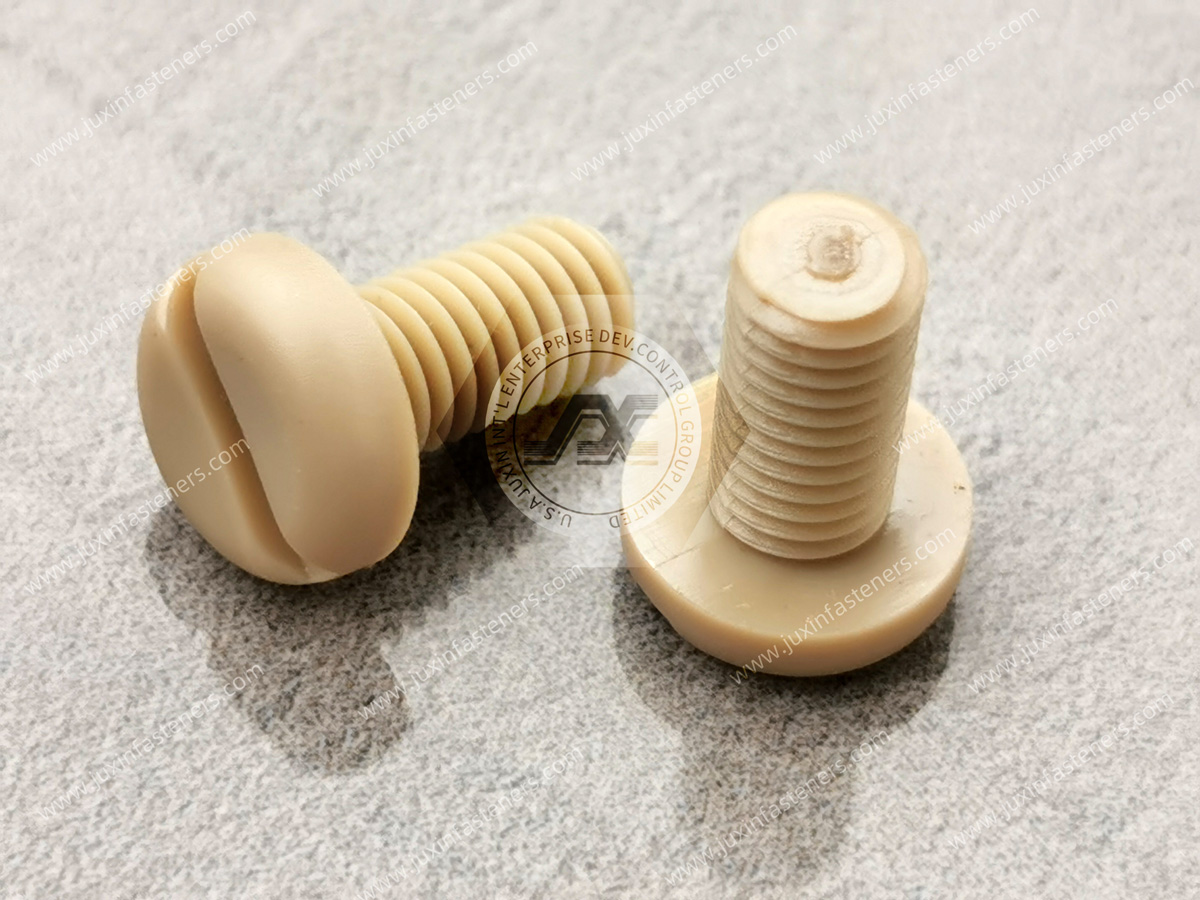
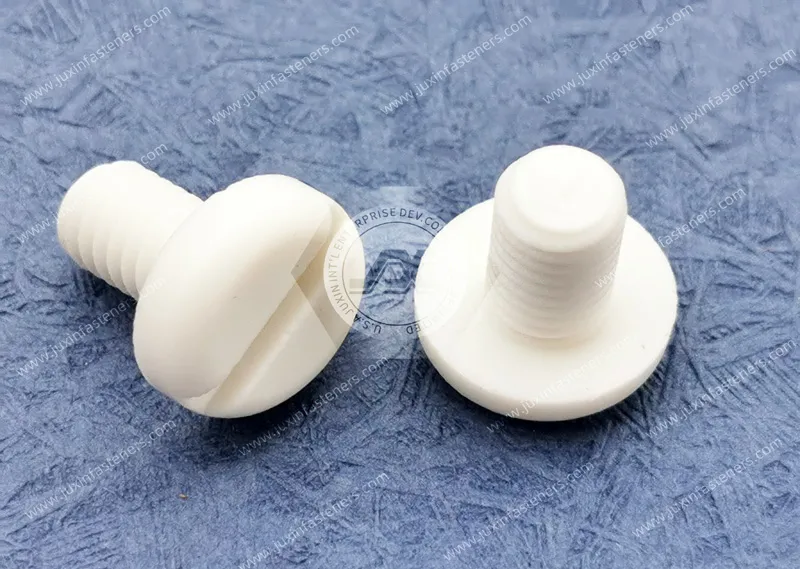
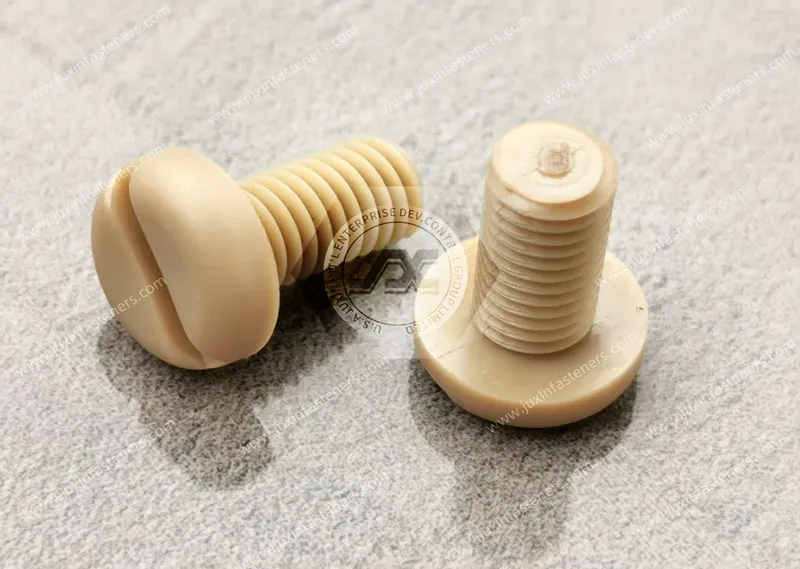
Nylon screws and plastic bolts may be appropriate when an assembly requires one or more characteristics that polymer fastening components can provide.
Typical considerations include:
Electrical non-conductivity: Polymer fasteners can be useful where the fastening component should not provide a conductive metallic path.
Weight reduction: Polymer components generally have lower density than common structural metals, which can be relevant to lightweight equipment and assemblies.
Corrosion considerations: Polymer materials do not undergo metallic corrosion in the same way as steel or other metals,
although the suitability of the polymer still depends on the surrounding environment and chemicals.
Surface protection: Plastic fasteners may reduce the risk of scratching or damaging certain mating surfaces compared with metal-to-metal fastening.
Material compatibility: A polymer fastener may be considered where direct metal contact is undesirable for the specific assembly.
Application-specific damping characteristics: Some polymer components can provide different contact and vibration behavior from rigid metallic hardware,
but the actual effect depends on the material and joint design.
These benefits should be evaluated against the lower mechanical performance and different long-term behavior that can occur with polymer fasteners.
For load-bearing or safety-critical joints, the fastener material, geometry, joint design, installation process, and service conditions require specific engineering evaluation.
The primary engineering question is not simply whether plastic can replace metal.
The question is whether the selected polymer fastener can provide the required joint function under the actual operating conditions.
Several factors require attention.
Polymer fasteners generally have different mechanical behavior from metallic fasteners.
Applying excessive installation torque can damage the head, deform the threads, strip the mating thread, or otherwise affect the joint.
At the same time, insufficient installation torque may result in inadequate seating or clamping for the intended application.
There is therefore no universal torque value for every nylon screw or plastic bolt.
A practical torque requirement depends on factors such as:
Polymer family
Specific material grade
Fastener size
Thread geometry
Thread engagement
Mating material
Joint design
Lubrication or surface condition
Installation speed
Temperature
Required preload
Assembly method
For production applications, the installation torque should be established through the applicable fastener specification, supplier data where available,
and application validation rather than copied directly from a metal-fastener torque chart.
Polyamide materials such as PA6 and PA66 can absorb moisture from the surrounding environment.
Moisture can change certain mechanical and dimensional characteristics of nylon.
This matters particularly where a design involves:
Tight dimensional tolerances
Long-term storage
Humid environments
Precision thread engagement
Small clearances
Dimensional stack-up
Engineers should therefore consider the expected material condition and service environment when designing close-tolerance nylon assemblies.
Polymer materials generally have different thermal expansion behavior from metals.
When a plastic screw or bolt is assembled with a metal component, temperature changes can affect the relative dimensions of the two materials.
In applications with significant temperature cycling, engineers should consider:
Material expansion
Joint geometry
Thread engagement
Preload variation
Clearance
Alignment
The actual effect depends on the material combination and joint architecture.
Polymer fasteners can exhibit time-dependent deformation under sustained loading.
This behavior, commonly referred to as creep, becomes more relevant when a component is continuously loaded.
Engineers should consider:
Applied load
Load duration
Temperature
Fastener geometry
Material grade
Thread engagement
Joint stiffness
Required service life
For applications requiring long-term preload retention, the polymer fastener should be evaluated as part of the complete joint rather than as an isolated component.
Stress relaxation is another consideration for polymer joints.
When a polymer component remains under deformation, the internal stress can decrease over time.
This can be relevant to assemblies where maintaining a particular clamping condition over an extended period is important.
Where long-term clamping force is critical, the design may require an alternative joint architecture, a different material, or additional mechanical elements.
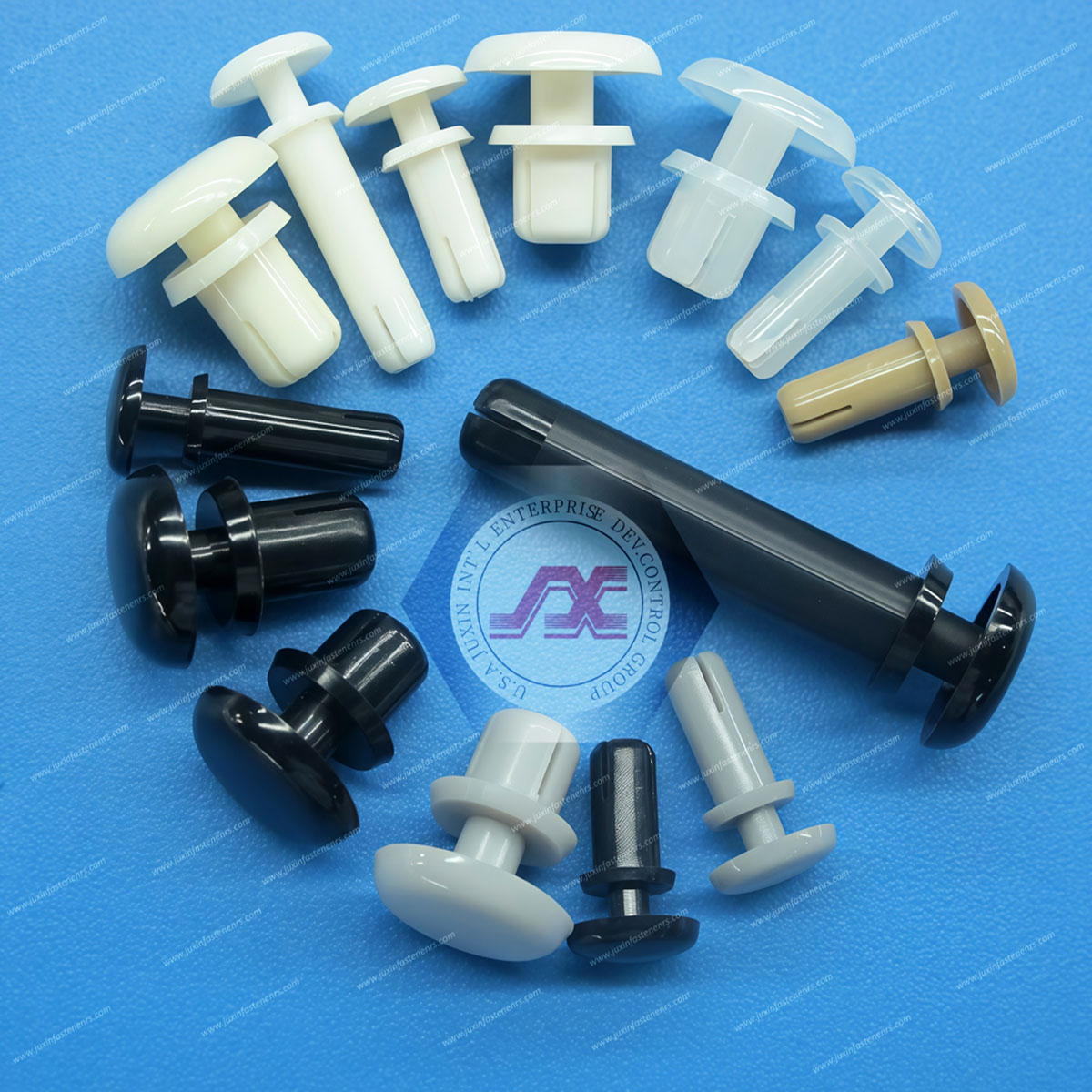
In professional OEM engineering, nylon screws and plastic bolts are rarely considered completely independently from the rest of the assembly.
The surrounding hardware can influence load distribution, positioning, electrical separation, and assembly behavior.
A complete plastic hardware solution may therefore combine several component types.
A plastic machine screw can be paired with a nylon flat washer or other suitable plastic washer where additional bearing-area distribution or surface protection is required.
The washer dimensions and material should be selected according to the mating surface and joint requirements.
A nylon bolt can be paired with a matching plastic nut for applications where a non-metallic fastening arrangement is appropriate.
The thread compatibility, engagement length, installation method, and expected load should be evaluated together.
A nylon lock nut or other locking configuration may be considered when the application requires additional resistance to loosening, but the suitability depends on the material and joint design.
Plastic screws can also be used together with spacers or threaded standoffs to establish a defined separation between components.
This can be relevant in:
PCB assemblies
Electronic enclosures
Control equipment
Instrumentation
Communications equipment
Electrical assemblies
The required standoff height, thread engagement, mounting interface, and clearance should be defined in the engineering drawing.
The polymer family has a major influence on the behavior of a plastic threaded fastener.
Nylon is common in industrial fastening, but it is not the only polymer option.
| Polymer Family | Typical Material Examples | General Characteristics to Evaluate | Potential Industrial Applications | Engineering & Sourcing Considerations |
|---|---|---|---|---|
| Nylon / Polyamide | PA6, PA66 | Balanced mechanical properties for many industrial applications | Electrical enclosures, control equipment, automotive components, equipment housings | Moisture absorption, creep, stress relaxation, temperature, chemical exposure, and dimensional behavior should be evaluated |
| POM / Acetal | Homopolymer / Copolymer Acetal | Rigidity, low friction, and useful dimensional characteristics in selected applications | Precision mechanisms, sliding components, equipment assemblies, mechanical linkages | Evaluate friction, wear, temperature, chemical compatibility, and mating-thread behavior |
| PP | Polypropylene | Low density and useful chemical resistance in selected environments | Industrial components, equipment accessories, chemical-related applications | Mechanical loading, temperature, dimensional requirements, and application environment require evaluation |
| PC | Polycarbonate | Toughness and impact-related properties can be useful in selected designs | Electronic housings, industrial equipment, protective components | Temperature, chemical compatibility, geometry, and required mechanical performance should be reviewed |
| PVDF | Polyvinylidene Fluoride | Chemical and environmental resistance can be relevant in demanding applications | Chemical-processing equipment, semiconductor-related equipment, specialized industrial applications | Material grade, chemical exposure, temperature, mechanical requirements, and service conditions should be verified |
| PEEK | Polyetheretherketone | High-performance engineering polymer for demanding environments | Specialized industrial equipment and selected high-temperature applications | Material cost, temperature, chemical environment, geometry, and production requirements should be evaluated |
The table provides a material-selection framework rather than universal performance data.
The correct material grade should be confirmed against the customer's specification and actual operating environment.
Nylon is widely considered for general industrial plastic fasteners because it offers a useful combination of mechanical properties, weight characteristics, and practical application range.
However, PA6 and PA66 should not automatically be treated as identical in every application.
If the design has tight dimensional requirements, continuous loading, elevated temperature, significant moisture exposure, or demanding chemical conditions, the exact material grade and application conditions should be reviewed.
POM can be considered where rigidity, friction behavior, and dimensional characteristics are important.
Its suitability depends on the specific application and mating materials.
PVDF can be considered for applications where chemical or environmental resistance is a significant design requirement.
The specific chemical environment and material grade should be evaluated before selection.
PEEK is a high-performance engineering polymer that may be considered for demanding thermal, chemical, or mechanical environments.
Its higher material cost means that it is generally selected because the application requirements justify the material choice rather than simply as a general substitute for nylon.
One of the most important design decisions in plastic assemblies is whether the screw should engage directly with the plastic component or whether a threaded insert should be incorporated.
A direct plastic thread can be suitable for applications where:
The load is appropriate for the selected material
Assembly cycles are limited or controlled
Thread engagement is sufficient
The host material provides adequate thread geometry
The joint does not require unusually high preload
Long-term environmental conditions are acceptable
Direct plastic threads can provide a simple and cost-conscious solution for many applications.
However, the actual suitability depends on the material, geometry, thread design, and application.
A threaded insert may be considered when the plastic housing or component needs a more durable internal threaded interface.
Potential reasons include:
Repeated assembly and disassembly
Higher thread durability requirements
Specific pull-out or torque requirements
Integration with a metal screw
Limited host-material thread strength
Need for a defined metal internal thread
The appropriate insert depends on the host plastic, boss geometry, installation process, load, and production requirements.
JUXIN FASTENERS also provides technical information on threaded inserts for plastic for engineers evaluating insert-based fastening solutions.
A common sourcing mistake is specifying the screw without defining the joint.
For polymer fastening, engineers should consider the complete assembly:
Fastener → mating component → joint geometry → installation process → service environment → expected service life
For example, changing from a metal screw to a nylon screw may change more than the fastener material.
It may also change:
Installation torque
Clamping force
Thread engagement
Joint stiffness
Thermal expansion behavior
Moisture sensitivity
Long-term preload
Tooling requirements
Inspection requirements
This is why a simple material substitution should be reviewed as an engineering change rather than treated as a one-for-one purchasing replacement.
A well-prepared RFQ allows the supplier to understand both the product and its intended application.
Procurement and engineering teams should provide as much of the following information as available.
Specify:
Fastener type
Head style
Drive configuration
Thread type
Nominal size
Length
Standard reference where applicable
Potential references may include ISO, DIN, ASME/ANSI, EN, or other applicable international standards.
For custom components, the engineering drawing should define the controlling requirements.
Provide:
2D engineering drawing
3D CAD model where available
Thread dimensions
Overall length
Head dimensions
Shank dimensions
Critical tolerances
Special geometry
Drawing revision
Where GD&T is used, the relevant drawing requirements should be clearly identified.
Specify:
Polymer family
Material grade
Reinforcement requirements where applicable
Color
Surface or appearance requirements
Material documentation requirements
For example, specifying “PA66” may not be sufficient when the application depends on a particular grade or reinforcement condition.
Where relevant, provide:
Operating temperature
Chemical exposure
Expected mechanical loading
Installation torque requirements if already established
Assembly frequency
Mating material
Electrical requirements
Environmental conditions
This information can help the supplier identify potential technical questions before quotation.
Provide:
Prototype quantity
Initial production quantity
Annual volume
Forecast information where available
Expected release schedule
Packaging requirements
Labeling requirements
Multi-SKU BOM information
For programs involving several related plastic hardware categories, a consolidated BOM can help the supplier understand the complete sourcing requirement.
For OEM sourcing, the supplier evaluation should go beyond whether a company can provide a nominally matching screw.
Can the supplier support the required product family?
This may include:
Nylon screws
Plastic screws
Nylon bolts
Plastic bolts
Plastic nuts
Nylon nuts
Washers
Spacers
Standoffs
Threaded inserts
Clips
Cable clamps
Custom plastic components
Can the supplier:
Review drawings?
Interpret CAD information?
Clarify unclear dimensions?
Discuss material considerations?
Identify critical requirements?
Understand assembly conditions?
A supplier's ability to identify questions before production can be particularly valuable for custom components.
Procurement teams should clarify:
Required material grade
Material identification
Material documentation
Lot identification where required
Substitution control
Customer-specific material requirements
The exact documentation should be defined according to the customer's quality agreement.
The supplier's inspection process should be evaluated against the characteristics that matter to the component.
Possible controls include:
Dimensional inspection
Visual inspection
Critical-dimension checks
Sampling
Material verification
Lot identification
Final inspection
Specific inspection equipment should not be assumed unless it has been confirmed for the supplier and project.
If an OEM needs several plastic hardware categories, procurement may evaluate whether those components can be coordinated within one sourcing program.
This may simplify:
Supplier communication
Quotation management
Purchase-order administration
Packaging coordination
Delivery planning
However, each SKU still requires its own technical and quality evaluation.
When reviewing a drawing for a nylon screw or plastic bolt, several characteristics may have a direct effect on assembly.
Potential critical-to-function characteristics include:
Thread size
Thread form
Thread engagement
Overall length
Shank diameter
Head diameter
Head height
Drive recess
Bearing surface
Concentricity
Mating interface
The importance of each characteristic depends on the actual application.
For example, a PCB enclosure may prioritize overall length, head geometry, and mounting-hole compatibility,
while a mechanically loaded assembly may place greater emphasis on thread engagement, joint geometry, and long-term load behavior.
Identifying these characteristics early helps align engineering, production, inspection, and procurement.
Potential applications include:
Electrical components
Cable management
Sensor mounting
Protective covers
Interior components
Selected battery-related assemblies
Non-conductive mounting applications
Automotive and EV applications require evaluation of temperature, vibration, chemicals, loading, and service conditions.
Plastic and nylon screws may be considered for:
Control panels
Electrical enclosures
Mounting components
Cable-management systems
Insulating applications
Equipment accessories
The selected component should be evaluated against the electrical and mechanical requirements of the actual application.
Potential applications include:
PCB mounting
Electronic enclosures
Instrumentation
Control equipment
Communications equipment
Computer equipment
Sensor assemblies
Spacers, standoffs, washers, and threaded inserts may be used together with plastic screws to create complete mounting systems.
Plastic hardware may be considered for:
Antenna-related components
Base-station equipment
Communications enclosures
Cable management
Non-conductive mounting applications
For outdoor equipment, environmental exposure such as moisture, UV, temperature cycling, and chemicals should be considered.
Polymer fasteners may be considered in selected:
Equipment housings
Instrumentation
Electronic assemblies
Laboratory equipment
Lightweight mounting applications
Actual suitability depends on cleaning processes, chemicals, temperature, mechanical requirements, and any customer-specific regulatory requirements.
Plastic fasteners and polymer components may be considered in selected equipment applications where material compatibility, electrical properties,
chemical exposure, or equipment design make polymer hardware appropriate.
Special requirements such as chemical resistance, contamination control, or controlled-environment use should be specified separately.
Potential applications include:
Sensor mounting
Cable management
Equipment covers
Spacing components
Lightweight assemblies
Selected non-structural applications
For moving systems, engineers should consider wear, vibration, repeated loading, temperature, and long-term material behavior.
Plastic screws, washers, spacers, and clips may be considered for:
Panel assemblies
Equipment covers
Cable management
Insulating components
Mounting accessories
Selected sheet-metal applications
The actual design should consider temperature, condensation, chemical exposure, assembly method, and mechanical loading.
Depending on the application, polymer fasteners can provide electrical non-conductivity, lower material density, resistance to many common corrosive environments, and reduced risk of scratching certain mating surfaces.
They also behave differently from metal fasteners, so mechanical loading, torque, temperature, moisture, creep, and long-term joint performance must be evaluated.
Not automatically.
Nylon screws have different mechanical and long-term behavior from metallic fasteners. For higher-load or safety-critical applications, the material grade,
fastener geometry, joint design, installation method, and service conditions require specific engineering evaluation.
There is no single universal torque value for all nylon screws.
Torque depends on material grade, screw size, thread geometry, mating material, lubrication, joint design, installation method, required preload, and environmental conditions.
For production use, the torque requirement should be established through the applicable product specification and application validation.
Nylon can absorb moisture from the environment.
This can influence mechanical and dimensional behavior. The effect becomes particularly relevant for close-tolerance applications, humid environments,
long-term storage, and assemblies where dimensional stability is important.
Suitability depends on the specific polymer and application.
Standard nylon should not automatically be treated as suitable for every elevated-temperature environment.
Where higher temperature performance is required, alternative materials such as PEEK or other engineering polymers may warrant evaluation.
The actual material grade and operating conditions should be reviewed before selection.
Plastic and nylon screws can be produced in different head configurations depending on the product design and manufacturing requirements.
Potential configurations include:
Pan head
Countersunk or flat head
Socket-style head
Hex-style head
Low-profile configurations
Customer-specific head geometry
The actual available configuration should be confirmed against the required drawing and production specification.
A plastic nut may be appropriate where the application requires a non-metallic fastening arrangement.
However, the thread compatibility, load, installation method, environmental conditions, and required assembly life should be evaluated together.
A threaded insert may be considered where repeated assembly, thread durability, higher mechanical requirements, or a metal internal thread are important.
The appropriate insert depends on the host plastic, geometry, installation method, load, and production requirements.
A useful RFQ should include:
2D drawing
3D CAD model where available
Material and grade
Thread requirements
Dimensions and tolerances
Application
Quantity
Quality requirements
Packaging requirements
Multi-SKU BOM information where applicable
This gives the supplier a clearer basis for technical review and quotation.
Selecting nylon screws, plastic bolts, and other polymer threaded fasteners for an OEM application requires more than matching the nominal thread size.
The engineering review should consider:
Polymer material
Material grade
Thread geometry
Fastener dimensions
Installation method
Torque and preload requirements
Mating component
Temperature
Moisture
Chemical exposure
Long-term loading
Assembly frequency
Quality requirements
For OEM programs involving multiple related plastic hardware products, procurement teams can also evaluate whether screws, bolts, nuts, washers, spacers, standoffs,
threaded inserts, clips, and other components can be coordinated within a broader sourcing program.
If you have a drawing or CAD model for a nylon screw, plastic bolt, or custom polymer threaded component, send the available technical information to JUXIN FASTENERS for review.
Recommended RFQ information includes:
2D engineering drawing
3D CAD file where available
Material requirement
Part number
Quantity
Application
Critical dimensions
Special requirements
Quality requirements
Packaging requirements
For OEM and industrial sourcing inquiries: info@juxinfasteners.com
Product Packaging
Packaging Standard
At Juxin Fasteners, we apply standardized export packaging to ensure product protection, traceability, and compliance with international logistics requirements.
1. Standard Export Packaging
Unless otherwise specified, all products will be packed according to our factory standard export packaging, which includes:
Moisture-resistant inner protection
Poly bag or small box packing as required
Reinforced export cartons
Clear labeling with part number, specification, batch number, and quantity
Palletizing for sea or air shipment when necessary
Our standard packaging is designed to ensure safe transportation, efficient warehousing, and long-distance international shipping.
2. Customized Packaging Options
We also provide customized packaging solutions according to customer requirements, including but not limited to:
Private labeling
Customized barcodes
Specific carton dimensions
Retail packaging
Special pallet configuration
Customer-specific marking and identification
So that you know, customized packaging may involve additional costs and extended lead time depending on the complexity of the requirements.
3. Compliance & Quality Assurance
All packaging processes are controlled under our ISO 9001 quality management system to ensure consistency, traceability, and product integrity throughout the supply chain.
Product Pictures

Contact Us
Tel.:
+86 020 8621 0320
+86 020 3121 6067
E-mail:
Technical Support:
Navigation
SEND INQUIREY