Call Us
+86 136 6007 9809
Call Us
+86 136 6007 9809

Nylon snap bushings, plastic panel bushings, cable entry bushings, wire harness bushings, and strain relief bushings are widely used where electrical wires,
cable bundles, control wiring, or flexible tubing must pass through punched, stamped, laser-cut, or drilled openings in sheet-metal and polymer enclosures.
Product Specification
Nylon snap bushings, plastic panel bushings, cable entry bushings, wire harness bushings, and strain relief bushings are widely used where electrical wires,
cable bundles, control wiring, or flexible tubing must pass through punched, stamped, laser-cut, or drilled openings in sheet-metal and polymer enclosures.
Without a properly designed cable-entry interface, a conductor passing directly through a sheet-metal opening can contact a sharp or unfinished panel edge.
Repeated vibration, cable movement, thermal cycling, assembly handling, or equipment servicing can gradually abrade the cable jacket and create premature insulation damage.
A precision-molded nylon snap bushing converts the raw panel opening into a smoother polymer-lined passage while separating the cable jacket from the metal edge.
However, one engineering distinction is essential:
Snap Bushing ≠ Strain Relief Bushing
A standard snap bushing primarily provides edge protection and cable pass-through.
A true strain relief bushing is designed to additionally control cable movement or transfer specified mechanical loads away from the internal electrical termination.
These functions should not be treated as interchangeable.
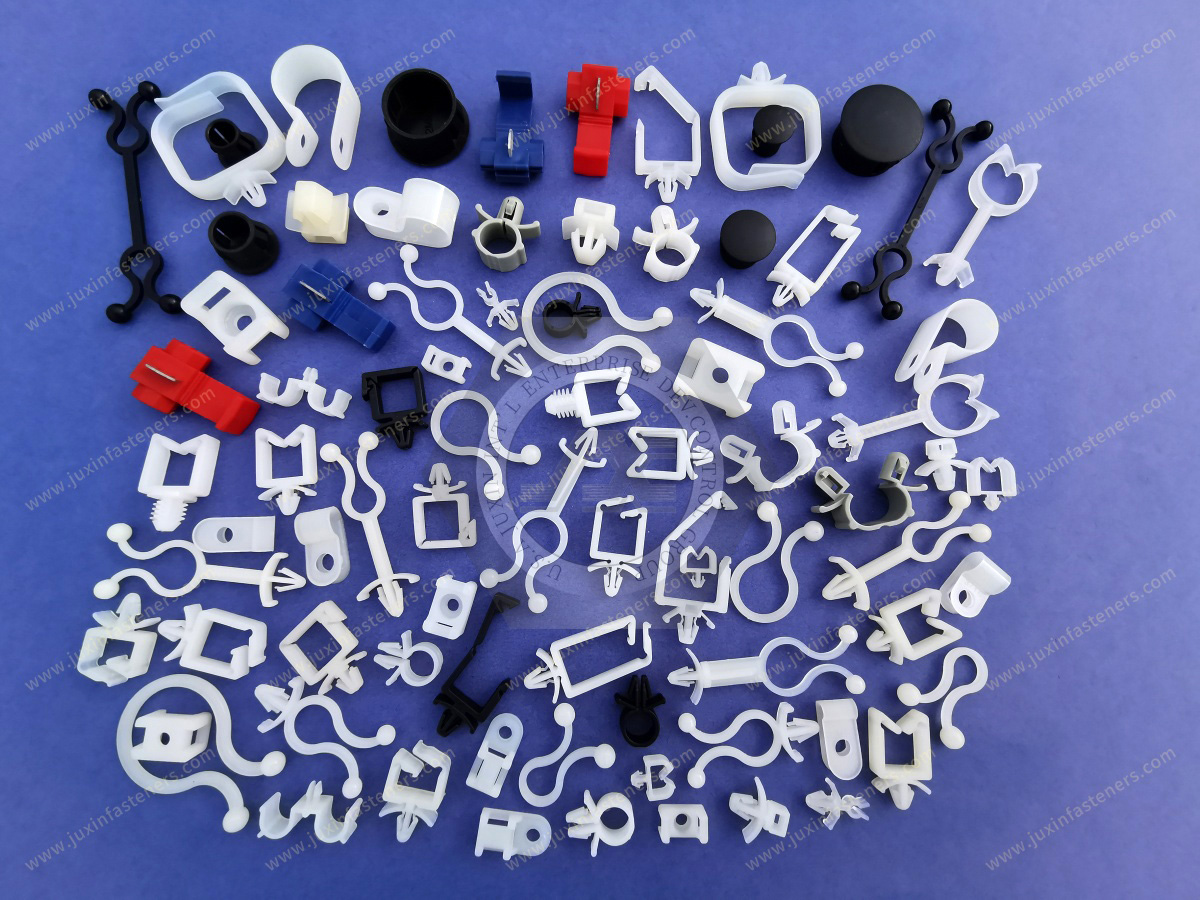
Juxin Fasteners supplies standard and custom nylon snap bushings, plastic panel bushings, cable protection components, wire-routing hardware,
and drawing-based molded plastic fasteners for global industrial OEM applications.
Engineering and sourcing review can begin from an existing manufacturer part number, OEM part number, 2D drawing, 3D CAD model, physical sample,
panel cutout dimensions, cable outer diameter, or complete application requirements.
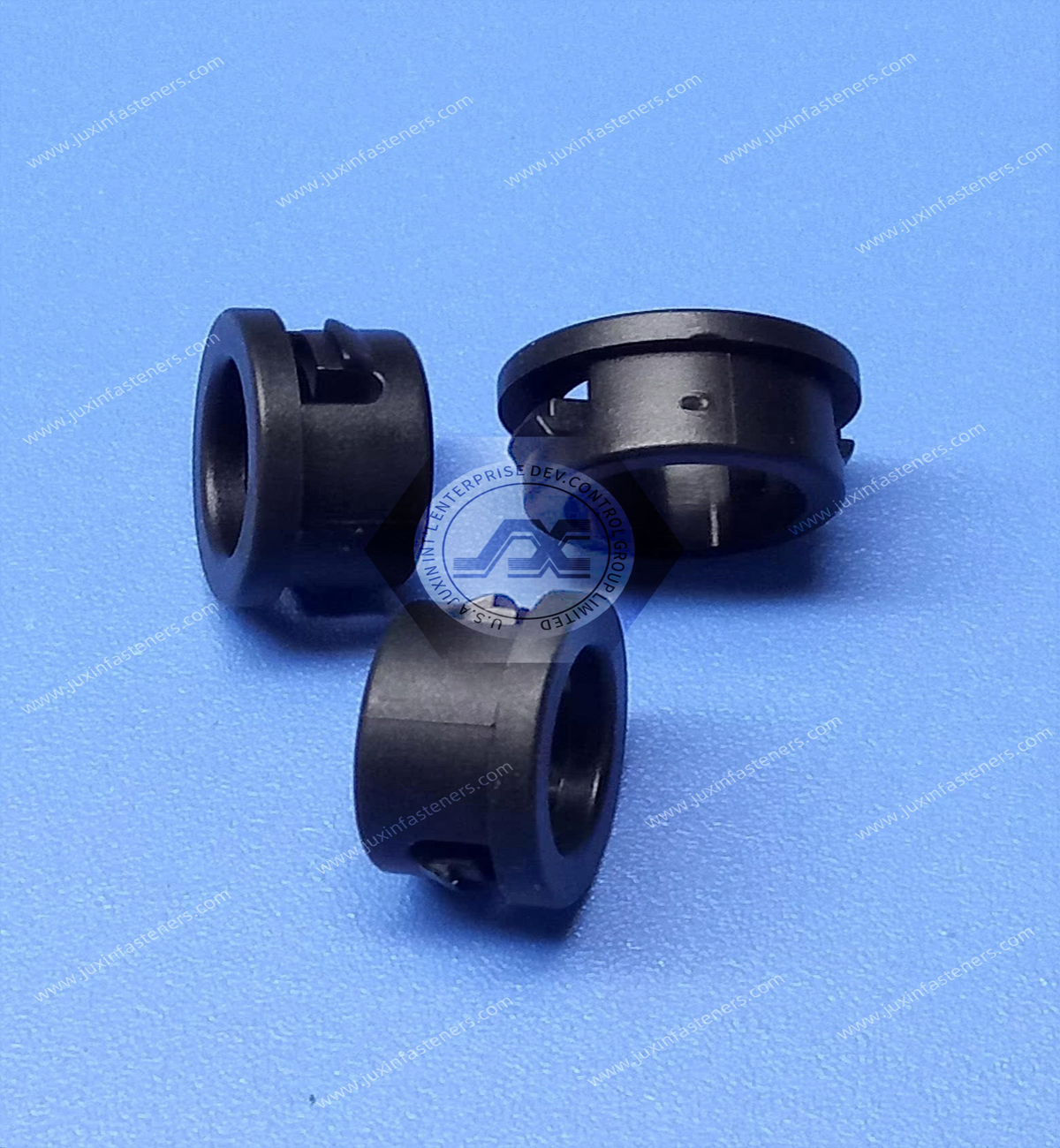
A nylon snap bushing is a molded component installed into a panel opening to create a protected passage for wires, cables, tubing, or other routed elements.
Typical functions include:
protecting cable insulation from panel edges;
separating conductors from conductive chassis edges;
creating a smoother cable-entry surface;
reducing direct cable-to-metal contact;
simplifying panel assembly;
providing a finished appearance around cable-entry holes.
Flexible locking features around the bushing body compress during insertion and then engage the panel after the bushing is seated.
This allows many designs to be installed without separate screws, nuts, or adhesives.
The distinction between these components is important for both engineering selection and procurement.
Primarily provides:
edge protection;
cable pass-through;
panel-hole lining;
electrical separation at the panel edge;
cable routing.
Designed to provide some combination of:
cable retention;
axial load transfer;
resistance to cable displacement;
bending control;
protection of internal terminations.
A standard snap bushing should not automatically be specified where certified or quantified strain relief is required.
Therefore:
Cable Protection ≠ Cable Retention
and
Cable Retention ≠ Verified Strain Relief Performance
The required function must be established before selecting the component.
A cable entering an enclosure creates a mechanical interface involving several independent elements:
Panel + Panel Edge + Bushing + Cable Jacket + Internal Termination
Failure can occur even when the bushing itself remains intact.
For example, excessive cable movement can transfer load directly to:
terminals;
connectors;
solder joints;
crimp connections;
internal wire routing.
For this reason, cable-entry protection should be considered as part of the complete wire-management architecture.
Finger-lock snap bushings use flexible retaining features around the outer body.
During installation, the locking fingers deflect inward as the bushing passes through the panel opening.
After the retaining geometry clears the panel, the fingers recover and engage the panel.
These components are commonly used for:
control cabinets;
electrical enclosures;
industrial machinery;
appliances;
power electronics;
automation equipment;
telecommunications equipment;
electronic chassis.
The geometry must match both the panel cutout and panel thickness.
Closed bushings are installed before the cable or harness is routed through the opening.
They provide a continuous inner circumference around the cable-entry path.
This design can be appropriate when:
wiring is installed after the bushing;
connectors have not yet been terminated;
harness routing sequence allows cable insertion through the bore.
The internal bore must be large enough for the cable or harness that must pass through it.
Split or open bushings can be useful when the cable assembly already exists and cannot conveniently be passed through a conventional closed bushing.
Depending on the design, they may be installed around:
pre-terminated wires;
existing harnesses;
cable assemblies;
tubing.
This can be valuable during:
equipment assembly;
field modification;
maintenance;
retrofit projects.
However, the exact installation method depends on the component geometry.
Strain relief bushings are designed to control cable movement more positively than ordinary edge-protection bushings.
Depending on the design, the bushing may use:
cable compression;
locking wedges;
mating sections;
shaped cable channels;
snap-lock geometry.
The objective is to reduce the mechanical load transferred from external cable movement to the internal electrical connection.
Actual strain-relief capability should be evaluated according to the specific component design and the applicable equipment requirements.
Generic claims such as “100% strain relief” should not replace application-specific testing.
The panel cutout is one of the most important dimensions in snap-bushing selection.
If the mounting hole is too small:
insertion force can increase;
locking fingers may overstress;
the bushing may not fully seat;
automated assembly may become inconsistent.
If the mounting hole is too large:
radial movement can increase;
axial play may occur;
retention can decrease;
vibration-related movement may develop.
The required panel-hole dimension should therefore be taken from the actual component drawing or validated sample.
A snap bushing does not interface only with the hole diameter.
The retaining geometry must also engage the panel thickness correctly.
If the panel is too thick:
locking features may not fully clear the panel;
the bushing may remain partially seated;
retention may be compromised.
If the panel is too thin:
excessive axial movement may occur;
the bushing may rattle;
the intended locking geometry may not engage as designed.
Therefore:
Correct Panel Hole + Incorrect Panel Thickness = Potentially Incorrect Bushing
Both dimensions must be checked.
The internal bore must be compatible with the cable, tubing, or wire bundle passing through it.
If the bore is too small:
cable insertion may become difficult;
the cable jacket may be compressed;
friction may increase;
serviceability can decrease.
If the bore is excessively large:
cable movement can increase;
the cable may contact the inner edge repeatedly;
the intended routing control may be reduced.
For strain relief designs, cable OD can be even more critical because the retention mechanism may depend directly on the cable diameter.
For practical engineering selection, the minimum review should include:
Panel Hole + Panel Thickness + Cable OD + Required Function
The required function should be identified as one of the following:
edge protection;
cable pass-through;
cable positioning;
cable retention;
strain relief;
retrofit protection.
This prevents a common sourcing error: selecting a visually similar component that fits the hole but does not perform the required mechanical function.
Two bushings designed for the same nominal panel hole can still differ in:
panel thickness range;
internal bore diameter;
flange diameter;
overall height;
locking geometry;
insertion force;
cable retention method;
material.
Therefore:
Same Hole Size ≠ Same Bushing
This is particularly important during second-source qualification.
PA66 is commonly used for molded cable-protection hardware because suitable grades can provide a useful combination of:
mechanical strength;
toughness;
wear resistance;
electrical insulation;
fatigue resistance;
moldability;
snap-feature flexibility.
However:
PA66 Is a Material Family, Not a Complete Product Specification
Actual performance depends on:
resin grade;
additives;
moisture condition;
temperature;
geometry;
processing.
Material selection should therefore be based on the actual application environment.
Polyamide absorbs moisture from the surrounding environment.
Moisture can affect:
stiffness;
toughness;
dimensions;
flexibility;
snap engagement.
Conditioned nylon can exhibit greater toughness than dry material, which can be beneficial for flexible snap features.
However, dimensional and mechanical changes should be considered in precision applications.
For this reason, engineering validation should reflect realistic service conditions rather than relying only on dry-as-molded properties.
Bushings installed in:
power electronics;
switchgear;
industrial drives;
inverters;
power distribution equipment;
high-density electronic systems;
may experience elevated enclosure temperatures.
Where temperature is significant, engineers should define:
normal operating temperature;
maximum continuous temperature;
short-term peak temperature;
thermal cycling conditions.
Heat-stabilized polymer grades can then be evaluated where appropriate.
Some electrical and electronic applications may require a defined material flammability classification.
Where UL 94 performance is specified, the requirement should identify the relevant classification and applicable tested thickness.
It is important to distinguish:
PA66 ≠ Automatically UL 94 V-0
and
PA66 ≠ Automatically UL 94 V-2
The flammability classification applies to the specific resin formulation under defined test conditions.
Project-specific requirements should therefore be stated in the RFQ or engineering drawing.
Simply inserting a plastic component into a metal hole does not guarantee effective edge protection.
Engineers should also evaluate:
flange coverage;
bore geometry;
panel edge condition;
cable movement direction;
cable bend radius;
installation orientation.
A bushing with insufficient flange or bore coverage may still allow the cable jacket to contact the panel under lateral movement.
Industrial equipment can expose wiring to continuous vibration from:
motors;
cooling fans;
pumps;
compressors;
transformers;
vehicle movement;
transportation.
If the cable repeatedly rubs against a hard panel edge, insulation wear can accumulate over time.
A correctly selected polymer bushing creates a less aggressive contact interface.
However, where significant cable motion exists, additional routing hardware may also be required.
Related solutions can include:
Nylon Cable Clips;
Heavy-Duty Nylon Cable Clamps & P-Clips;
Cable Tie Mounts.
Cable-entry protection and cable routing should be engineered as a system.
A common design mistake is protecting the panel hole while allowing the cable to bend sharply immediately after entering the enclosure.
The cable path should consider:
cable construction;
conductor size;
jacket stiffness;
connector location;
available enclosure space.
The bushing protects the panel interface, but it does not automatically establish an acceptable cable bend radius.
A polymer snap bushing physically separates the cable jacket from the conductive panel edge at the mounting opening.
This can support electrical isolation and reduce direct contact between the cable and grounded metal structure.
However:
Plastic Bushing ≠ Complete Electrical Safety Compliance
The complete equipment design must still consider applicable:
insulation requirements;
conductor ratings;
creepage;
clearance;
grounding;
enclosure standards.
The bushing is one component within the complete electrical architecture.
A cable can pass safely through a protected panel opening but still transfer external loads to internal terminals.
This is why edge protection and strain relief must be considered separately.
For equipment where cables can be pulled, twisted, or repeatedly moved, engineers should ask:
Where does the external cable load go?
If the answer is:
Directly into the terminal or connector
additional strain-relief engineering may be required.
Snap bushings can reduce assembly operations because many designs are installed by pushing the component directly into the panel cutout.
Benefits can include:
fewer loose parts;
no separate nut;
reduced tooling;
faster assembly.
However, insertion force must remain compatible with the intended production process.
Excessive force can:
slow operators;
damage snap features;
deform thin panels;
create incomplete seating.
For automated or semi-automated installation, consistent component and panel dimensions become particularly important.
Engineers should consider:
bushing orientation;
component feeding;
insertion force;
panel-hole tolerance;
panel flatness;
snap engagement confirmation.
A component that installs easily by hand may still require validation before automated production.

Nylon snap bushings are widely used where control wires and harnesses pass through:
cabinet walls;
sub-panels;
mounting plates;
internal partitions;
door structures.
Typical requirements include:
edge protection;
clean cable routing;
electrical separation;
fast assembly.
Electrical switchgear and power distribution assemblies can contain dense wiring architectures passing through metal barriers and mounting structures.
Relevant design factors include:
panel thickness;
cable OD;
operating temperature;
electrical requirements;
wire movement;
material specification.
Automation equipment uses extensive:
control wiring;
sensor cables;
motor cables;
communication lines;
power conductors.
Snap bushings can provide protected transitions through machine panels and control enclosures, while additional cable clamps and tie mounts control the harness after it enters the equipment.
AI data centers and high-performance computing systems contain high-density power, control, monitoring, cooling, and communication infrastructure.
Potential applications for plastic cable-entry protection include:
power distribution units;
rack-level control equipment;
cooling-control assemblies;
monitoring systems;
auxiliary electrical enclosures.
Selection should consider elevated equipment temperatures, cable density, maintenance access, and applicable material requirements.
Inverters, converters, UPS systems, rectifiers, power supplies, and industrial drives frequently route wiring through sheet-metal barriers.
Relevant considerations include:
temperature;
vibration;
electrical separation;
cable size;
enclosure geometry.
Heat-stabilized materials may be evaluated where the operating environment requires them.
Battery energy storage systems contain:
battery-management wiring;
sensor harnesses;
power electronics;
monitoring systems;
auxiliary electrical equipment.
Cable-entry protection should be coordinated with the complete enclosure and harness-routing architecture.
Solar inverters, power conversion systems, monitoring equipment, and other renewable-energy assemblies can require protected cable transitions.
For outdoor equipment, additional environmental requirements may apply, including:
temperature cycling;
moisture;
UV exposure where externally exposed;
material weatherability.
Material selection should therefore be based on the actual exposure condition.
Vehicle electrical architectures expose wire harnesses to:
vibration;
shock;
thermal cycling;
repeated movement.
Where wiring passes through structural or enclosure panels, plastic bushings can reduce direct cable-to-metal contact.
Automotive applications should be evaluated according to the specific OEM engineering requirements.
Semiconductor manufacturing systems contain extensive electrical, sensor, motion-control, and communication wiring.
Cable protection components may be used where harnesses pass through internal sheet-metal structures or equipment enclosures.
Dimensional consistency and clean routing architecture can be especially important in complex equipment assemblies.
Medical and laboratory equipment can use cable-entry bushings within internal electronic and electromechanical assemblies.
Project-specific requirements for:
materials;
cleaning;
chemicals;
electrical safety;
regulatory compliance;
must be defined by the equipment manufacturer.
HVAC equipment and appliances frequently route:
motor wiring;
sensor cables;
control wiring;
power cords;
through stamped sheet-metal structures.
Snap bushings provide an efficient way to protect cable jackets from cut edges while supporting high-volume assembly.
Possible causes:
panel hole too small;
wrong bushing series;
burrs around the cutout;
panel thickness incompatible with the design;
installation misalignment.
Possible causes:
panel too thick;
incorrect locking geometry;
incomplete insertion;
wrong component.
Possible causes:
panel hole too large;
panel too thin;
wrong snap geometry;
dimensional mismatch.
Possible causes:
insufficient flange coverage;
bore geometry not suitable for cable movement;
excessive lateral cable movement;
incorrect bushing size.
Possible causes:
incorrect cable OD;
wrong strain-relief design;
insufficient engagement;
cable jacket characteristics incompatible with the retention mechanism.
Possible contributors:
undersized hole;
excessive insertion force;
low-temperature installation;
material condition;
panel burrs;
misalignment.
Possible causes:
oversized panel hole;
incorrect panel-thickness range;
insufficient locking engagement.
Failure analysis should consider:
Bushing + Panel + Cable + Environment + Required Function
rather than the plastic component alone.
A procurement request may state:
“We need a snap bushing for a 12 mm panel hole.”
That is not enough to determine interchangeability.
Two bushings designed around a similar nominal panel opening can differ in:
panel thickness range;
bore diameter;
flange diameter;
locking geometry;
overall height;
material;
cable retention capability.
Therefore:
Same Panel Hole ≠ Same Bushing
Second-source qualification requires the complete interface to be reviewed.
For practical engineering and sourcing review, Juxin Fasteners recommends verifying at least:
Panel Hole + Panel Thickness + Cable OD + Required Function
For more demanding applications, also verify:
Temperature + Vibration + Material + Electrical Requirements + Environmental Exposure
This provides a stronger basis for replacement and second-source qualification than comparing appearance alone.
Provide:
manufacturer;
manufacturer part number;
OEM part number;
drawing;
CAD model;
physical sample;
photographs.
Confirm:
panel-hole diameter;
hole tolerance;
panel thickness;
panel material;
hole manufacturing method where relevant.
Confirm:
cable outer diameter;
cable shape;
wire bundle dimensions;
cable jacket material where relevant.
Identify whether the component is required for:
edge protection;
cable pass-through;
cable positioning;
cable retention;
strain relief;
retrofit installation.
Where applicable, specify:
cable pull;
cable movement;
vibration;
shock;
repeated servicing.
Provide:
minimum temperature;
maximum temperature;
humidity;
UV exposure where relevant;
chemical exposure;
other service conditions.
Specify where applicable:
PA66;
heat-stabilized polymer;
flame-retardant requirement;
other resin requirements.
Verify:
insertion force;
full snap engagement;
panel fit;
axial play;
bore clearance;
cable fit;
strain-relief function where applicable.
Where required, evaluate:
pull-out behavior;
cable movement;
vibration;
thermal cycling;
repeated assembly.
After approval, proceed to:
quotation;
material confirmation;
inspection requirements;
packaging requirements;
lot traceability;
production planning.
Standard snap bushings cover many common panel and cable combinations.
However, proprietary equipment may require:
non-standard panel cutouts;
unusual panel thickness;
custom cable OD;
special flange diameter;
extended bore geometry;
dedicated locking features;
split installation;
custom strain-relief geometry;
project-specific polymer.
Juxin Fasteners can support drawing-based custom plastic hardware through:
2D drawing review;
3D CAD review;
physical sample comparison;
dimensional analysis;
material evaluation;
DFM discussion;
tooling evaluation;
sample validation;
production sourcing.
See our Custom Molded Plastic Fasteners solutions for proprietary enclosure and cable-management components.
For faster engineering review and quotation, provide as much of the following information as possible.
manufacturer;
manufacturer part number;
OEM part number;
drawing;
CAD model;
physical sample;
photographs.
panel-hole diameter;
hole tolerance;
panel thickness;
panel material;
cutout shape.
cable outer diameter;
cable shape;
cable jacket material where relevant;
single cable or wire bundle;
pre-terminated or unterminated harness.
edge protection;
cable pass-through;
cable positioning;
cable retention;
strain relief;
retrofit installation.
cable pull requirement;
vibration;
shock;
movement;
service frequency.
minimum temperature;
maximum temperature;
humidity;
UV exposure;
chemical exposure.
PA66;
heat-stabilized grade;
flame-retardant requirement where applicable;
other specified polymer.
sample quantity;
production quantity;
expected annual usage;
delivery schedule;
RoHS declaration;
REACH declaration;
material documentation;
lot traceability;
inspection requirements.
Providing the panel dimensions, cable dimensions, and actual functional requirement significantly improves cross-reference accuracy.
Related Juxin Fasteners product and engineering solutions include:
Panel Hole Plugs for closing unused enclosure openings;
Nylon Cable Clips for organized internal wire routing;
Heavy-Duty Nylon Cable Clamps & P-Clips for bolted harness retention;
Cable Tie Mounts for structured wire-bundle anchoring;
Custom Molded Plastic Fasteners for proprietary cable-management and enclosure hardware.
These components perform different functions and should be selected according to the complete cable-routing architecture rather than treated as interchangeable accessories.
Juxin Fasteners supports industrial enclosure manufacturers, electrical equipment OEMs, switchgear manufacturers,
power-distribution equipment companies, industrial automation companies, power-electronics manufacturers,
AI data center and HPC infrastructure suppliers, telecommunications equipment manufacturers, automotive electronics suppliers,
energy-storage companies, renewable-energy equipment manufacturers, semiconductor-equipment manufacturers, medical-equipment companies,
HVAC manufacturers, appliance manufacturers, contract manufacturers, procurement teams, and supplier-development organizations requiring standard or custom plastic cable-protection hardware.
For nylon snap bushing and strain-relief projects, the sourcing pathway can begin with:
Existing Part / Drawing / Sample → Functional Classification → Panel Hole & Thickness Review → Cable OD Review
→ Mechanical & Environmental Review → Material Selection → Candidate Component → Physical Sample → Assembly & Functional Validation → Second-Source Qualification → Production RFQ
This process can support:
new equipment development;
cable-entry redesign;
wire-harness protection;
assembly-time reduction;
existing component replacement;
supplier consolidation;
second-source qualification;
obsolete component replacement;
custom cable-protection component development.
Send us your existing supplier part number, OEM part number, 2D drawing, 3D CAD model, physical sample, panel-hole diameter, panel thickness,
cable outer diameter, required function, temperature range, vibration requirements, material specification, compliance requirements, and expected annual volume for technical review.
Email: info@juxinfasteners.com
Website: www.juxinfasteners.com
Product Packaging
Packaging Standard
At Juxin Fasteners, we apply standardized export packaging to ensure product protection, traceability, and compliance with international logistics requirements.
1. Standard Export Packaging
Unless otherwise specified, all products will be packed according to our factory standard export packaging, which includes:
Moisture-resistant inner protection
Poly bag or small box packing as required
Reinforced export cartons
Clear labeling with part number, specification, batch number, and quantity
Palletizing for sea or air shipment when necessary
Our standard packaging is designed to ensure safe transportation, efficient warehousing, and long-distance international shipping.
2. Customized Packaging Options
We also provide customized packaging solutions according to customer requirements, including but not limited to:
Private labeling
Customized barcodes
Specific carton dimensions
Retail packaging
Special pallet configuration
Customer-specific marking and identification
So that you know, customized packaging may involve additional costs and extended lead time depending on the complexity of the requirements.
3. Compliance & Quality Assurance
All packaging processes are controlled under our ISO 9001 quality management system to ensure consistency, traceability, and product integrity throughout the supply chain.
Product Pictures

Contact Us
Tel.:
+86 020 8621 0320
+86 020 3121 6067
E-mail:
Technical Support:
Navigation
SEND INQUIREY