Call Us
+86 136 6007 9809
Call Us
+86 136 6007 9809

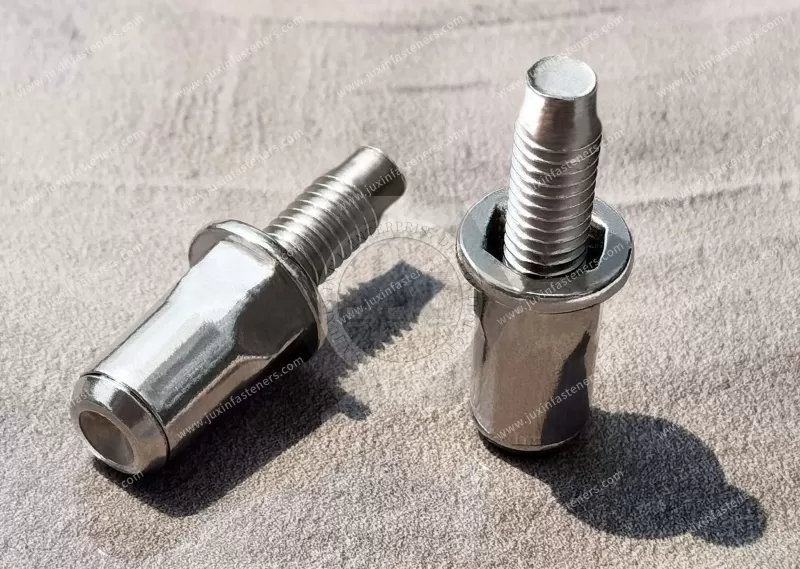
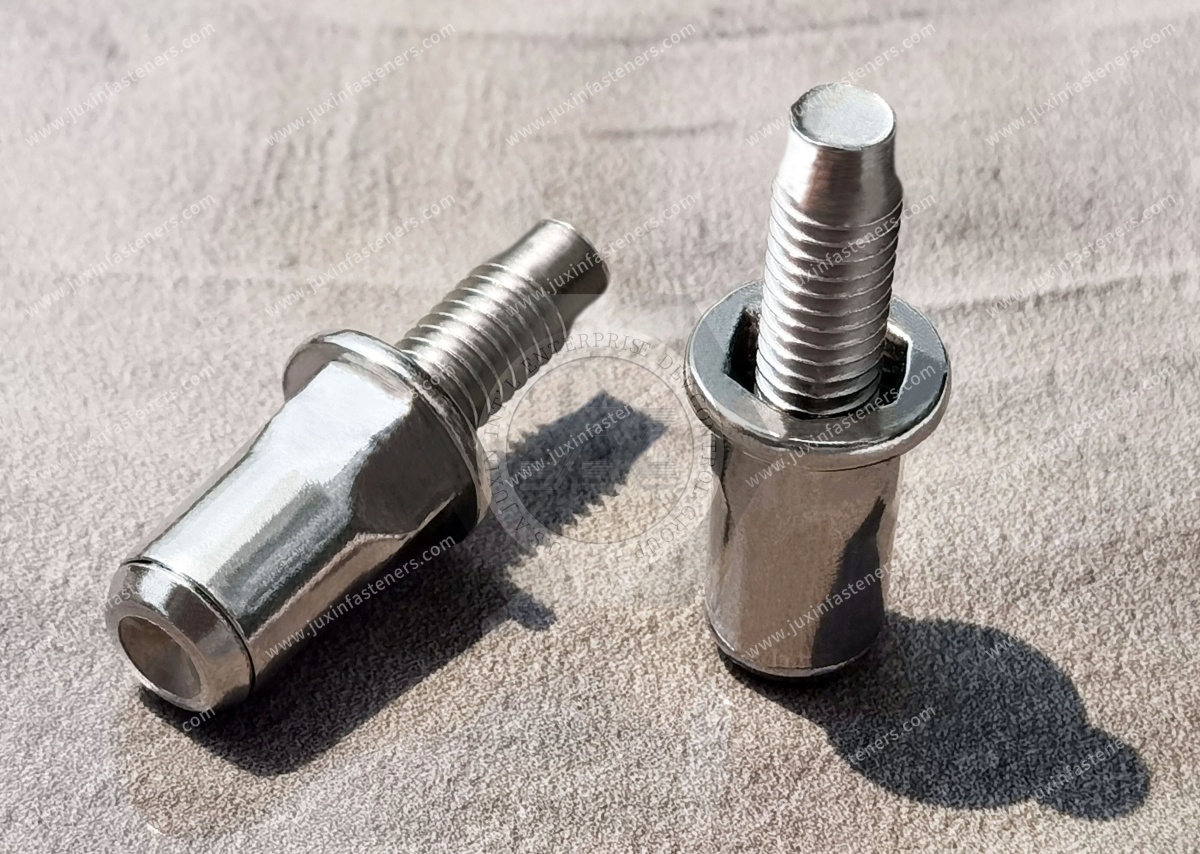
JUXIN FASTENERS supplies stainless steel flat head open-end partial hexagonal body blind rivet studs for external threaded mounting points in sheet-metal assemblies with one-sided installation access. The partially hexagonal body can engage a compatible mounting hole to resist rotation during mating-nut assembly. Offered in M5, M6 and M8 with a natural stainless steel finish, these studs can be evaluated for equipment enclosures, fabricated brackets and serviceable OEM components requiring controlled hole geometry and installation performance.
Thread Sizes: M5, M6, M8
Material: Stainless Steel (grade to be confirmed)
Surface Finish: Natural Stainless Steel Color
Grip Range: 0.5–5.5 mm (product family; verify by part number)
Head Type: Flat Head
Body Type: Open-End, Partial Hexagonal
Thread Type: External Male Metric Thread
Installation: One-Sided Mechanical Blind Riveting
Product Specification
Product Specifications — Stainless Steel Flat Head Open-End Partial Hexagonal Blind Rivet Studs
JUXIN FASTENERS supplies stainless steel flat head open-end partial hexagonal blind rivet studs for OEM sheet-metal assemblies requiring external male-threaded mounting points and installation from one accessible side.
This product combines a flat head, an open-end rivet body, a partially hexagonal exterior and an external metric threaded stud. The partial hexagonal section can engage a matching mounting hole, providing geometric resistance to rotation when a mating nut is installed or removed.
Unlike internally threaded blind rivet nuts, these fasteners provide an external male thread for attaching brackets, covers, mounting plates and other components.
The natural stainless steel finish distinguishes this version from zinc-coated steel alternatives. Its selection should be based on the required stainless steel grade, installation formability, operating environment and approved assembly performance.
Technical Specification Summary
Product Name: Flat Head Open-End Partial Hexagonal Blind Rivet Stud
Material: Stainless Steel
Material Grade: To be confirmed against the approved specification
Thread Sizes: M5, M6, M8
Thread Configuration: External Male Metric Thread
Head Type: Flat Head
Body Type: Open-End, Partial Hexagonal
Surface Finish: Natural Stainless Steel Color
Grip Range: 0.5–5.5 mm across the product family
Installation Method: One-Sided Mechanical Blind Riveting
Hexagonal Body Dimensions: According to the approved drawing
Mounting-Hole Geometry: According to the approved drawing
Thread Pitch and Tolerance: According to the approved drawing
External Stud Projection: According to the approved drawing
Installation Parameters: Subject to part and tooling verification
Custom Requirements: Subject to technical review and manufacturing feasibility
The stated grip range applies to the product family. Individual part-number dimensions and permitted grip thicknesses must be verified before installation.
Product Function and Construction
An open-end partial hexagonal blind rivet stud creates a retained external threaded mounting point in a sheet-metal panel or compatible hollow section.
The fastener is inserted through a prepared mounting hole from the accessible side.
A suitable setting tool then deforms the rivet body behind the parent material, establishing mechanical retention.
The external male thread remains available for attaching a component with a compatible nut.
This construction is relevant when rear-side access is unavailable after fabrication or assembly.
The partial hexagonal body adds a geometric anti-rotation feature, while the flat head provides the accessible-side seating interface.
The open-end body configuration should be distinguished from closed-end alternatives. Neither construction should be assumed to provide environmental sealing without separate validation.
Open-End Blind Rivet Stud vs. Blind Rivet Nut
These products can look similar before installation, but they serve different fastening functions.
Open-End Blind Rivet Stud
Provides an external male thread.
Typically receives a mating nut to secure an additional component.
Blind Rivet Nut
Provides an internal female thread.
Typically receives a mating bolt or screw.
Both may use one-sided mechanical installation, but the tooling engagement and assembly requirements differ.
For an OEM drawing, the supplier must confirm whether the application requires an external stud or an internally threaded insert.
Confusing the two products can lead to incorrect quotations, incompatible installation tools and assembly delays.
Partial Hexagonal Body and Geometric Anti-Rotation
The partially hexagonal body incorporates a polygonal section intended to engage a compatible mounting hole.
When the installed stud is subjected to torque during nut assembly, the polygonal interface can help resist rotation.
This mechanism differs from a smooth round body, where rotational resistance depends on installed deformation and contact conditions without the same hexagonal engagement.
It also differs from a knurled body, which uses raised exterior features that may engage the parent material.
Actual rotational resistance depends on:
Hexagonal section dimensions
Mounting-hole dimensions
Parent-material properties
Panel thickness
Hole-manufacturing accuracy
Installed body deformation
Tool setting conditions
Applied assembly torque
The geometric design does not establish a specific spin-out torque rating without testing.
Partial Hexagonal Body Geometry
A partial hexagonal body is not necessarily hexagonal along its entire length.
Its actual configuration may include a polygonal section, a transition region and a deformable rivet-body section.
The approved drawing should define:
Hexagonal across-flats dimension
Across-corners dimension
Hexagonal section length
Transition geometry
Rivet-body length
Head dimensions
External threaded projection
Grip range
These dimensions determine how the stud fits the prepared mounting hole and deforms during setting.
A product with the same nominal M6 thread may not be interchangeable if its partial hexagonal geometry differs.
Mounting-Hole Geometry and Production Compatibility
Where anti-rotation relies on polygonal engagement, the mounting hole must provide the required matching geometry.
The hole may be produced by a suitable controlled fabrication process, depending on the parent material and production requirements.
Important inspection characteristics include:
Across-flats dimension
Corner geometry
Hole position
Hole tolerance
Burr condition
Edge condition
Panel thickness
Local flatness
Distance from adjacent features
An oversized hole may reduce the intended geometric engagement.
An undersized hole may prevent insertion or damage the fastener or panel.
The hole specification must be taken from the approved part drawing rather than inferred from the nominal thread size.
Engineering Information Gain — Why an M6 Partial Hex Stud May Not Fit Another M6 Hole
Two stainless steel blind rivet studs may both be described as M6 flat head partial hexagonal products.
Nevertheless, they may require different mounting-hole geometries.
Consider the following differences.
Across-Flats Dimension
A different polygonal body width may prevent insertion or produce excessive clearance.
Hexagonal Section Length
A shorter or longer polygonal section may change the effective engagement with the panel.
Transition Geometry
The transition between the polygonal section and deformable body may interfere with the hole or affect setting behavior.
Head Diameter
A different head size changes the accessible-side bearing interface.
Grip Range
The selected fastener may not accommodate the actual panel thickness.
Stud Projection
The available external thread after installation may be insufficient for the mating bracket and nut.
The engineering lesson is that thread size alone is not an interchangeability criterion.
For supplier substitution, the complete drawing and installed assembly requirements should be compared.
Grip Range and Panel Thickness
The confirmed product-family grip range is 0.5–5.5 mm.
Approximate inch references:
0.5 mm = 0.020 in
5.5 mm = 0.217 in
Grip range refers to the parent-material thickness that the selected rivet body is designed to accommodate.
It is not equivalent to the external threaded length.
The actual grip range must be confirmed for each M5, M6 and M8 part number.
An incorrect selection can lead to incomplete deformation, excessive panel distortion, poor head seating or insufficient retention.
Where panels contain local reinforcements, multiple layers or formed features, the effective installed grip thickness should be evaluated.
Metric Thread Sizes and International References
The confirmed sizes are M5, M6 and M8.
M5: Approximately 0.197 in nominal diameter
M6: Approximately 0.236 in nominal diameter
M8: Approximately 0.315 in nominal diameter
These inch measurements are approximate diameter references only.
They are not equivalent UNC, UNF or BSW thread sizes.
Metric and Unified inch threads are not directly interchangeable.
ISO 261 and ISO 965 provide relevant technical references for ISO metric thread combinations and tolerances where specified.
Actual pitch and thread tolerance must be confirmed from the approved drawing.
Stainless Steel Material Requirements
The confirmed material is stainless steel.
The exact grade and mechanical condition have not been supplied.
Material selection should account for both the threaded portion and the deformable rivet body.
Relevant characteristics include:
Stainless steel grade
Material condition
Formability
Mechanical strength
Thread properties
Rivet-body deformation
Corrosion environment
Parent-material compatibility
A stainless steel grade suitable for conventional bolts is not automatically suitable for every mechanically deformable blind rivet stud design.
The material and installation process must be evaluated together.
Natural Stainless Steel Finish
The specified finish is natural stainless steel color.
This describes the product's appearance but does not establish a particular surface roughness, chemical passivation treatment or corrosion-resistance classification.
Where cleaning or passivation is specified, ASTM A380/A380M and ASTM A967/A967M may provide relevant technical references.
These standards should only be applied where required by the approved material and surface-treatment specification.
No specific passivation process, test result or certification is claimed.
Corrosion Selection for OEM Applications
Stainless steel can offer useful corrosion-resistance characteristics, but suitability depends on the actual grade and environment.
Engineering review should consider:
Atmospheric exposure
Moisture
Chloride contamination
Cleaning chemicals
Contact with dissimilar metals
Crevice conditions
Surface contamination
Operating temperature
A natural stainless steel finish should not automatically be described as suitable for all outdoor, marine or chemical environments.
The grade and service conditions must be evaluated before approval.
Stainless Steel Studs in Aluminum Panels
Stainless steel partial hexagonal blind rivet studs may be evaluated for installation in compatible aluminum panels.
However, the material combination introduces several considerations.
The aluminum alloy and thickness influence local hole deformation.
The polygonal mounting-hole geometry affects the intended anti-rotation engagement.
The setting process must produce acceptable retention without excessive panel distortion.
Where moisture is present, galvanic corrosion risk should be considered.
Protective finishes, joint design and environmental controls may be relevant, depending on the application.
Compatibility must be validated for the actual assembly.
Flat Head Seating and Installed Projection
The flat head provides the accessible-side bearing surface.
Its diameter and thickness influence contact area and head projection.
A flat head does not necessarily provide a flush installation.
The external threaded projection should also be checked after setting.
For assembly design, engineers should consider:
Head thickness
Head diameter
Panel clearance
Mating bracket thickness
Washer arrangement
Required nut engagement
Available thread projection
Tool access
The loose-fastener overall length should not automatically be treated as the usable installed stud projection.
One-Sided Mechanical Installation
A typical installation process includes:
Prepare the mounting hole according to the approved drawing.
Inspect the polygonal hole dimensions and edge condition.
Verify the parent-material thickness.
Confirm the selected stud's grip range.
Engage the external thread with compatible installation equipment.
Align the partial hexagonal section with the mounting hole.
Insert the rivet body from the accessible side.
Seat the flat head against the panel.
Apply the approved setting action.
Form the retaining feature behind the parent material.
Release the installation equipment.
Inspect the installed stud before mating-component assembly.
Installation-tool configuration, setting stroke and acceptance criteria must be verified for the selected product.
Installed Axial Retention
Axial retention describes resistance to extraction of the installed stud from the parent material.
It depends on the deformed rivet body and its interaction with the panel.
Relevant factors include:
Rivet-body geometry
Grip thickness
Material condition
Parent-panel properties
Hole dimensions
Installation deformation
Head seating
The partial hexagonal anti-rotation feature does not independently establish axial pull-out performance.
No universal axial retention rating is claimed.
Rotational Resistance and Mating-Nut Assembly
The partial hexagonal section can help resist stud rotation when a mating nut is tightened or removed.
However, the actual resistance depends on the installed assembly.
The engineer should establish the required assembly torque and verify that the stud-to-panel connection is compatible with it.
Repeated nut installation and removal may introduce additional requirements.
Where maintenance is expected, qualification should consider the intended service procedure and number of assembly cycles, if specified.
No universal spin-out torque or repeated-assembly rating is claimed.
Anti-Rotation Does Not Mean Vibration Locking
The partial hexagonal body contributes to resistance against rotation of the stud within the panel.
It does not independently prevent loosening of the mating nut.
These are separate engineering functions.
Stud Anti-Rotation
Prevents or limits rotation of the installed stud in the mounting hole.
Nut Loosening Resistance
Concerns maintaining the required threaded-joint condition during service.
Where vibration resistance is important, the complete nut-and-stud connection should be evaluated using an appropriate locking strategy and validated assembly conditions.
Engineering Example — Serviceable Equipment Mounting Bracket
Consider an OEM fabricated equipment enclosure requiring an M6 externally threaded mounting point.
The rear side of the panel becomes inaccessible after fabrication.
A mounting bracket must be removable during maintenance.
A stainless steel open-end partial hexagonal blind rivet stud may be considered.
Before approval, the engineering team should confirm:
Required M6 thread pitch and tolerance
Stainless steel grade
Parent-panel material
Actual panel thickness
Selected stud grip range
Hexagonal body dimensions
Mounting-hole geometry
Flat-head dimensions
Installed stud projection
Mating bracket thickness
Nut engagement
Assembly torque
Installation-tool compatibility
Installed axial retention
Installed rotational resistance
Corrosion environment
Inspection and documentation requirements
This evaluation is more reliable than selecting a product solely from its nominal thread size and appearance.
Open-End vs. Closed-End Stud Selection
Open-end and closed-end blind rivet studs may differ in body construction.
Selection should be based on the actual drawing and application requirements.
Relevant considerations include:
Body geometry
Installation tooling
Available blind-side clearance
Grip compatibility
Assembly environment
Inspection requirements
Environmental sealing needs
A closed-end designation does not automatically establish watertight performance.
An open-end designation does not automatically establish a particular ingress-protection classification.
Where sealing is required, the complete joint should be validated.
Stainless Steel vs. Zinc-Coated Steel Partial Hex Studs
The same general fastening function may be available in different materials.
Stainless Steel Version
Uses stainless steel as the base material and is supplied with a natural finish in this product configuration.
Zinc-Coated Steel Version
Uses steel with a specified zinc coating system.
Engineering comparison should consider:
Material grade
Installation formability
Corrosion requirements
Mechanical properties
Surface treatment
Finished dimensions
Parent-material compatibility
Installed performance
Total assembly cost
The two versions should not automatically be considered interchangeable.
A material change may require installation trials or additional qualification.
Industrial Applications
Industrial Machinery
Potential applications include mounting brackets, equipment covers and serviceable metal assemblies.
Electrical Cabinets and Control Enclosures
Possible uses include accessory supports and internal mounting points where rear-side access is limited.
Automotive Equipment and Tier 1 Assemblies
The studs may be evaluated for selected non-safety-critical brackets, fabricated panels and equipment housings.
Automotive use requires project-specific engineering and customer approval.
Electric Vehicle Equipment
Potential applications include selected mounting supports and fabricated enclosures.
Electrical isolation, grounding, sealing and structural requirements must be evaluated separately.
HVAC Equipment
Possible applications include equipment brackets, sheet-metal housings and removable components.
Commercial Vehicle Equipment
The fasteners may be considered for selected non-critical mounting points, subject to load and environmental validation.
Fabricated Metal Products
Other potential applications include hollow metal profiles, industrial cabinets and modular sheet-metal assemblies.
OEM Qualification and Inspection
For production applications, the installed fastener should be evaluated as part of the complete assembly.
Depending on customer requirements, qualification may include:
Approved engineering drawing
Stainless steel material identification
Dimensional inspection
Thread inspection
Partial hexagonal body inspection
Mounting-hole verification
Grip-range confirmation
Installation-tool compatibility
Head seating inspection
Installed axial retention
Installed rotational resistance
Surface condition
Corrosion evaluation where specified
Drawing revision control
Lot identification and traceability
Automotive programs may require additional customer-specific documentation or production approval activities.
No automotive OEM approval, PPAP status or certified performance is implied without supporting records.
Procurement Information Gain — Total Cost of a Stud Substitution
For purchasing managers and supplier development teams, a lower unit price does not necessarily produce a lower assembly cost.
Consider an alternative M6 stainless steel partial hexagonal blind rivet stud.
The alternative may require a different mounting-hole dimension.
This could introduce changes to punching tools, laser-cutting programs or inspection gauges.
It may also require different installation equipment or setting parameters.
If the external stud projection changes, the mating bracket or nut engagement may require review.
Additional validation may be necessary before the new supplier can be approved.
A practical sourcing comparison should therefore include:
Fastener unit price
Mounting-hole compatibility
Tooling changes
Installation cycle requirements
Qualification testing
Quality documentation
Production disruption risk
Packaging and logistics
Long-term supply consistency
This approach helps distinguish a genuinely interchangeable part from a component that only looks similar.
OEM Supplier Development Requirements
Purchasing and supplier quality teams should confirm:
Product Configuration
Flat head, open-end body, partial hexagonal geometry and external male metric thread.
Material
Required stainless steel grade and condition.
Dimensions
Head geometry, hexagonal section, grip range and stud projection.
Installation
Mounting-hole specification and compatible setting equipment.
Mechanical Performance
Required axial retention and rotational resistance.
Quality Documentation
Inspection criteria, traceability and drawing revision control.
Commercial Requirements
Initial order quantity, annual demand, delivery expectations and packaging instructions.
Change Management
Approval requirements for material, dimensional or manufacturing changes.
The approved drawing should remain the primary reference for technical quotation and supplier qualification.
Drawing-Based OEM Requirements
Some applications require dimensions or characteristics outside a standard catalog configuration.
Potential requirements include:
Specific hexagonal across-flats dimensions
Modified hexagonal section length
Special flat-head dimensions
Defined external stud projection
Application-specific grip range
Specified stainless steel grade
Controlled metric thread tolerance
Surface treatment requirements
Inspection documentation
Packaging and traceability instructions
Nonstandard requirements are subject to technical review and manufacturing feasibility confirmation.
Frequently Asked Questions
What is an open-end partial hexagonal blind rivet stud?
It is a mechanically installed fastener with an external male thread and a partially hexagonal body, designed for one-sided installation in a compatible panel.
What is the difference between a blind rivet stud and a blind rivet nut?
A blind rivet stud provides an external male thread. A blind rivet nut provides an internal female thread.
What thread sizes are available?
The confirmed sizes are M5, M6 and M8.
What is the grip range?
The supplied product-family range is 0.5–5.5 mm. Individual part-number ranges require confirmation.
Does the partial hexagonal body prevent rotation?
Its geometry can contribute to resistance against rotation when installed in a compatible mounting hole. Actual performance must be verified.
Does it require a hexagonal mounting hole?
Where anti-rotation depends on polygonal engagement, the mounting hole must provide the corresponding geometry. The exact dimensions must be confirmed from the approved drawing.
What stainless steel grade is used?
The material is confirmed as stainless steel. The exact grade must be established from the approved specification.
Is the natural finish the same as passivated stainless steel?
Not necessarily. Natural appearance does not establish that a particular chemical passivation treatment has been performed.
Can these studs be used in aluminum panels?
They may be evaluated where hole geometry, grip thickness and installed performance are compatible. Dissimilar-metal corrosion should also be considered.
Can they replace zinc-coated steel rivet studs?
Not automatically. Material, dimensions, installation behavior, corrosion requirements and mechanical performance must be reviewed.
Related Industrial Fastening Solutions
For additional engineering comparisons, JUXIN FASTENERS offers related product categories for evaluation.
Stainless Steel Flat Head Partial Hexagonal Blind Rivet Studs — for comparison of closely related part-hex configurations.
Steel Partial Hexagonal Blind Rivet Studs — for applications considering a zinc-coated steel material system.
Smooth Round Body Blind Rivet Studs — for cylindrical body configurations.
Knurled Body Blind Rivet Studs — for alternative body engagement features.
Countersunk Blind Rivet Studs — for recessed head installation requirements.
Blind Rivet Nuts — for one-sided assemblies requiring internal female threads.
Self-Clinching Studs — for suitable press-installed sheet-metal applications.
Weld Studs — for approved welding-based fastening systems.
Custom Industrial Fasteners — for drawing-based OEM requirements.
The appropriate product should be selected according to installation access, parent material, mounting-hole geometry and required mechanical performance.
OEM RFQ Checklist
For accurate quotation and technical review, please provide the following information where available:
Required thread size: M5, M6 or M8
Engineering drawing or CAD file
Thread pitch and tolerance
Stainless steel grade
Flat-head dimensions
Partial hexagonal across-flats dimension
Hexagonal section length
Body transition geometry
External stud projection
Parent-panel material
Panel thickness
Required grip range
Mounting-hole dimensions and tolerance
Installation equipment and setting requirements
Axial retention requirements
Rotational resistance requirements
Surface condition requirements
Inspection and traceability documentation
Initial order quantity
Estimated annual demand
Packaging and delivery requirements
Providing the approved drawing and intended installation conditions helps establish compatibility and accurate quotation requirements.
JUXIN FASTENERS — OEM Stainless Steel Blind Rivet Stud Supply
JUXIN FASTENERS supplies industrial fastening products for international OEM engineering, purchasing and supplier development requirements.
Our stainless steel flat head open-end partial hexagonal blind rivet studs are intended for applications requiring externally threaded mounting points, one-sided mechanical installation and polygonal body engagement.
For M5, M6 and M8 requirements, customers may submit engineering drawings, material specifications, mounting-hole details and purchasing quantities for technical review.
Request an OEM Technical Quotation
Email: info@juxinfasteners.com
Website: www.juxinfasteners.com
Please include your product drawing, required quantity, stainless steel specification, panel thickness, mounting-hole dimensions and installation requirements.
JUXIN FASTENERS — Industrial Fastening Solutions for OEM Engineering and Global Procurement.
Product Packaging
Product Packaging — Stainless Steel Open-End Partial Hex Blind Rivet Studs
Packaging for M5, M6 and M8 stainless steel flat head open-end partial hexagonal blind rivet studs is subject to confirmed order and customer requirements.
Protective Packaging: Suitable protective arrangements may be specified to reduce damage to external male threads, flat-head seating surfaces and partial hexagonal body geometry.
Outer Packaging: Carton arrangements can be reviewed according to shipment quantity, weight and handling requirements.
Pallet Packaging: Palletized shipments may be considered for bulk OEM orders, subject to confirmation.
Product Identification: Customer-specified labels may identify the part number, thread size, stainless steel grade, quantity, lot number and drawing revision.
Lot Traceability: Identification and traceability requirements should be defined in the approved purchase and quality documentation.
OEM Packaging: Customer-specific packing quantities, component segregation, labeling and logistics instructions are subject to review.
Final packaging details will be confirmed against the approved order.
For OEM quotations and packaging requirements:
Email: info@juxinfasteners.com
Website: www.juxinfasteners.com
Product Pictures
Tags
Contact Us
Tel.:
+86 020 8621 0320
+86 020 3121 6067
E-mail:
Technical Support:
Navigation
SEND INQUIREY