Call Us
+86 136 6007 9809
Call Us
+86 136 6007 9809

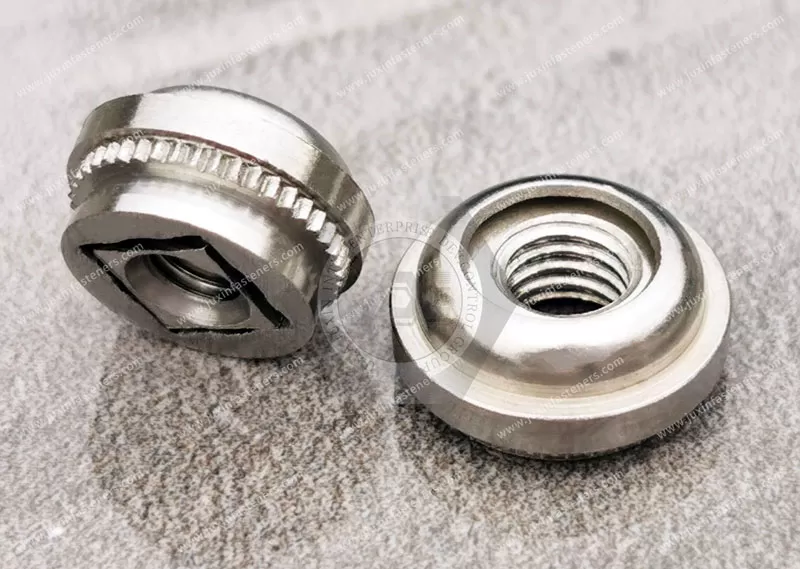
JUXIN FASTENERS supplies JX-AC stainless steel non-locking floating self-clinching nuts for precision sheet metal assemblies requiring captive internal threads and controlled compensation for mating-hole misalignment.
The fastener combines a self-clinching outer retainer with a movable internally threaded nut. This construction provides up to 0.76 mm (0.030 in) total floating adjustment within the specified product family, subject to the selected configuration and approved drawing.
JX-AC floating nuts are suitable for engineering evaluation in electronic enclosures, industrial control cabinets, telecommunications equipment, removable access panels and other fabricated metal assemblies.
Stainless steel material options include grades corresponding to 302, 303, 316, 410, 420 and 430, subject to suitability, availability and confirmation of the final material specification.
Metric and inch-series threads, mounting sheet requirements and special OEM dimensions should be verified against the technical drawing.
For engineering support, specifications and quotations, contact info@juxinfasteners.com.
Website: www.juxinfasteners.com
Product Specification
JX-AC Stainless Steel Non-Locking Floating Self-Clinching Nuts – Engineering Design and OEM Procurement Guide
Product Overview
JX-AC floating self-clinching nuts are stainless steel captive threaded fasteners designed to accommodate limited positional differences between sheet metal mounting points and mating components.
The fastener consists of an outer self-clinching retainer and an internally threaded nut that can move laterally within the retainer.
Once the outer body is properly installed, it remains mechanically retained in the mounting sheet while the internal nut retains its intended floating movement.
This construction can improve assembly alignment in applications involving independently manufactured panels, brackets, covers and enclosures.
The JX-AC designation identifies a non-locking floating nut configuration. It should not be confused with a prevailing-torque locking version.
The engineering benefit is controlled alignment compensation, not unlimited hole-position correction.
Product Identification
Product designation: JX-AC
Product type: Floating self-clinching nut
Material family: Stainless steel
Thread function: Non-locking internal female thread
Attachment method: Mechanical self-clinching
Construction: Fixed outer retainer with movable internal threaded nut
Primary application: Thin sheet metal fastening with limited alignment adjustment
Family floating adjustment: Up to 0.76 mm (0.030 in) total movement, subject to drawing confirmation
Metric thread references: M3 through M6, subject to individual size availability
Inch thread references: Selected #4 through 1/4-inch thread sizes, subject to drawing confirmation
Material options: Stainless steel grades corresponding to 302, 303, 316, 410, 420 and 430, subject to technical review
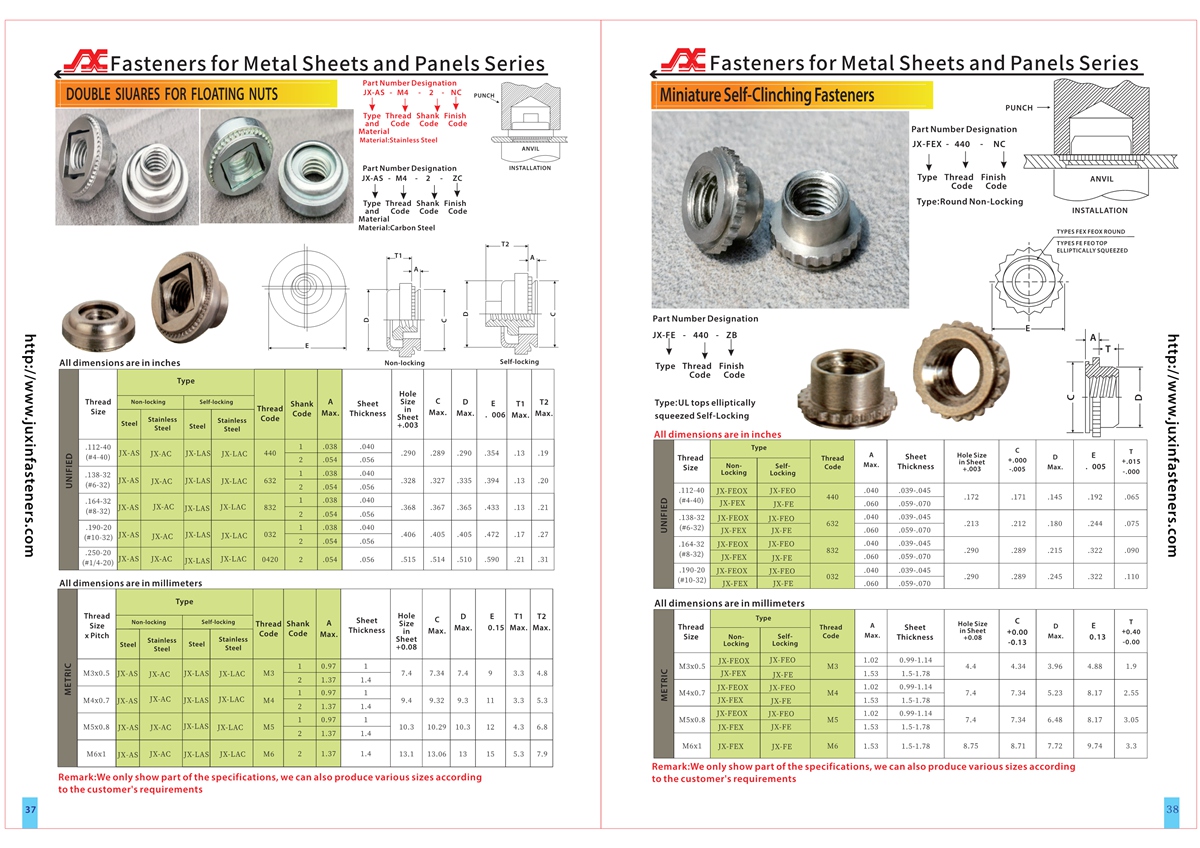
Dimensional reference: Product specification PDF or CAD documentation, pages 37–38
Custom requirements: Subject to drawing review and manufacturing feasibility
How JX-AC Floating Nuts Work
A conventional fixed self-clinching nut holds its threaded center in a fixed position relative to the mounting hole.
JX-AC uses a movable internal threaded element.
When the mating screw approaches the fastener, the internal nut can shift within its permitted movement range.
This movement helps accommodate small differences between the mating hole and the nominal thread location.
The outer retainer remains secured to the host sheet.
The internal nut provides the required positional adjustment.
These two functions must remain independent after installation.
A correctly installed floating nut must therefore satisfy both mechanical retention and internal movement requirements.
Understanding the 0.76 mm Adjustment Range
The supplied product information identifies a maximum total floating movement of up to 0.76 mm (0.030 in).
This value should not be interpreted as 0.76 mm of movement in every direction from the nominal center.
For a symmetric mechanism, a total diametral movement of 0.76 mm corresponds to approximately 0.38 mm of radial travel from the centered position.
The actual geometry and movement limits must be checked against the approved product drawing.
The available adjustment should be considered together with the mating clearance hole, screw diameter, fastener spacing and accumulated manufacturing tolerances.
A floating nut cannot compensate for unlimited dimensional variation.
Why Stainless Steel Matters
Stainless steel may be selected for corrosion resistance, appearance, environmental compatibility or application-specific material requirements.
However, stainless steel is not a single material with uniform mechanical behavior.
Different grades have different corrosion resistance, machinability, hardness, magnetic response and forming characteristics.
For floating self-clinching nuts, material selection must also account for the mechanical requirements of the retainer and the movable internal nut.
The selected material must be compatible with the manufacturing process and the intended host sheet.
A stainless steel fastener is not automatically suitable for installation into every stainless steel panel.
Stainless Steel Grade Selection
The supplied material references include 302, 303, 316, 410, 420 and 430 stainless steel grades.
These represent different material families and should not be treated as interchangeable.
302 stainless steel is an austenitic grade often considered for general corrosion-resistant applications.
303 stainless steel is commonly selected for machinability, although its corrosion resistance may differ from other austenitic grades.
316 stainless steel offers improved resistance to certain corrosive environments compared with many general-purpose stainless grades.
410 and 420 are martensitic stainless steel grades whose properties depend strongly on their processing and heat-treatment condition.
430 is a ferritic stainless steel grade with different corrosion and mechanical characteristics from austenitic grades.
Actual availability for JX-AC components must be confirmed.
The material grade for the outer retainer and internal floating nut should be identified on the approved drawing rather than assumed to be identical.
International Material Specifications
Material requirements should be specified using an appropriate internationally recognized designation.
Depending on the selected grade and product form, relevant material specifications may include ASTM, EN or other applicable international standards.
For example, ASTM A276 may be relevant to certain stainless steel bar products.
However, a material standard for bar stock does not automatically establish compliance for the completed floating fastener.
The purchasing specification should identify the actual material grade, product form, condition and any required verification documents.
No material equivalence should be assumed without reviewing the relevant chemical composition and mechanical requirements.
Stainless Steel Fastener Versus Stainless Steel Host Sheet
One of the most important design considerations is the hardness relationship between the fastener and the mounting sheet.
Self-clinching relies on controlled deformation of the host material around the fastener's retention features.
If the host sheet is too hard for the selected fastener, adequate material flow may not occur.
The result may be reduced retention, incomplete seating or damage to the fastener.
Therefore, JX-AC must be evaluated against the actual mounting sheet material and hardness.
The supplied technical information references A4 and LA4 variants for certain stainless steel sheet applications.
Those values, including the cited 0.97 mm minimum sheet thickness and HRB 88 hardness limit, must not automatically be applied to JX-AC.
Use the installation limits specified for the exact JX-AC configuration.
Sheet Thickness and Hole Geometry
The minimum sheet thickness depends on the selected fastener geometry and installation requirements.
Engineers should verify the following before production approval:
Nominal sheet thickness
Minimum sheet thickness after manufacturing tolerances
Sheet material grade
Sheet hardness
Mounting hole diameter
Mounting hole tolerance
Hole manufacturing method
Hole-to-edge distance
Distance to bends and formed features
Installation direction
Punch and anvil requirements
The mounting hole must provide the intended material engagement without excessive deformation.
A universal hole diameter or minimum sheet thickness should not be assigned to the entire JX-AC family without the appropriate dimensional table.
Installation Process
JX-AC floating self-clinching nuts are installed by applying a controlled squeezing force using suitable press tooling.
The installation process generally includes preparing the specified mounting hole, positioning the fastener, aligning the tooling and applying the required force.
The outer retainer becomes mechanically secured as the sheet material flows around the designated clinching features.
The internal threaded element must remain free to move within its designed range.
The press tooling should provide suitable support and maintain parallel contact surfaces.
The exact punch, anvil, force and orientation must be confirmed from the approved JX-AC installation instructions.
Why Installation Control Is Especially Important
A floating nut has more than one mechanical function.
The outer retainer must remain fixed.
The internal nut must remain movable.
Excessive installation force can potentially deform the retainer and restrict internal movement.
Insufficient force may result in inadequate retention.
Incorrect tooling can also damage the fastener or mounting sheet.
A production process should therefore verify both the installed retention and the intended floating action.
A fastener that appears seated correctly is not necessarily functioning correctly.
Floating Movement After Installation
The floating function should be checked after installation.
The internal threaded element should be able to move within its specified limits without binding.
The inspection method should not damage the internal thread or apply excessive force to the movable component.
If the floating nut becomes immobile after pressing, the installation tooling, force and sheet conditions should be investigated.
This inspection is particularly valuable during initial process qualification, tooling changes and material substitutions.
Push-Out Resistance
Push-out resistance concerns the installed fastener's ability to remain retained in the sheet under an applicable axial loading condition.
For JX-AC, the test should evaluate the relevant installed assembly rather than assume that stainless steel material alone guarantees retention.
Push-out performance depends on fastener geometry, sheet material, thickness, mounting hole preparation and installation conditions.
Acceptance values should be specified and validated for the selected configuration.
Torque-Out Resistance
Torque-out resistance concerns the installed fastener's ability to resist loss of retention under rotational loading.
In a floating nut, the internal threaded element and outer retainer perform different functions.
The assembly should be assessed using a test method appropriate to its construction.
A high-strength internal thread does not automatically guarantee adequate outer-body retention.
Torque-out performance must be confirmed through the relevant technical specification or application testing.
Non-Locking Thread Characteristics
JX-AC is a non-locking floating nut.
Its internal thread is intended to accept a compatible mating screw without a designed prevailing-torque locking feature.
This can be useful where the application requires controlled assembly, alignment adjustment or repeated access.
However, the absence of a locking feature means that vibration resistance must be evaluated at the complete joint level.
Where necessary, the designer may specify a suitable locking method or consider a locking floating nut configuration.
Do not assume that clinching retention prevents the mating screw from loosening.
JX-AC Versus JX-LAC
JX-AC is the non-locking floating version.
JX-LAC is a related locking floating fastener designation.
The main functional distinction is the presence or absence of an intentional locking-thread feature.
For applications with specified prevailing-torque requirements, the locking version may be considered.
The final selection must also account for material, thread size, sheet compatibility, geometry and applicable performance requirements.
A locking version should not be substituted without engineering approval.
JX-AC Versus JX-AS
JX-AS and JX-AC belong to the floating self-clinching nut family.
The supplied product information identifies JX-AS with steel material options and JX-AC with stainless steel material options.
Their material requirements, installation conditions and dimensional configurations should be evaluated separately.
An OEM drawing approved for JX-AS does not automatically qualify JX-AC as a direct replacement.
Differences in hardness, corrosion behavior, geometry or installation requirements may affect the final assembly.
Metric and Inch Thread Selection
The supplied product family references metric sizes from M3 through M6 and selected inch-series sizes from #4 through 1/4 inch.
Actual availability must be checked for the specific JX-AC version.
Metric threads may be specified using ISO 261 and ISO 965 where applicable.
Unified inch threads may be specified using ASME B1.1 where applicable.
Metric and UNC or UNF threads are not directly interchangeable.
A dimensional conversion between millimeters and inches does not establish thread compatibility.
The complete thread designation should be included in the RFQ.
Engineering Application: Stainless Steel Equipment Enclosure
Consider an industrial enclosure with a stainless steel cover and several fastening points.
The cover and the main enclosure may be manufactured through separate cutting, punching and forming operations.
Small variations in hole location can accumulate during production.
JX-AC floating nuts may help accommodate limited misalignment between the mating parts.
However, stainless steel sheet compatibility must be verified before the design is released.
The engineer should also evaluate the effect of the selected stainless steel grade, sheet hardness and installation tooling.
The correct solution must satisfy both assembly alignment and clinching performance.
Engineering Application: Telecommunications Equipment
Telecommunications equipment often uses fabricated metal housings with removable covers and serviceable modules.
When multiple fastening points are involved, slight positional differences may affect assembly.
Floating self-clinching nuts provide limited adjustment at the threaded attachment points.
JX-AC may be considered where stainless steel material requirements are relevant.
For production use, the fastener's floating travel, host sheet compatibility and mechanical retention must be validated.
Engineering Application: Industrial Control Cabinets
Industrial control cabinets frequently contain access doors, removable mounting panels and electrical equipment brackets.
These components may require accurate assembly across multiple fastening locations.
JX-AC floating nuts can help accommodate limited positional differences during installation.
For serviceable assemblies, the designer should consider screw accessibility, repeated assembly requirements and the intended tightening method.
Electrical bonding and grounding requirements must be evaluated separately.
The presence of a metal floating nut does not establish a qualified electrical bonding path.
Engineering Application: Medical Equipment Housings
Certain medical equipment housings use stainless steel components for cleaning compatibility, appearance or environmental requirements.
Floating captive nuts may be considered for removable panels and structural brackets.
However, material suitability, cleaning chemicals, corrosion behavior and product-specific regulatory requirements must be evaluated by the equipment manufacturer.
No medical-grade qualification should be inferred from the stainless steel material designation alone.
Engineering Application: Food Processing Equipment Enclosures
Food processing equipment may use stainless steel housings and protective covers.
JX-AC floating nuts may be evaluated for fastening locations where minor alignment adjustment is required.
The final design should assess cleaning exposure, moisture retention, corrosion conditions and hygiene requirements.
The floating mechanism may contain interfaces that require special consideration for cleaning and contamination control.
The product should not be described as hygienic-design compliant without application-specific verification.
Engineering Application: Industrial Automation Systems
Industrial automation equipment often incorporates modular metal enclosures, brackets and service panels.
Small positional differences between separately manufactured components can create assembly challenges.
Floating nuts may help improve alignment during assembly.
Where machinery vibration is present, the non-locking thread configuration should be considered carefully.
Joint security must be evaluated independently from the floating alignment function.
Stainless Steel Corrosion Considerations
Stainless steel corrosion resistance depends on grade, environment, surface condition and component design.
Crevices, retained moisture and contamination can affect corrosion performance.
The internal floating mechanism introduces contact interfaces that should be considered when selecting a material for aggressive environments.
316 stainless steel may be considered for certain demanding conditions, but it is not universally immune to corrosion.
Material grade, surface condition and any passivation requirements should be specified where relevant.
ASTM A967 or ASTM A380 may be relevant to specified stainless steel passivation or cleaning processes, depending on the actual process and project requirements.
Compliance must be confirmed rather than assumed.
Avoiding Galling and Thread Damage
Stainless steel threaded assemblies can be susceptible to galling under certain material, surface and tightening conditions.
The risk depends on the mating materials, thread condition, friction and assembly process.
For repeated assembly applications, engineers should evaluate the screw material, thread fit, tightening method and any permitted lubrication or surface treatment.
A floating nut should not be used to compensate for cross-threading or excessive angular misalignment.
The mating screw must enter the internal thread correctly.
Stainless Steel and Galvanic Compatibility
When dissimilar metals are assembled in the presence of an electrolyte, galvanic corrosion may become relevant.
The risk depends on the metal combination, electrical contact, exposed area relationship and environmental conditions.
The selection of a stainless steel floating nut should therefore consider the host sheet and mating screw materials.
For outdoor or high-humidity applications, the complete joint should be evaluated rather than selecting the fastener solely by its stainless steel grade.
Assembly Tolerance Stack-Up
Floating nuts can accommodate a defined portion of the positional variation in an assembly.
Engineers should consider:
Mounting hole location tolerance
Mating component hole location tolerance
Sheet metal forming variation
Welded structure distortion
Bracket positioning
Screw clearance
Fastener floating movement
Number of fastening locations
Assembly sequence
The total expected misalignment should remain within the verified capability of the selected fastener and mating joint.
A design should not rely on the entire floating range without considering manufacturing variation and assembly constraints.
Assembly Sequence for Multiple Floating Nuts
When several floating nuts are used on one panel, the first fully tightened screw may restrict the remaining assembly's ability to align.
A practical assembly method is to engage all mating screws loosely before final tightening, where permitted by the joint design.
This allows the internal nuts to shift within their available movement ranges.
Final tightening should follow the approved joint specification.
The method should be validated during prototype assembly.
If screws consistently require excessive force or enter at an angle, the tolerance stack and hole pattern should be reviewed.
Floating Nuts Versus Fixed Self-Clinching Nuts
Fixed self-clinching nuts provide a defined threaded location.
Floating self-clinching nuts allow limited positional movement.
Fixed nuts may be preferable where hole positions are well controlled and movement is unnecessary.
Floating nuts may be preferable where mating components have independent manufacturing tolerances.
The selection should consider assembly time, mechanical performance, manufacturing complexity and total installed cost.
Floating Nuts Versus Blind Rivet Nuts
Blind rivet nuts are generally installed by deforming the fastener body and can be useful where access is limited to one side of the mounting panel.
JX-AC floating self-clinching nuts require compatible press installation and suitable host sheet deformation.
These products use different attachment methods.
A standard blind rivet nut does not automatically provide the same floating alignment capability.
The appropriate solution depends on access, material, thickness, load requirements and assembly tolerance.
OEM Supplier Qualification
For an OEM or industrial supply program, procurement teams should confirm the actual fastener specification rather than relying on a general product-family description.
Relevant requirements may include:
Approved product drawing
Exact stainless steel grade
Material condition
Thread designation
Dimensional tolerances
Mounting sheet compatibility
Installation tooling requirements
Floating movement range
Mechanical retention requirements
Surface finish
Inspection requirements
Packaging
Traceability requirements
Engineering change control
Any required documentation or testing should be agreed during the quotation and qualification process.
Common Procurement Mistakes
One common mistake is assuming that all stainless steel grades provide equivalent corrosion resistance.
Another is assuming that a stainless steel fastener can be installed into any stainless steel panel.
A third is treating the 0.76 mm total floating range as the permissible offset in every direction.
A fourth is substituting JX-AC for JX-AS without checking material and installation differences.
A fifth is assuming that a non-locking floating nut provides the same prevailing-torque function as a locking variant.
Avoiding these mistakes can reduce engineering changes, installation problems and supplier qualification delays.
What Determines JX-AC Floating Nut Pricing?
Pricing depends on the complete manufacturing and supply specification.
Important factors include:
Stainless steel grade
Component geometry
Thread size and tolerance
Internal floating mechanism
Required floating movement
Dimensional inspection requirements
Surface treatment or passivation requirements
Mechanical testing
Order quantity
Annual forecast
Packaging
Delivery schedule
Special customer drawings
For accurate quotations, purchasing teams should provide the technical drawing and expected production volume.
Frequently Asked Questions
What is JX-AC?
JX-AC is a non-locking floating self-clinching nut configuration associated with stainless steel material options.
What is its main function?
It provides a captive internal thread with limited lateral movement to help accommodate mating-hole misalignment.
How much floating adjustment is available?
The supplied family information identifies up to 0.76 mm (0.030 in) total adjustment. The exact movement must be verified for the selected configuration.
Does JX-AC have a locking thread?
No. JX-AC is a non-locking version.
Can JX-AC be installed into stainless steel panels?
Compatibility must be confirmed against the specific JX-AC drawing and the actual sheet material, hardness and thickness.
Are JX-AC and JX-AS interchangeable?
Not automatically. Material, geometry, installation and mechanical requirements must be reviewed.
Can JX-AC be supplied with metric or inch threads?
Selected configurations may be available in metric and inch-series threads, subject to product drawing and availability confirmation.
Can the product be customized?
Drawing-based requirements can be submitted for technical and manufacturing feasibility review.
Related Products and Internal Linking
For product selection and technical comparison, the following JUXIN FASTENERS product categories are relevant:
JX-AS Steel Non-Locking Floating Self-Clinching Nuts
JX-LAC Locking Floating Self-Clinching Nuts
JX-LAS Locking Floating Self-Clinching Nuts
Self-Clinching Nuts
Self-Clinching Blind Nuts
Self-Clinching Standoffs
Self-Clinching Studs
Blind Rivet Nuts
Self-Clinching Fasteners for Sheet Metal
Each related product name should link to its corresponding verified product page.
The JX-AS page is particularly useful for material-selection comparisons.
The JX-LAC page is particularly useful for buyers evaluating locking versus non-locking floating threads.
Request a JX-AC OEM Quotation
JUXIN FASTENERS welcomes engineering and purchasing inquiries for JX-AC stainless steel floating self-clinching nuts.
Please provide:
Product designation: JX-AC
Required thread size
Metric or inch thread specification
Stainless steel grade
Product drawing or CAD file
Mounting sheet material
Sheet hardness
Sheet thickness
Mounting hole dimensions
Required floating movement
Mechanical performance requirements
Surface finish or passivation requirements
Inspection and documentation requirements
Estimated order quantity
Annual purchasing forecast
Packaging requirements
Delivery requirements
Our team will review the submitted requirements and provide technical and commercial feedback based on the confirmed product configuration.
Email: info@juxinfasteners.com
Website: www.juxinfasteners.com
Product Packaging
JX-AC stainless steel floating self-clinching nuts can be packed according to the confirmed product dimensions, order quantity and customer handling requirements.
Protective inner packaging, outer cartons and palletized shipment may be used where appropriate.
Packaging should protect the threads, external clinching features and internal floating mechanism against handling damage and contamination.
For OEM and industrial distribution orders, packaging specifications may include part-number labeling, lot identification, controlled carton quantities and separation of different material grades or thread configurations.
Actual carton dimensions, packing quantities, pallet specifications and shipment weights are determined by the approved order and packaging requirements.
Customer-specific packaging and labeling instructions can be reviewed during quotation.
For bulk orders and OEM packaging inquiries, contact info@juxinfasteners.com.
Website: www.juxinfasteners.com
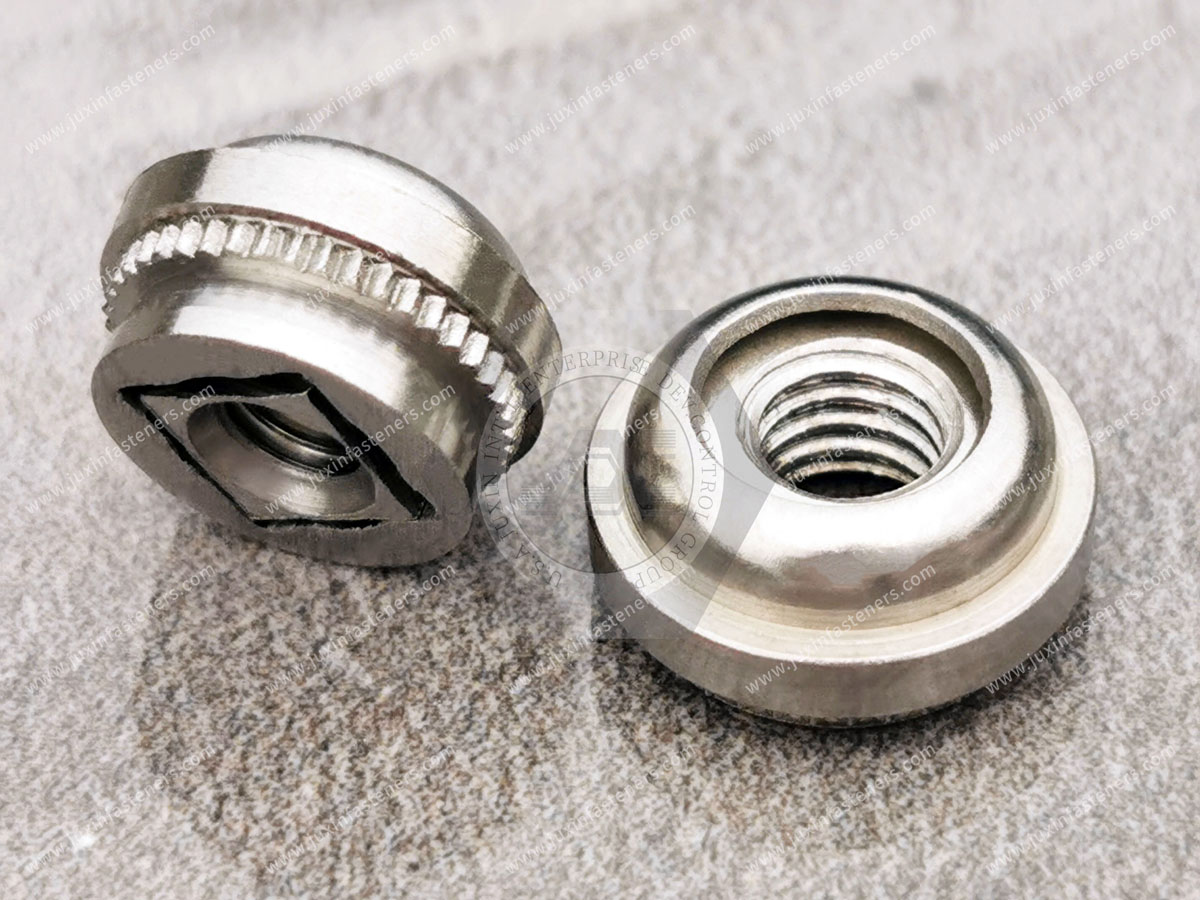
Product Pictures
Contact Us
Tel.:
+86 020 8621 0320
+86 020 3121 6067
E-mail:
Technical Support:
Navigation
SEND INQUIREY