Call Us
+86 136 6007 9809
Call Us
+86 136 6007 9809

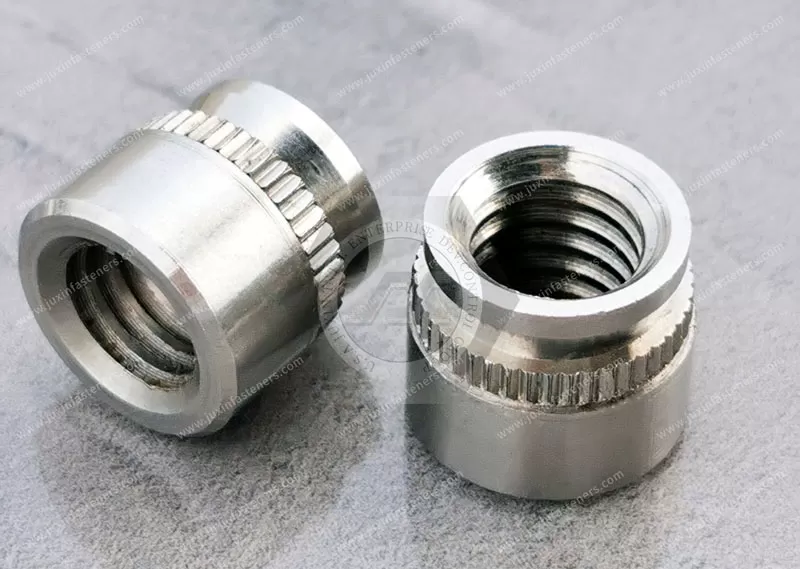
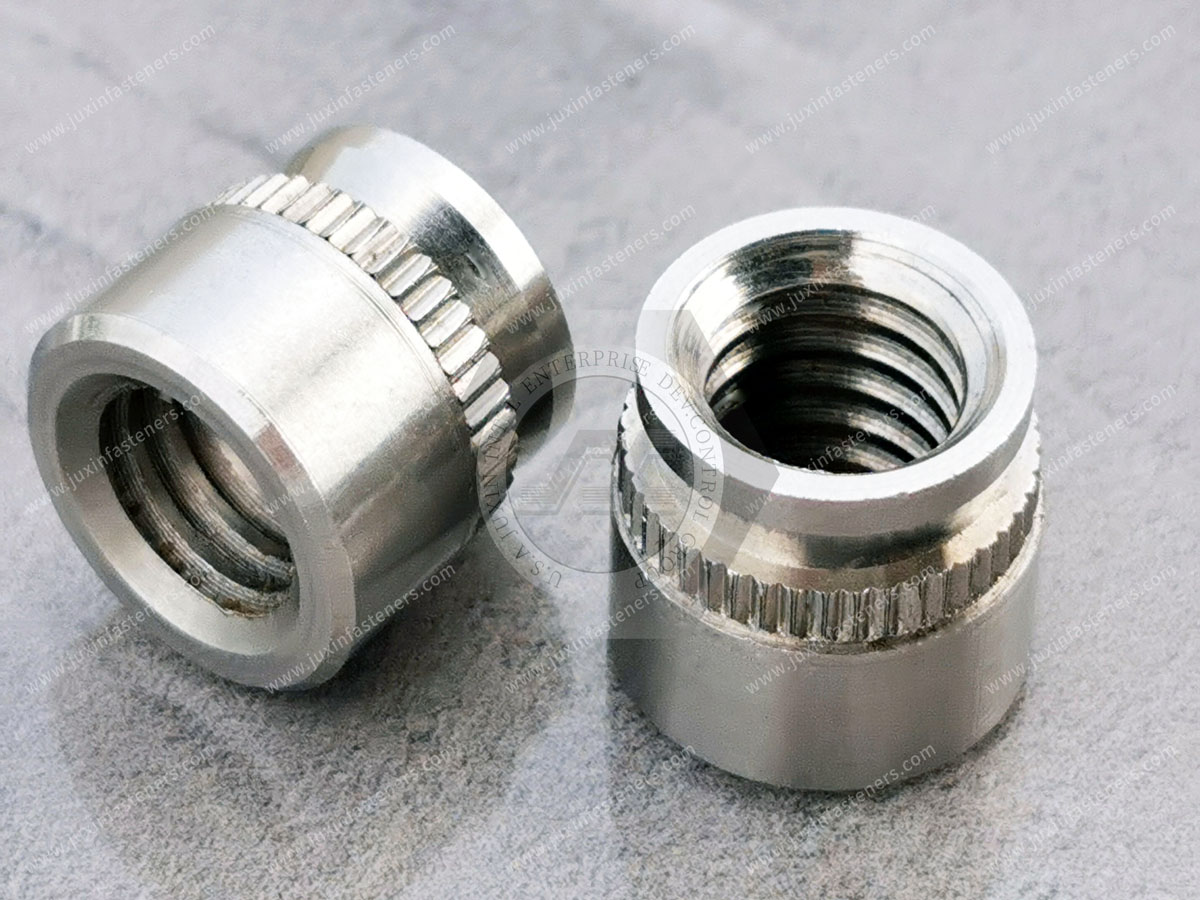
JUXIN FASTENERS supplies M6 and M8 self-clinching nuts, also called press-fit nuts or clinch nuts, for OEM sheet-metal assemblies, including designs using 5 mm panels. Controlled parallel pressing force causes the surrounding sheet metal to flow into the fastener's retaining undercut, while serrated clinching features resist rotation. JX-S, JX-CLS, JX-CLA and JX-SP series address different material and sheet-hardness requirements. Suitability for a particular 5 mm panel must be verified against the selected part's dimensions and installation data.
Product Type: Self-Clinching Nuts / Press-Fit Nuts
Featured Threads: M6, M8
Featured Panel Thickness: 5 mm, subject to part-specific verification
Fastener Materials: Steel and Stainless Steel, according to series
Material References: C45, C46, C20, 1213, 1214, 1215; SUS302, SUS303, SUS316, SUS410, SUS420, SUS430
JUXIN Series: JX-S, JX-CLS, JX-CLA, JX-SP
Installation: Controlled Parallel Pressing Force
Retention: Cold-Flow Mechanical Interlock
Anti-Rotation: Serrated Clinching Geometry
Product Specification
Product Specifications — M6/M8 Self-Clinching Nuts for 5 mm Sheet Metal
JUXIN FASTENERS supplies self-clinching nuts for OEM sheet-metal assemblies requiring retained internal threads, controlled press installation and reliable mechanical attachment.
This product page focuses on M6 and M8 threaded self-clinching nuts for engineering projects involving 5 mm sheet-metal panels.
These fasteners are also known as clinch nuts, press-fit nuts for sheet metal and press-in threaded nuts.
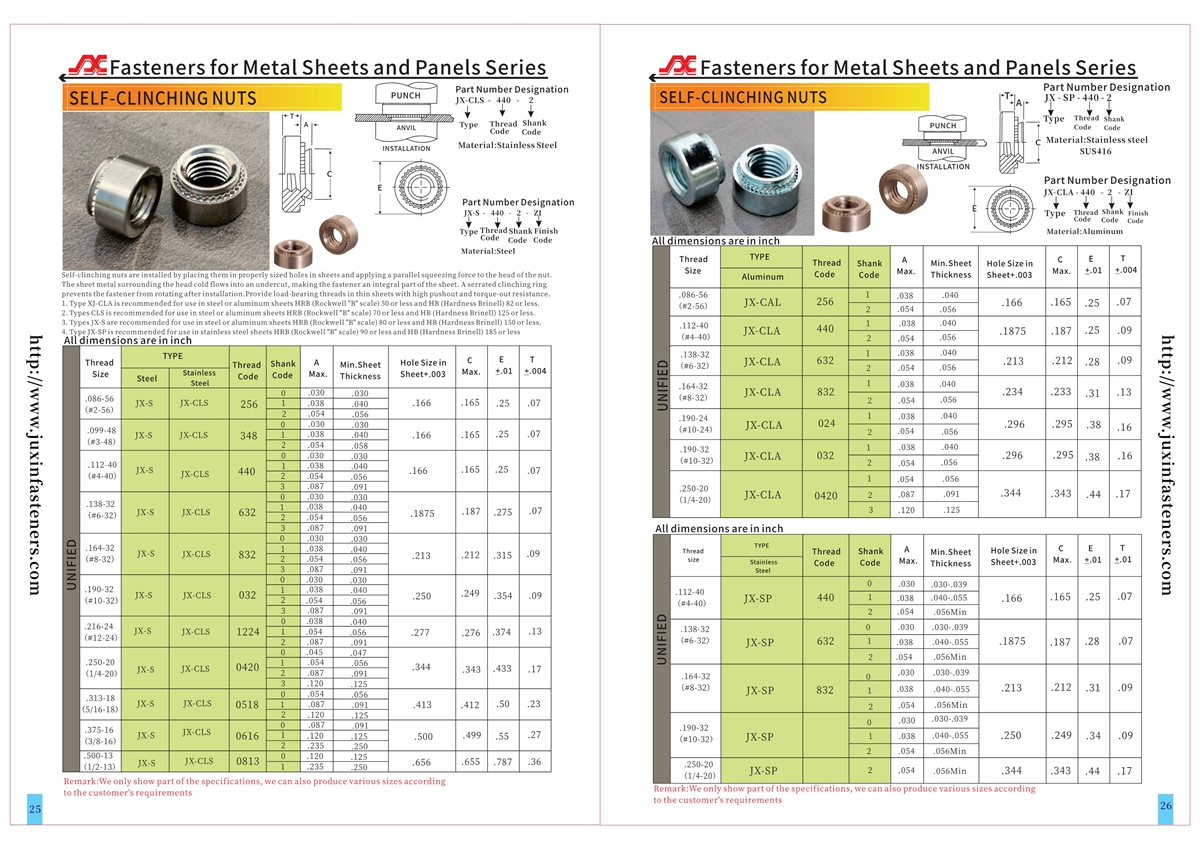
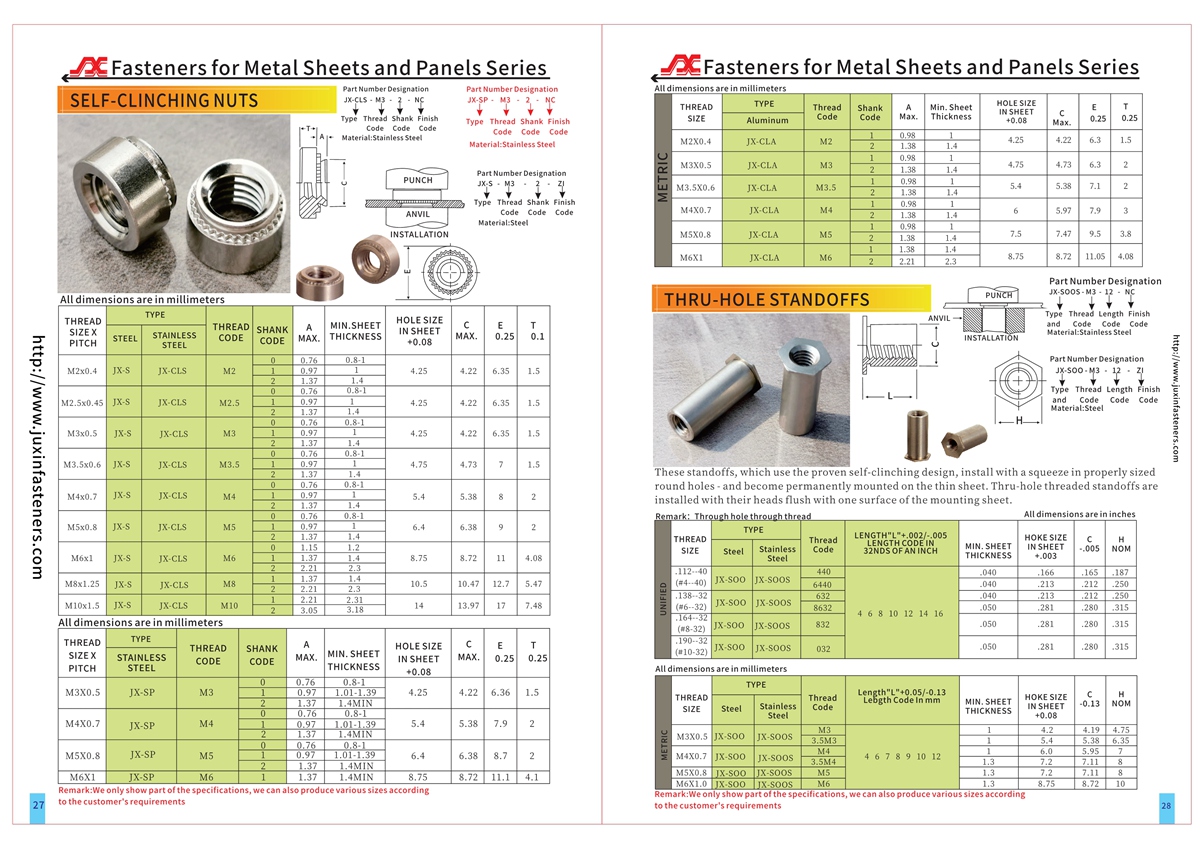
The JUXIN product family includes JX-S, JX-CLS, JX-CLA and JX-SP series.
Different series are intended for different parent-sheet materials and hardness conditions.
A 5 mm panel does not automatically qualify for every series or clinching length.
The actual fastener configuration, installation dimensions and mechanical performance must be confirmed against the approved product drawing and application requirements.
Technical Product Overview
Product Name: M6/M8 Self-Clinching Nuts
Alternative Names: Press-Fit Nuts, Clinch Nuts, Press-In Nuts
Featured Thread Sizes: M6 and M8
Featured Parent-Sheet Thickness: 5 mm
5 mm Inch Reference: Approximately 0.197 inch
Thread Configuration: Internal Female Thread
JUXIN Series: JX-S, JX-CLS, JX-CLA, JX-SP
Fastener Material Families: Steel and Stainless Steel
Steel Material References: C45, C46, C20, 1213, 1214, 1215
Stainless Steel Material References: SUS302, SUS303, SUS316, SUS410, SUS420, SUS430
Exact Grade: Subject to selected series and approved drawing
Parent-Sheet Materials: Steel, Aluminum and suitable Stainless Steel, depending on series
Installation Method: Controlled Parallel Pressing Force
Retention Mechanism: Parent-Sheet Cold Flow into Fastener Undercut
Anti-Rotation Feature: Serrated Clinching Ring
Mounting-Hole Dimensions: According to approved drawing
Installation Force: According to approved technical data
Push-Out Resistance: Subject to application-specific testing
Torque-Out Resistance: Subject to application-specific testing
Surface Treatment: According to approved material and coating specification
OEM Configurations: Subject to engineering and manufacturing review
What Are M6/M8 Self-Clinching Nuts?
M6 and M8 self-clinching nuts are internally threaded fasteners designed for mechanical retention in suitable sheet-metal panels.
They provide permanent threaded mounting points for mating screws or bolts.
During installation, a controlled pressing force causes the surrounding parent-sheet material to flow into a retaining undercut.
The resulting mechanical interlock retains the fastener in the panel.
Serrated clinching features provide resistance to rotation.
The mating screw remains removable, while the clinch nut is intended to remain attached to the parent sheet.
Why Use Self-Clinching Nuts in 5 mm Sheet Metal?
A 5 mm panel provides more material thickness than many thin-sheet applications, but this does not eliminate the need for correct fastener selection.
The engineering team must still determine:
Correct clinch nut series
Appropriate shank or clinching length
Mounting-hole diameter
Parent-sheet hardness
Installation force
Required push-out resistance
Required torque-out resistance
Panel edge distance
Available installation access
For an OEM design, the nominal sheet thickness is only one selection parameter.
Engineering Information Gain — A 5 mm Panel Does Not Automatically Require a 5 mm Clinching Shank
One common selection error is assuming that the fastener's clinching length must equal the total panel thickness.
Self-clinching fasteners use specific retaining geometry to create the mechanical interlock.
The required shank or clinching dimension is determined by the approved fastener design and applicable sheet-thickness range.
A 5 mm sheet should therefore be matched to the correct dimensional configuration rather than selecting a part solely by nominal shank length.
Where a manufacturer uses a numbered or lettered length code, that code must be interpreted using the corresponding dimensional table.
How Self-Clinching Nuts Are Installed
Self-clinching nuts are installed by placing them in correctly sized mounting holes and applying controlled parallel squeezing force.
The surrounding sheet metal plastically deforms into the fastener's retaining undercut.
A serrated clinching ring engages the parent material and helps prevent rotation after installation.
The installation process typically includes:
Confirm the selected fastener and panel specification.
Prepare the approved mounting hole.
Inspect hole dimensions and edge condition.
Position the fastener in the specified orientation.
Support the panel using suitable tooling.
Apply controlled parallel pressing force.
Complete the clinching operation.
Inspect seating and alignment.
Verify required installed performance.
Uncontrolled hammer installation should not be used as a substitute for an approved press process.
Cold-Flow Retention Mechanism
The self-clinching process depends on plastic deformation of the parent-sheet material.
During installation, the material surrounding the hole flows into the fastener's retaining undercut.
This creates a mechanical interlock.
The amount and consistency of material flow depend on:
Parent-sheet hardness
Parent-sheet thickness
Fastener geometry
Fastener hardness
Mounting-hole dimensions
Installation force
Tooling alignment
The actual installed performance must be verified for the selected combination.
JX-CLA Series — Softer Steel and Aluminum Sheets
The supplied JX-CLA series selection reference is:
Parent-Sheet Materials: Steel or Aluminum
Maximum Rockwell B Hardness: HRB 50
Maximum Brinell Hardness: HB 82
JX-CLA may be evaluated for suitable softer sheet-metal applications.
Actual compatibility with a 5 mm panel and the required M6 or M8 configuration must be confirmed.
JX-CLS Series — Steel and Aluminum Sheets
The supplied JX-CLS series selection reference is:
Parent-Sheet Materials: Steel or Aluminum
Maximum Rockwell B Hardness: HRB 70
Maximum Brinell Hardness: HB 125
JX-CLS may be evaluated where the parent sheet meets the approved material and hardness requirements.
The selected fastener material, dimensions and installation conditions must also be confirmed.
JX-S Series — Steel and Aluminum Sheets
The supplied JX-S series selection reference is:
Parent-Sheet Materials: Steel or Aluminum
Maximum Rockwell B Hardness: HRB 80
Maximum Brinell Hardness: HB 150
The JX-S series may be considered for suitable steel or aluminum sheet-metal applications.
The higher stated hardness limit does not automatically establish higher installed push-out or torque-out performance.
JX-SP Series — Suitable Stainless Steel Sheets
The supplied JX-SP series selection reference is:
Parent-Sheet Material: Stainless Steel
Maximum Rockwell B Hardness: HRB 90
Maximum Brinell Hardness: HB 185
JX-SP may be evaluated for stainless steel panels that meet the approved requirements.
Stainless steel grade, hardness, thickness and installation conditions must be reviewed.
Compatibility with every stainless steel grade is not implied.
Important Note on Series Hardness References
The supplied technical information also contains general guidance referring to lower parent-sheet hardness limits for certain steel and stainless steel applications.
These general values should not be combined with the series-specific limits as if they were a single universal specification.
The approved part-specific installation data takes precedence.
Where the applicable hardness limit is uncertain, JUXIN FASTENERS should review the actual part drawing, material specification and intended panel before confirming suitability.
Steel Fastener Materials
The supplied steel material references include:
C45
C46
C20
1213
1214
1215
These references represent different material families and grades.
They are not automatically interchangeable.
The exact material and condition must be defined for the selected fastener.
Stainless Steel Fastener Materials
The supplied stainless steel material references include:
SUS302
SUS303
SUS316
SUS410
SUS420
SUS430
These grades have different metallurgical characteristics.
Some are austenitic stainless steels, while others belong to different stainless steel families.
Their hardness, corrosion resistance, machinability and heat-treatment characteristics may differ substantially.
The exact grade must be selected according to the fastener design and installation requirements.
A listed stainless steel grade should not be interpreted as available for every JUXIN series or M6/M8 configuration.
Engineering Information Gain — Stainless Steel Fastener Material vs. Stainless Steel Parent Sheet
The material of the clinch nut and the material of the parent sheet are separate engineering decisions.
A stainless steel clinch nut is not automatically suitable for installation in every stainless steel panel.
The fastener must retain its intended clinching geometry while the parent-sheet material flows into the undercut.
If the parent sheet is too hard, the required mechanical interlock may not form.
For stainless steel assemblies, both material grades and hardness conditions must be confirmed.
Surface Treatment for Steel Self-Clinching Nuts
Steel fasteners may require surface protection depending on the specified application.
Where electroplated zinc is selected, the coating specification should define:
Coating type
Thickness
Conversion coating
Supplemental treatment
Corrosion performance
Restricted-substance requirements
Appearance
Thread compatibility
ISO 4042 is a relevant reference for electroplated fastener coatings where applicable.
No particular coating thickness or salt-spray performance is claimed without approved data.
Surface Condition of Stainless Steel Fasteners
Stainless steel fasteners may be supplied without an electroplated zinc coating when the approved specification permits.
However, stainless steel does not mean that every grade is suitable for every corrosive environment.
Cleaning, passivation or other finishing requirements should be defined according to the selected material and customer specification.
No universal corrosion performance is claimed.
Mounting-Hole Diameter and Tolerance
The mounting hole is a critical installation parameter.
The supplied manufacturing guidance identifies a nominal hole tolerance reference of 0 to +0.075 mm.
This tolerance should be applied only where confirmed by the selected product's approved drawing.
It is not a universal requirement for all self-clinching nuts.
Hole preparation should consider:
Diameter
Tolerance
Roundness
Burr condition
Edge quality
Panel flatness
Material hardness
Hole-to-edge distance
Punched vs. Drilled Holes
Punched holes may be suitable where the required dimensions and edge conditions can be maintained.
Drilled holes may also be evaluated if they meet the approved requirements.
Punching can create burrs and characteristic sheared or fractured edges.
Drilling can introduce burrs and dimensional variation.
The finished hole must be compatible with the selected fastener and installation method.
Installation Orientation
Installation orientation should follow the approved drawing and process specification.
The supplied technical guidance refers to installation from a particular side of a punched sheet.
However, the correct orientation depends on the product geometry and the hole's manufacturing condition.
The OEM should verify which panel face is intended to receive the fastener and whether burrs or edge features affect seating.
Parallel Pressing Force
Self-clinching nuts should be installed with equipment capable of controlled, aligned pressing.
Relevant factors include:
Press alignment
Punch geometry
Anvil support
Panel support
Fastener positioning
Installation force
Final seating
The required installation force must be confirmed for the actual part.
Why Impact Installation Is Not Recommended
The clinching process depends on controlled material flow.
Uncontrolled impact can cause:
Uneven seating
Fastener tilt
Panel distortion
Incomplete undercut engagement
Thread damage
Reduced retention
Use suitable pressing equipment and an approved installation procedure.
Push-Out Resistance
Push-out resistance describes the installed fastener's resistance to axial displacement under a defined test configuration.
Performance depends on:
Parent-sheet material
Sheet thickness
Mounting-hole dimensions
Fastener geometry
Installation conditions
Test method
No universal push-out value is claimed.
Torque-Out Resistance
Torque-out resistance describes the installed fastener's resistance to rotation within the parent sheet.
It is especially relevant when tightening or removing an M6 or M8 mating screw.
The serrated clinching ring contributes to rotational resistance.
Actual performance must be established through testing of the selected fastener and representative panel.
Engineering Information Gain — Why M8 Does Not Automatically Mean a Stronger Installed Joint
An M8 internal thread is larger than an M6 internal thread.
However, the completed joint's strength depends on more than thread diameter.
Relevant factors include:
Fastener material
Thread engagement
Parent-sheet strength
Clinching geometry
Edge distance
Loading direction
Mating screw
Installation quality
An M8 fastener installed in an unsuitable panel may perform worse than a properly selected M6 fastener in a compatible assembly.
The engineering decision should be based on required joint performance.
M6 vs. M8 Selection
M6 and M8 self-clinching nuts should be compared using:
Required screw diameter
Assembly load
Available mounting space
Panel thickness
Parent-sheet hardness
Mounting-hole dimensions
Minimum edge distance
Installation force
Push-out requirement
Torque-out requirement
Neither size should be selected solely because it appears larger or stronger.
Engineering Example — 5 mm Steel Equipment Panel
An OEM requires an M6 threaded mounting point in a 5 mm steel equipment panel.
The engineering team should confirm:
Steel grade
Actual sheet hardness
Panel thickness tolerance
Required M6 thread specification
Suitable JUXIN series
Correct clinching length
Mounting-hole diameter
Minimum edge distance
Installation orientation
Press tooling
Installation force
Required push-out resistance
Required torque-out resistance
Surface finish
Inspection criteria
The 5 mm sheet thickness alone is not sufficient to approve the part.
Engineering Example — Stainless Steel Electrical Cabinet
An OEM requires an M8 threaded mounting point in a stainless steel electrical cabinet.
The engineering team should first identify:
Stainless steel grade
Parent-sheet hardness
Panel thickness
Required thread specification
Available installation access
JX-SP may be evaluated where the approved series requirements are met.
The actual fastener grade, dimensions, installation force and mechanical retention must be confirmed.
Electrical Enclosures and Power Distribution Equipment
Potential applications include:
Electrical cabinets
Power distribution equipment housings
Control panels
Instrument enclosures
Fabricated mounting brackets
Serviceable equipment covers
The selected fastener must meet the mechanical and environmental requirements of the assembly.
Electrical grounding or bonding performance requires separate verification.
Telecommunications Equipment
Potential applications include:
Telecommunications cabinets
Network equipment enclosures
Equipment mounting panels
Internal support brackets
Electronic equipment housings
Retained M6 or M8 threads may simplify equipment assembly where suitable.
Industrial Machinery
Potential applications include:
Machine enclosures
Equipment mounting panels
Control cabinets
Fabricated brackets
Instrument housings
Service panels
Where the assembly experiences vibration, the complete threaded joint must be evaluated for loosening and fatigue.
Automotive Equipment
Potential applications include selected:
Automotive electronics housings
Equipment brackets
Interior mounting structures
Fabricated panels
Serviceable covers
Automotive projects may require customer-specific qualification, inspection, traceability and change control.
No automotive safety approval is implied.
Railway Equipment
Potential applications include suitable:
Electrical equipment cabinets
Communications equipment housings
Interior equipment panels
Non-structural mounting brackets
Maintenance-access assemblies
Project-specific vibration, corrosion and mechanical qualification may be required.
Self-Clinching Nuts vs. Tapped 5 mm Sheet Metal
A 5 mm steel panel may provide sufficient thickness for direct tapping in some applications.
Therefore, a self-clinching nut is not automatically necessary simply because the panel is 5 mm thick.
The engineering team should compare:
Required thread engagement
Parent-sheet material
Thread strength
Manufacturing cycle time
Tapping cost
Installation cost
Service requirements
Repair strategy
Production volume
This comparison is particularly important for 5 mm sheet-metal designs because direct tapping may be a practical alternative.
Self-Clinching Nuts vs. Weld Nuts
Self-clinching nuts use controlled mechanical pressing.
Weld nuts use a welding process.
Relevant comparison factors include:
Parent-sheet material
Installation access
Mechanical performance
Welding suitability
Heat effects
Surface finish
Equipment investment
Production volume
The correct method depends on the complete manufacturing and service requirements.
Self-Clinching Nuts vs. Blind Rivet Nuts
Self-clinching nuts typically require suitable press tooling and support access.
Blind rivet nuts are intended for one-sided installation.
For an accessible 5 mm panel, the OEM should compare self-clinching, direct tapping, welding and blind threaded insertion according to the actual assembly.
No single method is universally best.
OEM Procurement Information Gain — Installed Cost vs. Fastener Price
A purchasing team should evaluate total installed cost rather than unit price alone.
Relevant factors include:
Fastener unit cost
Mounting-hole preparation
Press equipment
Tooling
Installation cycle time
Quality inspection
Scrap and rework
Qualification testing
Inventory management
Packaging
Delivery reliability
A low-cost fastener may create higher production costs if it requires rework or inconsistent installation.
Supplier Interchangeability
Two M6 or M8 self-clinching nuts may have similar external dimensions but different installation requirements.
Potential differences include:
Fastener material
Fastener hardness
Undercut geometry
Serration design
Mounting-hole diameter
Clinching length
Installation force
Push-out resistance
Torque-out resistance
Replacement should be based on approved dimensional and functional requirements.
OEM Supplier Qualification Checklist
Product Identity
Confirm JUXIN series and part number.
Thread
Verify M6 or M8 pitch and tolerance.
Fastener Material
Confirm exact steel or stainless steel grade.
Parent Sheet
Confirm material, hardness and thickness.
Mounting Hole
Verify diameter, tolerance and edge condition.
Installation
Confirm tooling, force and orientation.
Performance
Define push-out and torque-out acceptance criteria.
Surface Finish
Confirm coating and corrosion requirements.
Documentation
Specify inspection and traceability requirements.
Commercial Terms
Confirm order quantity, annual demand, packaging and delivery expectations.
Relevant Engineering Standards
ISO 261 — ISO general-purpose metric screw thread combinations.
ISO 965 — ISO metric screw thread tolerances.
ASME B1.1 — Unified inch screw threads, where applicable.
ISO 6508-1 — Rockwell hardness testing.
ISO 6506-1 — Brinell hardness testing.
ASTM E18 — Rockwell hardness testing of metallic materials.
ASTM E10 — Brinell hardness testing of metallic materials.
ISO 4042 — Electroplated coating systems for fasteners, where applicable.
These references support engineering evaluation and do not imply that every supplied part has been certified to all listed standards.
Frequently Asked Questions
Can self-clinching nuts be installed in 5 mm sheet metal?
Potentially, depending on the selected fastener geometry, material, hardness and approved sheet-thickness range.
Are M6 and M8 self-clinching nuts available in steel?
Steel is included in the supplied material family. Actual size and series availability must be confirmed.
Are stainless steel self-clinching nuts suitable for stainless steel panels?
Suitable combinations may be evaluated, but compatibility depends on the actual fastener and parent-sheet properties.
Does a 5 mm panel require a 5 mm clinching shank?
Not necessarily. The required clinching dimension must follow the approved product design.
What mounting-hole tolerance is required?
The supplied guidance includes a 0 to +0.075 mm reference, but the approved part-specific drawing must govern.
Can self-clinching nuts be hammered into place?
Controlled press installation is recommended. Uncontrolled impact should not replace the approved process.
What is push-out resistance?
It measures resistance to axial displacement of the installed fastener under defined test conditions.
What is torque-out resistance?
It measures resistance to rotation of the installed fastener within the panel.
Can an M8 self-clinching nut replace an M6 nut?
Not directly. The thread size, mounting hole, fastener geometry and joint requirements differ.
Can a 5 mm steel panel be tapped instead?
Direct tapping may be a viable alternative depending on material, required thread engagement and assembly performance.
Related Sheet-Metal Fastening Solutions
Related JUXIN FASTENERS product categories include:
Steel Self-Clinching Nuts — for general steel and aluminum sheet-metal applications.
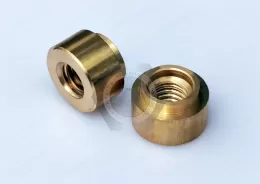
Brass Self-Clinching Nuts — for suitable applications requiring brass alloy threaded inserts.
Stainless Steel Self-Clinching Nuts — for selected material and environmental requirements.
Self-Clinching Studs — for retained external threaded attachment points.
Self-Clinching Standoffs — for spacing electronic components and equipment panels.
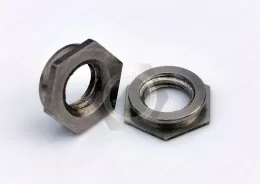
Floating Self-Clinching Nuts — for selected applications requiring alignment compensation.
Blind Rivet Nuts — for one-sided threaded installation.
Weld Nuts — for assemblies using an approved welding process.
These names are intended as contextual internal-link anchor texts. Add hyperlinks only to verified relevant live product pages.
OEM RFQ Checklist
For accurate technical review and quotation, please provide:
Required thread size: M6 or M8
JUXIN series or existing reference part
Engineering drawing or CAD file
Fastener material grade
Parent-sheet material
Parent-sheet hardness
Nominal and actual sheet thickness
Mounting-hole dimensions
Minimum edge distance
Required clinching length or part code
Installation orientation
Available press equipment
Installation force requirements
Push-out acceptance criteria
Torque-out acceptance criteria
Mating screw specification
Surface finish requirements
Corrosion requirements
Inspection documentation
Initial order quantity
Estimated annual demand
Packaging requirements
Delivery schedule
JUXIN FASTENERS — OEM M6/M8 Self-Clinching Nut Supply
JUXIN FASTENERS supplies industrial self-clinching nuts and sheet-metal fastening products for international OEM engineers, purchasing managers, supplier development teams and equipment manufacturers.
Our JX-S, JX-CLS, JX-CLA and JX-SP product families can be evaluated for different sheet-metal materials and hardness conditions.
For M6/M8 applications involving 5 mm sheet metal, the correct product must be selected according to the actual panel specification, clinching dimensions and installed performance requirements.
Request an OEM Technical Quotation
Email: info@juxinfasteners.com
Website: www.juxinfasteners.com
Please send your engineering drawing, parent-sheet material, hardness, panel thickness, required thread size, initial purchasing quantity and estimated annual demand.
JUXIN FASTENERS — Self-Clinching Fastening Solutions for OEM Sheet-Metal Engineering and Global Procurement.
Product Packaging
Product Packaging — M6/M8 Self-Clinching Nuts
JUXIN FASTENERS supplies self-clinching nuts with protective packaging arrangements for industrial and OEM shipments.
Product Type: M6/M8 Self-Clinching Nuts
Material: Steel or Stainless Steel, according to confirmed part specification
Inner Packaging: Poly Foam
Outer Packaging: Cartons
Shipping Arrangement: Palletized Packaging
Carton dimensions, packing quantities, gross weights and pallet arrangements are subject to order confirmation.
Thread Protection: Packaging should protect internal threads against mechanical damage and contamination.
Clinching Feature Protection: Retaining undercuts and serrated clinching rings should be protected from deformation before installation.
Product Identification: Customer-specified labels may identify part number, thread size, material, surface finish, quantity, lot number and drawing revision.
Series Segregation: Different JUXIN series, thread sizes and clinching-length configurations should be clearly identified to reduce mixing risk.
OEM Packaging: Customer-specific packing quantities, carton arrangements, labels and pallet requirements are subject to purchase-order confirmation.
Final packaging details will be confirmed before shipment.
For OEM packaging requirements and quotations:
Email: info@juxinfasteners.com
Website: www.juxinfasteners.com
Product Pictures
Contact Us
Tel.:
+86 020 8621 0320
+86 020 3121 6067
E-mail:
Technical Support:
Navigation
SEND INQUIREY