Call Us
+86 136 6007 9809
Call Us
+86 136 6007 9809

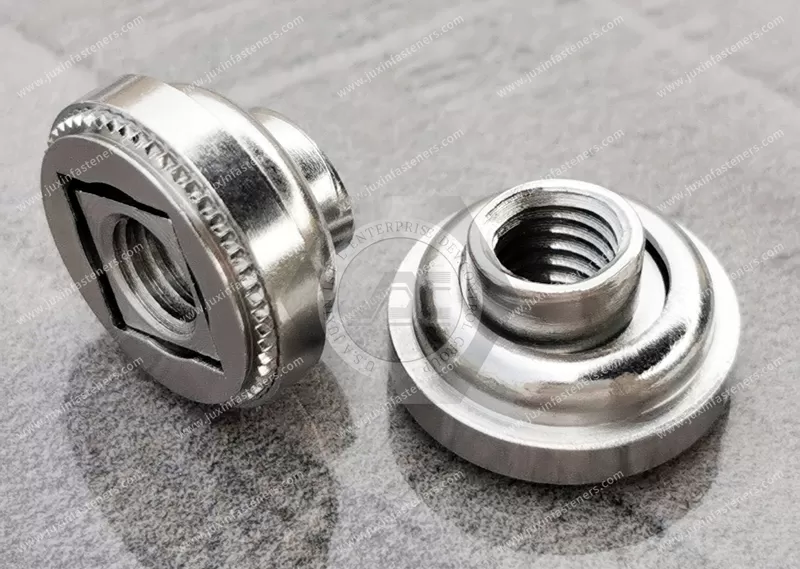
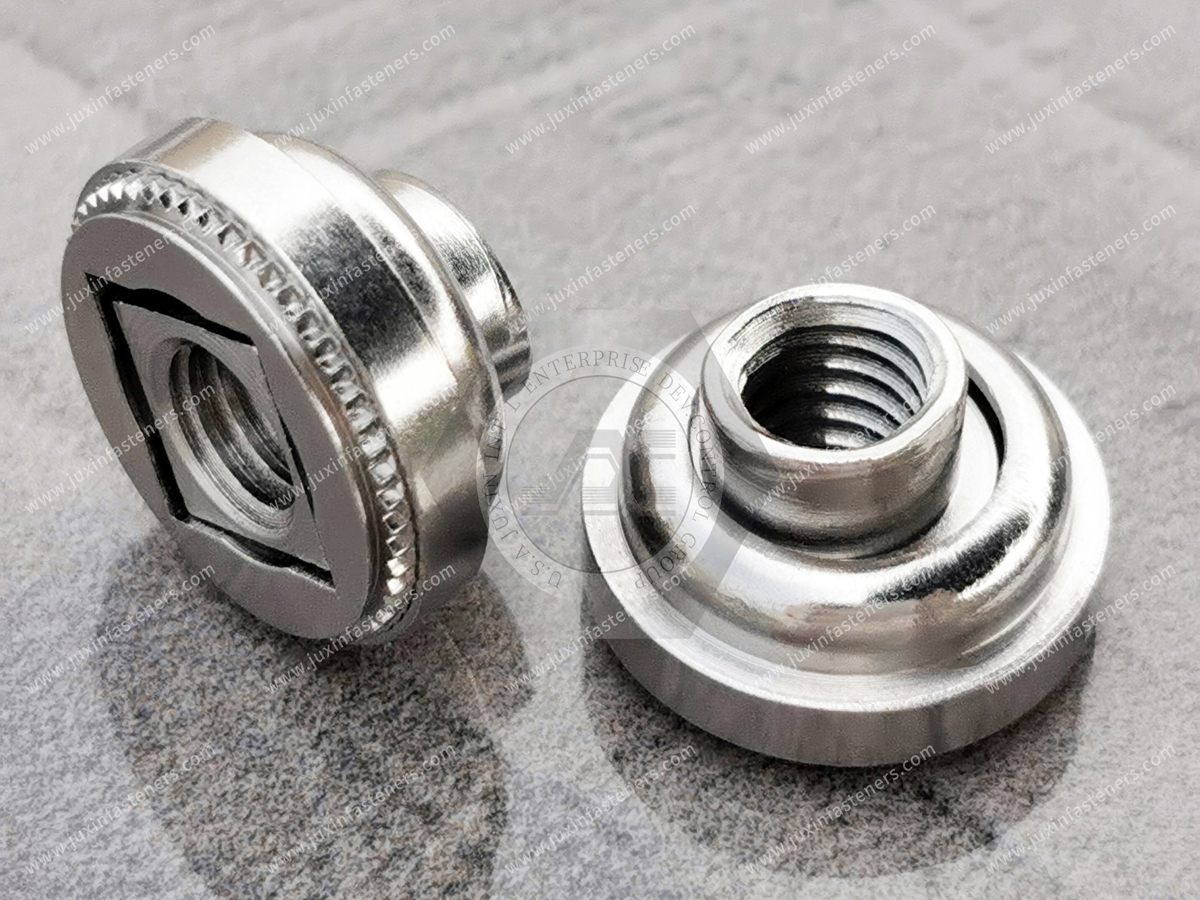
JUXIN FASTENERS supplies JX-LAC stainless steel locking floating self-clinching nuts for industrial sheet metal assemblies requiring captive internal threads, limited alignment adjustment and a specified thread-locking function.
The fastener combines a self-clinching outer retainer with a movable internally threaded nut incorporating a prevailing-torque locking feature. The floating mechanism helps accommodate mating-hole misalignment of up to 0.76 mm (0.030 in) total movement within the applicable product family, subject to drawing confirmation.
JX-LAC is suitable for engineering evaluation in electronic enclosures, industrial control cabinets, telecommunications equipment, automation systems and serviceable metal panel assemblies.
Stainless steel material options include grades corresponding to 302, 303, 316, 410, 420 and 430, subject to technical suitability and confirmed availability.
Thread dimensions, locking torque, installation requirements and host-sheet compatibility must be verified for the selected configuration.
For OEM drawings, specifications and quotations, contact info@juxinfasteners.com.
Website: www.juxinfasteners.com
Product Specification
JX-LAC Stainless Steel Locking Floating Self-Clinching Nuts – Engineering and OEM Procurement Guide
Product Overview
JX-LAC locking floating self-clinching nuts combine three distinct mechanical functions in one captive threaded fastening component.
First, the outer retainer is mechanically secured to the mounting sheet through a self-clinching installation process.
Second, the internally threaded nut is designed to move within a controlled lateral range to accommodate limited positional differences between mating components.
Third, the locking thread incorporates a prevailing-torque feature intended to resist unintended screw rotation under defined conditions.
These functions must be evaluated separately during product selection, installation qualification and assembly validation.
The JX-LAC configuration is particularly relevant where a design requires both positional tolerance compensation and a locking-thread function.
Product Identification
Product designation: JX-LAC
Product category: Locking floating self-clinching nuts
Material family: Stainless steel
Thread configuration: Internal female thread with locking function
Fastener construction: Self-clinching outer retainer with floating internal nut
Installation method: Mechanical press installation
Floating adjustment: Up to 0.76 mm (0.030 in) total movement within the referenced product family, subject to configuration verification
Thread range: Metric and inch-series configurations according to the approved specification
Material options: Stainless steel grades corresponding to 302, 303, 316, 410, 420 and 430, subject to feasibility and availability
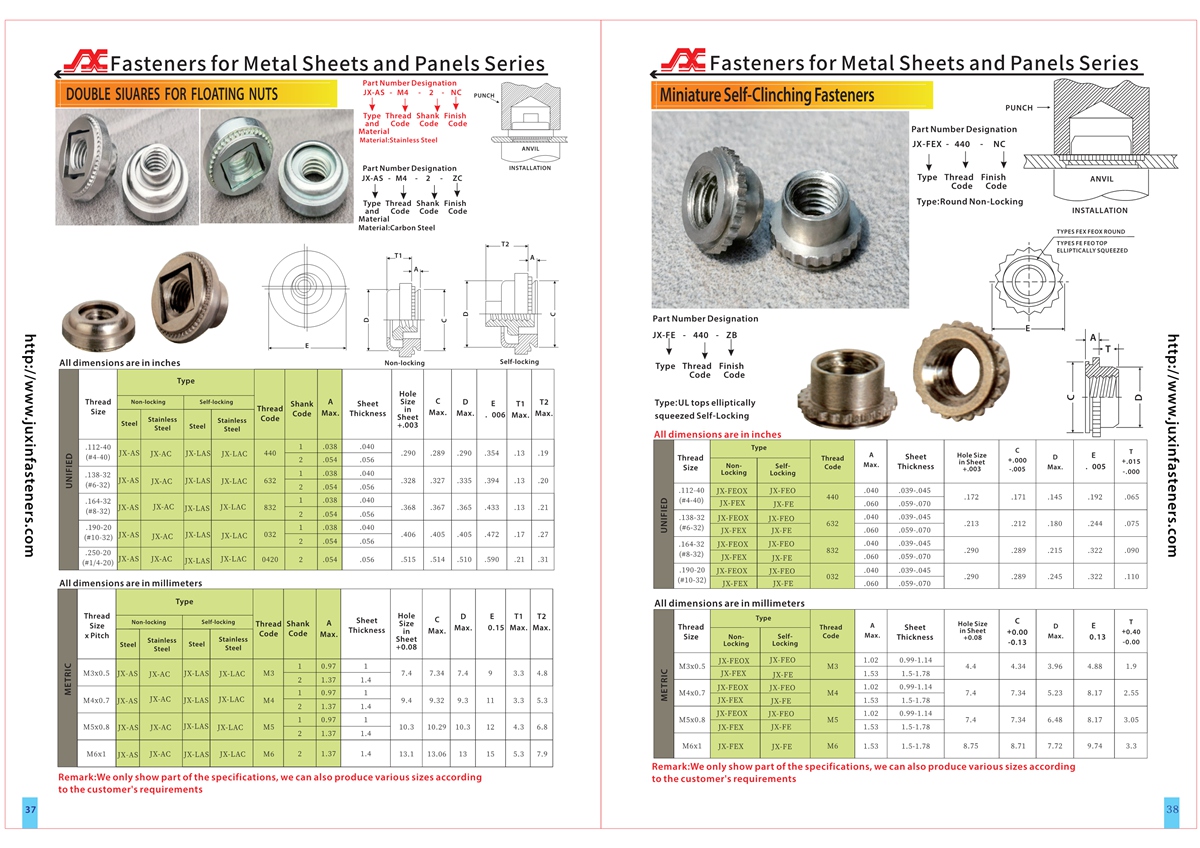
Dimensional reference: Product specification PDF or CAD documentation, pages 37–38
Custom configurations: Subject to drawing and manufacturing review
How JX-LAC Locking Floating Nuts Work
A JX-LAC assembly contains an outer retainer that becomes mechanically secured to the host sheet.
Inside this retainer is a movable threaded element.
The threaded element can shift laterally within its designed movement range.
This movement helps a mating screw align with the internal thread when small differences exist between the nominal positions of the mounting holes.
The locking feature then provides a specified resistance to thread rotation during engagement or removal.
The result is a fastener that addresses both assembly alignment and thread-locking requirements.
However, the locking function does not replace the need for proper joint design, tightening control or application testing.
Three Performance Requirements Must Be Verified
The most important engineering distinction for JX-LAC is that three separate performance requirements must be satisfied.
Outer-body retention: The installed retainer must remain secured in the host sheet.
Floating movement: The internal nut must retain the required lateral movement after installation.
Locking-thread performance: The internal thread must provide the specified prevailing-torque behavior.
A fastener can meet one requirement while failing another.
For example, excessive installation force may secure the outer retainer but restrict floating movement.
Similarly, an incorrectly selected locking-thread geometry may provide excessive assembly torque even if the floating mechanism operates correctly.
OEM qualification should therefore include all three functions.
Understanding Prevailing Torque
Prevailing torque is the torque required to rotate a mating threaded component because of an intentional locking feature, independent of the torque needed to clamp the joint.
It is not the same as final installation tightening torque.
It is also not the same as the axial preload in the joint.
A prevailing-torque feature may increase resistance to unintended screw rotation, but actual joint security depends on the complete assembly.
Engineers should specify the applicable prevailing-torque requirements, test method and reuse expectations.
The locking torque must be appropriate for the screw, joint materials and intended assembly equipment.
Locking Performance and Vibration Resistance
Industrial equipment may experience vibration, shock or repeated operational movement.
A locking floating nut may be considered where the design requires additional resistance to unintended screw rotation.
However, prevailing torque alone does not establish vibration qualification.
The final joint must be evaluated for clamp load, joint stiffness, loading direction, transverse movement and service conditions.
Where vibration performance is critical, the OEM should define an appropriate validation program.
No vibration endurance or locking-cycle guarantee should be assumed without testing.
JX-LAC Versus JX-AC
JX-LAC and JX-AC are related stainless steel floating self-clinching nut configurations.
JX-AC provides non-locking internal threads.
JX-LAC adds an intentional locking-thread function.
Both are intended to provide limited alignment adjustment through a movable internal nut.
JX-LAC may be considered where prevailing-torque requirements are specified.
JX-AC may be preferable where a locking feature is unnecessary or where lower thread-running resistance is desirable.
The two versions should not be substituted without reviewing the mating screw, assembly torque, reuse requirements and approved drawing.
JX-LAC Versus JX-LAS
JX-LAC and JX-LAS are both locking floating self-clinching nut designations.
The supplied product family identifies JX-LAC with stainless steel material options and JX-LAS with steel material options.
Material selection affects corrosion behavior, mechanical properties and installation compatibility.
The exact product geometry and mechanical performance must also be reviewed.
A material change does not automatically establish dimensional or functional interchangeability.
Stainless Steel Material Selection
The supplied material references include grades corresponding to 302, 303, 316, 410, 420 and 430 stainless steel.
These materials have different properties and should not be treated as equivalent.
302 is an austenitic stainless steel grade.
303 is an austenitic stainless steel grade commonly associated with improved machinability.
316 is an austenitic stainless steel grade often considered for environments requiring enhanced resistance to certain forms of corrosion.
410 and 420 are martensitic stainless steel grades with properties that depend on processing and heat-treatment condition.
430 is a ferritic stainless steel grade with different mechanical and corrosion characteristics.
The final material selection must consider both the fastener construction and its intended environment.
The material of the outer retainer and the internal locking nut should be confirmed individually where required.
Stainless Steel Fastener and Host-Sheet Compatibility
Self-clinching fasteners rely on the host sheet material deforming around designated retention features.
For reliable installation, the mounting sheet must have suitable thickness, hardness and material properties.
Stainless steel sheets may be harder than many common carbon steel or aluminum sheet materials.
Therefore, a stainless steel fastener should not automatically be considered suitable for every stainless steel mounting sheet.
The approved JX-LAC specification must identify the permitted host-sheet conditions.
Installation qualification should verify retention and floating movement using the actual production sheet material.
Sheet Thickness and Hardness Requirements
The supplied technical information references certain locking and non-locking floating fastener variants for stainless steel sheets as thin as approximately 0.97 mm (0.038 in), with hardness up to HRB 88.
These values should be treated as configuration-dependent reference information.
They are not universal guarantees for every JX-LAC thread size, material or installation condition.
The exact minimum sheet thickness and hardness limits must be confirmed from the approved product drawing and installation specification.
Installation Hole Design
The mounting hole must be prepared according to the selected fastener's dimensional requirements.
Important parameters include:
Hole diameter
Hole diameter tolerance
Sheet thickness
Sheet hardness
Hole location
Distance to the nearest edge
Distance to bends and formed features
Punching or machining method
Burr condition
Installation direction
The correct hole geometry is essential for self-clinching retention.
An oversized hole may reduce material engagement.
An undersized or incorrectly prepared hole may cause deformation or installation damage.
The mounting hole should not be modified based on generic fastener recommendations when a specific JX-LAC installation drawing is available.
Press Installation Process
JX-LAC is installed using suitable press equipment and correctly designed tooling.
The general process involves preparing the mounting hole, positioning the fastener, aligning the installation punch and anvil, and applying a controlled squeezing force.
The host sheet material flows around the designated retention features.
The outer retainer becomes mechanically secured to the panel.
The internal locking nut must remain movable.
The required force, tooling geometry and orientation depend on the actual fastener configuration.
Why Excessive Installation Force Is a Risk
Excessive pressing force can deform the outer retainer or interfere with the internal floating mechanism.
This can reduce or eliminate the intended lateral adjustment.
It may also affect the geometry of the locking-thread element.
Insufficient pressing force may produce inadequate retention.
For this reason, the installation process should be qualified using controlled press settings and appropriate inspection methods.
The installed fastener should be checked for seating, retention, thread condition and floating function.
Floating Movement and Alignment Adjustment
The supplied family information identifies up to 0.76 mm (0.030 in) total adjustment.
This is a total movement reference and should not automatically be interpreted as 0.76 mm of radial movement in every direction.
Where the mechanism is symmetric, a total diametral movement of 0.76 mm would correspond to approximately 0.38 mm from the centered position.
Actual movement depends on the approved geometry.
Engineers should verify the available travel and include it in the assembly tolerance analysis.
Tolerance Stack-Up in Multi-Fastener Assemblies
A panel containing several fastening points can accumulate positional variation from multiple manufacturing operations.
These may include:
Sheet cutting
Hole punching
Bending
Welding
Bracket positioning
Coating thickness
Assembly fixture variation
Component manufacturing tolerances
JX-LAC can accommodate a limited amount of mating-hole misalignment.
However, the floating mechanism cannot correct unlimited variation.
The assembly should be designed so that the expected misalignment remains within the verified movement capability.
Screw Engagement and Locking Torque
The mating screw must enter the internal thread correctly.
A floating mechanism can compensate for limited lateral offset, but it does not eliminate the risk of cross-threading.
The locking feature introduces additional running resistance.
The assembly process must therefore distinguish between normal locking resistance and abnormal resistance caused by misalignment or thread damage.
Screw engagement, thread condition and tightening procedures should be verified during prototype qualification.
Repeated Assembly and Locking Performance
Some industrial panels require periodic removal for inspection, maintenance or equipment servicing.
For such applications, the OEM should determine whether the locking-thread feature is intended for repeated use.
Prevailing torque can change over repeated installation and removal cycles.
The acceptable number of cycles and corresponding torque limits should be specified where required.
No reuse-cycle rating should be assumed without supporting product data.
Thread Size and International Standards
The referenced floating fastener family includes metric and inch-series thread options.
Actual JX-LAC sizes must be verified against the dimensional specification.
ISO 261 and ISO 965 may be relevant to metric thread designation and tolerance requirements.
ASME B1.1 may be relevant to Unified inch-series threads.
A metric M4 thread is not interchangeable with an inch-series thread merely because the nominal diameters are similar.
The RFQ should state the complete thread designation, tolerance requirements and mating screw specification.
Prevailing-Torque Testing and Specifications
Where a prevailing-torque specification is required, the applicable standard and test procedure must be defined.
NASM25027 may be relevant to certain self-locking fastener applications when explicitly required by the customer specification.
However, JX-LAC should not be represented as compliant with NASM25027 without documented product-specific verification.
The purchasing specification should identify the required first-installation torque, removal torque, subsequent-cycle requirements and acceptance criteria where applicable.
Push-Out Resistance
Push-out resistance evaluates the installed fastener's resistance to displacement from the mounting sheet under an applicable axial loading condition.
Performance depends on the outer retainer geometry, host sheet material, sheet thickness, hole preparation and installation conditions.
The locking thread does not independently guarantee adequate push-out resistance.
The OEM should specify and verify the required mechanical retention.
Torque-Out Resistance
Torque-out resistance concerns the ability of the installed retainer to resist rotation or loss of retention under the relevant loading condition.
For JX-LAC, this is especially important because the internal locking thread can introduce additional torque during screw engagement.
The installed retainer must withstand the intended assembly process without losing its attachment to the sheet.
The relationship between locking torque and retainer retention should be assessed during engineering qualification.
A Critical Design Check: Locking Torque Versus Retainer Retention
One useful engineering check is to evaluate whether the torque introduced by the locking feature is compatible with the installed retainer's resistance to rotation.
If the locking torque is too high relative to the retainer's retention capability, assembly problems may occur.
The design should provide a suitable margin between the required thread-running torque and the relevant retention limit.
The margin and test method must be established for the actual product and application.
This check is especially important for thin sheets, marginal hole conditions and repeated servicing.
Engineering Application: Industrial Control Cabinets
Industrial control cabinets may contain removable covers, mounting panels and equipment brackets.
These assemblies can experience positional variation due to independent fabrication processes.
JX-LAC locking floating nuts may help accommodate limited alignment differences while providing a locking-thread function.
The designer should verify that the selected mounting sheet is suitable for self-clinching installation.
The joint should also be evaluated for tightening torque, vibration exposure and service requirements.
Engineering Application: Telecommunications Equipment
Telecommunications equipment often incorporates sheet metal housings, access panels and modular components.
Floating nuts can help compensate for small differences between mating hole locations.
A locking-thread version may be considered where the joint specification calls for prevailing-torque resistance.
The fastener's locking performance and floating movement should be verified together.
Engineering Application: Industrial Automation Equipment
Automation systems may use fabricated steel or stainless steel panels, equipment guards and removable service covers.
Manufacturing variation can create minor assembly misalignment.
JX-LAC may provide a useful combination of captive fastening, limited positional adjustment and locking-thread function.
For vibrating equipment, joint-level testing remains necessary.
The presence of a locking nut does not establish vibration resistance for the complete assembly.
Engineering Application: Transportation Equipment
Transportation equipment can contain numerous sheet metal brackets, housings and access panels.
Some assemblies require controlled alignment during installation and specified resistance to loosening.
JX-LAC may be evaluated for suitable non-safety-critical or otherwise qualified applications.
Any safety-critical use requires application-specific engineering approval and validation.
No automotive, aerospace or railway qualification should be inferred without supporting documentation.
Engineering Application: Electronic Enclosures
Electronic enclosures may require precise assembly of multiple covers and internal structural components.
Floating nuts can reduce sensitivity to small hole-position differences.
Locking versions may be considered where the mechanical joint specification requires them.
Electrical bonding, grounding and electromagnetic compatibility must be evaluated separately.
A stainless steel floating nut does not automatically provide a qualified electrical connection.
Corrosion Resistance and Environmental Exposure
Stainless steel corrosion resistance depends on material grade, surface condition and exposure environment.
Moisture, chlorides, cleaning chemicals and crevice conditions may affect long-term performance.
The floating mechanism introduces internal contact surfaces that should be considered when evaluating contamination and corrosion exposure.
Material grade selection should be based on the actual environment.
If passivation or other processing is specified, the requirements should be clearly identified in the approved drawing or purchase specification.
Stainless Steel Thread Galling
Stainless steel threaded components can experience galling under certain conditions.
Factors include mating material, thread geometry, surface finish, friction, tightening speed and assembly load.
The locking-thread feature may introduce additional friction during screw engagement.
Therefore, engineers should evaluate thread material combinations and assembly conditions carefully.
Any lubrication or surface treatment must be compatible with the required locking performance.
Locking Floating Nuts Versus Standard Locknuts
A conventional locknut is normally a separate component installed onto a mating external thread.
JX-LAC is a captive internally threaded fastener installed into a mounting sheet.
Its floating mechanism provides positional adjustment.
Its locking thread provides specified rotational resistance.
These functions make it different from a loose prevailing-torque locknut.
The correct selection depends on assembly access, available space, host material and mechanical requirements.
Locking Floating Nuts Versus Blind Rivet Nuts
Blind rivet nuts are installed by mechanically deforming the fastener body, often from one accessible side of the sheet.
JX-LAC requires suitable press access and compatible sheet deformation for self-clinching retention.
The two fastening methods should not be treated as interchangeable.
Standard blind rivet nuts also do not necessarily provide floating alignment or prevailing-torque locking functions.
The selection should be based on the complete assembly requirements.
OEM Procurement and Supplier Qualification
OEM purchasing teams should request a complete technical specification before approving a locking floating nut.
Important qualification items include:
Approved product drawing
Exact product designation
Stainless steel grade
Thread size and tolerance
Locking-thread design
Prevailing-torque requirements
Floating movement range
Host-sheet material
Sheet thickness and hardness
Mounting hole geometry
Installation tooling
Push-out resistance
Torque-out resistance
Surface condition
Inspection requirements
Traceability requirements
Packaging requirements
Engineering change control
Production approval should be based on the confirmed configuration and agreed acceptance criteria.
Common Engineering and Purchasing Mistakes
Mistake 1: Assuming that locking-thread torque and final tightening torque are the same.
Mistake 2: Treating the stated 0.76 mm total movement as 0.76 mm of adjustment in every direction.
Mistake 3: Assuming that any stainless steel sheet is suitable for self-clinching installation.
Mistake 4: Checking outer retainer retention without checking the internal floating movement.
Mistake 5: Assuming that a locking feature automatically guarantees vibration resistance.
Mistake 6: Substituting JX-LAC for JX-AC without revising the assembly torque requirements.
Mistake 7: Treating all stainless steel grades as equivalent.
Mistake 8: Approving the product without confirming the required prevailing-torque test criteria.
What Determines JX-LAC Pricing?
Pricing depends on the complete technical and commercial specification.
Relevant factors include:
Stainless steel material grade
Thread size
Fastener geometry
Locking-thread construction
Floating mechanism
Dimensional tolerances
Required locking torque
Mechanical testing
Inspection requirements
Surface treatment
Order quantity
Annual forecast
Packaging
Delivery schedule
Customer-specific drawings
For a reliable quotation, provide the approved drawing and the intended production requirements.
Frequently Asked Questions
What is JX-LAC?
JX-LAC is a stainless steel locking floating self-clinching nut configuration intended for captive threaded fastening in compatible sheet metal assemblies.
What makes it different from JX-AC?
JX-LAC includes a locking-thread function, while JX-AC is non-locking.
Does JX-LAC compensate for misaligned holes?
Yes, within the verified floating movement range of the selected configuration.
Does a locking floating nut eliminate the need for vibration testing?
No. Joint-level performance must be validated for the application.
Can JX-LAC be installed into stainless steel sheets?
Only where the exact fastener specification confirms compatibility with the sheet material, hardness and thickness.
What is the minimum sheet thickness?
The minimum must be confirmed from the selected product drawing and installation specification.
Are metric and inch threads available?
The broader family references metric and inch-series configurations. Exact JX-LAC availability requires confirmation.
Can JX-LAC be supplied for OEM projects?
Drawing-based requirements and purchasing inquiries can be submitted for technical and commercial review.
Related Products and Internal Linking
The following JUXIN FASTENERS product pages are relevant to this product selection process:
JX-AC Stainless Steel Non-Locking Floating Self-Clinching Nuts
JX-AS Steel Non-Locking Floating Self-Clinching Nuts
JX-LAS Steel Locking Floating Self-Clinching Nuts
Self-Clinching Nuts
Self-Clinching Blind Nuts
Self-Clinching Studs
Self-Clinching Standoffs
Blind Rivet Nuts
Sheet Metal Fastening Solutions
Each anchor should link to the corresponding verified JUXIN FASTENERS product or solution page.
The JX-AC page should be linked from the section comparing locking and non-locking floating nuts.
The JX-LAS page should be linked from the section comparing stainless steel and steel locking floating nuts.
Request a JX-LAC OEM Quotation
JUXIN FASTENERS welcomes RFQs for stainless steel locking floating self-clinching nuts and related sheet metal fastening applications.
Please provide:
Product designation: JX-LAC
Thread size and standard
Stainless steel grade
Product drawing or CAD file
Host-sheet material
Host-sheet hardness
Sheet thickness
Mounting hole dimensions
Required floating movement
Required prevailing-torque performance
Assembly and removal cycle requirements
Push-out and torque-out requirements
Surface finish requirements
Inspection and documentation requirements
Estimated order quantity
Annual demand forecast
Packaging requirements
Delivery requirements
Our team will review the submitted specifications and provide technical and commercial feedback based on the confirmed product configuration.
Email: info@juxinfasteners.com
Website: www.juxinfasteners.com
Product Packaging
JX-LAC stainless steel locking floating self-clinching nuts can be packaged according to the confirmed product dimensions, order quantity and customer requirements.
Protective inner packaging, outer cartons and palletized shipment may be used where appropriate.
Packaging should protect the internal threads, locking features, outer clinching geometry and floating mechanism against handling damage, contamination and unintended deformation.
For OEM and industrial distribution orders, packaging requirements may include part-number identification, material grade identification, lot traceability, controlled carton quantities and separation of different thread configurations.
Actual packing quantities, carton dimensions, pallet specifications and shipment weights are determined by the approved order.
Customer-specific packaging, labeling and logistics requirements can be reviewed during quotation.
For bulk purchasing and OEM packaging inquiries, contact info@juxinfasteners.com.
Website: www.juxinfasteners.com
Product Pictures
Contact Us
Tel.:
+86 020 8621 0320
+86 020 3121 6067
E-mail:
Technical Support:
Navigation
SEND INQUIREY