Call Us
+86 136 6007 9809
Call Us
+86 136 6007 9809

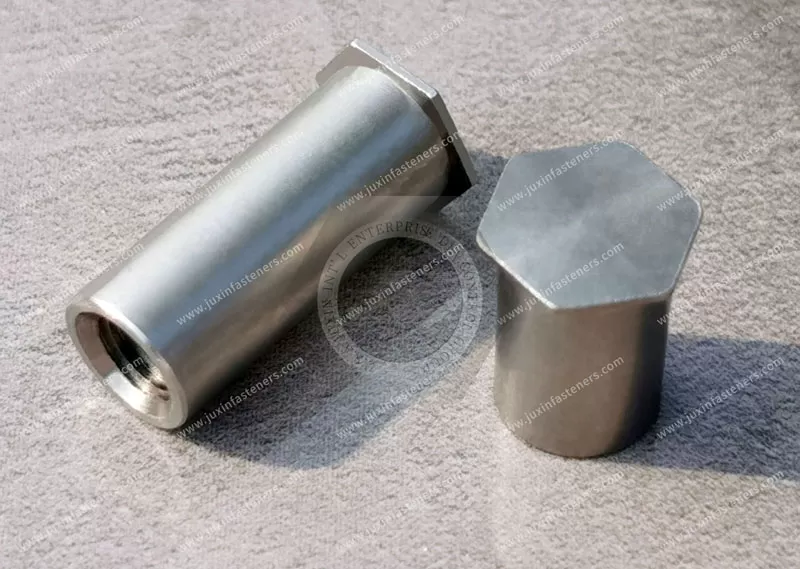
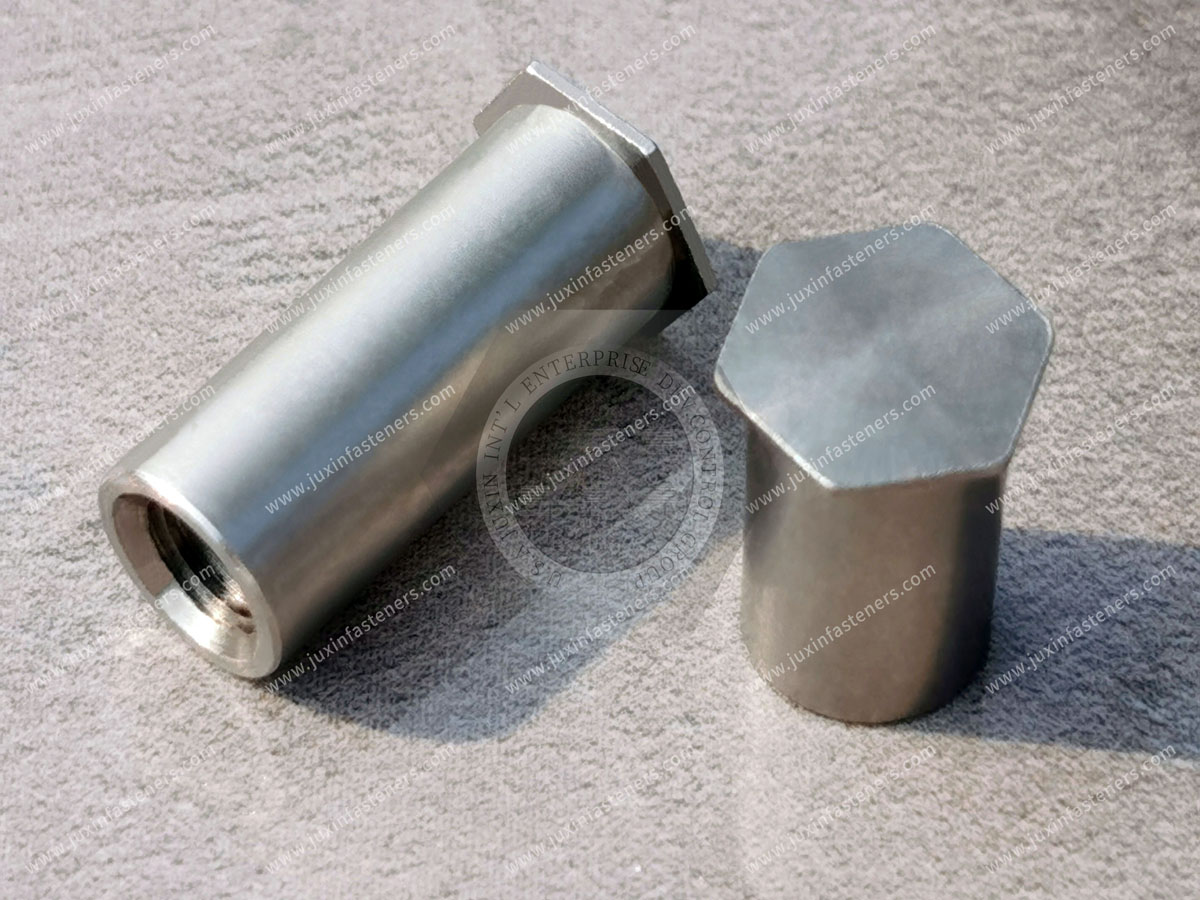
JUXIN FASTENERS supplies JX-BSOS stainless steel blind threaded self-clinching standoffs for permanent threaded spacing in sheet-metal assemblies. Their closed-end internal threads help prevent mating screws from projecting through the standoff toward the exterior panel face. Correctly installed designs provide a flush, closed mounting surface on the designated side while supporting circuit boards, electronic modules and enclosure components.
Product Series: JX-BSOS
Material: Stainless Steel
Exact Material Grade: According to approved drawing
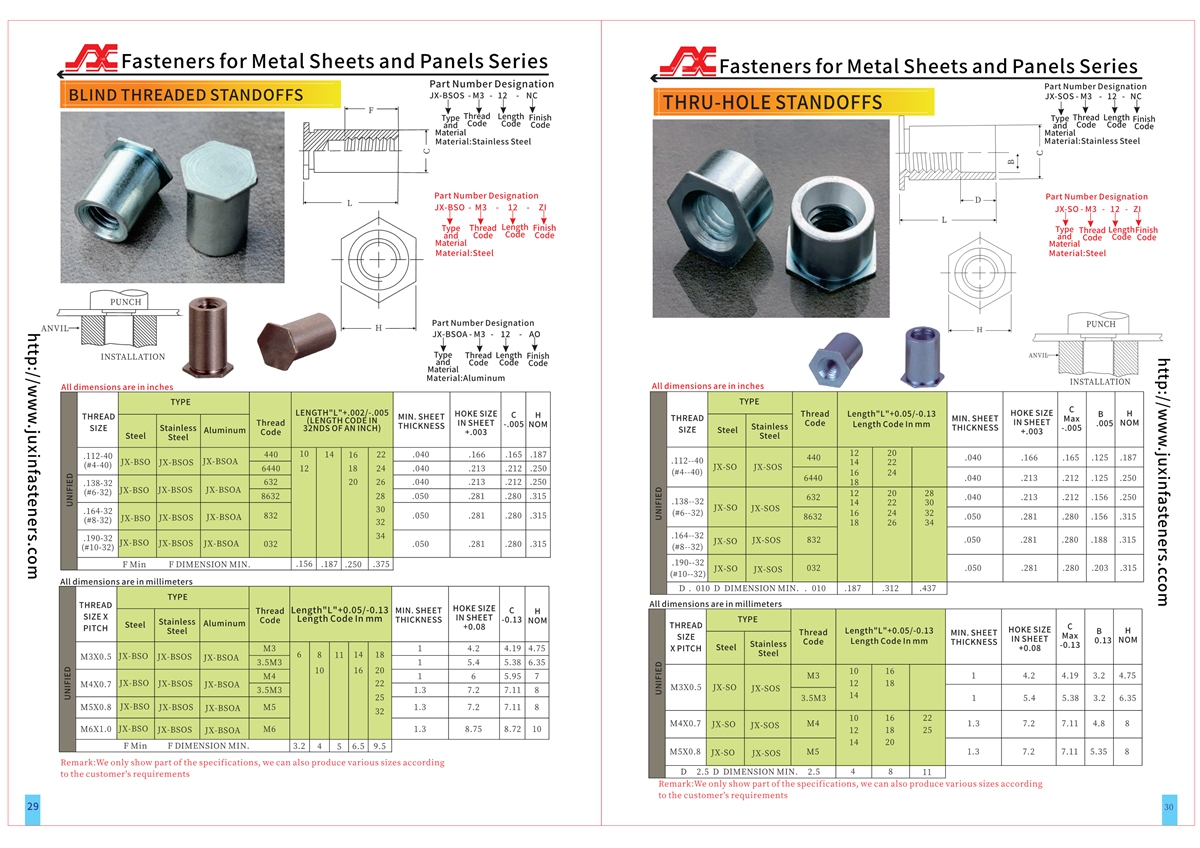
Metric Threads: M3–M6
Inch Threads: Selected #4–#10 sizes
Thread Configuration: Blind-Hole Internal Female Thread
Standoff Height: According to approved drawing
Usable Thread Depth: According to approved drawing
Installation: Controlled Parallel Pressing Force
Parent-Sheet Compatibility: Subject to material, hardness and thickness verification
Product Specification
Product Specifications — Stainless Steel Blind Threaded Self-Clinching Standoffs, JX-BSOS Series
JUXIN FASTENERS supplies JX-BSOS stainless steel blind threaded self-clinching standoffs for OEM sheet-metal assemblies requiring permanent threaded mounting points, defined spacing and a closed outer panel face.
The JX-BSOS series combines a mechanically retained standoff body with a blind-hole internal thread.
Unlike thru-hole threaded standoffs, the mating screw cannot pass completely through the standoff body.
When the selected fastener is correctly installed in a compatible panel, the mounting arrangement can provide a flush, closed surface on the designated exterior side.
These characteristics make blind threaded clinch standoffs useful for electronic enclosures, PCB supports, electrical equipment housings, industrial control panels and other precision sheet-metal assemblies.
The correct product must be selected according to thread size, standoff height, usable blind-hole depth, fastener material, parent-sheet properties and installation requirements.
Technical Product Overview
Product Name: Stainless Steel Blind Threaded Self-Clinching Standoffs
Alternative Names: Stainless Steel Blind-Hole Clinch Standoffs, Closed-End Threaded Standoffs, Blind Thread Press-In Standoffs
JUXIN Series: JX-BSOS
Fastener Material: Stainless Steel
Exact Stainless Steel Grade: According to approved drawing
Thread Configuration: Blind-Hole Internal Female Thread
Metric Thread Sizes: M3, M4, M5, M6
Inch Thread Family: Selected #4–#10 sizes
Individual Thread Availability: According to approved part number
Standoff Height: According to approved drawing
Usable Thread Depth: According to approved drawing
Mounting-Hole Diameter: According to approved installation data
Minimum Sheet Thickness: According to selected part specification
Parent-Sheet Material: Compatible sheet metal, subject to verification
Installation Method: Controlled Parallel Pressing Force
Retention Principle: Parent-Sheet Material Flow into Clinching Features
Installed Profile: Flush and closed on the designated panel face when correctly specified and installed
Push-Out Resistance: Subject to part-specific verification
Torque-Out Resistance: Subject to part-specific verification
Surface Finish: According to approved specification
Custom Dimensions: Subject to technical and manufacturing review
What Is a Stainless Steel Blind Threaded Self-Clinching Standoff?
A stainless steel blind threaded self-clinching standoff is a mechanically retained spacer containing an internal female thread that terminates within the fastener body.
It provides a defined spacing distance between a mounting panel and an attached component.
The standoff is installed into a correctly prepared hole in compatible sheet metal.
During installation, controlled pressing force causes the parent-sheet material to flow into the fastener's retaining features.
This creates a mechanical interlock that holds the standoff in place.
The internal thread then accepts a mating screw during component assembly.
JX-BSOS Product Series
JX-BSOS is the supplied JUXIN designation for this stainless steel blind threaded self-clinching standoff family.
The product family includes metric threads M3 through M6 and selected Unified inch thread sizes from #4 through #10.
The exact thread pitch, standoff height, usable blind-hole depth and installation dimensions must be confirmed from the approved product drawing.
Not every combination of thread size and standoff height should be assumed available.
Why Use Blind Threaded Standoffs?
Blind threaded standoffs provide internal threads without an opening through the entire standoff body.
This can help prevent the mating screw from projecting beyond the closed end.
Potential design benefits include:
Controlled screw penetration
Retained threaded mounting points
Defined component spacing
A closed designated exterior panel face
Reduced loose-part handling
Repeatable assembly positioning
The final performance depends on the approved product geometry and installation conditions.
Engineering Information Gain — Blind Thread Does Not Mean Blind Installation
Blind threaded describes the internal thread configuration.
Blind installation describes a fastening method that can be completed without access to the opposite side of the workpiece.
A blind threaded self-clinching standoff generally requires suitable pressing equipment and support during installation.
Therefore, the presence of a blind internal thread does not automatically provide one-sided installation capability.
This distinction is important when comparing self-clinching standoffs with blind rivet nuts and other blind-installed fasteners.
Blind Threaded vs. Thru-Hole Threaded Standoffs
Blind Threaded Standoffs
Have an internal thread that terminates within the fastener body.
The mating screw cannot pass completely through the standoff.
Thru-Hole Threaded Standoffs
Have an internal opening through the standoff body.
The mating screw may extend through the body when the assembly provides sufficient clearance.
Selection should consider:
Required screw penetration
Usable thread engagement
Available clearance
Exterior surface requirements
Standoff height
Installation access
Service conditions
Stainless Steel vs. Steel Blind Threaded Standoffs
The JX-BSOS series is specified here as stainless steel.
The related JX-BSO series is specified as steel.
Stainless steel may be selected where the application requires corrosion resistance appropriate to the selected grade.
Steel versions may be appropriate for other material and commercial requirements.
The exact material grade, hardness, coating and installed performance must be compared before substitution.
Stainless Steel Material Selection
The supplied product information identifies stainless steel but does not specify an exact grade.
The approved material grade should be established before quotation and production.
Selection factors include:
Mechanical properties
Fastener hardness
Corrosion resistance
Manufacturing suitability
Thread performance
Service temperature
Environmental exposure
Parent-sheet compatibility
No particular stainless steel grade is claimed without supporting documentation.
Engineering Information Gain — Stainless Steel Standoffs and Stainless Steel Panels
A stainless steel standoff is not automatically suitable for installation into every stainless steel panel.
Self-clinching technology depends on sufficient local deformation of the parent-sheet material.
If the panel is too hard relative to the selected fastener and clinching design, the required material flow may not occur.
The engineering team must verify:
Fastener stainless steel grade
Fastener hardness
Parent-sheet grade
Parent-sheet hardness
Sheet thickness
Mounting-hole dimensions
Installation force
Required retention performance
Compatibility must be established for the actual material combination.
Metric Thread Sizes
The supplied metric thread family includes:
M3
M4
M5
M6
Actual availability depends on the selected JX-BSOS part number.
ISO 261 provides relevant metric thread combinations.
ISO 965 provides relevant metric thread tolerance requirements.
Inch Thread Sizes
The supplied inch-thread family covers selected sizes from #4 to #10.
Actual Unified thread designations and pitches must be confirmed for each part.
ASME B1.1 is a relevant reference for Unified inch screw threads.
Metric and Unified inch threads are not directly interchangeable.
Engineering Information Gain — Blind-Hole Thread Depth
Blind-hole depth is a critical design parameter.
If the mating screw is too long, its tip may contact the bottom of the blind hole before the intended joint is fully clamped.
This can create tightening resistance without achieving the required clamping condition.
Potential consequences include:
Incomplete component clamping
Thread damage
Fastener damage
Assembly distortion
Inconsistent tightening results
Rework during production
The usable thread depth must be verified from the approved drawing.
Screw Length and Thread Engagement
The mating screw length should account for:
Thickness of the attached component
Washer thickness, if used
Required thread engagement
Usable blind-hole depth
Bottom clearance
Component tolerances
Screw-length tolerance
The final assembly should provide adequate thread engagement without unintended bottoming.
Engineering Example — Avoiding Screw Bottoming
An OEM uses an M4 JX-BSOS standoff to support a circuit board above a sheet-metal enclosure panel.
The screw passes through the board and engages the blind internal thread.
If the screw is too long, its tip may reach the closed end before the screw head fully clamps the board.
The assembler may feel resistance even though the board remains insufficiently secured.
The engineering team should confirm:
Board thickness
Washer thickness
Usable thread depth
Required thread engagement
Screw length
Bottom clearance
Assembly tolerances
Approved tightening requirements
This verification is particularly important for blind threaded standoffs.
Flush and Closed Exterior Surface
The supplied product description identifies blind threaded standoffs that can provide a flush, closed outer sheet surface.
This can be useful in enclosure designs where unwanted exterior protrusions or screw penetration are undesirable.
The actual installed profile depends on the approved standoff geometry, panel thickness and installation process.
Flush mounting should be verified against the engineering drawing.
Engineering Information Gain — Closed Does Not Automatically Mean Waterproof
A closed-end standoff prevents a screw from passing through the standoff body.
However, this does not automatically make the complete mounting interface waterproof, airtight or pressure-tight.
Moisture may still enter through other enclosure joints or interfaces.
Where environmental sealing is required, the complete assembly must be evaluated using the customer's applicable test requirements.
No IP rating or sealing certification is implied.
Standoff Height Selection
Standoff height defines the spacing between the mounting sheet and the supported component.
The correct height depends on:
Component geometry
PCB thickness
Connector clearance
Airflow requirements
Electrical clearance
Service access
Mechanical loading
Assembly tolerance
The required height and tolerance should be defined in the engineering drawing.
Self-Clinching Installation Principle
JX-BSOS standoffs use a mechanical self-clinching attachment principle.
Controlled pressing force causes the parent-sheet material to flow into the fastener's retaining geometry.
The resulting mechanical interlock retains the standoff in the mounting sheet.
Successful installation depends on compatible materials, correct hole preparation and suitable tooling.
How to Install JX-BSOS Self-Clinching Standoffs
A typical installation sequence includes:
Confirm the selected part number.
Verify fastener and parent-sheet materials.
Check parent-sheet hardness.
Confirm sheet thickness.
Prepare the specified mounting hole.
Inspect hole dimensions and edge condition.
Position the standoff correctly.
Support the panel with suitable tooling.
Apply controlled parallel pressing force.
Complete the clinching operation.
Inspect seating and alignment.
Verify required retention where specified.
Installation force and tooling geometry must follow the approved part specification.
Mounting-Hole Diameter
Correct mounting-hole dimensions are essential.
Important characteristics include:
Hole diameter
Hole tolerance
Roundness
Burr condition
Edge quality
Sheet thickness
Parent-sheet hardness
Use the approved JX-BSOS installation drawing.
Minimum Sheet Thickness
The minimum compatible sheet thickness depends on the selected fastener geometry.
It cannot be determined from thread size alone.
A panel that is too thin may not provide sufficient material for the required mechanical interlock.
The approved minimum sheet thickness must be verified.
Minimum Edge Distance
The distance from the mounting hole to the nearest panel edge affects local material support.
Insufficient edge distance may cause:
Panel distortion
Local cracking
Reduced retention
Installation inconsistency
The approved minimum edge distance must be followed.
Installation Force and Tooling
Self-clinching standoffs should be installed using equipment capable of applying controlled parallel pressing force.
Important process factors include:
Press alignment
Punch geometry
Anvil support
Panel support
Fastener orientation
Installation force
Final seating
Uncontrolled impact installation should not replace the approved pressing process.
Push-Out Resistance
Push-out resistance describes the installed standoff's resistance to axial displacement under defined test conditions.
Performance depends on:
Fastener geometry
Fastener material
Parent-sheet material
Sheet thickness
Mounting-hole dimensions
Installation quality
No universal push-out value is claimed.
Torque-Out Resistance
Torque-out resistance describes the installed standoff's resistance to rotation within the mounting sheet.
It is relevant during mating screw tightening and removal.
The required performance should be verified for the selected standoff and representative panel.
Engineering Information Gain — Standoff Height and Bending Loads
A standoff supports a component at a distance from the mounting sheet.
When lateral forces act on the supported component, the standoff height can create a bending moment at the mounting interface.
The engineer should consider:
Standoff height
Component mass
Lateral service load
Panel stiffness
Vibration
Fastener retention
Assembly geometry
A taller standoff may experience greater bending demand under the same lateral force.
Push-out and torque-out values alone may not represent every service-load condition.
Engineering Information Gain — Galvanic Corrosion
When stainless steel standoffs are installed in dissimilar-metal panels, galvanic corrosion may be a consideration in conductive, moisture-containing environments.
The actual risk depends on:
Material combination
Surface area ratio
Environmental exposure
Coatings
Moisture
Electrical continuity
Material compatibility should be reviewed where dissimilar metals are used in corrosive environments.
PCB Mounting Applications
Potential applications include:
Printed circuit board mounting
Electronic module support
Controller boards
Instrument electronics
Communication equipment boards
Internal electronic assemblies
The standoff height should provide the required mechanical spacing and electrical clearance.
A stainless steel standoff is electrically conductive unless the complete assembly incorporates an appropriate insulating arrangement.
Electrical Cabinets and Control Panels
Potential applications include:
Electrical enclosures
Control cabinets
Equipment mounting panels
Instrument housings
Power distribution equipment assemblies
Serviceable equipment modules
Blind threaded standoffs may be useful where screw penetration through the mounting assembly is undesirable.
Telecommunications Equipment
Potential applications include:
Network equipment enclosures
Communication modules
Equipment support panels
Electronic assemblies
Internal mounting structures
Self-clinching standoffs may reduce loose-part handling and improve repeatability during assembly.
Industrial Machinery
Potential applications include:
Machine control housings
Instrument panels
Equipment brackets
Electronic control modules
Fabricated metal enclosures
Where vibration is present, the complete assembly should be evaluated for fatigue, loosening and retention.
Automotive Electronics
Potential applications include selected:
Electronic control unit housings
Equipment modules
Instrument assemblies
Interior electronic mounting structures
Customer-specific qualification and change-control requirements may apply.
No automotive safety approval is implied.
Railway Equipment
Potential applications include suitable:
Communications equipment housings
Electrical cabinets
Instrument modules
Non-structural equipment assemblies
Project-specific vibration, corrosion and mechanical qualification may be required.
Stainless Steel Blind Standoffs vs. Loose Spacers
Loose threaded spacers may require additional handling during assembly.
Self-clinching standoffs remain attached to the mounting sheet.
Potential manufacturing advantages include:
Reduced loose-part handling
Repeatable component positioning
Retained threaded mounting points
Simplified final assembly
Reduced need for separate rear-side hardware
The correct choice depends on manufacturing access, service requirements and installed cost.
Stainless Steel Blind Standoffs vs. Welded Standoffs
Welded standoffs require a suitable welding process.
Self-clinching standoffs use controlled mechanical pressing.
Relevant comparison factors include:
Parent-sheet material
Sheet thickness
Installation access
Welding suitability
Heat effects
Surface finish
Mechanical performance
Production cost
Neither attachment method is universally superior.
Stainless Steel Blind Standoffs vs. Blind Rivet Nuts
Blind rivet nuts are designed for installation from one side of a workpiece.
Self-clinching standoffs generally require suitable press tooling and panel support.
A blind threaded self-clinching standoff provides a spacing function and a limited-depth internal thread.
A blind rivet nut primarily provides a retained internal thread.
The selection should be based on installation access, spacing requirements and mechanical performance.
OEM Engineering Example — Stainless Steel Blind Standoff for an Electronic Enclosure
An OEM requires an M4 stainless steel blind threaded standoff to support an electronic module above a sheet-metal enclosure panel.
The engineering team should confirm:
Exact stainless steel fastener grade
Parent-sheet material
Parent-sheet hardness
Sheet thickness
Required standoff height
M4 thread specification
Usable blind-hole thread depth
Mating screw length
Required thread engagement
Bottom clearance
Mounting-hole diameter
Minimum edge distance
Installation orientation
Press tooling
Installation force
Push-out resistance
Torque-out resistance
Lateral loading
Surface finish
Inspection requirements
The final selection must be validated against the approved drawing and representative assembly conditions.
OEM Procurement Information Gain — Total Installed Cost
The unit price of a standoff is only one part of the total assembly cost.
Relevant factors include:
Fastener cost
Hole preparation
Press equipment
Tooling
Installation cycle time
Inspection
Scrap and rework
Qualification testing
Packaging
Delivery reliability
For repeat-production OEM programs, consistent installation and dimensional performance may provide greater value than a small difference in component price.
Supplier Interchangeability
Two stainless steel blind threaded standoffs may have the same nominal thread size and height but different installation requirements.
Potential differences include:
Stainless steel grade
Fastener hardness
Blind-hole thread depth
Mounting-hole diameter
Retaining geometry
Installation force
Minimum sheet thickness
Push-out resistance
Torque-out resistance
Installed height tolerance
Replacement should be evaluated against the approved engineering drawing and performance requirements.
OEM Supplier Qualification Checklist
Product Identity
Confirm JX-BSOS designation.
Thread
Verify metric or Unified inch thread size and tolerance.
Standoff Height
Confirm required spacing dimension and tolerance.
Blind-Hole Thread Depth
Confirm usable thread engagement and bottom clearance.
Material
Confirm exact stainless steel grade and condition.
Parent Sheet
Confirm material, hardness and thickness.
Mounting Hole
Verify dimensions and edge condition.
Installation
Confirm tooling, force and orientation.
Performance
Define push-out, torque-out and other relevant acceptance criteria.
Documentation
Specify inspection, traceability and drawing revision requirements.
Commercial Requirements
Confirm order quantities, annual demand, packaging and delivery expectations.
Relevant Engineering Standards
ISO 261 — ISO metric screw thread combinations.
ISO 965 — ISO metric screw thread tolerances.
ASME B1.1 — Unified inch screw threads.
ISO 6508-1 — Rockwell hardness testing.
ISO 6506-1 — Brinell hardness testing.
ASTM E18 — Rockwell hardness testing of metallic materials.
ASTM E10 — Brinell hardness testing of metallic materials.
ASTM A967/A967M — Chemical passivation treatments for stainless steel parts, where specified.
These standards are relevant technical references and do not imply certification of every supplied product.
Frequently Asked Questions
What is a stainless steel blind threaded self-clinching standoff?
It is a mechanically retained stainless steel threaded spacer with an internal blind-hole thread.
What are blind threaded standoffs used for?
They provide defined spacing and threaded mounting points for circuit boards, electronic modules, panels and other components.
What is the difference between blind threaded and thru-hole standoffs?
Blind threaded standoffs have limited internal thread depth. Thru-hole standoffs have an internal opening through the body.
Can JX-BSOS standoffs be installed in stainless steel sheets?
Suitable combinations may be evaluated, but compatibility depends on the actual fastener and parent-sheet properties.
What happens if the screw is too long?
The screw may bottom against the blind-hole end before achieving the required clamping condition.
Are blind threaded standoffs waterproof?
Not automatically. The complete assembly must be evaluated for any required environmental sealing performance.
Can stainless steel blind threaded standoffs be used for PCB mounting?
Yes, suitable configurations may be evaluated for supporting circuit boards at a defined spacing height.
Do self-clinching standoffs require welding?
No. The described installation uses controlled mechanical pressing.
Can a self-clinching standoff be installed with a hammer?
Controlled press installation is recommended. Uncontrolled impact should not replace the approved installation process.
What determines the required standoff height?
Component clearance, mechanical support, electrical requirements and assembly geometry.
Related Sheet-Metal Fastening Solutions
Related JUXIN FASTENERS product categories include:
Steel Blind Threaded Self-Clinching Standoffs — for steel blind threaded spacing applications.
Stainless Steel Thru-Hole Self-Clinching Standoffs — for applications requiring internal threads through the standoff body.
Steel Thru-Hole Self-Clinching Standoffs — for compatible steel standoff applications.
Self-Clinching Nuts — for retained internal threads without an extended spacing body.
Self-Clinching Studs — for permanent external threaded mounting points.
Floating Self-Clinching Nuts — for selected applications requiring alignment compensation.
Captive Panel Screws — for serviceable equipment panels.
Blind Rivet Nuts — for one-sided threaded installation.
These product names are contextual internal-link anchor texts. Add hyperlinks only to verified relevant live product pages.
OEM RFQ Checklist
For accurate technical review and quotation, please provide:
Required JUXIN series
Engineering drawing or CAD file
Metric or Unified inch thread size
Required standoff height
Thread tolerance
Usable blind-hole thread depth
Mating screw specification
Required thread engagement
Bottom clearance requirements
Stainless steel fastener grade
Parent-sheet material
Parent-sheet hardness
Sheet thickness
Mounting-hole dimensions
Minimum edge distance
Installation orientation
Available press equipment
Installation force requirements
Push-out resistance requirements
Torque-out resistance requirements
Lateral load requirements
Surface finish requirements
Inspection documentation
Initial order quantity
Estimated annual demand
Packaging requirements
Delivery schedule
JUXIN FASTENERS — OEM Stainless Steel Blind Threaded Standoff Supply
JUXIN FASTENERS supplies stainless steel self-clinching standoffs and sheet-metal fastening products for international OEM engineers, purchasing managers, supplier development teams and equipment manufacturers.
The JX-BSOS series can be evaluated for blind threaded spacing applications in compatible sheet-metal assemblies.
Potential applications include electronic equipment, telecommunications housings, electrical cabinets, industrial control panels and fabricated metal enclosures.
For accurate product selection, customers should provide their engineering drawing, required standoff height, thread size, blind-hole depth, parent-sheet material, sheet hardness, thickness and installed performance requirements.
Request an OEM Technical Quotation
Email: info@juxinfasteners.com
Website: www.juxinfasteners.com
Please include the required thread size, standoff height, blind-hole depth, drawing, initial order quantity and estimated annual demand.
JUXIN FASTENERS — Stainless Steel Blind Threaded Self-Clinching Standoff Solutions for OEM Sheet-Metal Engineering and Global Procurement.
Product Packaging
Product Packaging — Stainless Steel Blind Threaded Self-Clinching Standoffs
JUXIN FASTENERS supplies JX-BSOS stainless steel blind threaded self-clinching standoffs with protective packaging for industrial and OEM shipments.
Product Series: JX-BSOS
Material: Stainless Steel
Inner Packaging: Poly Foam
Outer Packaging: Cartons
Shipping Arrangement: Palletized Packaging
Available Carton Dimension References:
29 × 19 × 19.5 cm
23.5 × 17.5 × 8 cm
Supplied Pallet Dimension Reference:
215 × 100 × 90 cm
The appropriate carton size, packing quantity, gross weight and pallet arrangement depend on the confirmed standoff dimensions and order requirements.
Thread Protection: Packaging should protect internal threads against mechanical damage and contamination.
Blind-Hole Protection: Packaging should minimize contamination entering the blind threaded cavity.
Clinching Feature Protection: Retaining undercuts and clinching features should be protected from deformation before installation.
Dimensional Protection: Packaging should minimize handling damage that could affect standoff height, seating surfaces or assembly alignment.
Product Identification: Customer-specified labels may identify part number, thread size, standoff height, blind-hole depth, stainless steel grade, quantity, lot number and drawing revision.
Series Segregation: Different thread sizes, standoff heights and blind-hole depths should be clearly identified to reduce mixing risk.
OEM Packaging: Customer-specific packing quantities, carton arrangements, labels and pallet configurations are subject to order confirmation.
Final packaging details will be confirmed against the approved purchase order.
For OEM packaging requirements and quotations:
Email: info@juxinfasteners.com
Website: www.juxinfasteners.com
Product Pictures
Contact Us
Tel.:
+86 020 8621 0320
+86 020 3121 6067
E-mail:
Technical Support:
Navigation
SEND INQUIREY