Call Us
+86 136 6007 9809
Call Us
+86 136 6007 9809

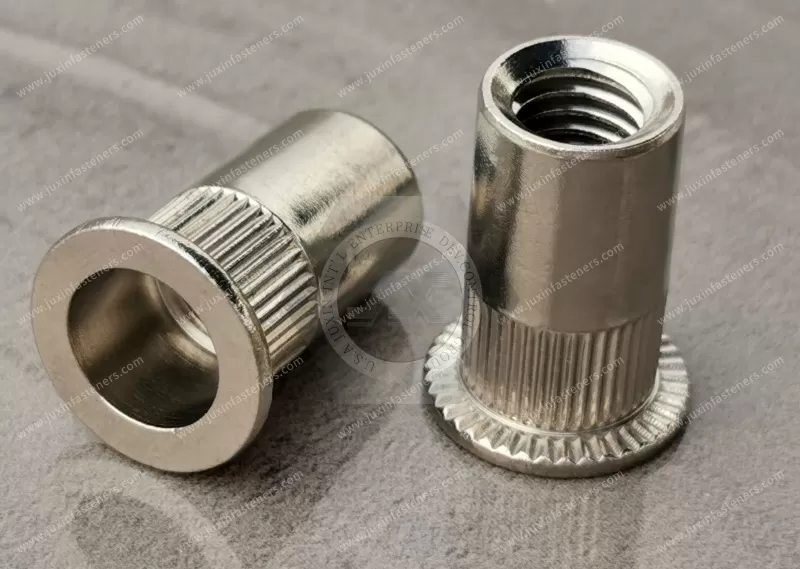
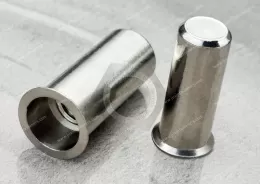
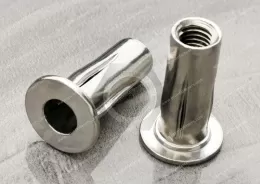
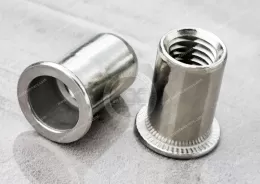
JUXIN FASTENERS manufactures stainless steel flat head, open-end knurled round body blind rivet nuts for creating reusable internal threads in thin sheet metal, hollow sections, and OEM assemblies requiring one-sided installation.
The flat flange provides a bearing surface, while the external knurling or ribs help resist insert rotation in compatible round mounting holes. The open-end design allows screw extension where sufficient backside clearance is available.
Product Features
Metric threads: M3, M4, M5, M6, M8, M10, M12
Inch-series threads: Custom OEM requirements subject to drawing review
Material: Stainless steel (grade subject to confirmation)
Grip range: 0.5–6.0 mm (approx. 0.020–0.236 in), depending on size
Head: Flat head / Flanged head
Body: Knurled / Ribbed round body
End: Open end
Mounting hole: Round hole, according to product drawing
Installation: One-sided blind installation
Applications include electrical enclosures, industrial machinery, transportation components, fabricated sheet-metal structures, and OEM equipment requiring reusable threaded connections.
Product Specification
Technical Specifications — Stainless Steel Flat Head Open-End Knurled Body Blind Rivet Nuts
Product Structure and Technical Overview
JUXIN FASTENERS stainless steel flat head open-end knurled body blind rivet nuts are internally threaded inserts designed to create mechanically retained female threads in sheet metal,
hollow sections and fabricated components.
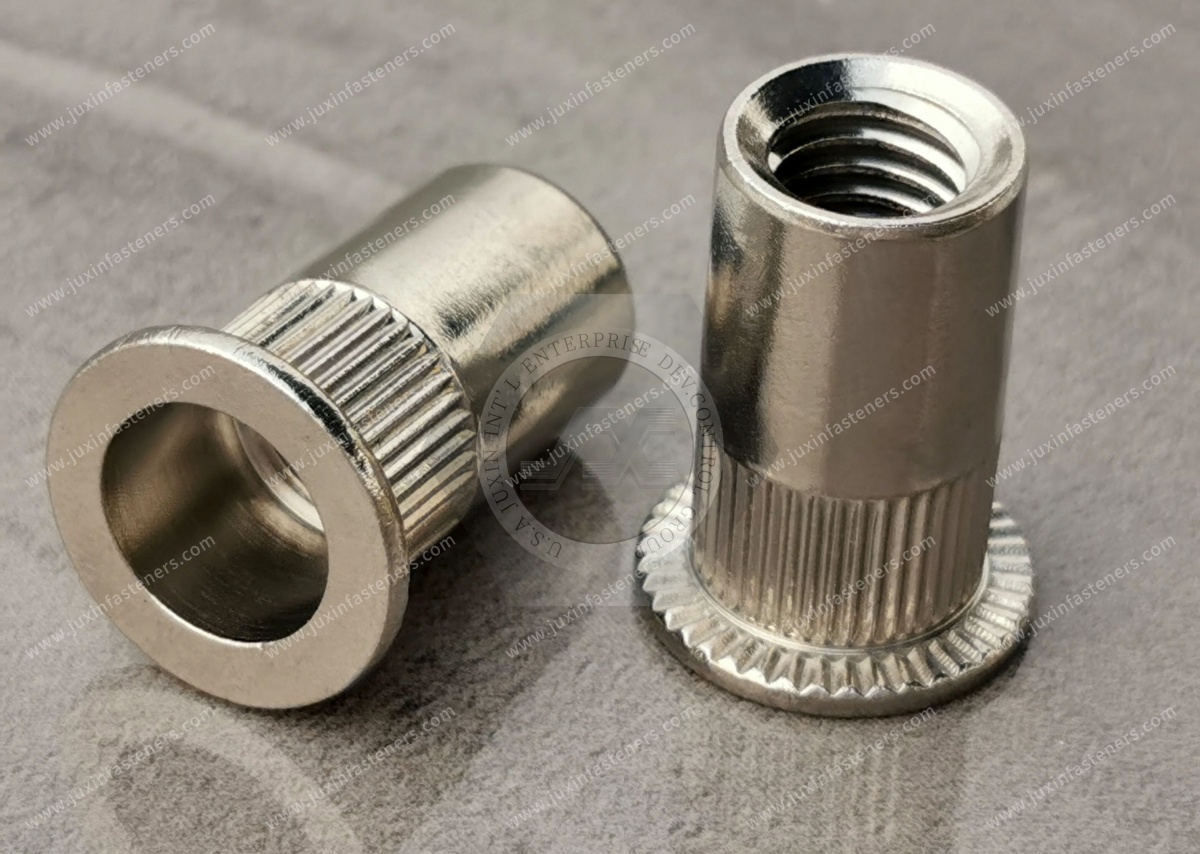
The product features a flat flanged head, externally knurled cylindrical body and open threaded end.
Its design combines one-sided installation, reusable internal threads and enhanced rotational engagement through the knurled body surface.
Unlike plain round-body rivet nuts, the external knurling provides additional contact features intended to resist insert rotation within the mounting hole.
Unlike closed-end rivet nuts, the open-end configuration permits the mating bolt to extend through the insert when sufficient clearance is available.
| Technical Parameter | Specification |
|---|---|
| Product Type | Stainless Steel Knurled Body Blind Rivet Nut |
| Head Configuration | Flat Head / Flanged Head |
| Body Configuration | Knurled Round Body / Ribbed Body |
| End Configuration | Open End |
| Material | Stainless Steel |
| Metric Thread Sizes | M3, M4, M5, M6, M8, M10, M12 |
| Stated Product-Family Grip Range | 0.5–6.0 mm |
| Installation Access | One-Sided |
| Mounting Hole | Round Hole, According to Approved Drawing |
| Material Grade | Confirm by Product Specification |
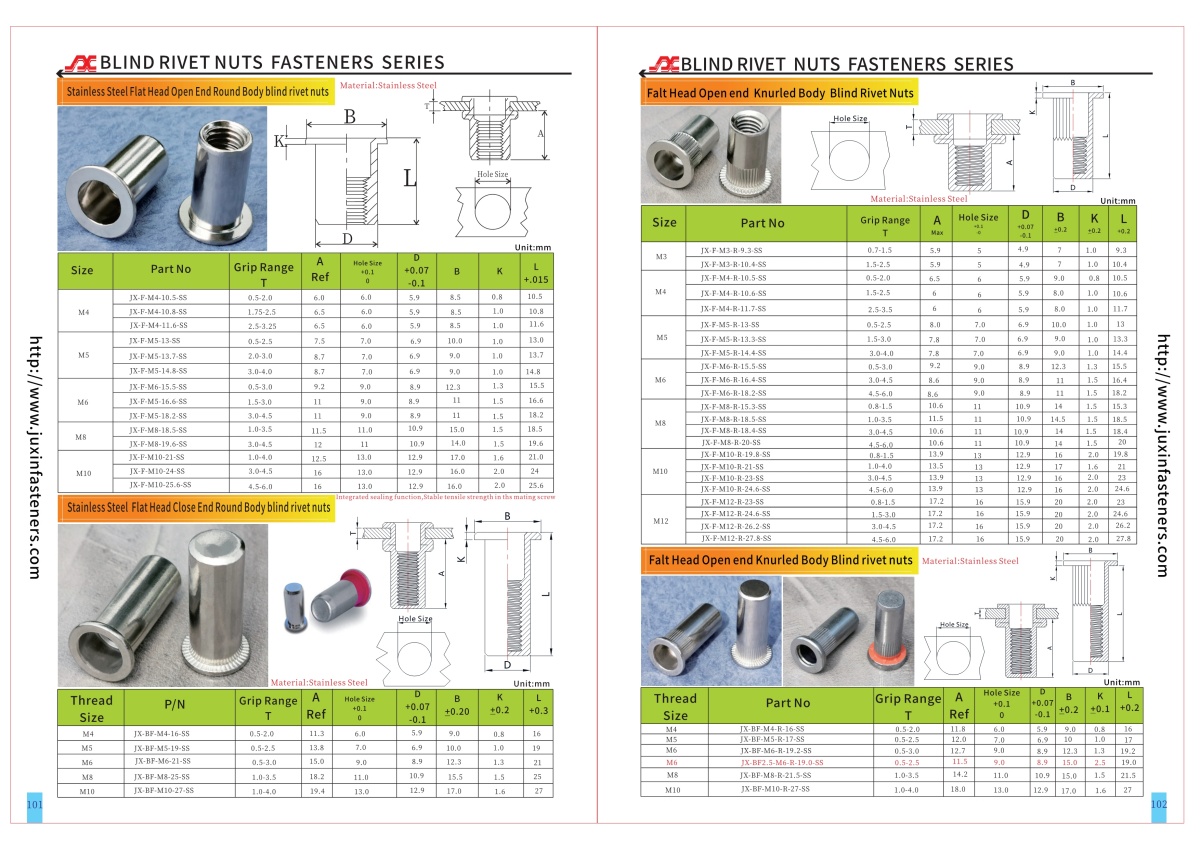
| Dimensional Reference | Product PDF, Pages 101–102, Subject to Variant Confirmation |
| Custom Manufacturing | Drawing-Specific Requirements Subject to Review |
The listed grip range represents the stated product family. Individual size and body-length combinations must be verified against the applicable drawing.
Knurled Body Geometry and Anti-Rotation Performance
The external knurling is the defining mechanical feature of this rivet nut.
During installation, the body is pulled axially while the flange is supported by the setting tool. The deformable section collapses behind the panel, creating a retaining bulge.
The knurled surface provides additional mechanical engagement at the mounting hole.
This engagement can improve resistance to rotation when the mating bolt is tightened or removed.
The effectiveness of the knurling depends on the shape and depth of the external features, the parent-material hardness, the mounting-hole diameter and the installation deformation.
Softer parent materials may allow greater local engagement with the knurled surface, but they may also be more susceptible to hole enlargement or local deformation.
Harder materials may respond differently and should not be assumed to provide identical rotational retention.
For critical assemblies, torque-to-turn performance should be evaluated using the actual panel material and representative production conditions.
Knurled Body Versus Plain Body Rivet Nuts
Knurled and plain-body rivet nuts may share similar head styles and installation principles, but they differ in how the outer body interacts with the mounting hole.
A plain-body insert relies on its installed deformation and contact conditions to resist rotation.
A knurled-body insert introduces external surface features that can provide additional engagement with the parent material.
This distinction becomes important where the mating fastener will be tightened repeatedly, where service access is limited or where the assembly is sensitive to insert rotation.
The knurled configuration is not automatically superior in every application.
For very thin, brittle or highly sensitive materials, the local deformation associated with knurl engagement should be evaluated.
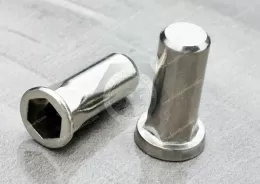
Where greater geometric anti-rotation engagement is required, a full-hex rivet nut installed in a corresponding hexagonal hole may be considered.
The appropriate body configuration should be selected according to the joint requirements rather than thread size alone.
Flat Flange Head and Axial Retention
The flat flange head provides a bearing surface on the accessible side of the workpiece.
After installation, the flange and the blind-side retaining bulge work together to hold the rivet nut in position.
The flange can help distribute contact pressure around the mounting hole and support the parent material under axial loading.
The actual resistance to pull-out and pull-through depends on the flange geometry, panel thickness, parent-material strength and installed retaining shape.
For applications involving significant axial loading, engineers should evaluate the complete joint rather than relying solely on the nominal strength of the stainless steel insert.
Where flange projection creates an interference problem, a low-profile or countersunk head configuration may be more appropriate.
Open-End Thread Design and Bolt Engagement
The open-end configuration allows the mating bolt to pass through the threaded insert.
This can provide flexibility in bolt-length selection, particularly where the available blind-side space is sufficient.
Unlike closed-end rivet nuts, there is no closed internal cavity that causes the bolt to bottom out within the insert body.
However, the mating bolt must still achieve the required thread engagement without interfering with surrounding components.
Engineers should evaluate the attached component thickness, thread engagement, bolt length and available rear-side clearance.
Because the threaded passage remains open, this configuration should not be assumed to prevent moisture, dust or other contaminants from passing through the insert.
Where the application requires a closed threaded cavity, a closed-end rivet nut should be considered.
Grip Range and Parent-Material Thickness
The stated product-family grip range is 0.5–6.0 mm.
Grip range refers to the material thickness or captured material stack that a particular rivet nut can retain after correct installation.
During setting, the deformable section of the body forms a retaining bulge behind the panel.
The geometry of this bulge depends on the selected rivet nut length, panel thickness and setting parameters.
If the selected rivet nut is used outside its permitted grip range, the resulting deformation may be insufficient or excessive.
This can affect mechanical retention, rotational resistance and installation consistency.
For assemblies containing multiple sheets, the relevant thickness should be evaluated according to the actual stack captured by the insert.
The complete family grip range should not be treated as the permissible thickness range of every M3–M12 variant.
Mounting Hole Geometry and Knurl Engagement
The mounting hole must be compatible with the selected knurled rivet nut.
Hole diameter, roundness, burr condition and panel flatness influence installation quality.
An oversized hole may reduce the intended engagement between the knurled body and the parent material.
An undersized hole may prevent correct insertion or cause damage to the insert and surrounding panel.
For punched holes, burr formation and edge quality should be considered. For drilled holes, dimensional accuracy and appropriate deburring are important.
The installation hole should be produced according to the approved dimensional drawing.
Where coated or painted panels are used, the effect of coating thickness and potential installation damage should be reviewed.
The knurled body should not be assumed to provide a defined electrical bonding function through coated surfaces without appropriate testing.
Installation Equipment and Setting Parameters
Stainless steel knurled rivet nuts are installed using compatible tools that engage the internal thread and apply a controlled axial setting action.
The setting tool supports the flange while the body deforms behind the workpiece.
Depending on thread size and production requirements, suitable manual, pneumatic, hydro-pneumatic or automated equipment may be used.
The setting mandrel, nosepiece and installation parameters must match the selected rivet nut.
Stainless steel inserts may require different setting forces or strokes compared with otherwise similar carbon steel or aluminum products.
Insufficient setting may result in inadequate retention or reduced knurl engagement.
Excessive setting may distort the flange, damage the internal thread or deform the parent panel.
For OEM production, installation settings should be validated using representative materials and production equipment.
Torque-to-Turn Resistance and Joint Reliability
Torque-to-turn resistance describes the ability of the installed rivet nut to resist rotation relative to the parent material.
This is distinct from the torque capacity of the internal thread and from the tightening torque applied to the mating bolt.
A knurled body can improve rotational engagement, but actual performance depends on the installed geometry and surrounding material.
The relevant engineering question is whether the installed rivet nut can resist the torque imposed during assembly and service.
If the insert rotates before the mating bolt reaches the intended tightening condition, the joint may not achieve the required clamping force.
For applications involving repeated maintenance, engineers should also consider how installation conditions and parent-material deformation affect long-term serviceability.
Where torque-to-turn resistance is a critical acceptance requirement, testing should be performed on representative installed samples.
Pull-Out, Pull-Through and Thread Failure
Axial retention depends on the mechanical interaction between the flange, blind-side retaining bulge and parent material.
Under excessive axial loading, the insert may pull out, the panel may deform or the surrounding material may fail.
Thread stripping is a separate failure mechanism associated with the internal thread, mating bolt and engagement conditions.
The controlling failure mode depends on the geometry and mechanical properties of the complete joint.
For thin or soft panels, parent-material deformation may govern performance before the nominal fastener material strength is reached.
Mechanical acceptance criteria should therefore be established according to the actual panel material, grip thickness, installation-hole dimensions and service loading.
No universal pull-out or torque-to-turn value should be assigned without product-specific test data.
Stainless Steel Material Selection
The supplied product information identifies stainless steel and references A2 stainless steel in the general product description.
A2 stainless steel is commonly associated with 304-type austenitic stainless steel.
A4 stainless steel, commonly associated with 316-type compositions, may be evaluated for applications involving certain chloride-containing environments.
The exact grade and its availability by size must be confirmed before ordering.
Material selection should consider corrosion exposure, mechanical requirements, temperature, contact with dissimilar metals and the intended service environment.
Stainless steel should not be assumed to provide identical corrosion resistance under all environmental conditions.
For projects requiring material documentation, the applicable ASTM or EN specification should be selected according to the actual grade and manufacturing requirements.
International Thread and Engineering References
Metric thread dimensions may be defined using ISO 261, with applicable tolerances established under ISO 965.
Where Unified inch threads are requested as a custom option, ASME B1.1 may provide a relevant thread reference.
The supplied standard size list for this product is metric M3–M12. Specific UNC or UNF sizes should not be assumed to be standard for this page without confirmation.
Relevant ASTM or EN material specifications may be applied according to the actual stainless steel grade and product requirements.
These standards provide engineering references and do not independently establish certification or conformity for a particular product.
The approved drawing and agreed customer specification remain the controlling technical documents.
Application Engineering for Automotive and Transportation Equipment
Automotive and transportation assemblies may require threaded fastening points that resist rotation during bolt tightening and maintenance.
Knurled rivet nuts can be evaluated for suitable fabricated brackets, equipment housings and service panels.
The design should consider vibration, tightening torque, panel strength, corrosion exposure and installation consistency.
For safety-critical or regulated applications, the relevant OEM-specific validation requirements must be established before product approval.
Application Engineering for Electrical Enclosures
Electrical cabinets and control enclosures often require one-sided threaded installation in thin sheet metal.
Knurled stainless steel rivet nuts may provide additional rotational engagement where removable components are fastened repeatedly.
If electrical bonding is required, the designer should evaluate contact resistance and the influence of surface coatings.
The open-end configuration should not be treated as a sealed fastening solution.
Application Engineering for Industrial Machinery
Machinery housings, guards, mounting brackets and removable panels may benefit from retained female threads that remain attached to the parent material.
The knurled body can be useful where service operations involve repeated tightening and loosening.
Joint design should account for the expected tightening torque, required clamp load, vibration and the possibility of insert rotation.
Application Engineering for Outdoor Equipment
Stainless steel knurled rivet nuts may be considered for suitable outdoor housings, mounting brackets and fabricated components.
Material grade, corrosion exposure, galvanic compatibility and installation geometry should be reviewed.
Where environmental sealing is required, an appropriate closed-end or sealed alternative may be more suitable.
OEM Manufacturing and Custom Component Development
JUXIN FASTENERS manufactures industrial fasteners and drawing-specific components for OEM applications.
Our broader manufacturing capabilities include cold heading, cold forming, secondary CNC machining and turning, metal stamping,
plastic injection molding and combined manufacturing processes where appropriate to the component design.
For suitable custom metal components, cold forming may be followed by secondary machining to achieve specific dimensional or functional requirements.
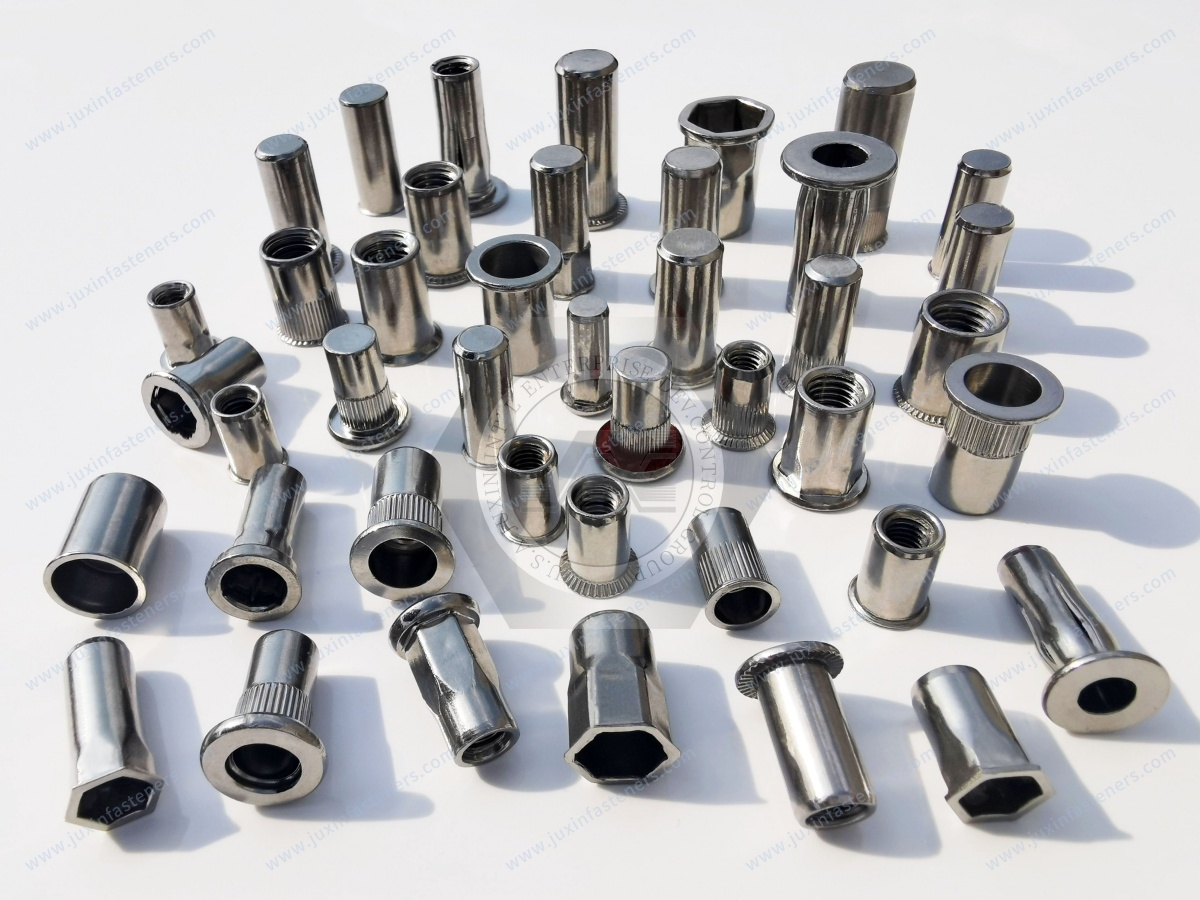
For knurled rivet nut projects, JUXIN can review requirements involving thread size, flange diameter, body length, knurl geometry, grip range, material grade and installation-hole compatibility.
The production process and inspection requirements are selected according to the approved drawing, material, tolerance requirements and order volume.
RFQ Requirements and Engineering Documentation
For an accurate technical review and quotation, customers should provide the required thread size, stainless steel grade, panel material, grip thickness, installation-hole dimensions and product drawing.
Where anti-rotation performance is critical, the inquiry should identify the expected tightening torque or required torque-to-turn acceptance criteria.
Where axial retention is critical, the required pull-out performance and relevant loading conditions should be specified.
Information about installation equipment, mating bolts, sample quantities, estimated annual demand and packaging requirements will also support project evaluation.
The existing JUXIN technical information refers to dimensional PDF pages 101–102. The corresponding drawing should be checked to confirm the exact knurled-body variant and available dimensions.
Knurled Body Design for Improved Resistance to Rotation
The principal engineering feature of this product is its externally knurled cylindrical body.
During installation, the deformable portion of the rivet nut collapses behind the parent material, while the knurled surface engages the surrounding mounting hole.
This engagement can improve resistance to unwanted rotation compared with a smooth-body insert under suitable installation conditions.
Rotational resistance is particularly important when the mating bolt is tightened, loosened or removed during equipment maintenance.
If a rivet nut rotates inside the panel, the threaded connection may become difficult to service and may damage the surrounding material.
The effectiveness of the knurled body depends on the panel material, mounting-hole diameter, grip thickness, knurl geometry and installation parameters.
Knurled rivet nuts should not be assumed to provide the same torque-to-turn performance in every material.
Representative installation testing is recommended for applications with demanding tightening or maintenance requirements.
Flat Flange Head for Panel Support
The flat flange head provides a bearing surface on the accessible side of the workpiece.
As the rivet nut is installed, the flange and the blind-side retaining bulge work together to mechanically secure the insert.
The flange helps distribute contact pressure around the installation hole and can be beneficial in applications involving thin sheet metal or materials requiring additional local support.
Its performance depends on flange dimensions, panel thickness, material strength and installation quality.
The flat-head configuration is suitable where a visible flange and its resulting head projection are acceptable.
For assemblies requiring a reduced head height or a near-flush surface, a low-profile or countersunk rivet nut should be evaluated instead.
Open-End Construction for Flexible Bolt Engagement
The open-end configuration provides a continuous threaded passage through the insert.
Unlike closed-end rivet nuts, an open-end design does not restrict the mating bolt with a closed internal cavity.
This can simplify bolt-length selection where the assembly has adequate blind-side clearance.
The engineer must still confirm the required thread engagement and ensure that any protruding bolt does not interfere with surrounding components.
Because the threaded bore remains open, this design should not be selected where the fastener itself must block a direct contamination or fluid pathway.
For applications requiring a closed threaded cavity or a validated sealing arrangement, an appropriate closed-end or sealed rivet nut should be considered.
Stainless Steel Construction for Industrial Applications
Stainless steel rivet nuts are commonly selected where corrosion resistance, durability, appearance and material compatibility are important.
A2 stainless steel is frequently associated with 304-type austenitic stainless steel, while A4 stainless steel is commonly associated with 316-type compositions.
The correct material grade should be established according to the approved product drawing and intended operating environment.
For outdoor, coastal or industrial applications, engineers should consider moisture exposure, chloride concentration, temperature, surface condition and contact with dissimilar metals.
Stainless steel construction alone does not establish suitability for every marine, chemical or high-temperature environment.
One-Sided Installation in Thin and Hollow Structures
Blind rivet nuts are designed for installation from one accessible side of the workpiece.
A compatible installation tool engages the internal thread and applies an axial setting action that compresses the designated deformable section of the rivet nut.
The resulting retaining bulge forms behind the panel, creating a mechanically retained female thread.
This method is useful for hollow sections, tubular structures, equipment cabinets and fabricated assemblies where conventional nuts cannot be positioned or held on the rear side.
Installation consistency depends on selecting the correct grip range, hole size and setting parameters.
The knurled body also requires suitable engagement with the parent material to achieve its intended anti-rotation function.
Engineering Applications and Industrial Solutions
Automotive and Transportation Equipment
Stainless steel knurled rivet nuts can be evaluated for suitable brackets, equipment housings, service panels and fabricated transportation components.
The knurled body may be beneficial where resistance to rotation is important during assembly or maintenance.
For vibration-sensitive applications, engineers should also consider bolt preload, joint locking strategy, panel strength and installation validation.
Electrical Enclosures and Control Cabinets
Electrical cabinets and control enclosures often require permanent female threads in thin sheet-metal panels.
Knurled open-end rivet nuts provide one-sided installation and can support removable mounting brackets, access covers and equipment attachments.
Where environmental sealing or electrical bonding is required, those functions should be assessed separately.
Industrial Machinery and Equipment Housings
Machinery guards, removable covers, instrument housings and fabricated equipment frames may require threaded inserts that remain securely positioned during repeated servicing.
The knurled body can provide additional rotational engagement with the parent material, subject to the actual installation conditions.
HVAC and Climate-Control Equipment
Knurled stainless steel rivet nuts may be considered for suitable HVAC housings, ventilation equipment and sheet-metal mounting assemblies.
Material selection should reflect the expected moisture exposure, temperature conditions and surrounding panel material.
Outdoor and Architectural Equipment
Outdoor equipment housings, fabricated brackets and selected architectural assemblies may benefit from stainless steel construction and one-sided installation.
The engineer should evaluate corrosion exposure, installation geometry and required mechanical retention.
Electronics and Industrial Instrumentation
Knurled rivet nuts can provide serviceable threaded connections in suitable instrument housings, control equipment and fabricated mounting panels.
The open-end body requires sufficient blind-side clearance for the mating bolt and any resulting protrusion.
General Sheet Metal Fabrication
For sheet-metal components produced by punching, drilling or other hole-forming processes, knurled round-body rivet nuts offer an alternative to welding or loose-nut installation.
The correct solution depends on the parent material, available access, mechanical loading and production process.
OEM Manufacturing and Custom Engineering Support
JUXIN FASTENERS is an industrial fastener and custom component manufacturer with production workshops and more than 20 years of industry experience.
Our manufacturing capabilities include cold heading, cold forming, secondary CNC machining and turning, metal stamping,
plastic injection molding and combined manufacturing processes where appropriate to the component design.
For suitable custom metal components, cold forming may be followed by secondary machining to achieve specific dimensions, tolerances or functional geometries.
JUXIN can review OEM requirements involving thread sizes, flange dimensions, knurled body geometry, grip ranges, stainless steel grades and drawing-specific product configurations.
Where the parent material is unusually soft, thin or difficult to fasten, the engineering review should consider the relationship between knurl engagement,
mounting-hole dimensions and the expected tightening torque.
Custom manufacturing arrangements are evaluated according to the approved drawing, material requirements, tooling feasibility and order volume.
OEM Procurement and Supplier Development
For purchasing managers, sourcing engineers and supplier development teams, rivet nut selection involves more than nominal thread size.
The product must be compatible with the parent material, installation equipment, assembly method, required mechanical performance and production quantity.
JUXIN can review drawing-specific requirements and help customers evaluate appropriate product configurations for OEM assembly programs.
For a quotation, customers should provide the required thread size, stainless steel grade, panel thickness, mounting-hole dimensions, estimated order quantity and technical drawing or reference sample.
Where torque-to-turn resistance, pull-out strength or repeated service performance is critical, the relevant acceptance criteria should also be identified.
Request an OEM Quotation or Engineering Review
JUXIN FASTENERS
Email: info@juxinfasteners.com
Website: www.juxinfasteners.com
Stainless Steel Knurled Rivet Nuts | OEM Threaded Inserts | Custom Industrial Fastener Manufacturing
Product Packaging
Product Packaging — Stainless Steel Flat Head Open-End Knurled Body Blind Rivet Nuts
Industrial Packaging for Stainless Steel Knurled Rivet Nuts
JUXIN FASTENERS provides industrial packaging arrangements for stainless steel flat head open-end knurled body blind rivet nuts supplied to OEM manufacturers,
equipment assembly operations, industrial distributors and international purchasing programs.
Packaging is selected according to the product dimensions, thread size, material requirements, order quantity and customer-specific handling instructions.
The objective is to protect the fasteners during transportation and storage while supporting efficient product identification and inventory management.
Protection of Threads and Knurled Surfaces
Stainless steel knurled rivet nuts should be packaged and handled to reduce unnecessary mechanical damage, contamination and moisture exposure.
Protection of the internal threads is important because thread damage may affect installation-tool engagement and mating bolt assembly.
The external knurled body is also a functional feature of the fastener. Excessive mechanical damage to the knurled surface may affect the intended engagement with the mounting hole.
Packaging and handling should therefore be selected to maintain the product condition required by the approved technical specification.
Where surface cleanliness or corrosion performance is important, suitable measures should be taken to reduce contamination from carbon steel particles or unsuitable handling equipment.
Packaging Configuration
JUXIN FASTENERS can review suitable inner protective packaging, outer cartons and palletized shipment arrangements according to the selected product and confirmed purchase order.
The actual inner packaging material, quantity per package, carton dimensions, carton weights and pallet loading configuration should be established for the specific order.
Packaging arrangements may vary between different thread sizes, product dimensions and custom configurations.
OEM Packaging and Product Identification
For OEM production and supply-chain programs, packaging can be coordinated with customer requirements for part-number identification,
thread-size separation, stainless steel grade labeling, batch identification and shipment marking.
Customers may specify preferred packing quantities and packaging formats to support warehouse operations, receiving inspection and assembly-line replenishment.
Where traceability or special documentation is required, the relevant labeling and record requirements should be agreed during order confirmation.
International Transportation and Storage
For international orders, packaging should be selected according to the shipment quantity, transportation method, handling conditions and customer requirements.
The final carton dimensions, gross weights, pallet quantities and shipping marks are confirmed according to the actual order.
Special protective packaging or handling instructions can be reviewed during quotation and production planning.
Custom Packaging Requirements
JUXIN FASTENERS can review customer-specific packaging arrangements for industrial purchasing and OEM assembly programs.
Customers may provide requirements relating to packing quantity, product separation, carton labeling, palletization and warehouse handling.
The final packaging arrangement is established according to the confirmed product specification and purchase order.
Request Packaging Information or an OEM Quotation
For accurate packaging coordination, please provide the required thread size, product drawing or part number, stainless steel grade, order quantity, preferred packaging arrangement and shipping destination.
JUXIN FASTENERS
Email: info@juxinfasteners.com
Website: www.juxinfasteners.com
Stainless Steel Knurled Rivet Nuts | OEM Manufacturing | Customer-Specific Industrial Packaging
Product Pictures
Contact Us
Tel.:
+86 020 8621 0320
+86 020 3121 6067
E-mail:
Technical Support:
Navigation
SEND INQUIREY