Call Us
+86 136 6007 9809
Call Us
+86 136 6007 9809

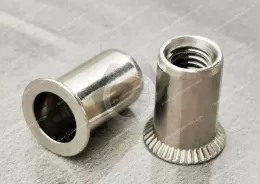
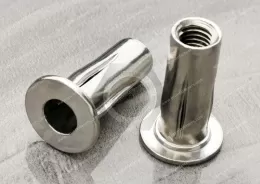
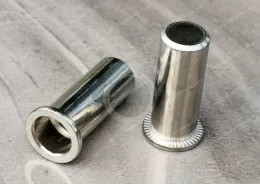
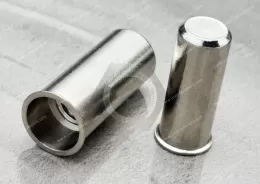
JUXIN FASTENERS manufactures stainless steel flat head, open-end plain body blind rivet nuts for creating reusable internal threads in thin sheet metal, hollow sections, and OEM assemblies requiring one-sided installation.
The smooth, unknurled cylindrical body fits a compatible round mounting hole, while the flat flange provides a bearing surface. The open-end design allows screw extension where sufficient backside clearance is available.
Product Features
Metric threads: M3, M4, M5, M6, M8, M10
Inch-series threads: Custom OEM requirements subject to drawing review
Material: Stainless steel (grade subject to confirmation)
Grip range: 0.5–6.0 mm (approx. 0.020–0.236 in), depending on size
Head: Flat head / Flanged head
Body: Plain / Smooth round body
End: Open end
Installation: One-sided blind installation into compatible round holes
Applications include electrical enclosures, machinery housings, fabricated sheet-metal components, industrial equipment, and OEM assemblies requiring stainless steel threaded inserts.
Product Specification
Technical Specifications — Stainless Steel Flat Head Open-End Plain Body Blind Rivet Nuts
Product Specifications and Dimensional Overview
JUXIN FASTENERS stainless steel flat head open-end plain body blind rivet nuts are internally threaded fasteners designed to create permanent threaded attachment points in thin sheet metal,
hollow profiles and other compatible fabricated components.
The product features a flat flanged head, smooth cylindrical body and open-ended female thread. Installation is performed from one accessible side of the workpiece using a suitable rivet nut setting tool.
| Technical Parameter | Product Specification |
|---|---|
| Product Type | Blind Rivet Nut / Threaded Rivet Insert |
| Head Configuration | Flat Head / Flanged Head |
| Body Configuration | Plain / Smooth Round Body |
| End Configuration | Open End |
| Material | Stainless Steel |
| Metric Thread Sizes | M3, M4, M5, M6, M8, M10 |
| Stated Product-Family Grip Range | 0.5–6.0 mm |
| Mounting Hole | Round Hole, According to Product Drawing |
| Installation Method | One-Sided Blind Installation |
| Material Grade | Confirm According to Part Number or Customer Specification |
| Dimensional Reference | Product Specification PDF, Pages 101–102 |
| Custom Manufacturing | Drawing-Specific Requirements Subject to Review |
The dimensions and installation requirements vary according to thread size and body length.
The stated grip range is a product-family reference and should not be interpreted as the permitted thickness range for every individual rivet nut.
Stainless Steel Material Grades and Engineering Selection
Stainless steel rivet nuts are selected for applications where material durability, corrosion resistance and compatibility with the surrounding assembly are important considerations.
The supplied product information identifies stainless steel as the standard material for this model.
The broader product-family description references A2 and A4 stainless steel, which are commonly associated with 304-type and 316-type austenitic stainless steels, respectively.
A2 stainless steel is widely used in general industrial equipment, fabricated metal assemblies and applications exposed to ordinary atmospheric conditions.
A4 stainless steel contains molybdenum in typical 316-type compositions and may provide improved resistance to certain chloride-containing and chemically aggressive environments.
However, the designation A4 should not be interpreted as a guarantee of corrosion resistance in every marine, coastal or chemical-processing application.
Temperature, chloride concentration, crevice geometry, cleaning chemicals and surface condition can significantly affect performance.
For an OEM project, the selected stainless steel grade should be defined by the approved drawing or material specification.
Material requirements may be established using relevant ASTM or EN specifications appropriate to the actual stock form and manufacturing process.
Where material certificates or specific traceability documents are required, these should be identified during quotation and order confirmation.
Flat Flange Head and Load Distribution
The flat flange head provides a contact surface against the accessible side of the mounting panel.
During installation, the flange remains seated against the panel while the deformable section of the rivet nut forms a retaining bulge behind the workpiece.
Together, these features mechanically retain the insert and provide a reusable internal thread.
The flange can distribute contact pressure around the mounting hole and help resist local panel deformation.
Nevertheless, the installed joint's pull-out and pull-through resistance depends on the actual flange dimensions, panel thickness, parent-material strength, hole quality and setting conditions.
For relatively thin or soft sheet materials, the flange bearing area should be evaluated together with the panel's ability to withstand localized loading.
A larger flange is not automatically the best choice for every assembly. Designers must also consider available head clearance, adjoining component geometry and the risk of interference.
This flat-head configuration should be distinguished from low-profile and countersunk rivet nuts. A conventional flange projects above the panel surface,
whereas low-profile and countersunk designs address different head-height and seating requirements.
Smooth Round Body and Anti-Rotation Performance
The smooth cylindrical body is intended for installation in a correctly dimensioned round hole.
This design can simplify integration with sheet-metal components produced using conventional drilling, punching or other suitable hole-forming processes.
Unlike knurled or ribbed rivet nuts, a plain-body insert does not have pronounced external ribs designed to engage the surrounding panel material.
Unlike full-hex rivet nuts, it does not depend on a matching hexagonal hole for geometric anti-rotation engagement.
Instead, rotational retention depends on the interaction between the installed body, its deformation, the mounting hole and the parent material.
This distinction becomes particularly important when selecting rivet nuts for applications involving high bolt tightening torque or frequent removal and reinstallation of the mating fastener.
An installed rivet nut can provide satisfactory axial retention while still having insufficient resistance to rotation for a particular tightening operation.
Consequently, pull-out resistance and torque-to-turn resistance should be treated as separate engineering requirements.
Where anti-rotation performance is critical, the OEM should define a suitable acceptance criterion and evaluate the rivet nut using representative production panels.
Grip Range and Total Material Thickness
The supplied product-family grip range is 0.5–6.0 mm.
Grip range describes the thickness of the panel or combined material stack that a particular rivet nut can retain after correct installation.
It is not equivalent to the total uninstalled body length or the available thread engagement.
When a rivet nut is installed through multiple sheets, the relevant thickness is the total material stack captured by the insert, subject to the assembly design.
An insert selected for a panel outside its permitted grip range may not form the intended blind-side retaining geometry.
Insufficient or excessive grip thickness can affect installation consistency, panel deformation and joint retention.
Engineers should therefore select the individual body length and grip configuration from the applicable dimensional drawing rather than relying only on the overall product-family range.
For very thin panels, the local stiffness and strength of the parent material must also be considered.
The fact that a rivet nut can be installed in a nominally thin sheet does not automatically establish that the resulting joint can support the intended service load.
Mounting Hole Dimensions and Manufacturing Tolerances
Correct mounting-hole preparation is essential to reliable rivet nut installation.
The installation hole must provide sufficient clearance for insertion while maintaining the dimensional relationship needed for proper retention after setting.
An oversized hole may reduce rotational resistance or allow unwanted movement. An undersized hole may damage the insert, interfere with installation or deform the surrounding panel.
Hole diameter, roundness, burr condition, panel flatness and coating thickness can all influence installation results.
For punched sheet-metal components, engineers should consider the direction of punching, edge condition and possible burr formation.
For drilled holes, dimensional accuracy and burr removal are similarly important.
The actual mounting-hole diameter and tolerance must be taken from the drawing for the selected rivet nut size.
The existing JUXIN product specification refers to PDF pages 101–102 for detailed dimensions and CAD information.
These drawings should be used to confirm head diameter, body diameter, body length, installation-hole requirements and individual grip ranges before production release.
Installation Method and Setting Tool Selection
Stainless steel plain body blind rivet nuts are installed using equipment that engages the internal thread and applies a controlled axial setting action.
During installation, the tool pulls on the threaded portion of the insert while supporting the flange against the accessible panel surface.
This causes the designated deformable section to collapse behind the panel, creating a retaining bulge.
After setting, the tool is released and the installed rivet nut remains in the workpiece as a female threaded attachment point.
Depending on the part size and production requirements, installation may be performed using manual, pneumatic, hydro-pneumatic or compatible automated setting equipment.
Stainless steel inserts may require different setting forces and tooling conditions from geometrically similar aluminum or carbon steel inserts.
The selected mandrel, nosepiece and setting parameters must therefore match the actual product.
Insufficient setting can result in inadequate retention, while excessive setting can damage the internal thread, deform the flange or distort the panel.
For repetitive OEM production, a validated installation process should establish suitable setting parameters and inspection requirements.
Blind-Side Clearance and Assembly Design
One-sided installation eliminates the need to access a loose nut behind the panel, but the blind side must still provide sufficient space for the insert and its deformation during setting.
This is especially important in hollow sections, tubular components, electrical cabinets and compact equipment housings.
The designer should consider the uninstalled body length, the space needed to form the retaining bulge and the final installed geometry.
Because this model has an open-ended threaded bore, the mating bolt may extend beyond the insert.
Its penetration must be checked against nearby components, internal brackets, wiring and moving parts.
A successful installation requires compatibility between the rivet nut, the panel, the setting equipment and the surrounding assembly geometry.
Open-End Thread Configuration and Bolt Engagement
The open-end configuration permits the mating screw or bolt to pass through the internal thread when the assembly provides sufficient clearance.
This can be useful where bolt engagement requirements differ between applications or where the designer wants to avoid a closed-end cavity limiting penetration.
Nevertheless, the correct bolt length must still be selected according to the joint design.
Adequate thread engagement is important, but increasing bolt length does not necessarily increase joint strength once the governing connection requirements have been satisfied.
The designer must also consider the strength of the mating bolt, the internal thread, the parent material and the installed insert.
For assemblies requiring protection against fluid or contamination passing through the threaded bore, an open-end rivet nut is not a sealed solution.
A closed-end or specially sealed fastening arrangement should be evaluated.
Joint Reliability: Pull-Out, Rotation and Thread Failure
A blind rivet nut connection can fail through several distinct mechanisms, and these should not be combined into a single unspecified strength claim.
Axial loading may cause the insert to pull out of the panel or the surrounding material to deform.
Excessive tightening torque may cause the insert to rotate or the internal thread to strip. The mating bolt may also fail if the applied loading exceeds its capacity.
In service, repeated vibration or cyclic loading can introduce additional joint reliability considerations.
For critical assemblies, engineers should define the required mechanical acceptance criteria based on the actual load path and intended service conditions.
Representative testing should use the specified panel material, thickness, installation hole, rivet nut configuration and setting process.
The flat flange and stainless steel construction are useful design features, but they do not establish universal pull-out, torque-to-turn or fatigue performance values.
Stainless Steel Compatibility and Corrosion Considerations
Stainless steel offers advantages in many environments, but corrosion resistance depends on the actual grade and the complete assembly.
When stainless steel rivet nuts are installed in aluminum, zinc-coated steel or other dissimilar metals, galvanic corrosion may become a consideration if an electrolyte is present.
The resulting risk depends on the material combination, exposed surface areas, moisture conditions and electrical contact.
Design measures may include selecting compatible materials, applying appropriate protective coatings, introducing suitable isolation or controlling moisture exposure.
Crevice corrosion should also be considered in environments where moisture or aggressive chemicals may remain trapped between the flange and panel.
For coastal, outdoor or washdown applications, the complete fastening arrangement should be assessed rather than assuming that a stainless steel rivet nut alone provides the required environmental durability.
Installation in Coated and Finished Panels
Blind rivet nuts can be incorporated into coated or painted assemblies when the hole geometry, coating thickness and installation process are suitable.
However, installation without coating damage cannot be guaranteed for every material or surface finish.
The setting operation may generate localized pressure, movement or deformation around the mounting hole.
These effects should be evaluated when the appearance or protective function of the coating is important.
For pre-coated panels, attention should be given to hole-edge protection, flange seating and possible coating buildup.
Where electrical bonding is required, the conductivity of the complete connection must be verified.
Stainless steel material selection and rivet nut geometry do not independently establish an acceptable grounding path.
International Thread and Material References
Metric thread designations may be defined using ISO 261, with applicable thread tolerances established under ISO 965.
Where an OEM project requires specific stainless steel material properties, the applicable ASTM or EN material specification should be selected according to the actual grade, stock form and manufacturing route.
ISO 3506 may provide relevant reference information for certain corrosion-resistant stainless steel fasteners, but its applicability to a particular blind rivet nut must be established rather than assumed.
Product dimensions, grip ranges, installation requirements and acceptance criteria should ultimately be controlled by the approved product drawing and agreed technical specification.
References to international standards are provided to support engineering communication and do not represent automatic certification of every product variant.
Application Engineering for OEM Industries
Automotive and Transportation Equipment
For automotive and transportation assemblies, the main considerations include vibration, repeated servicing, panel thickness, bolt tightening torque and material compatibility.
A smooth round body should be evaluated carefully where significant rotational loading is expected during assembly or maintenance.
Electrical Cabinets and Industrial Enclosures
In electrical cabinets and equipment enclosures, one-sided installation can simplify the attachment of removable covers, support brackets and mounting hardware.
Engineers should verify panel deformation, blind-side clearance and any electrical bonding requirements.
Machinery and Fabricated Equipment
Industrial machinery often requires serviceable fastening points in guards, covers and fabricated structures.
A stainless steel plain body rivet nut may be suitable where the required retention can be achieved in a round hole and the available flange projection is acceptable.
HVAC and Building Equipment
For HVAC equipment and building-related assemblies, material selection should account for moisture exposure, cleaning conditions, dissimilar metals and long-term service requirements.
Food-Processing and Washdown Environments
Where stainless steel is specified for equipment construction, the grade, surface condition and joint geometry should be reviewed against cleaning and environmental requirements.
The fastener should not be described as hygienic, food-contact approved or waterproof solely because it is manufactured from stainless steel.
Electronics and Industrial Instrumentation
For instrument housings and compact equipment, designers should consider installation-tool access, internal clearance, panel distortion and the protrusion of the mating bolt.
OEM Manufacturing and Drawing-Specific Production
JUXIN FASTENERS supports industrial customers requiring standard rivet nuts and drawing-specific fastener manufacturing.
Our broader production capabilities include cold heading, cold forming, secondary CNC machining and turning, metal stamping,
plastic injection molding and combined manufacturing processes for suitable component designs.
For certain custom metal components, cold forming and secondary machining may be combined to achieve particular geometries or dimensional requirements.
The appropriate production route depends on material selection, component geometry, tolerances, tooling requirements and production quantity.
For stainless steel rivet nut projects, JUXIN can review special thread sizes, modified flange dimensions, custom body lengths, grip requirements, material grades and customer-specific inspection criteria.
Drawing-based manufacturing is particularly useful when an OEM requires compatibility with an existing assembly or needs a component adapted to a specific mounting condition.
Custom requirements are evaluated according to technical feasibility and the agreed production specification.
Technical Documentation and RFQ Support
For an accurate quotation and engineering review, customers are encouraged to provide a 2D drawing or 3D CAD model, the required thread size,
stainless steel grade, panel material, grip thickness and mounting-hole dimensions.
Where mechanical performance is important, the inquiry should identify the required tightening torque, torque-to-turn resistance, pull-out requirements or other relevant acceptance criteria.
Information about environmental exposure, estimated annual usage, sample quantities, production volume and packaging requirements will also support manufacturing and commercial evaluation.
The dimensional reference for this product is the existing JUXIN specification PDF, pages 101–102, subject to confirmation that the drawing corresponds to the selected plain round body configuration.
Flat Flange Head for Panel Support
The flat flange head provides a bearing surface against the accessible side of the parent material and helps position the rivet nut during installation.
For suitable panel designs, the flange distributes contact pressure around the mounting hole and contributes to resistance against local deformation or pull-through.
Flange diameter, flange thickness, panel strength and installation quality all influence the installed joint's behavior.
A larger flange does not independently guarantee a particular pull-out strength, especially in thin or relatively soft materials.
This head configuration is useful where a conventional flanged bearing surface is preferred and sufficient clearance is available above the panel.
For applications requiring reduced head projection, a dedicated low-profile or countersunk rivet nut may be more appropriate.
Smooth Round Body for Conventional Round-Hole Installation
The plain cylindrical body is designed for installation in an appropriately sized round hole.
This configuration can be practical for sheet-metal components manufactured by drilling, punching or other suitable hole-forming processes.
Unlike knurled rivet nuts, the smooth body does not incorporate pronounced external anti-rotation ribs. Unlike full-hex rivet nuts, it does not require a hexagonal mounting hole.
The suitability of a smooth round body depends on the parent material, installation-hole tolerance, grip thickness, setting parameters and required resistance to insert rotation.
For applications involving higher tightening torque, repeated servicing or demanding vibration conditions,
engineers should assess whether a knurled or hexagonal body would provide a more appropriate retention arrangement.
Stainless Steel Material Selection
Stainless steel is commonly selected where corrosion resistance, appearance, cleaning conditions or compatibility with the surrounding assembly are important.
A2 stainless steel is frequently associated with 304-type austenitic stainless steel, while A4 is frequently associated with 316-type molybdenum-bearing stainless steel.
The exact material specification must be confirmed for the supplied part.
A4 may offer improved resistance to certain chloride-containing environments, but neither A2 nor A4 is universally corrosion-proof.
For outdoor, coastal, industrial washdown or chemically exposed assemblies, engineers should review the actual environmental conditions, stainless steel grade and surrounding materials.
The product's stainless steel construction does not automatically establish marine approval, food-contact suitability or a particular corrosion-resistance rating.
Open-End Threaded Design
The open-end configuration permits the mating screw or bolt to extend through the insert when sufficient clearance exists behind the panel.
This can provide flexibility in selecting thread engagement length and mating fastener dimensions.
However, bolt length must still be controlled to avoid interference with internal brackets, equipment, wiring or other components.
Because the threaded cavity remains open, this design does not provide a sealed barrier through the insert.
Applications requiring restricted through-bore access or environmental protection may need a closed-end or specially sealed configuration.
One-Sided Installation for Enclosed and Thin-Walled Structures
Blind installation allows a retained threaded fastening point to be created without reaching the rear of the workpiece.
This is particularly valuable for hollow metal sections, tubular fabrications, equipment cabinets and enclosed sheet-metal structures.
A compatible setting tool engages the internal thread and applies an axial force that deforms the rivet nut behind the panel.
The resulting retaining bulge works with the flange to hold the insert in place.
Correct installation depends on selecting a suitable grip range, preparing the mounting hole accurately and providing adequate blind-side clearance.
Industrial Applications and Engineering Solutions
Automotive and Transportation Equipment
Stainless steel flanged plain body rivet nuts can be evaluated for sheet-metal brackets, equipment housings,
access panels and removable components where one-sided threaded installation is needed.
Design engineers should assess vibration, bolt tightening torque, repeated maintenance and compatibility between the insert and parent material.
For production applications, retention and installation requirements should be established using representative assemblies.
Electrical Enclosures and Control Cabinets
These inserts provide threaded mounting points for brackets, removable covers, mounting plates and cabinet accessories.
Their round-hole installation geometry can be useful in fabricated metal enclosures where access behind the panel is restricted.
If the enclosure is painted or coated, hole preparation and setting parameters should be controlled to minimize unacceptable coating damage.
Electrical bonding must be evaluated separately when required by the equipment design.
Industrial Machinery and Fabricated Frames
Machinery guards, equipment covers and structural brackets may require internal threads that remain attached to the workpiece when a mating bolt is removed.
A blind rivet nut can simplify assembly and maintenance without requiring access to a separate nut behind the panel.
The joint should be evaluated for tightening torque, rotational retention, panel strength and service loading.
HVAC and Building Equipment
Stainless steel blind rivet nuts may be suitable for selected sheet-metal housings, service panels and mounting brackets.
Material grade, moisture exposure and contact with dissimilar metals should be considered when the assembly is installed outdoors or in humid conditions.
Food-Processing and Washdown Equipment
For compatible equipment housings and non-product-contact assemblies, stainless steel threaded inserts may be considered where cleaning and corrosion resistance are important.
The final material grade, surface condition and joint geometry must match the relevant environmental and hygienic design requirements.
A stainless steel insert alone does not establish suitability for direct food contact or high-pressure washdown.
Electronics and Industrial Instrumentation
These rivet nuts may provide retained female threads in metal instrument housings, control units and mounting structures.
Engineers should verify the available installation space, local panel deformation and the clearance required for the open-end mating bolt.
General Sheet Metal Fabrication
Flanged plain body rivet nuts can support threaded fastening in metal cabinets, brackets, enclosures and fabricated assemblies.
Consistent mounting-hole dimensions and controlled installation settings are important for repeatable production quality.
Engineering Selection: Plain Body vs. Knurled and Hexagonal Rivet Nuts
A plain round body is often selected where conventional round-hole installation and a smooth cylindrical exterior meet the assembly requirements.
Knurled or ribbed round body rivet nuts provide additional external geometry intended to engage the parent material and resist rotation.
Full-hex rivet nuts use geometric engagement with a matching hexagonal mounting hole.
These alternatives should be compared using the actual panel material, installation conditions, torque-to-turn requirements and joint loading.
For thin or soft materials, flange support and panel deformation may be just as important as body geometry.
The most suitable design is the one that satisfies the complete installation and service requirements rather than a single nominal strength characteristic.
OEM Manufacturing and Customization
JUXIN FASTENERS is an industrial fastener and custom component manufacturer with production workshops and more than 20 years of industry experience.
Our manufacturing capabilities include cold heading, cold forming, secondary CNC machining and turning, metal stamping,
plastic injection molding and combined manufacturing processes for suitable component designs.
Where required by a custom metal component's geometry and tolerances, cold forming may be followed by secondary machining.
For stainless steel rivet nut inquiries, JUXIN can review drawing-specific requirements involving thread sizes,
flange geometry, body dimensions, grip ranges, material grades, installation-hole compatibility and mechanical acceptance criteria.
Custom production feasibility depends on the drawing, material, tooling requirements, order volume and inspection specifications.
Our flexible manufacturing approach is intended to support OEM engineering teams, purchasing departments and supplier development programs with practical component solutions.
OEM Procurement and RFQ Support
When requesting a quotation, customers should provide the required thread size, stainless steel grade, panel material, grip thickness,
installation-hole dimensions and any applicable mechanical or environmental requirements.
A technical drawing or existing reference sample is particularly helpful when the customer requires dimensional compatibility with an established component.
For applications involving high tightening torque, repeated servicing or critical retention requirements,
please identify the relevant acceptance criteria so the proposed rivet nut can be evaluated against the actual joint conditions.
JUXIN can also review sample quantities, production volumes, packaging instructions and customer-specific documentation requirements.
Request a Technical Review or OEM Quotation
JUXIN FASTENERS
Email: info@juxinfasteners.com
Website: www.juxinfasteners.com
Stainless Steel Blind Rivet Nuts | Flanged Plain Body Threaded Inserts | Custom OEM Fastener Manufacturing
Product Packaging
Product Packaging — Stainless Steel Flat Head Open-End Plain Body Blind Rivet Nuts
Standard Packaging
JUXIN FASTENERS supplies stainless steel flat head open-end plain body blind rivet nuts with packaging suitable for industrial distribution,
OEM assembly operations and international transportation.
The standard packaging arrangement consists of inner poly foam protection, outer cartons and palletized shipment packaging where required.
Packaging configurations can be adjusted according to the selected rivet nut dimensions, thread size, order quantity and customer-specific handling requirements.
Packaging Specifications
| Packaging Item | Specification |
|---|---|
| Inner Packaging | Poly Foam |
| Outer Packaging | Cartons |
| Carton Size Option 1 | 29 × 19 × 19.5 cm |
| Carton Size Option 2 | 23.5 × 17.5 × 8 cm |
| Pallet Dimensions | 215 × 100 × 90 cm |
| Custom Packaging | According to Agreed Customer Requirements |
The carton and pallet dimensions are the supplied packaging references for this product family. Actual packing quantities, net weights,
gross weights and pallet loading arrangements are confirmed according to the selected product and purchase order.
Stainless Steel Handling and Surface Protection
Stainless steel rivet nuts should be packaged and stored under suitable conditions to reduce unnecessary handling damage, moisture exposure and surface contamination.
Contact with carbon steel particles or contaminated handling equipment should be controlled where surface cleanliness and corrosion performance are important.
For products requiring specific material identification, cleanliness or protective packaging, customers should provide the relevant requirements during quotation review.
OEM Packaging and Identification
JUXIN FASTENERS can review customer-specific packaging arrangements for industrial purchasing and production programs.
Options may include specified quantities per package, part-number identification, thread-size separation, material grade labeling,
batch identification, carton marking and palletization instructions.
Where traceability or documentation is required, the labeling format and supporting records should be agreed before shipment.
Packaging can also be coordinated with customer warehouse practices and production-line material handling requirements.
International Shipment and Order Requirements
For OEM buyers, distributors and supply-chain teams, packaging specifications should be confirmed together with the product drawing, purchase quantity and delivery requirements.
Customers may provide their preferred packaging quantities, shipping marks, palletization instructions and any special storage or handling requirements.
Final packaging arrangements are established according to the confirmed order.
Request Packaging Information or an OEM Quotation
JUXIN FASTENERS supports standard and custom stainless steel rivet nut requirements with flexible packaging coordination.
Email: info@juxinfasteners.com
Website: www.juxinfasteners.com
Stainless Steel Fasteners | OEM Manufacturing | Customer-Specific Packaging Solutions
Product Pictures


Contact Us
Tel.:
+86 020 8621 0320
+86 020 3121 6067
E-mail:
Technical Support:
Navigation
SEND INQUIREY