Call Us
+86 136 6007 9809
Call Us
+86 136 6007 9809

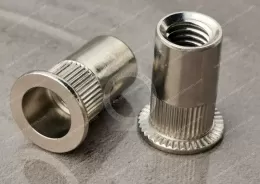
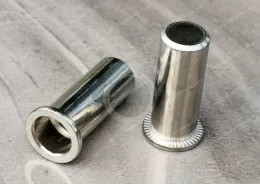
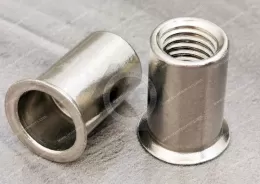
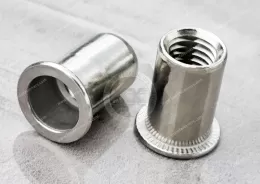
JUXIN FASTENERS supplies stainless steel slotted body rivet nuts for plastic and composite panels requiring reusable internal threads and one-sided installation.
During setting, the slotted shank expands behind the panel to form a wider bearing structure than a conventional localized upset design. This can help distribute retention loads and reduce concentrated stress in suitable plastics, fiberglass, composites, and thin sheet-metal assemblies.
Product Features
Metric threads: M6, M8, M10
UNC threads: 1/4-20, 5/16-18, 3/8-16
Material: Stainless steel
Grip range: 0.5–12.7 mm (approx. 0.020–0.500 in), depending on size
Head: Flat head / Flanged head
Body: Slotted shank / Expanding body
End: Open end
Installation: One-sided installation with a compatible rivet nut tool
Mounting hole: Round hole, dimensions per approved drawing
OEM requirements: Drawing-based technical review
Applications include plastic equipment housings, fiberglass panels, composite enclosures, automotive interior components, RV assemblies, electrical cabinets, machinery covers, and lightweight industrial panels.
For OEM quotations, send your panel material, thickness, hole dimensions, thread requirements, and drawings to info@juxinfasteners.com.
Product Specification
Stainless Steel Rivet Nuts for Plastic and Composites – Slotted Body Blind Threaded Inserts
JUXIN FASTENERS supplies stainless steel rivet nuts for plastic and composite panels, including flat head open-end slotted shank blind rivet nuts for industrial OEM applications.
These fasteners are designed to provide reusable internal threads in materials where conventional rivet nut installation may concentrate excessive stress around the mounting hole.
During installation, the slotted shank folds outward behind the parent panel to form an expanded backside bearing structure. This wider support area can distribute installation and service loads more broadly than the localized upset of many conventional blind rivet nuts.
Slotted body rivet nuts may be considered for selected plastics, fiberglass, composite panels, thin sheet metals, and other relatively soft or deformable materials.
Final suitability depends on the parent material, insert geometry, grip thickness, mounting-hole dimensions, installation settings, and required mechanical performance.
Product Specifications
Product category: Rivet Nuts for Plastic and Composites
Product type: Flat Head Open-End Slotted Shank Blind Rivet Nut
Material: Stainless Steel
Metric thread sizes: M6, M8, M10
UNC thread sizes: 1/4-20, 5/16-18, 3/8-16
Head style: Flat Head / Flanged Head
Body style: Slotted Shank / Expanding Body
End configuration: Open End
Product-family grip range: 0.5–12.7 mm (approximately 0.020–0.500 in)
Installation method: One-sided blind installation
Mounting-hole type: Round hole, dimensions according to the approved product drawing
Installation tooling: Compatible rivet nut setting tool
Stainless steel grade: Subject to confirmation
OEM customization: Drawing-based technical review
The listed grip range applies to the product family. Individual sizes may have different approved material-thickness ranges.
Metric and UNC thread specifications represent separate products and are not interchangeable.
How Do Rivet Nuts for Plastic and Composites Work?
A slotted body rivet nut contains longitudinal openings in the shank.
When a compatible setting tool pulls the threaded section toward the flange, the slotted shank deforms outward behind the parent material.
Depending on the product geometry, the expanding sections form a broad bearing pattern on the blind side of the panel.
This provides a mechanical anchor and an internally threaded connection without requiring rear-side access during installation.
The wider backside support pattern is particularly relevant where the parent material may be sensitive to concentrated compressive or pull-through loads.
The actual expansion geometry, number of supporting legs, and installed dimensions must be verified for the selected product.
Why Use Slotted Body Rivet Nuts in Plastic Panels?
Plastic panels can behave differently from steel or aluminum sheet metal during fastener installation.
Depending on the polymer type, thickness, temperature, and construction, excessive localized installation forces may cause:
Surface indentation
Hole enlargement
Local crushing
Cracking
Permanent deformation
Reduced retention after repeated loading
A properly selected slotted shank rivet nut can spread the backside reaction force over a larger area.
This may reduce localized stress and provide a more suitable fastening arrangement for certain plastic panels.
However, no rivet nut can be assumed to prevent cracking or crushing in every polymer.
Installation parameters and retention requirements should be validated using the actual panel material.
Rivet Nuts for Fiberglass and Composite Panels
Fiberglass-reinforced plastics and composite panels often require additional care during threaded fastener installation.
Unlike ductile sheet metal, some composite structures may be sensitive to local bearing stress, delamination, fiber damage, and cracking around mounting holes.
Slotted body rivet nuts may be considered because their expanded backside support can distribute load across a wider contact area.
For composite applications, engineers should evaluate:
Composite material and laminate construction
Panel thickness
Fiber orientation where relevant
Hole preparation and edge quality
Installation force and deformation
Local cracking or delamination
Backside contact area
Required axial and rotational retention
Long-term service loading
Temperature and environmental exposure
For sandwich panels or hollow composite structures, the core material and available backside expansion space must also be reviewed.
A slotted rivet nut should not be installed into a composite structure without confirming that the expansion process is compatible with the laminate and any internal core.
Large Backside Bearing Area and Pull-Out Resistance
One of the main engineering reasons to select a bulbing or slotted body rivet nut is its expanded backside bearing area.
When the slotted sections fold outward, the resulting support structure may engage a wider region of the parent panel than a conventional localized upset.
This can be advantageous when the surrounding material has limited resistance to concentrated loading.
However, pull-out resistance depends on more than the size of the expanded body.
Relevant factors include:
Parent-material strength
Panel thickness
Mounting-hole dimensions
Flange diameter
Expansion geometry
Installation consistency
Loading direction
Test conditions
A wider bearing area does not automatically establish a guaranteed pull-out load.
For critical OEM applications, retention testing should be performed on representative installed assemblies.
Installation in Drilled or Punched Round Holes
Slotted shank rivet nuts of this configuration are intended for installation into appropriately sized round holes.
Depending on the parent material and manufacturing process, holes may be drilled, punched, or produced using another approved method.
Hole preparation should be selected according to the material.
For plastic and composite panels, drilling conditions may require particular attention to cracking, heat generation, fiber damage, and hole quality.
For sheet metal, punching may be appropriate where the resulting hole meets the required dimensional and edge-quality criteria.
Before installation, verify:
Approved mounting-hole diameter
Hole tolerance
Panel thickness
Burrs and edge damage
Panel flatness
Available backside clearance
Insert seating against the panel
Exact drill sizes and hole tolerances must be taken from the approved product drawing.
Rivet Nut Tool Selection and Installation Control
Slotted body rivet nuts are installed using compatible rivet nut setting equipment.
Manual, pneumatic, and battery-powered tools may be considered depending on the product design, installation volume, and required process control.
Powered tools may improve installation productivity in recurring production programs.
However, tool compatibility cannot be determined from thread size alone.
The selected tool must be capable of producing the required shank expansion without damaging the parent material or internal thread.
Installation validation should include:
Correct mandrel thread
Tool capacity
Required setting stroke or force
Flange seating
Uniform backside expansion
Parent-material condition
Internal thread condition
Axial retention
Rotational retention
Where installation occurs in plastics or composites, excessive setting force may damage the substrate even if the insert itself remains intact.
The setting process should be qualified using actual production materials.
Wide Grip Range for Variable Panel Thicknesses
This stainless steel slotted shank rivet nut family is identified with a grip range of 0.5–12.7 mm.
Different thread sizes and configurations may cover different portions of this range.
For OEM manufacturers using several panel thicknesses, a wide-grip product family may provide opportunities for fastener standardization.
Where approved grip ranges overlap, a common insert may potentially be used across multiple product variants.
This can help reduce purchasing complexity, inventory variation, and assembly errors.
However, the grip range of each selected part must be confirmed individually.
A single rivet nut should not be assumed suitable for every panel thickness within the complete family range.
Installed Length vs. Uninstalled Length
Slotted body rivet nuts change shape during installation.
Therefore, the uninstalled overall length and the installed backside projection are different engineering dimensions.
Product length may be defined from beneath the flange, but the dimensional convention must be verified against the selected drawing.
The installed backside expansion can occupy a wider area than the original shank.
Engineers should confirm:
Uninstalled length below the flange
Installed backside projection
Expanded body diameter or footprint
Clearance to adjacent components
Available space behind the panel
This is particularly important for enclosed plastic housings, hollow composite panels, and closely spaced mounting locations.
Open-End Threaded Design
The open-end configuration allows the mating screw to extend through the threaded insert when sufficient clearance is available.
This can provide flexibility in screw-length selection.
However, screw projection must be checked against nearby components and internal structures.
The open-end design does not inherently provide waterproof or airtight sealing.
Where environmental sealing is required, the complete fastening arrangement should be evaluated.
Metric and UNC Thread Options
Available listed metric sizes:
M6
M8
M10
Available listed UNC sizes:
1/4-20 UNC
5/16-18 UNC
3/8-16 UNC
Metric threads should be specified using applicable ISO metric thread requirements.
UNC threads should be specified using applicable ASME unified thread requirements.
Metric and UNC threads are not directly interchangeable.
For example, M6 and 1/4-20 UNC must not be substituted for one another.
The exact thread designation should appear on the engineering drawing, RFQ, and purchase order.
Stainless Steel Material Selection
Stainless steel may provide corrosion-resistance advantages in selected industrial environments.
The exact stainless steel grade for this product family has not been confirmed.
For outdoor equipment, marine-adjacent applications, chemical exposure, or assemblies containing dissimilar materials, the required grade should be specified and verified.
For plastic and composite assemblies, engineers should also consider thermal expansion differences, substrate creep, and long-term retention.
Slotted Body vs. Standard Round Body Rivet Nuts
Conventional round body rivet nuts generally form a localized retaining bulge behind the panel.
Slotted body rivet nuts are designed to expand into a wider backside bearing structure.
This makes slotted body designs worth evaluating where a conventional insert creates excessive local stress or inadequate retention in softer materials.
However, standard round body rivet nuts may remain preferable where backside space is limited, the parent material is sufficiently strong, or the required installation performance favors a more compact deformation pattern.
The correct choice depends on the actual joint design and validated performance requirements.
Slotted Body vs. Jack Nuts
Jack nuts and slotted body rivet nuts may both be used in selected thin or softer materials, but their geometry and installation behavior are not necessarily identical.
They may differ in:
Body construction
Installation method
Mounting-hole dimensions
Backside expansion pattern
Grip range
Available thread sizes
Axial and rotational retention
They should not be treated as interchangeable without dimensional and installation review.
Straight Slotted Shank vs. Pre-Bulbed Rivet Nuts
Within the broader industrial fastening market, slotted body rivet nuts may be supplied in straight-shank or pre-bulbed configurations.
A straight slotted shank expands during setting.
A pre-bulbed design incorporates a partially formed expansion section before installation.
These configurations may require different setting conditions and installation tools.
The current product is identified as a slotted shank rivet nut. A pre-bulbed construction has not been confirmed.
Pre-bulbed specifications should therefore not be applied without drawing verification.
Industrial Applications and OEM Fastening Solutions
Automotive Plastic Components
Slotted body rivet nuts may be considered for selected automotive plastic panels, interior equipment housings, mounting brackets, and serviceable components.
The expanded backside support can be relevant where local panel deformation must be controlled.
Application-specific vibration, temperature, and retention requirements should be validated.
Recreational Vehicles and Motorhomes
Potential applications include fiberglass body panels, interior fittings, composite enclosures, and removable equipment mounting points.
For RV assemblies, the selected insert should be evaluated for panel thickness, backside clearance, vibration, and environmental exposure.
Fiberglass and Composite Equipment Housings
These rivet nuts may provide reusable threaded connections in selected fiberglass and composite housings.
The installation process should be reviewed for laminate damage, delamination, and long-term retention.
Electrical and Electronic Enclosures
Potential applications include plastic electrical cabinets, instrument housings, telecommunications equipment panels, and removable covers.
One-sided installation may simplify assembly where the back of the panel is inaccessible.
Screw projection and electrical clearance requirements must be checked.
Industrial Machinery and Equipment
Slotted shank rivet nuts may be considered for selected machine covers, polymer guards, access panels, and equipment housings.
For frequently serviced assemblies, both pull-out resistance and rotational retention should be evaluated.
HVAC and Appliance Manufacturing
Potential applications include polymer housings, appliance panels, lightweight covers, and fabricated sheet-metal components.
Material thickness, hole quality, and installation consistency should be verified.
Marine and Outdoor Equipment
Potential applications include fiberglass equipment housings, service panels, and selected outdoor structures.
The stainless steel grade and corrosion exposure must be reviewed.
The fastener should not be assumed suitable for every marine environment without material and application verification.
Lightweight Industrial Panels
Slotted body rivet nuts may be considered for selected lightweight panels where a broader backside bearing area is desirable.
The parent material must be able to accommodate the installation deformation and subsequent service loads.
Engineering Selection Checklist
Before selecting rivet nuts for plastic or composite panels, confirm:
Parent material and construction
Panel thickness
Required metric or UNC thread size
Stainless steel grade
Approved grip range
Mounting-hole diameter and tolerance
Flange diameter and thickness
Slotted shank geometry
Uninstalled body length
Installed backside expansion footprint
Available backside clearance
Mating screw length
Installation tool compatibility
Setting force or stroke
Required pull-out performance
Required rotational retention
Acceptable panel deformation
Environmental exposure
Inspection and documentation requirements
Engineering Standards and Technical Verification
Product selection should be based on the approved dimensional drawing and the intended assembly requirements.
Applicable ISO metric thread standards include ISO 261 and ISO 965 where relevant.
UNC thread specifications may refer to ASME B1.1.
Relevant ISO, DIN, EN, ASTM, SAE, ASME, or other applicable international standards should be selected according to the actual product, material, inspection, and application requirements.
For plastics and composites, material-specific testing may be necessary to establish installation compatibility and mechanical retention.
No specific certification, pull-out strength, or standard conformity should be assumed without supporting documentation.
OEM Procurement and Supplier Qualification
For OEM purchasing managers and supplier development teams, rivet nuts for plastic and composites require careful evaluation of the parent material and installation method.
Two slotted body rivet nuts with the same internal thread may differ in:
Flange geometry
Shank diameter
Slot configuration
Grip range
Required mounting hole
Installed backside footprint
Installation tool compatibility
Retention performance
These differences may affect interchangeability and production reliability.
Before approving an alternative supplier, procurement teams should compare the complete dimensional drawings and validate the selected insert in representative production panels.
For recurring OEM programs, material requirements, inspection criteria, traceability, packaging, annual demand, and delivery expectations should be established during sourcing.
Custom OEM Rivet Nuts for Plastic and Composites – RFQ Requirements
Please provide:
2D drawing or 3D CAD model
Required metric or UNC thread size
Stainless steel grade
Parent material and construction
Actual panel thickness
Mounting-hole diameter and tolerance
Flange diameter and thickness
Slotted body dimensions
Required grip range
Available backside expansion space
Mating screw length
Installation method and tooling requirements
Required pull-out and rotational retention
Environmental and corrosion requirements
Inspection and traceability requirements
Prototype or production quantity
Estimated annual demand
Delivery destination
JUXIN FASTENERS supports drawing-based technical reviews and OEM sourcing discussions for stainless steel rivet nuts for plastic and composite panels.
Final dimensions, material availability, installation compatibility, mechanical performance, and inspection requirements should be confirmed before production approval.
Related Fastening Solutions
Flat Head Open-End Partial Hex Body Blind Rivet Nuts
An alternative for assemblies where a partial hexagonal body and flange-bearing surface are required.
Flat Head Closed-End Partial Hex Body Blind Rivet Nuts
An alternative where a flanged head and prevention of screw penetration beyond the insert are required.
Thin Head Open-End Knurled Blind Rivet Nuts
A low-profile alternative for suitable sheet-metal assemblies.
Countersunk Head Open-End Knurled Blind Rivet Nuts
An alternative where a prepared countersink and reduced flange projection are required.
Closed-End Blind Rivet Nuts
A product family to consider where screw penetration through the insert must be restricted.
Request an OEM Quotation
Looking for stainless steel rivet nuts for plastic panels, fiberglass, composites, or thin sheet-metal assemblies?
Send JUXIN FASTENERS your engineering drawings, parent-material details, panel thickness, thread requirements, and estimated purchasing quantities.
Our team can review the requested product configuration and discuss suitable OEM supply requirements.
Email: info@juxinfasteners.com
Website: www.juxinfasteners.com
JUXIN FASTENERS – Industrial Rivet Nuts and Custom OEM Fastening Solutions.
Product Packaging
Packaging and Delivery – Stainless Steel Rivet Nuts for Plastic and Composites
JUXIN FASTENERS reviews packaging arrangements according to product dimensions, order quantities, handling conditions, and OEM purchasing requirements.
Packaging Requirements
Packaging quantity: Subject to order confirmation
Inner packaging: According to approved packing instructions
Outer packaging: According to shipment requirements
Product identification: Part number, thread designation, and material specification as required
Batch identification: According to agreed traceability requirements
Custom packaging: Subject to technical and commercial confirmation
Product Protection
Slotted body rivet nuts should be protected from unnecessary mechanical damage, thread contamination, flange deformation, and distortion of the slotted shank during handling, storage, and transportation.
Packaging should preserve the body geometry required for consistent installation and backside expansion.
OEM Supply and Documentation
For recurring OEM programs, packaging quantities, labeling, inspection documentation, material records, and delivery arrangements should be agreed upon before shipment.
Final packaging specifications are confirmed according to the approved purchase order.
For OEM quotations and packaging requirements, contact info@juxinfasteners.com.
Website: www.juxinfasteners.com
Product Pictures


Contact Us
Tel.:
+86 020 8621 0320
+86 020 3121 6067
E-mail:
Technical Support:
Navigation
SEND INQUIREY