Call Us
+86 136 6007 9809
Call Us
+86 136 6007 9809

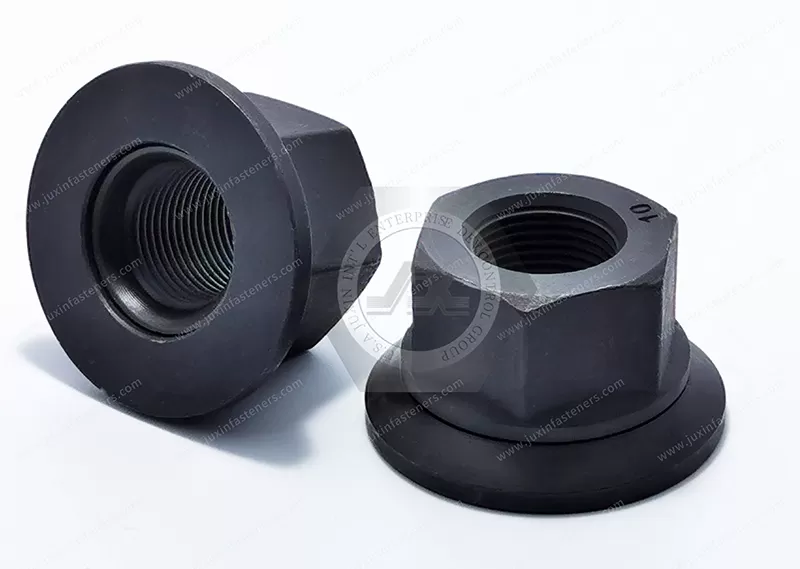
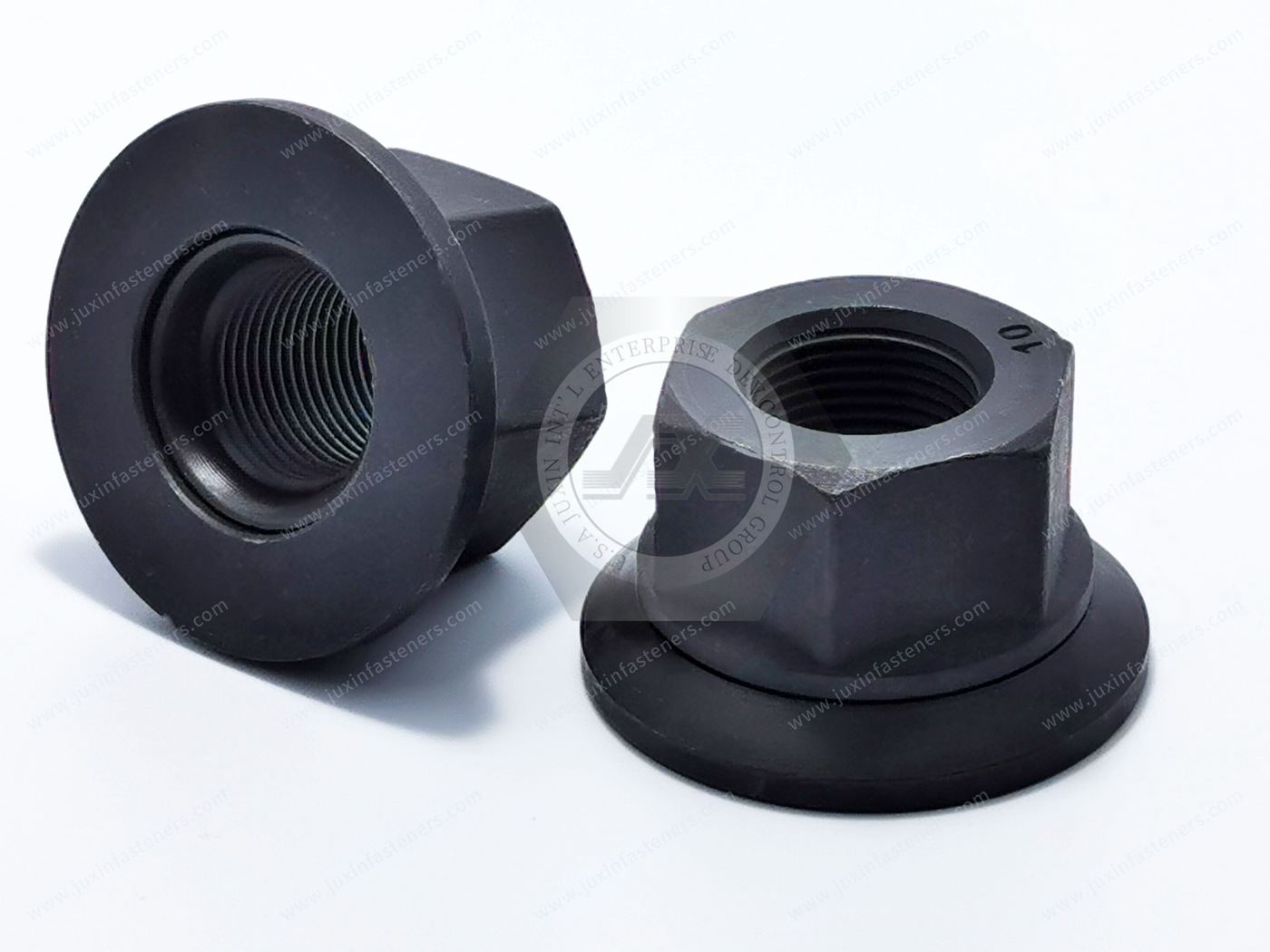
JUXIN FASTENERS supplies high-strength self-aligning wheel nuts with captive swivel washers for automotive and commercial vehicle fastening applications.
The two-piece assembly features a mechanically retained, freely rotating washer, a spherical nut-to-washer bearing interface for limited angular compensation, and a flat external bearing face.
Material options include carbon steel and specified alloy steel such as 40Cr, with a black phosphate finish and metric Property Class 10 requirements.
Original catalog sizes include M8–M20. OEM sourcing support covers custom thread specifications, washer retention, spherical bearing geometry,
wheel-seat compatibility, torque–tension control, mechanical testing and drawing-based bulk production.
Product Specification
High-Strength Self-Aligning Wheel Nuts with Captive Swivel Washers
Property Class 10 Steel Wheel Nuts with Spherical Nut-to-Washer Interfaces, Flat Bearing Faces and Black Phosphate Finish
JUXIN FASTENERS supplies high-strength self-aligning wheel nuts with captive swivel washers for automotive manufacturers, commercial vehicle OEMs,
wheel and axle system suppliers, and international industrial fastener procurement teams.
The featured product is a two-piece wheel nut assembly consisting of a high-strength hexagon nut and a mechanically retained washer.
The washer is secured to the nut through a formed or riveted retaining feature. It remains attached during normal handling while allowing relative rotation and limited angular movement.
The assembly incorporates a spherical bearing interface between the nut and washer. This internal curved contact geometry provides the self-aligning function.
The external washer bearing face is flat, not spherical.
This distinction is essential for correctly identifying the product and selecting a compatible wheel mounting system.
The spherical nut-to-washer interface allows limited angular compensation, while the flat external bearing face provides the mounting contact surface.
The featured product uses carbon steel or specified alloy steel, including 40Cr, with a black phosphate surface treatment and a nominal metric Property Class 10 mechanical strength requirement.
Its primary intended application is automotive wheel fastening, subject to the approved wheel, hub and stud design.
JUXIN FASTENERS supports OEM sourcing for engineering drawings, custom specifications, production quantities and long-term supply programs.
Product Overview and Technical Specifications
| Specification | Product Details |
|---|---|
| Product Name | High-Strength Self-Aligning Wheel Nuts with Captive Swivel Washers |
| Primary American Name | Self-Aligning Wheel Nuts |
| Product Type | Two-Piece Wheel Nut Assembly |
| Nut Body | Hexagon Steel Nut |
| Washer Type | Captive Swivel Washer |
| Washer Retention | Mechanically Retained by Formed or Riveted Feature |
| Washer Movement | Relative Rotation and Limited Angular Movement |
| Internal Bearing Interface | Spherical Nut-to-Washer Contact |
| External Bearing Face | Flat Washer-to-Wheel Contact Surface |
| Material | Carbon Steel or Specified Alloy Steel |
| Alloy Steel Option | 40Cr, Subject to Approved Specification |
| Mechanical Property | Metric Nut Property Class 10, Subject to Verification |
| Featured Surface Treatment | Black Phosphate |
| Original Catalog Sizes | M8, M10, M12, M14, M16, M20 |
| Thread Pitch | According to Approved Drawing |
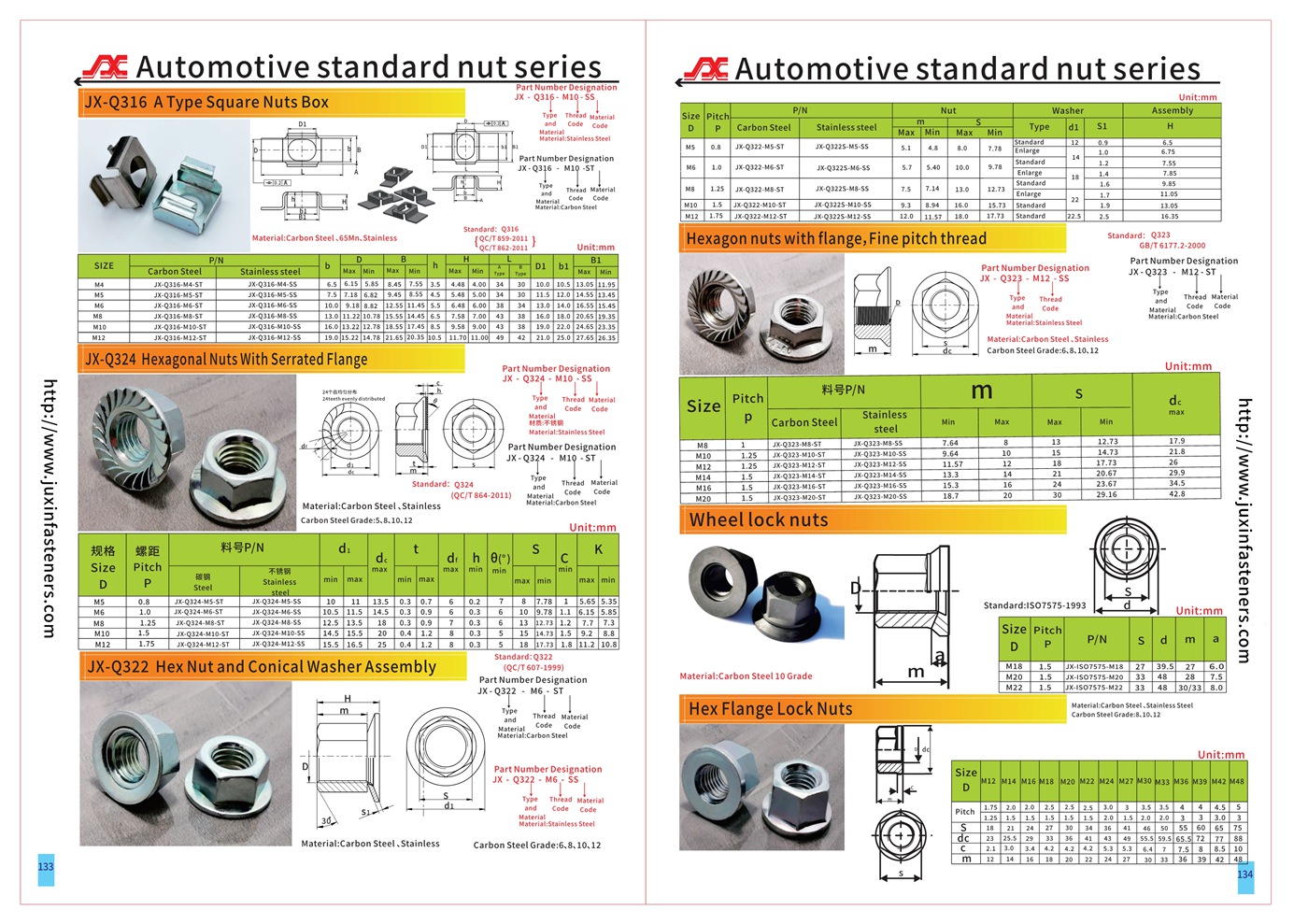
| Original Standard References | ISO 7575:1993; DIN 74361-3:2011 |
| Main Application | Automotive Wheel Fastening |
| OEM Production | According to Approved Drawings and Quality Requirements |
Alternative American and International Product Names
Depending on the actual wheel fastening configuration, procurement teams may use the following search terms:
High-Strength Self-Aligning Wheel Nuts
Self-Aligning Wheel Nuts
Wheel Nuts with Captive Swivel Washers
Two-Piece Wheel Nuts
Captive Washer Wheel Nuts
Swivel Washer Wheel Nuts
Wheel Nuts with Spherical Bearing Interfaces
Flat-Bearing-Face Wheel Nuts
Self-Aligning Flange Nuts
Automotive Wheel Fixing Nuts
Commercial Vehicle Wheel Nuts
Heavy-Duty Wheel Nuts
Truck Wheel Nuts
Custom Automotive Wheel Nuts
The terms describe related structural or application characteristics and should be matched to the actual approved product configuration.
What Are Self-Aligning Wheel Nuts?
Self-aligning wheel nuts are specialized threaded fastening assemblies designed to accommodate a limited amount of angular variation through a movable bearing interface.
The featured JUXIN product combines:
A high-strength hexagon nut body.
A mechanically retained swivel washer.
A spherical bearing interface between the nut and washer.
A flat external washer bearing face.
The washer remains attached to the nut but can move relative to it.
During installation, the internal spherical interface permits limited angular adjustment while the flat external washer face bears against the specified mounting surface.
This arrangement is different from a conventional one-piece hex flange nut.
Key Engineering Features
High-strength steel construction.
Metric Property Class 10 requirement.
Two-piece nut-and-washer design.
Captive washer retained by a formed or riveted feature.
Relative washer rotation.
Limited spherical self-alignment.
Flat external bearing face.
Black phosphate surface treatment.
OEM-specific thread and dimensional requirements.
Drawing-based manufacturing and inspection.
The actual performance depends on the approved design, material properties and wheel fastening system.
How the Captive Swivel Washer Works
The washer is mechanically attached to the nut body.
A retaining feature prevents the washer from separating during normal handling.
Unlike a fixed integral flange, the captive washer can rotate relative to the nut.
The spherical interface also permits limited angular movement.
1. Washer Retention
The formed or riveted retaining feature keeps the washer attached to the nut.
2. Relative Rotation
The washer can rotate relative to the hexagon nut body.
3. Spherical Contact
The curved nut-to-washer interface allows the washer to adjust its orientation within the designed range.
4. Flat External Bearing Surface
The washer presents a flat external face to the specified mounting surface.
5. Load Transfer
Clamping load passes through the nut, spherical bearing interface and captive washer into the wheel mounting joint.
Important Functional Requirements
Washer retention strength.
Free rotation.
Permitted angular movement.
Spherical bearing geometry.
Washer thickness.
Washer flatness.
Surface hardness.
Bearing contact.
Axial clearance.
Assembly durability.
These characteristics should be specified and verified according to the approved engineering drawing.
Spherical Nut-to-Washer Interface vs. Flat External Bearing Face
The featured product has two different bearing interfaces.
Internal Interface: Spherical
The contact between the nut body and washer incorporates curved mating geometry.
This provides limited angular compensation.
External Interface: Flat
The washer's external mounting face is flat.
This provides a planar bearing interface against the compatible mounting surface.
Critical Engineering Distinction
The internal spherical bearing interface does not make the external wheel seat spherical.
This product should not automatically be classified as a spherical-seat lug nut.
The actual wheel-contact geometry must be verified against the wheel manufacturer's specification.
Self-Aligning Wheel Nuts vs. Spherical-Seat Lug Nuts
The terms refer to different engineering features.
Self-Aligning Wheel Nuts
Use an internal movable interface to provide limited angular compensation.
Spherical-Seat Lug Nuts
Use an external spherical bearing seat that matches a corresponding spherical wheel seat.
The featured product has an internal spherical interface and an external flat washer face.
Therefore, it should not be marketed as a conventional spherical-seat lug nut.
Self-Aligning Wheel Nuts vs. Standard Flat-Seat Wheel Nuts
A conventional flat-seat wheel nut may incorporate a fixed or captive flat washer.
The featured self-aligning design additionally uses a spherical nut-to-washer interface.
Conventional Flat-Seat Wheel Nut
Flat external bearing surface.
May use a captive washer.
Does not necessarily provide angular compensation.
Featured Self-Aligning Wheel Nut
Flat external washer bearing face.
Captive rotating washer.
Spherical internal bearing interface.
Limited angular compensation.
The actual wheel fastening requirements determine which configuration is suitable.
Self-Aligning Wheel Nuts vs. Distorted-Thread Locknuts
A distorted-thread locknut uses an intentionally deformed thread section to create prevailing torque.
The featured self-aligning wheel nut uses a movable washer and spherical bearing interface.
These are different functions.
A captive swivel washer does not automatically create prevailing torque.
Important Product Classification
Unless the internal thread has a separately verified deformed-thread locking feature, this product should not be described as a distorted-thread prevailing-torque locknut.
Captive Washer vs. Separate Loose Washer
A separate loose washer must be handled and positioned independently.
A captive washer remains attached to the nut assembly.
Potential Assembly Advantages
Reduced loose component handling.
Reduced risk of missing washers.
Consistent nut-and-washer pairing.
Simplified assembly organization.
Improved component feeding.
Potential reduction in assembly handling time.
These benefits depend on the actual production process.
Why Self-Alignment Matters in Mechanical Fastening
Small angular differences between the nut axis and bearing surface can affect contact conditions.
A spherical bearing interface can permit limited adjustment.
Potential Engineering Benefits
Accommodation of specified angular variation.
Improved bearing contact under suitable conditions.
Reduced localized contact caused by small angular deviations.
Controlled load transfer through the washer.
Integrated fastening assembly.
Important Limitation
The washer cannot compensate for unlimited misalignment.
It must not be used to correct an incorrectly designed, damaged or incompatible wheel mounting system.
The allowable angular movement must be established by the engineering drawing and validated through testing.
Property Class 10 High-Strength Steel Wheel Nuts
The featured product is specified as metric Property Class 10.
This designation refers to the mechanical property class of a nut.
It is not the same as Property Class 10.9, which is commonly used for bolts and studs.
Important Mechanical Requirements
Nut proof load.
Thread strength.
Material hardness.
Heat treatment.
Mating stud strength.
Thread engagement.
Washer bearing capacity.
Spherical interface contact stress.
Fatigue resistance.
Wheel joint clamping force.
The complete wheel fastening system must be validated.
Carbon Steel and 40Cr Alloy Steel
The original material information identifies carbon steel and alloy steel, including 40Cr.
40Cr is a chromium-containing alloy steel used in various heat-treated mechanical components.
Material Selection Requirements
Chemical composition.
Heat treatment condition.
Mechanical properties.
Hardness.
Thread strength.
Fatigue behavior.
Dimensional stability.
Surface treatment compatibility.
The actual material must satisfy the approved OEM specification.
Black Phosphate Surface Treatment
The featured product uses a black phosphate finish.
Phosphate conversion coatings form a chemically produced surface layer on steel.
Depending on the process, a protective oil or other post-treatment may be applied.
Potential Functions
Dark industrial appearance.
Surface conditioning.
Compatibility with selected lubricants.
Defined friction characteristics where specified.
Limited corrosion protection depending on post-treatment.
Important Coating Distinction
Black phosphate is not the same as:
Black oxide.
Black zinc plating.
Black zinc-nickel plating.
Zinc-flake coating.
The actual coating specification must be confirmed.
Black Phosphate Corrosion Performance
Black phosphate alone generally provides limited corrosion protection.
Actual performance depends on:
Phosphate coating type.
Surface preparation.
Coating weight.
Protective oil.
Sealer or post-treatment.
Environmental exposure.
No specific neutral salt spray performance should be claimed without a supporting test report.
Black Phosphate and Torque–Tension Behavior
Surface treatment influences friction during tightening.
Important Variables
Thread friction.
Spherical interface friction.
Washer-to-wheel friction.
Phosphate coating.
Lubrication.
Stud coating.
Bearing surface condition.
Tightening procedure.
Engineering Requirement
The tightening process must be validated for the actual wheel nut, stud, washer and wheel combination.
A torque value approved for a different coating or nut design must not automatically be reused.
Wheel Nut Clamping Force and Joint Integrity
Wheel retention depends on the correct clamping force.
Insufficient preload may contribute to joint movement and loosening.
Excessive preload may damage studs, nuts, washers or wheel mounting components.
Important Design Factors
Wheel stud diameter.
Thread pitch.
Nut mechanical properties.
Stud mechanical properties.
Washer geometry.
Spherical interface contact.
Friction characteristics.
Wheel material.
Hub geometry.
Tightening sequence.
Tool calibration.
Safety Requirement
Installation torque must follow the approved vehicle, wheel or axle manufacturer's procedure.
Generic tightening torque tables should not replace application-specific requirements.
Flat Washer Bearing Face and Load Distribution
The external washer face provides the bearing contact surface against the wheel or other approved component.
Important Design Variables
Washer outside diameter.
Washer thickness.
Washer flatness.
Bearing area.
Wheel material.
Surface hardness.
Applied clamping force.
Contact pressure.
The washer must provide appropriate bearing support without unacceptable deformation.
Spherical Bearing Contact Stress
The internal spherical interface transfers load between the nut and washer.
Its geometry influences local contact pressure.
Important Variables
Spherical radius.
Contact area.
Surface finish.
Material hardness.
Washer thickness.
Applied clamp force.
Angular position.
Bearing stress.
The design should be evaluated for permanent deformation, surface damage and fatigue performance.
Captive Washer Retention and Rotation
The washer must remain securely attached while retaining the required movement.
Potential Functional Checks
Washer retention strength.
Rotational freedom.
Angular movement.
Axial clearance.
Retaining feature integrity.
Washer flatness.
Spherical contact condition.
Assembly durability.
The acceptable values should be established by the approved drawing.
Metric Wheel Nut Thread Specifications
The original catalog lists the following nominal diameters:
| Nominal Diameter | Actual Thread Pitch |
|---|---|
| M8 | According to Drawing |
| M10 | According to Drawing |
| M12 | According to Drawing |
| M14 | According to Drawing |
| M16 | According to Drawing |
| M20 | According to Drawing |
These are original product-family references.
They do not establish specific coarse-thread or fine-thread pitches.
The exact thread designation must be confirmed before quotation or production.
Common Commercial Vehicle Thread References
International commercial vehicle wheel nut catalogs may include:
M18 × 1.5
M20 × 1.5
M22 × 1.5
These are market reference sizes and are not confirmation of current availability for this featured product.
American Inch-Series Wheel Nut Threads
American automotive and commercial vehicle manufacturers may specify inch-series threads.
Common market references include:
1/2"-20 UNF
9/16"-18 UNF
5/8"-18 UNF
7/8"-14 UNF
These examples are provided for international sourcing terminology.
Actual supply must be confirmed separately.
Metric vs. UNF Thread Compatibility
Metric and UNF threads are different systems.
They are not directly interchangeable.
The customer must specify:
Nominal diameter.
Thread pitch or threads per inch.
Thread form.
Thread tolerance.
Thread direction.
A wheel nut must never be selected solely by approximate diameter.
Right-Hand and Left-Hand Threads
Some vehicle wheel systems use right-hand or left-hand threads.
Right-Hand Thread
Tightens clockwise.
Left-Hand Thread
Tightens counterclockwise.
The required direction must match the actual wheel stud specification.
DIN 74361-3 Standard Reference
DIN 74361-3 is a German standard reference associated with commercial vehicle wheel fastening components.
The original product catalog identifies DIN 74361-3:2011.
Its applicability must be checked against the actual product design.
Verification Requirements
Thread designation.
Nut geometry.
Washer configuration.
Bearing surface.
Dimensions.
Mechanical properties.
Product classification.
The presence of a captive washer or spherical internal interface does not automatically establish compliance.
ISO 7575 Standard Reference
ISO 7575:1993 addresses specified commercial vehicle flat-attachment wheel fixing nuts.
The standard covers defined configurations for commercial vehicle wheel studs.
Important Scope Limitation
The featured product has an internal spherical bearing interface and an external flat washer bearing face.
Its exact compliance with ISO 7575 must be verified against the standard's dimensional and construction requirements.
The original M8–M20 size range does not automatically establish conformity.
ISO 10597 Wheel Nut Testing Reference
ISO 10597:2012 provides test methods and performance requirements for applicable commercial vehicle flat-attachment wheel fixing nuts.
The standard should only be applied where the actual product falls within its scope.
Customer-specific tests may also be required for the spherical self-aligning design.
Automotive and Industrial Applications
1. Commercial Truck Wheel Assemblies
Commercial trucks require reliable wheel fastening systems.
Engineering Challenge
High vehicle loads and repeated operating cycles place demands on wheel joints.
Potential Solution
A drawing-approved self-aligning wheel nut may be evaluated where limited angular compensation is required by the wheel fastening design.
2. Commercial Bus Wheel Fastening
Buses require controlled wheel fastening and maintenance procedures.
Engineering Challenge
Wheel joint integrity must be maintained under repeated service conditions.
Potential Solution
A self-aligning wheel nut may be considered where the vehicle manufacturer specifies this type of fastening system.
3. Truck Trailer Wheel Systems
Trailers may operate under variable loading and road conditions.
Engineering Challenge
Wheel fastening components must maintain the required joint preload.
Potential Solution
A correctly specified high-strength wheel nut with captive swivel washer may be evaluated for compatible trailer wheel systems.
4. Commercial Vehicle Axle Assemblies
Axle manufacturers require controlled wheel fastening components.
Engineering Challenge
Stud, hub, wheel and nut geometry must be compatible.
Potential Solution
A drawing-based self-aligning wheel nut can be evaluated as part of the approved axle and wheel assembly.
5. Passenger Vehicle Wheel Applications
Some passenger vehicle applications may use specialized wheel fastening designs.
Engineering Challenge
Wheel seating geometry and installation requirements are safety-critical.
Potential Solution
A self-aligning wheel nut may only be used where specifically approved by the vehicle and wheel manufacturer.
6. Construction Vehicle Wheel Systems
Construction vehicles may operate under demanding mechanical loads.
Engineering Challenge
Wheel joints require appropriate strength and fatigue performance.
Potential Solution
A high-strength self-aligning wheel nut may be evaluated for an approved wheel fastening system.
7. Agricultural Vehicle Wheel Assemblies
Agricultural vehicles may experience vibration, contamination and variable loading.
Engineering Challenge
Wheel fastening reliability depends on the complete assembly design.
Potential Solution
A custom wheel nut with captive swivel washer may be evaluated where the OEM drawing requires this configuration.
8. Special-Purpose Vehicles
Special-purpose vehicles may use nonstandard wheel mounting systems.
Engineering Challenge
Standard wheel nuts may not match the required seat geometry.
Potential Solution
A drawing-based self-aligning wheel nut may be developed or sourced according to approved specifications.
9. Wheel and Hub Manufacturing
Wheel and hub manufacturers require dimensional compatibility among components.
Engineering Challenge
Small differences in bearing geometry can affect joint performance.
Potential Solution
A custom self-aligning wheel nut may be evaluated with the actual wheel and hub assembly.
10. Automotive Tier-1 and Tier-2 Supply Chains
Automotive suppliers require consistent production and documented quality controls.
Engineering Challenge
Wheel fastening components are safety-critical.
Potential Solution
A controlled manufacturing program should address material, heat treatment, dimensional inspection, functional testing and traceability.
11. Heavy Equipment Mounting Systems
Some industrial equipment uses specialized fasteners for mounting surfaces with limited angular variation.
Engineering Challenge
Nonparallel surfaces can create uneven bearing contact.
Potential Solution
A spherical bearing nut-and-washer assembly may be evaluated where the design, loads and application requirements are compatible.
This application requires separate engineering approval and must not be assumed from automotive wheel nut specifications.
12. Industrial Machinery Assemblies
Industrial machinery may use specialized captive washer fasteners.
Engineering Challenge
Assembly repeatability and bearing contact can influence joint reliability.
Potential Solution
A drawing-based self-aligning nut assembly may be considered for suitable mechanical connections.
Production Management and Assembly Efficiency
For production managers, captive swivel washer nuts can simplify component handling while requiring additional functional inspection.
Potential Production Benefits
Reduced loose washer handling.
Preassembled nut-and-washer configuration.
Reduced risk of missing washers.
Consistent component pairing.
Simplified component feeding.
Potential improvement in assembly efficiency.
Critical Production Controls
Material traceability.
Heat treatment consistency.
Thread accuracy.
Nut proof load.
Washer retention.
Washer rotation.
Angular movement.
Spherical contact geometry.
External washer flatness.
Coating friction.
Dimensional inspection.
Production lot identification.
Functional testing.
The actual manufacturing and assembly processes must be validated.
Common Engineering Problems and Troubleshooting
Problem 1: Washer Separation
Possible causes include insufficient retaining geometry or excessive handling loads.
Problem 2: Washer Does Not Rotate Freely
Possible causes include deformation, insufficient clearance or surface contamination.
Problem 3: Insufficient Angular Movement
Possible causes include incorrect spherical geometry or interference within the retaining structure.
Problem 4: Uneven Bearing Contact
Possible causes include excessive angular misalignment or unsuitable washer geometry.
Problem 5: Incorrect Wheel Seat
The external washer bearing face does not match the approved wheel mounting geometry.
Problem 6: Inconsistent Clamp Force
Possible causes include friction variation or unsuitable tightening procedures.
Problem 7: Thread Damage
Possible causes include incorrect thread pitch, cross-threading or excessive loading.
Problem 8: Excessive Bearing Stress
Possible causes include insufficient contact area or excessive clamp force.
Problem 9: Joint Loosening
Possible causes include insufficient preload, joint settlement or incorrect installation.
Problem 10: Incorrect Replacement Nut
A visually similar but incompatible wheel nut is installed.
Important Safety Notice
Wheel fastening components must be selected and installed according to approved vehicle and wheel system requirements.
Quality Inspection and OEM Validation
The product's mechanical and functional requirements should be established by the approved engineering drawing.
Dimensional Inspection
Potential characteristics include:
Thread diameter.
Thread pitch.
Thread direction.
Nut height.
Hexagon dimensions.
Washer outside diameter.
Washer thickness.
Spherical bearing radius.
Retaining feature geometry.
Overall assembly height.
Angular clearance.
External washer flatness.
Critical tolerances.
Material and Mechanical Verification
Potential requirements include:
Material verification.
Property Class 10 verification.
Heat treatment verification.
Hardness testing.
Proof-load testing.
Thread strength testing.
Captive Washer Functional Verification
Potential requirements include:
Washer retention strength.
Washer rotation.
Angular movement.
Axial clearance.
Spherical bearing contact.
Washer hardness.
Assembly handling durability.
Black Phosphate Coating Verification
Potential requirements include:
Surface treatment specification.
Coating appearance.
Post-treatment oil or lubricant.
Friction characteristics.
Corrosion performance, where specified.
Wheel Nut Functional Testing
Depending on the application:
Thread engagement.
Proof-load performance.
Torque–tension behavior.
Washer retention.
Washer rotation.
Angular compensation.
Bearing contact.
Clamp-force performance.
Fatigue performance.
Applicable wheel fastening tests.
OEM Quality Documentation
Depending on customer requirements, documentation may include:
Approved engineering drawings.
Material certificates.
Heat treatment records.
Dimensional inspection reports.
Mechanical test reports.
Functional test reports.
Surface treatment specifications.
First article inspection.
Production traceability.
Process control records.
PPAP documentation, where applicable.
Documentation must be supported by actual manufacturing and inspection records.
Custom Self-Aligning Wheel Nuts to Engineering Drawings
JUXIN FASTENERS supports OEM inquiries for high-strength steel self-aligning wheel nuts with captive swivel washers.
Custom requirements may include:
Carbon steel or alloy steel material.
40Cr material specification.
Property Class 10 requirements.
Thread diameter.
Thread pitch.
Thread direction.
Nut height.
Hexagon dimensions.
Captive washer diameter.
Washer thickness.
Spherical bearing radius.
Permitted angular movement.
Washer retention.
Washer rotation.
Flat external bearing face geometry.
Heat treatment.
Black phosphate coating.
Friction requirements.
Proof-load requirements.
Functional testing.
Packaging.
Production volume.
Manufacturing feasibility and compliance must be reviewed against the approved wheel system requirements.
Frequently Asked Engineering and Procurement Questions
What is the American name for this product?
High-Strength Self-Aligning Wheel Nuts with Captive Swivel Washers.
What makes this wheel nut self-aligning?
The spherical bearing interface between the nut and captive washer allows limited angular movement.
Is the washer permanently attached?
The washer is mechanically retained and designed to remain attached during normal handling.
Can the washer rotate independently?
Yes. The featured design allows relative rotation between the nut and washer.
Is this a two-piece wheel nut?
Yes. The assembly consists of a nut and a captive washer.
Is the external bearing face spherical?
No. The featured product has a flat external washer bearing face.
Where is the spherical interface located?
Between the hexagon nut body and the captive washer.
Is this the same as a conventional spherical-seat lug nut?
No. The internal spherical interface and external wheel-contact seat are different features.
Is this the same as a distorted-thread locknut?
Not necessarily. A distorted-thread locknut requires a separate verified thread-locking feature.
What is Property Class 10?
It is a mechanical property classification for specified metric nuts.
Is Property Class 10 the same as Class 10.9?
No. Class 10.9 is commonly used for bolts and studs.
What materials are available?
The original product information identifies carbon steel and alloy steel, including 40Cr.
What surface treatment is used?
The featured product uses black phosphate coating.
Does black phosphate provide high corrosion resistance?
Not automatically. Corrosion performance depends on the actual coating and post-treatment system.
What is DIN 74361-3?
It is a German standard reference associated with commercial vehicle wheel fastening components.
What is ISO 7575?
It specifies dimensions for certain commercial vehicle flat-attachment wheel fixing nuts.
Does ISO 7575 automatically cover this self-aligning design?
No. Applicability depends on the actual product geometry and standard scope.
Can this nut compensate for angular misalignment?
Only within the permitted range defined by the approved engineering design.
Can it be used on any vehicle wheel?
No. Wheel fastening components must match the approved vehicle and wheel system.
Are metric and UNF wheel nuts interchangeable?
No. They use different thread systems.
Can JUXIN FASTENERS review custom self-aligning wheel nut drawings?
Yes. Customer-specific inquiries can be evaluated according to supplied drawings and technical requirements.
Request a Custom Self-Aligning Wheel Nut RFQ
JUXIN FASTENERS supports international OEM sourcing for high-strength self-aligning wheel nuts, captive swivel washer wheel nuts and custom automotive wheel fastening components.
For a new OEM program or an existing production component, please provide:
2D engineering drawing or 3D CAD file.
Vehicle or wheel application.
Applicable standard and edition.
Thread diameter and pitch.
Right-hand or left-hand thread.
Material specification.
Mechanical property class.
Heat treatment requirements.
Nut height and hexagon dimensions.
Captive washer diameter and thickness.
Spherical bearing geometry.
Permitted angular movement.
Washer retention requirements.
Washer rotation requirements.
Flat external bearing face dimensions.
Black phosphate coating specification.
Friction requirements.
Proof-load requirements.
Functional test requirements.
Quality documentation requirements.
Initial order quantity.
Estimated annual production volume.
Target delivery schedule.
Our team can review the supplied engineering requirements and discuss manufacturing feasibility, technical clarification and quotation.
JUXIN FASTENERS
Website: https://www.juxinfasteners.com/
Email: info@juxinfasteners.com
Submit Your Engineering Drawings for a Custom High-Strength Self-Aligning Wheel Nut RFQ.
Product Packaging
Packaging Standard
At Juxin Fasteners, we apply standardized export packaging to ensure product protection, traceability, and compliance with international logistics requirements.
1. Standard Export Packaging
Unless otherwise specified, all products will be packed according to our factory standard export packaging, which includes:
Moisture-resistant inner protection
Poly bag or small box packing as required
Reinforced export cartons
Clear labeling with part number, specification, batch number, and quantity
Palletizing for sea or air shipment when necessary
Our standard packaging is designed to ensure safe transportation, efficient warehousing, and long-distance international shipping.
2. Customized Packaging Options
We also provide customized packaging solutions according to customer requirements, including but not limited to:
Private labeling
Customized barcodes
Specific carton dimensions
Retail packaging
Special pallet configuration
Customer-specific marking and identification
So that you know, customized packaging may involve additional costs and extended lead time depending on the complexity of the requirements.
3. Compliance & Quality Assurance
All packaging processes are controlled under our ISO 9001 quality management system to ensure consistency, traceability, and product integrity throughout the supply chain.
Product Pictures
Contact Us
Tel.:
+86 020 8621 0320
+86 020 3121 6067
E-mail:
Technical Support:
Navigation
SEND INQUIREY