Call Us
+86 136 6007 9809
Call Us
+86 136 6007 9809

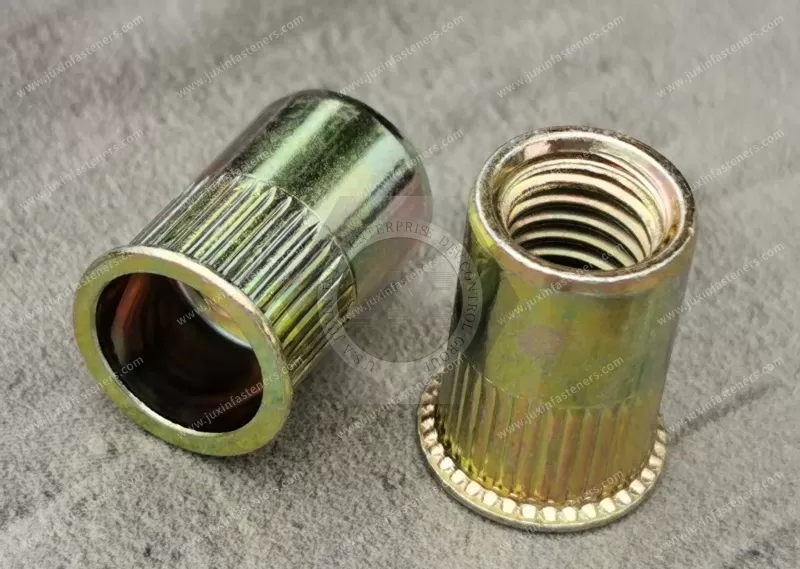
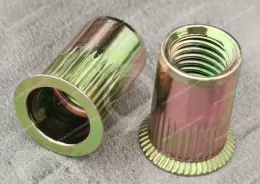
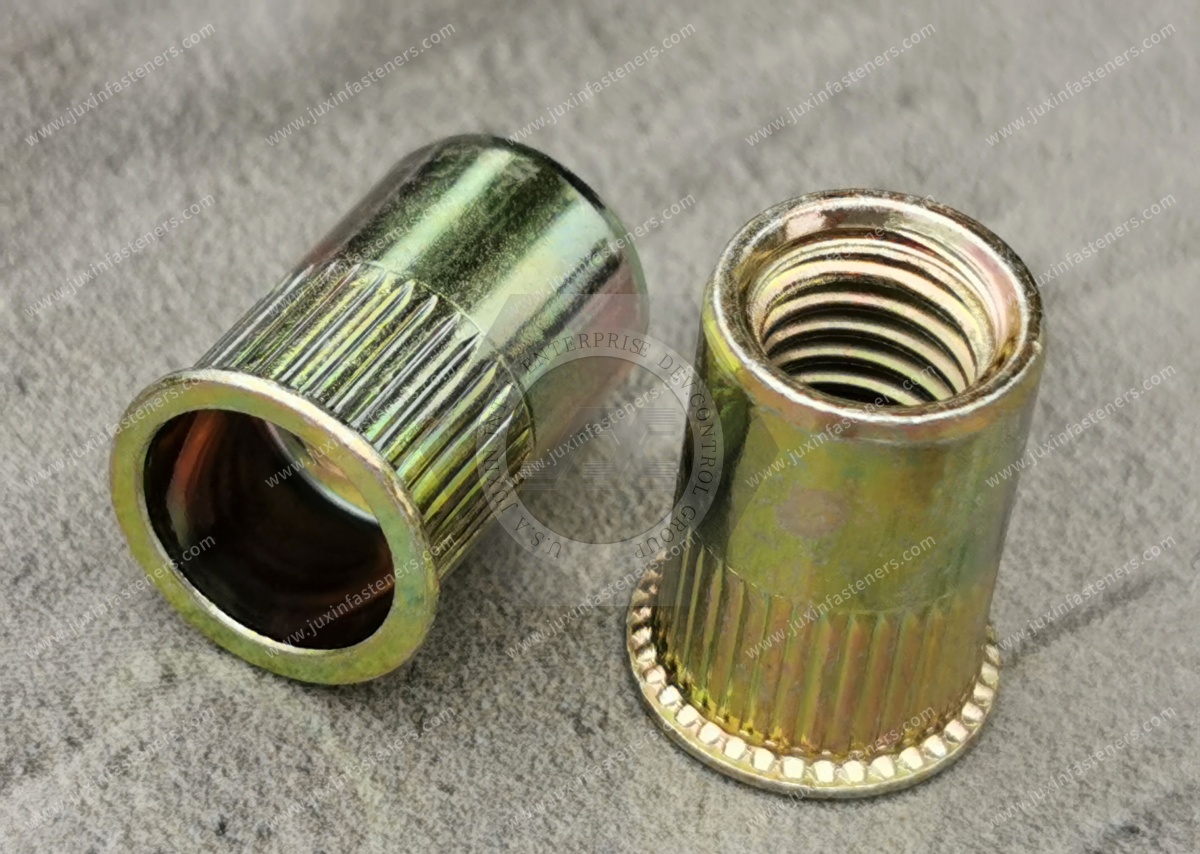
JUXIN FASTENERS manufactures color zinc-plated low-profile, open-end knurled round body steel blind rivet nuts for creating reusable internal threads in thin sheet metal, hollow sections, and OEM assemblies requiring one-sided installation.
The thin flange reduces surface protrusion, while the external knurling or ribs help resist insert rotation in compatible mounting holes. The open-end design allows screw extension where sufficient backside clearance is available.
Product Features
Metric threads: M4, M5, M6, M8, M10, M12
UNC threads: #6-32, #8-32, #10-24, 1/4"-20, 5/16"-18, 3/8"-16, 1/2"-13
UNF threads: #10-32
Material: Steel
Finish: Color zinc plating
Grip range: 0.5–7.9 mm (approx. 0.020–0.311 in), depending on size
Head: Thin head / Low-profile flange
Body: Knurled / Ribbed round body
End: Open end
Installation: One-sided blind installation
Applications include electrical enclosures, communication cabinets, compact equipment housings, machinery panels, and OEM sheet-metal assemblies requiring reduced head projection and reusable threaded connections.
Product Specification
Technical Specifications — Color Zinc Plated Low-Profile Knurled Round Body Blind Rivet Nuts
1. Product Identification and Construction
Product Name: Color Zinc Plated Low-Profile Knurled Round Body Blind Rivet Nuts
Alternative Names: Thin Head Rivet Nuts; Low-Profile Blind Rivet Nuts; Ribbed Body Rivet Nuts; Knurled Round Body Threaded Inserts; Open-End Steel Rivet Nuts.
Product Category: Steel Blind Rivet Nuts
Head Style: Thin Head / Low-Profile Head
Body Style: Round Body with External Knurling or Longitudinal Ribs
End Configuration: Open End
Material: Steel
Standard Finish: Color Zinc Plating
Stated Grip Range: 0.5–7.9 mm across the product family
Installation: One-Sided Blind Installation
Primary Function: Creation of a mechanically retained female threaded fastening point in a compatible panel or fabricated assembly.
2. Available Thread Sizes
Metric Thread Options
| Thread Designation | Thread System |
|---|---|
| M4 | ISO Metric |
| M5 | ISO Metric |
| M6 | ISO Metric |
| M8 | ISO Metric |
| M10 | ISO Metric |
| M12 | ISO Metric |
Unified Inch Thread Options
| Thread Designation | Thread Series |
|---|---|
| #6-32 | UNC |
| #8-32 | UNC |
| #10-24 | UNC |
| #10-32 | UNF |
| 1/4-20 | UNC |
| 5/16-18 | UNC |
| 3/8-16 | UNC |
| 1/2-13 | UNC |
The product-family introduction identifies M4 through M12 as the listed metric sizes. A separate general specification mentions M3–M12;
M3 is therefore not included in the stated standard range until availability for this particular product is confirmed.
Metric and Unified inch threads are different thread systems. Thread diameter, pitch, tolerance and mating bolt compatibility must be established from the applicable drawing.
3. Standard Material and Surface Finish
| Technical Attribute | Specification |
|---|---|
| Base Material | Steel |
| Standard Coating | Color Zinc Plating |
| Head Type | Low-Profile / Thin Head |
| Body Type | Knurled / Ribbed Round Body |
| End Type | Open End |
| Thread Systems | Metric and Unified Inch |
| Stated Family Grip Range | 0.5–7.9 mm |
| Installation Access | One-Sided |
| Dimensional Requirements | Product-Specific Drawing |
| Custom Manufacturing | Subject to Technical Review |
The supplied general technical information also mentions stainless steel and other head configurations.
Those represent possible alternative product families or custom requirements rather than confirmed specifications for this color zinc plated steel model.
Color Zinc Plating Considerations
Color zinc plating is an electroplated protective finish used on steel components.
The appearance and protective properties depend on the coating process and post-treatment system.
For a defined OEM requirement, the specification should identify:
Required coating type.
Coating thickness or coating designation.
Passivation or post-treatment requirements.
Appearance requirements.
Applicable substance restrictions.
Corrosion testing method and acceptance criteria, if required.
Any restrictions associated with the fastener material or manufacturing process.
No universal salt-spray duration is assigned to this product without supporting coating specifications and test results.
4. Grip Range and Material Stack Thickness
Stated Product-Family Grip Range: 0.5–7.9 mm
The grip range is the permitted thickness of the material or combined material stack retained by a specific rivet nut after correct installation.
It should not be confused with the total length of the uninstalled insert.
Grip Range Selection
The correct part number must be selected according to:
Actual total material thickness.
Individual insert body length.
Deformable body-section geometry.
Parent-material properties.
Installation stroke or setting force.
Available blind-side clearance.
The 0.5–7.9 mm range is a family-level statement. It does not establish that every listed thread size is available or suitable throughout the entire range.
Very Thin Panels
General technical literature sometimes describes blind rivet nut installation in material as thin as 0.25 mm (0.010 in).
However, this product's supplied family grip range begins at 0.5 mm.
Therefore, 0.25 mm should not be published as a confirmed minimum thickness for this specific model without corresponding product and assembly validation.
For very thin or fragile materials, the engineer should evaluate panel deformation, local bearing stress, flange support and installation damage.
5. Low-Profile Head Geometry
The low-profile head is designed to reduce the protrusion of the rivet nut above the mounting surface.
The actual installed head projection depends on head height, panel flatness, hole preparation and seating condition.
Required Head Dimensions
Head outside diameter.
Head thickness or height.
Body-to-head transition geometry.
Permitted head projection.
Seating and flatness requirements.
A reduced head height may be beneficial in compact assemblies, but the smaller flange geometry can affect the available bearing area.
Where the flange contributes significantly to load distribution or pull-through resistance, the designer should verify that the selected low-profile configuration is appropriate.
A thin-head rivet nut should not be described as a countersunk or completely flush rivet nut unless its geometry and installation arrangement support that description.
6. Knurled Round Body and Anti-Rotation Function
The external knurled or ribbed body provides a mechanical interface with the parent material.
When the insert is installed, the surrounding panel material and the external body features contribute to resistance against rotation.
Torque-to-Turn Performance
Torque-to-turn is the torque required to initiate rotation of the installed rivet nut relative to the parent material under a defined test arrangement.
Performance depends on:
Knurl profile.
Body outside diameter.
Hole diameter and tolerance.
Panel material and hardness.
Material thickness.
Setting stroke and installation force.
Coating condition.
Test method.
The original general technical text refers to an improvement of up to 50% compared with a plain-body insert.
This percentage is not stated as a guaranteed JUXIN specification because the associated part numbers, test specimens, parent materials and testing conditions have not been supplied.
For demanding assemblies, the customer should define a torque-to-turn acceptance value and validate the selected rivet nut under representative installation conditions.
7. Installation Hole and Dimensional Control
The mounting hole is a critical feature of the rivet nut joint.
Incorrect hole dimensions can reduce insert retention, increase the risk of rotation or cause installation damage.
Product-Specific Dimensions to Verify
| Parameter | Purpose |
|---|---|
| Internal Thread Size | Mating fastener compatibility |
| Body Outside Diameter | Insert-to-hole fit |
| Recommended Hole Diameter | Correct installation |
| Hole Tolerance | Installation repeatability |
| Head Diameter | Flange bearing area |
| Head Height | Clearance and projection |
| Body Length | Installation envelope |
| Grip Range | Material thickness compatibility |
| Blind-Side Clearance | Space for body deformation |
| Thread Engagement | Bolt and joint design |
The correct hole diameter must be taken from the product-specific drawing.
Do not assume that a nominal hole dimension suitable for one rivet nut size will be appropriate for another thread size or body configuration.
Hole Preparation
Before installation, inspect:
Hole diameter and roundness.
Burrs and sharp edges.
Panel flatness.
Coating buildup.
Material thickness.
Access for the installation tool.
Excessive burrs or poor head seating can interfere with proper deformation and joint retention.
8. Installation Process and Tool Compatibility
Blind rivet nuts are installed using a setting tool that engages the internal thread and deforms the insert's collapsible body section.
Depending on the selected product size and production requirements, compatible equipment may include:
Manual rivet nut setting tools.
Pneumatic or hydro-pneumatic tools.
Suitable automated production-line equipment.
Compatibility must be confirmed for the selected rivet nut size, material, head geometry and installation requirements.
Typical Installation Procedure
Verify the product part number and required grip range.
Prepare the approved mounting hole.
Inspect hole quality and panel thickness.
Fit the correct mandrel and installation nosepiece.
Insert the rivet nut into the prepared hole.
Seat the low-profile head against the panel.
Apply the specified setting stroke or force.
Form the retaining bulge on the blind side.
Release the setting tool without damaging the internal thread.
Inspect the installed head, panel and thread condition.
The correct setting parameters must be established for the actual product and parent material.
Insufficient setting can lead to poor retention. Excessive setting may damage the insert, strip the thread or distort the surrounding panel.
9. Blind-Side Clearance and Installed Geometry
Blind-side clearance is the available space behind the panel for the rivet nut body and its deformation during installation.
For enclosed structures, this dimension can be as important as the visible head height.
Designers should check:
Clearance for the uninstalled body.
Clearance required during setting.
Final installed deformation envelope.
Bolt penetration beyond the insert.
Interference with internal brackets, wiring or moving parts.
A compact head on the accessible side does not necessarily mean the complete installed fastening arrangement requires minimal space behind the panel.
This distinction is particularly important in electrical enclosures, hollow profiles and compact equipment housings.
10. Pull-Out Resistance and Joint Failure Modes
Pull-out resistance is the axial force required to extract the installed rivet nut from the parent material under defined conditions.
It depends on the installed retaining geometry, panel thickness, hole dimensions, parent-material strength and installation process.
A complete engineering assessment should distinguish:
Insert Rotation: The insert turns in the panel during bolt tightening or removal.
Insert Pull-Out: The insert is extracted from the parent material under axial load.
Panel Pull-Through or Deformation: The surrounding sheet material fails or deforms excessively.
Thread Stripping: The internal or mating thread fails under loading.
Bolt Failure: The mating fastener fails in tension, shear or another loading mode.
Fatigue or Vibration-Related Failure: Repeated loading degrades the connection.
No universal torque-to-turn, pull-out or fatigue value is claimed across all thread sizes and panel materials.
Where these properties are critical, acceptance limits should be established in the customer specification and verified on representative assemblies.
11. Open-End Configuration and Bolt Length
An open-end rivet nut has an internal threaded passage that is not closed at the blind end.
This permits bolt penetration through the insert where the assembly geometry allows.
However, the bolt length must still be selected to avoid interference with surrounding components.
For enclosed equipment, verify that the bolt does not contact internal structures or sensitive components.
Open-end rivet nuts do not provide a sealed barrier through the threaded bore.
For applications involving water, dust or contamination, consider a closed-end or specially sealed arrangement and validate the complete joint.
12. Installation in Painted or Coated Assemblies
These rivet nuts may be considered for pre-coated or painted panels where installation has been validated.
Important process considerations include:
Coating thickness around the hole.
Burr formation and exposed panel edges.
Head seating.
Tool alignment.
Installation force.
Local deformation.
Potential coating cracking or scratching.
A claim of completely damage-free installation should not be made without testing the actual panel coating and installation process.
Electrical Bonding Considerations
The knurled body may contribute to metal-to-metal contact in certain assemblies.
However, electrical continuity depends on the complete joint, including the panel coating, material, contact conditions and fastening arrangement.
Where grounding or bonding is required, specify and verify the electrical performance of the installed assembly.
13. International Engineering References
The following standards may be relevant when defining thread geometry, plating requirements and testing methods.
They are provided as engineering references rather than blanket claims of product certification.
| Standard | Relevant Application |
|---|---|
| ISO 261 | ISO metric screw thread series |
| ISO 965 | Metric thread tolerances |
| ASME B1.1 | Unified inch screw threads |
| ISO 4042 | Electroplated coating systems for fasteners, where applicable |
| ASTM B117 | Salt-spray testing when specified |
| Customer-Approved Drawing | Dimensions, tolerances and product acceptance requirements |
The actual applicable standards and editions must be established by the customer drawing, technical specification and agreed inspection requirements.
14. Industrial Application Considerations
Automotive and Transportation
Evaluate bolt tightening torque, panel thickness, vibration, coating durability and repeated service cycles.
Electrical Enclosures
Check flange clearance, panel coating, installation-hole quality and any required electrical bonding performance.
Industrial Machinery
Evaluate retention under maintenance loading, vibration and repeated bolt removal.
Electronics and Equipment Housings
Verify low-profile head clearance, blind-side installation space and local panel deformation.
HVAC and Appliances
Consider sheet thickness, installation repeatability, corrosion exposure and production-line tool compatibility.
General Metal Fabrication
Establish suitable hole tolerances, setting parameters and inspection criteria for consistent production.
15. Manufacturing Capabilities and OEM Customization
JUXIN FASTENERS manufactures industrial fasteners and drawing-specific components.
Our broader production capabilities include cold heading, cold forming, secondary CNC turning and machining,
metal stamping, plastic injection molding and combined manufacturing processes.
For custom metal components, cold forming and secondary machining may be combined where part geometry and tolerance requirements make that approach suitable.
For custom rivet nut projects, JUXIN can review:
Modified thread sizes.
Special head height or flange diameter.
Alternative body lengths.
Custom knurling profiles.
Different grip ranges.
Material specifications.
Color zinc plating requirements.
Installation-tool compatibility.
Inspection and performance criteria.
Packaging and delivery requirements.
The final manufacturing process and product requirements are determined by technical review of the customer's drawings and intended application.
16. Product Drawings and CAD Information
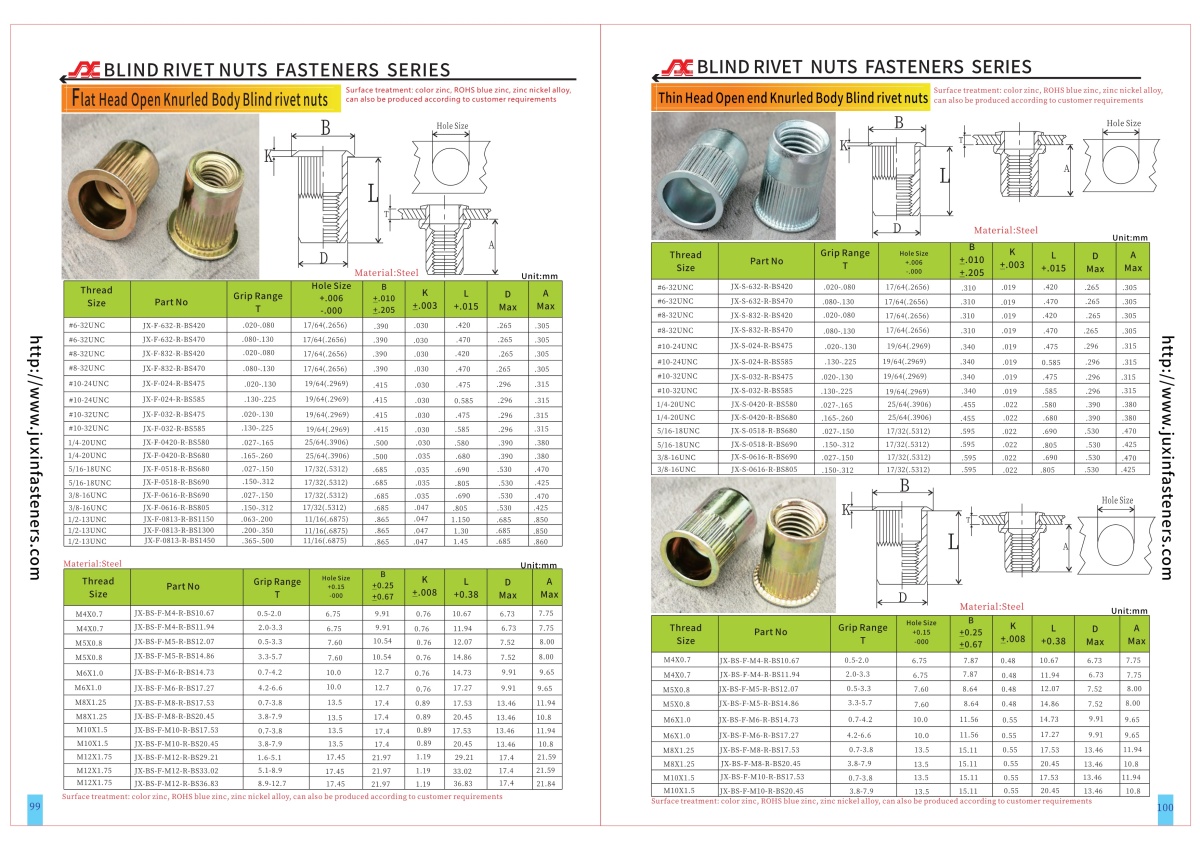
The supplied technical source identifies PDF pages 99–100 as the reference for dimensional specifications.
Before publishing numerical size tables, confirm that those pages correspond to this exact low-profile, open-end, knurled round body variant.
Customers may submit 2D drawings or 3D CAD models for manufacturing feasibility review and quotation.
17. OEM RFQ Checklist
For an efficient quotation, please provide:
Metric or Unified thread designation.
Required product drawing or part number.
Panel material and thickness.
Installation-hole dimensions.
Head-height and flange requirements.
Available blind-side clearance.
Required torque-to-turn or pull-out performance.
Color zinc coating specification.
Corrosion-resistance and compliance requirements.
Sample quantity, order quantity and annual usage.
Packaging, inspection and documentation requirements.
Key Engineering Benefits
1. Low-Profile Head for Reduced Assembly Height
The low-profile head minimizes the height of the installed flange above the accessible mounting surface.
This design can be beneficial when adjoining components require close clearance, when equipment covers must fit over the fastening point,
or when a conventional large-flange rivet nut would interfere with the surrounding assembly.
Typical applications include compact electrical enclosures, machinery covers, equipment housings, mounting brackets and thin sheet-metal structures.
A low-profile head is not automatically flush with the panel. Where zero or near-zero installed head projection is essential,
the engineer should verify the actual head height and consider a dedicated countersunk design if necessary.
2. Knurled Round Body for Rotational Resistance
The external knurling or longitudinal ribs create a mechanical interface with the parent material.
When the rivet nut is correctly installed in a compatible mounting hole, this geometry can help resist rotation during bolt tightening and repeated servicing.
The resulting torque-to-turn performance depends on the body geometry, parent-material properties, installation-hole tolerance, grip thickness and setting conditions.
For assemblies with demanding tightening torque or frequent maintenance, the rotational resistance should be validated using representative production panels.
3. One-Sided Installation Without Rear Access
Blind rivet nuts can be installed from the accessible side of the assembly.
This is useful for hollow sections, enclosed structures, equipment cabinets and fabricated components where conventional nut-and-bolt installation is difficult.
The installation process does not require a welding operation, although a suitable installation tool and adequate blind-side clearance are necessary.
4. Internal Threads for Thin Sheet-Metal Assemblies
Directly tapping a thin panel may provide insufficient thread engagement for the intended fastening requirement.
A blind rivet nut creates a dedicated internal thread and a mechanically retained attachment point.
This can improve assembly practicality where components need to be removed for inspection, replacement or maintenance.
The final joint capacity depends on the insert, mating fastener, panel material, installation quality and applied loads.
5. Open-End Design for Bolt Engagement Flexibility
The open-end configuration allows the mating screw to pass through the threaded body where the surrounding assembly provides sufficient clearance.
This can accommodate different bolt engagement requirements without a closed cavity restricting penetration.
However, the designer must ensure that the projecting bolt does not interfere with nearby components.
An open-end rivet nut is not a sealed threaded insert. Where environmental sealing or a closed threaded cavity is required, a suitable closed-end or sealing configuration should be evaluated.
6. Steel Construction with Color Zinc Plating
Steel provides a practical combination of mechanical strength, formability and manufacturing efficiency for many industrial fastening applications.
The specified color zinc plated finish provides a protective surface coating for suitable environments.
The finish may also be described commercially as yellow or iridescent zinc plating, depending on the actual appearance and coating process.
The precise plating system and passivation requirements should be confirmed for the supplied part.
Corrosion performance cannot be determined from plating color alone. Coating thickness, passivation chemistry, sealing treatments and exposure conditions must be considered.
For OEM programs, JUXIN can review customer-specified surface treatment and corrosion testing requirements.
Engineering Selection: Color Zinc vs. Blue-White Zinc Rivet Nuts
JUXIN's color zinc plated and blue-white zinc plated low-profile knurled rivet nuts may serve similar mechanical applications,
but they should be identified as separate finish variants when the purchasing specification requires a particular appearance or plating process.
| Selection Factor | Color Zinc Plated Version | Blue-White Zinc Plated Version |
|---|---|---|
| Main Product Geometry | Low-Profile Knurled Round Body | Low-Profile Knurled Round Body |
| Base Material | Steel | Steel |
| End Configuration | Open End | Open End |
| Finish Identification | Color Zinc | Blue-White Zinc |
| Appearance | Depends on the approved color zinc process | Depends on the approved blue-white zinc process |
| Corrosion Performance | Must be confirmed by coating specification and test | Must be confirmed by coating specification and test |
| OEM Selection | Drawing and finish requirements | Drawing and finish requirements |
Important: Color zinc plating is not inherently superior or inferior to blue-white zinc plating solely because of its appearance.
The actual corrosion resistance must be established from the specified coating system and relevant test results.
For customers changing from one finish to another, coating thickness, hole fit, installation behavior, appearance requirements and any applicable substance restrictions should be reviewed.
Industrial Applications and Engineering Solutions
Automotive Components and Transportation Equipment
Low-profile knurled rivet nuts can be considered for sheet-metal brackets, removable covers, mounting structures and equipment components where compact fastening geometry is important.
Engineering teams should evaluate vibration, repeated bolt installation, tightening torque, corrosion exposure and the ability of the panel to support the installed insert.
Where automotive OEM requirements apply, the drawing, finish specification and validation plan should define the required acceptance criteria.
Electrical Enclosures and Control Cabinets
These rivet nuts provide threaded attachment points for mounting plates, enclosure brackets, support hardware and removable cabinet panels.
The low-profile head can reduce interference with adjoining components, while the knurled body can contribute to resistance against rotation.
If the enclosure is painted or coated, the mounting-hole condition and installation parameters should be controlled to avoid unacceptable damage.
Electrical continuity or grounding must be validated through the complete joint and should not be assumed from the knurled geometry.
Industrial Machinery and Equipment Housings
Machine guards, service panels, fabricated frames and equipment covers may require threaded fastening points that remain in place when the mating screw is removed.
A blind rivet nut can simplify maintenance where rear-side access is restricted.
For machinery applications, consider repeated service cycles, joint vibration, insert rotation, panel deformation and the expected tightening torque.
HVAC and Appliance Manufacturing
Thin sheet-metal housings, access panels and equipment brackets may benefit from one-sided threaded fastening.
The low-profile head is useful where limited clearance exists between overlapping components.
For production-line installation, the mounting-hole dimensions, tool settings and inspection process should be standardized for the selected part.
Electronics and Compact Equipment Assemblies
Low-profile rivet nuts may be suitable for metal equipment housings, mounting brackets and supporting structures.
Design engineers should verify installation access, blind-side clearance, flange projection and the potential for local deformation near sensitive components.
General Sheet Metal Fabrication
These threaded inserts can support industrial cabinets, metal brackets, enclosures and fabricated structures requiring reusable threaded attachment points.
For higher-volume manufacturing, consistent hole preparation and controlled installation are essential to repeatable retention performance.
Choosing Between Low-Profile, Flat Head and Hex Body Rivet Nuts
Low-Profile Knurled Round Body: Suitable for consideration where reduced head projection and a round mounting hole are important.
Flat Head Knurled Round Body: May provide a larger bearing surface, depending on the flange geometry, where head projection is less restrictive.
Smooth Round Body: A possible option where a plain cylindrical body meets the required installation and retention performance.
Full-Hex Rivet Nut: Uses geometric engagement with a compatible hexagonal hole to resist rotation.
Half-Hex Rivet Nut: Combines hexagonal and round body features and requires the corresponding hole and installation design.
Closed-End Rivet Nut: Provides a closed threaded cavity where direct through-bore access is undesirable.
These configurations are not interchangeable without reviewing the hole geometry, grip range, flange dimensions and mechanical requirements.
OEM Manufacturing and Custom Rivet Nut Solutions
JUXIN FASTENERS is an industrial fastener and custom component manufacturer with production workshops and more than 20 years of industry experience.
Our manufacturing capabilities include cold heading, cold forming, secondary CNC machining and turning, metal stamping,
plastic injection molding and combined manufacturing processes for suitable product designs.
Some custom metal components require cold forming followed by secondary machining to achieve specific features or tolerances.
The appropriate production route is determined by the actual drawing, material, geometry and production quantity.
For custom rivet nut requirements, JUXIN can review:
Metric and Unified inch-thread specifications.
Low-profile head height and flange diameter.
Body diameter and length.
Knurling or rib geometry.
Grip range and installation-hole requirements.
Steel material specifications.
Color zinc plating and alternative coating requirements.
Tool compatibility and installation conditions.
Customer drawings and technical acceptance requirements.
Sample quantities, production volumes and packaging instructions.
Our manufacturing approach is designed to support customer engineering requirements with practical process selection and flexible production coordination.
OEM Procurement and RFQ Support
For sourcing managers, supplier development engineers and purchasing teams, the most useful RFQ information includes:
Required thread size and thread system.
Product drawing or 3D model.
Panel material and total grip thickness.
Installation-hole dimensions and tolerance.
Maximum allowable head projection.
Available blind-side clearance.
Required tightening torque or retention performance.
Color zinc coating specification and corrosion requirements.
Expected order quantity and annual demand.
Inspection, packaging and delivery requirements.
Where the customer has an existing part number or approved sample, please provide it for dimensional and manufacturing review.
Request a Technical Review or Quotation
JUXIN FASTENERS
Email: info@juxinfasteners.com
Website: www.juxinfasteners.com
Standard and Custom Blind Rivet Nuts | OEM Manufacturing | Engineering-Oriented Fastener Solutions
Product Packaging
Product Packaging — Color Zinc Plated Low-Profile Knurled Rivet Nuts
Standard Packaging Arrangement
JUXIN FASTENERS supplies color zinc plated low-profile knurled round body blind rivet nuts in industrial packaging suitable for OEM assembly plants,
equipment manufacturers, industrial distributors and international shipments.
The standard packaging system consists of inner plastic bags, outer cartons and palletized shipment packaging where required.
The packaging arrangement may be adjusted according to the product dimensions, thread size, order quantity and customer requirements.
Packaging Specifications
| Packaging Component | Specification |
|---|---|
| Inner Packaging | Plastic Bags |
| Outer Packaging | Cartons |
| Standard Carton Option 1 | 29 × 19 × 19.5 cm |
| Standard Carton Option 2 | 23.5 × 17.5 × 8 cm |
| Pallet Dimensions | 215 × 100 × 90 cm |
| Customized Packaging | Subject to Customer Requirements |
The listed carton and pallet dimensions are the packaging references supplied for this product family.
Actual quantities per bag, quantities per carton, carton weights and pallet loading arrangements are determined according to the selected rivet nut size and confirmed order requirements.
Packaging Protection for Color Zinc Plated Steel Rivet Nuts
The packaging arrangement should help protect the product from unnecessary handling damage, contamination and moisture exposure during storage and transportation.
For color zinc plated steel fasteners, suitable dry storage conditions are recommended.
Customers should avoid prolonged exposure to condensation, standing water and corrosive storage environments.
For special shipment conditions or extended storage periods, additional protective packaging requirements can be reviewed during order preparation.
OEM and Customer-Specific Packaging
JUXIN FASTENERS can review packaging instructions for industrial production and purchasing programs, including:
Defined quantities per inner bag.
Specified quantities per carton.
Product segregation by thread size.
Customer part-number identification.
Batch or lot identification.
Carton labels and shipping marks.
Packaging for warehouse handling.
Packaging for production-line replenishment.
Customized palletization.
Customer-specific packing instructions.
Where traceability or labeling is required, the applicable documentation and identification format should be confirmed before production shipment.
Packaging for Industrial Procurement and Distribution
For purchasing departments, supply-chain teams and industrial distributors,
packaging requirements can affect receiving efficiency, inventory control and production-line material handling.
Customers may specify preferred packing quantities, labeling formats and shipment arrangements to support their internal logistics processes.
For custom orders, please provide the required product size, order quantity, packaging instructions and shipping destination.
Request Packaging Details or a Quotation
JUXIN FASTENERS supports standard and drawing-specific industrial fastener requirements with flexible packaging coordination.
Contact JUXIN FASTENERS
Email: info@juxinfasteners.com
Website: www.juxinfasteners.com
Flexible Manufacturing | OEM Fastener Supply | Customer-Specific Packaging
Product Pictures
Tags
Contact Us
Tel.:
+86 020 8621 0320
+86 020 3121 6067
E-mail:
Technical Support:
Navigation
SEND INQUIREY