Call Us
+86 136 6007 9809
Call Us
+86 136 6007 9809

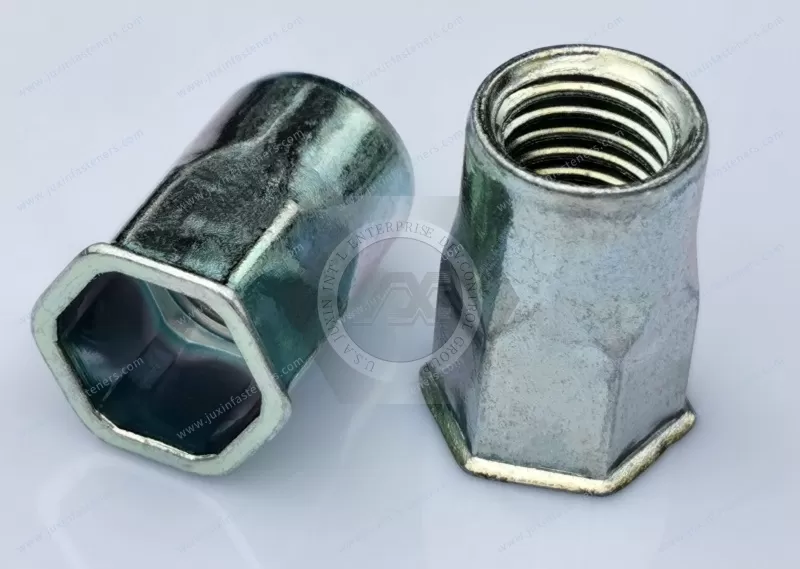
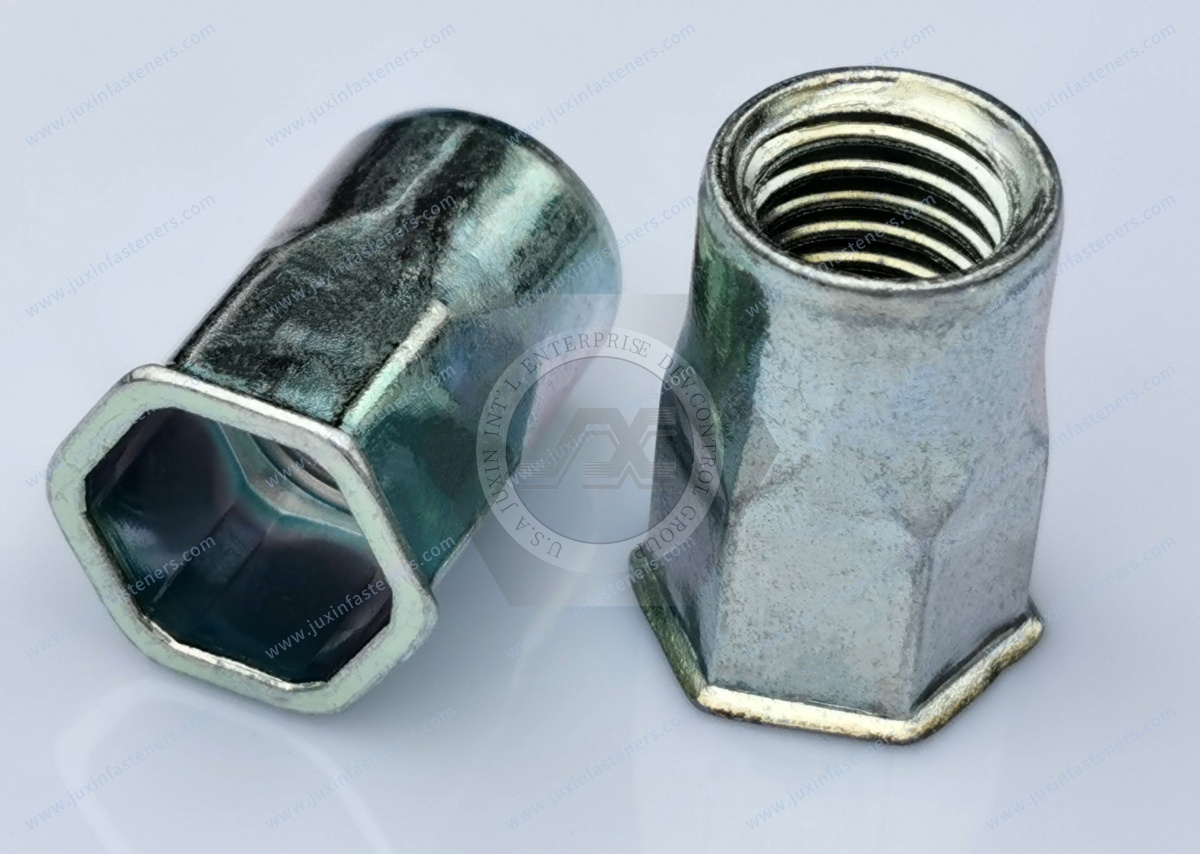
JUXIN FASTENERS manufactures thin head, open-end steel half-hex blind rivet nuts with blue zinc plating for creating reusable internal threads in thin sheet metal, hollow sections, and industrial assemblies requiring one-sided installation.
The reduced-height flange minimizes head projection, while the partial hexagonal body engages with a matching non-round mounting hole to help resist insert rotation. The open-end barrel allows screw extension where sufficient backside clearance is available.
Product Features
Metric thread sizes: M4, M5, M6, M8, M10
Inch-series threads: Custom OEM requirements subject to drawing review
Material: Steel
Surface finish: Blue zinc plating
Grip range: 0.5–3.5 mm (approx. 0.020–0.138 in) across the product family, depending on configuration
Head style: Thin head / Low-profile flange
Body style: Half-hex / Partial hexagonal body
End style: Open end
Installation: One-sided blind installation into compatible non-round mounting holes
Typical applications include electrical cabinets, communication equipment, industrial control enclosures, electronic housings, and OEM sheet-metal assemblies requiring reduced flange projection and improved rotational resistance.
Product Specification
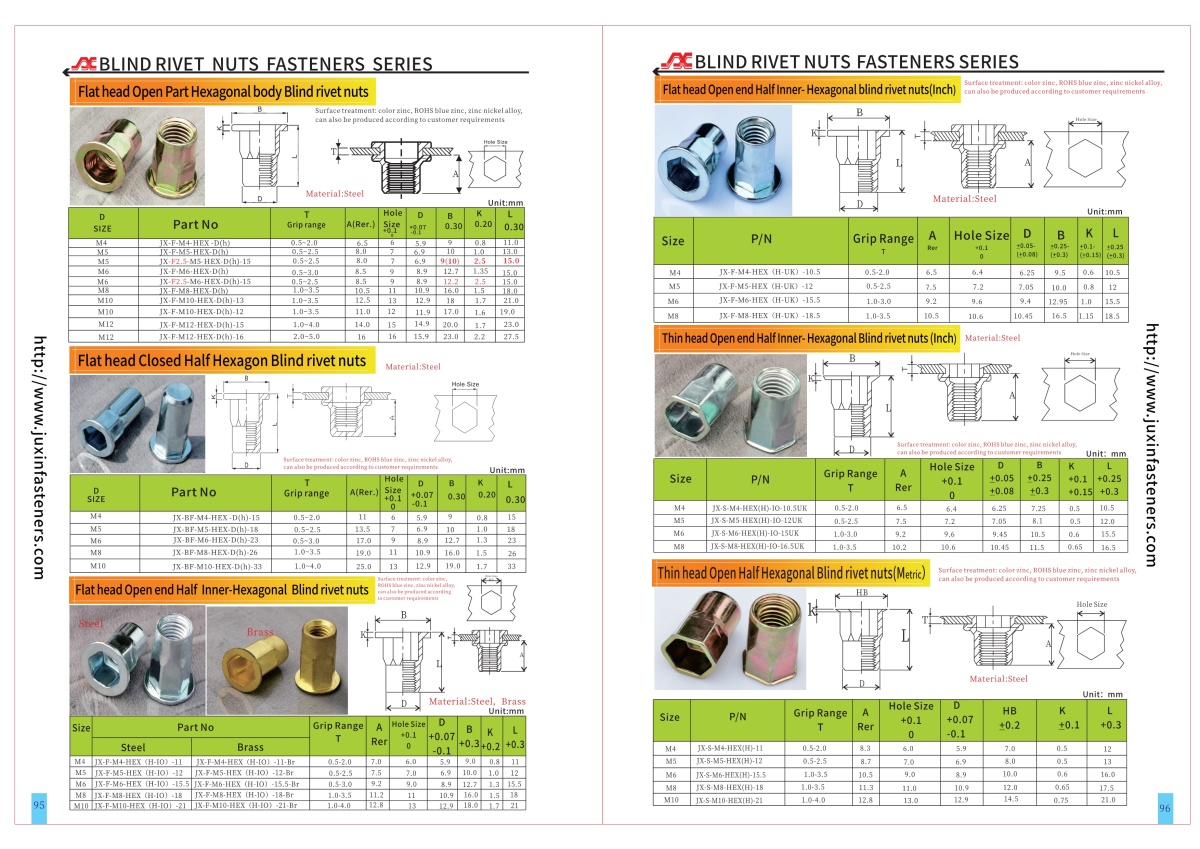
Thin Head Half-Hex Blind Rivet Nut Specifications
Standard Product Range
| Parameter | Specification |
|---|---|
| Product Type | Reduced Head Half-Hex Blind Rivet Nut |
| Material | Steel |
| Surface Finish | Blue Zinc |
| End Type | Open End |
| Body Geometry | Partial Hexagonal |
| Thread Sizes | M4, M5, M6, M8, M10 |
| Family Grip Range | 0.5–3.5 mm |
| Installation | One-Sided Mechanical Setting |
| Custom Sizes | Subject to Technical Review |
M8 Reference Dimensions
| Dimension | Value |
|---|---|
| Nominal Thread | M8 |
| Mounting Hole A/F | 10.6 mm |
| Hole Tolerance | +0.1 / −0.0 mm |
| Grip Range | 0.9–3.3 mm |
| Flange Thickness | 0.5 mm |
| Reported Flange Dimension | 11.5 mm A/F |
| Length Under Head | 15.5 mm |
| Finish | Cr(III) Clear-Passivated Zinc |
The flange geometry and all installation-hole dimensions must be confirmed against the approved technical drawing.
M8 Thin Head Half-Hex Rivet Nut: Detailed Engineering Dimensions
For engineers evaluating M8 fastening points in thin sheet metal assemblies, the following dimensions are provided for the documented M8 configuration.
| Engineering Parameter | M8 Specification |
|---|---|
| Thread Size | M8 |
| Material | Steel |
| Head Style | Thin Head |
| Body | Partial Hexagonal |
| End Type | Open |
| Surface Finish | Cr(III) Clear Passivation / Blue Zinc |
| Installation Hole | 10.6 mm Across Flats |
| Hole Tolerance | +0.1 / −0.0 mm |
| Grip Range | 0.9–3.3 mm |
| Flange Thickness | 0.5 mm |
| Flange Dimension | 11.5 mm A/F, as supplied |
| Body Length Under Head | 15.5 mm |
Important dimensional clarification: The supplied 11.5 mm flange dimension is identified as “A/F,” normally meaning across flats,
while the product is also described as having a flange diameter. These terms are not interchangeable. The approved drawing must confirm the actual flange geometry before machining or tooling release.
Why the M8 Mounting Hole Dimension Matters
A half-hex rivet nut is not intended to rely entirely on friction against the mounting hole.
The partial-hexagonal body must engage with the correctly formed hole profile.
For the documented M8 configuration, the nominal installation-hole dimension is 10.6 mm across flats, with a positive tolerance of 0.1 mm and no negative tolerance.
This means the specified across-flats dimension is 10.6–10.7 mm.
However, across-flats measurement alone does not fully define the required hole geometry. Corner dimensions, round-section clearance and hole orientation must also follow the approved drawing.
Excessive hole clearance may reduce resistance to rotation.
An undersized hole may prevent proper insertion or damage the rivet nut body during installation.
Why the M8 Grip Range Is 0.9–3.3 mm
The overall product family is described as covering 0.5–3.5 mm, but the supplied M8 configuration has a more specific grip range of 0.9–3.3 mm.
This distinction is important for OEM engineering.
A panel thickness that falls within the general product-family range may still be unsuitable for a particular insert size or barrel length.
For example, a 0.7 mm panel would fall below the stated minimum grip thickness for this M8 configuration.
Selecting the insert based only on the overall family range could therefore lead to an incorrect specification.
The actual panel thickness, material properties and installation conditions must be checked before final selection.
Understanding the 0.5 mm Flange Thickness
The documented M8 thin-head rivet nut has a flange thickness of 0.5 mm.
This provides a lower-profile mounting surface than many conventional flanged designs.
Nevertheless, a thin flange may provide less bearing area or different resistance to push-through forces than a larger or thicker flange.
Engineers should evaluate the required clamping force, panel material and flange support before replacing an existing flat-head rivet nut with a thin-head version.
Understanding the 15.5 mm Under-Head Length
The documented body length is measured from beneath the flange.
This dimension is useful when evaluating the available installation envelope.
However, the undeformed body length should not be confused with the installed protrusion behind the panel.
The final installed geometry depends on the setting process, grip thickness and insert design.
For assemblies containing electronic components, wiring or adjacent structural features, installed clearance should be verified using representative samples.
Thin Head Half-Hex Versus Standard Flat-Head Rivet Nuts
Selecting between thin-head and conventional flat-head rivet nuts requires more than comparing appearance.
| Selection Factor | Thin Head Half-Hex | Flat Head Half-Hex |
|---|---|---|
| Head Protrusion | Reduced | Generally Greater |
| Hole Geometry | Matching Partial-Hex | Matching Partial-Hex |
| Anti-Rotation Principle | Geometric Engagement | Geometric Engagement |
| Flange Bearing Area | Depends on Dimensions | Depends on Dimensions |
| Surface Clearance | Useful for Low-Profile Assemblies | More Head Clearance Required |
| Installation Access | One Side | One Side |
| Best Selection Basis | Clearance and Validated Joint Performance | Bearing Requirements and Validated Joint Performance |
Neither configuration should be considered universally stronger.
The appropriate choice depends on panel thickness, insert dimensions, installation conditions and mechanical performance requirements.
Industrial Applications
Communication Cabinets and Telecommunications Equipment
Communication cabinets often contain removable panels, electronic modules, support brackets and internal mounting structures.
Thin-head half-hex rivet nuts may be used where limited surface clearance and repeated screw removal are important.
Typical applications include:
Communication equipment housings
Network cabinet panels
Internal electronic module brackets
Cable management supports
Service access covers
Sheet metal equipment frames
Electrical Cabinets and Industrial Control Panels
Electrical enclosure manufacturers frequently require threaded fastening points in relatively thin metal panels.
Thin-head half-hex blind rivet nuts can provide removable fastening connections for internal mounting brackets, cover panels and mechanical accessories.
Electrical bonding or grounding performance must be evaluated separately. The presence of a metallic rivet nut does not automatically establish a qualified protective bonding path.
Data Center Equipment Enclosures
Potential applications include sheet metal components used in server cabinets, telecommunications racks, equipment housings and associated mounting accessories.
The reduced head may be useful where adjacent panels or components have limited clearance.
Actual suitability depends on mechanical loading and equipment-specific requirements.
Industrial Automation and Machinery
Automation equipment often includes removable protective covers, instrument brackets and sheet metal housings.
Half-hex rivet nuts provide threaded fastening points where conventional backing nuts would be difficult to access.
Electronics and Instrument Enclosures
Thin-head inserts may be considered for metal instrument housings, equipment covers and internal mechanical supports.
Designers should check screw protrusion, electrical clearances and installed insert dimensions.
HVAC and Mechanical Equipment
Potential uses include service panels, equipment covers, mounting brackets and fabricated metal housings.
Corrosion exposure, vibration and service conditions must be evaluated during product selection.
Engineering Selection: Six Factors That Determine Installation Reliability
1. Correct Mounting Hole Geometry
The mounting hole must match the partial-hex body profile.
A conventional round hole should not be assumed suitable.
The approved drawing must define all critical dimensions and tolerances.
2. Panel Thickness and Grip Range
Choose the specific insert configuration according to the actual panel thickness.
For the documented M8 version, the specified grip range is 0.9–3.3 mm.
3. Panel Material and Hardness
Steel, stainless steel and aluminum panels may respond differently during rivet nut installation.
Panel hardness, ductility and thickness affect the deformation and retention behavior of the installed insert.
4. Installation Stroke and Force
Incorrect setting parameters can result in insufficient deformation, damaged threads or panel distortion.
Setting parameters should be established through installation trials.
5. Screw Tightening Torque
The mating screw torque must be compatible with the installed insert and the complete joint.
A higher-strength screw does not automatically increase the load capacity of the rivet nut installation.
6. Environmental Conditions
Blue zinc plating provides corrosion protection through a zinc-based coating system.
Coating thickness, passivation and service exposure influence actual performance.
Outdoor or aggressive environments may require alternative protection systems.
How to Install Thin Head Half-Hex Blind Rivet Nuts
Verify the selected thread size and grip range.
Prepare the specified partial-hex mounting hole.
Inspect hole dimensions, burrs and panel condition.
Install the correct mandrel on the setting tool.
Engage the rivet nut with the tool mandrel.
Insert the rivet nut into the mounting hole.
Keep the setting tool perpendicular to the panel.
Apply the validated installation stroke or force.
Release the setting mandrel.
Inspect flange seating, thread integrity and mechanical retention.
For production applications, representative installation trials are recommended before finalizing process settings.
Mechanical Qualification for OEM Applications
JUXIN FASTENERS recommends evaluating the installed fastening system according to the actual application requirements.
Important performance characteristics include:
Spin-Out Torque: Resistance to rotation within the mounting hole.
Axial Pull-Out Resistance: Resistance to extraction from the parent material.
Push-Out Resistance: Resistance to displacement through the mounting hole.
Thread Integrity: Ability of the internal thread to function after setting.
Installation Repeatability: Consistency of deformation and retention across production samples.
Corrosion Resistance: Suitability of the specified coating system for the intended service environment.
Test methods and acceptance criteria should be defined by the customer or agreed during engineering review.
Materials, Threads and Surface Treatment
Steel Construction
The documented product is manufactured from steel.
Mechanical properties depend on the actual material specification and manufacturing process.
Blue Zinc Surface Finish
The supplied M8 example specifies a Cr(III) clear passivation system.
Trivalent chromium passivation is commonly used with zinc electroplating where hexavalent chromium restrictions must be addressed.
RoHS compliance should be supported by applicable material and coating documentation.
International Thread References
Relevant international metric thread standards include:
ISO 261 — General-purpose metric screw thread plan
ISO 724 — Basic metric thread dimensions
ISO 965 — Metric thread tolerances
For zinc electroplating, ISO 2081 and ASTM B633 may be relevant where specifically required by the customer.
These standards are references for engineering specification and do not imply automatic certification of the product.
Custom Thin Head Half-Hex Rivet Nuts for OEM Manufacturing
JUXIN FASTENERS can review drawing-defined blind rivet nut requirements for industrial applications.
Customization requests may include:
Special thread sizes
Modified flange dimensions
Alternative body lengths
Custom partial-hex geometry
Special grip ranges
Drawing-defined tolerances
Alternative zinc coating specifications
Customer-specific inspection requirements
Packaging and identification requirements
Manufacturing feasibility, minimum order quantities, tooling requirements and delivery schedules depend on the final specification.
OEM Procurement and RFQ Checklist
To obtain an accurate quotation, purchasing and engineering teams should provide:
Product drawing or reference part number
Thread size and tolerance
Material specification
Surface finish requirements
Mounting hole geometry
Panel thickness and material
Required mechanical performance
Estimated annual usage
Order quantities
Packaging requirements
Delivery destination
For an M8 application, please indicate whether the documented 10.6 mm across-flats mounting hole, 0.9–3.3 mm grip range and 0.5 mm flange thickness match your design.
This information helps reduce specification uncertainty and supports a more efficient technical review.
Request a Quotation from JUXIN FASTENERS
JUXIN FASTENERS provides industrial fastening and custom component solutions for OEM manufacturers, equipment designers and global procurement teams.
For thin-head half-hex blind rivet nuts, custom nutserts or drawing-based threaded insert requirements, please send your technical specifications and expected order quantities.
JUXIN FASTENERS
Email: info@juxinfasteners.com
Website: www.juxinfasteners.com
Contact: https://www.juxinfasteners.com/contact-us/
Product Packaging
Packaging and OEM Supply
Thin head half-hex blind rivet nuts are supplied with plastic inner-bag packaging and outer cartons. Palletized packaging can be arranged according to shipment requirements.
Reference Packaging Dimensions
| Packaging Type | Dimensions |
|---|---|
| Carton Option 1 | 29 × 19 × 19.5 cm |
| Carton Option 2 | 23.5 × 17.5 × 8 cm |
| Reference Pallet | 215 × 100 × 90 cm |
Actual packing quantities and carton selection depend on product size and order requirements.
Custom packaging, part-number identification, batch labeling and customer-specific shipment arrangements can be reviewed for OEM purchasing programs.
JUXIN FASTENERS
Email: info@juxinfasteners.com
Website: www.juxinfasteners.com
Product Pictures
Tags
Contact Us
Tel.:
+86 020 8621 0320
+86 020 3121 6067
E-mail:
Technical Support:
Navigation
SEND INQUIREY