Call Us
+86 136 6007 9809
Call Us
+86 136 6007 9809

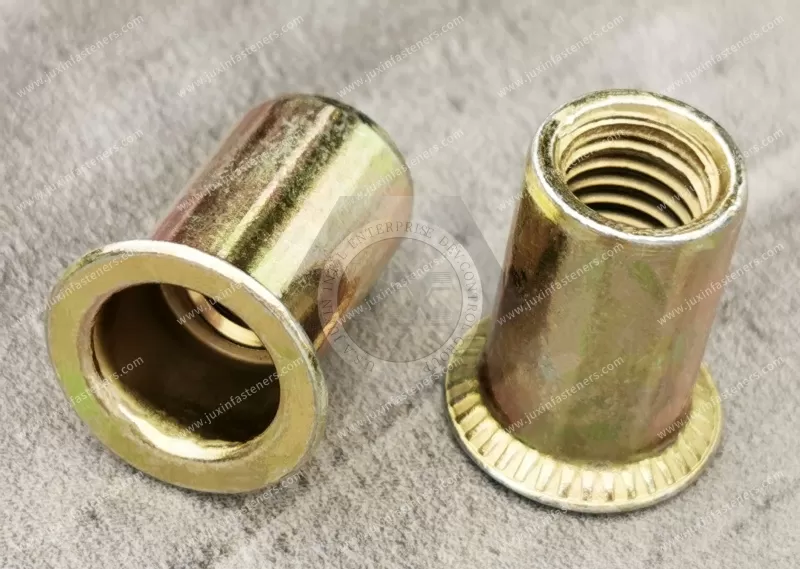
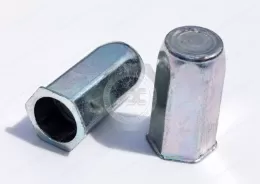
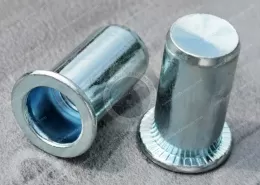
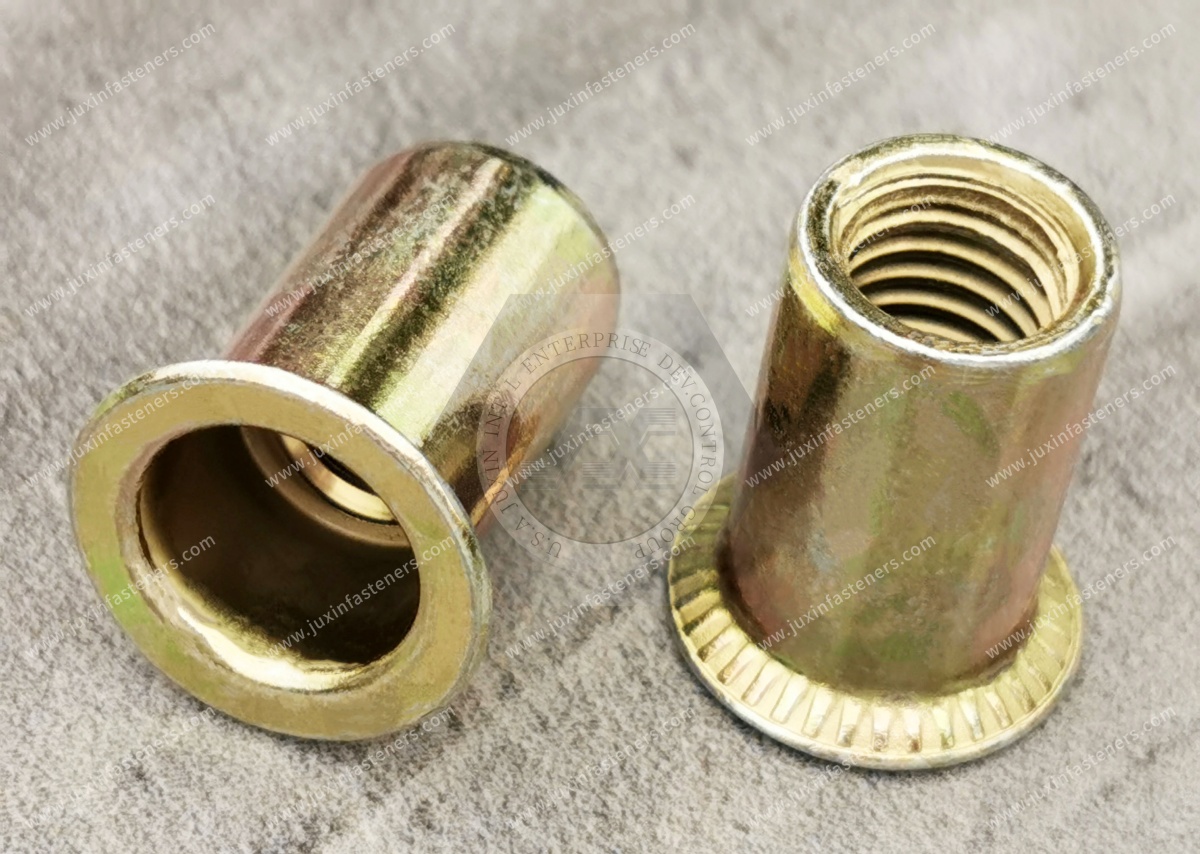
JUXIN FASTENERS manufactures color zinc-plated carbon steel blind rivet nuts with countersunk heads, open-end barrels, and smooth round bodies for creating internal threads in thin sheet metal, hollow sections, and industrial assemblies requiring one-sided installation.
The countersunk head allows flush or near-flush mounting in a correctly prepared countersunk hole. During installation, the smooth body deforms behind the panel, while the open-end barrel permits screw extension where backside clearance is available.
Product Features
Metric thread sizes: M3, M4, M5, M6, M8, M10
Inch-series threads: Custom OEM requirements subject to drawing review
Material: Carbon steel
Surface finish: Color zinc plating
Grip range: 0.5–5.0 mm (approx. 0.020–0.197 in) across the product family, depending on configuration
Head style: Countersunk head / Flush-mount design
Body style: Smooth round body
End style: Open end
Installation: One-sided blind installation
Typical applications include electrical enclosures, automotive brackets, machinery housings, equipment covers, transportation components, and OEM sheet-metal assemblies requiring reduced head projection.
Product Specification
Technical Specifications — Color Zinc Countersunk Steel Rivet Nuts
Standard Product Information
| Parameter | Specification |
|---|---|
| Product Name | Countersunk Open-End Smooth Body Steel Blind Rivet Nut |
| Material | Steel |
| Head Type | Countersunk |
| Body Type | Smooth Round Body |
| End Type | Open End |
| Surface Treatment | Color Zinc Plating |
| Metric Sizes | M3, M4, M5, M6, M8, M10 |
| Published Grip Range | 0.5–5.0 mm |
| Approximate Inch Range | 0.020–0.197 in |
| Installation | Blind, One-Sided |
| Thread System | ISO Metric |
| Custom Thread Options | Unified Inch Threads Subject to Review |
| Custom Dimensions | According to Approved Customer Drawing |
Standard Metric Thread Sizes
| Thread | Pitch (mm) | Nominal Diameter (in) |
|---|---|---|
| M3 × 0.5 | 0.50 | 0.1181 |
| M4 × 0.7 | 0.70 | 0.1575 |
| M5 × 0.8 | 0.80 | 0.1969 |
| M6 × 1.0 | 1.00 | 0.2362 |
| M8 × 1.25 | 1.25 | 0.3150 |
| M10 × 1.5 | 1.50 | 0.3937 |
Metric thread specifications may reference ISO 261, ISO 724, and ISO 965 as applicable.
The individual fastener drawing determines the actual thread tolerance, body dimensions, installation hole, and grip interval.
Unified Inch Thread Requirements
For North American OEM projects, JUXIN FASTENERS can review custom Unified inch-thread requirements.
| Inch Thread | Thread Type | Status |
|---|---|---|
| #4-40 | UNC | Custom inquiry |
| #6-32 | UNC | Custom inquiry |
| #8-32 | UNC | Custom inquiry |
| #10-24 | UNC | Custom inquiry |
| #10-32 | UNF | Custom inquiry |
| 1/4-20 | UNC | Custom inquiry |
| 5/16-18 | UNC | Custom inquiry |
| 3/8-16 | UNC | Custom inquiry |
Unified thread requirements should be defined according to ASME B1.1.
These inch-thread designations are sourcing options for engineering review, not confirmed stock sizes.
Mounting Hole and Countersink Requirements
The installation drawing should specify:
Pilot hole diameter and tolerance
Countersink included angle
Countersink major diameter
Countersink depth
Panel thickness
Remaining material beneath the countersink
Installed head height
Available backside clearance
Installation stroke or setting requirements
Do not select a mounting hole solely from the nominal thread diameter.
For example, an M6 rivet nut requires a mounting hole larger than the M6 internal thread diameter, but the exact hole size depends on the rivet nut body geometry.
The approved drawing is the controlling reference.
Grip Range and Panel Thickness
The published product-series grip range is 0.5–5.0 mm.
This corresponds approximately to 0.020–0.197 in.
The full range does not necessarily apply to every thread size or body length.
Individual grip intervals must be confirmed before ordering.
For countersunk applications, engineers must also consider the remaining effective panel thickness after countersinking.
Installation Instructions
Step 1 — Confirm Product Selection
Verify the thread size, grip range, body diameter, head geometry, and panel material.
Step 2 — Prepare the Mounting Hole
Drill or punch the hole according to the approved dimensional drawing.
Step 3 — Prepare the Countersink
Machine or form the countersink to the specified angle, diameter, and depth.
Step 4 — Inspect the Hole
Check for excessive burrs, deformation, and dimensional deviations.
Step 5 — Prepare the Setting Tool
Select a compatible manual, pneumatic, hydraulic, or automated rivet nut setting tool.
Confirm that the mandrel matches the internal thread.
Step 6 — Install the Rivet Nut
Insert the rivet nut into the prepared hole and keep the setting tool perpendicular to the panel.
Step 7 — Set the Fastener
Apply the approved installation stroke or force.
The unthreaded section of the rivet nut deforms behind the panel to create mechanical retention.
Step 8 — Inspect the Installation
Verify flange seating, backside deformation, internal thread integrity, and the installed head position.
Step 9 — Validate Retention
Perform spin-out, pull-out, push-out, or other tests according to the OEM qualification plan.
Engineering Comparison: Countersunk and Flat-Head Rivet Nuts
| Feature | Countersunk Head | Conventional Flat Head |
|---|---|---|
| Mounting Surface | Flush when correctly installed | Flange normally protrudes |
| Hole Preparation | Countersink required | Standard mounting hole |
| Panel Material Removal | Greater | Generally less |
| Installation Access | One side | One side |
| Head Bearing Support | Depends on countersink geometry | Depends on flange geometry |
| Appearance | Flush mounting interface | Visible raised flange |
| Mechanical Retention | Must be validated | Must be validated |
| Typical Selection Driver | Surface clearance | Simpler installation and flange support |
Corrosion and Surface Treatment
The specified product finish is color zinc plating.
For procurement and engineering approval, coating requirements should be defined by the applicable drawing or purchasing specification.
Potential reference standards include ASTM B633 and relevant ISO zinc electroplating specifications.
The approved coating specification should define the coating thickness, passivation system, corrosion test method, and acceptance criteria.
No specific salt spray duration or restricted-substance compliance should be assumed without supporting test documentation.
Engineering Quality Verification
Depending on the application, quality requirements may include:
Material identification
Thread inspection
Body diameter inspection
Countersunk head dimensions
Head angle verification
Overall length inspection
Grip range confirmation
Coating thickness inspection
Surface appearance
Spin-out torque testing
Axial pull-out testing
Push-out testing
Installed head height verification
Inspection methods and acceptance limits should be agreed before production approval.
Drawings, CAD and OEM Customization
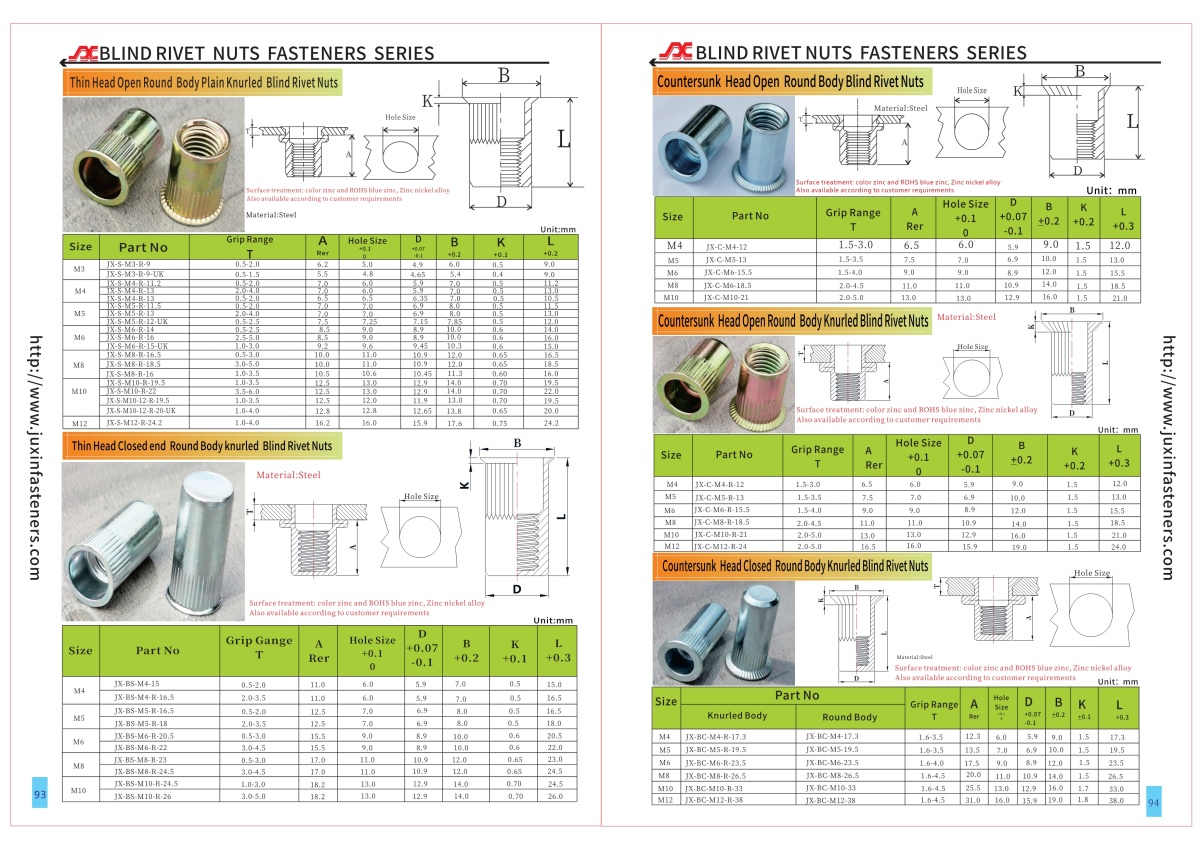
Detailed dimensional information should be verified against the corresponding product PDF and CAD drawings.
The existing product documentation references pages 93–94.
Custom dimensions, Unified inch threads, surface treatment requirements, and customer-specific installation configurations can be reviewed according to supplied drawings.
RFQ Information for OEM Buyers
To obtain an accurate quotation, please provide:
Thread size and thread system
Technical drawing or CAD model
Required order quantity
Estimated annual consumption
Panel material and thickness
Mounting hole diameter
Countersink angle and depth
Required grip range
Installation method
Surface treatment specification
Corrosion requirements
Mechanical performance requirements
Inspection and documentation requirements
Packaging requirements
Delivery destination
Engineering Advantages of Countersunk Rivet Nuts
Countersunk blind rivet nuts address an important limitation of conventional flat-head rivet nuts: flange protrusion.
A conventional flat-head rivet nut normally leaves its flange above the panel surface.
In some assemblies, this raised flange can interfere with:
Mating sheet metal panels
Sliding mechanisms
Close-fitting equipment covers
Internal mounting brackets
Flush decorative surfaces
Precision equipment interfaces
A countersunk rivet nut reduces this interference by seating the flange within a prepared recess.
However, countersunk installation requires more careful hole preparation.
The engineering trade-off is that material must be removed or formed to accommodate the countersunk head.
In thin panels, this may reduce the remaining material available to support the flange.
Consequently, countersunk rivet nuts should not automatically be considered stronger than flat-head designs.
Countersunk Versus Flat-Head Rivet Nuts
Countersunk Rivet Nuts
Best suited to applications requiring a flush mounting surface.
Advantages include reduced head protrusion and improved clearance for mating components.
Important design considerations include countersink angle, countersink depth, remaining panel thickness, and installed head height.
Flat-Head Rivet Nuts
Best suited to applications where flange protrusion is acceptable and a larger bearing surface may be beneficial.
A flat-head design generally requires less panel preparation because the mounting hole does not need to accommodate a countersunk flange.
Depending on the head geometry and installation material, a flat-head rivet nut may provide better resistance to certain push-through or pull-through loading conditions.
The final selection should be based on installation geometry and mechanical testing rather than appearance alone.
Why Countersink Geometry Matters
A countersunk rivet nut can meet its dimensional specifications and still perform poorly if the mounting hole is incorrectly prepared.
Three important engineering variables must be considered together.
1. Countersink Angle
The included angle of the countersink must match the fastener head.
Some countersunk fastener families use 90° or 100° designs, but the exact angle must be confirmed from the approved product drawing.
Thread system alone does not determine countersink angle.
2. Countersink Depth
An insufficient countersink depth may leave the flange above the panel.
An excessive countersink depth may allow the flange to sit below the intended mounting surface and reduce the material supporting the head.
3. Remaining Panel Thickness
The panel must retain enough material to support the installed rivet nut.
This is especially important for thin-gauge steel, aluminum sheet, and other materials susceptible to local deformation.
The correct design balances flush installation requirements with mechanical retention.
Smooth Body Versus Knurled Body
Smooth body rivet nuts and knurled body rivet nuts are not necessarily interchangeable.
A smooth body design relies on the mechanical deformation of the rivet nut and its engagement with the surrounding panel material.
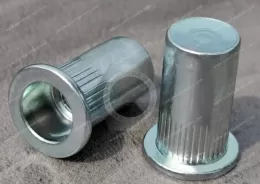
Knurled designs include external ribs or serrations that may increase resistance to rotation in compatible mounting materials.
For applications requiring high tightening torque, repeated service, or increased resistance to spin-out, engineers should compare both designs.
Relevant validation includes:
Spin-out torque
Axial pull-out resistance
Push-out resistance
Installation deformation
Hole tolerance sensitivity
Panel damage
Repeated screw installation performance
For critical assemblies, testing should be conducted using the actual production panel material and installation equipment.
Color Zinc Surface Treatment for Industrial Sourcing
Color zinc plating is commonly specified for steel fasteners requiring sacrificial corrosion protection and a distinctive conversion-coating appearance.
The appearance may range from yellow to iridescent tones depending on the coating process.
However, coating color should not be used as the sole method of defining corrosion resistance or environmental compliance.
For OEM sourcing, the coating specification should identify:
Base steel material
Zinc coating thickness
Passivation type
Required corrosion resistance
Applicable restricted-substance requirements
Appearance requirements
Inspection and acceptance criteria
ASTM B633 or an applicable ISO electroplating specification may be used as a reference where required by the customer.
RoHS and REACH requirements should be confirmed through the relevant coating documentation rather than inferred from the finish color.
Industrial Applications
Automotive and Commercial Vehicle Assemblies
Potential applications include interior mounting brackets, access panels, electrical equipment supports, and removable sheet metal components.
Countersunk inserts are useful where protruding flanges would interfere with adjacent parts.
Electrical Enclosures and Control Cabinets
Flush-mount rivet nuts can provide reusable fastening points for removable covers, internal support panels, and equipment mounting interfaces.
Electrical continuity, insulation, and enclosure sealing must be addressed separately where required.
Industrial Machinery
Countersunk blind rivet nuts can be considered for equipment guards, fabricated housings, machine covers, and maintenance access panels.
HVAC and Appliance Manufacturing
These threaded inserts can support removable panels, equipment housings, and selected sheet metal assemblies.
Railway and Transportation Interiors
Potential uses include non-structural interior panels, removable equipment covers, and fabricated support components.
Application-specific engineering qualification remains necessary.
Metal Furniture and Fabricated Fixtures
Countersunk rivet nuts may be used where a flush mounting interface improves appearance or component fit.
OEM Engineering and Supplier Development
For engineers, the primary selection factors are countersink geometry, installation hole tolerance, panel thickness, mechanical retention, and mating screw engagement.
For procurement managers and supplier development teams, important sourcing requirements include dimensional consistency,
approved surface treatment, production repeatability, traceability, inspection documentation, and order volume.
JUXIN FASTENERS supports drawing-based inquiries for metric and customer-specific threaded insert requirements.
Request a Quotation
For color zinc countersunk steel rivet nuts, custom blind threaded inserts, and industrial OEM sourcing, please send your technical requirements to JUXIN FASTENERS.
Include your drawing, thread size, grip range, countersink dimensions, coating specification, order quantity, and annual demand forecast.
JUXIN FASTENERS
Email: info@juxinfasteners.com
Website: www.juxinfasteners.com
Contact: https://www.juxinfasteners.com/contact-us/
Product Packaging
Industrial Packaging and OEM Supply Requirements
Standard Export Packaging
JUXIN FASTENERS provides protective export packaging for countersunk steel blind rivet nuts.
Standard packaging arrangements can include plastic inner bags, reinforced outer cartons, and palletized shipments according to order quantity and transportation requirements.
Packaging is selected to help protect threaded components and plated surfaces during handling, storage, and international transportation.
Packaging Options
Plastic bag inner packaging
Reinforced export cartons
Moisture-resistant protection where required
Product identification labels
Batch and quantity identification
Palletized shipping configurations
Customer-specific packaging arrangements
OEM Customized Packaging
Packaging requirements can be reviewed according to the customer's purchasing specifications, including:
Customer part numbers
Private labeling
Barcode identification
Specified packing quantities
Customized carton dimensions
Pallet configuration
Batch traceability
Special shipping identification
Final packaging quantities, dimensions, and shipment arrangements are confirmed during order review.
Supply Chain and Procurement Support
For industrial purchasing programs, JUXIN FASTENERS can review annual demand forecasts, delivery schedules, customer-specific labeling, inspection requirements, and documentation needs.
Customized packaging may affect order cost and production lead time.
Request Packaging and Commercial Information
For OEM purchasing, custom rivet nuts, bulk quantities, or packaging requirements, contact:
JUXIN FASTENERS
Email: info@juxinfasteners.com
Website: www.juxinfasteners.com
Contact: https://www.juxinfasteners.com/contact-us/
Product Pictures
Tags
Contact Us
Tel.:
+86 020 8621 0320
+86 020 3121 6067
E-mail:
Technical Support:
Navigation
SEND INQUIREY