Call Us
+86 136 6007 9809
Call Us
+86 136 6007 9809

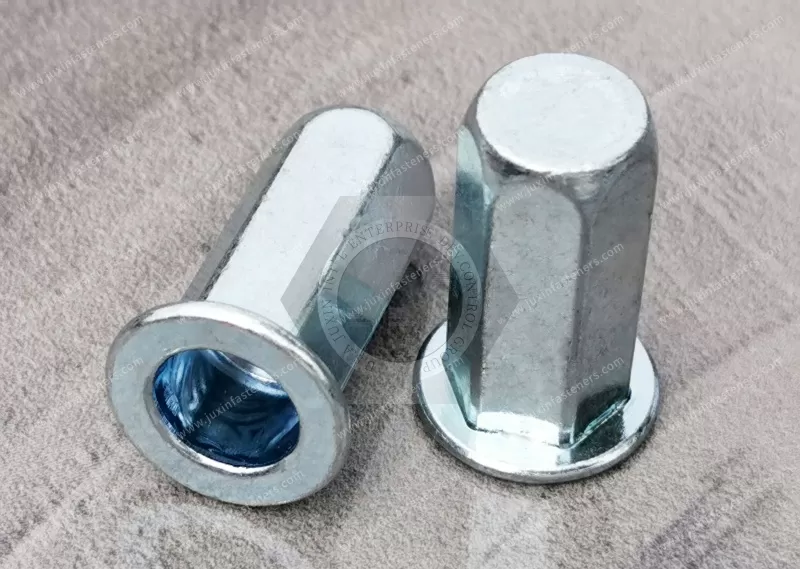
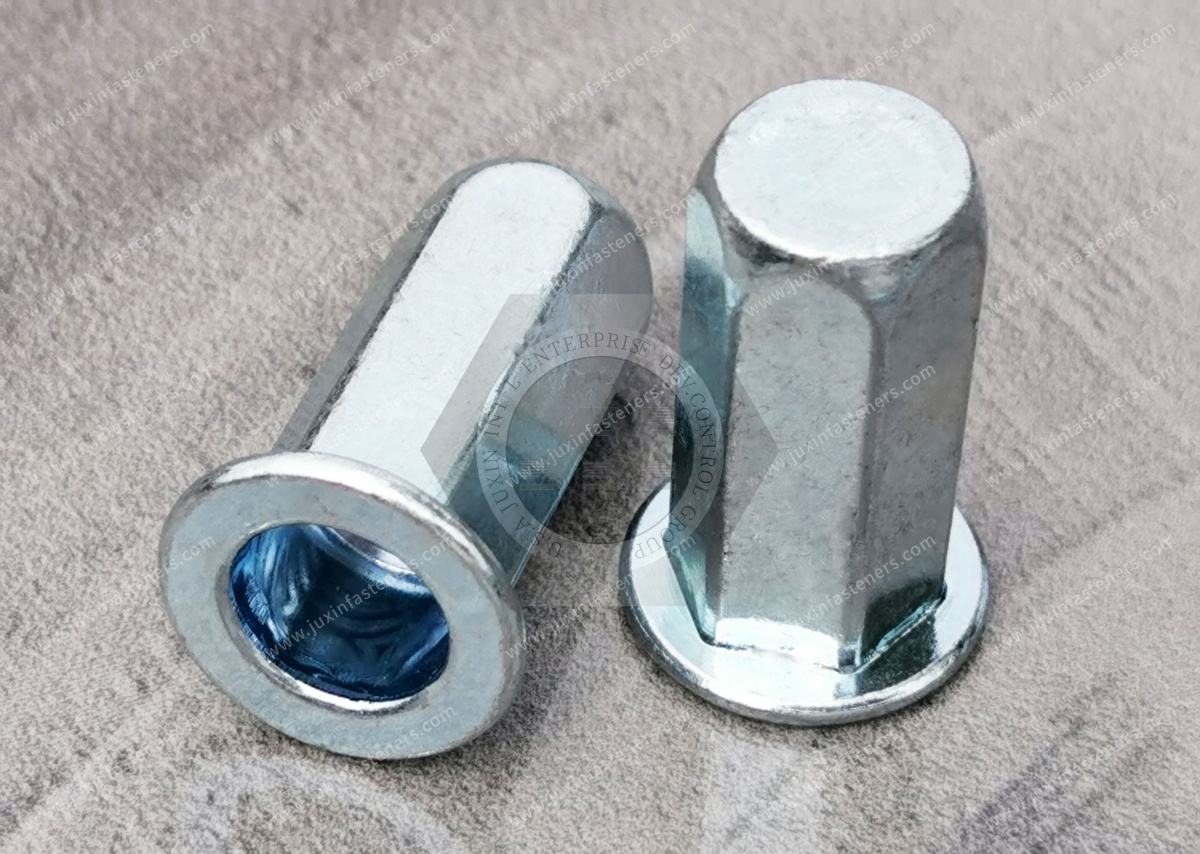
JUXIN FASTENERS manufactures flat head, closed-end full-hex steel blind rivet nuts with blue zinc plating for creating reusable internal threads in thin sheet metal, hollow sections, and OEM assemblies requiring one-sided installation.
The full hexagonal body engages with a matching hexagonal mounting hole to help resist insert rotation. The large flat flange provides a wider bearing surface, while the closed-end barrel encloses the threaded cavity and prevents screws from passing through the insert end.
Product Features
Metric threads: M4, M5, M6, M8, M10, M12
Inch-series threads: Custom OEM requirements subject to drawing review
Material: Steel
Finish: Blue zinc plating
Grip range: 0.5–5.0 mm (approx. 0.020–0.197 in), depending on size
Head: Flat head / Large flange
Body: Full hexagonal
End: Closed end
Installation: One-sided, matching hexagonal hole
Applications include electrical cabinets, industrial enclosures, machinery housings, fabricated sheet-metal structures, and OEM equipment requiring enclosed threaded inserts.
Product Specification
Technical Specifications – Flat Head Closed-End Full-Hex Blind Rivet Nuts
1. General Technical Specifications
| Parameter | Specification |
|---|---|
| Product | Flat Head Closed-End Full-Hex Blind Rivet Nuts |
| Product Type | Blind Threaded Insert / Hex Nutsert |
| Thread Sizes | M4, M5, M6, M8, M10, M12 |
| Material | Steel |
| Standard Surface Finish | RoHS Blue Zinc |
| Grip Range | 0.5–5.0 mm |
| Head Configuration | Flat Head / Large Flange |
| Body Geometry | Full Hexagonal |
| End Configuration | Closed End |
| Installation Method | Blind / Single-Sided |
| Installation Hole | Matching Hexagonal Hole |
| Thread System | ISO Metric |
| Installation Equipment | Compatible Threaded-Mandrel Rivet Nut Setting Tools |
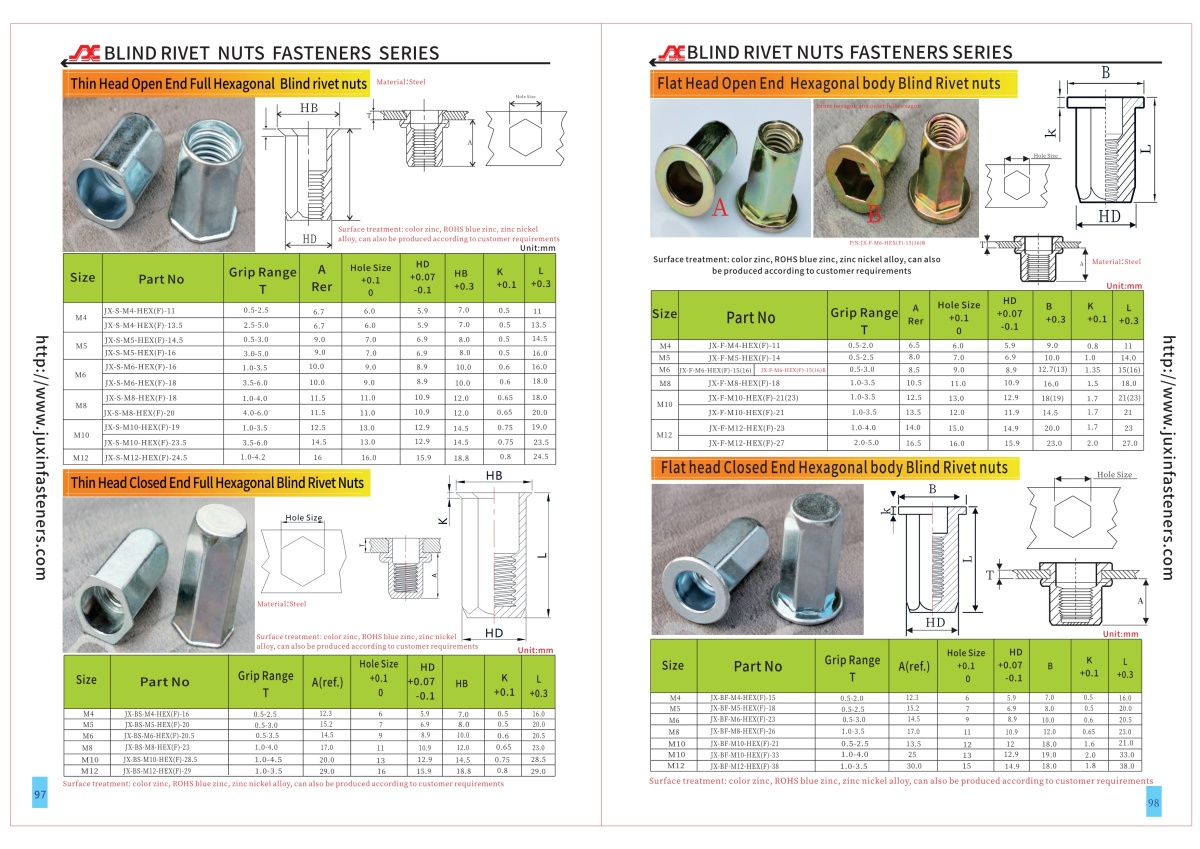
| Technical Reference | PDF Catalogue, Pages 97–98 |
| Special Designs | Subject to OEM Drawing Review |
The supplied grip range applies to the product series. Individual grip ranges and installation dimensions must be verified using the relevant size-specific drawing.
2. Metric Thread Specifications
| Nominal Thread | ISO Metric Coarse Pitch |
|---|---|
| M4 | 0.7 mm |
| M5 | 0.8 mm |
| M6 | 1.0 mm |
| M8 | 1.25 mm |
| M10 | 1.5 mm |
| M12 | 1.75 mm |
The thread pitches shown are ISO metric coarse-thread references. Final thread pitch and tolerance class must match the approved product drawing.
Relevant international references include:
ISO 261 — ISO General-Purpose Metric Screw Threads
ISO 965 — Tolerances for ISO Metric Screw Threads
ISO 4042 — Electroplated Coating Systems for Fasteners
ASTM B117 — Standard Practice for Operating Salt Spray Apparatus
Compliance with a particular standard must be confirmed against the ordered product specification and available documentation.
3. Full-Hexagonal Body Design
The full hexagonal body provides positive mechanical engagement with a matching hexagonal installation hole.
Anti-Rotation Performance
A correctly installed full-hex blind rivet nut resists rotation through geometric engagement with the workpiece.
This design can provide advantages over conventional round-body inserts in applications where resistance to torque-induced spinning is important.
Factors affecting torque-to-turn performance include:
Hexagonal body dimensions
Installation-hole across-flats dimensions
Hole manufacturing tolerances
Panel thickness
Workpiece material strength
Insert setting conditions
Installed deformation
Bolt tightening torque
Full-hex geometry does not eliminate the need to validate torque-to-turn performance for the actual joint.
Applications Requiring Anti-Rotation Resistance
Typical examples include removable equipment panels, electrical cabinet brackets, machine covers, and threaded connections requiring periodic servicing.
4. Closed-End Construction and Contamination Protection
The closed-end design incorporates an enclosed bottom rather than a through-hole.
This provides a physical barrier against direct contamination entering the threaded cavity from the rear of the insert.
Main Functional Advantages
Protects the threaded cavity from direct backside exposure.
Reduces the possibility of contamination entering through the insert bottom.
Limits available bolt penetration depth.
Provides an alternative to open-end rivet nuts in selected protected-thread applications.
Supports fastening designs where rear-side contamination is a concern.
Watertight and Airtight Applications
Closed-end rivet nuts may be considered for equipment requiring resistance to moisture or contamination, including electrical enclosures, HVAC housings, and industrial containers.
However, a closed-end insert alone does not guarantee a watertight or airtight joint.
Potential leakage paths include:
The interface between the flange and the workpiece
Gaps around the installation hole
Surface irregularities
Coating defects
Incorrect installation deformation
For sealing-critical applications, engineers should evaluate an appropriate under-head gasket or sealant and validate the completed assembly against the required leakage or ingress-protection criteria.
Where applicable, IEC 60529 may be used as a reference for enclosure ingress-protection testing.
5. Flat Head and Large-Flange Configuration
The flat-head configuration provides a bearing surface around the installation hole.
Compared with reduced-head designs, a larger flange may provide greater contact area and improve load distribution in suitable materials.
Engineering Advantages
Increased bearing contact area
Support around the installation opening
Improved local load distribution
Reduced risk of local flange pull-through under suitable loading conditions
Suitable configuration for selected load-bearing threaded connections
The flange must be fully seated against the mounting surface after installation.
Flat Head vs. Countersunk Head
Flat-head large-flange rivet nuts normally sit above the workpiece surface.
Countersunk rivet nuts require a corresponding countersunk hole and are selected where a recessed head is required.
These designs should not be treated as dimensionally interchangeable.
6. Grip Range and Workpiece Thickness
Product Family Grip Range: 0.5–5.0 mm
The grip range refers to the workpiece thickness over which a specific rivet nut is designed to deform and retain correctly.
Important Selection Factors
Engineers should verify:
Nominal workpiece thickness
Thickness tolerance
Coating thickness
Material hardness
Workpiece strength
Insert body length
Required backside clearance
Installation setting stroke
Multiple-Sheet Assemblies
Where the insert is used to clamp or retain multiple sheets, the combined thickness and stack-up tolerances must fall within the approved grip range.
Thin Sheet Materials
Selected configurations may be suitable for material thicknesses starting at 0.5 mm.
However, suitability depends on the exact rivet nut size, panel material, and installation conditions.
7. Installation-Hole Requirements
Full-hex blind rivet nuts require a corresponding hexagonal mounting hole.
Critical Hole Dimensions
Across-flats dimension
Across-corners clearance
Hole tolerance
Panel thickness
Hole edge condition
Edge distance
Hole alignment
The correct hole size must be obtained from the product-specific technical drawing.
Hexagonal Hole Production
Depending on the workpiece and production process, hexagonal holes may be manufactured through:
Punching
Broaching
CNC machining
Dedicated hexagonal hole-forming equipment
For certain applications, compatible hole-forming tools may allow a prepared round hole to be converted into a hexagonal opening.
Tool compatibility and dimensional requirements must be confirmed before production.
8. Installation Method and Setting Process
Closed-end full-hex rivet nuts are installed using compatible threaded-mandrel setting equipment.
The installation tool engages the internal thread of the rivet nut and applies axial pulling force.
This causes the designated deformable section of the rivet nut body to collapse behind the workpiece, creating mechanical retention.
Recommended Installation Procedure
Step 1 — Confirm Product Selection
Verify the thread size, grip range, body dimensions, and approved drawing.
Step 2 — Prepare the Mounting Hole
Produce the required hexagonal installation hole and remove excessive burrs.
Step 3 — Check Panel Thickness
Confirm that the workpiece thickness is within the specified grip range.
Step 4 — Engage the Setting Tool
Thread the compatible mandrel into the rivet nut.
Step 5 — Insert the Rivet Nut
Position the hexagonal body in the matching hole with the flange seated against the panel.
Step 6 — Apply Setting Force
Operate the installation tool using the approved setting stroke or force.
Step 7 — Release the Tool
Unthread the mandrel without damaging the installed insert.
Step 8 — Inspect the Installed Connection
Check flange seating, backside deformation, thread condition, and insert alignment.
Step 9 — Verify Mechanical Performance
Where required, perform torque-to-turn, pull-out, push-out, or application-specific tests.
9. Closed-End Bolt Length Selection
Unlike open-end rivet nuts, closed-end inserts have a limited internal depth.
The mating bolt must not bottom against the closed end before the joint reaches its intended clamping condition.
Important Engineering Checks
Available internal thread depth
Required thread engagement
Bolt length
Joint stack thickness
Washer thickness
Installation tolerances
Available internal clearance
Why Bolt Length Matters
An excessively long bolt may contact the closed bottom before properly clamping the assembled components.
This can create misleading tightening resistance, damage the insert, or prevent the joint from achieving the intended clamp load.
Engineers should confirm the allowable bolt penetration using the approved product drawing.
10. Steel Material and Blue Zinc Surface Finish
Base Material
Steel provides mechanical strength for industrial threaded fastening applications.
The exact steel grade and mechanical properties should be confirmed according to the ordered product specification.
Standard Surface Finish
RoHS Blue Zinc
The product is specified with a blue zinc-plated finish.
The zinc coating provides sacrificial corrosion protection to the steel substrate.
Actual corrosion resistance depends on:
Zinc coating thickness
Passivation system
Coating quality
Exposure environment
Surface damage
Storage and handling conditions
RoHS Compliance
Where RoHS compliance is required, the relevant plating and passivation documentation should be confirmed for the supplied product.
ASTM B117 Corrosion Testing
ASTM B117 may be used to evaluate coating performance under controlled salt-spray exposure.
A specific salt-spray duration or red-rust resistance rating should only be stated when supported by the applicable coating specification and test results.
Alternative Materials and Finishes
Depending on engineering requirements, alternative configurations may be reviewed, including:
A2 stainless steel
A4 stainless steel
Aluminum
Alternative zinc-plated finishes
Customer-specified protective coatings
These are potential material and finish options, not confirmed stock specifications for the displayed steel product.
11. Mechanical Performance Considerations
Torque-to-Turn Resistance
Measures the resistance of the installed insert to rotation within the workpiece.
Pull-Out Resistance
Measures resistance to axial extraction of the installed insert.
Push-Out Resistance
Evaluates resistance to displacement under loading in the relevant direction.
Thread Strength
Depends on the insert material, thread geometry, thread engagement, and mating bolt specification.
Joint Reliability
The final connection performance depends on the complete assembly, not only the rivet nut.
Engineering validation should consider:
Bolt strength
Insert strength
Panel strength
Hole dimensions
Setting conditions
Clamp load
Service vibration
Corrosion exposure
Maintenance requirements
12. Industrial Application Solutions
Electrical Cabinets and Switchgear
Closed-end full-hex rivet nuts can provide protected threaded fastening points for:
Internal mounting rails
Equipment brackets
Removable panels
Component supports
Service-access covers
Where enclosure ingress protection is required, sealing performance must be validated at the assembly level.
Telecommunications Equipment
The combination of anti-rotation geometry and one-sided installation can support fastening in confined metal cabinets and equipment housings.
HVAC Equipment
Potential applications include equipment panels, brackets, and selected housings where backside access is limited.
Industrial Containers and Tanks
Closed-end rivet nuts may be considered for selected container or tank fastening points.
For pressure-retaining, liquid-containing, or safety-critical applications, additional sealing, structural analysis, and validation are essential.
Industrial Machinery
Full-hex inserts provide reusable threaded fastening points for covers, brackets, and maintenance-access components.
Transportation Equipment
The design may be evaluated for fabricated panels, equipment housings, and non-critical mounting applications where vibration and repeated maintenance are relevant.
13. Open-End vs. Closed-End Blind Rivet Nuts
| Feature | Open-End | Closed-End |
|---|---|---|
| Internal Thread | Through-Opening | Enclosed Bottom |
| Bolt Penetration | May Extend Through | Limited by Internal Depth |
| Rear Contamination Barrier | No Enclosed Bottom | Enclosed Bottom |
| Single-Sided Installation | Yes | Yes |
| Anti-Rotation | Depends on Body Design | Depends on Body Design |
| Sealing Requirement | Additional Design Needed | Additional Design May Still Be Needed |
| Typical Selection | General Threaded Fastening | Protected-Thread Applications |
For applications requiring protection against moisture, dirt, or fluid ingress, closed-end inserts may offer advantages over open-end configurations.
However, the complete fastening interface must still be evaluated.
14. Full-Hex vs. Round-Body Rivet Nuts
Full-Hex Body
The full-hex body engages mechanically with the corresponding hole, providing resistance to rotation.
Round Body
Round-body rivet nuts are installed in circular holes and may be more convenient where standard drilling operations are preferred.
Selection Guidance
Full-hex designs are particularly relevant where:
High torque-to-turn resistance is required.
Repeated bolt removal is expected.
The workpiece can accommodate a hexagonal hole.
Mechanical anti-rotation engagement is a priority.
Round-body designs may be preferred where manufacturing simplicity or circular-hole compatibility is more important.
15. OEM Customization and Drawing-Based Supply
JUXIN FASTENERS can review special requirements for:
Custom metric or imperial threads
Special grip ranges
Modified body lengths
Different flange dimensions
Alternative hexagonal body geometry
Special closed-end depths
Alternative materials
Customer-specific surface finishes
Sealing-related design requirements
Custom inspection criteria
OEM packaging and labeling
Non-standard configurations are subject to technical review, manufacturing feasibility, tooling requirements, and minimum order quantities.
16. Technical Drawings and CAD Reference
Product Catalogue: PDF Pages 97–98
Please refer to the corresponding detailed specification sheet and available CAD drawings for exact dimensions.
The following information should be confirmed:
Thread size and pitch
Flange diameter
Flange thickness
Body length
Hexagonal across-flats dimension
Installation-hole dimensions
Grip range
Closed-end internal depth
Dimensional tolerances
Customers may submit PDF drawings, 2D engineering drawings, or 3D CAD files for review.
17. OEM Purchasing and RFQ Checklist
| RFQ Information | Customer Requirement |
|---|---|
| Product | Flat Head Closed-End Full-Hex Blind Rivet Nuts |
| Thread Size | M4–M12 |
| Material | Steel or Specified Alternative |
| Surface Finish | RoHS Blue Zinc |
| Grip Range | Required Workpiece Thickness |
| Installation Hole | Hexagonal Dimensions |
| Closed-End Depth | Required Bolt Clearance |
| Mechanical Requirements | Torque-to-Turn / Pull-Out / Push-Out |
| Environmental Requirements | Corrosion / Sealing / Temperature |
| Technical Drawing | PDF / 2D / 3D CAD |
| Purchase Quantity | Required Order Volume |
| Annual Forecast | Estimated Annual Demand |
| Packaging | Standard or OEM-Specific |
Key Product Features and Benefits
Full-Hex Anti-Rotation Design
The hexagonal body mechanically engages with a corresponding hexagonal hole, providing resistance to unwanted rotation during assembly and servicing.
This is particularly valuable for applications requiring repeated bolt installation and removal.
Closed-End Thread Protection
The closed bottom prevents direct passage through the rear of the threaded insert, helping protect the threaded cavity from contamination originating behind the workpiece.
For applications requiring a watertight or airtight joint, an appropriate under-head sealing system and validated installation conditions are necessary.
Reliable Internal Threads in Thin Materials
The rivet nut provides a steel female thread in materials that may be too thin for conventional thread tapping.
Large-Flange Bearing Support
The flat flange increases the bearing contact area against the workpiece and helps distribute local loads around the mounting hole.
Single-Sided Installation
The rivet nut can be installed entirely from the accessible side of a workpiece without requiring a separate backing nut.
Blue Zinc-Plated Steel
The steel construction provides mechanical strength, while the blue zinc finish offers corrosion protection according to the specified plating and passivation system.
OEM Customization
Special thread dimensions, body lengths, grip ranges, surface finishes, and drawing-based configurations can be reviewed according to customer requirements.
Typical Industrial Applications
Electrical cabinets and switchgear enclosures
Telecommunications cabinets and control panels
Industrial equipment housings
Sheet-metal fabrication assemblies
HVAC equipment panels
Machinery covers and mounting brackets
Transportation equipment enclosures
Tubular steel assemblies
Service-access panels
Industrial containers and selected equipment housings
Engineering and Procurement Support
JUXIN FASTENERS supports design engineers, purchasing managers, OEM sourcing teams, and supplier development professionals in selecting suitable threaded fastening components.
Important selection criteria include thread size, grip range, installation-hole geometry, torque-to-turn resistance, pull-out performance, corrosion protection, and any required environmental sealing.
Our focus is not simply supplying fasteners, but helping customers solve engineering and sourcing challenges through appropriate product selection, clear technical communication, and dependable service.
Request a Quotation
For standard or custom closed-end full-hex blind rivet nuts, please provide:
Required thread size
Workpiece material and thickness
Installation-hole dimensions
Required mechanical performance
Surface finish
Technical drawing or CAD file
Estimated order quantity
Annual purchasing forecast
Email: info@juxinfasteners.com
Website: www.juxinfasteners.com
JUXIN FASTENERS — Industrial Fastening and Custom Component Solutions.
Product Packaging
Product Packaging – Closed-End Full-Hex Blind Rivet Nuts
Standard Industrial Packaging
JUXIN FASTENERS provides industrial packaging for closed-end full-hex blind rivet nuts to support OEM purchasing, bulk shipment, warehouse storage, and industrial distribution.
The standard packaging system consists of plastic inner bags, outer cartons, and pallet arrangements for larger shipments.
Packaging quantities and configurations can be adjusted according to product dimensions, thread sizes, shipment quantities, and customer requirements.
1. Inner Packaging – Plastic Bags
The standard inner packaging consists of plastic bags.
Blind rivet nuts are packed according to the confirmed order quantity and packaging requirements.
Inner Packaging Options
Standard plastic bag packaging
Separate packaging by thread size
Separate packaging by product type
Customer-defined quantities per bag
Batch identification where required
OEM part-number identification
Special packaging instructions upon request
Inner Packaging Label Information
Where required, inner bag labels may include:
Product name
Thread size
Material
Surface finish
Product part number
Quantity
Batch or lot number
The number of pieces per bag is confirmed according to product size, weight, and order requirements.
2. Outer Packaging – Cartons
Plastic-bagged products are packed into outer cartons.
Standard Carton Dimensions
| Carton Type | Dimensions |
|---|---|
| Carton A | 29 × 19 × 19.5 cm |
| Carton B | 23.5 × 17.5 × 8 cm |
Carton selection depends on the thread size, product dimensions, quantity, and shipment weight.
Final pieces per carton, net weight, and gross weight are confirmed for each order.
Carton Labeling
Customer-specific labels may include:
Product description
Thread size
Material
Surface treatment
Customer part number
Purchase order number
Quantity per carton
Net weight
Gross weight
Batch or lot identification
Shipping marks
3. Pallet Packaging
For bulk orders, cartons may be arranged on pallets for consolidated transportation and warehouse handling.
Provided Pallet Dimensions: 215 × 100 × 90 cm
The final pallet configuration depends on carton quantities, total weight, shipping requirements, and customer instructions.
Pallet Information
Where required, pallet identification may include:
Product name
Purchase order number
Number of cartons
Total quantity
Gross weight
Pallet dimensions
Customer shipping marks
Destination information
4. OEM Customized Packaging
JUXIN FASTENERS can review packaging requirements for OEM manufacturers, industrial distributors, and global purchasing programs.
Available packaging arrangements for review include:
Custom pieces per plastic bag
Customer-defined carton quantities
Special carton dimensions
OEM part-number labels
Barcode labeling
Batch and lot identification
Warehouse receiving labels
Custom shipping marks
Customer-specific pallet arrangements
Special handling instructions
Customized packaging is confirmed during quotation and order processing.
5. Packaging Protection for Blue Zinc-Plated Steel
Closed-end full-hex blind rivet nuts with blue zinc plating should be handled and stored under appropriate conditions to help protect the plated surface.
Recommended Storage and Handling
Store products in a clean, dry environment.
Avoid prolonged moisture exposure.
Prevent unnecessary abrasion of plated surfaces.
Keep products away from corrosive substances.
Avoid excessive carton stacking loads.
Maintain clear identification between thread sizes.
Inspect packaging condition before storage or shipment.
Additional protective packaging can be reviewed where special transportation or storage conditions apply.
6. Standard Packaging Summary
| Packaging Parameter | Specification |
|---|---|
| Product | Closed-End Full-Hex Blind Rivet Nuts |
| Thread Sizes | M4, M5, M6, M8, M10, M12 |
| Material | Steel |
| Surface Finish | RoHS Blue Zinc |
| Inner Packaging | Plastic Bags |
| Outer Packaging | Cartons |
| Carton A | 29 × 19 × 19.5 cm |
| Carton B | 23.5 × 17.5 × 8 cm |
| Pallet Dimensions | 215 × 100 × 90 cm |
| Quantity per Bag | According to Confirmed Order |
| Quantity per Carton | According to Confirmed Order |
| Custom Packaging | Subject to Customer Requirements |
7. Bulk Packaging and OEM Shipment Inquiries
For bulk orders, OEM packaging, custom labeling, and industrial shipment requirements, please contact JUXIN FASTENERS.
Please provide the required thread sizes, quantities, destination, and any special packaging or labeling instructions.
Email: info@juxinfasteners.com
Website: www.juxinfasteners.com
JUXIN FASTENERS — Industrial Fastening and Custom Component Solutions.
Product Pictures
Tags
Contact Us
Tel.:
+86 020 8621 0320
+86 020 3121 6067
E-mail:
Technical Support:
Navigation
SEND INQUIREY