Call Us
+86 136 6007 9809
Call Us
+86 136 6007 9809

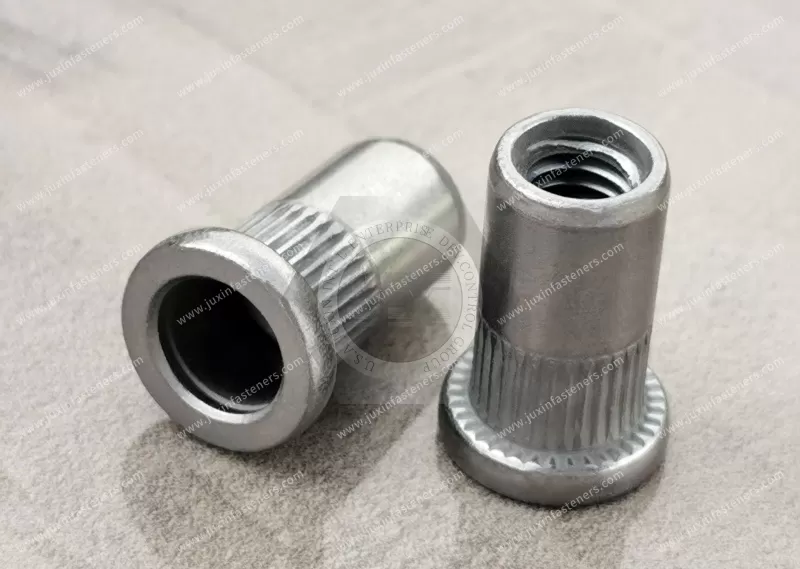
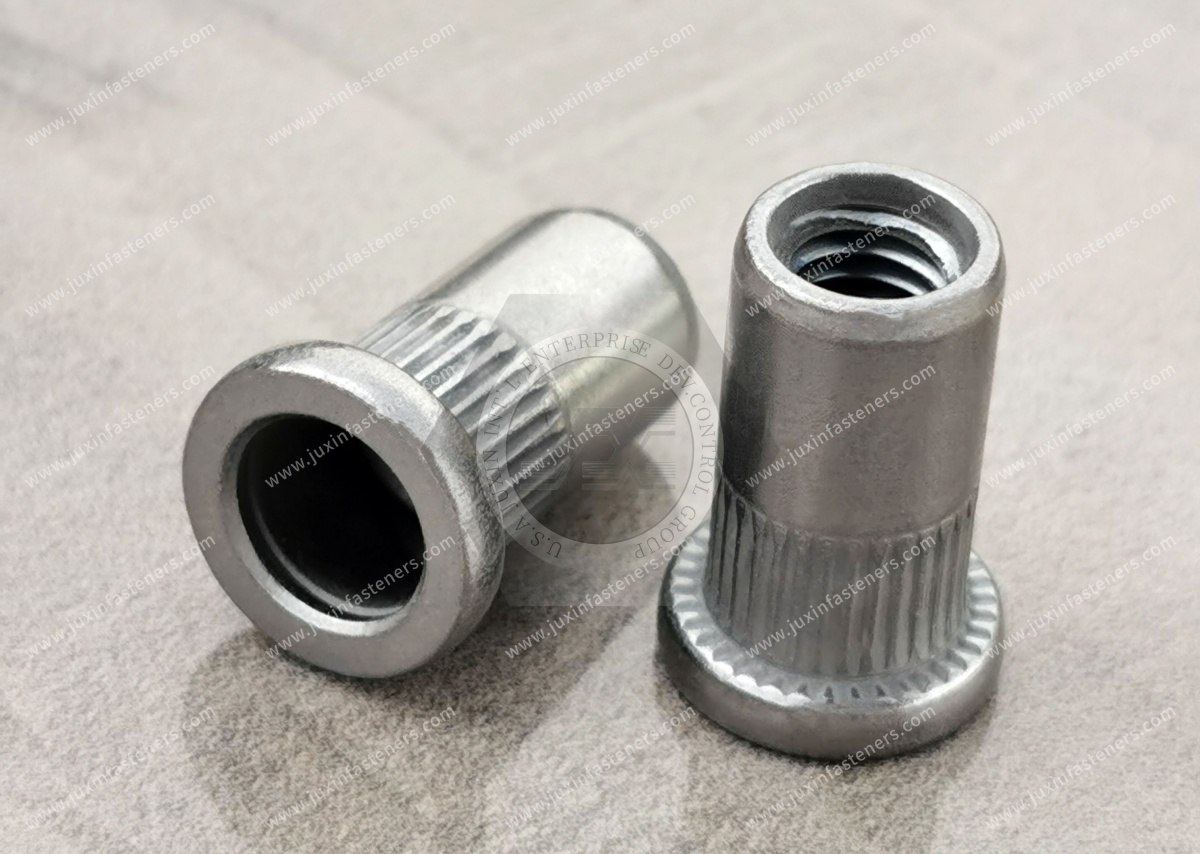
JUXIN FASTENERS supplies M6 Steel High Flat Head Open-End Knurled Body Blind Rivet Nuts for reusable threaded connections in thin sheet-metal assemblies. The knurled round body helps resist rotation after installation, while the high flat-head flange provides front-side bearing support.
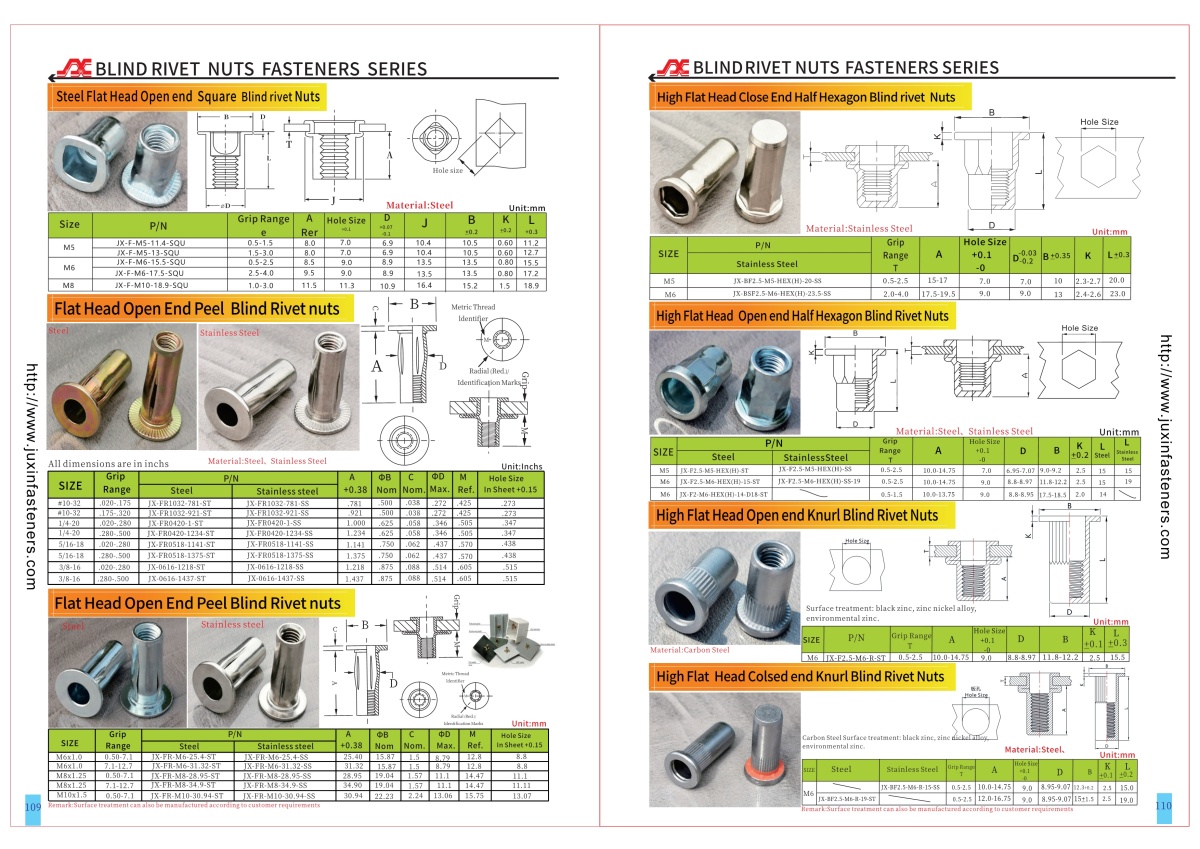
Part No.: JX-F2.5-M6-R-ST
Thread Size: M6
Material: Steel
Grip Range: 0.5–2.5 mm
Surface Treatment: Color Zinc or RoHS Blue Zinc
Head Type: High Flat Head
Body Type: Knurled Round Body
End Type: Open End
Product Specification
Product Name: Steel High Flat Head Open-End Knurled Body Blind Rivet Nut
Part Number: JX-F2.5-M6-R-ST
Thread Size: M6
Material: Steel
Grip Range: 0.5–2.5 mm (approximately 0.020–0.098 in)
Head Type: High Flat Head
Body Type: Knurled Round Body
End Configuration: Open End
Surface Treatment: Color Zinc or RoHS Blue Zinc
Installation Method: One-Sided Blind Installation
Mounting Hole: Round hole, dimensions according to the approved drawing
Thread Pitch and Tolerance: According to the approved drawing
Material Grade and Coating Requirements: According to the approved specification
Mechanical Retention: To be validated in the actual parent material
Product Overview
JUXIN FASTENERS supplies M6 steel high flat head open-end knurled body blind rivet nuts for automotive OEM production, electric vehicle components, and industrial sheet-metal assemblies.
Part number JX-F2.5-M6-R-ST combines a high flat-head flange, an externally knurled round body, and an open-end internal thread. It is intended to provide a permanent threaded insert in thin panels where rear-side access is limited or conventional tapped threads are unsuitable.
The 0.5–2.5 mm grip range supports engineering evaluation across selected thin-sheet applications. Final installation dimensions and mechanical requirements must be confirmed using the approved product drawing and representative assembly testing.
Automotive and Electric Vehicle Applications
Automotive manufacturers require threaded fastening solutions that support efficient assembly, consistent installation, and dependable service access.
M6 knurled blind rivet nuts are relevant to vehicle assemblies where a threaded attachment point must be installed from one side of a panel.
Potential applications include:
Automotive body and sheet-metal brackets
Electric vehicle equipment mounting panels
EV battery system accessory brackets
Battery management system equipment housings
Automotive electrical enclosure mounting points
Vehicle interior structural support brackets
Dashboard and instrument support assemblies
Automotive HVAC equipment brackets
Commercial vehicle equipment housings
Removable inspection and service panels
Thermal management component brackets
Selected automotive underbody equipment supports
Application suitability depends on the actual parent material, joint loading, installation conditions, and environmental requirements.
For EV battery-related assemblies, these rivet nuts must not be assumed to provide sealing, electrical isolation, or crash-load performance without separate engineering validation.
Knurled Round Body: Anti-Rotation Engineering
The external knurling is a key functional feature of this product.
During installation, the knurled surface can engage the wall of the prepared mounting hole. This engagement helps resist rotation when the mating screw is tightened or removed.
For automotive production, insert spin-out is a significant concern because an insert that rotates inside a closed panel can be difficult to repair.
Knurled body performance depends on several interacting factors:
Knurl geometry and manufacturing consistency
Mounting-hole diameter and tolerance
Parent-panel material and hardness
Panel thickness
Installation force or stroke
Degree of backside deformation
Mating screw tightening conditions
A knurled round body generally provides greater rotational engagement than a comparable smooth round body in suitable materials, but the improvement must be verified for the actual installation.
The knurling does not function as a thread-locking device. Resistance to insert spin-out and resistance to mating screw loosening are separate engineering requirements.
Round-Hole Installation and Automotive Production Efficiency
One potential advantage of a knurled round-body rivet nut is its compatibility with a correctly dimensioned round mounting hole.
Round holes may be produced by drilling, punching, or other approved sheet-metal processes.
Compared with a hexagonal-body rivet nut requiring a shaped hole, a round-body design may simplify hole preparation when the assembly already uses circular openings.
However, round-hole compatibility alone does not guarantee equivalent rotational retention.
Automotive engineers should compare hole-production cost, required spin-out resistance, installation cycle time, and assembly performance before selecting a body style.
The approved hole diameter must be established from the actual JX-F2.5-M6-R-ST drawing. Hole dimensions from another manufacturer's M6 rivet nut should not be copied without verification.
High Flat Head: Flange Support and Joint Geometry
The high flat-head flange provides a bearing surface on the accessible side of the panel.
This geometry may help distribute front-side contact forces and support consistent seating during installation.
The flange also creates a defined projection above the panel surface.
For automotive design engineers, the critical considerations include:
Flange diameter and thickness
Clearance beneath the mating component
Local panel deformation
Contact between the mating component and flange
Installation-tool nosepiece clearance
Joint clamping geometry
A high flat-head rivet nut should not be treated as a flush-mounted insert.
The flange must be included in the assembly stack-up calculation.
Where a flush surface is essential, a thin-head or countersunk configuration may be more appropriate, subject to the relevant mechanical requirements.
Open-End Design and Screw Engagement
The open-end configuration allows the mating screw to extend through the threaded insert, provided that the assembly has sufficient clearance behind the panel.
This can be useful where screw length, thread engagement, and installation access must be coordinated.
For automotive applications, engineers should verify:
Actual internal thread specification
Mating screw thread compatibility
Required thread engagement
Screw projection behind the insert
Clearance to adjacent components
Risk of interference during installation or service
An open-end rivet nut does not create a sealed threaded connection.
Where water, dust, pressure, or fluid containment is required, the complete joint must incorporate a validated sealing solution.
M6 Thread Selection and International Compatibility
The supplied nominal thread size is M6.
M6 × 1.0 is a common ISO metric coarse-thread designation, but the actual thread pitch and tolerance must be confirmed from the approved product drawing.
Relevant metric thread references include ISO 261 and ISO 965.
The M6 nominal diameter is approximately 0.236 in.
This inch conversion is provided for reference only.
M6 metric threads are not interchangeable with 1/4-20 UNC, 1/4-28 UNF, or other Unified thread forms.
For North American automotive OEM purchasing, the thread designation must be stated clearly on drawings and purchase orders to prevent metric and inch-thread substitutions.
Grip Range: 0.5–2.5 mm
The specified grip range identifies the parent-panel thickness range for the supplied product configuration.
For JX-F2.5-M6-R-ST, the stated grip range is 0.5–2.5 mm.
The selected installation must be evaluated within this range.
Panel thickness influences the deformation of the rivet nut body and the resulting backside retention.
If the panel is too thin or too thick for the selected configuration, the insert may not deform or seat as intended.
For production approval, the parent material and actual panel thickness should be included in installation trials.
Where a painted, coated, or multilayer assembly is involved, engineers should determine which material layers are actually included in the effective grip thickness.
Installation Process for Automotive Assembly Lines
The rivet nut is installed using compatible blind rivet nut setting equipment.
A typical installation process involves preparing the approved mounting hole, positioning the insert, engaging the installation mandrel, deforming the body behind the panel, and releasing the tool.
For high-volume automotive production, the installation process should be established using representative production components.
Critical process variables include:
Mounting-hole diameter and quality
Parent-panel thickness
Tool alignment
Mandrel condition
Setting force or stroke
Flange seating
Backside deformation
Thread condition after installation
Retention consistency between production batches
Under-setting may produce inadequate retention.
Over-setting may damage the internal thread, distort the flange, or deform the parent panel.
The correct installation parameters must be determined from the actual insert geometry, tooling, and parent material.
Automated and High-Volume Assembly Considerations
For automotive OEM and Tier 1 production, component performance and assembly-line compatibility should be evaluated together.
When considering automated or semi-automated installation, procurement and manufacturing engineers should review:
Part orientation and feeding requirements
Consistency of external dimensions
Tool access and alignment
Hole-position tolerance
Installation cycle-time requirements
Process monitoring
Thread inspection
Traceability requirements
Handling of rejected or improperly installed parts
Compatibility with a specific automatic feeding or setting system must be verified before production integration.
No particular automation capability or production rate is assumed for this part number.
Mechanical Performance: What OEM Engineers Should Test
The mechanical performance of a blind rivet nut cannot be determined from nominal thread size alone.
For automotive applications, three important retention characteristics should be evaluated separately.
Spin-Out Resistance
Spin-out testing evaluates the torque required to rotate the installed rivet nut within its mounting hole.
This is especially relevant to knurled round-body designs.
Pull-Out Resistance
Pull-out testing evaluates axial retention when force acts to extract the insert from the parent panel.
Results depend on panel material, thickness, hole dimensions, installation deformation, and insert geometry.
Push-Out Resistance
Push-out testing evaluates resistance to displacement in the opposite axial direction.
The high flat-head flange and parent-panel contact geometry can influence this behavior.
Testing should use representative production materials and agreed acceptance criteria.
No numerical spin-out, pull-out, or push-out values are claimed without verified product-specific test data.
Vibration and Service Reliability
Automotive components may experience vibration, shock, temperature changes, and repeated maintenance operations.
The knurled body helps address insert rotation, but it does not independently prevent loosening of the mating screw.
The complete joint should be evaluated for:
Required clamp load
Mating screw properties
Tightening torque
Thread engagement
Joint stiffness
Transverse vibration
Thermal cycling
Repeated assembly and disassembly
Environmental exposure
Where screw loosening is a concern, a suitable joint-level locking strategy may be required.
The locking method must be compatible with the application and approved by the responsible engineer.
Steel Material and Zinc Surface Treatment
JX-F2.5-M6-R-ST is specified as a steel rivet nut with Color Zinc or RoHS Blue Zinc surface-treatment options.
The exact steel grade, coating system, coating thickness, and passivation chemistry should be established through the approved material and finishing specifications.
Zinc coatings are commonly used for corrosion protection of steel fasteners.
However, a zinc finish should not be evaluated by color alone.
The term Color Zinc does not establish whether the passivation system contains hexavalent chromium.
Likewise, blue appearance alone does not establish RoHS compliance.
For automotive sourcing, the coating requirement should identify:
Approved coating system
Required corrosion performance
Restricted-substance requirements
Applicable coating documentation
Compatibility with the parent material
Any customer-specific finish requirements
ISO 4042 may be relevant to electroplated coating systems for fasteners.
ISO 9227 or ASTM B117 may be referenced where an agreed salt-spray test method is required.
A salt-spray test result should not be treated as a direct prediction of service life.
For susceptible high-strength steel components, electroplating-related hydrogen embrittlement risk should also be considered.
Corrosion Compatibility in EV Assemblies
Automotive assemblies increasingly combine steel fasteners with aluminum alloys and other lightweight materials.
When dissimilar conductive materials are exposed to moisture or electrolytes, galvanic corrosion may become a concern.
For zinc-plated steel rivet nuts installed in aluminum panels, engineering evaluation should consider:
Parent-panel alloy
Fastener coating system
Mating screw material
Moisture exposure
Electrical contact
Protective coatings
Assembly drainage and sealing
Environmental service conditions
The appropriate corrosion-control measures depend on the complete assembly design.
A zinc-plated steel insert should not automatically be considered suitable for every aluminum EV enclosure.
Knurled Round Body vs. Partial Hex and Full Hex Rivet Nuts
Automotive engineers often compare different body styles when selecting threaded inserts.
Knurled Round Body
Uses external surface features to engage a compatible round mounting hole. It can be useful where round-hole preparation is preferred and the required spin-out resistance can be achieved.
Partial Hex Body
Uses a partially non-round geometry to resist rotation through engagement with the approved mounting-hole profile.
Full Hex Body
Uses a hexagonal body profile for geometric anti-rotation engagement in a compatible hexagonal mounting hole.
The correct choice depends on the required mechanical performance, parent material, hole preparation, installation tooling, and total assembly cost.
These body styles should not be treated as directly interchangeable merely because they share an M6 thread.
OEM Quality Control and Supplier Qualification
For automotive OEM and Tier 1 purchasing, product qualification should address dimensional consistency, material conformity, surface treatment, and installation performance.
Recommended areas for review include:
Approved dimensional drawing
Part-number identification
M6 internal thread inspection
Knurl geometry and body dimensions
Flange dimensions
Grip range
Steel material requirements
Coating specification
Installation compatibility
Retention test requirements
Lot identification
Inspection and acceptance criteria
Customer programs may require first article inspection, PPAP documentation, material declarations, or additional automotive quality submissions.
Such requirements must be agreed for the actual sourcing program.
No IATF 16949 certification, PPAP approval, or OEM qualification is claimed without supporting documentation.
Procurement and Supply Chain Considerations
For purchasing managers, sourcing engineers, and supplier development teams, selecting an automotive rivet nut involves more than comparing unit prices.
Important commercial and technical considerations include:
Drawing compatibility
Installation process compatibility
Required annual purchasing volume
Production batch consistency
Coating requirements
Quality inspection expectations
Traceability
Packaging and labeling
Delivery planning
Engineering change control
A low-cost fastener may create additional assembly costs if hole preparation, setting parameters, or product dimensions are inconsistent.
For high-volume automotive programs, the total installed cost should include the insert, hole preparation, installation, inspection, and potential rework.
Other Industrial Applications
Beyond automotive manufacturing, M6 steel knurled blind rivet nuts may be evaluated for:
Industrial machinery
Electrical control cabinets
Sheet-metal equipment housings
HVAC equipment
Agricultural machinery
Commercial vehicle equipment
Automation systems
Fabricated metal panels
Maintenance access covers
Industrial equipment brackets
The same engineering principles apply: correct hole geometry, grip-range selection, installation control, and mechanical validation.
Related Fastening Solutions
JUXIN FASTENERS also supplies other blind rivet nut configurations for different engineering requirements.
Steel High Flat Head Open-End Partial Hex Body Blind Rivet Nuts
An alternative body configuration for applications requiring geometric anti-rotation engagement.
Steel Flat Head Open-End Square Body Blind Rivet Nuts
An alternative for approved square-hole mounting arrangements.
Aluminum Flat Head Open-End Knurled Body Blind Rivet Nuts
An alternative material configuration for suitable applications where component weight is a design consideration.
Aluminum Flat Head Open-End Full Hex Body Blind Rivet Nuts
An alternative where aluminum construction and full hex body engagement are required.
Product selection and substitution must be based on the approved drawing, mounting-hole requirements, and application-specific testing.
Information Required for an Automotive OEM RFQ
To evaluate JX-F2.5-M6-R-ST for a production program, please provide:
Part number or approved product drawing
Required M6 thread specification
Parent-panel material
Panel thickness
Mounting-hole dimensions
Required grip range
Installation equipment information
Required spin-out resistance
Required pull-out and push-out performance
Surface-treatment specification
Corrosion and environmental requirements
Inspection and traceability requirements
Prototype or production quantity
Estimated annual purchasing volume
Delivery destination
Customer-specific quality requirements
Why Source This Product from JUXIN FASTENERS?
JUXIN FASTENERS supplies industrial fastening products for OEM purchasing and drawing-based sourcing requirements.
For automotive customers, the technical discussion can focus on the actual part geometry, material specification, coating requirements, installation compatibility, and quality expectations rather than nominal thread size alone.
JX-F2.5-M6-R-ST is a defined M6 steel high flat head open-end knurled body blind rivet nut with a stated grip range of 0.5–2.5 mm.
Final dimensional details, installation parameters, and mechanical acceptance criteria should be confirmed before production approval.
Request a Quotation
Looking for an M6 steel knurled blind rivet nut supplier for automotive OEM production, EV equipment assemblies, or high-volume sheet-metal manufacturing?
Send your drawings, technical specifications, estimated annual demand, and purchasing requirements to JUXIN FASTENERS.
Email: info@juxinfasteners.com
Website: www.juxinfasteners.com
Product Packaging
Product Packaging
JUXIN FASTENERS arranges packaging for M6 steel high flat head open-end knurled body blind rivet nuts according to confirmed purchasing quantities, product protection requirements, and customer-specific shipping instructions.
Packaging Configuration
Inner Packaging: Protective bags or suitable containers, as agreed.
Outer Packaging: Export cartons according to the confirmed order.
Pallet Packaging: Subject to shipment requirements and prior agreement.
Quantity per Package: Confirmed according to order quantity, part dimensions, and handling requirements.
Custom OEM Packaging: Subject to approved customer specifications.
Product Identification
Packaging labels can be specified to include:
Product Name: Steel High Flat Head Open-End Knurled Body Blind Rivet Nut
Part Number: JX-F2.5-M6-R-ST
Thread Size: M6
Material: Steel
Grip Range: 0.5–2.5 mm
Surface Treatment: Color Zinc or RoHS Blue Zinc
Lot or Batch Number
Package Quantity
Customer Purchase Order Number
Product Protection
Packaging should protect the internal threads, knurled body surface, high flat-head flange, and zinc coating against unnecessary damage during handling, storage, and transportation.
Different surface-treatment variants should be identified separately to reduce the risk of mixing during order fulfillment.
Automotive OEM Packaging Requirements
For automotive OEM and Tier 1 purchasing programs, packaging and labeling requirements may be agreed according to the customer's production and logistics procedures.
Where required, packaging arrangements may address lot traceability, barcode identification, batch segregation, handling instructions, and supporting shipment documentation.
Any customer-specific returnable packaging, labeling format, or logistics specification must be confirmed before implementation.
Packaging quantities and final shipment configurations are established during order confirmation.
Product Pictures
Tags
Contact Us
Tel.:
+86 020 8621 0320
+86 020 3121 6067
E-mail:
Technical Support:
Navigation
SEND INQUIREY