Call Us
+86 136 6007 9809
Call Us
+86 136 6007 9809

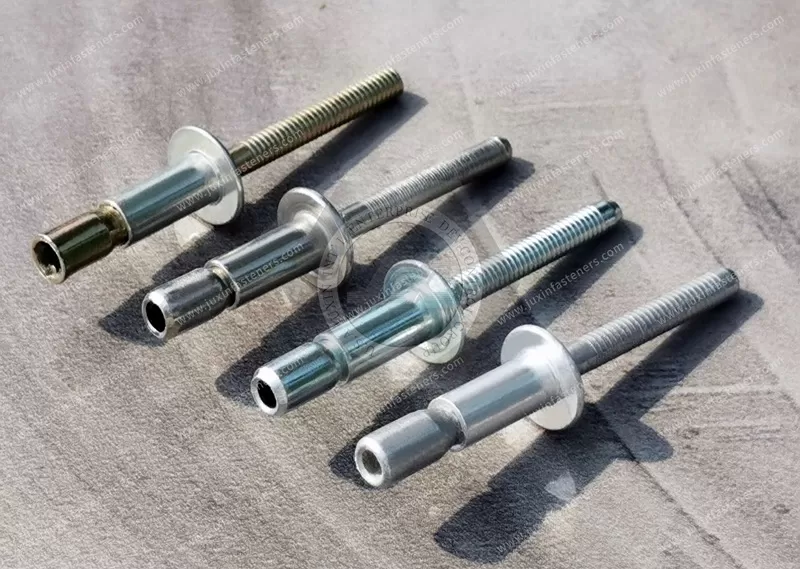
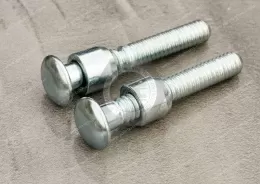
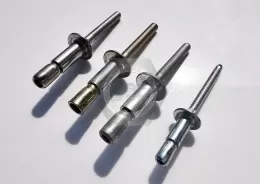
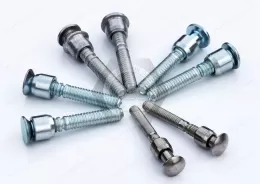
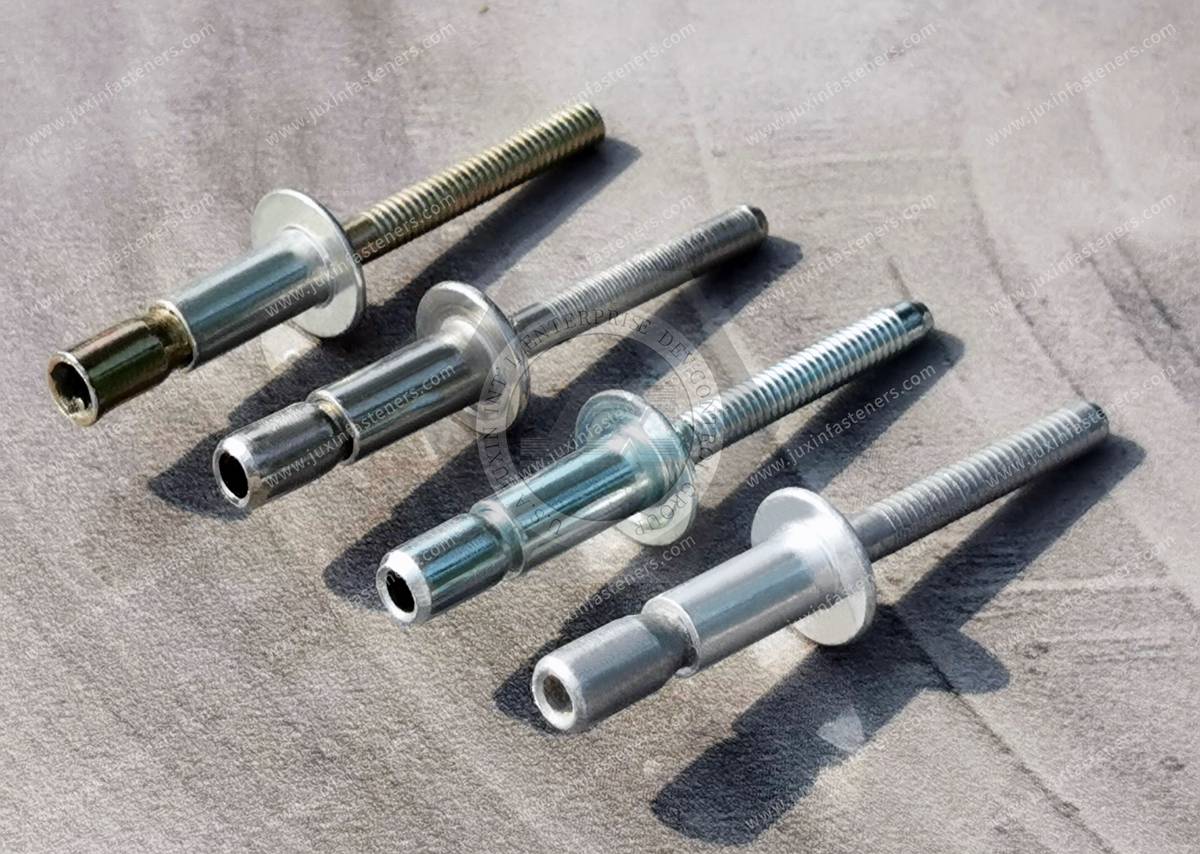
JUXIN FASTENERS supplies wide-grip domed head high-strength structural blind rivets for industrial assemblies requiring one-sided installation, reliable joint formation, and an extended material thickness range.
Available body and mandrel material combinations include aluminum/aluminum, steel/steel, and stainless steel/stainless steel. These structural breakstem rivets are intended for OEM sheet metal assemblies, commercial vehicle components, industrial enclosures, equipment frames, and other applications where joint design, grip range, mandrel retention, and installation consistency are important.
Wide-grip designs can help reduce the number of individual rivet lengths needed across assemblies with different total material thicknesses. Final fastener selection must be based on the specified grip range, hole dimensions, material grade, installation method, and verified joint performance.
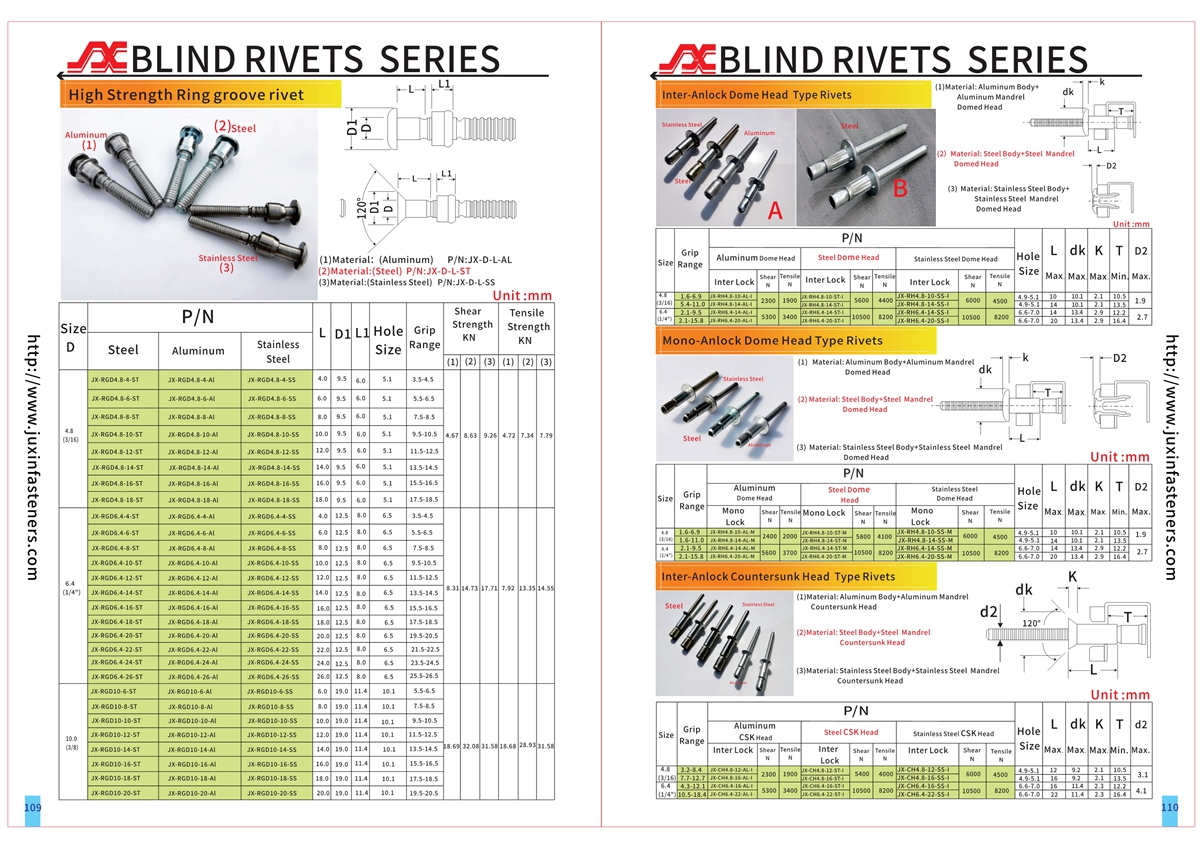
Refer to the detailed product specification sheets, PDF/CAD drawings, and catalog pages 109–110 for dimensional information. OEM drawings, customized dimensions, material requirements, and bulk purchasing inquiries are welcome.
Contact: info@juxinfasteners.com
Product Specification
Wide-Grip Domed Head High-Strength Structural Blind Rivets
High-Strength Wide-Grip Blind Rivets for OEM and Industrial Assembly
JUXIN FASTENERS supplies wide-grip domed head high-strength structural blind rivets for manufacturers requiring one-sided fastening, extended material thickness coverage, and dependable joint formation in engineered industrial assemblies.
These products are also relevant to searches for wide-thickness-range blind rivets, multi-grip structural blind rivets, high-strength structural breakstem rivets, and dome head structural blind rivets.
Unlike conventional blind rivets with relatively narrow grip ranges, wide-grip designs are intended to accommodate a broader specified range of combined material thicknesses. This can simplify fastener selection for product families using different sheet thicknesses and may reduce the number of individual rivet lengths required in production inventory.
JUXIN offers the following body and mandrel material combinations:
Aluminum body + aluminum mandrel
Steel body + steel mandrel
Stainless steel body + stainless steel mandrel
All three configurations are described within this domed head product series. Exact material grades, dimensions, grip ranges, mandrel-locking mechanisms, and mechanical performance must be confirmed against the corresponding product specifications.
1. What Are Wide-Grip Structural Blind Rivets?
A structural blind rivet is a fastening component designed to join two or more materials when installation access is available from only one side of the assembly.
The fastener generally consists of a rivet body and a mandrel. During installation, a compatible riveting tool pulls the mandrel through the body, causing the blind-side portion to deform and form a retaining head behind the joined materials.
The original domed head remains on the accessible side, while the formed blind-side head helps clamp the components together.
Structural blind rivets are commonly considered for demanding industrial assemblies where joint strength, installation consistency, and mandrel retention are important.
Depending on the specific construction, a structural blind rivet may incorporate an internal or external mechanical mandrel-locking feature. Such features must be verified for the actual product design rather than assumed from the general term "structural rivet."
2. Main Product Features and Engineering Benefits
2.1 Extended Grip Range
Grip range refers to the minimum and maximum combined material thickness that a rivet is designed to fasten.
A wide-grip rivet can accommodate a broader specified thickness range than a comparable narrow-grip design.
For OEM manufacturers, this may provide several operational advantages:
Reduced number of rivet lengths across related assemblies
Simplified inventory management
Easier fastener selection for variable sheet thicknesses
Fewer opportunities for incorrect length selection
Greater flexibility when assembling multiple product configurations
The selected rivet must still cover the actual minimum and maximum assembled thickness, including manufacturing tolerances.
A wide grip range does not eliminate the need to verify the approved installation limits.
2.2 Domed Head Design
The domed head, also described as a protruding or button-style head in some industrial catalogs, provides a bearing surface on the accessible side of the assembly.
This design is suitable for applications where a flush countersunk finish is not required.
Head diameter and head height should be evaluated together with substrate strength, material thickness, edge distance, and joint loading.
A domed head can provide a practical finished appearance while supporting industrial fastening requirements.
2.3 One-Sided Installation
Blind rivets can be installed without accessing the reverse side of the assembly.
This is useful for:
Closed sections
Box-shaped structures
Tubular components
Equipment housings
Fabricated sheet metal assemblies
Enclosures with restricted internal access
One-sided installation may reduce assembly complexity and eliminate the need for certain secondary fastening operations.
2.4 Structural Joint Performance
High-strength structural blind rivets are intended for applications where shear resistance, tensile resistance, and joint integrity may be important.
Actual strength depends on the specific fastener diameter, material grade, body geometry, mandrel design, grip condition, and installation quality.
The description "high strength" does not establish a universal load rating.
Mechanical performance values should be taken from verified product test data or an approved engineering specification.
2.5 Mandrel Retention
In certain structural blind rivet designs, the retained mandrel contributes to the mechanical behavior of the installed fastener.
Positive mechanical locking systems may help secure the retained mandrel after installation.
However, structural rivets use different retention arrangements. An external visible lock, internal mechanical lock, or another retention mechanism should be specified only when supported by the corresponding drawing and product documentation.
2.6 Body Expansion and Hole Fill
During setting, the rivet body expands to form the blind-side retaining structure.
Certain structural designs provide enhanced radial expansion and hole-fill behavior.
Nevertheless, the degree of expansion depends on the actual rivet geometry, material properties, installation tool, and hole condition.
Oversized, elliptical, slotted, or misaligned holes should not be considered acceptable unless specifically permitted by the product specification and validated for the application.
3. Available Materials and Selection Considerations
3.1 Aluminum Body + Aluminum Mandrel
Aluminum body and aluminum mandrel structural blind rivets may be considered for applications where component weight and material compatibility are important.
Potential applications include lightweight fabricated assemblies, aluminum equipment housings, selected transportation components, and industrial sheet metal structures.
Engineering selection should consider:
Aluminum alloy and temper
Required joint strength
Grip range
Substrate material
Installation hole dimensions
Corrosion environment
Tool compatibility
Head pull-through resistance
The exact alloy and mechanical properties must be confirmed for the selected part.
Aluminum construction should not automatically be interpreted as suitable for every high-load application.
3.2 Steel Body + Steel Mandrel
Steel body and steel mandrel configurations may be selected for fabricated industrial assemblies where the required joint performance favors steel fastening components.
Potential applications include machinery frames, steel equipment housings, industrial brackets, and commercial vehicle components.
Important engineering considerations include:
Steel grade
Shear and tensile requirements
Rivet diameter
Joint thickness
Protective coating
Corrosion exposure
Installation force
Production inspection requirements
Surface treatments such as zinc plating should be specified only when available and verified for the selected product.
3.3 Stainless Steel Body + Stainless Steel Mandrel
Stainless steel body and stainless steel mandrel configurations may be considered where corrosion resistance and stainless steel material compatibility are required.
Potential applications include outdoor equipment, stainless steel enclosures, industrial processing equipment, and selected transportation assemblies.
Selection should account for:
Stainless steel grade
Environmental exposure
Dissimilar-metal contact
Mechanical loading
Grip range
Installation tool capacity
Surface condition
Corrosion-control requirements
The term "stainless steel" alone does not identify a particular grade such as 304, 316, A2, or A4.
Material grade and corrosion suitability must be verified for the intended operating environment.
4. Wide-Grip Structural Rivets Versus Conventional Blind Rivets
Wide-grip structural blind rivets and conventional blind rivets both support one-sided installation, but their design objectives may differ.
Grip Coverage
Wide-grip products are designed for broader specified thickness intervals, while conventional narrow-grip products may require more individual length selections.
Joint Performance
Structural rivets are developed for demanding fastening applications, but actual mechanical capability must be established using product-specific data.
Mandrel Construction
Some structural designs incorporate positive mandrel retention. Conventional blind rivets and different structural rivet families may use other mandrel arrangements.
Installation Equipment
Structural blind rivets may require specialized riveting tools or nosepieces. Tool compatibility cannot be assumed solely from nominal rivet diameter.
Inventory Management
A wide-grip product may replace several narrower-grip selections where all relevant dimensional and performance requirements are satisfied.
Engineers should evaluate the complete assembly rather than selecting a rivet solely because it is described as high strength or wide grip.
5. Engineering Selection Guide
5.1 Determine the Combined Material Thickness
The total grip thickness is the combined thickness of all components held within the joint.
For two metal sheets, this is generally the sum of the individual sheet thicknesses, together with any relevant intermediate layers or coatings that affect the assembled stack.
The actual minimum and maximum thickness must fall within the rivet's specified grip range.
5.2 Select the Correct Rivet Diameter
Rivet diameter influences the available joint performance, installation hole dimensions, tool requirements, and fastener arrangement.
The selected diameter should reflect:
Required shear loading
Required tensile loading
Substrate strength
Available edge distance
Rivet spacing
Installation access
Engineering design constraints
A larger diameter does not automatically guarantee a stronger complete joint.
5.3 Verify the Installation Hole
Hole diameter is a critical installation parameter.
An undersized hole can prevent correct insertion or damage the rivet.
An oversized hole may reduce support, affect blind-side formation, and compromise joint performance.
The recommended hole diameter and tolerance must be obtained from the applicable product drawing.
5.4 Check Edge Distance and Rivet Spacing
Fastener location influences the ability of the joined materials to transfer load.
Insufficient edge distance or unsuitable spacing may lead to sheet tearing, local deformation, or other joint failures.
The design should consider substrate thickness, material strength, load direction, and fastener arrangement.
5.5 Evaluate Material Compatibility
Body material, mandrel material, and joined materials must be selected with regard to strength, corrosion exposure, and possible galvanic interaction.
Protective coatings or material isolation may be required in certain mixed-metal assemblies.
5.6 Confirm Installation Equipment
The correct tool and nosepiece are essential for repeatable rivet setting.
Certain structural rivets require dedicated nose assemblies or specific installation equipment.
Tool compatibility should be verified before production approval.
6. Understanding Shear Strength and Tensile Strength
Shear Strength
Shear loading acts across the fastener and generally parallel to the plane of the joined materials.
Rivet shear performance depends on the fastener material, diameter, geometry, and installed construction.
Tensile Strength
Tensile loading acts in a direction tending to separate the joined components.
The complete joint must resist both fastener-related failure and possible deformation or pull-through of the surrounding material.
Joint Strength
The rated strength of an individual rivet is not necessarily the allowable strength of the finished assembly.
Joint performance is influenced by:
Rivet diameter and material
Number of rivets
Rivet arrangement
Sheet thickness and strength
Hole diameter
Edge distance
Grip condition
Installation quality
Vibration and fatigue
Corrosion and service conditions
For structurally critical applications, appropriate engineering validation and joint testing are necessary.
7. Installation Process for Production Assembly
Wide-grip structural blind rivets should be installed using compatible equipment and the approved setting procedure.
A typical production process includes the following steps.
Step 1: Verify the Assembly
Confirm the material thickness, grip range, hole dimensions, and selected rivet specification.
Step 2: Prepare the Installation Holes
Produce holes according to the approved diameter and tolerance.
Remove burrs and inspect for excessive deformation or misalignment.
Step 3: Position the Components
Align the workpieces and insert the rivet through the prepared hole.
Step 4: Select the Correct Tooling
Use a compatible riveting tool and nosepiece for the specific rivet diameter and construction.
Step 5: Install the Rivet
Position the tool correctly against the rivet head and complete the setting operation according to the approved procedure.
Step 6: Inspect the Finished Joint
Check the accessible head, installation condition, mandrel position, and any required locking or setting features.
Where possible, verify blind-side formation against an approved installation sample.
Step 7: Record Quality Results
For production applications, establish appropriate inspection records and process controls.
High-volume manufacturers may also consider tool maintenance schedules, installation monitoring, and periodic destructive testing where required.
8. Common Installation Problems and Prevention
8.1 Incorrect Grip Selection
A rivet used outside its approved grip range may not form the intended blind-side geometry.
Prevention: Confirm the complete thickness stack and allowable manufacturing variation.
8.2 Oversized Installation Holes
Oversized holes can affect rivet support, body expansion, and joint consistency.
Prevention: Control hole diameter, inspect tooling, and verify the specified tolerance.
8.3 Incompatible Riveting Tool
An incorrect tool or nosepiece can damage the rivet or prevent proper setting.
Prevention: Use the approved installation equipment for the selected rivet design.
8.4 Incomplete Rivet Setting
Incomplete setting may result in inadequate blind-side formation or abnormal mandrel behavior.
Prevention: Establish installation acceptance criteria and inspect representative samples.
8.5 Mandrel Retention Problems
Improper mandrel retention can be a concern in assemblies subject to vibration or where loose components are unacceptable.
Prevention: Verify the actual mandrel-locking design and follow the product-specific inspection procedure.
8.6 Corrosion and Material Mismatch
Unsuitable material combinations may contribute to corrosion or premature joint deterioration.
Prevention: Select verified material grades and protective finishes appropriate to the service environment.
9. Industrial Applications
9.1 Commercial Vehicles, Trucks, and Trailers
Wide-grip structural blind rivets may be evaluated for fabricated vehicle components, body structures, brackets, equipment housings, and other assemblies with restricted rear-side access.
Engineers should consider vibration, fatigue, material strength, and the required service life.
9.2 Industrial Machinery and Equipment
Potential applications include equipment frames, sheet metal covers, support brackets, fabricated housings, and machinery structures.
One-sided installation can be advantageous where conventional nut-and-bolt access is difficult.
9.3 Electrical Cabinets and Power Distribution Equipment
Domed head structural blind rivets may be considered for industrial electrical enclosures, cabinet frames, sheet metal support components, and equipment housings.
Fastener selection must account for electrical clearances, grounding requirements, vibration, corrosion, and the surrounding joint materials.
9.4 HVAC and Ventilation Systems
Potential applications include fabricated ventilation equipment, industrial housings, equipment frames, and selected sheet metal assemblies.
Installation access, vibration, corrosion exposure, and material thickness should be evaluated.
9.5 Energy Storage and Power Electronics Equipment
Structural blind fastening may be useful in selected equipment enclosures, support brackets, and fabricated sheet metal components.
The fastener should not be assumed to provide electrical insulation, grounding continuity, or sealing without appropriate verification.
9.6 AI Data Center and Thermal Management Equipment
Potential applications include equipment cabinets, supporting sheet metal structures, fabricated frames, and selected cooling-equipment housings.
Engineers should consider service accessibility, vibration, material compatibility, and installation consistency.
9.7 Transportation and Rail Equipment
Blind riveting may be considered for selected fabricated transportation assemblies where installation access is restricted.
Applications with specific structural, fatigue, or safety requirements must be separately evaluated and qualified.
10. OEM Customization and Engineering Support
JUXIN FASTENERS welcomes OEM and industrial procurement inquiries for structural blind rivets and related fastening components.
Customer-specific requirements may include:
Rivet diameter
Grip range
Domed head dimensions
Body and mandrel material
Material grade
Surface finish
Installation hole specification
Dimensional tolerances
Mechanical performance requirements
Packaging and identification
Production quantities
Quality inspection requirements
Custom dimensions and configurations are subject to engineering review and manufacturing feasibility.
Customer drawings and specifications should be reviewed before confirming production availability.
11. Purchasing and Supply Chain Considerations
For purchasing managers, sourcing engineers, supply chain managers, and production managers, selecting a structural blind rivet involves more than comparing unit prices.
Important commercial and operational factors include:
Part Standardization
A verified wide-grip design may reduce the number of separate rivet lengths used across related assemblies.
Installation Efficiency
Compatible tooling, consistent hole preparation, and repeatable setting processes can support efficient production.
Quality Consistency
Documented dimensions, material requirements, and installation criteria help reduce variation during incoming inspection and assembly.
Supply Planning
Annual demand, production forecasts, packaging quantities, and delivery schedules should be considered when selecting an OEM fastening supplier.
Engineering Change Control
Changes to grip range, material grade, rivet geometry, or installation tooling should be reviewed before production implementation.
12. Metric and Inch Size References
Industrial blind rivets are used in markets where both metric and inch-based dimensional designations are common.
Examples of mathematical conversions include:
3/16 inch = 4.7625 mm
1/4 inch = 6.35 mm
3/8 inch = 9.525 mm
These conversions are provided for reference only.
A nominal metric rivet should not automatically be substituted for an inch-designated rivet without verifying the actual manufactured dimensions, installation hole, grip range, and approved drawing.
For OEM projects, use the confirmed product specification rather than nominal dimensional conversion alone.
13. Product Specifications, PDF and CAD Drawings
Please refer to the detailed product documentation for dimensional and technical information.
Catalog Reference: Pages 109–110
Relevant specifications may include:
Rivet body diameter
Rivet length
Domed head diameter
Head height
Grip range
Recommended installation hole
Body material
Mandrel material
Mandrel-locking construction
Dimensional tolerances
Mechanical performance data, where available
Installation requirements
The information on this page supports preliminary engineering selection.
Final product approval should be based on the confirmed drawing, applicable specification, and required application testing.
14. Frequently Asked Questions
What is a wide-grip structural blind rivet?
A wide-grip structural blind rivet is designed to accommodate a broader specified range of combined material thicknesses while providing structural fastening capability appropriate to its verified design and performance ratings.
Are these rivets suitable for one-sided installation?
Yes. Blind rivets are designed for installation when access is available from only one side of the assembly.
What materials are available in this JUXIN product series?
The described configurations include aluminum body with aluminum mandrel, steel body with steel mandrel, and stainless steel body with stainless steel mandrel.
Can a wide-grip rivet replace several standard rivet lengths?
Potentially. A wider approved grip range may allow one product to cover multiple thickness conditions, provided every application meets the dimensional and mechanical requirements.
Do all structural blind rivets have a visible mechanical lock?
No. Mandrel-locking systems vary by product design. A visible external lock must be confirmed for the specific rivet.
Can these rivets be installed in oversized or elliptical holes?
Only when the hole dimensions and geometry are permitted by the applicable specification. Enhanced hole-fill capability should not be assumed for every structural rivet.
Are these structural blind rivets waterproof?
Not necessarily. Sealing performance depends on the specific rivet and joint design and requires appropriate verification.
How should I choose between aluminum, steel, and stainless steel?
Consider joint loading, substrate material, corrosion exposure, weight, installation equipment, and the verified material properties of the selected rivet.
Do these rivets require special installation tools?
Some structural blind rivets require dedicated installation tools or nosepieces. Confirm compatibility before production use.
Can JUXIN support OEM drawings and customized requirements?
JUXIN welcomes drawing-based inquiries for dimensional, material, finish, packaging, and production requirements. Custom manufacturing feasibility is reviewed for each project.
15. Request a Quotation — OEM Structural Blind Rivets
JUXIN FASTENERS supplies industrial fastening solutions for international OEM manufacturers, equipment builders, engineering teams, purchasing departments, and supply chain organizations.
For a quotation on wide-grip domed head high-strength structural blind rivets, please provide:
Required rivet diameter
Minimum and maximum grip thickness
Body and mandrel materials
Installation hole dimensions
Joint material and thickness
Mechanical performance requirements
Surface treatment requirements
2D drawings or 3D CAD models
Estimated order quantity and annual demand
Packaging and delivery requirements
Our team can review your specifications and coordinate technical and commercial clarification for your project.
Email: info@juxinfasteners.com
Website: www.juxinfasteners.com
JUXIN FASTENERS — Industrial Fasteners and Custom OEM Fastening Solutions
Product Packaging
Packaging Standard
At Juxin Fasteners, we apply standardized export packaging to ensure product protection, traceability, and compliance with international logistics requirements.
1. Standard Export Packaging
Unless otherwise specified, all products will be packed according to our factory standard export packaging, which includes:
Moisture-resistant inner protection
Poly bag or small box packing as required
Reinforced export cartons
Clear labeling with part number, specification, batch number, and quantity
Palletizing for sea or air shipment when necessary
Our standard packaging is designed to ensure safe transportation, efficient warehousing, and long-distance international shipping.
2. Customized Packaging Options
We also provide customized packaging solutions according to customer requirements, including but not limited to:
Private labeling
Customized barcodes
Specific carton dimensions
Retail packaging
Special pallet configuration
Customer-specific marking and identification
So that you know, customized packaging may involve additional costs and extended lead time depending on the complexity of the requirements.
3. Compliance & Quality Assurance
All packaging processes are controlled under our ISO 9001 quality management system to ensure consistency, traceability, and product integrity throughout the supply chain.
Product Pictures
Contact Us
Tel.:
+86 020 8621 0320
+86 020 3121 6067
E-mail:
Technical Support:
Navigation
SEND INQUIREY