Call Us
+86 136 6007 9809
Call Us
+86 136 6007 9809

When designing sheet-metal enclosures, laboratory equipment, food-processing machinery, HVAC systems,
electrical cabinets and industrial equipment for humid, chloride-containing or chemically active environments, corrosion behavior becomes an important part of fastener selection.
Product Specification
When designing sheet-metal enclosures, laboratory equipment, food-processing machinery, HVAC systems,
electrical cabinets and industrial equipment for humid, chloride-containing or chemically active environments, corrosion behavior becomes an important part of fastener selection.
Carbon steel clip-on nuts can provide an effective fastening solution when paired with an appropriate surface-protection system.
For applications where stainless steel is preferred or specifically required, engineers frequently compare 304 vs 316 stainless steel clip-on nuts.
However, selecting between these two stainless steel families should not be reduced to:
304 = normal environment
and
316 = harsh environment.
The correct decision depends on the actual corrosion mechanism, exposure conditions, cleaning chemistry, panel material, component geometry, surface condition and service requirements.
For OEM sourcing, JUXIN FASTENERS recommends a more complete selection path:
Environment → Corrosion Mechanism → Stainless Grade → Clip Geometry → Panel Interface → Surface Condition → Validation → Production Specification
This provides design engineers and procurement teams with a stronger technical basis than specifying “stainless steel” alone.
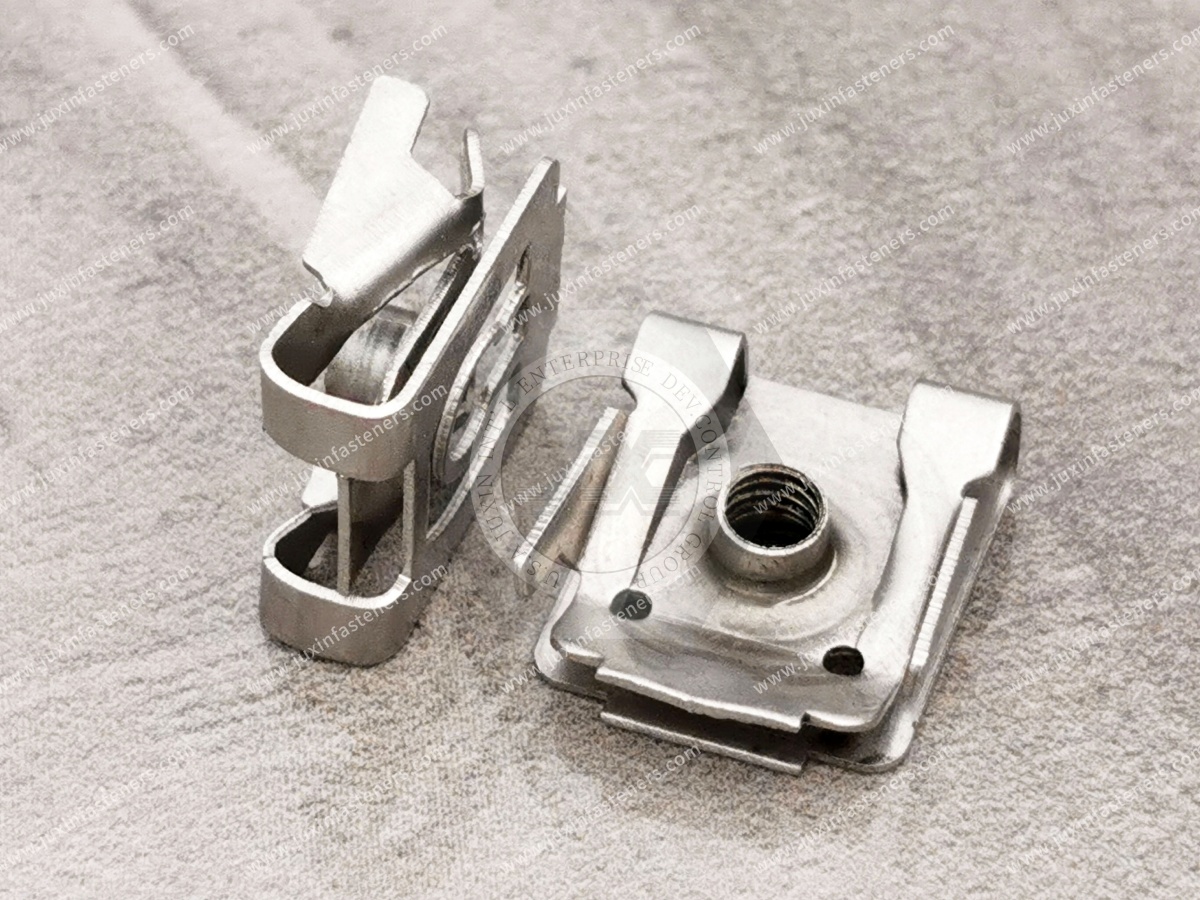
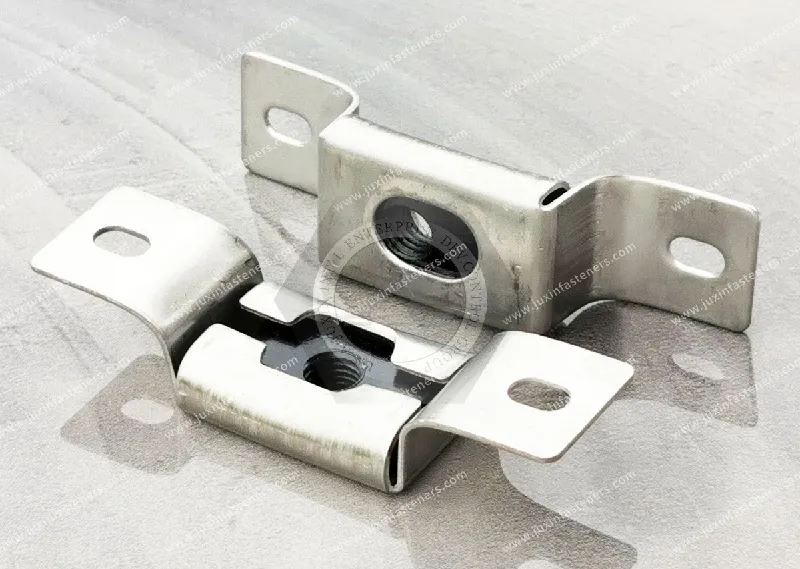
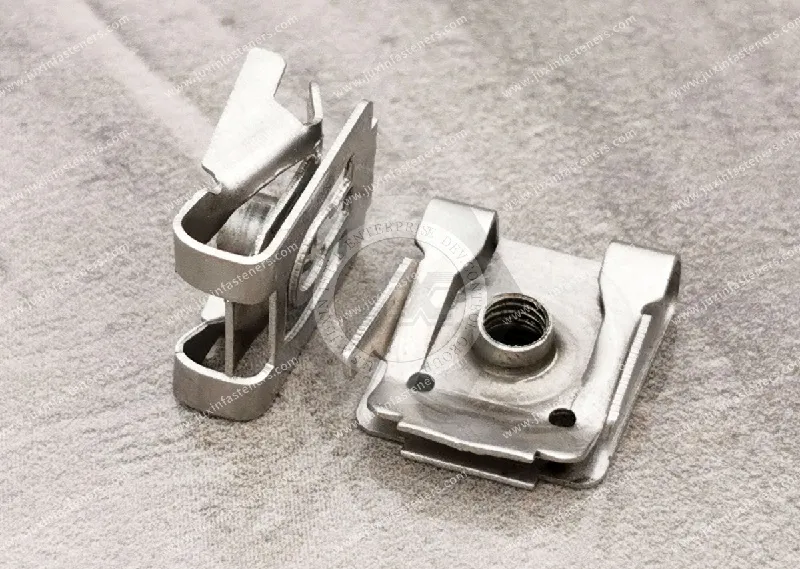
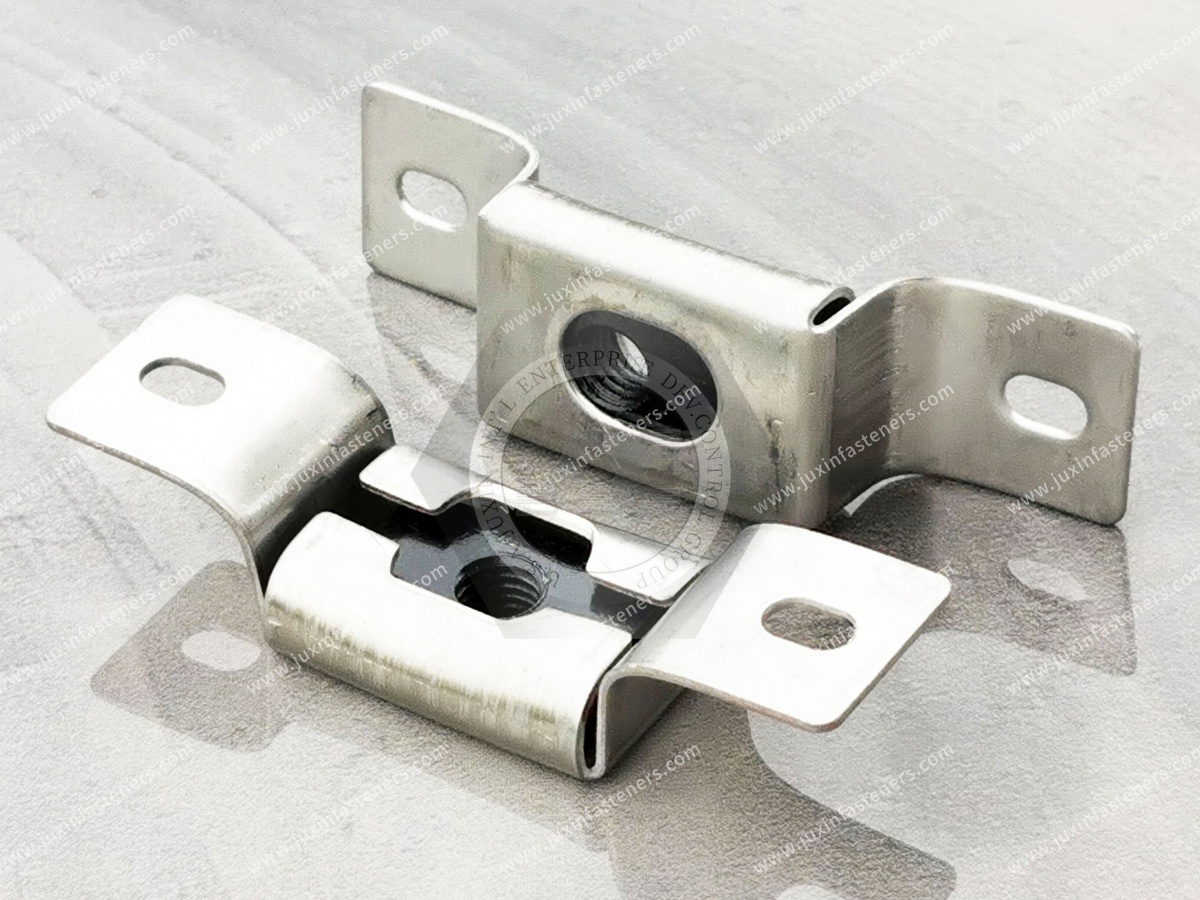
Stainless steel clip-on nuts are edge-mounted spring fasteners manufactured from a stainless steel material selected for the required product and application.
Depending on geometry, the family can include:
U-nuts;
J-nuts;
spring nuts;
clip-on nuts;
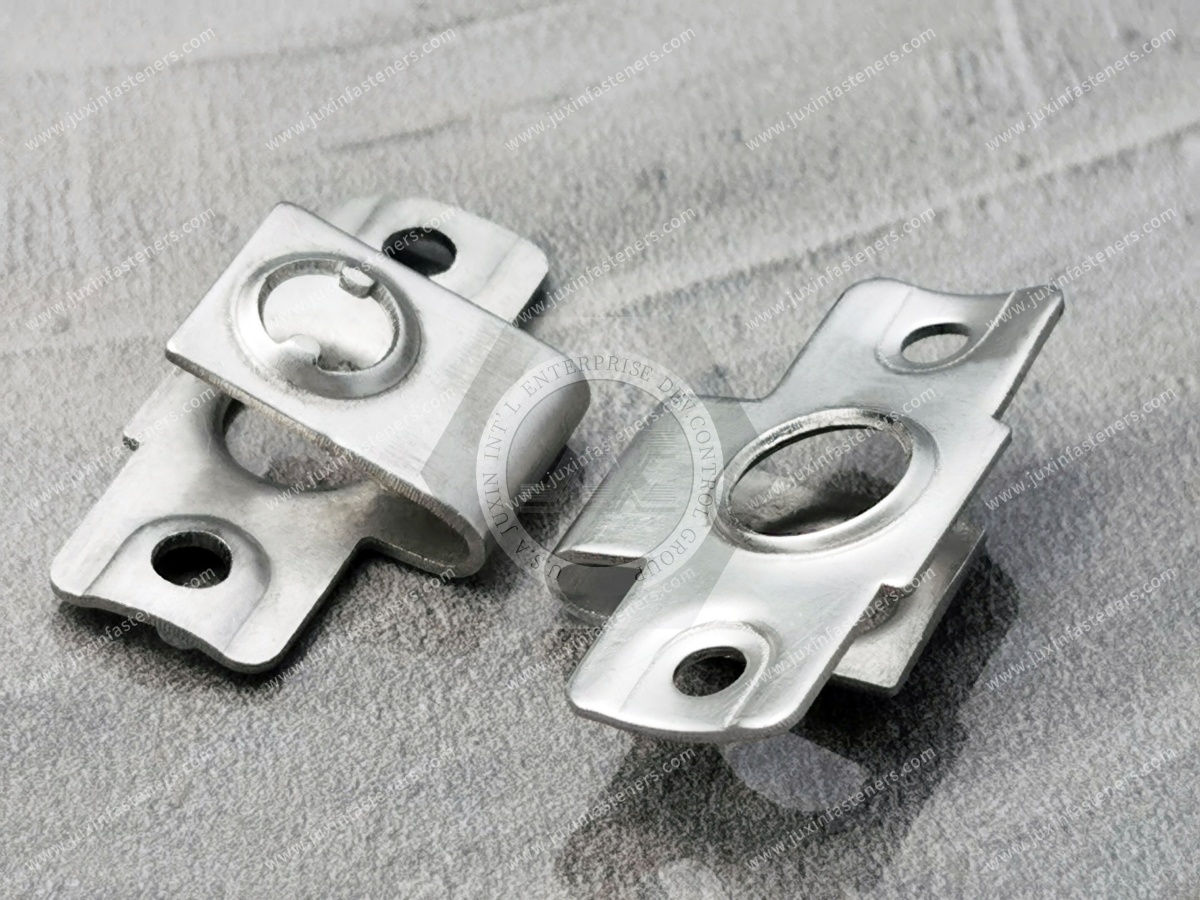
flanged-edge clip nuts;
other edge-mounted spring fasteners.
JUXIN FASTENERS product information includes stainless steel clip-on nut options in relevant product families, including SUS304 and SUS316 options.
However, not every clip geometry, thread size or dimensional configuration should be assumed to be available in both grades.
Material and dimensional availability should be confirmed against the actual drawing or RFQ.
304 and 316 belong to the austenitic stainless steel family.
Both rely on chromium-containing passive surface behavior for corrosion resistance, but their alloy compositions differ.
The most important practical distinction for many corrosion-sensitive applications is that 316 includes molybdenum as an intentional alloying element,
which can improve resistance to certain forms of localized corrosion, particularly in chloride-containing environments.
This does not mean 316 is corrosion-proof.
Nor does it mean 304 is unsuitable whenever moisture or chemicals are present.
The application environment determines whether the additional alloying characteristics of 316 are technically justified.
304 stainless steel is sometimes commercially described as “18/8 stainless.”
That shorthand can be useful in general discussion, but it should not replace the actual material specification on an OEM drawing.
Chemical composition is controlled within ranges under the applicable material specification rather than by one exact chromium and nickel percentage.
For production sourcing, procurement should specify the required grade and applicable material requirements rather than relying on the term “18/8.”
Molybdenum is one of the key compositional differences between common 304 and 316 stainless steel families.
Its presence can improve resistance to localized attack in certain chloride-containing environments.
This is one reason 316 is frequently evaluated for:
coastal equipment;
chloride exposure;
washdown environments;
selected chemical-processing applications;
industrial equipment exposed to aggressive moisture conditions.
However, the benefit must still be evaluated against the actual environment.
Concentration, temperature, deposit formation, cleaning chemistry and component geometry can all influence corrosion behavior.
When engineers hear “corrosion resistance,” they often think about uniform surface rust.
For stainless clip-on nuts, several different corrosion mechanisms may need to be considered.
These include:
general corrosion;
pitting corrosion;
crevice corrosion;
galvanic corrosion;
contamination-related corrosion;
environment-specific chemical attack.
Selecting 304 or 316 should therefore begin with identifying the likely corrosion mechanism.
Pitting is a localized form of corrosion that can create small but potentially deep attack sites on stainless steel.
Chloride-containing environments are particularly important when evaluating pitting susceptibility.
Possible chloride sources include:
marine aerosols;
de-icing salts;
process chemicals;
cleaning agents;
contaminated moisture;
industrial deposits.
316 can provide improved resistance to chloride-induced pitting compared with 304 under many conditions.
But “improved resistance” is not the same as immunity.
Clip-on nuts naturally create contact interfaces.
A spring clip may contact:
the top surface of a panel;
the underside of a panel;
an edge;
a folded flange;
another sheet layer.
These interfaces can create narrow spaces where moisture or contaminants may remain.
That makes crevice conditions relevant to stainless fastener selection.
A material that performs well on an open, freely washed surface may behave differently inside a tight contact zone.
For this reason, engineers should evaluate not only stainless grade but also the installed geometry.
This is an important Information Gain point for spring fasteners.
The exposed face of a stainless clip may dry quickly.
The interface trapped between the clip and panel may not.
Moisture, salt or cleaning residue can remain at the contact area.
Therefore:
External environment ≠ interface environment
when evaluating corrosion.
This is especially relevant for:
coastal cabinets;
outdoor HVAC equipment;
washdown machinery;
equipment exposed to condensation.
The Pitting Resistance Equivalent Number, or PREN, is an alloy-composition-based index used as one tool for comparing relative resistance to pitting among stainless steels.
A commonly used expression considers chromium, molybdenum and nitrogen content.
Because 316 contains molybdenum, its calculated PREN is generally higher than that of comparable 304 material.
This helps explain why 316 is often considered when chloride exposure is more demanding.
However, PREN should be used carefully.
A higher PREN does not tell an engineer:
how many years a clip nut will last;
whether it will survive a particular cleaning chemical;
whether crevice corrosion will occur;
whether galvanic corrosion will occur;
whether the fastener will pass a customer-specific corrosion test;
whether the spring geometry will remain functional.
PREN compares alloy composition.
It does not replace application testing or environmental evaluation.
Therefore, JUXIN FASTENERS should not market a calculated PREN number as a guaranteed performance rating for a finished clip-on nut.
304 stainless steel can be considered for many industrial environments where the exposure conditions are compatible with the material.
Potential applications can include suitable:
indoor industrial equipment;
electrical enclosures;
laboratory equipment;
machinery covers;
HVAC components;
service panels;
fabricated stainless assemblies.
The correct selection still depends on the actual environment.
304 should not be described as universally suitable for every indoor application, just as 316 should not be described as universally required for every outdoor application.
316 stainless steel may be considered when the application requires increased resistance to certain localized corrosion conditions, particularly where chlorides are relevant.
Potential applications can include suitable:
coastal equipment enclosures;
washdown equipment;
selected food-processing equipment;
laboratory equipment;
HVAC equipment exposed to aggressive moisture;
industrial enclosures exposed to chloride-containing conditions.
The final selection should be based on the actual exposure rather than the label “marine grade.”
316 is frequently marketed commercially as “marine-grade stainless steel.”
The term is useful as a general market description, but it should not be interpreted as a guarantee that 316 cannot corrode in marine environments.
Actual performance depends on factors including:
chloride concentration;
temperature;
wet/dry cycling;
deposits;
crevice geometry;
cleaning;
surface condition;
oxygen availability;
galvanic coupling.
For coastal or marine-adjacent equipment, engineers should evaluate the actual exposure and acceptance criteria rather than relying solely on the phrase “marine grade.”
Medical, laboratory, food-processing and industrial equipment may be exposed to repeated cleaning.
But “washdown” does not describe one universal chemical environment.
Cleaning programs may involve different:
detergents;
disinfectants;
oxidizing agents;
alkaline cleaners;
acidic cleaners;
chloride-containing products;
concentrations;
temperatures;
contact times;
rinse procedures.
Therefore, the statement:
“chlorine cleaner = use 316”
is too simplistic.
The correct approach is to identify the actual cleaning chemistry and evaluate material compatibility.
A stainless steel grade can behave differently as chemical concentration and temperature change.
A material considered suitable under one cleaning condition may not behave identically at:
higher concentration;
elevated temperature;
longer contact time;
incomplete rinsing;
repeated exposure.
For OEM equipment subject to defined sanitation procedures, the fastener material should be evaluated against the actual cleaning protocol.
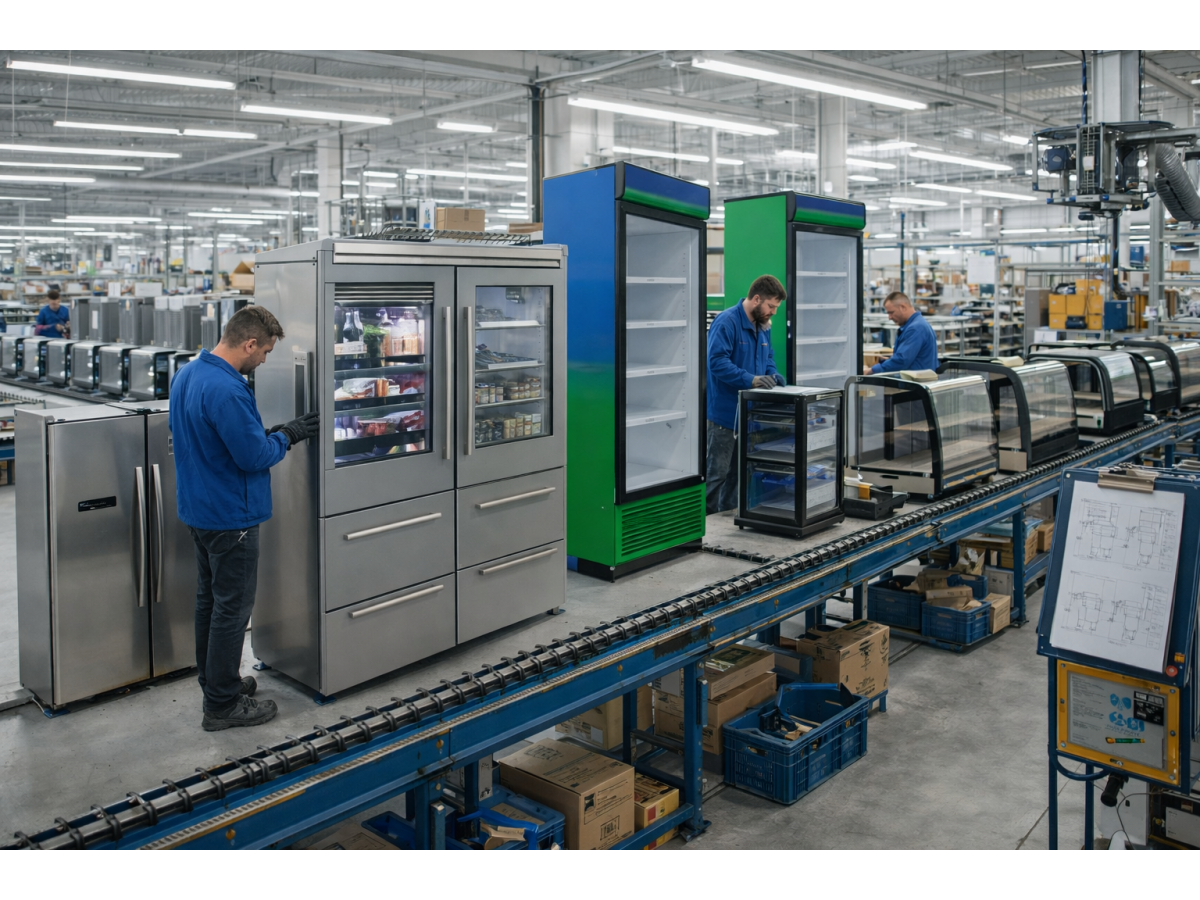
Stainless steel clip-on nuts can be considered for suitable medical and laboratory equipment structures such as:
diagnostic equipment housings;
laboratory instrument covers;
service panels;
equipment carts;
internal brackets;
removable enclosure components.
However, the use of 304 or 316 stainless steel does not automatically establish:
medical-device certification;
ISO 13485 compliance;
biocompatibility;
sterile suitability;
cleanroom qualification;
patient-contact suitability.
Those are separate requirements that must be defined and validated for the specific equipment.
For many enclosure applications, the engineering question is simply whether the selected stainless fastener suits the mechanical and environmental conditions of the equipment.
Laboratory instruments may encounter:
humidity;
cleaning chemicals;
reagents;
condensation;
repeated service access.
A stainless clip-on nut may provide an appropriate corrosion-aware fastening option for selected sheet-metal housings and service panels.
The material grade should be selected according to the actual chemical exposure.
“Laboratory use” alone does not automatically require 316.
Food-processing equipment can involve frequent cleaning and wet environments.
Suitable stainless clip-on nut applications may include:
equipment covers;
non-product-contact housings;
service panels;
control enclosures;
internal brackets.
The required stainless grade depends on:
cleaning chemistry;
chloride exposure;
temperature;
hygienic design requirements;
contact location;
customer specification.
A stainless fastener should not automatically be described as food-contact compliant merely because it is made from 304 or 316.
HVAC equipment can experience very different environments depending on location.
An indoor control enclosure in a conditioned building is not equivalent to an outdoor coastal air-handling unit.
Engineers should evaluate:
humidity;
condensation;
coastal salt;
industrial atmosphere;
cleaning;
temperature;
panel material.
304 may be suitable for some environments.
316 may be preferred for others.
The grade decision should follow exposure conditions rather than the industry name alone.
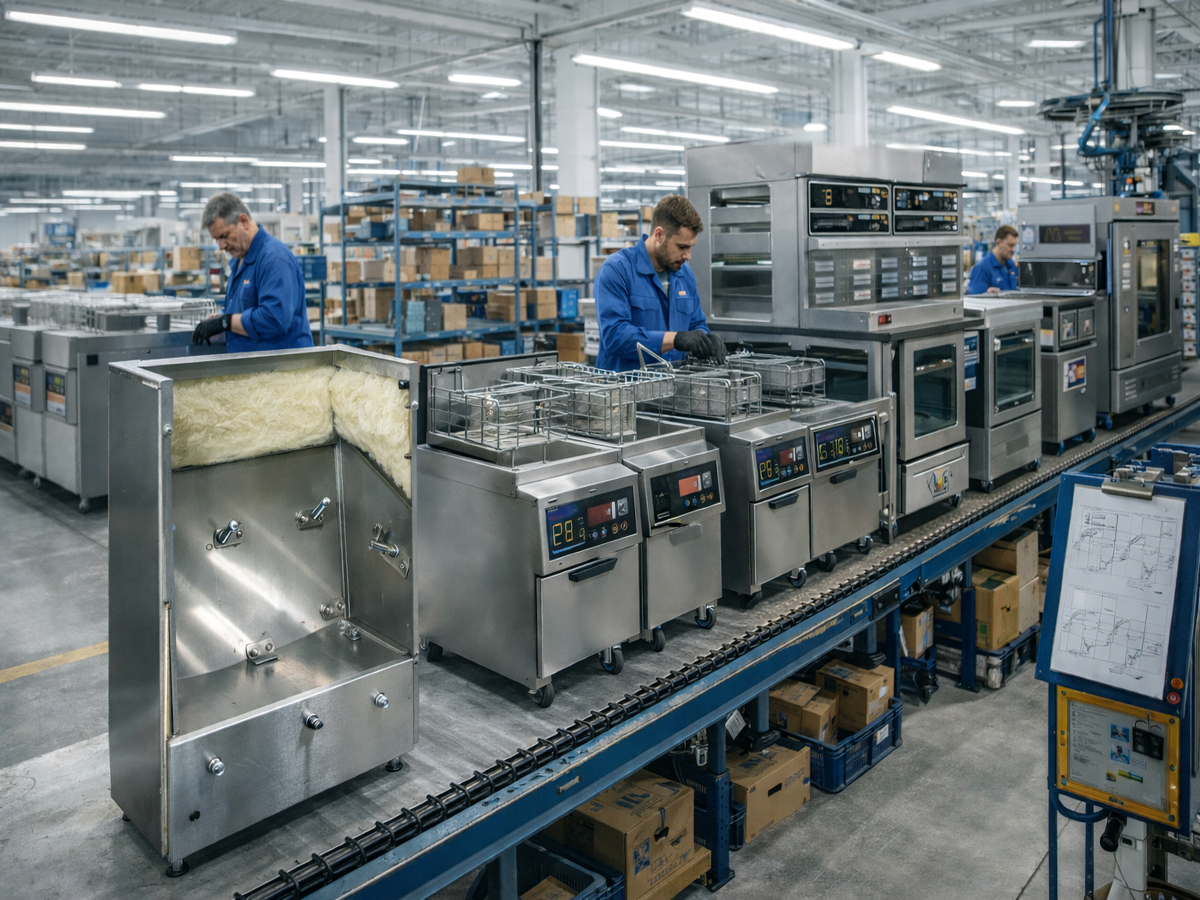
Electrical cabinets may be installed:
indoors;
outdoors;
near the coast;
inside industrial plants;
in humid utility areas;
near chemical processes.
Stainless clip-on nuts can be considered where corrosion resistance is part of the enclosure specification.
However, the clip-on nut should not automatically be treated as:
a grounding fastener;
a bonding component;
an EMI component;
a sealing fastener.
Those functions require separate engineering.
Rail vehicles and infrastructure equipment may use stainless spring fasteners in suitable sheet-metal enclosures and service structures.
Potential applications can include:
communication cabinets;
equipment enclosures;
interior service panels;
electrical housings;
removable covers.
Rail environments may involve:
humidity;
cleaning chemicals;
de-icing salts;
vibration;
cyclic loading.
Selecting 316 instead of 304 addresses only part of this engineering picture.
The stainless grade does not establish vibration, fatigue or rail qualification.
Coastal equipment can experience airborne chloride deposition even when it is not directly exposed to seawater.
Potential applications include:
electrical cabinets;
HVAC housings;
industrial control boxes;
outdoor equipment enclosures.
For these applications, engineers should evaluate:
distance from direct salt exposure;
sheltering;
wash frequency;
condensation;
crevice geometry;
panel material.
316 may provide useful additional localized-corrosion resistance, but the complete enclosure design still matters.
Corrosion resistance is only one side of the selection.
A clip-on nut is also a spring component.
Austenitic stainless steels have forming and work-hardening characteristics that differ from many carbon and spring steels.
The finished clip behavior therefore depends on:
stainless grade;
strip condition;
forming process;
clip geometry;
amount of installation deflection;
panel thickness;
finished material condition.
Engineers should not assume that changing a carbon steel clip directly to 304 or 316 while keeping every dimension unchanged will automatically produce identical clip-retention behavior.
The finished component should be evaluated.
Cold forming can change the local material condition of austenitic stainless steel.
For spring fasteners, this means the properties of the finished formed clip may differ from those of the starting flat material.
This reinforces an important sourcing principle:
Material certificate + finished-part validation
is more meaningful than material designation alone.
304 and 316 are commonly described as austenitic stainless steels and may have low magnetic response in certain material conditions.
However, cold working during forming can alter magnetic response.
A finished clip-on nut should therefore not automatically be marketed as completely non-magnetic solely because the starting material is 304 or 316.
If magnetic behavior is important to the equipment, it should be specified and evaluated separately.
Stainless steel derives corrosion resistance from its passive surface condition, but manufacturing can influence that surface.
Processes such as:
forming;
tooling contact;
handling;
heat exposure;
contamination;
fabrication;
can affect surface condition.
Where a project requires cleaning, passivation or another defined post-fabrication treatment, the requirement should be specified explicitly.
Passivation treatments may be specified for stainless components to help remove certain surface contaminants and support an appropriate passive surface condition.
ASTM A967/A967M is one recognized specification covering chemical passivation treatments for stainless steel parts.
Its applicability should be determined by the customer's product and process requirements.
JUXIN FASTENERS should not claim that every stainless clip-on nut is passivated unless that process is actually specified and performed for the product.
ASTM material standards can be useful during stainless steel sourcing, but their scope must be respected.
ASTM A240/A240M covers chromium and chromium-nickel stainless steel plate, sheet and strip for specified applications.
ASTM A666 covers annealed or cold-worked austenitic stainless steel sheet, strip, plate and flat bar.
These standards can be relevant to raw or semi-finished material selection where their scope fits.
They should not automatically be presented as finished clip-on nut product standards.
The finished fastener remains controlled by its drawing, manufacturing requirements and applicable customer specifications.
Rather than publishing one fixed chemistry number, an OEM specification should reference the required grade under the applicable material framework.
This avoids turning nominal chemistry descriptions into false exact limits.
Where material traceability is required, procurement can request appropriate material documentation according to the project requirement.
Some OEM programs require:
material certificates;
heat/lot identification;
chemical composition documentation;
incoming material traceability;
inspection records.
Other commercial applications may not require the same documentation level.
JUXIN FASTENERS should therefore supply documentation according to the agreed purchase specification rather than claiming universal certification packages for every clip-on nut order.
Stainless clip-on nuts are sometimes installed on aluminum sheet-metal structures.
This creates a dissimilar-metal interface.
When electrically connected dissimilar metals are exposed to an electrolyte, galvanic corrosion may become relevant.
Risk depends on:
material combination;
relative exposed areas;
moisture;
electrolyte;
coating;
geometry;
drainage;
environmental severity.
The engineer should evaluate the complete material couple.
A stainless clip can also be installed onto painted, powder-coated or otherwise protected carbon steel.
In this case, the coating can act as part of the interface condition.
But coating damage during clip installation may expose underlying steel.
Therefore, engineers should consider:
coating thickness;
clip installation force;
edge condition;
coating damage;
moisture exposure;
service environment.
Material selection should not stop at the fastener itself.
A poorly drained 316 assembly can experience a different environment from a freely drained 304 assembly.
This does not mean geometry always outweighs material grade.
It means corrosion performance is a system property.
A robust design considers:
Alloy + Geometry + Surface Condition + Environment + Maintenance
rather than alloy alone.
| Engineering Question | 304 Stainless Steel | 316 Stainless Steel |
|---|---|---|
| General indoor industrial exposure | Often evaluated | Can also be used |
| Higher chloride exposure | Requires careful evaluation | Often considered because of improved localized-corrosion resistance |
| Coastal atmosphere | Application-specific | Frequently evaluated |
| Cleaning chemicals | Check actual chemistry | Check actual chemistry; not universally resistant |
| Pitting resistance | Lower relative resistance than comparable 316 | Generally improved due in part to molybdenum |
| Crevice corrosion | Possible | Possible |
| Galvanic corrosion | Must be evaluated | Must be evaluated |
| Medical equipment | Does not automatically establish compliance | Does not automatically establish compliance |
| Food equipment | Does not automatically establish food-contact suitability | Does not automatically establish food-contact suitability |
| Spring performance | Finished part must be validated | Finished part must be validated |
| Cost | Often commercially attractive | Typically higher material cost; evaluate application need |
The table is a screening guide, not a substitute for project-specific engineering.
The decision is not always between two stainless grades.
Carbon steel with an appropriate surface treatment may also be technically and commercially suitable for many applications.
A broader decision process can ask:
Is stainless steel required?
If no, evaluate carbon steel plus the specified coating.
If yes, determine:
What corrosion mechanism is driving the requirement?
Then compare 304, 316 or another material according to the actual environment.
For a detailed carbon steel discussion, see Carbon Steel Clip-On Nuts: Material Grades, Coatings & OEM Selection at /solutions/carbon-steel-clip-on-nuts-material-coating-guide.
65Mn and stainless steel represent different material-selection paths.
65Mn may be specified for a particular spring-fastener design.
304 or 316 may be specified where stainless material characteristics are required.
Neither should be selected solely from a generic statement such as:
“65Mn is stronger”
or
“316 is better.”
The correct selection depends on the actual clip geometry, panel interface, environmental requirement and customer specification.
For additional material-selection guidance, see 65Mn Spring Steel Clip-On Nuts: Material Selection, Elastic Recovery & Panel Fit at /solutions/65mn-spring-steel-clip-nuts.
Folded and flanged panels create additional corrosion and fit considerations.
A clip installed over a folded edge may create:
additional contact surfaces;
narrow crevices;
multi-layer thickness;
drainage restrictions.
The engineer should therefore evaluate both corrosion and geometry.
For flange-selection guidance, see Clip-On Nuts for Flanged Edges: Fastening Folded Sheet-Metal Panels at /solutions/clip-on-nuts-for-flanged-edges.
Material grade does not determine whether a U-nut or J-nut geometry is correct.
Engineers should still evaluate:
panel thickness;
hole setback;
throat depth;
installation direction;
surrounding clearance.
For geometry guidance, see U-Nuts vs J-Nuts: Geometric Selection for Edge-Mounted Sheet Metal at /solutions/u-nuts-vs-j-nuts-geometry.
A stronger material-selection process begins with the environment.
Define:
indoor or outdoor;
humidity;
condensation;
chloride exposure;
coastal conditions;
industrial contamination;
cleaning frequency.
Where chemicals are present, record:
chemical name;
concentration;
temperature;
exposure duration;
cleaning frequency;
rinse condition.
Consider whether the concern is primarily:
general corrosion;
pitting;
crevice corrosion;
galvanic corrosion;
contamination.
Identify whether the clip will contact:
stainless steel;
carbon steel;
coated steel;
aluminum;
another alloy.
Specify:
U-nut;
J-nut;
flanged-edge clip;
other spring fastener;
panel thickness;
hole setback;
thread interface.
Compare 304 and 316 according to the actual exposure.
Do not select 316 simply because it is perceived as “premium.”
Where necessary, specify:
surface condition;
cleaning;
passivation;
contamination control;
appearance.
For demanding environments, validate the actual fastener-panel system under representative conditions.
A quotation stating “stainless clip nut” is incomplete for grade-controlled sourcing.
Procurement should compare:
exact material grade;
applicable material specification;
product geometry;
drawing revision;
panel-fit requirement;
thread specification;
finished material condition;
surface treatment where required;
passivation requirement where applicable;
material documentation requirement;
inspection requirements;
packaging;
production quantity;
annual demand.
The supplier should not substitute 304 and 316 without customer approval where the grade is drawing-controlled.
316 can cost more than 304.
Using it where the environment does not require its additional corrosion characteristics can increase component cost without necessarily improving another required function.
Conversely, selecting 304 solely to reduce cost in a chloride-sensitive environment may create unnecessary corrosion risk.
A more useful procurement objective is therefore:
Specify the least complex material solution that satisfies the validated application requirement.
That is different from choosing either the cheapest grade or the most expensive grade by default.
When submitting an RFQ to JUXIN FASTENERS at info@juxinfasteners.com, include as much of the following information as available:
2D drawing;
3D CAD model where relevant;
existing sample or reference photo;
customer part number;
clip-on nut geometry;
U-nut, J-nut or other configuration;
required stainless steel grade;
applicable material specification where required;
metric or inch requirement;
thread size;
thread pitch where applicable;
mating screw specification;
panel material;
panel thickness;
panel thickness tolerance;
hole diameter;
hole setback;
edge or flange geometry;
indoor or outdoor environment;
humidity or condensation exposure;
chloride exposure;
coastal exposure where applicable;
cleaning chemical;
chemical concentration where relevant;
cleaning temperature where relevant;
cleaning frequency;
passivation requirement where applicable;
material documentation requirement;
inspection requirements;
galvanic corrosion considerations;
prototype/sample quantity;
production order quantity;
annual demand;
packaging requirements;
customer-specific specifications.
A technically controlled sourcing path for stainless steel clip-on nuts is:
Environment → Corrosion Mechanism → Panel Material → Clip Geometry → 304/316 Material Evaluation → Surface Condition
→ Chemical Compatibility Review → Prototype Evaluation → Environmental Validation Where Required → Production Specification → Supplier RFQ → Repeat Supply
This prevents “304 vs 316” from becoming a simplistic material comparison.
For drawing-based 304 stainless steel clip-on nuts, 316 stainless steel clip-on nuts, stainless U-nuts, stainless J-nuts and related OEM spring fasteners, contact JUXIN FASTENERS at info@juxinfasteners.com.
Providing the actual drawing, stainless grade requirement, panel material,
environmental exposure and cleaning conditions allows JUXIN FASTENERS to evaluate the requested component more accurately than specifying “stainless steel” alone.
Product Packaging
Packaging Standard
At Juxin Fasteners, we apply standardized export packaging to ensure product protection, traceability, and compliance with international logistics requirements.
1. Standard Export Packaging
Unless otherwise specified, all products will be packed according to our factory standard export packaging, which includes:
Moisture-resistant inner protection
Poly bag or small box packing as required
Reinforced export cartons
Clear labeling with part number, specification, batch number, and quantity
Palletizing for sea or air shipment when necessary
Our standard packaging is designed to ensure safe transportation, efficient warehousing, and long-distance international shipping.
2. Customized Packaging Options
We also provide customized packaging solutions according to customer requirements, including but not limited to:
Private labeling
Customized barcodes
Specific carton dimensions
Retail packaging
Special pallet configuration
Customer-specific marking and identification
So that you know, customized packaging may involve additional costs and extended lead time depending on the complexity of the requirements.
3. Compliance & Quality Assurance
All packaging processes are controlled under our ISO 9001 quality management system to ensure consistency, traceability, and product integrity throughout the supply chain.
Product Pictures
Contact Us
Tel.:
+86 020 8621 0320
+86 020 3121 6067
E-mail:
Technical Support:
Navigation
SEND INQUIREY