Call Us
+86 136 6007 9809
Call Us
+86 136 6007 9809

Product Specification
Clip-on nuts provide a practical threaded fastening solution for sheet metal panels, brackets, flanges, covers, trim components, electrical enclosures,
appliances, and industrial assemblies where installing a conventional loose nut or welding a nut directly to the substrate is not convenient.
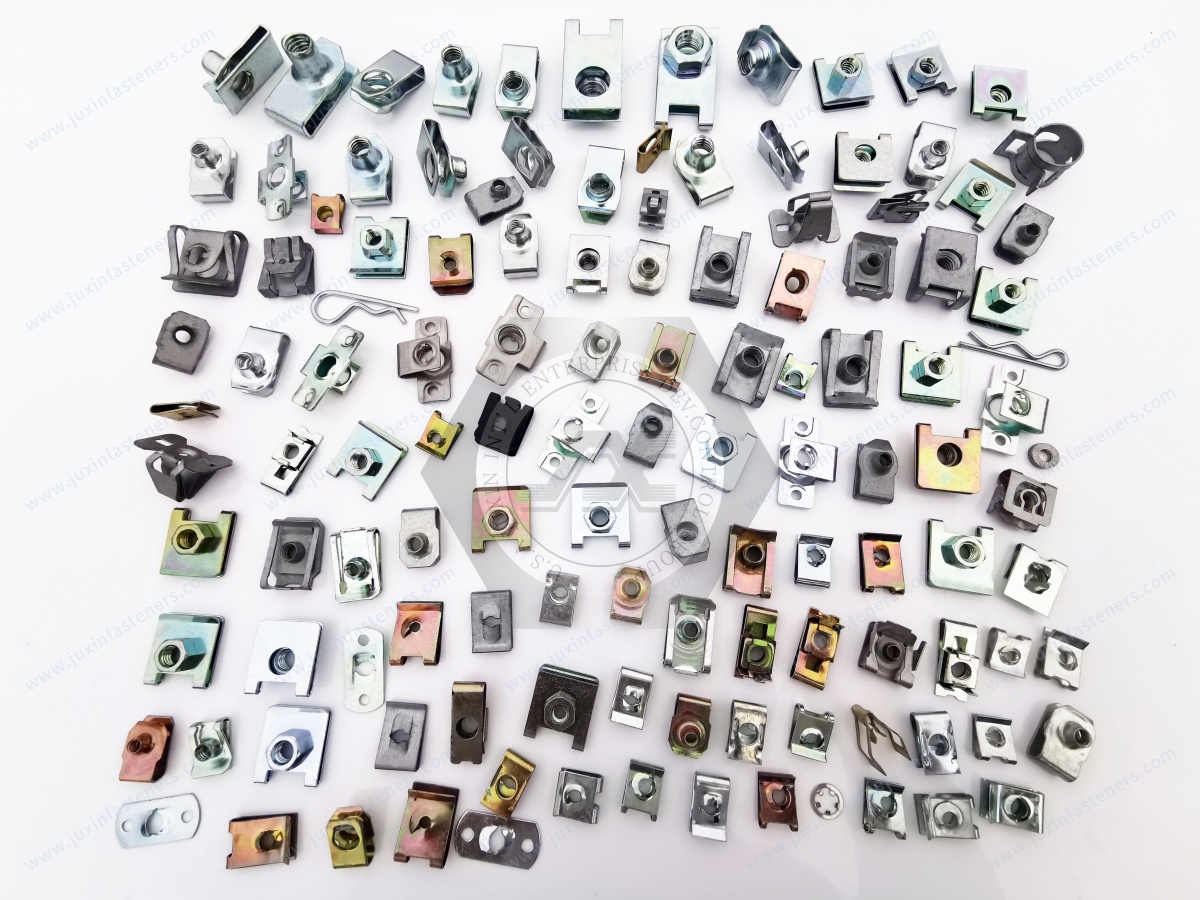
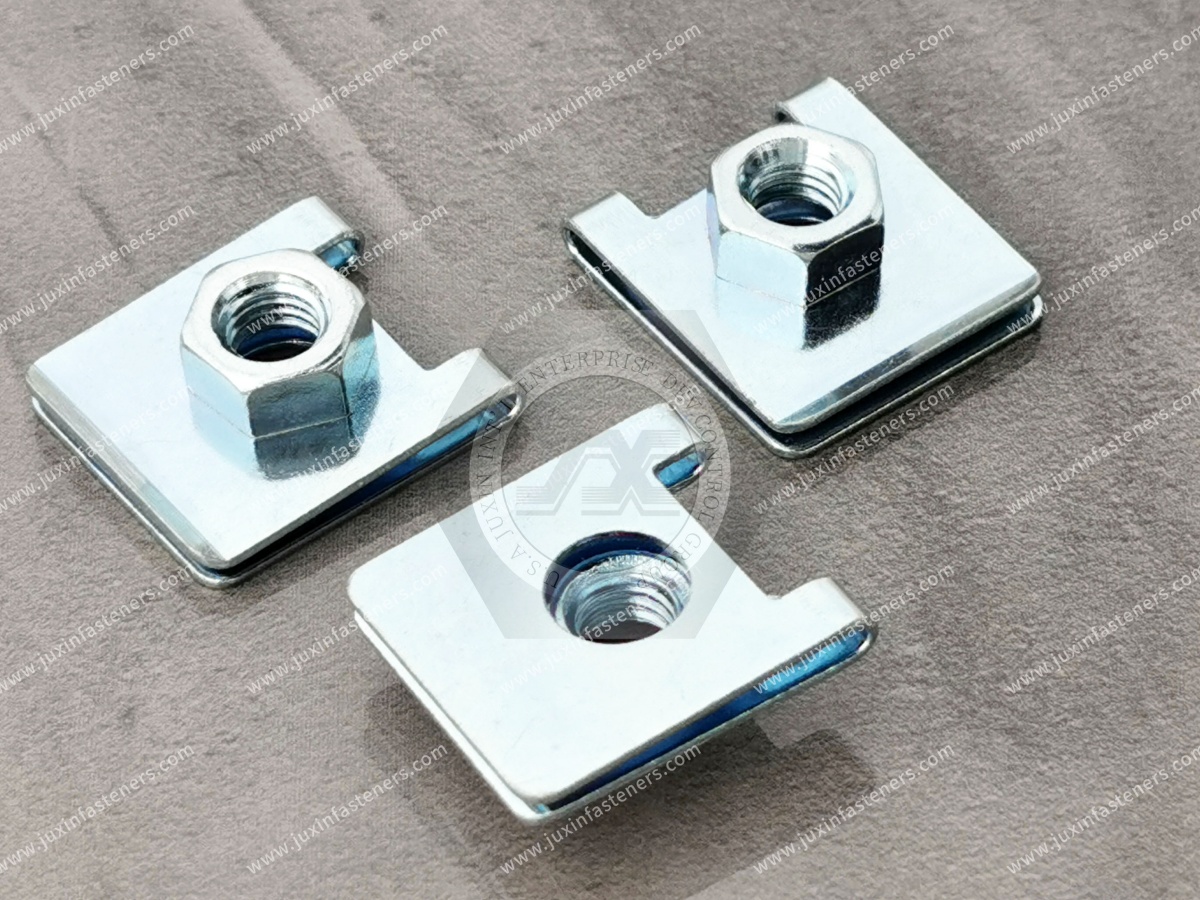
J-nuts, U-nuts, spring nuts, clip nuts, clip-on barrel nuts, and related spring steel fastening components are designed to position a threaded element on a panel edge, flange, hole, slot, or other defined mounting feature.
This makes clip-on nuts particularly useful when an assembly requires fast installation, limited backside access, removable fastening, pre-positioned hardware, or a compact threaded attachment point.
However, selecting the correct clip-on nut is more than matching the nominal screw size.
Panel thickness, edge geometry, thread type, screw design, clip retention, nut position, installation direction, material, surface treatment, corrosion environment, and service conditions all need to be considered.
JUXIN FASTENERS supplies clip-on nuts and spring fastening components for OEM and industrial applications,
including J-style and U-style configurations, clip-on nuts for tapping screws, low-profile designs, and custom configurations based on application requirements.
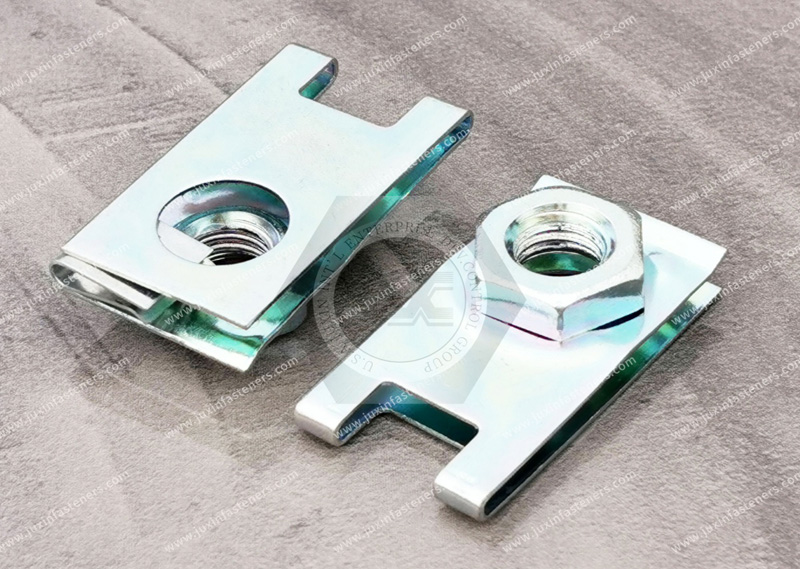
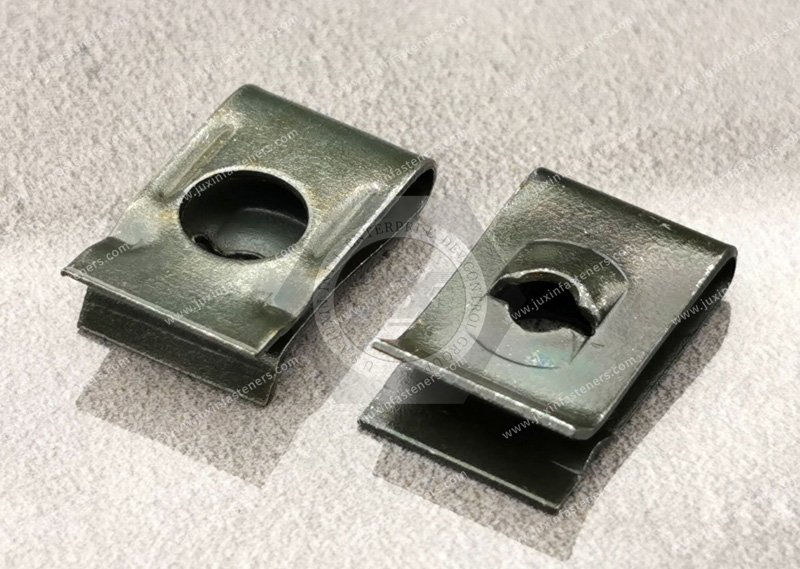
A clip-on nut is a threaded fastening component designed to attach to a panel, sheet-metal edge, flange, slot, hole, or similar feature.
Instead of machining a conventional threaded hole into the base panel, the clip-on nut provides the threaded interface for the mating screw.
The basic fastening architecture is:
Panel + retaining clip + threaded element + mating screw
The spring portion positions and retains the nut during assembly while the screw engages the internal thread.
Depending on the configuration, the nut may have limited positional movement before tightening.
This can help accommodate normal assembly variation, but the amount of movement depends on the actual product geometry.
A clip-on nut should therefore not automatically be described as a self-locking fastener or as a permanent captive nut unless the specific design has been validated for that function.
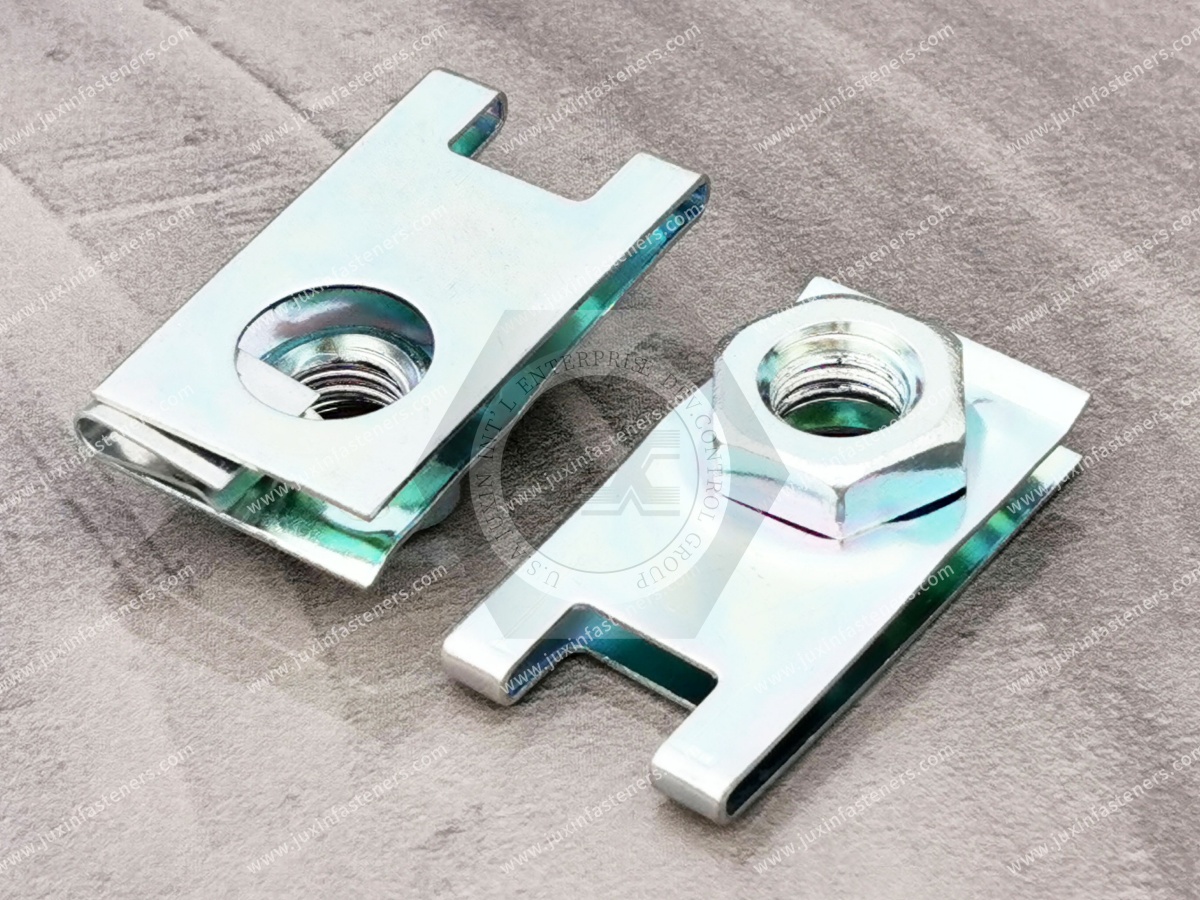
Clip-on nuts are commonly considered when an assembly has one or more of the following requirements:
Thin sheet-metal construction
Limited backside access
One-sided screw installation
Fast assembly
Removable fastening
Pre-positioned threaded hardware
Low installation height
Panel-edge attachment
Automotive trim fastening
Electrical enclosure assembly
Appliance panel fastening
Industrial equipment covers
Bracket attachment
The main advantage is that the threaded attachment point can be installed without welding a conventional nut directly to the panel.
J-nuts use a J-shaped retaining profile.
The geometry normally includes a longer leg and a shorter retaining leg, with the threaded portion positioned to receive the mating screw.
J-nuts can be useful where a panel edge or flange provides the installation interface and the assembly requires a pre-positioned threaded attachment.
The exact retention behavior depends on the design, panel thickness, and geometry.
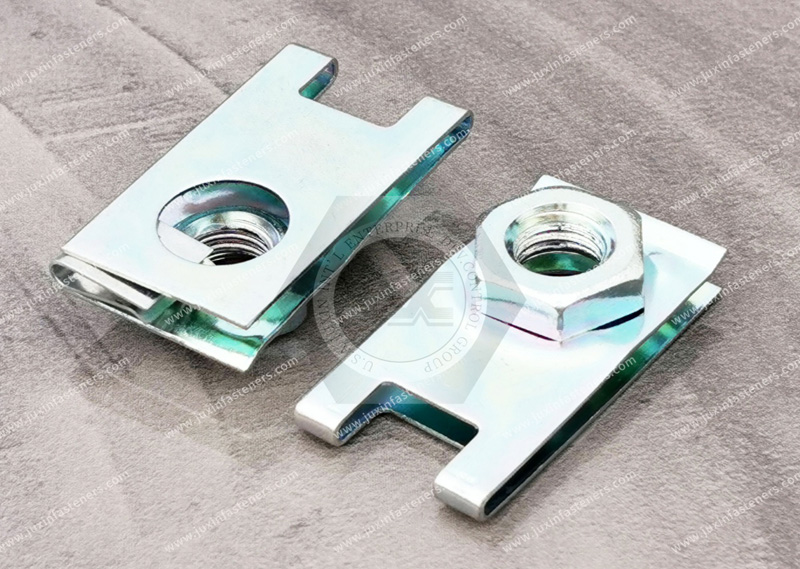
U-nuts use a U-shaped spring configuration.
The clip surrounds the panel edge or designated mounting feature, while the threaded section provides the screw interface.
U-style designs are widely used for sheet-metal fastening because the spring structure can hold the nut in position before final screw installation.
JUXIN FASTENERS supplies U-style clip-on nut configurations for industrial and automotive fastening applications.
“Spring nut” is a broader engineering term that can cover several spring-retained nut configurations.
SAE J891 addresses metric and inch spring nuts recognized as SAE standard and provides general and dimensional specifications within its defined scope.
The standard also notes that other spring-nut configurations exist.
Therefore, “spring nut” and “clip-on nut” should not automatically be treated as identical terms in every catalog or drawing.
For OEM sourcing, the actual geometry and drawing should control.
A clip-on barrel nut combines a retaining clip with a barrel-shaped threaded element.
The barrel configuration can provide a defined threaded interface and, depending on the design, may incorporate external geometry that helps resist rotation during screw installation.
These designs can be useful when the application requires:
Defined screw alignment
A more substantial threaded element
Panel-edge retention
Anti-rotation geometry
A controlled installation position
The actual performance depends on the specific configuration and should be confirmed from the engineering drawing.
Some clip-on nuts are specifically designed for tapping screws.
This creates a different fastening system from a conventional machine-screw nut.
The screw and clip-on nut should be considered together because thread engagement, screw geometry, installation torque, and material interaction can all influence assembly performance.
JUXIN FASTENERS offers clip-on nut configurations designed for tapping-screw applications.
The panel is one of the most important inputs for clip-on nut selection.
Identify:
Panel material
Panel thickness
Minimum thickness
Maximum thickness
Edge condition
Hole or slot geometry
Flange geometry
Burr condition
Available clearance
A clip-on nut designed for one panel thickness should not automatically be assumed suitable for another.
The retaining clip must fit the actual panel thickness.
If the panel is too thin, the clip may not retain correctly.
If the panel is too thick, the clip may not seat correctly or may require excessive deformation during installation.
For an OEM project, provide the actual panel thickness range rather than simply stating “thin sheet metal.”
The supplier should understand whether the nut is being installed onto:
A straight sheet edge
A flange
A return flange
A formed bracket
A punched opening
A slot
A reinforced panel edge
A stepped sheet-metal feature
The retaining geometry must match the actual substrate.
Some clip-on nuts interact with holes or slots rather than simply clipping over an exposed edge.
Important parameters may include:
Hole diameter
Slot width
Slot length
Edge distance
Panel thickness
Burr condition
Formed geometry
These details should be included on the engineering drawing.
This distinction is critical.
A machine screw normally engages an established internal thread.
A tapping screw is designed to form or engage its mating thread according to the specific screw and nut configuration.
Using the wrong screw can lead to:
Poor thread engagement
Thread damage
Excessive installation torque
Inconsistent assembly
Difficult disassembly
Reduced joint performance
The clip-on nut and mating screw should therefore be specified together.
Metric clip-on nuts can be specified with metric thread sizes and pitches according to the applicable product design and customer drawing.
ISO 261 and ISO 262 provide references for metric screw-thread dimensions, while ISO 965 addresses metric screw-thread tolerances within its scope.
The applicable thread specification should always be confirmed against the actual drawing.
For inch-series applications, the required thread designation should be clearly specified on the customer drawing or purchase specification.
Do not assume an inch thread simply from a product description such as “U-nut” or “spring nut.”
Thread engagement should be considered separately from clip retention.
The spring clip holds the nut relative to the panel.
The internal thread transfers the screw load into the nut.
These are different engineering functions.
A strong retaining clip does not automatically mean that the threaded joint has sufficient load capacity.
Spring steel is commonly used where the retaining clip must flex during installation and return toward its original position.
Material selection should balance:
Elastic behavior
Strength
Formability
Manufacturing requirements
Corrosion resistance
Heat-treatment condition
Service environment
JUXIN FASTENERS supplies spring-steel clip-on nut configurations for industrial applications.
65Mn is used in selected JUXIN FASTENERS spring-nut and clip-on nut products.
Its suitability depends on the complete design, forming process, heat-treatment condition, geometry, and application requirements.
It should not be treated as a universal material recommendation for every clip-on nut.
Carbon steel can provide a practical combination of mechanical performance, manufacturability, and cost for general applications.
Where carbon steel is used, the surface treatment should be selected according to the actual environmental exposure.
Stainless steel clip-on nuts can be considered where corrosion resistance is an important design requirement.
Potential applications include:
Humid environments
Outdoor equipment
Electrical equipment
Industrial machinery
Equipment exposed to condensation
Applications where a corrosion-resistant substrate is preferred
The appropriate stainless grade depends on the environment, forming requirements, strength requirements, and cost target.
A stainless-steel designation by itself does not guarantee suitability for every corrosive environment.
Zinc-plated carbon-steel clip-on nuts can be used where additional surface protection is required.
Actual corrosion performance depends on the base material, coating system, coating condition, environment, and assembly process.
The coating should therefore be specified together with the actual environmental requirement.
Black phosphate can be suitable for selected steel fastening applications, particularly controlled or dry environments.
It should not automatically be treated as equivalent to a corrosion-protection system intended for wet or highly corrosive service.
In some environments, selecting stainless steel can be more appropriate than adding a coating to carbon steel.
The decision should consider:
Corrosion environment
Material compatibility
Cost
Forming requirements
Mechanical requirements
Appearance
This is one of the most important engineering distinctions when evaluating clip-on nuts.
Spring retention keeps the nut positioned during assembly.
Joint retention concerns the behavior of the completed screw joint.
The spring clip can help prevent the nut from falling away or moving excessively before screw installation.
It does not automatically prevent the screw from loosening under vibration.
The final joint depends on the screw, thread engagement, preload, friction, joint stiffness, materials, surface conditions, and service environment.
Some clip-on nut designs allow limited movement before tightening.
This can help compensate for normal assembly variation.
However, too much movement can make screw engagement difficult.
The designer should therefore determine whether the application needs:
Fixed positioning
Limited floating
Lateral adjustment
Controlled alignment
The required movement should be treated as a design characteristic rather than assumed.
Some clip-on nut geometries naturally resist rotation during screw installation.
Others depend on the panel edge, flange, hole, or surrounding geometry.
If anti-rotation is important, it should be specified as a functional requirement.
A generic term such as “U-nut” does not define the complete anti-rotation behavior.
The screw length should account for the complete joint stack-up.
This may include:
Attached component + panel + clip-on nut thread interface + washer if applicable
Too short a screw may produce inadequate thread engagement.
Too long a screw may interfere with:
Wiring
Moving components
Adjacent panels
Interior trim
Sealing surfaces
Service components
One of the practical benefits of clip-on nuts is that the operator can often install the screw from the accessible side while the clip-on nut remains positioned on the panel.
This can reduce the need for a second operator to hold a loose nut behind the panel.
A typical assembly sequence may be:
Clip the nut onto the panel → position the mating component → align the screw → drive the screw → verify the assembly.
This can simplify high-volume assembly.
Some clip-on nut configurations have a defined installation direction.
Incorrect orientation can cause:
Poor retention
Difficult screw engagement
Incorrect nut position
Excessive assembly force
Interference with surrounding components
For production applications, orientation should be clearly shown on the drawing or assembly instructions.
The installation force should be appropriate for the panel and clip geometry.
Excessive installation force may indicate:
Incorrect panel thickness
Incorrect clip geometry
Burr interference
Misalignment
Coating interference
Incorrect installation direction
Increasing spring force is not automatically the correct solution.
It is tempting to describe spring nuts as “stronger” when the clip has higher retention force.
But the complete load path may be:
Screw → internal thread → clip-on nut → panel → bracket → structure
If the panel deforms, bends, tears, or loses local stiffness, increasing the spring retention may not solve the actual joint problem.
A stronger spring can increase retention, but excessive clip force can make assembly difficult or deform a thin panel.
The engineering target is not maximum spring force.
It is appropriate functional retention for the actual panel and assembly process.
When a customer asks for a “vibration-resistant clip-on nut,” the supplier should clarify what must resist vibration.
Possible requirements include:
Nut retention during assembly
Resistance to nut displacement
Screw-joint loosening resistance
Fatigue performance
Repeated-service retention
These are different engineering requirements.
The validation method should match the intended function.
Automotive interior trim frequently combines:
Thin sheet metal
Plastic components
Decorative panels
Restricted access
High-volume assembly
Serviceable components
Clip-on nuts can provide threaded attachment points without requiring a welded nut.
Typical applications can include:
Dashboard components
Console assemblies
Interior brackets
Trim panels
Covers
Small mounting brackets
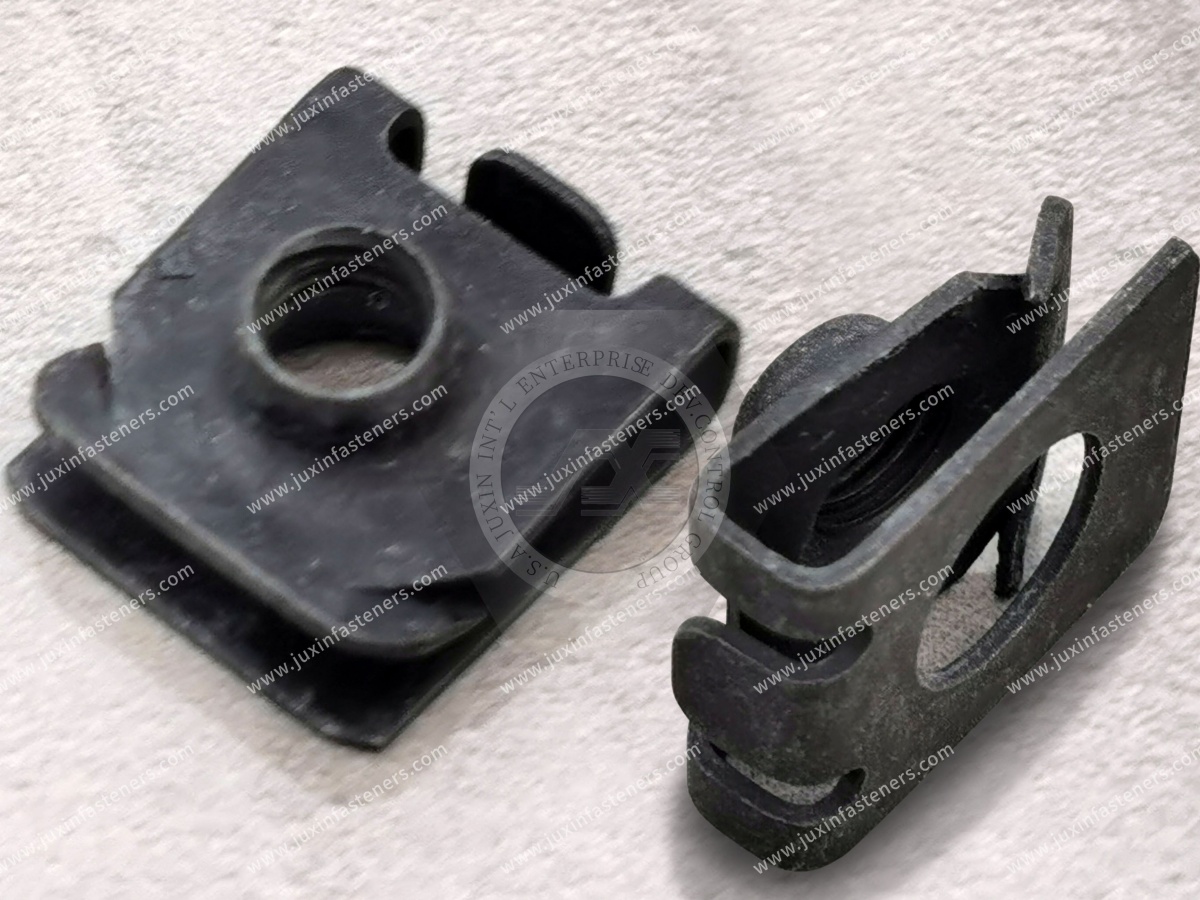
Clip-on nuts can also be considered for selected sheet-metal body and panel assemblies.
The application should be evaluated for:
Panel thickness
Corrosion exposure
Vibration
Service conditions
Assembly sequence
Screw access
Electrical modules and sheet-metal brackets can require compact threaded attachment points.
The engineer should additionally evaluate:
Electrical isolation
Grounding requirements
Corrosion
Panel material
Screw compatibility
Clearance
A clip-on nut should not be described as a grounding component unless the complete assembly has been designed and validated for that purpose.
Clip-on nuts can provide removable threaded attachment points for:
Covers
Brackets
Internal shields
Cable-management components
Equipment supports
Material and surface treatment should be selected according to the enclosure environment.
Formed sheet-metal housings often require removable panels and brackets.
Clip-on nuts can be considered for:
Access covers
Control panels
Internal supports
Guards
Brackets
Service components
Industrial machinery can use clip-on nuts for:
Covers
Guards
Brackets
Access panels
Sheet-metal subassemblies
Vibration, service frequency, corrosion, panel stiffness, and assembly access should all be evaluated.
Sheet-metal chassis and equipment housings often have limited installation space.
Clip-on nuts can help provide removable threaded attachments without welding.
Important parameters include:
Low-profile geometry
Panel thickness
Screw head clearance
Thread type
Material
Surface finish
Weld nuts provide a permanently attached threaded interface.
Clip-on nuts provide a removable or replaceable threaded component.
Clip-on nuts can be attractive where:
Welding is undesirable
Heat input must be avoided
The panel is already finished
Assembly flexibility is important
A replaceable nut is preferred
Weld nuts may be more appropriate where permanent attachment and fixed positioning are required.
Self-clinching nuts are mechanically installed into prepared sheet metal and become integrated with the panel.
Clip-on nuts are generally installed by clipping onto a panel edge, flange, or designated feature.
Self-clinching nuts can be appropriate when permanent retention is required.
Clip-on nuts can be attractive when rapid installation, removability, or edge attachment is important.
For permanent sheet-metal fastening applications, see the JUXIN FASTENERS self-clinching nut and telecommunications fastening solution.
Blind rivet nuts are mechanically installed into prepared holes and deformed to create a threaded insert.
They are particularly useful where only one side of the panel is accessible.
Clip-on nuts use a different architecture and are often installed over an edge, flange, slot, or designated feature.
For closed or inaccessible panels, a blind rivet nut may be more appropriate.
For fast panel-edge attachment, a clip-on nut may provide a simpler assembly approach.
See the JUXIN FASTENERS Blind Rivet Nuts Engineering Guide.
A loose hex nut normally requires access to the opposite side of the joint.
A clip-on nut can remain positioned on the panel while the screw is installed from the accessible side.
This can simplify high-volume production.
SAE J891 is a relevant reference for spring nuts.
SAE describes J891 as covering general and dimensional specifications for metric and inch types of spring nuts recognized as SAE standard.
It also notes that spring nuts with other configurations and dimensions are available.
This distinction matters because not every commercial product described as a “clip-on nut” should automatically be represented as SAE J891 compliant.
For metric applications, ISO 261 and ISO 262 can be relevant to metric screw-thread dimensions, while ISO 965 covers metric screw-thread tolerances within its defined scope.
The applicable thread specification should always be confirmed from the customer's drawing.
A standard can provide a useful engineering framework, but an OEM drawing may define additional requirements.
These may include:
Special geometry
Panel thickness
Thread location
Surface treatment
Material
Inspection
Functional testing
Packaging
For custom clip-on nuts, the approved drawing should be the primary purchasing reference.
Prioritize:
Panel thickness
Clip opening
Retention
Nut position
Thread engagement
Installation force
Prioritize:
Assembly speed
Panel compatibility
Retention during handling
Screw access
Corrosion environment
Serviceability
Prioritize:
Panel thickness
Corrosion
Material compatibility
Clearance
Screw type
Removability
Prioritize:
Vibration environment
Service frequency
Corrosion
Panel stiffness
Assembly access
Joint requirements
A professional clip-on nut RFQ should identify:
Product type
Thread specification
Mating screw
Panel thickness
Panel material
Panel geometry
Nut material
Surface treatment
Drawing
Annual usage
Initial order quantity
Application environment
Inspection requirements
Packaging requirements
Validation requirements
This is much more useful than a generic request for “strong clip-on nuts.”
The engineering drawing should define the characteristics that control function.
These can include:
Overall dimensions
Thread
Critical clip dimensions
Panel interface
Material
Surface treatment
Functional requirements
Applicable standard
Inspection requirements
A standard clip-on nut may be preferable when it satisfies the application.
Custom development can be considered when the project requires:
Special panel thickness
Special retaining geometry
Unusual thread location
Reduced overall height
Custom nut position
Special screw compatibility
Special material or finish
JUXIN FASTENERS can evaluate custom clip-on nut configurations based on customer drawings and application requirements.
Important dimensions can include:
Thread location
Overall width
Overall height
Clip opening
Retaining-leg position
Nut position
Panel interface
Not every dimension has equal functional importance.
Critical-to-function dimensions should be clearly identified on the engineering drawing.
Thread inspection should correspond to the specified thread standard and tolerance.
The inspection method should be established according to the approved drawing or customer specification.
The spring element is a functional component.
Depending on the application, validation may consider:
Retention
Installed position
Elastic response
Deformation
Fit on the specified panel
The actual test method should be defined according to the product specification.
If corrosion resistance is critical, the customer should specify the required material, coating system, environmental exposure, and validation method.
Salt-spray testing can be useful for controlled coating evaluation, but laboratory results should not automatically be interpreted as a direct field-service-life prediction.
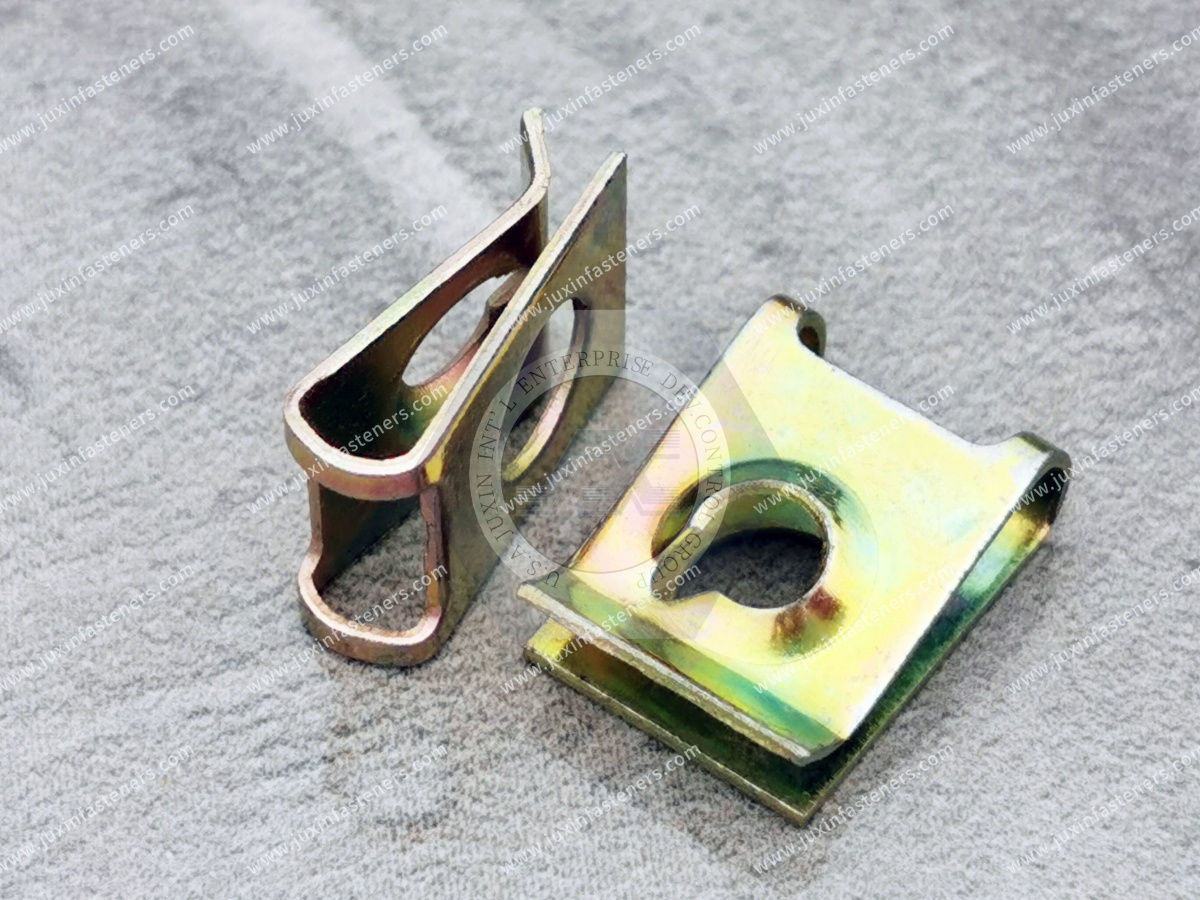
A practical sourcing process can follow this sequence:
Application review
Understand where and how the clip-on nut will be used.
Geometry review
Confirm panel thickness, edge, flange, hole, or slot.
Thread review
Confirm the mating screw and thread type.
Material review
Select spring steel, carbon steel, stainless steel, or another approved material.
Surface-treatment review
Match the finish to the actual environment.
Drawing review
Confirm critical dimensions and tolerances.
Sample evaluation
Verify fit and assembly behavior.
Production quotation
Confirm commercial requirements.
Production approval
Manufacture against the approved specification.
For a new OEM RFQ, send:
2D drawing
3D model if available
Product photograph if useful
Thread specification
Mating screw specification
Panel thickness
Panel material
Panel-edge or hole geometry
Required material
Surface treatment
Application environment
Annual usage
Initial order quantity
Required validation
Inspection requirements
Packaging requirements
Providing this information allows the supplier to evaluate the application rather than making assumptions from the product name.
Clip-on nut pricing can be influenced by:
Material
Thread size
Overall dimensions
Spring geometry
Forming complexity
Heat treatment
Surface treatment
Tooling
Inspection requirements
Packaging
Order volume
Customization
Unit-price comparisons are meaningful only when the specifications are equivalent.
Before approving a clip-on nut, ask:
What exactly retains the nut during assembly?
What transfers the final screw load?
What happens when panel thickness varies?
What happens after repeated assembly?
What actual failure mode are we trying to prevent?
These questions help engineering and procurement teams evaluate the fastening system rather than simply comparing catalog descriptions.
A clip-on nut is a threaded fastening component designed to attach to a sheet-metal panel, edge, flange, hole, or similar feature and provide a threaded attachment point.
A J-nut is a J-shaped spring-style clip-on nut commonly used on panel edges and similar sheet-metal features.
A U-nut is a U-shaped spring-style nut that clips onto a panel or flange and provides a threaded attachment point.
They are related spring-nut configurations but have different retaining geometries. The correct choice depends on the panel and assembly requirements.
Yes. Specific clip-on nut designs are available for tapping-screw applications. The screw and nut should be evaluated together.
They can be suitable for many automotive sheet-metal, trim, bracket, and enclosure applications. The correct design depends on the panel, screw, environment, loading, and assembly process.
Yes. Stainless-steel configurations can be considered where corrosion resistance is an important requirement.
Yes. Custom dimensions, materials, retaining geometry, thread locations, and other features can be evaluated from customer drawings.
No. The clip can help retain the nut during assembly, but the completed screw joint must be evaluated separately for vibration loosening.
Provide the drawing, thread specification, mating screw, panel thickness, panel material, material preference, surface treatment, application environment, annual usage, and validation requirements.
For projects involving other sheet-metal fastening technologies, explore:
Telecommunications Equipment Fasteners & Self-Clinching Nuts
Automotive High-Strength Fasteners: Bolts, Nuts, Clamps & Engineering Selection Guide
Washers and Bolts in Fastening Systems: Engineering Selection Guide
If your application requires clip-on nuts, J-nuts, U-nuts, spring nuts, clip-on barrel nuts, low-profile clip-on nuts, or clip-on nuts for tapping screws,
JUXIN FASTENERS can review the requirement based on your actual drawing and assembly conditions.
For OEM and industrial sourcing, send:
2D drawing or specification
3D model if available
Thread and mating screw information
Panel thickness and material
Required fastener material
Surface treatment
Application environment
Annual usage and initial quantity
Inspection or validation requirements
Packaging requirements
Email: info@juxinfasteners.com
Website: www.juxinfasteners.com
JUXIN FASTENERS supports standard and custom clip-on nut requirements for automotive, electrical, electronics, appliance, industrial equipment, and other OEM fastening applications.
Product Packaging
Packaging Standard
At Juxin Fasteners, we apply standardized export packaging to ensure product protection, traceability, and compliance with international logistics requirements.
1. Standard Export Packaging
Unless otherwise specified, all products will be packed according to our factory standard export packaging, which includes:
Moisture-resistant inner protection
Poly bag or small box packing as required
Reinforced export cartons
Clear labeling with part number, specification, batch number, and quantity
Palletizing for sea or air shipment when necessary
Our standard packaging is designed to ensure safe transportation, efficient warehousing, and long-distance international shipping.
2. Customized Packaging Options
We also provide customized packaging solutions according to customer requirements, including but not limited to:
Private labeling
Customized barcodes
Specific carton dimensions
Retail packaging
Special pallet configuration
Customer-specific marking and identification
So that you know, customized packaging may involve additional costs and extended lead time depending on the complexity of the requirements.
3. Compliance & Quality Assurance
All packaging processes are controlled under our ISO 9001 quality management system to ensure consistency, traceability, and product integrity throughout the supply chain.
Product Pictures
Contact Us
Tel.:
+86 020 8621 0320
+86 020 3121 6067
E-mail:
Technical Support:
Navigation
SEND INQUIREY