Call Us
+86 136 6007 9809
Call Us
+86 136 6007 9809

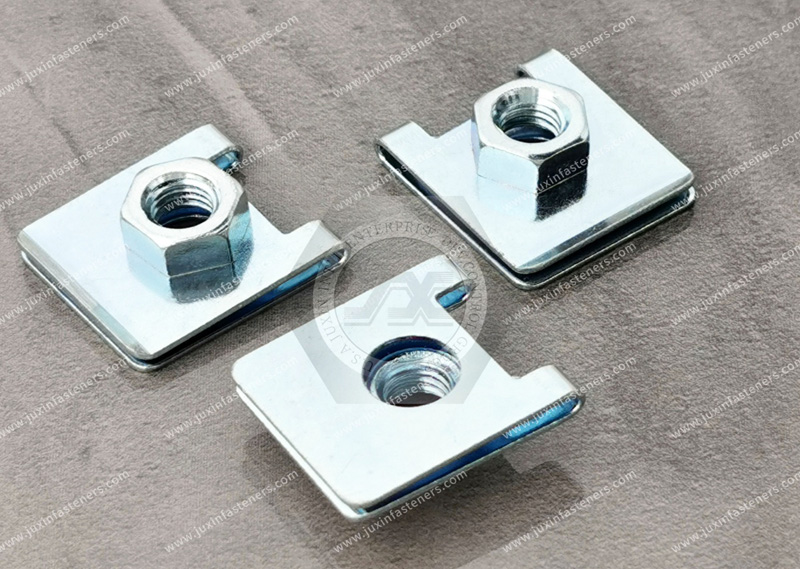
Strong-grip clip-on nuts provide a practical way to add a threaded fastening point to sheet metal, brackets, panels and other components without permanently welding a nut to the assembly.
Two product families are especially useful in industrial fastening design: clip-on nuts for tapping screws and clip-on barrel nuts.
Product Specification
Strong-grip clip-on nuts provide a practical way to add a threaded fastening point to sheet metal, brackets, panels and other components without permanently welding a nut to the assembly.
Two product families are especially useful in industrial fastening design: clip-on nuts for tapping screws and clip-on barrel nuts.
Although both are retained on a panel by a spring-steel clip structure, they are not interchangeable in every application. Their thread architecture, installation method, panel geometry and screw compatibility are different.
For design engineers, the important question is therefore not simply which clip-on nut has the strongest grip. The better question is:
Which clip-on fastening architecture matches the panel, screw, installation direction, service environment and required joint function?
JUXIN FASTENERS supplies OEM-oriented clip-on fastening solutions including strong-grip clip-on nuts for tapping screws and no-slip clip-on barrel nuts in spring-steel and
other material options according to application requirements.
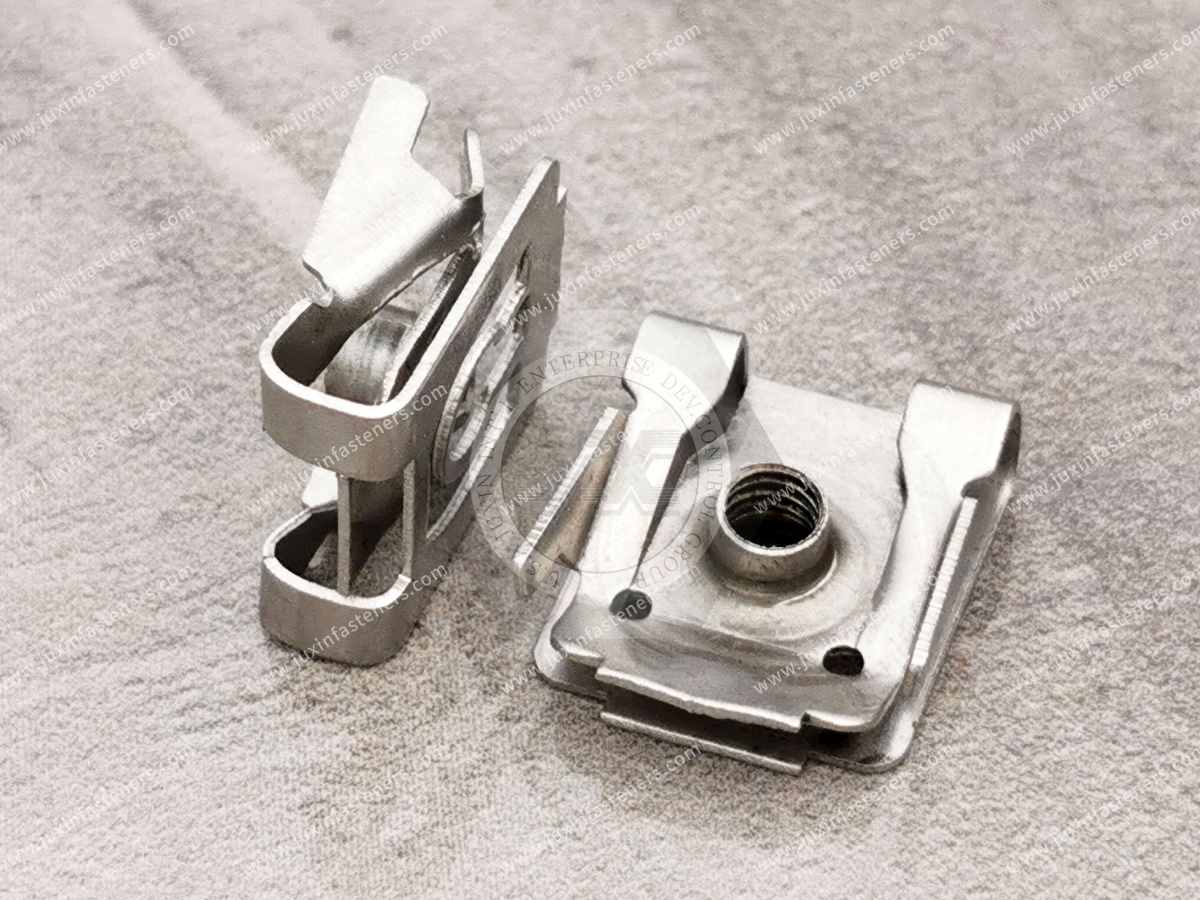
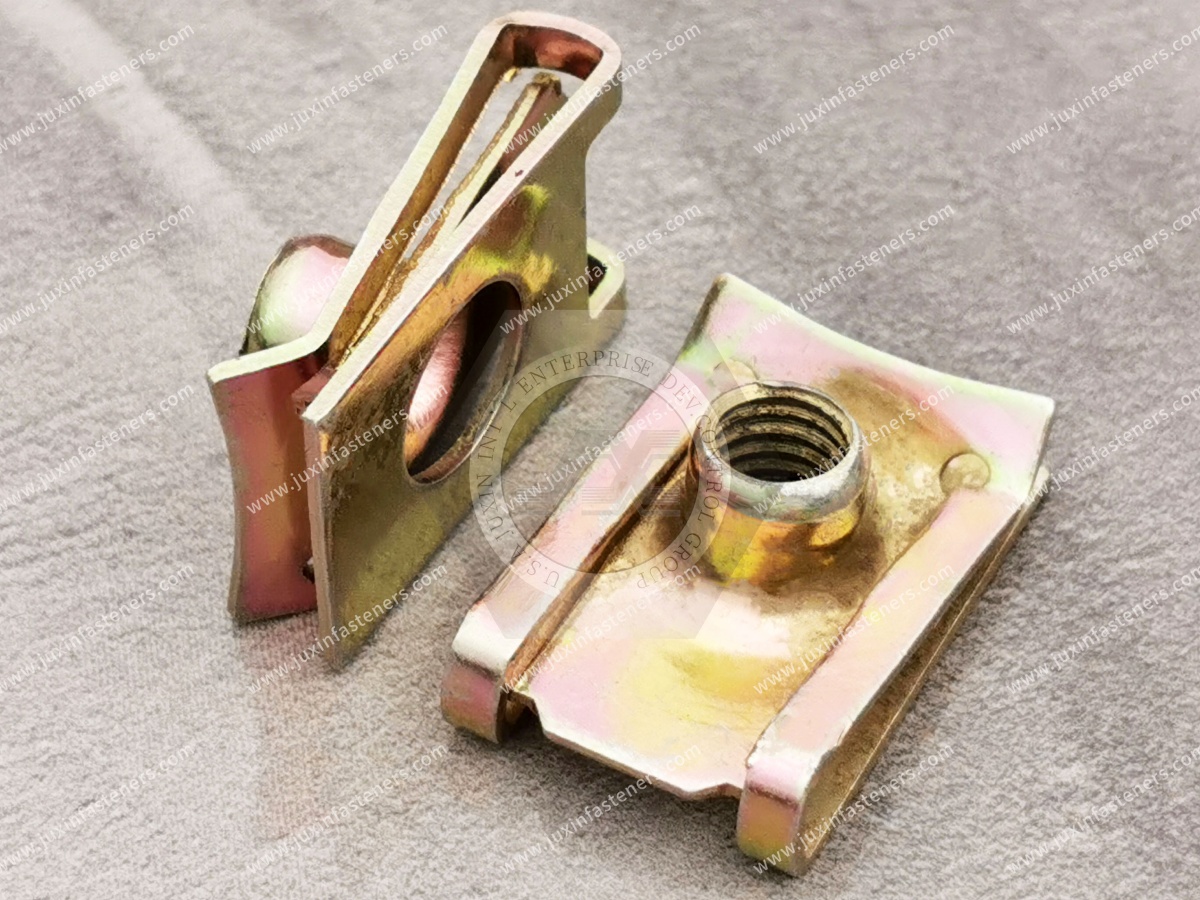
A clip-on nut is a retained threaded fastener designed to attach to the edge or opening of a sheet-metal panel. The spring section grips the panel while the threaded section provides the mating point for a screw.
Unlike a conventional loose nut, the clip-on nut can be positioned on the panel before the mating component is installed.
This can simplify assembly where access to the rear side of the panel is limited.
The term strong-grip clip-on nut describes the functional objective of the design: maintaining reliable retention on the panel during handling and screw installation.
That retention is important, but it should not be confused with the strength of the completed bolted or screwed joint.
The clip must remain properly positioned. The screw must be compatible with the nut design.
The panel must have suitable thickness and edge geometry.
The completed assembly must then be evaluated for the actual service loads, vibration, temperature, corrosion environment and installation process.
This distinction is particularly important in automotive, electrical, appliance and industrial sheet-metal applications.
The two product families solve related but different fastening problems.
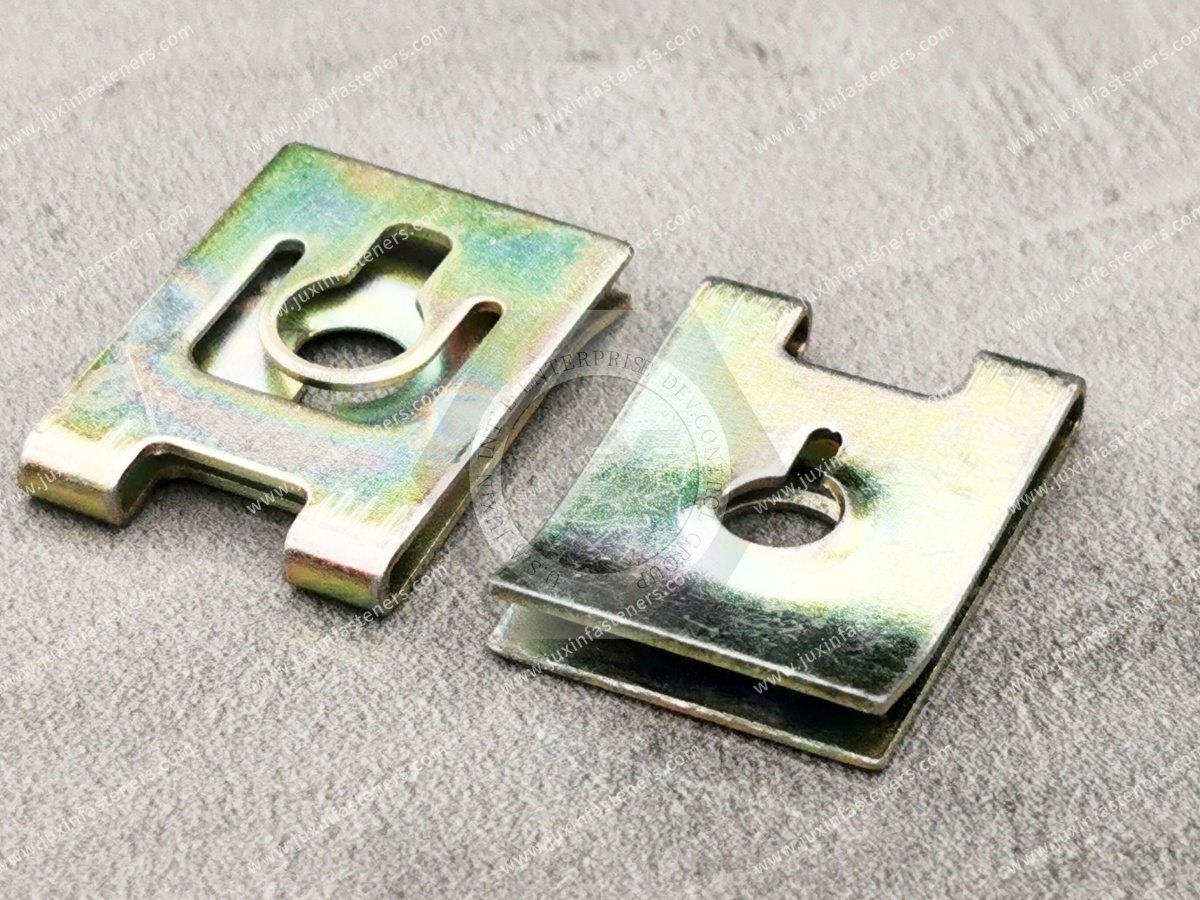
These are designed specifically to work with tapping screws. The fastening system relies on the screw forming or engaging the intended mating thread in the clip-on nut during installation.
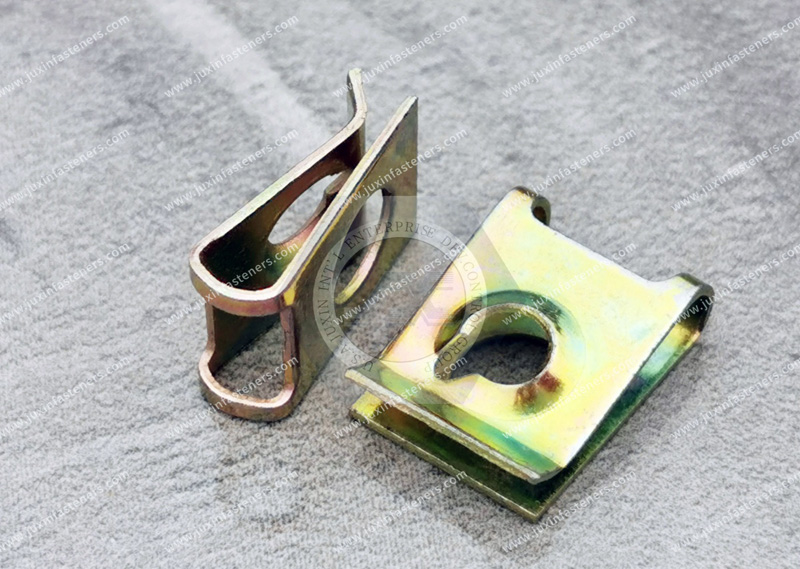
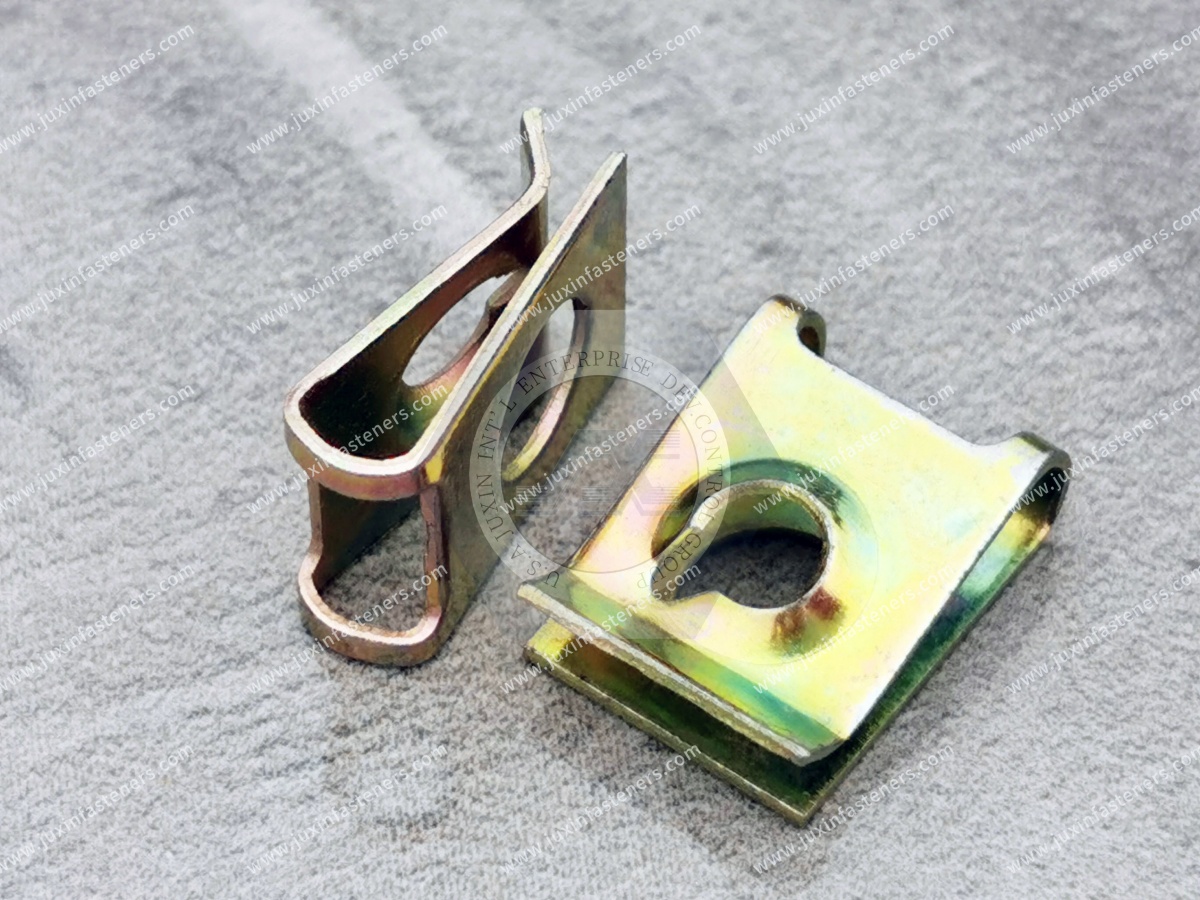
J-nut and U-nut terminology is common in the industrial fastener market.
Some J-nut designs have one leg shorter than the other, allowing the component to be positioned over an edge with some installation clearance.
U-nut designs generally grip the panel from both sides more symmetrically.
This architecture is useful when the assembly has been designed around a tapping screw rather than a conventional machine screw.
JUXIN FASTENERS supplies clip-on nuts for tapping screws and no-slip clip-on versions for applications where panel retention and convenient screw installation are important.
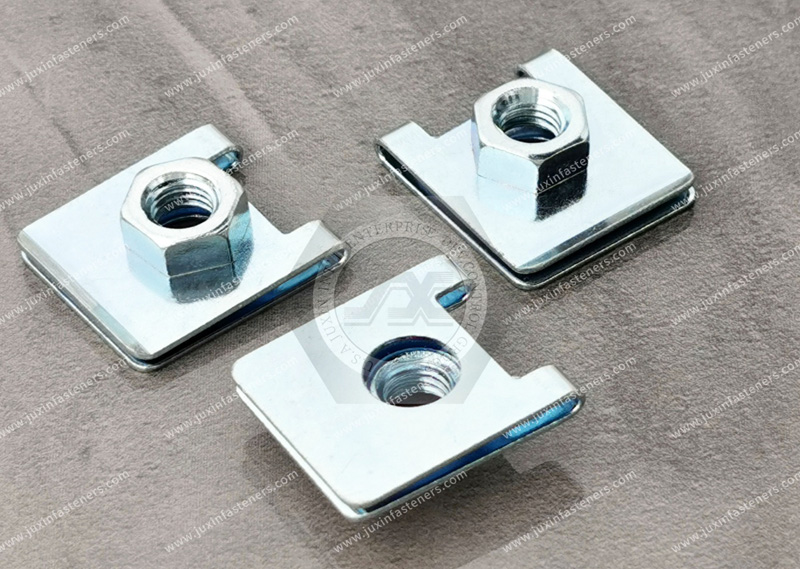
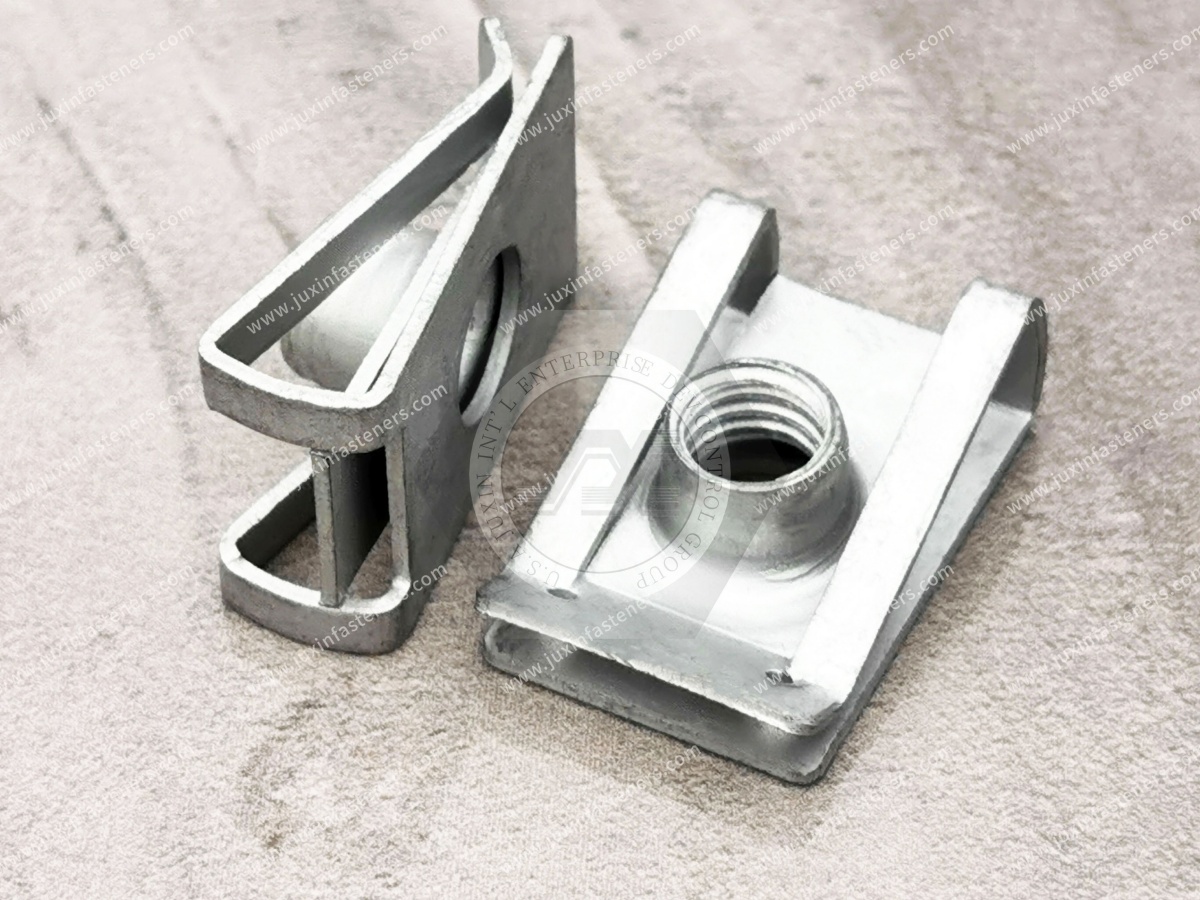
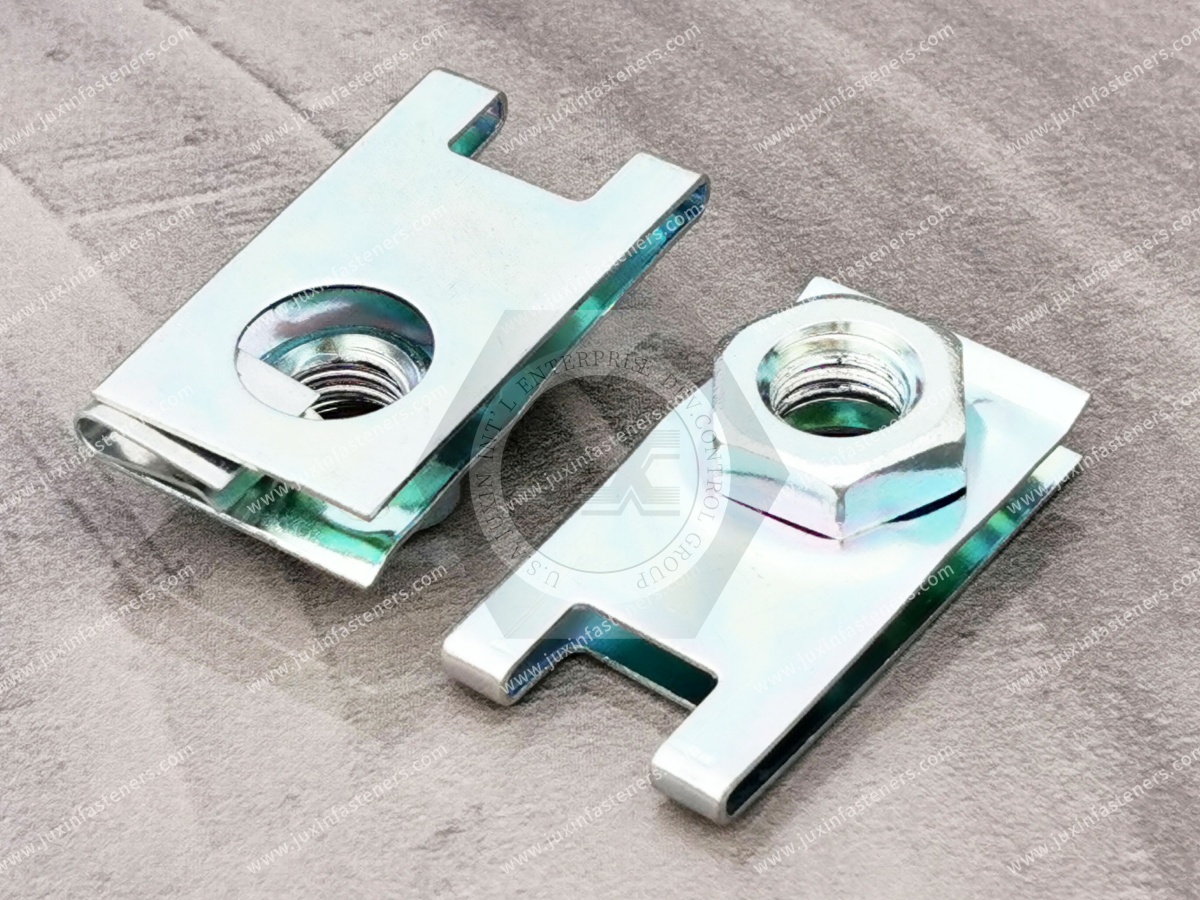
Clip-on barrel nuts use a threaded barrel or threaded section retained by a spring clip.
The barrel provides the mating thread for a machine screw or other compatible screw, depending on the selected design.
JUXIN FASTENERS offers metric no-slip clip-on barrel nuts, also described as U-style clip-on nuts, with multiple internal threads and a spring structure designed to retain the nut on the panel edge.
This makes the barrel-nut architecture particularly useful when the engineering design calls for a defined internal machine thread rather than a tapping-screw interface.
The primary value of a clip-on nut is not simply its material strength. It is the way the fastener combines threaded attachment with panel retention.
A well-selected clip-on nut can provide several practical advantages:
No permanent welding operation is required to create the threaded attachment point.
The nut can be retained on the panel before the mating component is installed.
The assembly can remain accessible from one side during screw installation.
The fastener can be removable when the design requires service or replacement.
Clip-on designs can reduce the number of loose components handled during assembly.
The solution is well suited to thin sheet-metal structures where creating a conventional tapped hole is undesirable or impractical.
These advantages become particularly useful when many fastening points must be installed across a sheet-metal assembly.
The correct selection, however, depends on more than the nominal thread size.
The spring section is the functional part that keeps the nut positioned on the panel.
During installation, the clip is pushed over the panel edge or positioned into the intended panel feature.
Elastic deformation of the spring section creates a retaining force against the sheet.
This produces a useful distinction between two different functions:
Panel retention keeps the clip-on nut in position before and during assembly.
Joint clamping occurs when the mating screw is tightened and the connected components are brought together.
A clip-on nut should therefore not automatically be described as a complete anti-loosening device simply because it grips the panel.
For a vibration-sensitive assembly, the complete fastening system should be evaluated,
including screw type, thread engagement, preload, joint stiffness, friction conditions, panel behavior and service loads.
This is one of the most important engineering distinctions when selecting clip-on nuts for automotive and industrial applications.
The phrase “strong grip” can easily create confusion during procurement.
A clip-on nut can have strong retention on a panel while the overall joint still depends on the panel material, screw engagement, bearing area and installation conditions.
For example, a clip that remains firmly attached to a sheet does not automatically mean that the sheet can withstand every possible pull-out, stripping or vibration load.
Engineers should separately consider:
Clip-to-panel retention
Thread engagement
Screw compatibility
Panel thickness
Hole or edge geometry
Bearing area
Installation torque or driving conditions
Service loads
Vibration and shock
Temperature
Corrosion environment
Assembly and disassembly requirements
This approach produces a much more useful specification than simply requesting a “high-strength clip-on nut.”
J-nuts and U-nuts are often grouped together because both are clip-on fastening solutions, but their geometry can affect installation behavior.
A J-nut typically has an asymmetric clip profile, with one leg shorter than the other.
That geometry can provide useful installation clearance and positioning flexibility, particularly where the panel edge or surrounding structure makes access difficult.
J-nuts are commonly associated with tapping-screw applications and thin panels. Industrial fastener catalogs use the J-nut term for these clip-on tapping-screw designs.
A U-nut generally provides a more symmetrical spring-clip arrangement around the panel edge.
This can be useful where stronger panel retention or a more balanced clip configuration is required.
Industrial catalogs also commonly use “U-nut” for strong-grip clip-on nuts designed for tapping screws.
The actual geometry should be selected according to the drawing rather than by the name alone because manufacturers can use different dimensional configurations for similar product names.
One of the most common sourcing mistakes is specifying only the screw size.
For clip-on nuts, the panel itself is part of the fastening system.
The supplier should know the actual panel thickness or thickness range for which the clip is required.
A clip that is too loose may not remain securely positioned during assembly. A clip that is too tight may be difficult to install or may not fit correctly over the panel.
The RFQ should therefore identify:
Nominal panel thickness
Minimum and maximum panel thickness if applicable
Panel material
Panel edge configuration
Hole diameter and location
Distance from hole center to panel edge
Available installation clearance
Whether the panel is flat or formed
Whether the clip must remain captive during handling
This information is often more important than simply stating “M6 clip-on nut.”
Clip-on nuts depend on the geometry of the panel.
The edge may be straight, flanged, folded, recessed or surrounded by another component. A hole may be close to the edge or located farther into the panel.
These details affect:
Clip engagement
Nut positioning
Screw alignment
Clearance around the fastener
Installation direction
Resistance to movement during assembly
For this reason, a 2D drawing or representative sample is highly valuable when sourcing custom clip-on nuts.
A supplier may be able to provide a nominally similar product, but dimensional differences in the clip body can make the fastener unsuitable for the actual panel.
A clip-on nut for tapping screws should be specified together with the intended screw.
The engineering team should verify:
Screw diameter or screw designation
Screw thread-forming or tapping function
Screw length
Head style
Drive type
Material and coating
Required installation method
Available thread engagement
A common procurement mistake is to replace a specified tapping-screw clip nut with a visually similar machine-thread clip nut.
They may look similar in a catalog but are not necessarily functionally interchangeable.
This is why JUXIN FASTENERS recommends specifying the actual mating screw or screw drawing when requesting a custom quotation.
For clip-on barrel nuts, the primary consideration is the internal thread and the mating screw.
The specification should normally identify:
Thread designation
Thread pitch
Screw size
Panel thickness
Panel edge geometry
Required thread engagement
Clip retention requirements
Available installation space
Material
Surface finish
Service environment
JUXIN FASTENERS' no-slip clip-on barrel nut product range includes metric configurations and spring-steel constructions, with customer-specific sizes available according to application requirements.
Where a machine screw is required, a barrel-nut design may be more appropriate than a tapping-screw clip nut because the internal thread is already defined.
Material selection should follow the application rather than simply choosing the highest-strength material.
Spring-steel constructions are useful where the clip must provide elastic retention and repeated deformation within the intended design range.
JUXIN FASTENERS' product information identifies spring-steel materials including 65Mn and 60Si2Mn for its no-slip clip-on barrel nut range,
while stainless steel and other material options are also available within the broader clip-on fastener portfolio.
For corrosive or outdoor environments, the base material and surface finish should be evaluated together.
For example, zinc-plated steel and black-phosphate steel have different environmental suitability.
A coating should not be described simply as “corrosion-proof.” The actual coating system, service environment and customer corrosion requirements should be specified.
Where the application has unusual chemical exposure, humidity, temperature cycling or outdoor exposure, this should be stated in the RFQ.
Surface treatment is not just a cosmetic decision.
The supplier should understand where the component will be used:
Interior dry environment
Exterior automotive environment
Humid industrial environment
Electrical enclosure
Outdoor equipment
Chemical exposure
High-contamination environment
JUXIN FASTENERS' existing product information identifies black-phosphate and zinc-plated options for different clip-on nut applications.
The final finish should be selected against the customer's corrosion, appearance, electrical and environmental requirements rather than using a generic statement such as “anti-rust.”
Clip-on fastening systems are particularly useful where sheet-metal assembly speed, limited backside access and serviceability are important.
Applications can include:
Interior trim panels
Body brackets
Underbody shields
Wheel-area components
Bumper-related sheet-metal assemblies
Access panels
Mounting brackets
Electrical and cable-management brackets
Automotive applications should be evaluated against actual panel thickness, vibration environment, corrosion exposure and assembly process.
Clip-on nuts can provide threaded mounting points on sheet-metal enclosures without requiring a welded nut.
Potential applications include:
Electrical cabinets
Control panels
Equipment covers
Cable-management brackets
Mounting plates
Instrument enclosures
The product should be selected according to the enclosure material, panel thickness and required screw system.
Industrial machinery often contains sheet-metal guards, covers, brackets and service panels where removable fastening is valuable.
Clip-on nuts can be considered where the design requires:
Fast installation
One-sided screw access
Replaceable fastening points
Repeated maintenance access
No permanent weld operation
Sheet-metal housings and internal brackets can also benefit from retained clip-on fastening solutions when the design requires economical assembly and service access.
A weld nut becomes a permanent part of the sheet-metal component after welding.
A clip-on nut, by contrast, is mechanically retained and can generally be removed from the panel.
This creates a straightforward engineering choice.
Consider a weld nut when:
The threaded feature should be permanently integrated into the panel.
The assembly process already includes welding.
The design requires a fixed nut position.
Welding and subsequent finishing are acceptable.
Consider a clip-on nut when:
Welding is undesirable.
The threaded point may need replacement.
One-sided installation is important.
The panel is already finished.
Assembly flexibility is valuable.
The correct choice depends on the complete manufacturing process rather than on fastener strength alone.
Self-clinching nuts are permanently installed into a suitable sheet-metal panel through a controlled installation process.
Clip-on nuts provide a different approach: the nut is retained by its spring clip rather than permanently clinched into the panel.
A self-clinching nut may be preferred when the threaded insert needs to become a permanent part of the panel.
A clip-on nut may be preferred when removable installation, assembly flexibility or simplified field replacement is more important.
The panel material and thickness also matter because self-clinching products have specific installation requirements.
For related sheet-metal fastening solutions, see JUXIN FASTENERS' guide to self-clinching nuts and telecommunications equipment fastening.
Blind rivet nuts solve another important problem: creating a threaded attachment point in a panel when installation must be performed from one accessible side.
They are particularly useful when there is no convenient panel edge for a clip-on nut.
A blind rivet nut can therefore be a better architecture when:
The threaded point is located away from the panel edge.
A captive internal thread is required.
The assembly cannot accommodate a clip.
Blind installation is important.
The panel geometry does not support a clip-on design.
For a broader comparison and selection framework, see JUXIN FASTENERS' Blind Rivet Nuts Engineering Guide.
Vibration resistance is frequently used as a search term for clip-on nuts, but the engineering interpretation needs to be precise.
The spring clip can help maintain the nut's position on the panel and can resist unwanted movement of the retained component.
That does not mean the clip-on nut automatically prevents every form of screw loosening.
The completed joint should still be evaluated for:
Screw preload
Thread friction
Joint stiffness
Clamp load
Panel flexibility
Vibration frequency
Shock loading
Thermal cycling
Corrosion
Assembly variation
If a customer requires validated vibration performance, the test method and acceptance criteria should be defined before production rather than assumed from the product name.
Several problems repeatedly appear when clip-on nuts are specified without enough application information.
“M6 clip-on nut” is rarely enough information for a production RFQ.
The supplier also needs to understand the panel, edge geometry and intended screw.
A visually similar clip can have a completely different grip range.
The actual panel thickness should therefore be included in the drawing or RFQ.
A clip-on nut designed for a tapping screw should not automatically be replaced by a threaded barrel nut.
The mating screw architecture matters.
The spring clip holds the nut on the panel. It does not by itself define the complete vibration performance of the assembled joint.
A coating appropriate for a dry interior assembly may not be appropriate for an exterior or corrosive environment.
Clip dimensions, edge distance, screw position and surrounding clearance can determine whether an otherwise correct-looking part actually fits.
A good RFQ allows the supplier to evaluate the actual fastening system rather than quote a generic catalog item.
For clip-on nuts for tapping screws, provide:
Screw designation
Screw drawing if available
Panel thickness
Panel material
Panel edge geometry
Hole diameter and location
Edge distance
Installation direction
Required clip retention
Material preference
Surface finish
Service environment
Annual or forecast quantity
Packaging requirements
Drawing revision
Inspection requirements
For clip-on barrel nuts, additionally provide:
Internal thread specification
Thread pitch
Mating screw
Required thread engagement
Required barrel dimensions
Panel thickness
Panel opening or edge geometry
Clearance around the nut
A 2D drawing is highly recommended for custom development.
A 3D model can also help the supplier understand surrounding clearance and installation orientation when the geometry is complex.
For OEM and Tier-supply-chain development, procurement should evaluate more than unit price.
Useful supplier questions include:
Can the supplier manufacture the required clip geometry consistently?
The spring section is functional, so dimensional control matters.
Can the supplier match the panel thickness and edge configuration?
A generic catalog part may not fit the production panel.
Can the supplier provide samples for assembly validation?
Samples allow engineering teams to confirm installation, retention and mating-screw compatibility before production release.
Can the supplier support custom dimensions?
This is particularly important when the required clip must fit a specific hole, flange or edge configuration.
Can the supplier clearly define material and surface finish?
The purchasing specification should identify the actual material and finish rather than relying on broad terms such as “spring steel” or “anti-rust.”
Can the supplier maintain traceability to the agreed specification?
For controlled OEM supply, the purchase specification, drawing revision, material requirement, surface treatment and inspection requirements should be clearly linked to the production order.
“U-nut,” “J-nut,” “spring nut,” “speed nut,” “clip nut” and “barrel nut” can describe overlapping product families in different catalogs.
The name alone may therefore be insufficient for international sourcing.
For OEM procurement, the drawing defines the actual product.
A useful drawing should show:
Overall length and width
Clip geometry
Panel grip range
Thread or tapping-screw interface
Hole position
Edge distance
Material
Surface finish
Critical tolerances
Mating screw
Applicable inspection requirements
This reduces the risk of sourcing a part that has the correct commercial name but the wrong physical configuration.

JUXIN FASTENERS supplies clip-on fastening products for industrial sheet-metal applications, including:
Clip-on nuts for tapping screws
No-slip clip-on nuts
J-nut style fastening solutions
U-style clip-on nuts
Metric no-slip clip-on barrel nuts
Spring-steel clip-on fastening components
Custom clip-on nut configurations according to customer drawings and requirements
JUXIN FASTENERS' product information confirms clip-on nuts for tapping screws as well as metric no-slip clip-on barrel nut products, with material and size options depending on the product configuration.
For applications requiring a different sheet-metal fastening architecture, JUXIN FASTENERS also supplies self-clinching fasteners, weld fasteners, blind rivet nuts and other custom fastening components.
The most efficient sourcing process starts with the application rather than a generic product name.
A typical development path is:
Application → Panel geometry → Screw system → Clip-on nut architecture → Material → Surface finish → Prototype/sample → Assembly validation → Production specification → RFQ
This approach allows engineering and procurement teams to evaluate the fastening system together.
If the panel geometry, screw type or installation requirements change, the correct fastening architecture may also change.
That is why JUXIN FASTENERS encourages customers to provide the available drawing, sample, screw specification or application information when requesting a quotation.
If you are sourcing strong-grip clip-on nuts for tapping screws, J-nuts, U-nuts, no-slip clip-on nuts or clip-on barrel nuts,
JUXIN FASTENERS can review your application and determine which fastening architecture best matches the panel and mating screw.
For an OEM quotation or supplier-development inquiry, please send:
2D drawing or specification
3D model when available
Panel thickness
Panel material
Mating screw specification
Required thread or tapping-screw type
Surface-finish requirement
Application environment
Prototype/sample quantity
Annual or forecast volume
Email: info@juxinfasteners.com
Website: www.juxinfasteners.com
A complete drawing and application description will help the engineering and sourcing teams evaluate the correct clip-on nut configuration rather than quoting only by thread size.
Product Packaging
Packaging Standard
At Juxin Fasteners, we apply standardized export packaging to ensure product protection, traceability, and compliance with international logistics requirements.
1. Standard Export Packaging
Unless otherwise specified, all products will be packed according to our factory standard export packaging, which includes:
Moisture-resistant inner protection
Poly bag or small box packing as required
Reinforced export cartons
Clear labeling with part number, specification, batch number, and quantity
Palletizing for sea or air shipment when necessary
Our standard packaging is designed to ensure safe transportation, efficient warehousing, and long-distance international shipping.
2. Customized Packaging Options
We also provide customized packaging solutions according to customer requirements, including but not limited to:
Private labeling
Customized barcodes
Specific carton dimensions
Retail packaging
Special pallet configuration
Customer-specific marking and identification
So that you know, customized packaging may involve additional costs and extended lead time depending on the complexity of the requirements.
3. Compliance & Quality Assurance
All packaging processes are controlled under our ISO 9001 quality management system to ensure consistency, traceability, and product integrity throughout the supply chain.
Product Pictures
Contact Us
Tel.:
+86 020 8621 0320
+86 020 3121 6067
E-mail:
Technical Support:
Navigation
SEND INQUIREY